NocoDB
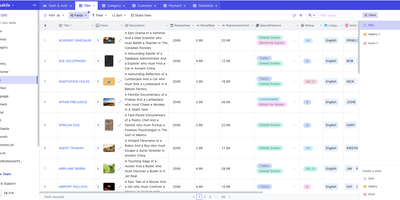
Any existing relational database becomes a collaborative, Airtable-style smart spreadsheet under NocoDB. It connects to PostgreSQL, MySQL, MariaDB, SQL Server, or SQLite, introspects the schema - tables, relationships, indexes - and renders it as interactive Grid, Gallery, Kanban, Calendar, and Form views without migrating a single row. Your business data stays in your database; NocoDB keeps only its own metadata (view configs, permissions, webhooks) in a separate store. Every connected table automatically gets REST APIs with Swagger documentation, effectively turning legacy databases into modern backends. The spreadsheet layer adds 20+ field types including formulas, lookups, rollups, links, attachments, and currency, plus sorting, filtering, grouping, and multi-field editing. Views can be locked or shared publicly with password protection, role-based access control scopes permissions per user, and webhooks plus CSV, Excel, and Airtable import round out integration. An ERD view visualizes the schema. Built with Node.js and Vue, deployed via Docker, handling millions of rows.
Apache DolphinScheduler
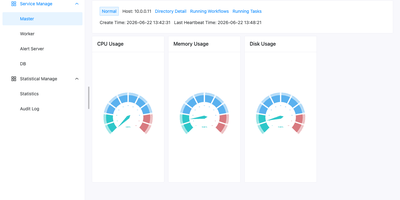
When nightly SQL, Spark, and Python jobs outgrow cron, Apache DolphinScheduler replaces the tangle with a visual workflow orchestrator where every dependency is a line on a drag-and-drop canvas. More than 30 built-in task types cover Shell, SQL, Python, HTTP, Spark, Flink, Kubernetes, SeaTunnel, and Jupyter, while logic nodes add sub-workflows, conditions, switches, and dependencies across projects. Workflows can also be written as code through a Python SDK, YAML, or the Open API and run on timezone-aware cron schedules. Backfill reruns a workflow across a date range or a hand-picked list of dates, in serial or parallel, and any instance can be modified, rolled back, and rerun without touching the saved template. Kill, pause, and resume running tasks, and choose whether a failure ends the run or lets parallel branches continue. Alert groups route results to Email, Slack, Telegram, PagerDuty, Feishu, DingTalk, webhooks, or custom scripts. Tenants, worker groups, and environments isolate teams on shared infrastructure, with project and data source permissions. A Resource Center stores scripts and task files locally or on HDFS, MinIO, and cloud object storage, and the monitor page shows master, worker, and database health at a glance. Standalone, Cluster, Docker, and Kubernetes deployments scale from one node to many masters and workers that can join or leave a running cluster. Running on a dedicated VPS on RepoCloud with guaranteed CPU, RAM, and SSD, full root SSH access, and a browser serial console. Apache 2.0 licensed.

OpenCart
An online store you own end to end: OpenCart bundles the storefront, product catalog, checkout, and admin panel into one self-hosted install with no monthly software fee. Products take options and attributes, and master products can spawn variants that override price, SKU, and stock level. Unlimited categories, filters, reviews and ratings, coupons, specials, and reward points help shoppers find items and return for more. Guests and registered customers can check out by bank transfer, cheque or money order, or cash on delivery; subscription plans with trial periods handle recurring orders, and more gateways and carriers install from the extension marketplace. Shipping rules include flat-rate, free, per-item, pickup, and weight-based options. Tax classes, geo zones, and multiple currencies with automatic rate updates support selling abroad. One admin interface manages several stores, each with its own theme, layout, and language settings, and user groups control who may edit what. A built-in blog adds topics, articles, and comments with anti-spam rules, and language packs cover more than 40 languages, right-to-left scripts included. Sales, tax, shipping, product, and customer reports, campaign tracking, an affiliate program, bulk customer mail, GDPR export and removal tools, and downloadable digital goods round out the business side. Running on a dedicated VPS on RepoCloud with guaranteed CPU, RAM, and SSD, full root SSH access, and a browser serial console. GPL-3.0 licensed.

PrestaShop
Behind a storefront you own sits PrestaShop, an open-source e-commerce platform that runs the catalog, the checkout, and the order desk. Products carry size and color combinations, features, brands, suppliers, and categories, CSV import loads products and customers in bulk, and Extra Properties adds custom fields with their own types to products, customers, and orders. The bundled One Page Checkout module, switched on from the back office, puts every checkout step on a guest-first page, and the four-page flow stays available. Hummingbird, the default theme, presents a mobile-optimized, accessibility-minded storefront, and native WebP and AVIF image support helps pages load faster. Staff handle orders, invoices, credit slips, abandoned carts, and returns, create orders by hand, and answer shoppers from the customer service page. Carriers, payment methods, taxes, currencies, languages, and shipping zones are configured in the back office, multistore runs several shops with separate settings, and the Update Assistant guides upgrades through backup, update, and restore. In the Classic edition, an Ask AI assistant answers questions from real store data and runs plain-language requests after asking your approval, using the provider and API key you connect. The Admin API connects ERP, order management, PIM, and marketing automation tools through scoped OAuth clients, and Addons marketplace modules extend the shop. Running on a dedicated VPS on RepoCloud with guaranteed CPU, RAM, and SSD, full root SSH access, and a browser serial console. OSL-3.0 licensed.
ZeroClaw
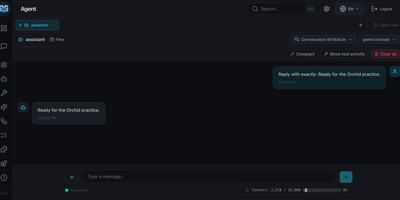
ZeroClaw puts one personal AI agent on every messaging app you already use, answering from your own server with your own model keys. A single instance binds Discord, Telegram, Matrix, Slack, WhatsApp, Signal, email, and webhooks at once, so you can start a conversation on your phone and finish it at your desk without losing context. You choose the brain behind it: Anthropic, OpenAI, a local Ollama model, or any OpenAI-compatible endpoint, with fallback chains that keep the agent answering when one provider has a bad day. The agent acts through tools that run shell commands, drive a browser, call HTTP APIs, and talk to custom MCP servers you plug in. A web dashboard gives you chat, a memory browser, a configuration editor, cron job management, and a tool inspector from any browser. Long-term memory lives in SQLite on your disk with embedding-based recall, so past conversations stay searchable and private. Supervised autonomy is the default posture: medium-risk actions pause for your approval, high-risk actions are blocked outright, and operating system sandboxes plus cryptographic receipts keep every tool call bounded and auditable. Event-driven standard operating procedures react to MQTT messages, webhooks, schedules, and hardware events, and named agents let different personalities guard different channels. Registered as a system service, it stays online around the clock. Running on a dedicated VPS on RepoCloud with guaranteed CPU, RAM, and SSD, full root SSH access, and a browser serial console. MIT or Apache-2.0 licensed.
Directus
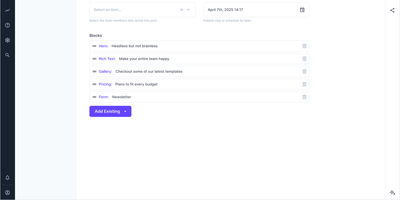
With 37,000 GitHub stars and over 45 million downloads powering 500,000+ deployed projects, Directus is the most widely adopted open-source backend platform that connects to your existing SQL database without requiring schema migrations or data duplication. Point it at PostgreSQL, MySQL, MariaDB, MS SQL, SQLite, OracleDB, or CockroachDB and it instantly generates production-ready REST and GraphQL APIs complete with filtering, sorting, pagination, field selection, and relational queries — all derived from your actual schema with zero configuration. The visual Studio provides a full no-code management interface where non-technical teammates create content, manage assets, build dashboards, and configure access policies without engineering involvement. Field-level granular permissions govern every API request and Studio action through composable policies applied to roles, users, and AI agents identically. A built-in AI Assistant writes copy, translates content across languages, creates records, and routes items for review directly within the Studio interface. The native Model Context Protocol server connects Claude Desktop, Cursor, ChatGPT, or any MCP-compatible tool to your live data governed by the same access policies. Real-time WebSocket subscriptions push collection changes instantly for collaborative editing and live dashboards. Extensibility covers custom endpoints, hooks, interfaces, displays, layouts, modules, and operations. Deploy via Docker with environment-variable configuration or use Directus Cloud for managed hosting. Running on a dedicated VPS on RepoCloud with guaranteed CPU, RAM, and SSD, full root SSH access, and a browser serial console. BSL-1.1 licensed with free self-hosting.
Sentry
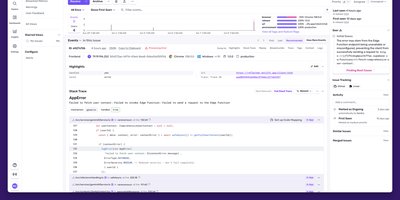
Backed by 44,000 GitHub stars and trusted by over four million developers, Sentry is the debugging platform that captures errors, traces, replays, profiles, and metrics from your applications and connects them all through distributed tracing. The error tracking engine captures full stack traces with source context, breadcrumbs, and automatic demangling for native crashes, while intelligent grouping consolidates duplicate events into actionable issues with regression detection and automatic assignment. Performance monitoring instruments your frameworks automatically, capturing every database query, API call, cache hit, and queue operation as spans within distributed traces that flow across frontend, backend, and mobile boundaries. Session Replay produces video-like recordings of real user sessions showing DOM interactions, network requests, console messages, and errors on a synchronized timeline, with AI-powered summaries that describe what happened without watching the full replay. Continuous profiling captures CPU execution data at the function and line level for Node.js, Python, iOS, and Android, linking slow spans directly to the exact code responsible. Cron monitoring tracks scheduled jobs for failures, missed runs, and duration anomalies. The alerting engine fires notifications through Slack, PagerDuty, Opsgenie, and webhooks on new issues, regressions, error spikes, or when latency and crash-free session rate thresholds are crossed. Self-hosted deployment runs as a Docker Compose stack with PostgreSQL, ClickHouse, Kafka, Redis, and Relay. Running on a dedicated VPS on RepoCloud with guaranteed CPU, RAM, and SSD, full root SSH access, and a browser serial console. FSL licensed.
mitmproxy
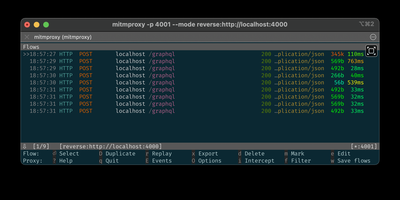
A man-in-the-middle proxy you run on purpose, mitmproxy lets developers and testers inspect, edit, and replay HTTP and HTTPS traffic from any client. Point a browser, phone, or script at it and every HTTP/1, HTTP/2, HTTP/3, WebSocket, and TLS-protected connection appears as a flow you can open, search, and filter. Content views turn payloads from HTML to Protobuf into readable text. Intercept a request or response before it moves on, change its headers, body, or status by hand, then release it, or save the flow and replay it to the client or the server later. Map local and map remote rules answer requests with files or other URLs, while blocklists, anticache, sticky cookies, and proxy authentication cover routine test chores. Choose the interface that fits the job: a keyboard-driven terminal console, mitmweb in the browser with a Capture tab that sets up WireGuard devices with a QR code, or mitmdump for unattended logging in scripts. Proxy modes include regular, local capture, WireGuard, transparent, reverse, upstream, SOCKS5, and DNS. Addons written in Python add custom rewriting, recording, and automation. Teams use it for debugging, testing, privacy measurements, and penetration testing. Running on a dedicated VPS on RepoCloud with guaranteed CPU, RAM, and SSD, full root SSH access, and a browser serial console. MIT licensed.
Memos
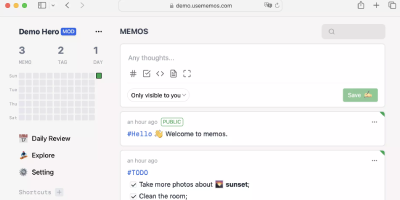
Open the page, write a Markdown note, move on - Memos is a lightweight, self-hosted service built for quick capture. Instead of folders, notebooks, and titles, it presents a timeline: open the page, write a Markdown note, and move on. Notes support headings, code blocks with syntax highlighting, task lists, tables, and file attachments, with tags auto-extracted from #hashtags in the text. Each memo carries a visibility level, private, protected (logged-in users), or public, so one instance works as a personal log, a small team wiki, or a lightweight microblog. The backend is a single Go binary with a React frontend, around 50 MB of memory at runtime and a ~20 MB Docker image, so it fits comfortably on the smallest instance size with near-zero maintenance. SQLite is the default store, with MySQL and PostgreSQL supported for multi-user deployments needing more concurrency, and full REST and gRPC APIs - Connect RPC for browsers, gRPC-Gateway for external tools - make capture scriptable from CLIs, bots, and automation platforms. Fast full-text search spans all memos, pinned notes keep references handy, and a masonry view suits visual browsing. MIT-licensed with zero telemetry; content is stored as plain Markdown in a database you control, so notes remain readable, exportable, and free of proprietary formats.
Usermemos
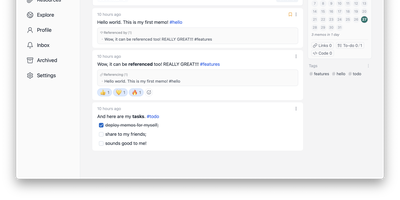
Memos, the lightweight open-source note service from the usememos project, packaged as a containerized deployment for multi-architecture Docker hosts (x86-64 and arm64): that is Usermemos. The model is frictionless capture: no folders or titles, just a chronological stream of Markdown notes with code blocks, task lists, tables, and file attachments, organized by #hashtags pulled automatically from the text. Per-memo visibility - private, protected for logged-in users, or public - lets a single instance serve as a personal journal, a shared team log, or a public microblog simultaneously. Multi-user support with authentication makes it workable for small teams, and full REST and gRPC APIs open capture and retrieval to CLIs, bots, and automation tools. The runtime is a single Go binary with a React frontend that idles around 50 MB of memory and stores content as plain Markdown in SQLite by default, with MySQL and PostgreSQL available for heavier deployments. Configuration happens through environment variables, access works over HTTP or HTTPS behind a reverse proxy, and there is no telemetry - notes stay on your server in a portable format.

Reactive Resume
With over 38,000 GitHub stars, nearly one million registered users, and over 1.3 million resumes created, Reactive Resume delivers a professional resume creation experience that rivals commercial platforms like Resume.io and Zety without collecting user data, showing advertisements, or imposing paywall restrictions. The real-time WYSIWYG editor renders changes instantly as users type, providing immediate visual feedback across all resume sections including work experience, education, skills, certifications, projects, and custom sections with typed extensions. Over fifteen professionally designed templates with full color customization, font selection, spacing adjustment, and icon style selectors ensure each resume reflects individual style preferences. The drag-and-drop system lets users move items between sections and pages freely across multi-column and full-width layouts. PDF generation produces pixel-perfect documents using a headless Chromium rendering pipeline, ensuring consistent output across all devices and print settings. Multi-language support covers over twenty languages with RTL script handling for Arabic and Hebrew. Authentication supports passkeys and multiple OAuth providers via Better Auth, while self-hosted deployment runs via Docker Compose with PostgreSQL and Browserless for PDF rendering. The import system accepts JSON Resume format, LinkedIn data exports, and PDF/DOCX files when AI integration is configured. AI-powered content suggestions using OpenAI, Google Gemini, Anthropic Claude, or local Ollama models help improve bullet points and professional summaries. A CSS editor with autocompletion allows fine-grained styling control. Running on a dedicated VPS on RepoCloud with guaranteed CPU, RAM, and SSD, full root SSH access, and a browser serial console. MIT licensed.
Buzz
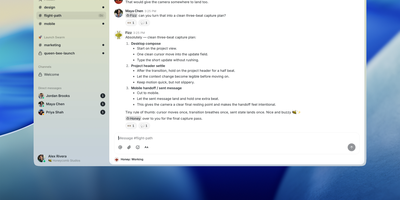
Buzz delivers the first production workspace where humans and AI agents operate as cryptographically equal team members on a self-hosted Nostr relay. The Rust-based backend stores every message, code patch, CI result, review comment, and workflow step as a signed Nostr event in a unified PostgreSQL-backed event log with Redis pub/sub for real-time presence and S3/MinIO for media storage. The integrated Git forge implements NIP-34, turning feature branches into dedicated channels where patches, reviews, and merge decisions live alongside the discussion that produced them — eliminating the split between chat tools and code hosts. Through the open Agent Client Protocol, Buzz natively supports Goose, Anthropic Claude Code, and OpenAI Codex as first-class channel members with scoped permissions, their own audit trails, and the ability to create patches, run workflows, and orchestrate multi-step automations via YAML-defined triggers including message events, reactions, schedules, and webhooks. The Tauri-based desktop client runs on macOS, Windows, and Linux, while buzz-cli provides agent-first JSON I/O for headless automation. Deploy via Docker Compose with the production bundle in deploy/compose/, Railway one-click, or build from source requiring Rust 1.88+, Node 24+, and pnpm. Multi-community mode scopes tenant data by domain with NIP-42 Schnorr authentication, rate limiting, and hash-chain audit logging. Running on a dedicated VPS on RepoCloud with guaranteed CPU, RAM, and SSD, full root SSH access, and a browser serial console. Apache 2.0 licensed.
Appsmith
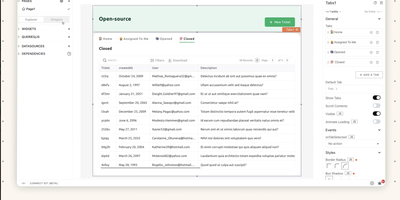
Admin panels, database GUIs, dashboards, approval flows, customer support consoles - Appsmith builds the internal tools your team keeps postponing, on an open-source low-code platform. The UI assembles from 45+ drag-and-drop widgets - tables with server-side pagination and inline editing, charts, forms, lists, buttons - which bind to data through {{ }} JavaScript expressions anywhere in the editor. Datasources cover PostgreSQL, MySQL, MongoDB, MS SQL, Redis, Snowflake, and more, plus any REST or GraphQL API, with SaaS integrations and AI query support for prompt-based steps inside apps. When the widget library falls short, custom widgets are plain JavaScript, HTML, and CSS, and external JS libraries can be imported, which keeps the platform extensible where pure no-code tools hit walls. Git-based version control enables branch-based collaboration, review, and rollback of app definitions. Queries and JS objects hold the business logic layer between datasources and UI. Self-hosted via Docker or Kubernetes, with role-based access control for published apps.
Open Notebook
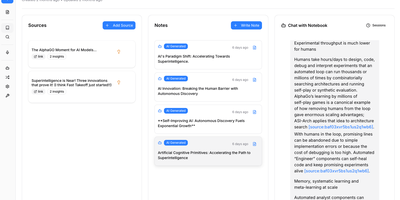
The most feature-complete open-source alternative to Google's NotebookLM — a self-hosted research platform where you upload PDFs, videos, audio files, and web pages into organized notebooks, then chat with your content, generate multi-speaker podcasts, and run semantic search across everything without sending a single byte to Google's servers. The podcast engine supports 1-4 fully customizable speakers with backstories, personalities, and expertise profiles, generating professional audio dialogue through OpenAI, ElevenLabs, Google TTS, or completely local text-to-speech via Kokoro for maximum privacy. Content processing uses token-based chunking with RAG-powered retrieval grounded in your uploaded sources, while both full-text keyword search and semantic vector search via SurrealDB enable conceptual discovery across all notebooks. The 18+ supported AI providers include OpenAI, Anthropic, Google Gemini, Groq, Ollama, LM Studio, and more — configurable per task so you can route cheap models to summarization and powerful models to analysis. Content transformations extract insights, generate summaries, create study guides, and produce structured outputs from any source material. The MCP integration connects Open Notebook to Claude Desktop, VS Code, and other MCP clients for seamless workflow integration. A full REST API on port 5055 enables complete automation of notebook management, source upload, and podcast generation. Deploy via Docker Compose with the application container, SurrealDB v2 on RocksDB, and optional TTS containers. Running on a dedicated VPS on RepoCloud with guaranteed CPU, RAM, and SSD, full root SSH access, and a browser serial console. MIT licensed.
HashiCorp Vault
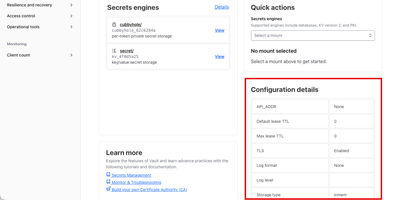
With over 36,000 GitHub stars and adoption by organizations including Adobe, Shopify, and Roblox, HashiCorp Vault is the industry-standard platform for secrets management, encryption services, and privileged access control across hybrid and multi-cloud infrastructure. The key/value secrets engine stores arbitrary secrets with full versioning, soft-delete, and metadata tracking, while dynamic secrets engines generate on-demand, short-lived credentials for AWS, Azure, GCP, databases including PostgreSQL, MySQL, MongoDB, and MSSQL, and SSH access with automatic revocation after configurable lease periods. The PKI secrets engine dynamically issues X.509 certificates on demand with automatic rotation and ACME protocol support, eliminating manual certificate management workflows entirely. Encryption as a service through the transit secrets engine lets applications encrypt, decrypt, sign, verify, and generate HMACs without managing cryptographic keys directly, supporting AES-GCM-256, ChaCha20-Poly1305, RSA-2048/4096, ECDSA-P256/P384, and ED25519 algorithms. Authentication integrates with LDAP, OIDC/OAuth2, SAML, AppRole for machine-to-machine access, Kubernetes service accounts, AWS IAM, Azure Active Directory, and GitHub tokens. Fine-grained ACL policies use path-based rules with glob patterns and sentinel policies for programmatic enforcement. The integrated Raft storage backend provides high-availability clustering without external dependencies, while alternative backends include Consul, S3, DynamoDB, PostgreSQL, and MySQL. The built-in web UI provides a visual interface for browsing secrets, managing policies, configuring auth methods, and monitoring cluster health. Running on a dedicated VPS on RepoCloud with guaranteed CPU, RAM, and SSD, full root SSH access, and a browser serial console. BSL 1.1 licensed.
Parse Server
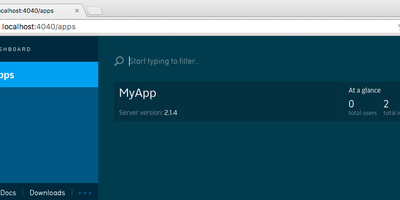
With 21,400 GitHub stars, 500+ contributors, and battle-tested since its 2016 open-source release after powering Facebook's mobile backend infrastructure, Parse Server delivers production-grade Backend-as-a-Service that eliminates months of custom API development. The platform generates REST and GraphQL endpoints automatically from your data schema with class-level permissions and object-level ACLs providing granular access control. Cloud Code enables server-side JavaScript execution for triggers (beforeSave, afterSave, beforeDelete, afterDelete), custom functions, and scheduled jobs — all deployable without restarting the server. Live Queries push realtime data changes to subscribed clients via WebSockets, powering chat applications, collaborative editors, and live dashboards. Push notification support spans APNs for iOS, FCM for Android, and web push for browsers with audience segmentation, scheduling, and delivery analytics. The Parse Dashboard provides a comprehensive admin interface with a data browser featuring configurable info panels, graph visualization, custom canvas builder with draggable elements, AI agent integration via OpenAI, data import/export, and multi-factor authentication. Database flexibility supports MongoDB 6-8 and PostgreSQL 13-18 with PostGIS for geospatial queries. Native SDKs cover JavaScript, iOS (Swift/Objective-C), Android, Flutter/Dart, .NET/Xamarin, Unity, PHP, and Arduino for IoT devices. Deploy via npm, Docker, or the official Express template with automatic schema migration. Running on a dedicated VPS on RepoCloud with guaranteed CPU, RAM, and SSD, full root SSH access, and a browser serial console. Apache 2.0 licensed.
Wagtail
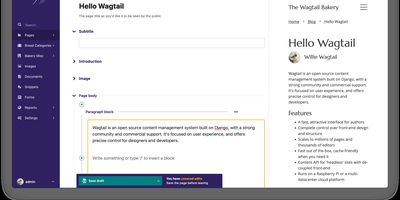
Backed by over 20,000 GitHub stars, 800 contributors, and organizations like Google, NASA, and the NHS, Wagtail is the Django-powered content management system that gives editors creative freedom through StreamField while keeping developers in full control of data structure and front-end rendering. StreamField lets editors compose pages from a custom library of content blocks — rich text, images, embedded videos, tables, code snippets, and developer-defined custom types — without compromising the underlying data model or breaking responsive layouts. The built-in JSON API supports headless deployments with versioned endpoints for pages, images, and documents, enabling decoupled front-ends in Next.js, Nuxt.js, or any framework that consumes REST. Editorial workflows provide configurable approval chains where content moves through draft, review, and publish states with commenting, task assignment, and email notifications built into the admin interface. Integrated search connects to Elasticsearch for full-text indexing with faceted filtering, or falls back to PostgreSQL and SQLite backends with fuzzy matching support added in v7.4. Multi-site management serves multiple domains from a single Wagtail installation with independent page trees, while the internationalization framework handles content translation with locale-aware URL routing. Image management includes focal point detection, responsive renditions, and automatic format conversion. The platform supports Django 5.2 and 6.0 with Python 3.10 through 3.14 and PostgreSQL, MySQL, MariaDB, or SQLite databases. Running on a dedicated VPS on RepoCloud with guaranteed CPU, RAM, and SSD, full root SSH access, and a browser serial console. BSD-3-Clause licensed.
Onyx
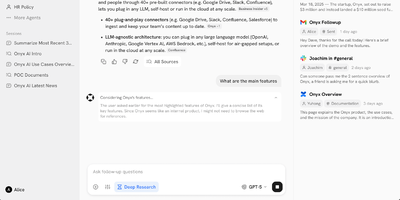
Formerly known as Danswer and now backed by over 31,000 GitHub stars with 253 releases, Onyx delivers a production-ready AI platform that turns any LLM into a context-aware enterprise assistant connected to your organization's actual knowledge. The agentic RAG pipeline combines BM-25 keyword search with prefix-aware embedding models in a hybrid index, then deploys AI agents to retrieve, verify, and synthesize answers with source citations from over 40 connected workplace tools including Google Drive, Confluence, Slack, Notion, Jira, SharePoint, GitHub, and Linear. Custom AI assistants with configurable prompts, backing knowledge sets, and document-level access control enable specialized agents for engineering, sales, support, and research workflows. The platform supports every major LLM provider — Anthropic Claude, OpenAI, Google Gemini, plus self-hosted options via Ollama, LiteLLM, and vLLM for fully air-gapped deployments. Beyond chat, Onyx provides web search with Serper, Google PSE, Brave, and SearXNG integration, an in-house web crawler, code execution, file creation, and multi-step deep research with report generation. Enterprise features include SSO via Google OAuth, OIDC, or SAML with SCIM provisioning, role-based access control, usage analytics by team and agent, query history auditing, PII removal through custom code hooks, and full whitelabeling. Deploy via Docker Compose on any infrastructure. Running on a dedicated VPS on RepoCloud with guaranteed CPU, RAM, and SSD, full root SSH access, and a browser serial console. MIT licensed (Community Edition).