n8n
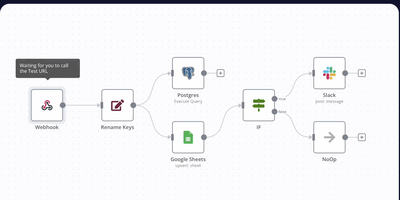
Webhooks, cron schedules, and app events trigger chains of nodes that fetch, transform, and route data: n8n is a workflow automation platform built around a visual, node-based editor. It ships with 400+ built-in integrations covering databases like Postgres, SaaS tools like Slack and HubSpot, and every major AI provider. When a pre-built node does not exist, the HTTP Request node calls any REST API, and the Code node runs JavaScript or Python inline, so you are never blocked by a missing connector. Workflows execute as directed graphs with branching, loops, error handling, and sub-workflows, and every run is logged for inspection and replay during debugging. It also includes LangChain-based nodes for building AI agents with tool calling and memory. Self-hosting on RepoCloud gives you unlimited workflow executions with no per-task pricing, and all data stays on your instance. Runs on Node.js with SQLite by default; add Postgres and Redis queue mode when you need to scale workers horizontally.
Open Connector
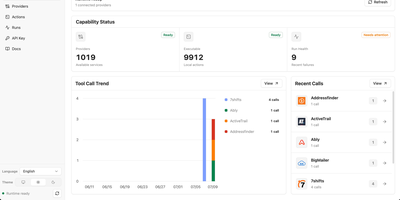
With over 5,000 GitHub stars since its June 2026 launch, OOMOL OpenConnector bridges the gap between AI agents and the real world by handling the authentication nightmare that stops LLMs from calling external APIs safely. The runtime connects to more than 1,000 SaaS providers — GitHub, Gmail, Notion, Slack, Microsoft, HubSpot, Google Workspace, and hundreds more — through 10,000+ prebuilt typed Actions that agents can discover and execute without ever touching raw credentials. OAuth2 flows, API key rotation, custom credentials, and no-auth providers are all managed centrally with AES-encrypted storage, scoped runtime tokens, and configurable action allowlists and blocklists that enforce least-privilege access. Agents interact through five access surfaces: the Model Context Protocol endpoint at /mcp for Claude and other MCP-capable hosts, a full REST API at /v1 for programmatic control, an auto-generated OpenAPI specification for code generation, a TypeScript SDK for application integration, and the oo CLI for local agent relay. The built-in Web Console provides browser-based administration for configuring OAuth apps, managing connections, inspecting action schemas, and reviewing execution logs with redacted inputs. Deploy via Docker Compose with SQLite for single-server setups, run from source on Node.js 22+, or push to Cloudflare Workers with D1 and R2 for edge deployment. Running on a dedicated VPS on RepoCloud with guaranteed CPU, RAM, and SSD, full root SSH access, and a browser serial console. Apache 2.0 licensed.
Sim Studio
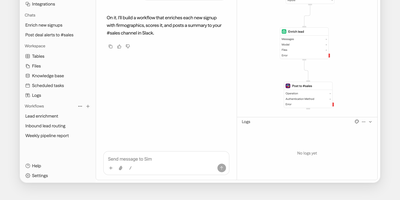
Sim Studio lets teams build, deploy, and monitor AI agent workflows by dragging blocks onto a visual canvas and wiring them into executable pipelines, backed by over 1,000 integrations. The React Flow editor represents each step as a node: LLM calls, tool invocations, conditional branches, and data transformations form directed acyclic graphs that run as complete agent pipelines. Every major LLM provider works natively, including OpenAI, Anthropic, Google Gemini, Groq, and Cerebras, plus local models through Ollama and vLLM. Integrations span Gmail, Slack, Microsoft Teams, Telegram, WhatsApp, Notion, Google Workspace, Airtable, GitHub, Jira, Linear, Perplexity, Firecrawl, PostgreSQL, Supabase, Pinecone, and Qdrant. Built-in tables provide a database layer, a file store offers shared team storage, and knowledge bases powered by PostgreSQL with pgvector enable retrieval-augmented generation. Finished workflows deploy as REST API endpoints, scheduled jobs, or Slack bots, with block-by-block execution traces for full observability. Real-time collaborative editing via Socket.io supports simultaneous multi-user construction. Alternatively, describe agent behavior in natural language and Sim assembles the workflow automatically. Built on Next.js App Router, Bun runtime, Drizzle ORM, and Tailwind CSS. 29,400+ GitHub stars and 100,000+ builders. Apache-2.0 licensed.
multi-scrobbler
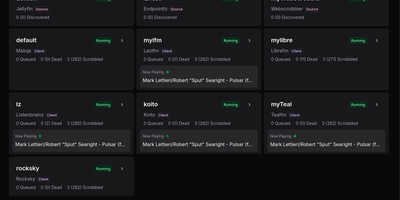
Listening to music across Spotify on your commute, Jellyfin at your desk, and Sonos in the living room usually leaves your play history fragmented across walled gardens, which is why multi-scrobbler unifies over 30 music sources and routes every track to your chosen scrobble backends automatically. Instead of relying on brittle browser plugins per device, you configure active polling or ingress webhooks once for sources including Plex, Navidrome, Subsonic, Apple Music, Deezer, YouTube Music, MPD, VLC, Chromecast, and Music Assistant. Every detected play passes through an intelligent pipeline that verifies listen duration thresholds, cleans messy track titles or featured artist tags using regex rules, and enriches missing metadata against the MusicBrainz, Spotify, or Rocksky catalogs. Before forwarding a play to Last.fm, ListenBrainz, Libre.fm, Maloja, Koito, teal.fm, Discord Now Playing, or Tuneshine, the engine checks temporal and title similarity scores to block duplicate scrobbles. When a downstream service goes offline, failed scrobbles enter a persistent retry queue so you never lose listening history, while Gotify, Ntfy, and Apprise webhooks alert you to source issues. Running on a dedicated VPS on RepoCloud with guaranteed CPU, RAM, and SSD, full root SSH access, and a browser serial console. MIT licensed.
Apache NiFi
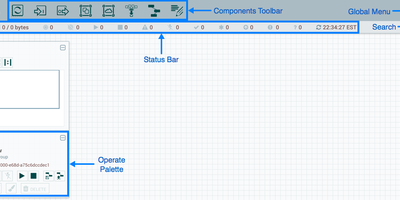
Deployed at thousands of enterprises across financial services, healthcare, government, and telecommunications, Apache NiFi is the industry-standard platform for building automated data pipelines through a visual drag-and-drop browser interface that requires zero coding for common integration patterns. The flow-based programming model connects over 300 built-in processors covering relational databases via ExecuteSQL and PutDatabaseRecord, Apache Kafka with PublishKafka and ConsumeKafka, HTTP endpoints through InvokeHTTP and ListenHTTP, cloud storage for AWS S3, Azure Blob, and Google Cloud Storage, SFTP/FTP file transfers, and JSON, XML, CSV, and Avro transformations. Data provenance tracking logs every routing decision, transformation, and delivery for every FlowFile, creating a searchable lineage graph from source to destination with full content replay capability for auditing and debugging. Guaranteed delivery uses configurable backpressure thresholds, prioritized queuing with latency or throughput optimization, and automatic retry with exponential backoff, ensuring no data loss even during downstream outages. The zero-leader clustering architecture distributes processing across nodes with automatic load balancing, while site-to-site protocol enables secure data transfer between NiFi instances across network boundaries. Security includes OpenID Connect and SAML 2.0 single sign-on, role-based access control with fine-grained policies per component, and TLS encryption for all communication. Custom processors can be written in Java and packaged as NAR bundles, or implemented directly in Python through the native scripting framework. Running on a dedicated VPS on RepoCloud with guaranteed CPU, RAM, and SSD, full root SSH access, and a browser serial console. Apache 2.0 licensed.
Scrumboy
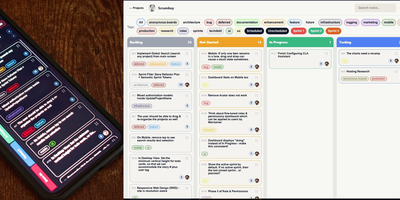
Scrumboy is a Kanban and sprint management tool that ships as a single Go binary backed by SQLite, deploys in under ten seconds via Docker, and uniquely integrates with AI coding agents through a standards-compliant MCP JSON-RPC endpoint. The dual-mode architecture supports Full mode with bootstrapped authentication, TOTP two-factor auth, OIDC/SSO integration through Keycloak, Authentik, Auth0, or Entra ID, role-based access control across Owner, Admin, User system tiers plus per-project Maintainer, Contributor, and Viewer roles, and Anonymous mode that generates instant shareable boards accessible via unique URLs with zero signup requirement. Custom workflows allow user-defined lane configurations per project including designated "Done" lanes, while sprints with configurable one or two-week cycles include board-level sprint filtering and the ability to disable and re-enable sprint tracking without losing history. Real-time Server-Sent Events power instant multi-user board updates, and outbound webhooks deliver JSON payloads to registered URLs when domain events fire with HMAC signature verification. The MCP endpoint at /mcp/rpc enables native integration with Cursor, Claude Code, and other AI agents through OAuth 2.1 with PKCE authorization, while API access tokens support CLI automation and CI/CD pipelines. Additional capabilities include VoiceFlow voice commands, per-project sticky-note walls, Markdown and Mermaid diagram support in task notes, append-only audit trails, VAPID Web Push notifications, SMTP password reset, Trello import, JSON backup with merge/replace/copy strategies, and 22-language internationalization. Running on a dedicated VPS on RepoCloud with guaranteed CPU, RAM, and SSD, full root SSH access, and a browser serial console. AGPL v3.0 licensed.
AnythingMCP
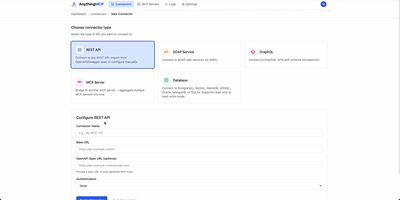
Connecting autonomous AI assistants to internal enterprise databases and legacy systems is streamlined by AnythingMCP, a visual Model Context Protocol gateway with automated knowledge graph generation and granular access controls. Engineers can import OpenAPI specifications, Postman collections, SOAP WSDL files, or raw database credentials to generate standardized Model Context Protocol tools in minutes without writing custom code. The built-in knowledge graph automatically maps entity relationships across disparate databases and software platforms, teaching agents how to correlate customer records in CRM tools with live order histories in enterprise resource planning software. System administrators can enforce fine-grained access policies by restricting tool execution permissions to specific roles and scoping database operations to read-only queries with strict row limits. An interactive web console provides real-time tool inspection, payload testing, request tracing, and comprehensive audit logs that capture every upstream invocation with full parameter visibility. Enterprise teams can integrate identity providers through OAuth2, SAML single sign-on, and SCIM automated user provisioning while protecting sensitive credentials using AES-256-GCM encryption at rest. Running on a dedicated VPS on RepoCloud with guaranteed CPU, RAM, and SSD, full root SSH access, and a browser serial console. GNU AGPLv3 licensed.
Apache Kafka
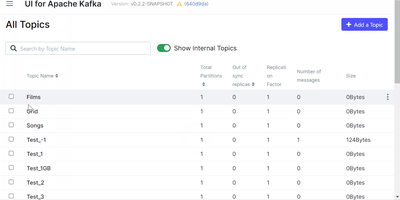
Used by over 80% of Fortune 100 companies including LinkedIn, Netflix, Uber, and Goldman Sachs, Apache Kafka processes trillions of messages per day as the world's most widely deployed distributed event streaming platform. Since version 4.0 released in March 2025, Kafka operates exclusively with KRaft consensus, replacing Apache ZooKeeper entirely with an internal Raft-based metadata quorum managed by controller nodes, reducing operational complexity and eliminating external coordination dependencies. Topics are organized as append-only partitioned commit logs with configurable replication factors across brokers, delivering network-limited throughput with end-to-end latencies as low as 2 milliseconds. Kafka Streams provides a client library for building stateful stream processing applications with exactly-once semantics, windowed aggregations, joins across streams and tables, and interactive queries against local state stores. Kafka Connect integrates with hundreds of systems including PostgreSQL, MySQL, Elasticsearch, Amazon S3, MongoDB, HDFS, and JMS through a standardized connector framework with distributed worker mode and automatic offset management. Share Groups introduced in version 4.2 deliver queue-style consumption semantics alongside traditional consumer groups, enabling Kafka to serve both pub-sub and point-to-point messaging patterns natively. The Schema Registry enforces Avro, Protobuf, and JSON Schema compatibility rules across producers and consumers, preventing schema evolution from breaking downstream applications. Tiered Storage offloads older log segments to object storage like S3 while maintaining transparent consumer access, dramatically reducing local broker storage costs for long-retention topics. Running on a dedicated VPS on RepoCloud with guaranteed CPU, RAM, and SSD, full root SSH access, and a browser serial console. Apache 2.0 licensed.
Airbyte
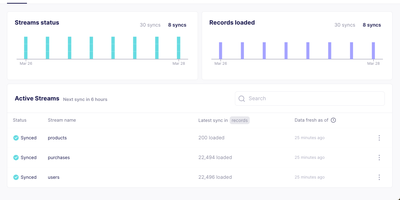
Backed by over 21,800 GitHub stars and more than 1,000 community contributors, Airbyte has become the standard open-source data movement platform, powering ELT pipelines for organizations ranging from startups to Fortune 500 enterprises. The platform provides 600+ pre-built connectors covering PostgreSQL, MySQL, MongoDB, Snowflake, BigQuery, Redshift, S3, Salesforce, HubSpot, Stripe, Shopify, Google Analytics, and hundreds of additional APIs, databases, and SaaS applications. The no-code Connector Builder lets practitioners create new source connectors in minutes by pointing at an API documentation URL, while the Python CDK enables custom connectors with full programmatic control for complex authentication flows and pagination strategies. Airbyte's AI agent capabilities include the MCP Gateway for Model Context Protocol integration, the open-source Agent SDK compatible with pydantic-ai, LangChain, OpenAI Agents, and FastMCP, and a Context Store that lets AI agents query business data across connected systems without runtime API stitching. Change Data Capture streams incremental updates from PostgreSQL, MySQL, and SQL Server using Debezium, while dbt integration handles post-load transformations within the pipeline. Self-hosted deployment uses Kubernetes via the abctl CLI tool, which bootstraps a local kind cluster with a single command, or Helm charts for production clusters with Keycloak OIDC authentication and secrets management through AWS Secrets Manager, Google Secrets Manager, or HashiCorp Vault. Running on a dedicated VPS on RepoCloud with guaranteed CPU, RAM, and SSD, full root SSH access, and a browser serial console. ELv2 licensed with MIT-licensed connectors.
Concourse
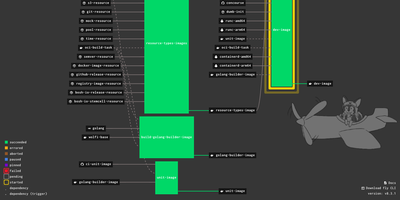
When a commit lands, a timer fires, or a pull request opens, Concourse runs the matching jobs in fresh containers and draws the entire CI/CD pipeline as a live graph you can read at a glance. Pipelines are plain YAML files that tie resources such as git repositories, registries, and buckets to jobs made of get, put, and task steps, so the same file behaves the same on every installation. Resources are checked continuously for new versions, webhooks can request an immediate check, and a version can be pinned when something needs to stay put. The dashboard lists every pipeline by team with status colors, a filter box, favorites, and a high-density view, while build pages stream colored logs and let you rerun a build with the exact same inputs. The fly command line sets pipelines, runs one-off tasks against local files from your laptop, and opens a shell inside the container of a failed step. A set_pipeline step lets pipelines configure other pipelines, and instance vars create a family of related pipelines, such as one per pull request. Teams keep projects separate and can be tied to a GitHub organization, credentials arrive at run time from Vault, CredHub, AWS, or Kubernetes, and policy rules can block disallowed images. Running on a dedicated VPS on RepoCloud with guaranteed CPU, RAM, and SSD, full root SSH access, and a browser serial console. Apache-2.0 licensed.
Chatwoot
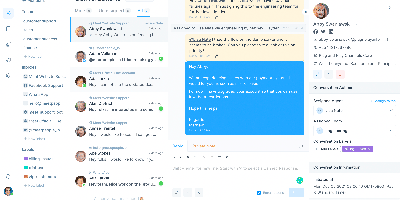
Unleash the power of Chatwoot, the open-source superhero in the world of customer experience! This platform is perfect for businesses craving to connect with their customers across a multitude of channels without breaking the bank. Wave goodbye to the high-and-mighty likes of Intercom, Zendesk, and Salesforce Service Cloud, and say hello to a wallet-friendly powerhouse. Chatwoot turns your agents into customer service ninjas, armed with the latest in workload management, performance tracking reports that refresh themselves (because who has time for that?), and automations that work smarter, not harder. Zap through conversations with lightning-fast responses and manage your social media and email interactions in a single bound. Plus, with Chatwoot, you get to be the Sherlock of customer satisfaction, deducing your CSAT scores on autopilot. All this hosted on RepoCloud, where the cost is as tiny as the effort you'll need to switch over. Get ready to engage, enlighten, and entertain your customers with Chatwoot!
Duckle
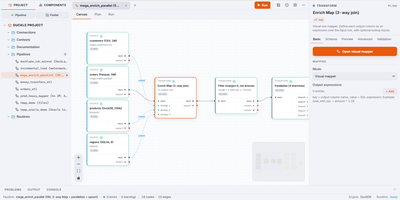
Duckle compiles visual data integration pipelines into vectorized analytical SQL executed on an embedded columnar engine, eliminating the overhead and cloud egress costs of traditional ETL infrastructure. Engineers can construct data pipelines on a drag-and-drop canvas, connecting hundreds of data sources spanning relational databases, cloud object storage, streaming event buses, vector databases, and SaaS application programming interfaces. An interactive mapping editor enables complex joins between primary data inputs and lookup streams with typed transform expressions and live sample inspections. Built-in transformation blocks execute change data capture, slowly changing dimensions, aggregation rollups, and integrated dbt models with zero row-based metering or cloud egress fees. Teams schedule headless production executions through a dedicated web console equipped with role-based access management, execution audit trails, and automated failure alerts dispatched to webhook endpoints. Embedded Model Context Protocol capabilities allow AI coding assistants to validate schema configurations, inspect execution logs, and trigger batch workflows directly through conversational commands. Workspaces store entire pipeline definitions as individual files in version control, ensuring reproducible deployments across staging and production environments. Running on a dedicated VPS on RepoCloud with guaranteed CPU, RAM, and SSD, full root SSH access, and a browser serial console. Apache-2.0 licensed.
MindsHub
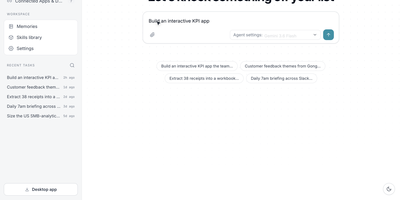
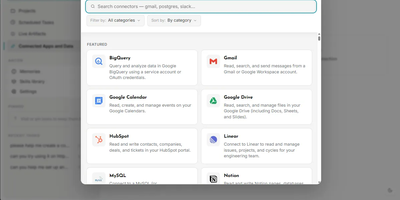
Backed by $50M+ from Benchmark, Y Combinator, and NVIDIA with 800+ contributors and 39,000+ GitHub stars, MindsHub Cowork is the unified AI workspace where open-source models handle entire projects — research, reporting, internal tools, scheduled operations — and return finished, shareable deliverables. The platform runs two interchangeable open-source agent harnesses, Anton and Hermes, swappable from a dropdown without losing context. A built-in Model Router pre-wires 25+ models spanning Anthropic Claude, OpenAI GPT, Google Gemini, DeepSeek, Qwen, Kimi, Grok, and MindsHub Air with automatic failover — no per-provider API keys required. A secure credentials vault connects BigQuery, PostgreSQL, Salesforce, HubSpot, Zendesk, Gong, Gmail, Google Drive, Notion, Linear, Stripe, and Slack, keeping secrets scoped per connection so agents never see raw keys. Agent output becomes publishable artifacts — documents, dashboards, apps, and code — each deployable to a live shareable URL. Cross-session persistent memory, a reusable skill library, and a background scheduler supporting hourly, daily, and weekly cadences enable autonomous recurring workflows. The architecture separates a React/Vite frontend (shipping as both Electron desktop app and web SPA) from a FastAPI backend with a versioned REST API at /api/v1 covering conversations, projects, artifacts, schedules, and connectors. Self-host via Docker Compose with nginx on port 3000 and the API on port 26866, or deploy on-prem, in a VPC, or air-gapped. Running on a dedicated VPS on RepoCloud with guaranteed CPU, RAM, and SSD, full root SSH access, and a browser serial console. MIT licensed.
Node-RED
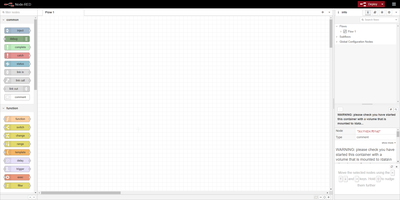
Wire nodes together in a browser, deploy in one click, and real-time data flows from sources through transformations to outputs: Node-RED is the OpenJS Foundation's flow-based programming tool for event-driven applications. Born at IBM as a proof-of-concept for manipulating MQTT topic mappings, it has become the lingua franca of IoT and automation glue - home automation, industrial control, edge data collection - with a community library of over 5,000 contributed nodes and flows covering protocols, devices, and services. Where visual wiring runs out, JavaScript function nodes written in a rich in-editor code editor take over, and every flow serializes to importable, exportable JSON that shares cleanly and version-controls sensibly. Version 5.0 (2026) delivered the largest editor overhaul in the project's history: a rethought layout with Explorer and Information panels in a split sidebar, a native dark theme with theme variants, improved accessibility, and refreshed node appearance. The runtime is lightweight Node.js, exploiting the event-driven non-blocking model so the same flows run on a Raspberry Pi at the network edge or a cloud VM. Apache-2.0 licensed with 240+ contributors, it pairs naturally with dashboard nodes for live charts and controls.
Evolution API
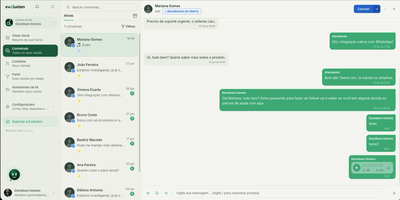
Evolution API gives your applications a production-ready REST interface to WhatsApp, supporting both free Baileys-based Web connections and Meta's official Business Cloud API from the same server. With 9,200+ stars and 7,100+ forks, it is the most widely deployed WhatsApp integration layer available. Each installation handles unlimited isolated instances (one per phone number) with independent auth, webhooks, and database separation via Prisma ORM against PostgreSQL or MySQL, cached through Redis. Message types include text, images, audio, video, documents, contacts, locations, interactive buttons, list messages, carousel cards, and PIX payment links through unified endpoints. Native integrations connect to Typebot for chatbot flows, Chatwoot for multi-agent support, Dify and OpenAI for AI conversations, N8N and Flowise for workflow automation, and RabbitMQ, Kafka, or SQS for enterprise event streaming. Socket.io delivers real-time message and connection events. Amazon S3 or MinIO handles media offloading. The Evolution Manager v2 dashboard provides visual instance creation, QR code scanning, connection monitoring, and integration configuration without touching the API directly. Docker Compose bundles the server, PostgreSQL, and Redis with environment-variable-driven setup. Running on a dedicated VPS on RepoCloud with guaranteed CPU, RAM, and SSD, full root SSH access, and a browser serial console. Apache 2.0 licensed.
MindsDB
Backed by 39,500+ GitHub stars and over 339 releases, MindsDB delivers the open-source federated query engine that gives AI agents a single SQL interface to read, join, and aggregate across 200+ live data sources without any ETL pipelines or data movement. The Connect-Unify-Respond architecture wires up Postgres, MySQL, MongoDB, Snowflake, BigQuery, ClickHouse, Redshift, Databricks, Salesforce, Shopify, Slack, S3, GCS, Azure Blob, and dozens more through self-contained Python handler packages merged in the open from the community. Knowledge Bases fuse structured tables with vectorized unstructured data from PDFs, emails, support tickets, and documents using hybrid search combining vector similarity with keyword matching for retrieval-augmented generation. Jobs execute queries on configurable schedules refreshing Knowledge Bases nightly or syncing derived tables hourly, while Triggers fire on data changes to automatically vectorize new rows into the appropriate store. The SQL-compatible query language extends standard SQL with constructs for creating models, defining agents, managing workflows, and searching unstructured data. The built-in web editor at port 47334 provides interactive SQL authoring, while the MySQL-compatible API at port 47335 and PostgreSQL API at port 47336 connect any database client directly. An MCP Server integration exposes MindsDB to AI assistants, and the Python SDK enables programmatic access from application code. Docker deployment runs with a single command exposing all APIs immediately. Running on a dedicated VPS on RepoCloud with guaranteed CPU, RAM, and SSD, full root SSH access, and a browser serial console. MIT licensed.
Rocket.Chat
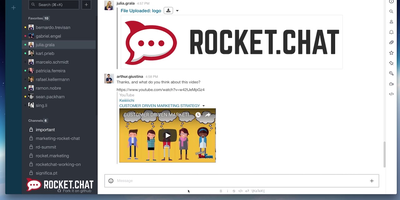
Blast off into productivity space with Rocket.Chat SIX, the ultimate team collaboration cosmos! Imagine a place where your messages, tasks, and projects all live in harmony, orbiting around your team's efficiency like a well-organized galaxy. This isn't just any old chat platform; it's a customizable universe where you're the master of your data domain, with the power to tweak, integrate, and innovate to your heart's content. Ready to provide stellar customer service? Engage with your clients in a way that's so contextually on-point, they'll feel like you're mind-reading across the cosmos. Plus, with a chat engine that's like a gravitational pull for user engagement, your app or website will become the center of your users' universe. And for the security-conscious space cadets, fear not! Rocket.Chat SIX is locked down tighter than a spaceship hatch, with end-to-end encryption and a buffet of deployment options to satisfy your security appetite. All this, hosted on RepoCloud, where the cost is as lightweight as zero-gravity. So why settle for a terrestrial tool when you can have a celestial experience? Rocket.Chat SIX: because your team deserves to collaborate in a universe that's light-years ahead!
BigBlueButton
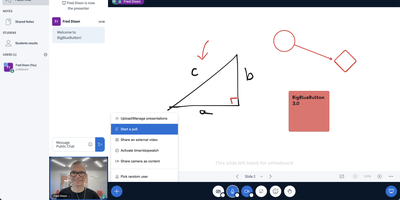
Used daily by millions of educators and learners in over 65 languages and embedded as the default virtual classroom in Moodle Cloud, Canvas, Sakai, D2L, Jenzabar, and Schoology — together comprising more than 75% of the worldwide learning management system market — BigBlueButton has been the leading open-source web conferencing platform for education since its creation at Carleton University in 2007. The platform delivers WebRTC-based real-time audio, video, and screen sharing with a tldraw v2-powered multi-user whiteboard featuring infinite canvas support, allowing multiple participants to annotate slides and draw simultaneously. Breakout rooms support up to eight concurrent groups with collaborative whiteboards enabled by default, and polling with customizable response types lets instructors assess understanding in real time. The built-in Learning Analytics Dashboard answers three questions at a glance: who is attending, who is participating, and who is learning based on poll responses, providing actionable engagement metrics without requiring webcam surveillance. Session recording captures audio, video, slides, chat, and whiteboard annotations for asynchronous playback on any device. The plugin architecture introduced in version 3.0 enables custom extensions, while IMS LTI 1.0 compliance allows integration with Blackboard, Desire2Learn, Pearson Learning Studio, and any conformant platform without custom code. The REST API enables programmatic session management, user authentication, and recording access for custom frontends like the included Greenlight application. Version 4.0 introduces LiveKit-based media and a redesigned interface. Running on a dedicated VPS on RepoCloud with guaranteed CPU, RAM, and SSD, full root SSH access, and a browser serial console. LGPL-3.0 licensed.