OpenSuperBot
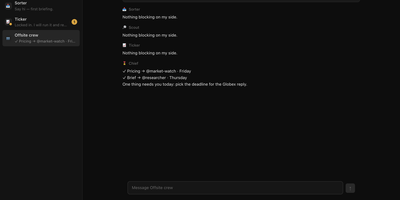
Always-on AI teammates that each get a real computer of their own, with a browser, files and a terminal, working from your hardware instead of a vendor cloud: that is OpenSuperBot. You hire a teammate from the sidebar with a name and a one-line job, and it works inside its own sealed computer with a browser, shell and persistent workspace. At a login wall the bot asks you to take over its live screen and sign in once inside its own browser profile, so passwords never pass through the gateway. Group threads let you ask the whole room at once: everyone answers in parallel, the chief of staff closes with a dispatch table, and @names pick which teammates respond. Nothing leaves the workspace without your say-so, because outward actions stop at a draft-and-hold approval chip. Standing approvals cover repeat sends to one destination for an hour or a day, and money and bookings always ask. Memory is a visible file you control: tell a bot a rule and it posts the exact change as a chip, and forget removes it the same way. Routines come from plain conversation, so a daily digest, a secret webhook trigger or a quiet status-page watch can be scheduled in chat. Each teammate runs a model you pick, with daily token budgets and live step cards for every action. Running on a dedicated VPS on RepoCloud with guaranteed CPU, RAM, and SSD, full root SSH access, and a browser serial console. MIT licensed.

VoidAccess
VoidAccess is a self-hosted dark web OSINT platform that takes a single investigation question and returns a sourced report, a searchable relationship graph, and indicators you can load straight into your defenses. One query fans out in parallel to more than a dozen Tor search engines, code hosts, paste sites, security feeds, and curated onion seeds, then follows newly discovered onion links while mandatory safety gates drop prohibited queries, URLs, and content. A thirteen-step pipeline refines the question, collects across English, Russian, and Chinese sources, filters signal from duplicates and dead ends, enriches what survives, and extracts the entities that matter. It recognizes threat actors, ransomware groups, malware families, IP addresses, domains, onion addresses, file hashes, cryptocurrency wallets across seven chains, exposed credentials with secrets masked, messaging handles, CVEs, and MITRE ATT&CK techniques. Everything lands in an interactive graph with communities and infrastructure clusters, so you can start from one wallet or handle and walk the neighborhood it belongs to, cross-referenced against earlier investigations. Scheduled monitors watch for changes and send Telegram or email alerts when your targets move. Finished work exports as STIX 2.1, MISP events, Sigma and YARA rules, CSV, JSON, and bundled IOC packages, with multi-user access for a team. Running on a dedicated VPS on RepoCloud with guaranteed CPU, RAM, and SSD, full root SSH access, and a browser serial console. MIT licensed.
AI WorkDeck
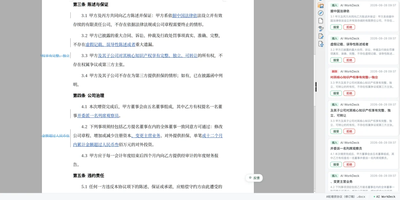
Lawyers work in piles of text, and AI WorkDeck gives them the IDE that programmers take for granted: every matter keeps its files, drafts, evidence and AI help in one window. The AI edits the real document, not a chat transcript, writing its changes straight into the file as tracked changes that you accept or reject one by one. Every conclusion carries a citation, and clicking it lands on the supporting passage in the source document, with changed or missing anchors flagged for review. Drafts live under git-backed history with three-way merges and paragraph-level provenance, so two people can revise the same pleading and still see exactly who wrote what. Out in the field, photos and recordings taken on a phone land back in the matter on your computer, filed by date and ready as evidence. A built-in marketplace adds one-click Skills, plugins and MCP servers, and a Word add-in meets colleagues who never leave their usual editor. Run it as a desktop app for one lawyer or as a server for the whole firm, where accounts, sync and shared matters live on infrastructure you control. Running on a dedicated VPS on RepoCloud with guaranteed CPU, RAM, and SSD, full root SSH access, and a browser serial console. AGPL-3.0 licensed.
AutoMorph
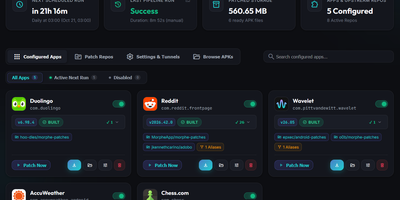
Patching the same Android apps by hand every time a patch repository updates is a chore with your name on it, and AutoMorph is the self-hosted patcher that takes the chore over and rebuilds your apps on schedule. It monitors patch repositories such as ReVanced, Morphe, and community repos for updates, downloads base APKs automatically with Google Play first and APKCombo, Uptodown, and APKPure as fallbacks, and applies your chosen patches without you touching a command line. The Add Package wizard walks you from a package name through suggested repositories, patch selection with per-patch options, and aliases that map same-role patches across repositories so two repos stop fighting over the same job. Builds run once a day at a time you choose, or start manually from the web portal while live build logs stream to your browser. The Patcher Control Center shows every tracked app's version, patch status, and download links, and email alerts carry direct download links whenever a patch succeeds. Distribution goes further: one-tap Obtainium import by QR code or deep link, plus an F-Droid compatible feed for Obtainium and Neo Store, deliver updates straight to your phone, and a custom keystore keeps them seamless. A low-spec mode trims heap and thread limits for small servers, retention settings clean up old builds, and Pangolin, Tailscale Funnel, or Cloudflare Tunnels expose the portal over HTTPS. Running on a dedicated VPS on RepoCloud with guaranteed CPU, RAM, and SSD, full root SSH access, and a browser serial console. MIT licensed.
Pi-Remote
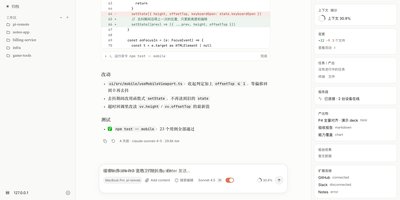
Your pi agent is mid-refactor on the server at home, you are on a train with only a phone, and Pi-Remote is the self-hosted relay that puts that live session in your browser so the work does not wait for your desk. Output, tool calls, and status changes sync in real time, with incremental catch up after a reconnect, and the session itself never leaves the local pi process. Send messages while pi is busy and they queue or steer, with delivery confirmed; switch the model or thinking level, compact the context, fork or clone a session, and walk the session tree, all executed locally. Several machines share one relay, and the UI lists each device, its online state, and its sessions, and can start a new session on the device you pick. Link a device by scanning a QR code, checking the 2 digit code on the confirmation page, and approving with the admin token. Desktop and mobile get separate layouts with six skins in Cursor, Claude, and Codex looks, dark and light, and token and cost usage updates in the status area. At home the relay can run serverless over the LAN, with a Cloudflare Tunnel switched on when you leave; on a server it runs under systemd or Docker Compose, and a device stays reachable only while its attach window is open. Running on a dedicated VPS on RepoCloud with guaranteed CPU, RAM, and SSD, full root SSH access, and a browser serial console. MIT licensed.
Libre-Closet
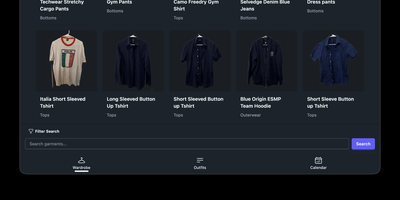
Your closet, cataloged like an inventory system instead of a pile you rummage through every morning. Photograph each garment once and record its name, category, brand, size, colors, washing details, and acquisition date, then filter the whole wardrobe by custom categories you define yourself, with type-ahead suggestions keeping entries consistent. Uploads get automatic background removal and WebP optimization, so every item sits on a clean backdrop that makes outfits easy to judge side by side. The outfit builder combines garments into saved looks, and the scheduling calendar lays those looks across the week while showing what you have already worn, so repeats and neglected favorites become obvious. A weather forecast rides along on each calendar day, and tapping a day opens the detail you need before dressing for an important date. Wardrobes can be shared through invite links with view-only or can-edit permissions, which suits couples, families, and stylists managing client closets. The interface installs to a phone home screen as a PWA and keeps working offline, with the UI available in seven languages. Run it wide open for personal use or switch on JWT accounts for a multi-user household, all from one container with SQLite on local disk. Running on a dedicated VPS on RepoCloud with guaranteed CPU, RAM, and SSD, full root SSH access, and a browser serial console. AGPL-3.0 licensed.

Ziwei Doushu
Ziwei Doushu casts a complete Zi Wei Dou Shu chart, the twelve-palace Purple Star astrology chart, from a birth date, birth double-hour, and gender, and shows you the whole board instead of a single fortune line. Enter the details and the engine places the fourteen major stars and supporting stars across the twelve palaces, marks each star's brightness on a seven-tier scale, and layers the Four Transformations for the natal chart, the current decade, and the current year, including flying-star self-transformations. Births near an hour boundary stay accurate because true solar time correction combines birthplace longitude with the equation of time, and the calendar edge cases are handled openly: China's 1986 to 1991 daylight-saving years, four selectable leap-month conventions, and the late Zi hour day change. Switch between natal, decade, and annual views to watch the same life read at three speeds, then look up what you are seeing. A star encyclopedia explains the fourteen major stars in each of the twelve palaces, a pattern library of more than 1,100 rules names the classic configurations on the board, and a classics library offers full-text search across public-domain source texts. Compatibility charting compares two people side by side, dark and light themes keep long study sessions comfortable, and the layout adapts to phones. Running on a dedicated VPS on RepoCloud with guaranteed CPU, RAM, and SSD, full root SSH access, and a browser serial console. MIT licensed.

015
015 is a send-it-and-forget-it file sharing service for files that should exist for hours, not forever. Drop in a large file and it uploads in chunks, resuming where it stopped if the connection drops, while a short pickup code and a share link give the recipient two easy ways to collect it. If the same file was uploaded before, its hash gives it away and the transfer completes instantly without moving the data again. Every share carries your rules: an expiration time, a password, and a download count limit, enforced by signed download tokens so a shared link cannot be passed around indefinitely. Uploaded images can be compressed or converted in the background while you keep working, and text snippets share through the same expiring-link system when a file is overkill. Images and videos preview in the browser before downloading, and email or webhook notifications can tell you when a share is picked up. The interface speaks seven languages and answers just as well on a phone as on a desktop. When the window closes, a daily janitor sweeps expired files off the disk, so the server never quietly fills with forgotten uploads. Running on a dedicated VPS on RepoCloud with guaranteed CPU, RAM, and SSD, full root SSH access, and a browser serial console. AGPL-3.0 licensed.
Agentring
"Run the migration and call me if anything fails" is an instruction your agent can finally obey, because Agentring is the self-hosted bridge that lets AI agents ring your phone and talk it through with you. When an agent needs a decision, hits a wall, or finishes a long job, your phone rings even locked and in Doze; a realtime voice AI explains why it is calling, answers your questions, and hands the transcript back so the agent carries on with your decision. You can also call your agents back from the Android app and ask what CI said while driving; the voice AI can consult your other agents mid-call, and a slow answer arrives when ready, or as a message if you have hung up. A missed call turns into a message you can answer from the notification. Anything that speaks MCP can reach you, including Claude Code, Codex, opencode, OpenClaw, and Hermes, and scripts or n8n reach you through the REST API and CLI. Pick your voice: Gemini Live by default, OpenAI Realtime, Grok Voice, Phonic, or your own local speech server with no key at all. The relay and LiveKit run in one Docker Compose behind Caddy, the daemon sits beside your agents and connects outbound only, and FCM push wakes the locked phone. No phone numbers, no Twilio, no per-minute fees. Running on a dedicated VPS on RepoCloud with guaranteed CPU, RAM, and SSD, full root SSH access, and a browser serial console. Apache-2.0 licensed.
ClipForge
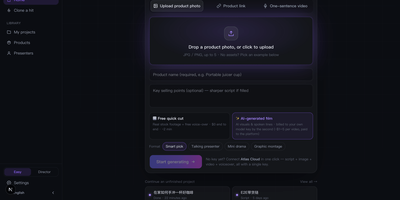
ClipForge turns one product photo into a short selling video, extracting the selling points, writing the pitch, and keeping your product looking like itself instead of letting a generator redraw it. Paste a product link and it pulls the title, price, and images into a review form before anything enters your library, or start from a single sentence when the video is not about a product at all. Choose the free path and it composes with openly licensed stock footage, free voiceover, and local rendering, so your first video costs nothing and needs no API key. Choose AI generation and a script gate shows the full plan and price before a paid call, while a judge panel revises weak lines and a quality check can order a precise retake of only the bad segment. Ten script styles cover drama skits, unboxings, comparisons, talking heads, and pain-point pitches, with a different voice cast for each character in dialogue scenes. A library of 391 commerce templates, a variant matrix for hook and caption combinations, and resumable batch production let one person prepare dozens of platform-ready cuts for TikTok Shop, Reels, Shorts, Douyin, Kuaishou, and Xiaohongshu. Exports arrive without watermarks, with titles, hashtags, and caption copy ready to paste. Running on a dedicated VPS on RepoCloud with guaranteed CPU, RAM, and SSD, full root SSH access, and a browser serial console. AGPL-3.0 licensed.

Neonlink
Neonlink is the bookmark page you actually keep open: a private dashboard of your links, grouped, tagged, and dressed up with your own background. Adding a link takes seconds because the title, description, and site icon are fetched for you the moment you paste the URL. Links live in groups you create and color yourself, so work tools, reading, and projects each get their own card on the page, and drag and drop puts them in the order your eyes expect. Tags cut across groups for the links that belong to two worlds at once, and the sidebar can filter by them in combination. Search covers titles, URLs, descriptions, and tags and updates as you type, which matters once the collection passes the few hundred links every browser bookmark bar quietly becomes. The whole page is yours visually too: pick a background image and switch between grid and list layouts, light and dark themes. Because it sits behind a login on your own server, the collection follows you to any browser on any machine without syncing through a browser vendor's cloud or handing your reading habits to a bookmarking service. Running on a dedicated VPS on RepoCloud with guaranteed CPU, RAM, and SSD, full root SSH access, and a browser serial console. MIT licensed.
Bookshelf
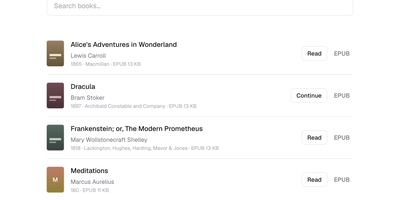
Bookshelf turns a folder of EPUBs and PDFs you already own into a private library you can browse and read from any browser, at home or on your own server. Drop books into a folder, run the sync, and the shelf appears with covers extracted, titles searchable, and accents forgiven, so typing Bronte finds Brontë. Each reader in the house gets a profile that remembers their place in every book, and picking a book up on your phone resumes where the laptop left it, with a Continue button waiting on the shelf. EPUBs open chapter by chapter instead of downloading the whole archive, and PDFs stream in small ranged reads, so even a large scanned book opens quickly. Choose a two-page spread, a single page, or continuous scroll, then set paper, sepia, or night tints for longer sessions. E-readers join through the OPDS catalog, which lets a Kobo or Kindle-side client browse and download from the same shelf. There is no database to run and no account system to manage; the library is plain files you can back up with the volume. Running on a dedicated VPS on RepoCloud with guaranteed CPU, RAM, and SSD, full root SSH access, and a browser serial console. MIT licensed.
Papyra
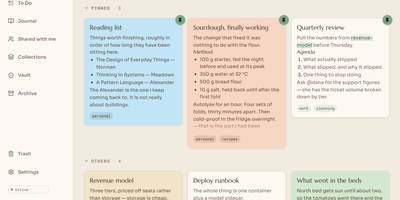
Papyra gives you a calm, private home for notes that stays as easy as sticky notes while quietly linking everything together like a wiki. Cards pin, colour, and drag into place on your desk, and opening one drops you into an editor where slash commands insert headings, checklists, tables, or maps without leaving the keyboard. Type two brackets to link another note, and backlinks gather the other direction automatically, following the note even if you rename it. Notes save themselves, and every earlier version is kept, so you can scrub back through history and restore the draft you actually wanted. Sharing a note lets several people type in it together with visible cursors, comments in threads, and mentions that bring the right person in. Private notes lock behind a PIN or your fingerprint and sit encrypted on disk, while a daily journal page collects the day with a mood and a calendar to browse the year. Search covers notes, to-dos, and attachments with highlighted matches, and image text and audio transcripts can join the index. Running on a dedicated VPS on RepoCloud with guaranteed CPU, RAM, and SSD, full root SSH access, and a browser serial console. GPL-3.0 licensed.
Limelit Open
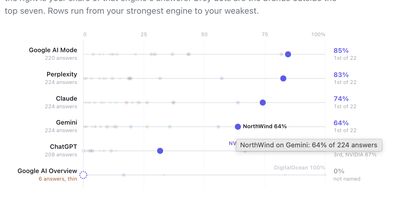
When a buyer asks ChatGPT, Claude, or Perplexity which product to choose, Limelit Open shows whether your brand appears in the answer, where it ranks, and which sources the engines trusted. You define the prompts your market actually asks, register your competitors, and the tracker runs every prompt against seven engines on a schedule you control: ChatGPT, Claude, Perplexity, and Gemini through vendor APIs with web search on, plus Google AI Overviews, Google AI Mode, and Bing Copilot through scraper providers, each result labeled by how it was collected. Every stored answer is searched for your brand and each competitor with the rank of the list item they appear in, so visibility, share of voice, average position, and citation share rest on readable evidence rather than a black-box score. Click any number and you land on the full answer text with matches highlighted, the searches the engine ran, the brands it named, and every cited URL classified as yours, a competitor's, social, informational, or other. A prompt by engine grid makes weak spots obvious, and the built-in MCP server lets Claude or another assistant query the same data in plain language. Runs are capped by a daily ceiling you set, prompts and answers live in one SQLite file, and a single export command dumps the whole instance as JSON or CSVs for your own reporting. Running on a dedicated VPS on RepoCloud with guaranteed CPU, RAM, and SSD, full root SSH access, and a browser serial console. Apache-2.0 licensed.
Goofish Monitor
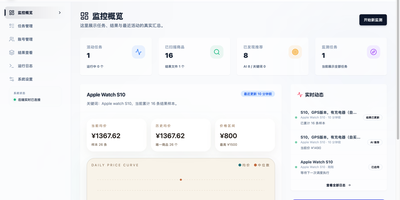
Goofish Monitor watches Xianyu for the secondhand deals you actually want, checking listings around the clock and alerting you when a match appears at the right price. Describe what you are hunting in plain language and the AI judge turns it into analysis criteria, or skip the model and write exact keyword rules yourself. Each task carries its own keywords, price range, listing age window, and province, city, and district filters, and several tasks run side by side without stepping on each other. Results land in a browsable page with price history, so you can see whether a seller dropped the price or relisted the same item. When something matches, notifications fan out to ntfy, Telegram, Bark, WeChat Work, or a generic webhook, which means the good deals reach your phone before someone else grabs them. Cron schedules let tasks wake on your timetable, accounts can be bound per task, and proxy rotation with retries keeps longer monitoring runs alive. The management interface covers task creation, account login states, prompt editing, run logs, and system settings, so diagnosis happens in the browser instead of a log file. Running on a dedicated VPS on RepoCloud with guaranteed CPU, RAM, and SSD, full root SSH access, and a browser serial console. MIT licensed.
imgpush
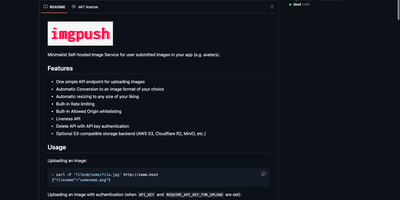
Your app needs avatars, attachments and user photos, and imgpush is the tiny service that takes them off your hands. Send one upload request with a file or a URL and you get back a filename; ask for that file with a width and height in the address and you receive exactly that crop, converted to the format you configured. Originals live on local disk or in any S3-compatible bucket (AWS S3, Cloudflare R2, MinIO or Backblaze B2), with resized variants cached locally for fast serving. Abuse controls come built in: per-IP upload quotas per minute, hour and day, an allowed-origins whitelist, and an optional nudity filter that can also sample video frames before an upload is accepted. An API key can be required for uploads, deletes remove the original together with every cached size, and a liveness endpoint keeps Docker and Kubernetes health checks honest. One Docker container on port 5000, a page of environment variables, and your application never writes image code again. Running on a dedicated VPS on RepoCloud with guaranteed CPU, RAM, and SSD, full root SSH access, and a browser serial console. MIT licensed.
xEdit
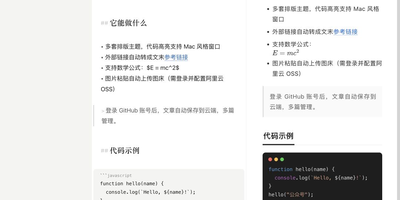
xEdit is a free, open-source Markdown editor that keeps your notes as plain text, on your device or on your own server, and hands AI clients a proper door instead of a scrape. Write in live preview, where headings, code and images render in place and only the line under your cursor shows its source, or flip to a split view when you want both sides visible. Slash commands insert headings, callouts, tables, to-dos, code blocks and media, and wiki links tie notes together by title, with renames updating every link that points at the note. Any checkbox in any note with a date rolls up into a Today view, and nested folders, global search and a recoverable trash keep a growing library tidy. Choose where notes live: browser storage, a local folder of Markdown files, or cloud sync with an offline mirror on every device. Cloud notes gain version history with line-by-line diffs and one-click rollback, share links that collect comments on selected passages, and exports to Markdown, HTML, PDF, PNG and Word. Pick one of thirteen layout themes and copy straight into WeChat or Zhihu with styles inlined and math intact, then connect Claude or Cursor through the built-in MCP server to search, organize and edit the whole library. Running on a dedicated VPS on RepoCloud with guaranteed CPU, RAM, and SSD, full root SSH access, and a browser serial console. MIT licensed.
HiveMTK
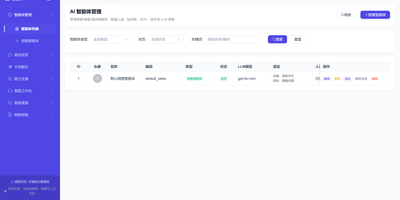
Your sales team's conversations scatter across a dozen apps, and HiveMTK pulls them into one private workspace where AI agents do the daily chasing. Douyin, Xiaohongshu, TikTok, WeChat, Telegram, WhatsApp, email and SMS all land in a unified inbox, and every customer merges into a single profile no matter where they first appeared. A ReAct agent perceives, plans, calls tools and reflects instead of following a fixed script, composing its 45 tools across outreach, customers, knowledge and business tasks to handle situations nobody scripted. A proactive partner agent works the other direction, mining group leads and starting conversations, and a visual canvas turns the whole playbook into marketing flows anyone on the team can edit. The knowledge base answers from your own documents with hybrid vector and keyword retrieval, and because inference runs locally, chats, embeddings and customer data never leave your network. Dashboards track leads, conversions and channel mix, and a GEO module works on getting your brand cited by AI search. It is a full acquisition to repurchase funnel for teams of five to fifty who refuse SaaS lock-in. Running on a dedicated VPS on RepoCloud with guaranteed CPU, RAM, and SSD, full root SSH access, and a browser serial console. AGPL-3.0 licensed.