
Bloom
Bloom hires you a private tutor for any subject, then teaches one lesson at a time and rewrites the next lesson around what you actually understood. You begin with a topic, an uploaded PDF, text, or Markdown source, or a set of project files, and Bloom drafts a syllabus of concrete mastery items at simple, standard, or deep expansion. Each lesson arrives focused and readable, with a chapter sidebar for quick jumps and a collapsible syllabus tracking what is already mastered. Reading is active work: highlight any passage and a question thread opens beside it, streaming an answer that stays attached to that sentence for later follow-ups. Reflection questions close every lesson, and your answers, annotations, and highlighted gaps become the raw material for the next lesson, which opens by reviewing the previous answers. Source mode keeps page numbers and sections so lessons can cite where an idea came from, and project files render each document as its own page for highlight questions without generated lessons. Finished courses produce an evaluation and a summary, followed by three recommended next topics drawn from your learning history. A personal center shows a study calendar, daily activity, and streaks across your courses. Running on a dedicated VPS on RepoCloud with guaranteed CPU, RAM, and SSD, full root SSH access, and a browser serial console. MIT licensed.
Moltis
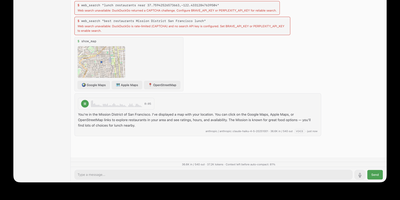
Moltis gives individuals and teams a completely private personal AI agent server that bridges conversational assistants to everyday messaging platforms while executing real-world computing tasks inside secure execution environments. Users can interact with autonomous agents across Telegram, Discord, WhatsApp, Slack, Matrix, and browser interfaces to draft correspondence, automate research, and schedule recurring cron tasks. The system coordinates multi-agent delegation by spinning up specialized sub-agents with dedicated roles for code generation, pull request reviews, quality assurance testing, and technical documentation. Built-in sandboxing isolates tool operations within container boundaries or WebAssembly modules, ensuring shell commands, web scraping routines, and script executions cannot alter underlying operating system files without explicit permission. Native Model Context Protocol integration allows operators to attach external data endpoints, database connectors, and custom command-line utilities without rewriting core routing logic. Persistent memory preserves conversational context and document embeddings across multiple sessions, allowing assistants to recall prior discussions, user preferences, and project guidelines indefinitely. Administrators can configure granular tool approvals, manage WebAuthn passkey authentication, and review real-time WebSocket communication logs through an embedded control panel. Running on a dedicated VPS on RepoCloud with guaranteed CPU, RAM, and SSD, full root SSH access, and a browser serial console. MIT licensed.
Keygate
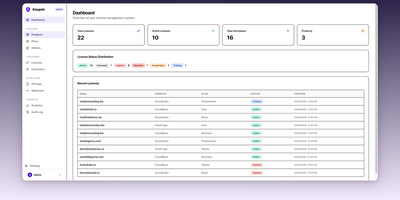
Software makers who would rather not rent a licensing backend use Keygate to issue, sell, and enforce license keys from infrastructure they control. You create desktop, SaaS, or hybrid products and sell them as subscriptions, perpetual licenses, perpetual licenses with a maintenance period, trials, or floating concurrent licenses that are checked out, heartbeated, and returned automatically. The admin dashboard manages products, plans, customers, licenses, API keys, webhooks, analytics, audit logs, team members, email templates, and branding, with search, filters, and CSV or JSON export. Your application activates and verifies keys through the license API, enforces per-device or per-user activation limits with grace periods, and can verify Ed25519 signed tokens offline with a public key. Usage metering tracks API calls, storage, bandwidth, or custom metrics against quotas with hourly, daily, monthly, or yearly reset cycles and webhook threshold warnings. Connecting Stripe makes checkout create licenses automatically, follows plan and seat changes with proration, handles refunds and cancellations, sends dunning emails after failed payments, and gives customers a billing portal and self-service license management. Team seats, feature entitlements, purchasable add-ons, scoped API keys, and optional S3-backed release hosting round out the selling stack in one binary with one PostgreSQL database. Running on a dedicated VPS on RepoCloud with guaranteed CPU, RAM, and SSD, full root SSH access, and a browser serial console. AGPL-3.0 licensed.
OxiCloud
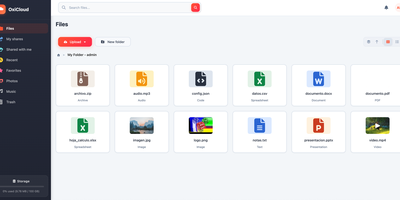
OxiCloud is a self-hosted cloud for files, photos, calendars, contacts, and office documents. Drives can be personal or shared, with configurable storage quotas. Multi-gigabyte uploads travel as parallel, resumable chunks with integrity verification. Images, PDFs, audio tracks, and video streams preview right in the browser, and photos show EXIF details and map locations. Files sync over WebDAV. Calendars sync over CalDAV. Contacts sync over CardDAV. Desktop file managers, Thunderbird, Apple Calendar, and mobile DAVx5 clients connect without proprietary software. Collabora Online or OnlyOffice plug in through WOPI for real-time co-editing of spreadsheets, presentations, and text documents. Administrators enforce role-based access controls. Sign-in runs through OpenID Connect providers such as Keycloak, Authentik, or Azure AD. Public share links can carry a password and an expiration. Identical files are stored once, and adaptive compression keeps footprints compact. Local disks, Amazon S3, and Azure Blob can be mounted at the same time, with live background migration and automated consistency checks. Running on a dedicated VPS on RepoCloud with guaranteed CPU, RAM, and SSD, full root SSH access, and a browser serial console. MIT licensed.
InvenTree
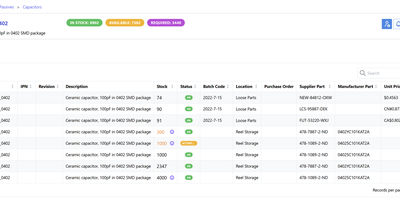
InvenTree is an inventory management system for electronics manufacturers, makerspaces, and small-to-medium businesses. The hierarchical part categorization system organizes components into unlimited nested categories, while stock items tracked across cascading locations and sub-locations provide instant visibility into current inventory levels, with optional serial number tracking for individual item traceability and acceptance testing. Intelligent BOM management calculates sub-part requirements, validates availability against current stock, supports multi-format BOM upload including KiCad integration, and generates detailed bills of materials with full database enrichment. Build orders consume BOM-allocated stock to produce assembled parts with step-by-step work order tracking, while purchase orders manage supplier relationships with pricing history, lead times, and automatic stock receipt processing. The modern React frontend built with Mantine, TanStack Query, and Zustand provides responsive data tables, tree-select navigation, a preview drawer, and a snippet editor. The extensible plugin system supports 19 mixin types including BarcodeMixin for scanner integration, LabelPrintingMixin for Zebra and Brother printers, AppMixin for custom database tables, and ScheduleMixin for periodic background tasks. Companion mobile apps on Android and iOS provide barcode scanning and stock operations in the warehouse. Docker Compose deploys with PostgreSQL, MySQL, or MariaDB backends behind any reverse proxy. Running on a dedicated VPS on RepoCloud with guaranteed CPU, RAM, and SSD, full root SSH access, and a browser serial console. MIT licensed.
Jellystat
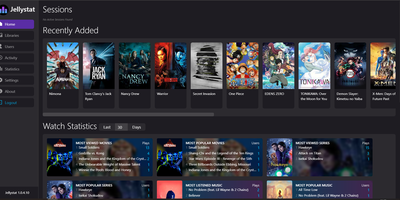
Jellystat is a self-hosted media analytics and live session monitoring dashboard for Jellyfin and Emby servers that turns raw streaming activity into detailed user, library, and playback insights. Media server administrators use the live dashboard to watch active streams in real time, inspecting transcoding status, client devices, bitrates, and playback progress as sessions happen. Every completed or partial stream is logged automatically so you can browse chronological watch histories, filter by library or stream type, and analyze peak concurrent streaming hours across the week. Dedicated library and user views break down total watch duration, play counts, and most popular movies, episodes, or music albums per account. If you already use the official Jellyfin Playback Reporting or Statistics plugins, you can import existing historical records directly into your instance without losing past data. Built-in database backup and restore tools, automatic library synchronization tasks, IP geolocation via MaxMind GeoLite, and interactive Swagger API documentation at the /swagger endpoint round out the administrative toolkit. Running on a dedicated VPS on RepoCloud with guaranteed CPU, RAM, and SSD, full root SSH access, and a browser serial console. MIT licensed.
Instatic
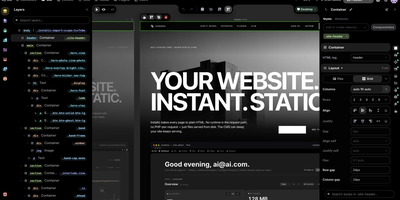
Design a website on a canvas, manage its content in spreadsheet-style tables, and publish plain HTML, all from one self-hosted Instatic server. Designers see several breakpoint frames side by side, or switch to live mode and edit one full-size page in place. A built-in design system expands one brand color into a full shade scale, generates fluid type and spacing scales, and writes the utility classes into a single small stylesheet. Reusable Visual Components take typed parameters and named slots, templates set site-wide or per-post-type layouts, and loops repeat a design over posts or media. Editors work in custom post types and data tables, and posts move through draft, scheduled, and published states. Forms on the site save their submissions to tables of your own. An AI agent can do the building, placing real, editable nodes on the canvas using Claude, OpenAI, OpenRouter, or Ollama with your own key, and an MCP connector lets Claude, ChatGPT, and other remote agents work on the site too. Super Import converts a whole static site into pages, styles, tokens, and media. Teams get roles built from 38 capabilities, TOTP two-factor sign-in, and an append-only audit log, plus site branches with private copies, shareable preview links, and merge review. Everything published is baked to plain HTML and CSS on disk. Running on a dedicated VPS on RepoCloud with guaranteed CPU, RAM, and SSD, full root SSH access, and a browser serial console. MIT licensed.
OpenNetWorth
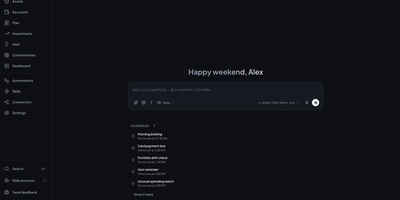
Open Net Worth is a self-hosted personal finance system where an AI agent named Lucius works a real multi-currency ledger, a zero-based budget, and an investment book through guarded write tools instead of merely describing your money. Record every account you own or owe, from bank accounts and cards to loans, retirement funds, and brokerages, then reconcile balances, split transactions, and review statement imports before anything books. Budget with Ready to Assign envelopes, category targets, and credit card payment tracking, or switch to a simple 50/30/20 split and project cash flow months ahead. Track holdings, buys, sales, dividends, tax lots, realized gains, options, and equity grants, with watchlists and price alerts for the positions you follow. Lucius can categorize transactions, reconcile accounts, build reports, and act in connected apps, and every tool carries a permission level you control, so sensitive changes pause on a confirm card before they land. Schedule automations for a daily briefing, a weekly report, or a bank sync, and save repeatable jobs as skills he follows again. Connect SimpleFIN, Plaid, Enable Banking, Alpaca, or Interactive Brokers, import from YNAB or Lunch Money, and bring an Anthropic, OpenAI, or local Ollama model. Running on a dedicated VPS on RepoCloud with guaranteed CPU, RAM, and SSD, full root SSH access, and a browser serial console. AGPL-3.0 licensed.
Swetrix
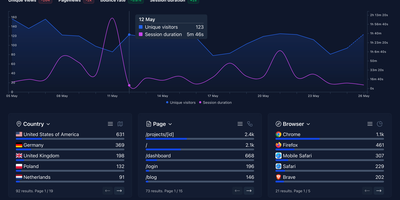
Traffic analytics, real-user performance monitoring, and client-side error tracking - normally three tools - in one cookieless, privacy-first dashboard: Swetrix. The Community Edition ships the same core engine as the cloud product - a NestJS API with ClickHouse for high-volume event storage, MySQL for relational data, and Redis for caching, fronted by a React dashboard and a ~5 KB tracking script with official packages for 20+ frameworks including Next.js, WordPress, and Shopify. Traffic analytics cover pageviews, referrers, UTM campaigns, geolocation, sessions with page flows, funnels, and custom events - all anonymized server-side with no cookies, no cross-device tracking, and no consent banner required for GDPR compliance. Performance monitoring records real-user metrics per pageview: TTFB, DNS and TLS timing, and render times, so regressions surface in the same place as traffic. Error tracking captures unhandled JavaScript exceptions automatically with formatted stack traces, filename/line metadata, affected browsers and pages, first/last-seen timestamps, and a resolve workflow - replacing a separate error monitoring subscription for many teams. Alerts fire to email, Slack, Telegram, Discord, or webhooks on traffic spikes, new errors, and custom events. If Plausible covers your traffic questions but you also want to know why the site broke, Swetrix answers both.

Skuul
Several campuses, one installation: Skuul is school management software that handles admissions, teaching, fees, and family access, with separate roles and records for each campus. Organizations hold campuses, learners can move between them, and campuses share selected records. Enrollment staff work an admissions waitlist and place learners into grades and sections. Teachers take daily section registers and keep gradebooks whose assessments are marked numerically, on a scale, or with comments only, each with its own weight and category. Results go through review and approval before publication, and published results feed report cards and transcripts. Accountants issue invoices with waivers and fines, while payments, refunds, and student credit post to a ledger governed by financial periods. Parents and students sign in to a portal showing approved results, attendance rates, timetables, invoices, documents, notices, library loans, and requests to the school. Each campus switches optional modules on or off: discipline and wellbeing cases, staff leave, closure days, boarding, library lending, clubs and programmes, and student and staff imports. A report desk builds CSV, XLSX, and PDF exports in the background. Running on a dedicated VPS on RepoCloud with guaranteed CPU, RAM, and SSD, full root SSH access, and a browser serial console. MIT licensed.
AxonHub
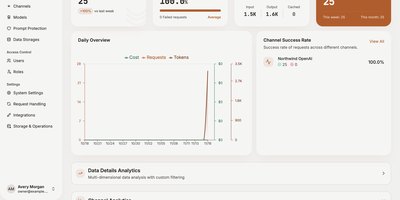
AxonHub is an open-source AI gateway that lets any OpenAI, Anthropic, or Gemini SDK reach more than 100 models through a single address. Point Claude Code, Codex, OpenCode, or your own scripts at one base URL, and the gateway translates each request for whichever provider sits behind the model name, so changing vendors means editing a string instead of rewriting code. Channels hold provider keys, model lists, weights, and health history, and load balancing with automatic failover sends traffic to the healthiest route. Chat, image generation, embeddings, and reranking all travel through the same endpoint. Every call lands in request logs with token counts, first-token latency, and cost, and traces group related calls into threads with a timeline of spans. A built-in playground tests one channel or the full gateway, prompt protection rules filter sensitive text before it leaves your network, and API keys can be limited by project, owner, or IP range. Roles and per-user usage tables keep teams apart. Running on a dedicated VPS on RepoCloud with guaranteed CPU, RAM, and SSD, full root SSH access, and a browser serial console. Apache-2.0 licensed.
Sim Studio
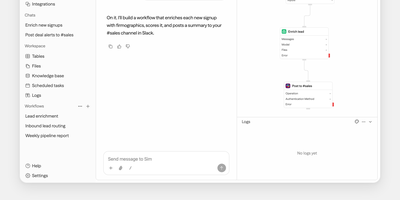
Sim Studio lets teams build, deploy, and monitor AI agent workflows by dragging blocks onto a visual canvas and wiring them into executable pipelines, backed by over 1,000 integrations. The React Flow editor represents each step as a node: LLM calls, tool invocations, conditional branches, and data transformations form directed acyclic graphs that run as complete agent pipelines. Every major LLM provider works natively, including OpenAI, Anthropic, Google Gemini, Groq, and Cerebras, plus local models through Ollama and vLLM. Integrations span Gmail, Slack, Microsoft Teams, Telegram, WhatsApp, Notion, Google Workspace, Airtable, GitHub, Jira, Linear, Perplexity, Firecrawl, PostgreSQL, Supabase, Pinecone, and Qdrant. Built-in tables provide a database layer, a file store offers shared team storage, and knowledge bases powered by PostgreSQL with pgvector enable retrieval-augmented generation. Finished workflows deploy as REST API endpoints, scheduled jobs, or Slack bots, with block-by-block execution traces for full observability. Real-time collaborative editing via Socket.io supports simultaneous multi-user construction. Alternatively, describe agent behavior in natural language and Sim assembles the workflow automatically. Built on Next.js App Router, Bun runtime, Drizzle ORM, and Tailwind CSS. 29,400+ GitHub stars and 100,000+ builders. Apache-2.0 licensed.
Fleetbase
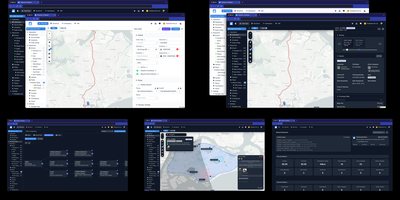
Tracking over 50,000 fleet vehicles across production deployments, Fleetbase delivers a modular logistics operating system where each module—Fleet-Ops, Storefront, Pallet, and Ledger—works independently yet shares a unified data layer that eliminates middleware between ordering, dispatch, warehousing, and accounting. The Fleet-Ops core handles real-time driver tracking through a SocketCluster-based WebSocket event bus, interactive map-based dispatch with both directed and ad-hoc driver assignment, configurable order workflows with custom rules, automation triggers, and activity flows, plus a Kanban-style order board for visual pipeline management. Service zones let dispatchers define geographic operating areas, while proof-of-delivery capture and route optimization close the last-mile loop. The Storefront module provides headless e-commerce with products, carts, and checkout that feed directly into dispatch queues, and the Ledger module records invoices and financial journal entries across all operations. The Navigator driver app—also AGPL-3.0 licensed and fully white-label—delivers turn-by-turn navigation, live order communication, and fault reporting to drivers in the field. The extension architecture pairs backend Laravel Composer packages with frontend Ember Engine modules, enabling third-party developers to build first-class platform extensions without forking. A RESTful API with full documentation, webhook delivery via Redis-backed queues, and push notification support through APNs and FCM round out the integration surface. Running on a dedicated VPS on RepoCloud with guaranteed CPU, RAM, and SSD, full root SSH access, and a browser serial console. AGPL-3.0 licensed.
Pulse
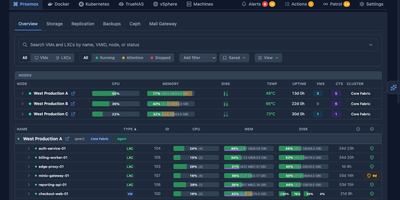
Pulse monitors your entire heterogeneous infrastructure from one screen: Proxmox VE, Proxmox Backup Server, Proxmox Mail Gateway, Docker, Podman, Docker Swarm, Kubernetes, TrueNAS SCALE/CORE, VMware vSphere, and standalone Linux/Windows/macOS machines. The Go binary embeds a SolidJS/TypeScript frontend, delivering WebSocket-driven dashboards with sub-second metric updates on port 7655. A unified agent auto-detects Docker, Podman, Kubernetes, and Proxmox on each host without manual configuration and self-updates silently, while Proxmox nodes need only API credentials with zero agent installation. Smart alerts use adaptive hysteresis-based thresholds to prevent notification floods, pushing to Discord, Slack, Telegram, Teams, email, ntfy.sh, Gotify, and generic webhooks with per-resource overrides. The standout feature is Pulse Patrol: scheduled AI health checks running every ten minutes to seven days using OpenAI, Anthropic, Gemini, or local Ollama models. Patrol catches silent backup failures, capacity creep, restart loops, unhealthy containers, and clock drift that dashboards miss when nobody is watching. Platform-specific views render Proxmox nodes, Ceph clusters, Docker Compose projects, Kubernetes workloads, TrueNAS pools, and vSphere VMs in familiar layouts. OIDC, SSO, and SAML authentication with credential encryption at rest secures access. 6,500+ stars and 441 releases since February 2025. Running on a dedicated VPS on RepoCloud with guaranteed CPU, RAM, and SSD, full root SSH access, and a browser serial console. MIT licensed.
Nautobot
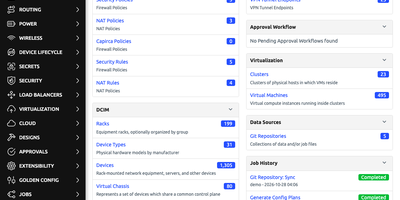
From the first rack to the last circuit, Nautobot is the open-source network source of truth that records what your network should look like and runs automation against it. Built-in models cover locations, racks, devices, interfaces, cables, VLANs, VRFs, IP prefixes, circuits, and contacts, so one searchable record replaces the spreadsheet and the wiki. Teams encode their own standards with custom fields, user-defined relationships, computed fields, and validation rules. Config contexts attach JSON or YAML data, such as syslog servers, to devices by location, role, platform, or tag. Jobs run your own automation code from the web UI, REST API, or command line, on a schedule, or through hooks when an object changes, with approvals and logs built in. Query the data over REST or GraphQL, and let the GraphiQL editor autocomplete a device and interface query you can save inside Nautobot. When an object is created, updated, or deleted, webhooks notify outside systems, with Jinja2-templated bodies and HMAC SHA-512 signatures. Git repositories can carry export templates, Jobs, and config contexts too, so YAML data and Jinja2 templates get pull request review before Nautobot syncs them. Open-source Apps add Golden Configuration for config backup, compliance, and remediation, Device Lifecycle for hardware tracking, SSoT for syncing other systems, and ChatOps. Object permissions and change logging keep a shared instance auditable. Running on a dedicated VPS on RepoCloud with guaranteed CPU, RAM, and SSD, full root SSH access, and a browser serial console. Apache-2.0 licensed.
OTOBO
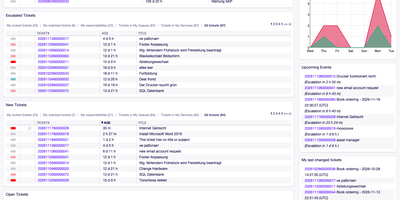
Email, phone, and portal requests become tickets with owners, queues, and deadlines in OTOBO, the open-source service management platform for IT, HR, and facility teams. Agents start on a dashboard of reminder, escalated, and new tickets, with a seven-day created-versus-closed chart and a list of upcoming escalations. Opening a ticket shows its service, service level agreement, owner, customer details, and a full article history where agents reply, forward, split, pin, or add notes. Queues, roles, and access control lists decide who sees what, while PostMaster filters sort incoming mail by sender, subject, or keywords. Dynamic fields attach custom data to tickets and can point at customers, services, and FAQ articles. Process management models multi-step workflows such as approvals with approve and reject buttons. Power search finds tickets and configuration items as you type, and a Similar Tickets widget surfaces related cases. Customers open and follow their requests in a white-label self-service portal. Optional add-on packages bring a CMDB whose configuration items link to tickets, an FAQ knowledge base, and customer satisfaction surveys. Team calendars handle recurring appointments, built-in statistics and reports measure service performance, and sign-on works through OpenID Connect, LDAP, or Active Directory. REST and SOAP web services connect OTOBO to other systems. Running on a dedicated VPS on RepoCloud with guaranteed CPU, RAM, and SSD, full root SSH access, and a browser serial console. GPL-3.0 licensed.

OvertChat
Your household gets one private chat front door for the models you already run, local or hosted, with voice, search, and coding agents included from the same server. Point it at Ollama, vLLM, llama.cpp, SGLang, or LM Studio, then add OpenAI, Anthropic, Gemini, DeepSeek, Bedrock, or OpenRouter beside them. Models that support tools can answer with charts, tables, forms, and follow-up buttons instead of plain paragraphs. Ask for a live conversation and speak, hear the reply, cut in mid-sentence, and keep going; Parakeet handles recognition and Kokoro speaks back on CPU or GPU. Documents open beside the chat for drafting and revising Markdown, code, web pages, SVG, and Mermaid diagrams. Attach spreadsheets, PDFs, images, Word, Excel, CSV, or source files and run Python on them in an offline sandbox that returns charts, cleaned data, or finished documents. Search the web through bundled SearXNG or Brave, read pages with inline citations, connect MCP servers, and set thinking controls per local model. Replies keep streaming after you close the tab, full-text search finds old answers, and read-only links share a conversation. Coding agents run on your machines or over SSH and stay reachable from browser, desktop, Android, or iOS. Running on a dedicated VPS on RepoCloud with guaranteed CPU, RAM, and SSD, full root SSH access, and a browser serial console. MIT licensed.
OHIF Viewer
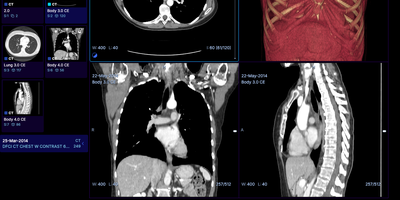
The OHIF Viewer reads CT, MR, PET, and slide microscopy studies straight from a DICOMweb archive and shows them in any browser tab, with no workstation software to install. The study list filters by patient name, MRN, study date, description, modality, and accession number. Each study launches into the workflow mode that fits its modalities. Basic Viewer mode tracks the measurements drawn on images and gathers them in a side panel for review. Layouts include MPR, four-up 3D, volume rendering, and PET/CT fusion with maximum intensity projection. Labelmap tools offer brush, eraser, threshold, and shape segmentation, and DICOM segmentation, RT Structure, and structured report objects display alongside the pixels. PDFs, video clips, ECG waveforms, 4D series, and whole slide microscopy open in the same interface. Hanging protocols arrange series the way each workflow expects. An iframe embed drops the viewer into a portal or research app. Pair it with Orthanc or DCM4CHEE for storage and Keycloak for sign-in. Oncology trial reads, imaging research, and web front ends for a PACS are the usual jobs. Running on a dedicated VPS on RepoCloud with guaranteed CPU, RAM, and SSD, full root SSH access, and a browser serial console. MIT licensed.