
OpenBot
Open source GrokBot, built by the team behind the AG-UI protocol. OpenBot is the open-source enterprise agent platform that gives every AI coworker its own sandboxed computer — a real Chromium browser with its own login sessions, a private filesystem, and only the MCP tools you explicitly grant. The centralized gateway evaluates CEL policy rules against tool name, intent, bot identity, page URL, element attributes, and file paths before any action executes, writing an immutable audit row for every call and outcome. Any agent that speaks AG-UI — LangGraph, Mastra, CrewAI, Pydantic AI, Google ADK, or hand-written endpoints — registers as a Bot and receives its own channel with persistent conversation history. The take-the-wheel system lets humans assume control when an agent encounters login walls or two-factor prompts, recording control transfers as structured audit events. Knowledge documents from Google Drive and OneDrive carry source-based permissions where deny principals always win and ambiguous mappings refuse retrieval entirely. The React and Vite frontend provides live screen viewing of each agent's browser, channel-based chat, admin settings, and component galleries. The Hono API server on port 3001 handles authentication, role-based access, tenant packaging, and credential management backed by PostgreSQL with pgvector. Deploy via Docker Compose with the included supervisor that manages per-bot computer containers. Running on a dedicated VPS on RepoCloud with guaranteed CPU, RAM, and SSD, full root SSH access, and a browser serial console. MIT licensed.
DefectDojo
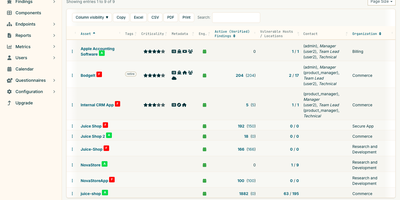
Security scanners each report in their own format, and DefectDojo is the self-hosted platform that imports those reports and keeps a single, triaged list of findings. Reports in mixed formats? More than 350 built-in parsers read output from Burp Suite, ZAP, Trivy, Tenable Nessus, SonarQube, Snyk, and Checkmarx, and Generic Findings Import covers tools without a parser through CSV or JSON files. The same scan every night? Reimport adds new findings, can close the ones that vanished, and reopens the ones that return, while deduplication ties repeat detections inside an asset to their original. Decisions already made? False positive, out of scope, and risk accepted statuses survive reimport, so nobody triages the same noise twice. A deadline on every fix? Severity-based SLA countdowns flag breaches and can notify the users assigned to each asset, and full risk acceptances carry notes, files, and an expiry date that returns findings to active by default. Many teams, many applications? Organizations, assets, engagements, and tests mirror how security work is organized, with permissions that cascade downward. Pipelines that should report themselves? The REST API and CI/CD engagements import results automatically, and findings push to Jira as tickets. Someone outside security wants a summary? Dashboards track metrics, and a widget-based report builder produces HTML reports that print to PDF. Running on a dedicated VPS on RepoCloud with guaranteed CPU, RAM, and SSD, full root SSH access, and a browser serial console. BSD-3-Clause licensed.
Mira
The fastest tool on the public Martian Code Review Bench at 77 seconds per PR with competitive F1 scores — while every higher-scoring competitor takes 5 to 14 times longer — Mira is the fully open-source AI code reviewer that ships the entire feature surface other tools gate behind per-seat subscriptions: indexed PR reviews with full-repo context, streaming walkthroughs posted within seconds, inline vulnerability scanning from hourly OSV.dev polls, org-wide package inventory answering "which repos use [email protected]?" in one query, interactive dependency graphs with blast-radius SVG rendering via ReactFlow, a learning loop that synthesizes rules from rejected comments and human review patterns on merged PRs, and cost telemetry showing actual spend per repo and per model. Unlike CodeRabbit, Greptile, and GitHub Copilot code review which are SaaS-only with per-seat pricing, Mira runs as a single Docker image on your infrastructure with your LLM key through OpenRouter (fronting Anthropic, OpenAI, Google Gemini, DeepSeek) or direct to Ollama and vLLM for fully air-gapped deployments. The engine indexes Python, TypeScript, Go, Rust, Java, C/C++, C#, Swift, Kotlin, Scala, and PHP with per-file symbol extraction, enabling multi-file reasoning across diffs rather than isolated line-by-line review. Integrates with GitHub, GitLab, and Forgejo via webhook with full feature parity. Running on a dedicated VPS on RepoCloud with guaranteed CPU, RAM, and SSD, full root SSH access, and a browser serial console. Apache 2.0 licensed.
Prowler
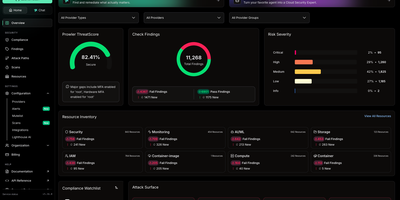
Point it at your cloud accounts and it returns a ranked list of what is misconfigured, mapped to the standards auditors ask about. Connect providers like AWS, Azure, Google Cloud, Kubernetes, Microsoft 365, and GitHub, launch a scan or schedule recurring ones, and read the results on an overview with a ThreatScore gauge, severity bars, and a resource inventory by category. The Findings page groups failed checks, expands each group into the affected resources, and lets teams mute noise, triage status, send groups to Jira, and create alerts that email or message people after each scan. Compliance pages score every framework from CIS and NIST to PCI DSS, SOC 2, HIPAA, GDPR, and ISO 27001, with a watchlist for the ones you care about and downloadable reports. Attack Paths draws a graph from IAM roles and policies to outcomes like code execution, using a Neo4j graph database filled by AWS scans. A built-in AI assistant answers questions about critical findings and compliance gaps with the model provider you configure. Organizations, roles, and API keys keep access tidy. Running on a dedicated VPS on RepoCloud with guaranteed CPU, RAM, and SSD, full root SSH access, and a browser serial console. Apache-2.0 licensed.
Casdoor
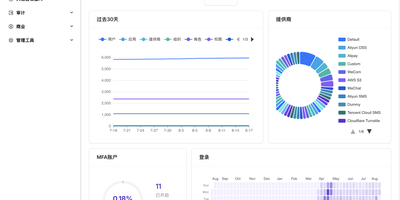
With 13,800+ GitHub stars and active releases through 2026, Casdoor is the open-source identity platform that ships OAuth 2.0, OIDC, SAML 2.0, CAS, LDAP, SCIM 2.0, WebAuthn passkeys, TOTP multi-factor authentication, and Face ID biometric login in a single Go binary with a React web console — covering every authentication protocol your organization will ever need. Social login connects 50+ identity providers including Google, GitHub, Microsoft Azure AD, Facebook, WeChat, DingTalk, Apple, Twitter, and LinkedIn without custom code. The AI-first architecture includes a Model Context Protocol gateway for AI agent authentication and Agent-to-Agent protocol support for securing LLM-powered workflows. Built-in Casbin integration delivers authorization primitives beyond basic RBAC: attribute-based access control, relationship-based access control, and custom policy models through a unified engine. The organization-scoped multi-tenancy model isolates users, applications, and identity providers per tenant with customizable login pages, branding, and SMTP configuration. SCIM 2.0 endpoints automate user provisioning from HR systems and Active Directory. Official SDKs for Go, Java, Node.js, Python, and PHP accelerate application integration. The RESTful API exposes every resource for programmatic management. Comprehensive audit logs record authentication events and administrative actions. Deploy via Docker Compose with MySQL or PostgreSQL, the all-in-one SQLite Docker image for quick trials, or the official Kubernetes Helm chart for production clusters. Running on a dedicated VPS on RepoCloud with guaranteed CPU, RAM, and SSD, full root SSH access, and a browser serial console. Apache 2.0 licensed.
Bitwarden
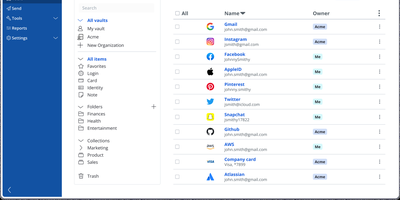
Backed by nearly 20,000 GitHub stars and ranked number one in G2's Enterprise User Satisfaction for eleven consecutive quarters, Bitwarden is the open-source password manager trusted by millions worldwide. The zero-knowledge encryption architecture ensures all vault data — passwords, passkeys, credit cards, identities, secure notes, and file attachments — is encrypted exclusively on client devices using AES-256 with PBKDF2-SHA256 or Argon2id key derivation and RSA-2048 for organization key exchange. Cross-platform clients span a web vault, browser extensions for Chrome, Firefox, Safari, Edge, Opera, Vivaldi, and Brave, native desktop apps for Windows, macOS, and Linux, mobile apps for iOS and Android, and a CLI for scripting. Bitwarden Send enables time-limited, password-protected sharing of text and files, while the built-in TOTP authenticator generates two-factor codes alongside stored credentials. Enterprise deployments integrate with identity providers through SAML 2.0 and OpenID Connect SSO, automate provisioning via SCIM or Directory Connector supporting LDAP, Active Directory, Azure AD, Okta, and OneLogin, and enforce security policies with custom roles and granular permissions. Emergency access allows designated contacts to request vault view or takeover through configurable waiting periods with cryptographic key exchange. The Secrets Manager stores API keys, tokens, and infrastructure credentials with native GitHub Actions, GitLab CI/CD, Ansible, and Terraform integrations. Running on a dedicated VPS on RepoCloud with guaranteed CPU, RAM, and SSD, full root SSH access, and a browser serial console. AGPL-3.0 licensed.
CertMate
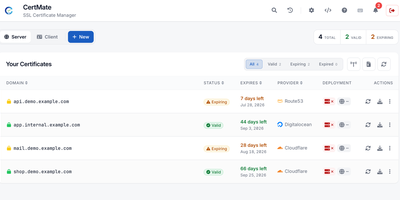
Certificate lifetimes are collapsing toward 47 days, which turns TLS from a yearly chore into a weekly one, and CertMate is the control plane that makes that schedule boring. It issues and renews certificates from Let's Encrypt, ZeroSSL, Google Trust Services, Actalis, DigiCert, SSL.com, Sectigo, or your own private CA, validating by DNS-01 through 29 DNS providers, HTTP-01, or a CSR whose private key never leaves the device. Renewals run automatically, earlier when a certificate's life is short or the CA moves the date through ARI, and deploy hooks push each renewed certificate where it is actually served, then probe the live endpoint to prove the new certificate answers. Discovery watches hosts and certificate transparency logs for certificates you did not issue, folding them into one inventory of what is served where and when it expires. Certificates rest on local disk or in Azure Key Vault, AWS Secrets Manager, HashiCorp Vault, Infisical, or S3 storage, with encrypted backups copied off-site. Its built-in CA issues client certificates for mTLS with OCSP and CRL, and can serve ACME itself, so certbot, lego, acme.sh, and cert-manager get internal certificates under EAB rules you define. Every action lands in a tamper-evident, hash-chained audit trail you can export and verify independently. Running on a dedicated VPS on RepoCloud with guaranteed CPU, RAM, and SSD, full root SSH access, and a browser serial console. MIT licensed.
Zitadel
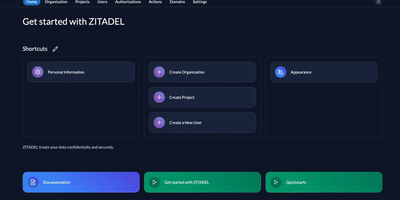
Securing a SaaS product, running B2B onboarding, or replacing Auth0 and Keycloak with a stack they own - teams needing more than basic auth reach for ZITADEL, an open-source identity and access management platform built in Go. Its multi-tenancy model is the differentiator: a strict Instance, Organization, Project hierarchy isolates data and scopes policy at each level, with identity brokering (pre-built templates for Google, GitHub, Microsoft, Apple, plus generic OIDC, OAuth, SAML, and LDAP), domain discovery that routes users to the right organization by email domain, and delegated management so customers administer their own users and roles. Authentication covers OpenID Connect (certified, including device authorization and token exchange), SAML 2.0 as both IdP and SP, SCIM, FIDO2 passkeys for phishing-resistant passwordless login, and MFA via OTP, email, SMS, and U2F; machine-to-machine flows support JWT profile, PATs, and client credentials. The architecture is event-sourced - every mutation is an immutable event, yielding a complete audit trail - with relational projections for queries and no external session store, so it scales horizontally. API-first with gRPC and REST, extensible via Actions webhooks, and the same codebase self-hosted (Docker Compose or Helm on PostgreSQL) as in the cloud.
Xalgorix
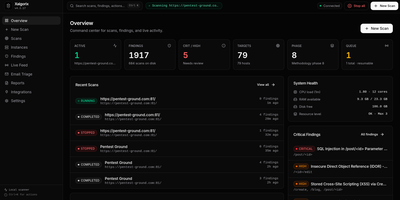
Xalgorix delivers AI-driven penetration testing that proves vulnerabilities exist rather than guessing, pairing an autonomous LLM agent with an independent exploit verifier that re-exploits every finding before it reaches your report. The 22-phase methodology mirrors how a skilled human pentester works through an engagement, covering reconnaissance, subdomain enumeration, port scanning, web crawling, parameter fuzzing, SQL injection testing, XSS detection, authentication bypass, API testing, and more. Select all phases or pick specific ones per target. The platform ships with 85+ offensive security tools preinstalled (nmap, nuclei, httpx, subfinder, katana, ffuf, gobuster, sqlmap, masscan, dalfox, feroxbuster) plus 14 built-in agent tools for browser automation, terminal execution, and note-taking. Connect your own LLM provider (OpenAI, Anthropic, DeepSeek, Gemini, Groq, Ollama, or MiniMax) so no scan data or target information leaves your infrastructure. The web dashboard on port 9137 provides live WebSocket telemetry showing tool calls, agent reasoning, and findings as scans progress. A findings index with CVSS scoring and severity filters organizes results, and branded PDF reports include your company name and logo. Wildcard and multi-target scans handle red team attack-surface mapping, while source-code scanning audits repositories directly without requiring a deployed target. A REST API enables scripted scans and SIEM pipeline integration, and webhooks push notifications to Discord or Telegram. Running on a dedicated VPS on RepoCloud with guaranteed CPU, RAM, and SSD, full root SSH access, and a browser serial console. Apache 2.0 licensed.
Blocky UI
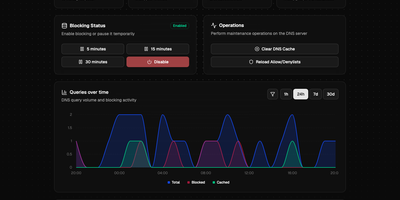
BlockyUI gives your Blocky DNS server a clean browser dashboard for seeing what gets queried, what gets blocked, and how quickly answers come back. Overview cards show total queries, blocked requests, cache hit rate, listed domains, and average response time. Pause blocking for 5, 15, or 30 minutes with one click, or disable it outright, then let it return on its own. Clear the DNS cache and reload allow and deny lists without touching the command line. A queries over time chart switches between 1 hour, 24 hours, 7 days, and 30 days, with filters for a single domain or client. Paginated top lists rank the busiest domains and devices and offer a blocked-only view. The query tool tests how any domain resolves, so a new filtering rule can be checked in seconds. Query logs are searchable and filterable by reason and record type, and they read from MySQL, PostgreSQL, Timescale, SQLite, CSV, or VictoriaLogs. Panels that depend on logging or statistics appear when your Blocky instance supports them, and the dashboard adapts otherwise. Settings live in one YAML file that points at your Blocky server. Running on a dedicated VPS on RepoCloud with guaranteed CPU, RAM, and SSD, full root SSH access, and a browser serial console. MIT licensed.
SpiderFoot
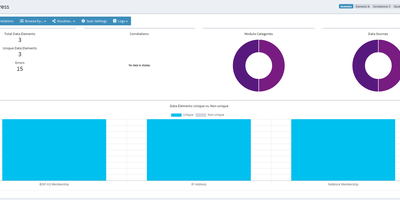
SpiderFoot is an open-source OSINT automation platform, replacing hours of manual reconnaissance with automated intelligence gathering across more than 200 data collection modules. The platform accepts ten distinct target types including IP addresses, domains, hostnames, network subnets, ASNs, email addresses, phone numbers, usernames, person names, and Bitcoin addresses, then feeds them through a publisher-subscriber event bus where each module's findings trigger downstream analysis automatically. SpiderFoot queries Shodan, VirusTotal, HaveIBeenPwned, AlienVault OTX, Censys, crt.sh, WHOIS databases, social media platforms, breach databases, and dozens more sources, with most modules requiring no API keys and many offering free tiers for those that do. The YAML-configurable correlation engine applies 37 pre-defined rules to identify relationships between discovered data points, flagging patterns like shared infrastructure, credential exposure, and domain reputation anomalies. Results export in CSV, JSON, and GEXF graph formats for integration with external analysis tools. TOR integration enables dark web searching, and SpiderFoot can invoke external tools including DNSTwist, Whatweb, Nmap, and CMSeeK for deeper technical assessment. The embedded web server delivers an intuitive dashboard for scan management, data visualization, and result exploration alongside a full command-line interface for scripted automation. Running on a dedicated VPS on RepoCloud with guaranteed CPU, RAM, and SSD, full root SSH access, and a browser serial console. MIT licensed.
Rauthy
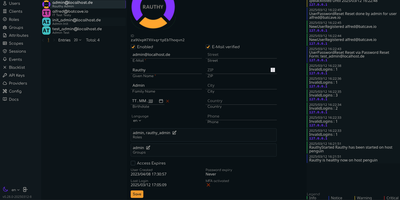
Every self-hosted app asking for its own password is a liability you keep re-creating. Rauthy is a lightweight single sign-on identity provider that gives your whole homelab or organization one secure login through OpenID Connect and OAuth 2, with passkeys at the center instead of passwords. Accounts can be fully passwordless: an email address plus a FIDO2 passkey with user verification, or a password backed by a security key, with magic links and upstream login providers also supported. The admin UI manages users, clients, roles, groups, sessions, API keys, blacklists, and per-client login branding with custom logos and colors, and events stream to email, Matrix, or Slack when something deserves attention. Login endpoints defend themselves with brute-force and credential-stuffing detection, automatic IP blacklisting, rate limiting, and optional geolocation blocking. Beyond web apps, a PAM and NSS module extends the same identities to Linux workstations and SSH logins with ephemeral passwords or public keys, and the OAuth device flow covers headless and IoT devices. It runs as a single efficient service on embedded Hiqlite or Postgres, clusters for high availability, needs only tens of megabytes of memory, and has passed an independent security audit. Dynamic client registration, SCIM provisioning, and DPoP tokens cover modern decentralized login flows. Running on a dedicated VPS on RepoCloud with guaranteed CPU, RAM, and SSD, full root SSH access, and a browser serial console. Apache-2.0 licensed.
AnonAddy
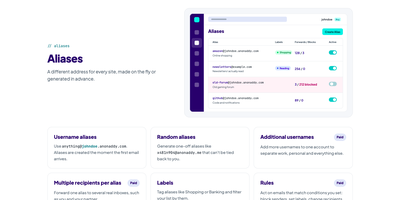
Give every website its own email address and your real inbox stays yours alone with AnonAddy, a private email forwarding service where [email protected] and [email protected] land in one inbox and hide the real address behind them. Create aliases on the fly from your username, generate random character or random word aliases that cannot be linked back to you, and label each one so you know exactly which site handed it out. When an alias starts attracting spam, deactivate it to silently discard mail or delete it so senders get a bounce, and the rest of your addresses keep working untouched. Reply to forwarded mail or start new conversations from the alias itself, so recipients never learn your real address. Attach your own domain or subdomain with MX records and make any address on it, add GPG or OpenPGP encryption so forwarded mail arrives encrypted, and strip tracking pixels before messages reach your client. Rules act on matching mail by blocking senders, changing recipients, rewriting subjects, or firing webhooks, and a REST API plus browser extension and Bitwarden integration create aliases right where you sign up. Running on a dedicated VPS on RepoCloud with guaranteed CPU, RAM, and SSD, full root SSH access, and a browser serial console. AGPL-3.0 licensed.
tirreno
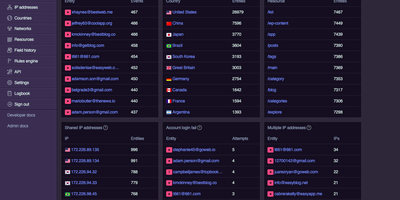
tirreno watches what accounts actually do inside your product, then surfaces the ones that look like account takeover, credential stuffing, fake signups, or insider abuse. Your backend reports events such as logins, registrations, page views, searches, email changes, and field edits through an SDK or one HTTP call, and a scheduled job turns them into per-user context: devices, IP addresses, sessions, and connected identities. Preset rules cover account takeover, credential stuffing, content spam, bot detection, multi-accounting, promo abuse, dormant accounts, API protection, and high-risk regions, and you can add rules of your own. Each rule adds to a risk score, and thresholds decide whether a user is flagged for manual review or suspended automatically. The review queue lists who needs a look, and the single user view shows behaviour patterns, risk scores, connected identities, and an activity timeline. A field audit trail records what changed and when, which supports compliance reviews, while the logbook lists every API request the instance received. Your application can ask a blacklist endpoint whether a user or IP should be blocked before it responds. An optional IP enrichment pack adds geolocation, ISP, and VPN or proxy detection. All event data stays on your own server. Running on a dedicated VPS on RepoCloud with guaranteed CPU, RAM, and SSD, full root SSH access, and a browser serial console. AGPL-3.0 licensed.
CaddyUI
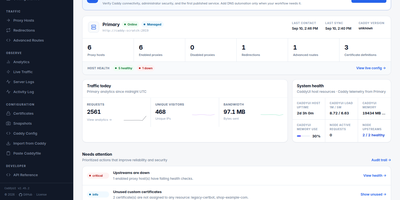
Providing an intuitive control plane for modern reverse proxy infrastructure, CaddyUI enables system administrators to manage proxy hosts, automated TLS certificates, and traffic routing without hand-editing configuration files. Operators can create and adjust reverse proxy destinations, URL path rewrites, custom headers, and redirection rules using structured forms that validate against the proxy engine before saving. The platform coordinates automatic ACME certificate requests and renewals, displaying live certificate expiration timelines, validation stages, and internal self-signed certificate authority options for local network services. Fleet management tools synchronize proxy rules across multiple distributed server instances, preventing configuration drift across staging and production clusters. Automated post-deployment health checks verify upstream endpoint availability, HTTP status codes, and latency thresholds, instantly rolling back to the previous configuration if an expectation fails. An integrated observability suite delivers real-time visitor traffic analytics, geographic maps, HTTP response code breakdowns, and single-click client IP blocking to counter malicious probing attempts. Administrators can schedule automated database backups, configure multi-user access with role permissions, and integrate CrowdSec threat intelligence to protect backends. Running on a dedicated VPS on RepoCloud with guaranteed CPU, RAM, and SSD, full root SSH access, and a browser serial console. Apache 2.0 licensed.

Sealskin
SealSkin is a self-hosted browser isolation platform that runs desktop applications in isolated containers on your server and streams them to any browser or phone, so links, files and downloads open remotely and nothing from the web ever executes on the device in front of you. Right-click a link, send a download, or drop a file from your local browser through the extension, and it opens in a fresh container on the server; close it and nothing is left behind, or keep a persistent home directory for work you return to. The catalog holds more than a hundred applications: browsers, office suites, IDEs, media editors, emulators and 3D tools from LinuxServer.io images, plus any Selkies-compatible image you add, with NVIDIA and DRI3 GPU acceleration for demanding workloads. Files stay on the server behind a file manager with chunked uploads, intercepted downloads, and password-protected public share links. Launch any app into a collaboration room with chat, voice and video, gamepad slots, and hand-over of mouse and keyboard control. Administrators brand the web app, manage users, groups, application keys, VPN profiles, and audit logs, and can route a session out through a WireGuard or OpenVPN exit at launch. Servers cluster with shared users and applications and no master node, and one manifest runs the whole thing on Kubernetes. Running on a dedicated VPS on RepoCloud with guaranteed CPU, RAM, and SSD, full root SSH access, and a browser serial console. MPL-2.0 licensed.
JumpServer
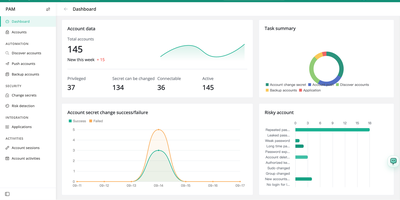
Every server login, database query, and remote desktop session passes through one audited front door instead of scattered SSH keys and shared passwords. Administrators register assets like Linux hosts, Windows machines, databases, clouds, and websites, store the accounts for each, and grant people access through authorization rules. Users open a web terminal or connect with a native client to reach SSH, SFTP, RDP, VNC, database, and Kubernetes targets, with an AI assistant that can describe tasks and run commands in the terminal. Every session is recorded for replay, commands are logged, file transfers are tracked, and auditors can watch live sessions or cut them off. Access control lists filter commands, limit source addresses, and restrict time windows, and multi-factor authentication and LDAP or Active Directory sign-in protect the front door. Automation jobs discover accounts on assets, push new ones, rotate secrets on a schedule, and back up credentials, with a risk dashboard that flags weak, repeated, or stale passwords. Community Edition covers up to 5,000 assets. Running on a dedicated VPS on RepoCloud with guaranteed CPU, RAM, and SSD, full root SSH access, and a browser serial console. GPL-3.0 licensed.
GoAccess
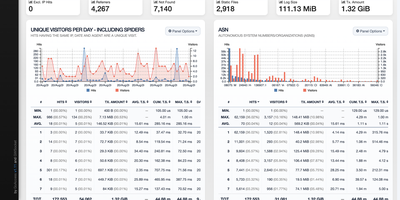
GoAccess processes millions of web log entries in seconds and renders the results as interactive dashboards that update every 200 milliseconds in the terminal or every second via WebSocket-connected HTML reports. Written entirely in C with only ncurses as a dependency, it achieves exceptional performance even on resource-constrained servers, reducing memory usage by approximately 20% and parsing time by 35% in recent releases through optimized in-memory hash tables with on-disk persistence support. The analyzer parses virtually every web log format out of the box (Apache Combined and Common, Nginx, Amazon CloudFront, Amazon S3, AWS Elastic Load Balancing, Google Cloud Storage, Squid, W3C IIS, Caddy JSON, and Traefik) while supporting fully custom log format strings for non-standard configurations. The self-contained HTML dashboard displays 15+ interactive panels covering unique visitors, requested files, static files, 404 errors, referring sites, search keyphrases, geographic location with city-level GeoIP resolution, operating systems, browsers, HTTP status codes, time distribution, and virtual host metrics. WebSocket authentication via JWT provides secure remote access, and incremental log processing ensures data continuity across daemon restarts. Docker deployment requires a single command with volume-mapped access logs. Over 20,800 stars with active development since 2010. Running on a dedicated VPS on RepoCloud with guaranteed CPU, RAM, and SSD, full root SSH access, and a browser serial console. MIT licensed.