OrcaRouter Lite
Every prompt your application sends is a small buying decision, and OrcaRouter Lite makes it a smart one instead of a habit. Point your app at one OpenAI-compatible endpoint on your server, and each request is shopped across the providers whose keys you hold: OpenAI, Anthropic, Google, xAI, DeepSeek, and dozens more. Send model set to auto and the router picks the cheapest model that can actually do the job, checking whether the request needs tools, vision, or JSON mode before it commits your money. Prefer a different tradeoff and you can switch the whole gateway between balanced, cheapest, fastest, and quality strategies, with quality picks driven by real benchmark scores rather than vibes. Clients that speak Anthropic's or Gemini's native protocols connect directly too, so Claude Code, the OpenAI SDK, and google-genai all land on the same routing pipeline. Streaming responses flow through untouched, and every answer reports which model really served it. The built-in dashboard shows recent requests, spend, latency percentiles, unreachable providers, and a savings tile that tells you what your traffic would have cost if you had blindly used a flagship model for everything. Your provider keys stay encrypted on your own box, your analytics never leave it, and if every local provider has a bad day, the hosted OrcaRouter can step in as a failover safety net. Running on a dedicated VPS on RepoCloud with guaranteed CPU, RAM, and SSD, full root SSH access, and a browser serial console. MIT licensed.

OpenSERP
Search the web from your own server, with no API key and no per-query bill: OpenSERP is a self-hosted search API that returns structured results from Google, Bing, Yandex, Baidu, DuckDuckGo, and Ecosia through one interface. Every answer arrives as ranked JSON with titles, URLs, snippets, source engines, and timing, ready for an agent, a RAG pipeline, or an SEO tracker to consume. A mega search aggregates and deduplicates across engines in a single call, image search does the same for pictures, and an extract mode reads linked pages back as clean Markdown for models to cite. AI agents connect over MCP with tools for search, mega search, fast search, image search, and batch extraction, and it is a built-in web search provider in Open WebUI. Developers get Python and TypeScript SDKs, an n8n node, a full OpenAPI reference, and a CLI that runs the same searches from a terminal. Engines load in a real browser session, proxy support routes traffic through HTTP or SOCKS5, and one Docker command serves everything on port 7000. Running on a dedicated VPS on RepoCloud with guaranteed CPU, RAM, and SSD, full root SSH access, and a browser serial console. MIT licensed.
DevDocs
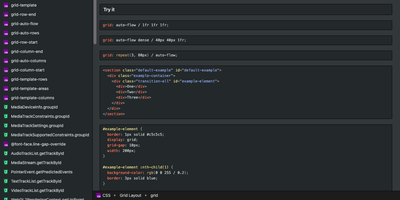
A half-remembered name like bgcp is enough for DevDocs to find background-clip in the reference documentation of hundreds of languages, frameworks, and tools. Search is fuzzy and instant. Type a project name or alias such as js or py, press Tab, and results narrow to that single reference. Share a link like #q=js date or add DevDocs to the browser address bar through OpenSearch. The catalog holds 247 documentations in 844 versions, including JavaScript, CSS, Python, PostgreSQL, Rust, Terraform, and Kubernetes. Enable only the versions your stack uses to keep the sidebar short and search results focused. The Offline page installs enabled documentation for use without a connection and lists every download's size. Export the whole set as a file and import it on another computer. Keyboard shortcuts move through the sidebar, open or copy the original page, and send a query to Google, Stack Overflow, or DuckDuckGo. Preferences offer automatic, light, and dark themes, custom fonts, fixed-width or justified layouts, and a custom CSS box. A mobile layout and installable web app keep references within reach on a phone. A shared instance gives a team or classroom one address for the same references, and the official build refreshes its documentation every month. Running on a dedicated VPS on RepoCloud with guaranteed CPU, RAM, and SSD, full root SSH access, and a browser serial console. MPL-2.0 licensed.
Lemonade
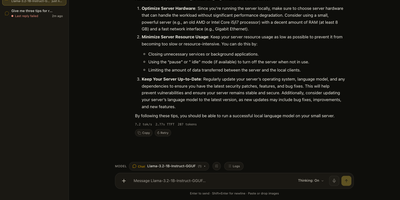
Squeeze a full AI stack out of one lightweight server and point every app you own at it. Lemonade serves chat, coding, speech, transcription, and image models over OpenAI, Anthropic, and Ollama style APIs, so existing editors, agents, and automation tools connect without code changes. Open port 13305 in a browser and the bundled web app takes over: a chat view with conversation history, a Model Manager that pulls GGUF and ONNX files from Hugging Face or ModelScope, and an Apps marketplace linking tools like Open WebUI, AnythingLLM, and Claude Code. Each modality has its own backend to install or remove from a Backends page, covering text, Whisper transcription, Kokoro speech, and Stable Diffusion images. A Monitor section charts tokens per second, parallel slots, memory, and recent inference runs. The command line pulls models, sets aliases for instant failover between model versions, and launches coding agents. Built-in tools and an MCP gateway let chats manage the server itself, and an experimental cloud offload routes selected requests to OpenAI compatible providers. Set an API key before opening the port to a network. Running on a dedicated VPS on RepoCloud with guaranteed CPU, RAM, and SSD, full root SSH access, and a browser serial console. Apache-2.0 licensed.
Relay Pulse
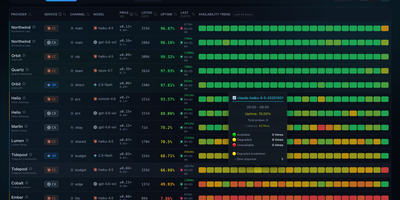
An API relay that answers HTTP 200 with an empty reply is not alive, and Relay Pulse exists to catch exactly that. Every minute, or any interval you set, it sends a tiny real request to each relay, asks a simple arithmetic question, and counts the probe as healthy only when the right answer comes back. Results land in a color-coded availability matrix where green, yellow, and red blocks show good, slow, and failed checks across the last 90 minutes, 24 hours, 7 days, or 30 days. Each row lists provider, service type, channel, model, price multiplier, days listed, uptime percentage, and the latest latency, and hovering a block reveals its probe counts and a breakdown of why it degraded. Filters narrow the table by category, provider, service, channel, vendor, or model, and the page switches between table and card views, four themes, and English or Chinese. Sponsor levels can pin trusted channels to the top, hot and cold boards separate active relays from dormant ones, and Telegram or QQ bots push status changes. Configuration reloads without a restart, templates cover Claude, Codex, and Gemini style endpoints, and a JSON API exposes current status. Running on a dedicated VPS on RepoCloud with guaranteed CPU, RAM, and SSD, full root SSH access, and a browser serial console. MIT licensed.
Documenso
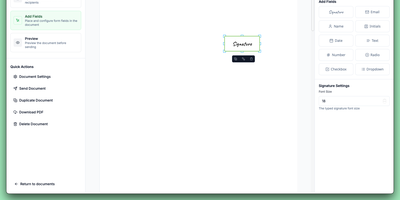
With over 14,000 GitHub stars and a mission to become the world's most trusted document-signing tool, Documenso delivers a beautifully designed electronic signature platform that organizations can self-host for complete data sovereignty. The signing workflow handles everything from simple one-party signatures to complex multi-recipient documents with configurable roles including signers, approvers, viewers, and CC recipients, each with distinct permissions and notification flows. Document templates enable reusable signing packages with pre-configured fields and recipient patterns, eliminating repetitive setup for contracts, NDAs, and onboarding documents that teams process regularly. The PAdES-standard implementation ensures digital signatures are legally compliant and cryptographically verifiable, with complete audit trails documenting every action from document creation through final signature. Direct link signing allows recipients to access documents without email, enabling embedded signing experiences within existing applications and websites. The REST API provides programmatic document creation, recipient management, and webhook notifications for integrating signature workflows into CRM systems, HR platforms, and custom business applications. Team management features organize users into groups with role-based permissions, custom branding per team, and centralized billing for organizations with multiple signing workflows. SSO integration supports standard authentication providers for enterprise identity management. The TypeScript codebase built on Next.js and Prisma with PostgreSQL makes customization and contribution accessible to modern web developers. Zapier integration connects Documenso to thousands of third-party applications for automated document routing. Deploy on a dedicated VPS on RepoCloud with guaranteed CPU, RAM, and SSD, full root SSH access, and a browser serial console. AGPL-3.0 licensed.
CLIProxyAPI
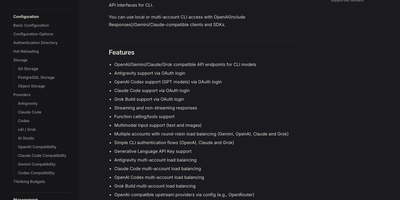
CLIProxyAPI turns AI coding subscriptions you already hold into one standard API endpoint that any OpenAI, Gemini, or Claude compatible client can call. Connect Codex, Claude Code, Grok Build, and Gemini accounts through simple OAuth sign in flows, then point your editor, agent, or script at a single base URL instead of juggling separate tools. Add several accounts per provider and the proxy spreads requests across them with round robin load balancing, so a busy team can pool capacity instead of pressing against one account's limits. Streaming, non streaming, and WebSocket responses are supported where the provider allows them, which keeps interactive coding sessions responsive. Function calling and tool use pass through, so agents can still run commands, edit files, and call external tools through the unified endpoint. Multimodal requests combine text and images, covering screenshot driven debugging and visual questions. Gemini API keys, AI Studio accounts, and hosted Gemini access sit alongside subscription accounts, and OpenAI compatible upstreams such as OpenRouter can be added in configuration. A management API exposes control endpoints for companion dashboards, while a reusable Go SDK lets developers embed the proxy inside their own services. Running on a dedicated VPS on RepoCloud with guaranteed CPU, RAM, and SSD, full root SSH access, and a browser serial console. MIT licensed.
Oh My CPA
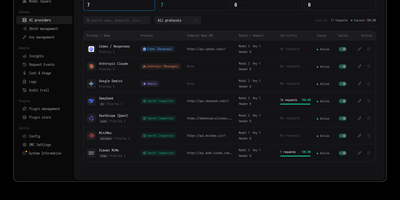
Oh My CPA gives a CLIProxyAPI gateway a proper control room, where providers, OAuth credentials, client keys, model routing, and the cost of every request are managed and watched from one self-hosted console. You add providers such as Codex, Claude, Gemini, xAI, DeepSeek, Vertex AI, and OpenAI-compatible services, each with credentials, retry and error policies, priority, weight, and an enable switch the gateway actually enforces. OAuth accounts are signed in from the console, with quota window readings, refresh schedules, and per-credential model aliases kept next to the keys they belong to. Client keys can be created, named, and revoked, and those names follow the traffic into request records and filters so you always know which key spent what. The dashboard follows request volume, token throughput, cache hit rate, and cost from the last fifteen minutes out to ninety days, with a year-long token heatmap for the long view. Insights compare keys, models, providers, and credentials against the previous period, while the live routing view shows which credential each request travelled to and whether it was rerouted. Every request stays searchable, with duration, time to first token, token breakdown, and the raw log in a detail drawer. A playground tests any routed model with text and images before your users do. Running on a dedicated VPS on RepoCloud with guaranteed CPU, RAM, and SSD, full root SSH access, and a browser serial console. MIT licensed.
LocalAI
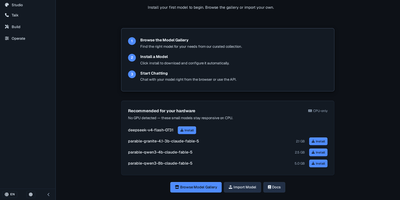
With over 48,000 GitHub stars and monthly releases since March 2023, LocalAI is the self-hosted AI engine that replaces every OpenAI endpoint with a single Docker container running on your own infrastructure — serving chat completions, image generation, text-to-speech, speech-to-text, embeddings, vision, video generation, and function calling through identical API schemas that require zero application code changes. The composable backend architecture isolates each inference engine as a separate gRPC service running in its own OCI container, so llama.cpp, vLLM, SGLang, transformers, whisper.cpp, diffusers, MLX, Stable Diffusion, and Flux install on demand without touching the core, can run on separate machines, and a fault in one never affects others. Hardware acceleration spans NVIDIA CUDA 12 and 13, AMD ROCm, Intel oneAPI/SYCL, Apple Silicon Metal, Vulkan, and NVIDIA Jetson L4T — or runs entirely on CPU without any GPU. Built-in AI agents support autonomous tool use, retrieval-augmented generation, Model Context Protocol integration, and skill-based workflows directly in the web interface. The model gallery provides curated YAML configuration files for hundreds of models that install with a single command, while P2P federated inference distributes model shards across multiple machines for running models larger than any single node's memory. Multi-user API key authentication with quotas and role-based access enables team deployments. Running on a dedicated VPS on RepoCloud with guaranteed CPU, RAM, and SSD, full root SSH access, and a browser serial console. MIT licensed.
FreeLLMAPI
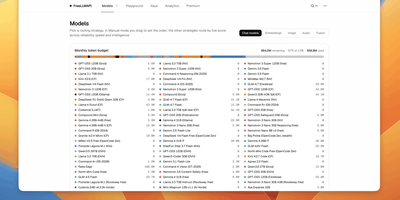
FreeLLMAPI collapses the chaos of 29 free LLM providers — Google AI, Cerebras, Groq, Mistral, OpenRouter, GitHub Models, Cohere, Cloudflare Workers AI, NVIDIA NIM, HuggingFace, SiliconFlow, Reka, Z.ai, and more — into a single /v1 endpoint that speaks both OpenAI and Anthropic protocols. The smart router selects the best available model for each request, automatically fails over to the next provider when rate limits hit, and tracks per-key token consumption so you never exceed a free-tier cap. Keys are stored with AES-256-GCM encryption and clients authenticate using a single unified bearer token, never exposing upstream provider credentials to downstream applications. The catalog tracks 251 model families across 358 provider/model endpoints with approximately 4 billion tokens per month of aggregate free-tier capacity, auto-refreshing from a signed manifest at freellmapi.co twice daily without requiring git pulls. Beyond chat completions, the proxy handles embedding, image generation, and audio/TTS endpoints, plus structured outputs with JSON schema forwarding, JSON healing, and format-ignore failover. An integrated MCP server at /mcp provides gateway introspection for coding agents, while the self-hosted OpenAPI reference at /v1/docs documents every route. Compatible with OpenAI SDKs, LangChain, LlamaIndex, Continue, Claude Code, and Hermes — just change base_url. Deploy via Docker, npm, or build from source. Running on a dedicated VPS on RepoCloud with guaranteed CPU, RAM, and SSD, full root SSH access, and a browser serial console. MIT licensed.
Squidex
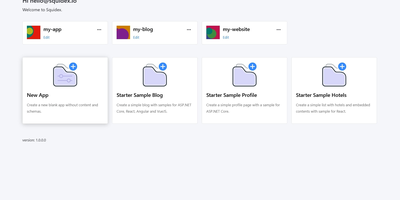
The front end should never dictate how your content is shaped. Squidex is an open-source headless CMS that stores content once and delivers it to any website, app, or service through REST, OData, and GraphQL APIs, so teams design schemas around their domain instead of around a theme. Editors work in a clean management UI: define schemas with validation and localisation, write content with references and components, manage images and files with resizing built in, and move drafts through custom workflows that say who creates, reviews, and publishes. Nothing waits on a developer for routine changes, and nothing ships unreviewed in organisations that need approval chains. Rules react to every content event, pushing fresh posts to syndication partners, notifying search indexes, invalidating caches, or calling your own webhooks; backups, versioning with diff-style history, and role-based permissions keep an auditable operation. Multiple projects live in one installation, clients authenticate API consumers, and content plugs into static-site generators, storefronts, and mobile apps from one hub. Because you run it yourself, the database options span MongoDB and several SQL servers, and the API your applications depend on answers from infrastructure you control with no per-seat tax on editors. Running on a dedicated VPS on RepoCloud with guaranteed CPU, RAM, and SSD, full root SSH access, and a browser serial console. MIT licensed.
Microcks
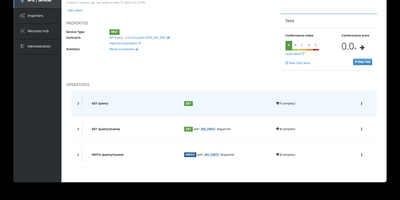
Microcks turns your API specifications into living mocks and contract tests, so teams can develop and verify against an API long before the real implementation exists. Feed it OpenAPI, AsyncAPI, GraphQL schemas, gRPC Protobuf files, Postman collections, or SoapUI projects, and it immediately publishes mock endpoints that answer with realistic examples drawn from the specification itself. Dispatching rules route requests by path, query parameters, headers, body content, or XPath and Groovy expressions, while content negotiation and templating functions shape each response to look convincingly real. Event-driven APIs get the same treatment, with AsyncAPI mocks that publish messages to Kafka topics or WebSocket channels your consumers can subscribe to during development. When an implementation shows up, contract tests replay the recorded expectations against the live service and report every mismatch, down to the exact request and response that failed. Run those tests from the web interface, on a schedule, or from CI pipelines with the command-line client, and wire importers to rescan your Git repositories so new specification versions appear as mocks automatically. The built-in hub adds one-click samples and reusable API packages, giving a new team a stocked repository of mockable services within minutes of the first login. Running on a dedicated VPS on RepoCloud with guaranteed CPU, RAM, and SSD, full root SSH access, and a browser serial console. Apache-2.0 licensed.
APITable
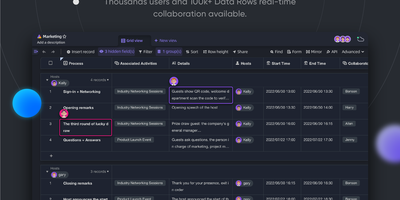
With over 15,000 GitHub stars and positioning itself as the most feature-complete open-source alternative to Airtable, APITable combines a buttery-smooth spreadsheet interface with a full database engine and automatic API generation that turns every datasheet into a queryable REST endpoint without writing a single line of backend code. Real-time collaborative editing powered by Operational Transformation algorithms supports 100,000+ rows with multiple simultaneous users, while seven built-in view types — Grid, Kanban, Gallery, Gantt chart, Calendar, Mindmap, and Form — let teams visualize the same data in whatever format suits their workflow. The one-click API panel exposes every table as a documented REST API with filtering, sorting, and pagination, effectively functioning as a backend-as-a-service for frontend developers and automation builders. Robot automation triggers workflows on record changes with integrations into n8n, Zapier, Appsmith, and Slack, while the extensible widget system provides 20+ open-source widgets for custom charts, dashboards, and data visualizations embedded directly into datasheets. Enterprise features include SAML single sign-on, field-level and row-level permissions via Mirrors, organizational team management, audit logging, database auto-backup, and data export. Bi-directional table linking with infinite cross-links creates relational data models across workspaces, and built-in templates cover CRM, project management, inventory, and content planning. Running on a dedicated VPS on RepoCloud with guaranteed CPU, RAM, and SSD, full root SSH access, and a browser serial console. AGPL-3.0 licensed.
mitmproxy
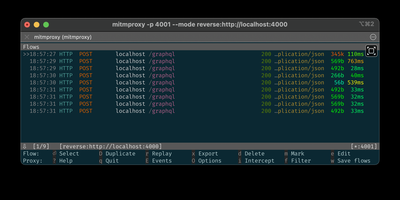
A man-in-the-middle proxy you run on purpose, mitmproxy lets developers and testers inspect, edit, and replay HTTP and HTTPS traffic from any client. Point a browser, phone, or script at it and every HTTP/1, HTTP/2, HTTP/3, WebSocket, and TLS-protected connection appears as a flow you can open, search, and filter. Content views turn payloads from HTML to Protobuf into readable text. Intercept a request or response before it moves on, change its headers, body, or status by hand, then release it, or save the flow and replay it to the client or the server later. Map local and map remote rules answer requests with files or other URLs, while blocklists, anticache, sticky cookies, and proxy authentication cover routine test chores. Choose the interface that fits the job: a keyboard-driven terminal console, mitmweb in the browser with a Capture tab that sets up WireGuard devices with a QR code, or mitmdump for unattended logging in scripts. Proxy modes include regular, local capture, WireGuard, transparent, reverse, upstream, SOCKS5, and DNS. Addons written in Python add custom rewriting, recording, and automation. Teams use it for debugging, testing, privacy measurements, and penetration testing. Running on a dedicated VPS on RepoCloud with guaranteed CPU, RAM, and SSD, full root SSH access, and a browser serial console. MIT licensed.
Traduora
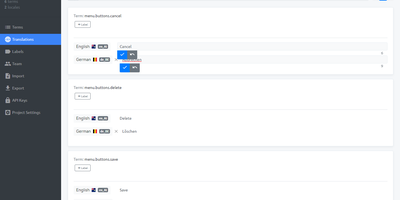
Teams that ship one app in many languages keep every string, translator, and reviewer in a single workspace by hosting their own Traduora translation management platform. Developers import the files they already have: JSON, YAML, PO, XLIFF, CSV, Android XML, iOS Strings, Java properties, PHP array, or RESX. Each string becomes a term that can carry a context note and colored labels. A search bar and a label filter narrow long lists in seconds. Translators open a locale and type inline beside a reference language, with per-locale progress showing how much is finished and a toggle that hides what is already done. Colleagues join by email invitation as admins, editors, or viewers, with optional Google sign-in. Build pipelines get their own API clients, each with a role, to fetch and push translations over a REST API. Exports go back out in whichever format each platform wants, with fallback-locale and untranslated-key options. Mobile and web teams can keep iOS, Android, and website copy in sync from a single source of truth. Running on a dedicated VPS on RepoCloud with guaranteed CPU, RAM, and SSD, full root SSH access, and a browser serial console. AGPL-3.0 licensed.
Mesh LLM
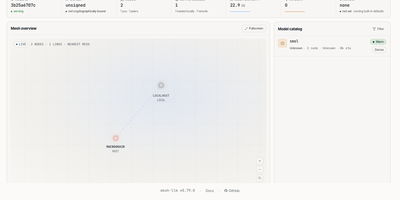
Spare GPUs and memory scattered across many machines become one OpenAI-compatible API for running open models on hardware you already own. Mesh LLM merges a home lab, an office, or a group of friends into a single pool, so existing chat apps and coding agents work unchanged. Start a node, add more later, and the mesh chooses between running a model locally, routing to a peer, or splitting it across several machines when it is too large for one box. Requests are routed by the model name, a virtual model called mesh picks a compatible one for you, and traffic between nodes travels over encrypted QUIC. Private meshes join by invite token and public ones can be discovered, with an API-only client mode for machines that host nothing. A web console shows the node map, model catalog, connected peers, chat with streaming replies, request logs, and a configuration editor. Goose, OpenCode, Claude Code, and Pi launch with one command and use the mesh as their provider, and plugins add extra backends. Releases cover Linux, macOS, and Windows with CPU, CUDA, ROCm, Vulkan, and Metal runtimes, and a headless flag keeps servers tidy. Running on a dedicated VPS on RepoCloud with guaranteed CPU, RAM, and SSD, full root SSH access, and a browser serial console. Apache-2.0 licensed.
CCX
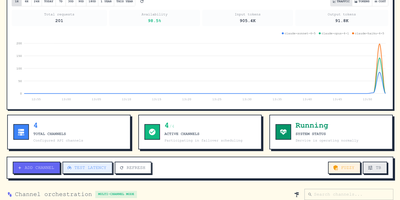
CCX gives every coding agent and chat client one stable address, and the real model providers can come and go behind it. Point Claude Code, Codex, or any SDK at the gateway and it forwards requests to the first healthy channel in a failover sequence, then moves down the list when an upstream returns errors. Each channel carries its own keys, model allowlist, proxy, and custom headers, and the Add Channel dialog detects a base URL and keys from pasted text. The admin console tracks requests, availability, tokens, and cost over ranges from one hour to a year, with a chart per model and a live success rate beside each channel. Drag a channel to change its priority, park it in the standby pool, or open its log to see the status, timing, and key of every call. Separate tabs cover Claude Messages, OpenAI Chat, Images, Vectors, Codex, and Gemini, and a dark theme and language switch are built in. Access is guarded by a proxy key and an optional admin key. Running on a dedicated VPS on RepoCloud with guaranteed CPU, RAM, and SSD, full root SSH access, and a browser serial console. MIT licensed.
Xinference
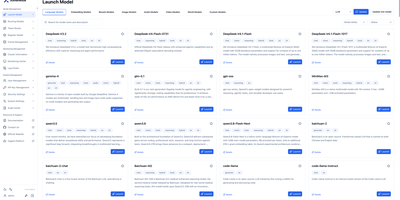
Xinference lets a team swap a hosted model API for models running on its own machines, with the same client code and a web console for managing them. The Launch Model page lists 300+ models across language, vision, embeddings, reranking, images, audio, video, and experimental world generation, and a Recommend configuration button fills in engine, size, format, and quantization for your hardware. Custom models, including traditional machine learning models, can be registered beside the built-in ones. Chat models can run on vLLM, SGLang, TRT-LLM, Transformers, llama.cpp, or MLX across CPUs, GPUs, and Apple Silicon. Workers and replicas can be added to serve one large model across several machines. Running Models shows each replica and a built-in chat window, and Performance Tests measure throughput and latency at several concurrency levels, with saved runs to compare. Endpoints speak the OpenAI and Anthropic protocols with streaming and tool calling where a model supports it. API keys, user management, and an audit center cover access control. The interface is available in five languages. Running on a dedicated VPS on RepoCloud with guaranteed CPU, RAM, and SSD, full root SSH access, and a browser serial console. Apache 2.0 licensed.