MiroTalk WebRTC
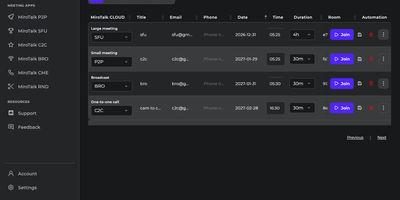
MiroTalk WebRTC is the front desk for your own video meeting platform, where users register, schedule rooms across your MiroTalk servers, and invite guests by email or link. Each account gets a personal dashboard of upcoming, recurring, and past meetings, with room links ready to copy the moment a call needs to happen. Scheduling works for the whole MiroTalk family, SFU group calls, P2P chats, and broadcast or direct-call rooms, so one calendar front door serves every meeting style you run. Invitations travel by email or plain shareable links, and guests join from any modern browser with no account and no downloads. Turn on SaaS mode and the same platform sells access, with monthly, annual, and lifetime plans handled by Stripe checkout and webhooks while free mode stays completely open. A documented REST API lets your own systems create rooms and manage users, and the official Docker image with MongoDB gets the whole front desk online in minutes. Running on a dedicated VPS on RepoCloud with guaranteed CPU, RAM, and SSD, full root SSH access, and a browser serial console. AGPL-3.0 licensed.

Clu Comics
Comic Library Utilities (CLU) is a self-hosted comic library manager that converts, repairs, tags, downloads, and reads your entire comic collection from one web interface. Convert whole folders or libraries from CBR to CBZ in bulk, turn PDFs into CBZ with JPEG or WebP output, and rename thousands of files to one consistent pattern without touching a terminal. Open any CBZ in the browser editor to reorder pages, add or delete images, crop covers, split merged multi issue archives, and adjust contrast and brightness issue by issue. Write ComicInfo.xml from Metron, ComicVine, Grand Comics Database, AniList, MangaDex, MangaUpdates, or Bedetheque, then bulk apply tags across a directory with review before saving and a history log that can revert any change. Browse your library by publisher, series, or folder, read page by page in the built in reader that remembers your place, and follow weekly release calendars with a pull list and Wanted tracker for issues you do not own yet. Download new issues from Direct Download sources, Usenet through Newznab indexers with SABnzbd or NZBGet, and DC++, while folder monitoring unpacks, converts, renames, and files new arrivals automatically. Add Reader, Clerk, and Store Owner accounts with per folder permissions, publish OPDS feeds for reader apps, and sync reading history with Komga. Running on a dedicated VPS on RepoCloud with guaranteed CPU, RAM, and SSD, full root SSH access, and a browser serial console. GPL-3.0 licensed.
LinguaCafe
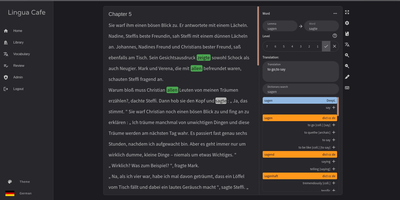
LinguaCafe turns your own reading material, novels, news sites, ebooks, and video subtitles, into a private language tutor that lives entirely on your server. Import a text and every word starts out highlighted as new; as you read and mark words known, the highlighting thins out until whole pages sit clean. When an unknown word stops you, the built-in vocabulary search shows its dictionary form, so inflected verbs surface as their infinitive and nouns carry their gender, while optional DeepL translation covers anything the dictionaries miss. Marking a word adds it to your vocabulary, and multi-word selections become phrases that stay highlighted everywhere they appear again. Chapters track how many new, highlighted, and known words they contain, which makes judging a text's difficulty a glance instead of a guess. The review system cycles highlighted words through Leitner-style spaced repetition, and anything you collect can be exported or pushed straight into Anki through AnkiConnect for study on your phone. Japanese learners get kanji and radical breakdowns beside the reading pane. Everything stays local: your books, your words, and your progress never leave the machine. Running on a dedicated VPS on RepoCloud with guaranteed CPU, RAM, and SSD, full root SSH access, and a browser serial console. GPL-3.0 licensed.
CHMonitor
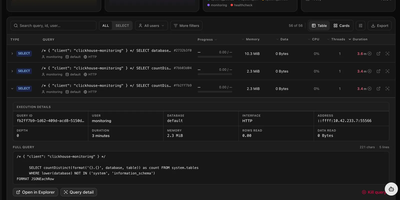
When a ClickHouse cluster slows down, the answers are buried in system tables nobody wants to query by hand; CHMonitor turns those tables into an operations dashboard that explains what the cluster is doing and what to fix next. Live views cover running queries with elapsed time, memory, and a kill action, while history, failed, slowest, and most-expensive pages rank finished work by CPU, duration, and rows read, each with the full statement and one-click EXPLAIN. Thread-level analysis shows how a single query parallelized, and per-user summaries reveal which analyst or service is eating the cluster. Beyond queries, you get a merge and part-lifecycle timeline, replication queue and Keeper health, a live topology map of shards and replicas, storage breakdowns by database, table, and part, and a query activity heatmap spanning a year. An AI advisor reviews the workload and recommends skip indexes, projections, PREWHERE clauses, and TTL changes ranked by impact, with an MCP interface and built-in agent for asking questions in plain English; it recommends only and never applies DDL. Threshold-based health checks alert to Slack, Discord, PagerDuty, or Opsgenie, multiple ClickHouse hosts are watched from one dashboard, and a companion terminal UI covers quick checks from the shell. Running on a dedicated VPS on RepoCloud with guaranteed CPU, RAM, and SSD, full root SSH access, and a browser serial console. GPL-3.0 licensed.
Scrob
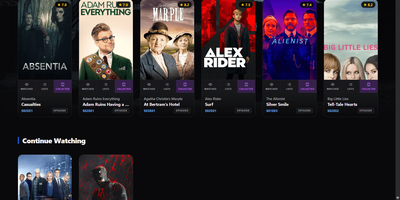
Scrob is your own private Letterboxd and Trakt: it syncs Jellyfin, Plex, and Emby libraries, tracks every movie and episode you watch, and keeps ratings and lists on your server. Connect Jellyfin, Plex, Emby, Nuvio, ARVIO, or Stremio and Scrob imports libraries, watched status, and playback progress, then pushes watched state and ratings back to keep every server aligned. Webhooks from Jellyfin, Plex, and Emby and the scrob-kodi addon mark items watched the moment playback finishes; a manual scrobble starts a live session from any title page. Rate titles on a ten point scale, score seasons separately, add reviews, and log repeat plays with their own dates. Personal lists stay private or open to other users on your instance, comments attach to titles, seasons, and episodes, and following users surfaces their ratings and activity. TMDB powers discovery: trending titles, genre and provider filters, release schedules, and search across people and collections merged with your library. Detail pages combine posters, cast, trailers, and your files' quality details, and one click sends a missing title to Radarr or Sonarr. Continue Watching and Next Up cards, a fifteen day episode calendar, and Pick a Movie or Pick a Show suggestions answer what to watch next. Trakt, Simkl, and MDBList sync moves history and ratings in both directions. Running on a dedicated VPS on RepoCloud with guaranteed CPU, RAM, and SSD, full root SSH access, and a browser serial console. GPL-3.0 licensed.
Cupdate
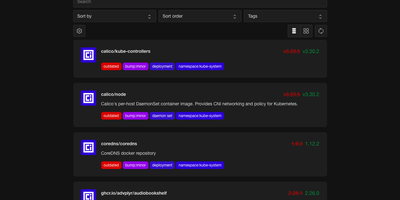
Cupdate keeps a watchful eye on every container image you run, reporting which ones are outdated or vulnerable while deliberately never touching the update button itself. Point it at a Kubernetes cluster, a Docker socket, or Podman hosts (local or remote, one or several) and it inventories every image in use with no configuration to write. Each image is matched against its registry to find the newest available version, and the dashboard shows the gap between what you deployed and what you could be running, with release notes inline so the decision to upgrade takes seconds instead of a changelog hunt. Vulnerability data is layered on top from four sources: Docker Scout for Docker Hub images, Clair for participating Quay images, GitHub Advisories for images tied to repositories, and osv.dev correlation for images shipping SBOMs. A dependency graph explains why each image exists in your stack by showing which workloads pull it, which ends the "can I delete this?" guessing game. Subscribe to the RSS feed to hear about new releases passively, query the REST API to drive scripts that update compose files or kustomizations, or surface outdated and vulnerable counts in a Homepage dashboard widget. Prometheus metrics and traces are available when you want the watcher itself watched. Running on a dedicated VPS on RepoCloud with guaranteed CPU, RAM, and SSD, full root SSH access, and a browser serial console. MIT licensed.

Split Pro
Split Pro settles the question that ruins group dinners, who owes whom, with a private expense ledger that runs on your own server instead of an ad-supported app. Create a group for the apartment, the trip, or the team lunch rotation, then log each shared cost with its category, currency, date, and a photo of the receipt. Every expense splits your way: equally, by percentage, by shares, by exact amounts, or with manual adjustments when someone covered the tip. Rent, utilities, and subscriptions can repeat on a schedule so recurring bills enter the ledger on their own. The balances view shows exactly who is ahead and who owes, and debt simplification collapses a web of small obligations into the fewest possible payments. Negative expenses record refunds and corrections without breaking the math, and the activity feed keeps a visible history of every edit and deletion. Coming from Splitwise, you can import your friends and groups to pick up where you left off, and bank transactions from supported providers convert straight into expenses. On phones it installs as a progressive web app with push notifications whenever a new expense lands. Logins use email magic links, Google, or your own OIDC provider, and signups can be closed so the instance stays limited to your circle. Running on a dedicated VPS on RepoCloud with guaranteed CPU, RAM, and SSD, full root SSH access, and a browser serial console. MIT licensed.
AyakaLeaf Pro
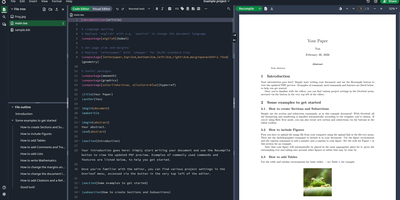
Overleaf locks its best collaboration tools behind a paid server license, and AyakaLeaf Pro is the open-source edition that hands them to your own server instead. You get the familiar online LaTeX editor, with several people typing in the same document at once, but compilation runs in an isolated Docker sandbox with a full TeX Live image, so a runaway document cannot take the service down and compile times are yours to set. Reviewers work the way they do in a word processor: track changes, comment in the review panel, and roll back through full project history with restore and download. Projects stay connected to the rest of your workflow through two-way sync with GitHub, GitLab, Gitea, and Dropbox, a git-bridge for clone, pull, and push, and reference managers through Zotero and Mendeley with searchable bibliography entries. A template gallery lets you publish house styles for your lab or department, the symbol palette inserts math notation in one click, and an AI chat assistant plus a compile-error assistant help inside the editor, while an MCP server lets external AI agents edit and compile too. Administrators get SSO through LDAP, SAML, or OAuth, domain-limited self-registration, and a panel for users and projects. Running on a dedicated VPS on RepoCloud with guaranteed CPU, RAM, and SSD, full root SSH access, and a browser serial console. AGPL-3.0 licensed.
BorgWarehouse
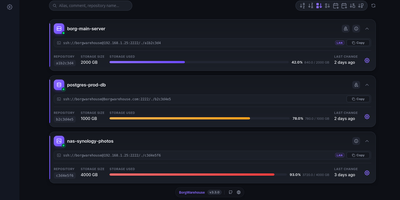
Centralizing BorgBackup usually means hand-creating Unix users, wiring SSH keys, and remembering which machine stopped backing up three weeks ago; BorgWarehouse replaces that terminal work with a dashboard built for exactly this job. Add a repository and it provisions the dedicated user, authorized key, and storage quota for you, then hands back ready-to-paste client commands so a new machine is backing up in minutes. Every repository carries a freshness threshold: when no modification lands within the window you set, its status dot turns red and an alert goes out by SMTP email, through Apprise to Discord, Telegram, Slack, Gotify, or ntfy, or as a signed webhook POST to tools like n8n and Uptime Kuma, rate-limited to one alert per repository per day. Append-only mode is enforced on the server, so even a fully compromised client can add archives but never destroy existing ones, which is the property that keeps ransomware from eating your backup history. The monitoring view tracks storage consumption against each quota, a setup wizard walks new clients through onboarding (with a LAN variant for local transfers), and sign-in can delegate to GitHub, Google, Microsoft, GitLab, or any OIDC provider. A versioned REST API automates provisioning, and your passphrase never reaches the server: backups stay end-to-end encrypted on the clients. Running on a dedicated VPS on RepoCloud with guaranteed CPU, RAM, and SSD, full root SSH access, and a browser serial console. AGPL-3.0 licensed.
Sharry
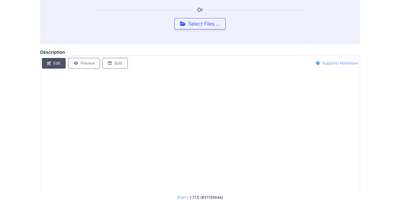
Sharry moves files in both directions: you hand someone a download link, and they hand files back to you, without either side juggling accounts on a commercial transfer service. Upload a file and you get a public URL that is hard to guess but open to anyone who has it; add a password as a second secret, set how long the share lives, and cap how many times it may be downloaded. Expired shares clean themselves up on a schedule. Uploads run over the tus protocol, so a dropped connection in the middle of a two-gigabyte video is an inconvenience, not a restart: send the same file again and it resumes from the last received chunk. Downloads support caching and range requests, which means recipients can stream a video in the browser and scrub its timeline instead of waiting for the whole file. The reverse direction is what makes Sharry unusual: every registered user can maintain alias pages behind their own unguessable URLs, where clients, students, or family members upload files straight to that user, with an email notification when something arrives. Everything is scriptable through a documented REST API, and files can live in the database, on the filesystem, or in S3-compatible storage. Running on a dedicated VPS on RepoCloud with guaranteed CPU, RAM, and SSD, full root SSH access, and a browser serial console. GPL-3.0 licensed.
HRConvert2
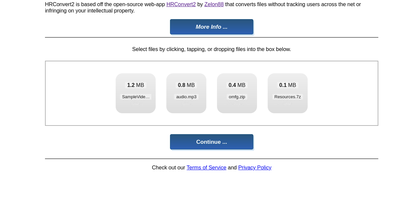
Stop pasting your files into ad-riddled online converters and handing strangers copies of your documents: HRConvert2 runs the whole conversion workshop on your own server instead. Drop a file onto the browser page and pick an output format from a catalogue of 488, covering documents, spreadsheets, presentations, ebooks, comics, images, audio, video, subtitles, and archives. Built-in OCR reads scanned PDFs and images and hands back editable text documents you can search and reuse. It converts 3D models and CAD drawings, renders OpenSCAD projects with their multi-file assemblies resolved, and can even build bootable ISO disk images for x86 and ARM machines from ordinary uploads. Live streams are captured and re-encoded straight from .m3u8 playlists, and every uploaded file can be virus-scanned with ClamAV before or after conversion. Finished files go back out through temporary share links that expire on their own, so sending a converted video to a client takes one click. Each visitor works in an isolated scratch space, files delete themselves when they age out, and nobody needs an account, ever. When traffic spikes, the server watches its own CPU and memory, throttles conversions, and spreads storage across disks so it stays upright. Three interfaces, seven color schemes, and 26 languages let each user shape the page to taste, and the whole thing runs happily on a Raspberry Pi with no database at all. Running on a dedicated VPS on RepoCloud with guaranteed CPU, RAM, and SSD, full root SSH access, and a browser serial console. GPL-3.0 licensed.
Email OAuth 2.0 Proxy
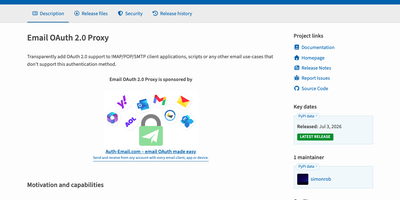
Your scanner still emails PDFs, your backup scripts still send nightly reports, and none of them will ever learn OAuth 2.0: Email OAuth 2.0 Proxy learns it on their behalf. It listens on local IMAP, POP, and SMTP ports on your server, and when a client logs in the old-fashioned way with a username and password, the proxy swaps that exchange for a modern SASL XOAUTH2 token before the connection ever reaches the provider. The client never knows anything changed, so ancient mail apps, embedded devices, monitoring tools, and hand-rolled scripts keep sending and fetching mail through Outlook, Office 365, Gmail, Google Workspace, Fastmail, Yahoo, AOL, and any other provider that demands OAuth 2.0. The hop from your client to the proxy stays simple, while the proxy opens a fully encrypted TLS connection upstream, including STARTTLS negotiation for SMTP relays that require it. One proxy instance serves many accounts at once, with each mailbox mapped to its own local port and its tokens cached under a password you control. Optional plugins can even rewrite traffic in flight: strip Microsoft Defender Safe Links back to their real URLs, stop duplicate sent messages, or swallow test mail into a black hole. Setup is a single configuration file covering server ports, per-account scopes, and token endpoints, and the proxy then runs quietly as a headless service. Running on a dedicated VPS on RepoCloud with guaranteed CPU, RAM, and SSD, full root SSH access, and a browser serial console. Apache-2.0 licensed.

Afilmory
Afilmory turns a storage bucket full of originals into a polished photography portfolio, complete with EXIF panels, a GPS map, and a GPU-accelerated viewer that makes full-resolution images feel instant. Point the builder at Amazon S3, Cloudflare R2, MinIO, Backblaze B2, a GitHub repository, an Eagle library, or a plain local folder, and it syncs your photos, converts HEIC and TIFF files for the web, generates multi-size thumbnails with ThumbHash placeholders, and extracts complete metadata into a manifest the gallery reads at runtime. Visitors browse a responsive masonry grid that loads progressively, open any shot in a WebGPU viewer (WebGL fallback included) with smooth zoom and pan, and inspect camera body, lens, focal length, aperture, ISO, and GPS coordinates for every frame. Geotagged work appears on an interactive MapLibre map, iPhone Live Photos play back as motion, HDR gain-map images render properly on HDR displays, and Fujifilm shooters get their film simulation recipes displayed alongside the shot. Photographers can organize by the folders they already keep, since directory structure becomes tags automatically, and backend-powered galleries add visitor comments and reactions. Deploy it as a static site on any CDN or as a server-rendered Node.js application with per-photo Open Graph previews for sharing. Running on a dedicated VPS on RepoCloud with guaranteed CPU, RAM, and SSD, full root SSH access, and a browser serial console. AGPL-3.0 licensed.
Reclip
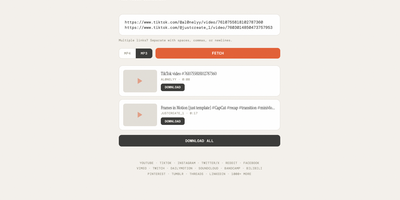
Reclip is a self-hosted web downloader that turns links from YouTube, TikTok, Instagram, and more than a thousand other video sites into MP4 or MP3 files saved on your own server. Paste one link or a whole batch of URLs, and Reclip fetches each video's title, thumbnail, duration, and uploader before you commit to anything. A quality picker lists every available resolution, so a lecture can be grabbed at 360p for a phone while a concert film comes down at full height with the best audio stream merged in. MP3 mode strips the picture away entirely, which makes it painless to archive podcasts, DJ sets, and spoken-word clips as plain audio files. Playlists expand into their individual videos automatically, repeated URLs are deduplicated before any bandwidth is spent, and a Download All button works through the whole queue without babysitting. Each job runs in a background thread with live status in the interface, so the page stays responsive while ffmpeg finishes merging streams behind the scenes. Everything lives behind one clean page with no accounts, no uploads to third-party converters, and no expiring download links, and finished files land in a downloads folder you control. Running on a dedicated VPS on RepoCloud with guaranteed CPU, RAM, and SSD, full root SSH access, and a browser serial console. MIT licensed.
DashBeam
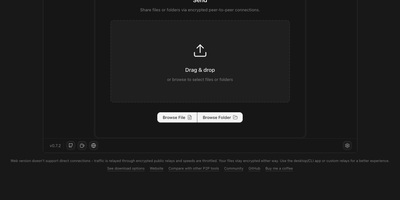
DashBeam sends files and folders of any size straight from one device to another, end to end encrypted, with no cloud account, no size limits, and nothing parked on a third party server in between. Drop in a file and share it through a short code, a link, or a QR scan; whoever receives it needs no account and can collect it in a plain browser tab with nothing installed. On the same network, nearby machines appear on their own, so pairing two devices and sending between them takes a couple of clicks instead of a cable or a memory stick. Pair a device once and it stays reachable by its identity, so your machines can exchange files from anywhere without swapping fresh tickets every time. Interrupted transfers resume where they stopped, and hopping from Wi-Fi to cellular mid-send does not drop the connection. One share can fan out to several receivers at once, and devices you mark as trusted can accept files automatically, which suits pushing builds, media libraries, or backups around a small fleet. You can preview what is arriving before downloading it, and a local history records every completed transfer. The repository also ships Docker Compose stacks for your own relay and discovery server, so even the encrypted fallback path can run entirely on machines you own. Running on a dedicated VPS on RepoCloud with guaranteed CPU, RAM, and SSD, full root SSH access, and a browser serial console. AGPL-3.0 licensed.
Kanidm
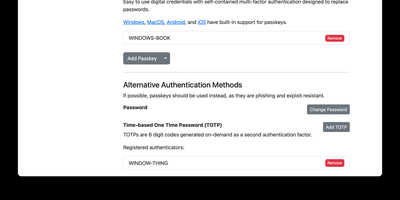
Every service you self-host wants its own account database, and Kanidm exists so they can all share one: one identity server where people sign in with passkeys and every application trusts the same login. Users register YubiKeys, Touch ID, Windows Hello, or TPM backed authenticators, and attested passkey policies let administrators restrict sign-in to specific authenticator models in high security environments. Applications connect as OAuth2 or OpenID Connect clients with authorization code, client credentials, PKCE, token exchange, and revocation supported, so your wiki, Git forge, and file sync all delegate sign-in instead of storing passwords. The application portal gives each person one page of tiles for every service they may open, and role based access control decides which groups see which applications and scopes. Older systems that only speak LDAP bind to the read-only LDAPS gateway, while Wi-Fi and VPN gear authenticates through the built-in RADIUS server with MS-CHAPv2 and EAP-TLS. Linux machines join through the Unix client for PAM and NSS authentication, cached offline credentials protected by the machine TPM, and SSH keys distributed from the server to every host. A second server replicates the whole database with strong eventual consistency, every node accepting writes without elections or quorums, so a failed machine never locks your users out of sign-in. Running on a dedicated VPS on RepoCloud with guaranteed CPU, RAM, and SSD, full root SSH access, and a browser serial console. MPL-2.0 licensed.
OrcaRouter Lite
Every prompt your application sends is a small buying decision, and OrcaRouter Lite makes it a smart one instead of a habit. Point your app at one OpenAI-compatible endpoint on your server, and each request is shopped across the providers whose keys you hold: OpenAI, Anthropic, Google, xAI, DeepSeek, and dozens more. Send model set to auto and the router picks the cheapest model that can actually do the job, checking whether the request needs tools, vision, or JSON mode before it commits your money. Prefer a different tradeoff and you can switch the whole gateway between balanced, cheapest, fastest, and quality strategies, with quality picks driven by real benchmark scores rather than vibes. Clients that speak Anthropic's or Gemini's native protocols connect directly too, so Claude Code, the OpenAI SDK, and google-genai all land on the same routing pipeline. Streaming responses flow through untouched, and every answer reports which model really served it. The built-in dashboard shows recent requests, spend, latency percentiles, unreachable providers, and a savings tile that tells you what your traffic would have cost if you had blindly used a flagship model for everything. Your provider keys stay encrypted on your own box, your analytics never leave it, and if every local provider has a bad day, the hosted OrcaRouter can step in as a failover safety net. Running on a dedicated VPS on RepoCloud with guaranteed CPU, RAM, and SSD, full root SSH access, and a browser serial console. MIT licensed.
PullMD
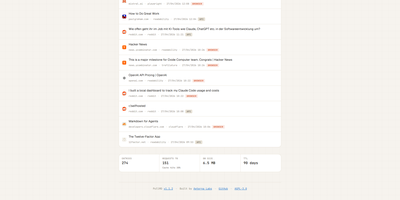
PullMD turns any URL or file you point it at into clean Markdown your AI agent can actually afford to read. Paste a web page and get back tidy body text with metadata tucked into frontmatter instead of navigation soup and cookie banners. Send it a Reddit or Hacker News thread and it returns the full comment tree with depth and count under your control. Hand it a PDF, Word file, PowerPoint, spreadsheet, or EPUB and it hands back Markdown, with an optional OCR tier for stubborn table-heavy documents. YouTube links come back as title, description, and a transcript with clickable timecodes, no API key required. The query-scoped mode answers a question about a long page by returning only the relevant sections, typically cutting 70 to 95 percent of the tokens. Every conversion gets a short share link that re-fetches the source when it goes stale and serves the last good snapshot if the original dies. Agents connect through the built-in MCP server with OAuth 2.1, a plain REST API, or a downloadable Claude Code skill, while you keep history, an archive, and cache statistics in the web app. Running on a dedicated VPS on RepoCloud with guaranteed CPU, RAM, and SSD, full root SSH access, and a browser serial console. AGPL-3.0 licensed.