Paisa
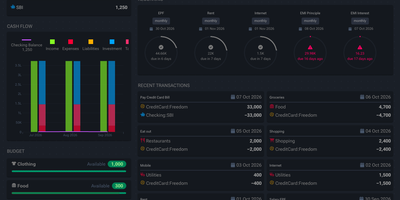
A plain text journal is all Paisa needs to put your net worth, cash flow, expenses, and investment returns on one set of dashboards. Write entries in the built-in editor. It brings syntax highlighting, auto completion, error checking, and auto formatting to double-entry journals. Bank and credit card statements in CSV, Excel, or PDF import through reusable templates that categorize every transaction. Price providers track mutual funds, NPS holdings, and stocks. Manual prices revalue a house, a car, or a plot of land. Budgets set a limit for each category and track spending against it. Allocation targets show how far a debt and equity split has drifted. Goals compute a completion date from monthly savings. The retirement planner works from a safe withdrawal rate and yearly expenses. A calendar marks recurring bills as cleared, late, past due, or upcoming, and Liabilities pages cover credit cards, loan repayment, and interest. Live Sheets calculate taxes and EMIs from ledger data. Journals and settings stay in plain text files that can be version controlled or shared, and ledger, hledger, and beancount are all supported. Running on a dedicated VPS on RepoCloud with guaranteed CPU, RAM, and SSD, full root SSH access, and a browser serial console. AGPL-3.0-or-later licensed.
evcc
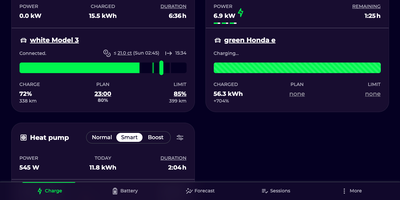
evcc turns surplus rooftop solar and the cheapest hours of a dynamic tariff into cheap, clean kilometers by coordinating an EV charger, heat pump, and home battery from one local dashboard. Each charging point offers Off, Smart, and Fast modes. In Smart mode, charging starts once the surplus covers the car's minimum power, follows the sun up and down, pauses when clouds win, and can switch between one and three phases on wallboxes that allow it. A solar share slider lets small systems start earlier, and Always charge keeps fussy cars from being interrupted. Set a departure time and a target charge, and a charging plan picks the cheapest or cleanest hours before it, repeating weekly if you like. Tibber, Awattar, fixed and time-based rates, dynamic feed-in prices, and CO2 and solar forecasts all feed those decisions. A home battery can claim the surplus first or lend a boost for fast charging, and load management keeps several chargers inside a circuit's current limit while honoring grid operator dimming. Hundreds of wallboxes, inverters, meters, heat pumps, and vehicle APIs are supported, including Tesla, BMW, Mercedes-Benz, Skoda, and Volkswagen. Sessions land in a history with charts and CSV export, and REST, MQTT, InfluxDB, Grafana, Home Assistant, and openHAB link evcc to the rest of the house. Running on a dedicated VPS on RepoCloud with guaranteed CPU, RAM, and SSD, full root SSH access, and a browser serial console. MIT licensed.
RosarioSIS
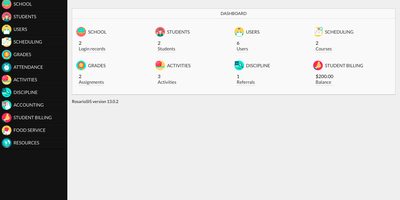
Report cards, attendance rosters, class schedules, discipline logs, and fee statements all live in one browser-based system with RosarioSIS, an open-source student information system for K-12 schools and similar institutions. Administrators define marking periods in up to three tiers, set grade levels and daily periods, and search students by gender, grade level, schedule, absences, GPA, or class rank. The scheduler places whole classes or a single student, and runs in test mode each time a student's requests are saved, so conflicts can be resolved with the student still in front of you. Teachers keep a weighted gradebook with grade ranges, progress reports, report cards, and transcripts, take attendance electronically, and use the eligibility feature to flag who may join athletic or academic activities. Discipline logs, student billing with fees, payments, balances, and statements, food service, and accounting complete the core modules. Parents and students get their own portal, new families can register online, listings export to Excel, CSV, or XML, and charts and PDF documents support decisions and paperwork. The interface adapts to tablets and phones and is translated into a dozen languages. Add-on modules bring email, library, hostel, Jitsi Meet video rooms, and Moodle integration. Running on a dedicated VPS on RepoCloud with guaranteed CPU, RAM, and SSD, full root SSH access, and a browser serial console. GPL-2.0 licensed.
Tiny File Manager
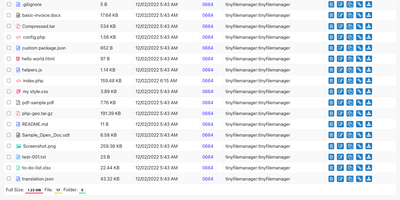
Browse, upload, edit, preview, and archive the files on your server from any web browser, with no FTP client, no shell session, and no database to set up. Tiny File Manager lists every folder in a sortable table showing size, modified date, permissions, and owner, with a search box that filters as you type. Drag files into the upload zone, send several at once, or paste a URL for the server to fetch. Rename items, select several to copy, move, delete, or pack into a zip or tar archive, and extract uploaded archives on the server. Click any text file to open the built-in editor, which offers syntax highlighting for 150+ languages and 35+ color themes, so quick fixes to configs and scripts happen where the files live. Images, audio, video, and text open in a preview without downloading, and every file has a copyable direct link. Give teammates or clients their own accounts, each locked to a root folder you choose, mark accounts read-only, and limit uploads to approved file extensions. Hide folders you never want listed, restrict access with IP allow and block lists, switch between light and dark themes, pick from 35+ interface languages, and use the responsive layout on a phone. Setup is one file copied to a web server, or one Docker container. Running on a dedicated VPS on RepoCloud with guaranteed CPU, RAM, and SSD, full root SSH access, and a browser serial console. GPL-3.0 licensed.
Busabase
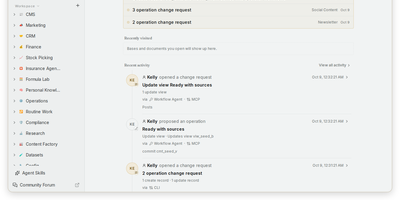
Every AI agent session starts from zero, and Busabase fixes that: it is an open-source workspace where agents and people share records, docs, skills, and apps, and every agent write arrives as a reviewable change. Bases hold typed records with relations, views, and forms, while Docs, Files, Whiteboards, and Workflows live in the same tree, so a project's data and context stay together. Skills are SKILL.md playbooks that any connected agent can look up before it acts. Each write becomes a Change Request carrying a message, a field-level diff, an author, and history; your permissions decide whether it merges at once or waits in the Inbox for approval, and any change can be reversed. Ask an agent to turn a Base into a dashboard, CRM, or content desk and it runs as an AirApp on live workspace data. Claude Code, Codex, Cursor, Gemini CLI, n8n, or your own process can connect through MCP, OpenAPI, the CLI, TypeScript and Python SDKs, or an in-app chat session. Templates install a complete setup, with sample data and an agent manual, in one command. Start it with one command and no accounts, because the open-source edition is a single-user workspace with no sign-in screen. Running on a dedicated VPS on RepoCloud with guaranteed CPU, RAM, and SSD, full root SSH access, and a browser serial console. MIT licensed.
Veritas Kanban
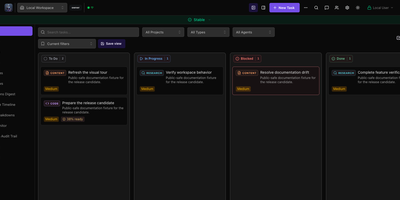
A drag-and-drop task board that works fine on its own and can also hand cards to AI coding agents, Veritas Kanban shows what each agent is doing, what it changed, and what is waiting for your approval. Start with no agents at all. Cards move through To Do, In Progress, Blocked, and Done, and each one carries subtasks, dependencies, time tracking, comments, and an activity log. When you are ready, connect Codex, Claude Code, Copilot CLI, Hermes, or OpenClaw, give every agent an Intern, Specialist, or Lead permission level, and follow each agent's status and model on a live dashboard. Let a task run in its own Git worktree, read the diff, leave inline comments, approve or request changes, and open a GitHub pull request from the task panel. Squad Chat gives agents one shared channel that posts spawned, completed, and failed events. Workflows chain steps with parallel branches, loops, and human approval gates. Policy rules allow, deny, or hold agent actions for review. Assistants reach the board through an MCP server, a command-line client, or a REST API. Running on a dedicated VPS on RepoCloud with guaranteed CPU, RAM, and SSD, full root SSH access, and a browser serial console. MIT licensed.
TextBee
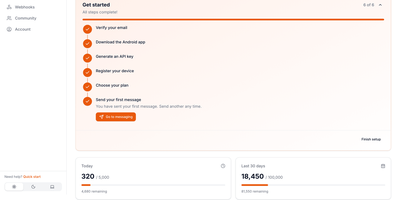
TextBee turns an Android phone with a SIM card into an SMS gateway your applications can call, so one-time codes, alerts, reminders, and two-way conversations go out as ordinary texts from a real number. Pair a phone by scanning a QR code in the dashboard, then send messages from the REST API, the dashboard, or the JavaScript SDK. Bulk campaigns load from a CSV file and are paced to stay within carrier limits, and any message can be scheduled up to 72 hours ahead. With several phones or SIM cards attached, each message can name the device and SIM it should use. Every message moves through pending, dispatched, sent, delivered, or failed, and the history view lists all devices together. Incoming texts appear in the dashboard and the API, and webhooks push received messages and delivery reports to your server with an HMAC-SHA256 signature you can verify. An official MCP server lets AI assistants send texts and read replies. API keys, devices, usage, and webhook subscriptions are all managed from one web interface. Running on a dedicated VPS on RepoCloud with guaranteed CPU, RAM, and SSD, full root SSH access, and a browser serial console. MIT licensed.

GrandNode
GrandNode lets you run one shop, a dozen regional storefronts, or a full marketplace from a single installation, with a back office for every role involved. Each store gets its own domain, theme, currencies, languages, and settings, and a store manager panel limits staff to the catalog, orders, and customers of their own store. Outside sellers join through a vendor panel where they manage their own products and orders. The catalog handles attributes and combinations, bundles, grouped items, downloads, date-based reservations, and auctions. B2B selling adds customer groups, tier prices, sales employees, and approvals. Checkout accepts payments through plugins such as Stripe Checkout, Braintree, and cash on delivery, with shipping by fixed rate, weight, or pickup point and tax rules by country, state, or zip code. Marketing tools include coupon codes, discount rules, loyalty points, gift vouchers, customer segments, newsletter campaigns, and push notifications. Clean URLs, sitemaps, and structured data with price and availability help search engines read your products. Pages, blog posts, news, and sliders cover content, and a REST API serves headless storefronts and ERP or CRM integrations. Running on a dedicated VPS on RepoCloud with guaranteed CPU, RAM, and SSD, full root SSH access, and a browser serial console. GPL-3.0 licensed.
tirreno
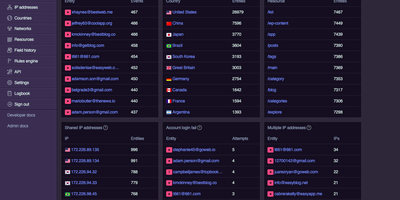
tirreno watches what accounts actually do inside your product, then surfaces the ones that look like account takeover, credential stuffing, fake signups, or insider abuse. Your backend reports events such as logins, registrations, page views, searches, email changes, and field edits through an SDK or one HTTP call, and a scheduled job turns them into per-user context: devices, IP addresses, sessions, and connected identities. Preset rules cover account takeover, credential stuffing, content spam, bot detection, multi-accounting, promo abuse, dormant accounts, API protection, and high-risk regions, and you can add rules of your own. Each rule adds to a risk score, and thresholds decide whether a user is flagged for manual review or suspended automatically. The review queue lists who needs a look, and the single user view shows behaviour patterns, risk scores, connected identities, and an activity timeline. A field audit trail records what changed and when, which supports compliance reviews, while the logbook lists every API request the instance received. Your application can ask a blacklist endpoint whether a user or IP should be blocked before it responds. An optional IP enrichment pack adds geolocation, ISP, and VPN or proxy detection. All event data stays on your own server. Running on a dedicated VPS on RepoCloud with guaranteed CPU, RAM, and SSD, full root SSH access, and a browser serial console. AGPL-3.0 licensed.
CookCLI
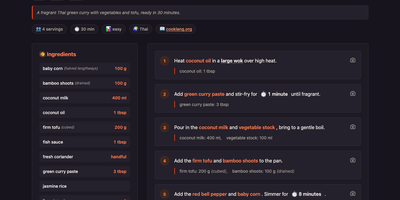
Plain-text recipes in, a phone-friendly recipe site out: CookCLI reads Cooklang files and serves them with scaling, search, shopping lists, meal plans, and pantry tracking. Write ingredients, cookware, and timers inline. Open any recipe from a phone or laptop on your network. Change the serving count and the quantities recalculate. Search by ingredient or by text. Plan a week in a .menu file and get one shopping list, merged across recipes, grouped by store aisle from your own aisle configuration, with pantry items already subtracted. The pantry file holds quantities, expiry dates, and low-stock thresholds. Ask which items are depleted or expiring, or which dishes you can cook right now, near matches included. In the terminal, print any recipe as Cooklang, JSON, or Markdown, run template-driven reports, and let a doctor command check your files. Import a recipe from a web page with an OpenAI API key. Switch on sign-in so everyone can browse but only signed-in users can edit recipes, the pantry, or the shopping list. A documented HTTP API feeds other tools. The whole collection also builds into a static website. Running on a dedicated VPS on RepoCloud with guaranteed CPU, RAM, and SSD, full root SSH access, and a browser serial console. MIT licensed.
D-Tale
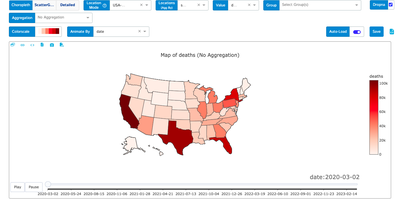
If your data lives in a pandas DataFrame, D-Tale gives it a spreadsheet-style grid, a column profiler, and a chart builder in the browser, started with one call from a notebook or script. In the grid you sort, filter, and edit cells inline, lock, hide, reorder, rename, or reformat columns from their menus, and open a Describe view with each column's distribution, summary statistics, outliers, and missing values, while highlight modes color dtypes, outliers, and numeric ranges across the whole table. Correlation matrices, a predictive power score, and duplicate reports sit beside dataframe functions that add numeric, binned, date, random, and type-converted columns, and Merge & Stack combines dataframes, including ones uploaded from Excel files. The chart builder draws line, bar, stacked, pie, wordcloud, heatmap, 3D scatter, surface, and map charts with grouping and aggregation, exports them as standalone HTML, and a network viewer graphs relationships between nodes. Whatever you build in the interface can be exported as reproducible Python code, and data can be saved as CSV or TSV. Launch it from Jupyter, Google Colab, Kaggle, a terminal, or the command line with a CSV path, protect it with optional authentication, and choose light or dark themes and English or Chinese. Running on a dedicated VPS on RepoCloud with guaranteed CPU, RAM, and SSD, full root SSH access, and a browser serial console. LGPL-2.1 licensed.
Measure
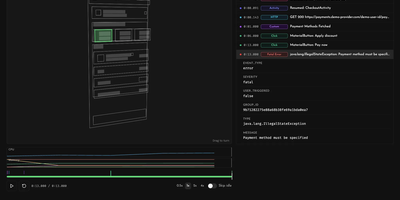
Measure is an open-source mobile monitoring platform that shows mobile teams what broke, how often, and what the user did right before it happened. Crashes, ANRs, and app hangs are grouped into single issues, and each fatal error arrives with a session replay: an ordered timeline of screens opened, taps, network calls, logs, and lifecycle events, with CPU and memory charts alongside screenshots and wireframe layout snapshots. Bug reports can be filed with a device shake or an SDK call and carry the same history of user actions. Performance traces and spans break slow startups and screens into steps, and network monitoring ranks the slowest and most error-prone endpoints. Funnels built from custom events show conversion and drop-off at each step, with a Friction view that ties every step to the crashes, errors, slow traces, and network requests users hit there. User journeys chart how people move between screens, and Adaptive Capture changes sampling, replay length, and screenshot masking remotely, with no new app build. SDKs cover Android, iOS, Flutter, React Native, and Kotlin Multiplatform. Teams sign in with Google or GitHub, invite colleagues by email, and send alerts to Slack, and an optional Measure Agent lets a coding agent or Slack help debug production issues. Running on a dedicated VPS on RepoCloud with guaranteed CPU, RAM, and SSD, full root SSH access, and a browser serial console. Apache-2.0 licensed.
MoneyMatter
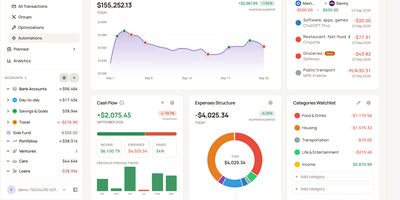
Your bank balance is only part of what you own, and MoneyMatter adds the rest: cash accounts, brokerage portfolios, cars, loans, and private deals roll into one net worth figure in your base currency. Add transactions by hand, import CSV, OFX, QFX, YNAB, Wallet, or Microsoft Money files, or let an AI model you provide parse a statement, while Monobank, SimpleFIN, Lunch Flow, and Walutomat connections sync accounts automatically. Each transaction can carry categories, tags, payees, notes, attachments, and splits, transfers and refunds link to their counterparts, and automation rules tidy new entries. Envelope-style budgets assign money to lines with Assigned, Activity, and Available columns and rollover rules, savings goals read progress from account balances, subscriptions and bills send reminders, and loans show payoff projections. Stocks, ETFs, and crypto are priced daily, vehicles depreciate along a curve, and a FIRE planner estimates years to Lean, Regular, Fat, Barista, and Coast FIRE. A customizable dashboard, cash flow, money flow, net worth history, trends comparison, and pivot table chart the results. Share accounts with a household member, export JSON, CSV, or XLSX, back up everything, or connect Claude, ChatGPT, or Claude Code through the built-in MCP server. Running on a dedicated VPS on RepoCloud with guaranteed CPU, RAM, and SSD, full root SSH access, and a browser serial console. AGPL-3.0 licensed.
GymCoach
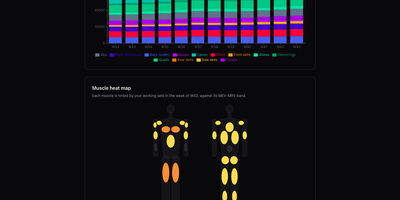
Strength training, cardio, and body metrics land in one workout log on your own server, backed by an optional AI coach that explains its advice from your real numbers. Quick entry such as 100x8@9 logs weight, reps, and effort in one line, with a rest timer, plate-loading calculator, and warm-up ramp beside the set table. A weight picker offers only loads your equipment can build, and a readiness check-in adjusts the suggested load and says why. Templates for 5/3/1 BBB, GZCLP, nSuns, PPL, and Upper/Lower run as written and edit like any custom program. Progress pages chart estimated 1RM, weekly volume per muscle group against MEV and MRV bands, a muscle heat map, bodyweight goals, and a training calendar. Garmin FIT, TCX, and GPX imports need no cloud account and add heart-rate charts and aerobic decoupling to each run or ride. The coach writes a weekly debrief, chats in a streaming conversation, and drafts a full program from a one-sentence goal, using your own Anthropic or OpenRouter key. History imports from Strong or Hevy CSV files with a dry-run preview and exports to CSV or TCX, and an MCP connector lets ChatGPT or other agents analyse it. The app installs as an offline-capable PWA, speaks English, French, Russian, and German, and keeps every user's data separate. Running on a dedicated VPS on RepoCloud with guaranteed CPU, RAM, and SSD, full root SSH access, and a browser serial console. MIT licensed.
OpenTakeoff
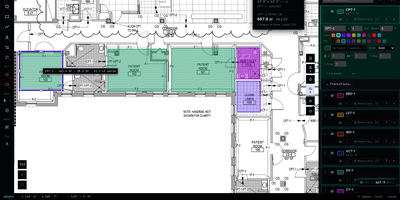
From a PDF plan set to a waste-adjusted material order takes one browser tab: OpenTakeoff measures floors, walls, and fixtures at the drawn scale and never uploads a single drawing. Drag in a PDF, image, or zip plan set, view up to four sheets side by side, and search sheet text, while stitching joins floors split across a match line. Scale comes from the drawn scale note or a known dimension, and a check tool reports percent error before a wrong scale can skew a bid. Area, linear, and count tools carry condition colors, CAD hatches, waste percentages, and wall heights, and a marquee over the architect's finish schedule turns approved rows into conditions. Supporting materials convert coverage rates into rounded-up order quantities, and roll-goods mode lays out lanes, seams, and cuts to scale. Totals in SF, SY, LF, and EA export to CSV, JSON, Excel, print, or a marked-set PDF, while named revisions compare addenda as quantity deltas. Highlighters, revision clouds, callouts, and notes mark up sheets on a layer that is never counted, and dimension lines label measured lengths at the sheet scale. An MCP server with more than 50 tools lets AI agents open plans, set scale, and measure rooms, and each shape they draw stays a dashed proposal until a person accepts it. Running on a dedicated VPS on RepoCloud with guaranteed CPU, RAM, and SSD, full root SSH access, and a browser serial console. AGPL-3.0 licensed.
Docker Registry UI
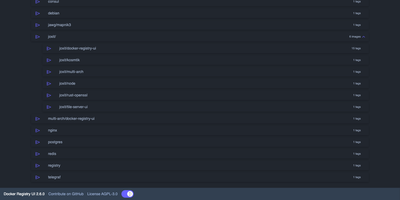
Instead of querying a private registry with curl and its HTTP API, open Docker Registry UI and click through repositories, tags, digests, and layers in a browser. The catalog groups images by namespace, shows tag counts, and filters as you type in the search bar, which Ctrl+F or F3 focuses. Each repository's tag list shows creation date, size, content digest, and CPU architecture, sorts numerically, and copies a ready-made pull reference with one click. A history page expands any tag into its operating system, entrypoint, environment variables, exposed ports, and layer-by-layer build steps, and a Dockerfile view reconstructs the file from those steps. The same view also covers multi-architecture images and OCI Helm exports. When the registry allows deletion, tags go one at a time or in bulk with checkboxes, Alt+Click for a whole page, and Shift+Click for a range. One interface can switch between several registries from its menu, or be locked to a single registry with your own title. Basic authentication passes through the browser, and a built-in proxy option forwards requests to your registry container so CORS needs no configuration. Light, dark, and automatic themes come with color variables for custom branding, and a weekly notice announces newer releases. Running on a dedicated VPS on RepoCloud with guaranteed CPU, RAM, and SSD, full root SSH access, and a browser serial console. AGPL-3.0 licensed.
Wiki-Go
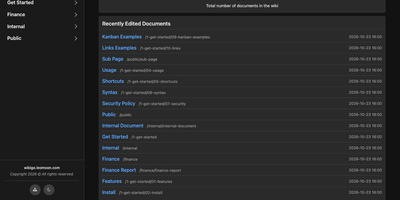
Wiki-Go turns a folder of Markdown files into a searchable team wiki with page history, comments, and access rules, and never asks you to run a database. Pages live in a nested tree with a sidebar and breadcrumbs, and an editor with a preview toggle handles emoji shortcodes, highlighted code, LaTeX math, Mermaid diagrams, collapsible sections, GitHub-style alerts, and embedded YouTube, Vimeo, or MP4 video. Full-text search supports exact phrases in quotes and term inclusion or exclusion, and highlights each match. Each save keeps a revision, up to a configurable limit, and any stored version can be restored later. Attachments such as PDFs, spreadsheets, images, and archives sit beside the page they belong to. Drop a Kanban board into any document for drag-and-drop task tracking with nested tasks, or build a categorized link library that fills in page metadata automatically. Signed-in users comment in Markdown, and admins can remove comments. Admin, editor, and viewer roles, user groups, path-based public or private rules, and an optional private-wiki mode decide who sees what. Branding comes from a custom logo, banner, and favicon, shortcodes such as stats insert live site statistics, and readers can switch between dark and light themes or print any page. A REST API opens content to scripts, and a community tool imports Notion exports. Running on a dedicated VPS on RepoCloud with guaranteed CPU, RAM, and SSD, full root SSH access, and a browser serial console. GPL-3.0 licensed.
Liwan
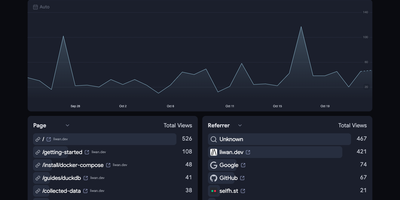
When you want honest traffic numbers without tracking cookies or stored IP addresses, Liwan puts a real-time analytics dashboard on your own server. The dashboard ranks pages, referrers, countries, browsers, platforms, and devices, charts visitors over time, and filters out bot traffic by default. Session metrics add bounce rate, average time on site, and entry and exit pages, while UTM fields attribute visits to campaigns. Collection is adjustable globally and per site: choose how visitors are grouped, whether to store country and city, country only, or no location, and how long events are kept. Drop rules discard internal, test, and local traffic before storage, and a pruning tool applies new settings to history after a dry-run preview. Tracking is one line of HTML, or your own server can send events with custom names and properties. Location can come from a MaxMind database or from Cloudflare, Vercel, and other proxy headers. One instance holds several projects and sites, with team accounts and single sign-on through Google Workspace, Microsoft Entra ID, or an OpenID Connect provider such as Keycloak or Dex. Running on a dedicated VPS on RepoCloud with guaranteed CPU, RAM, and SSD, full root SSH access, and a browser serial console. Apache-2.0 licensed.