CrowdSec
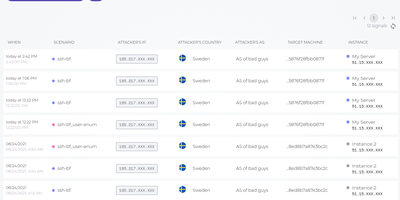
With over 14,000 GitHub stars and a growing global network of security deployments, CrowdSec turns every attack on any participating server into protection for the entire community. The security engine operates as a combined IDS/IPS and WAF, analyzing log sources from Nginx, Apache, SSH, WordPress, and over 50 other services to detect brute force attacks, port scans, web vulnerability exploitation, and credential stuffing in real time. When one server detects a new threat, the attacker's IP is shared through the community blocklist, proactively protecting thousands of other installations before the attacker can reach them. The built-in WAF powered by Coraza v3 inspects HTTP requests at the application layer, validates against OpenAPI schemas, and applies custom rules with flexible AND/OR condition mixing for precise threat detection. Bot detection serves challenge pages with client fingerprinting to distinguish legitimate traffic from automated scrapers and scanners. Remediation components block malicious IPs at multiple infrastructure layers including iptables, nftables, Nginx, HAProxy, Cloudflare, and AWS Security Groups through the detect-here-remedy-there architecture. The scenario-based detection system ships with default rules for common attack patterns and supports custom scenarios written in YAML with an expressive filter language. A centralized console provides real-time visualization of alerts, threat intelligence analysis, and management of multiple distributed security engines. GDPR compliant by design, all log analysis happens locally and raw logs never leave your infrastructure. Running on a dedicated VPS on RepoCloud with guaranteed CPU, RAM, and SSD, full root SSH access, and a browser serial console. MIT licensed.
3X-UI
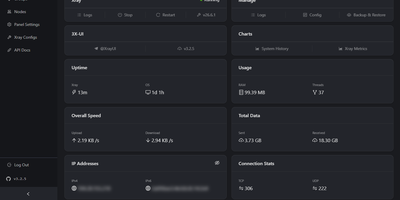
3X-UI is the most popular open-source Xray management panel, providing a full-featured web interface for deploying and monitoring proxy and VPN protocols on Linux servers. The Go backend manages Xray-core instances supporting VLESS, VMess, Trojan, Shadowsocks, WireGuard, Hysteria2, HTTP, SOCKS, Dokodemo-door, and TUN inbounds across TCP, mKCP, WebSocket, gRPC, HTTPUpgrade, and XHTTP transports secured with TLS, XTLS Vision, and REALITY. The Clients page tracks each user with individual traffic quotas, expiration dates, concurrent connection limits, and live online status indicators, while one-click share links, QR codes, and a built-in subscription server distribute configurations in multiple output formats. The multi-node architecture manages and scales deployments across multiple servers from a single panel instance. The Panel Settings page configures listen address, port, URI path, session duration, trusted proxy CIDRs, authentication, and Telegram bot integration for remote monitoring and management alerts. Outbound routing supports WARP, NordVPN, custom rules, load balancers, and proxy chaining. Xray Configs provides template-level control over the core configuration, while the API Docs page exposes a complete RESTful API with in-panel Swagger documentation. Data persists in SQLite by default or PostgreSQL for larger deployments, with database export and import from the panel. Fail2ban integration enforces per-client IP limits. On RepoCloud, deploy 3X-UI on a dedicated VPS with Docker, root SSH access, and complete control over your proxy infrastructure, all under the GPL-3.0 license.
CaddyUI
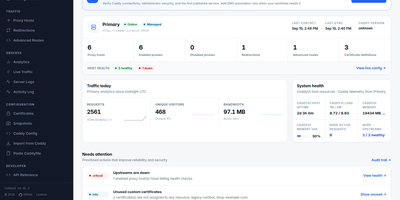
Providing an intuitive control plane for modern reverse proxy infrastructure, CaddyUI enables system administrators to manage proxy hosts, automated TLS certificates, and traffic routing without hand-editing configuration files. Operators can create and adjust reverse proxy destinations, URL path rewrites, custom headers, and redirection rules using structured forms that validate against the proxy engine before saving. The platform coordinates automatic ACME certificate requests and renewals, displaying live certificate expiration timelines, validation stages, and internal self-signed certificate authority options for local network services. Fleet management tools synchronize proxy rules across multiple distributed server instances, preventing configuration drift across staging and production clusters. Automated post-deployment health checks verify upstream endpoint availability, HTTP status codes, and latency thresholds, instantly rolling back to the previous configuration if an expectation fails. An integrated observability suite delivers real-time visitor traffic analytics, geographic maps, HTTP response code breakdowns, and single-click client IP blocking to counter malicious probing attempts. Administrators can schedule automated database backups, configure multi-user access with role permissions, and integrate CrowdSec threat intelligence to protect backends. Running on a dedicated VPS on RepoCloud with guaranteed CPU, RAM, and SSD, full root SSH access, and a browser serial console. Apache 2.0 licensed.
CrowdSec Web UI
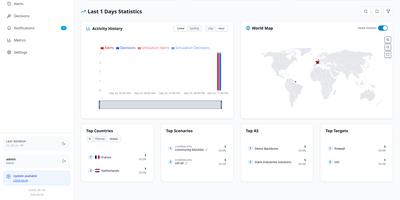
CrowdSec Web UI provides a centralized web console for monitoring intrusion detection telemetry, managing firewall remediation decisions, and auditing security events across multiple CrowdSec security engines. Administrators can connect several CrowdSec Local API endpoints simultaneously, aggregating threat intelligence and active bans into a unified visual interface. The dashboard displays geographic origins of attacking IP addresses, active remediation durations, and specific scenario triggers such as brute-force authentication attacks or web vulnerability probes. Operators can search through historical alert logs, inspect raw HTTP request details, and drill down into individual IP behaviors to differentiate authentic threats from false positives. Manual intervention tools let security teams enforce custom IP bans, adjust expiration timers, or immediately revoke erroneous bans across all connected bouncers with a single click. Integrated notification pipelines dispatch real-time security alerts to external destinations including ntfy, Gotify, and MQTT message brokers whenever critical thresholds are breached. Built-in Prometheus metrics dashboards visualize processing latencies, parser throughput, and decision counts over customizable time windows. Running on a dedicated VPS on RepoCloud with guaranteed CPU, RAM, and SSD, full root SSH access, and a browser serial console. AGPL-3.0 licensed.
PowerDNS-Admin
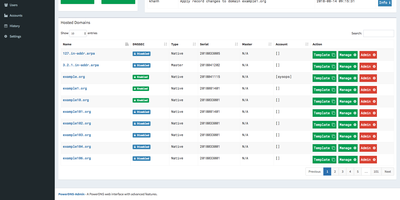
Raw zone files and API calls become something a whole team can operate safely once PowerDNS-Admin puts its web interface in front of a PowerDNS authoritative server. It's a Python/Flask application covering full forward and reverse zone management, with the touches that matter in daily DNS work: zone templates for stamping out consistent new domains, easy IPv6 PTR record editing (reverse zones by hand are misery), full IDN/Punycode support for internationalized domains, and DynDNS 2 protocol support so routers and scripts can update records the way they would against a commercial dynamic-DNS service. Access control is enterprise-grade: local users, LDAP against OpenLDAP or Active Directory, SAML, and OAuth via Google, GitHub, Azure, or OpenID Connect, hardened with TOTP two-factor authentication. Role-based permissions extend to zone-specific access control - hand a developer their project's zone without exposing the rest of your namespace - and activity logging records who changed which record when, the audit trail bare PowerDNS never gives you. The dashboard monitors PDNS service configuration and statistics, and its own API exposes zone and record management for automation on top of the UI. Runs against MySQL/MariaDB or PostgreSQL, talking to PowerDNS through its REST API. MIT-licensed.
Rivet
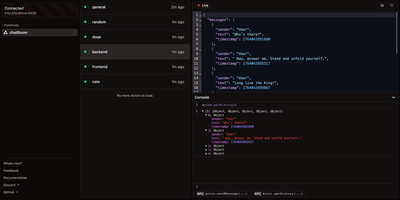
Stateful serverless actors that run indefinitely, sleep when idle, and persist state across restarts without external database round trips. Rivet provides a vendor-neutral alternative to Cloudflare Durable Objects, delivering long-running processes with co-located in-memory state and per-actor SQLite databases on any infrastructure you choose. The Rust engine comprises four packages: Pegboard for actor orchestration, Gasoline for durable execution, Guard for traffic routing via Envoy, and Epoxy implementing multi-region KV storage through EPaxos consensus. Each actor maintains instant-access in-memory state plus a dedicated SQLite database for relational queries, backed by RocksDB on single nodes or PostgreSQL with NATS pub/sub for multi-node clusters. RivetKit SDKs in TypeScript, Rust, and Python support built-in WebSocket connections, task queues, scheduling, and CRDT-based real-time collaboration. The v2.3 rewrite moved the core runtime from JavaScript to native Rust via WebAssembly, eliminating main-thread blocking across Node.js, Bun, Deno, and Cloudflare Workers. A built-in dashboard provides actor inspection with real-time Prometheus metrics. Deploys as a single Docker container on port 6420 with optional PostgreSQL for persistence. Available on RepoCloud with a dedicated VPS under the Apache 2.0 license.
Tau
Tau delivers a complete self-hosted cloud platform where Git is the control plane and WebAssembly is the runtime. The Go binary deploys as interconnected nodes that form a P2P network using libp2p for automatic service discovery, eliminating Kubernetes entirely. Serverless functions compile to WebAssembly for secure multi-tenant execution with automatic horizontal scaling — write in Go, Rust, AssemblyScript, or C and deploy by pushing to Git. Branch-based environments map Git branches to isolated deployments, so staging and production run identical infrastructure from different refs. Static website hosting serves frontends with global distribution and automatic content-addressed deduplication via IPFS-derived storage. The built-in K/V database provides distributed storage with automatic replication across nodes, while object storage handles file management with content addressing. Pub/Sub messaging enables real-time communication between functions and external services including WebSocket support. Spore Drive automates multi-host deployment and rolling updates from a single command across bare metal or VMs running Ubuntu. The Dream CLI provides a complete local development environment that mirrors production exactly — same services, same routing, same deployment flow. Zero-configuration HTTPS provisions TLS certificates automatically for custom domains. The web console at console.taubyte.com provides visual project management, or use the tau CLI for Git-native workflows. Running on a dedicated VPS on RepoCloud with guaranteed CPU, RAM, and SSD, full root SSH access, and a browser serial console. BSD-3-Clause licensed.
NetsGo
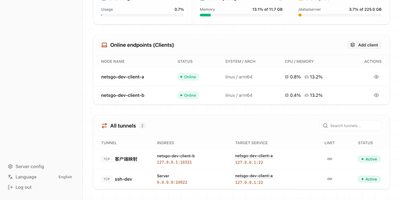
Created to eliminate the configuration fragmentation plaguing multi-device Homelab setups and small-team infrastructures, NetsGo merges what typically requires three separate tools — a tunnel daemon, a management panel, and a monitoring stack — into a single Go binary that starts with one command and listens on one port. The server exposes HTTP, TCP, and UDP tunnels, a built-in Web console for node management, a REST API for automation, and real-time traffic statistics with per-client bandwidth limiting, all sharing default port 9527 so firewalls and reverse proxies need only a single rule. Version 0.1.11 introduced Client-to-Client P2P tunnels via WebRTC DataChannel with three selectable transport strategies — Server relay, Prefer P2P with automatic fallback, and P2P only — reducing latency for direct connections while maintaining the centralized control plane. The management console displays every connected client's online status, authentication tokens, tunnel configuration, active transport mode, P2P candidate gathering progress, and cumulative byte-level traffic counters updated every second. Unlike frp or rathole which delegate management to external plugins or configuration files, NetsGo provides built-in client key generation, tunnel target migration between nodes, SOCKS5 proxying, IP-whitelist console access, and one-command server upgrades. Running on a dedicated VPS on RepoCloud with guaranteed CPU, RAM, and SSD, full root SSH access, and a browser serial console. Apache 2.0 licensed.
mCaptcha
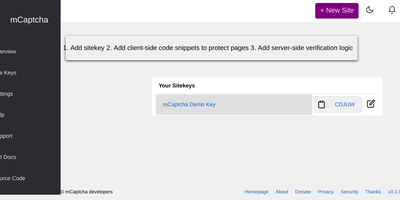
The CAPTCHA bargain - annoy your users and feed their behavior to Google - gets replaced with economics by mCaptcha. Instead of image puzzles, it uses SHA256 proof-of-work: every visitor's browser silently solves a small computational challenge (via a WebAssembly library) before submitting a form. Humans never notice the milliseconds; bots hammering your site must burn more compute sending requests than your server spends answering them, which makes attacks more expensive than defense - the property that also makes mCaptcha genuine DoS protection, not just bot filtering. Written in Rust, the system is fully automated: difficulty scales with traffic, so challenges stay trivial in normal conditions and harden under attack. The privacy and accessibility wins are structural rather than promised: no tracking, no profiling, no user-pattern data collection, and no visual puzzles that exclude users with visual or cognitive impairments - the design was published in Communications of the ACM. Rate limiting is IP-independent, so users behind NATs, VPNs, or Tor get the same experience instead of endless challenge loops, and proofs resist replay attacks, neutering captcha farms. Migration is deliberately easy: the API is compatible with reCAPTCHA and hCaptcha, making it a drop-in replacement. AGPL-licensed core with proprietary-friendly client libraries.