Spector
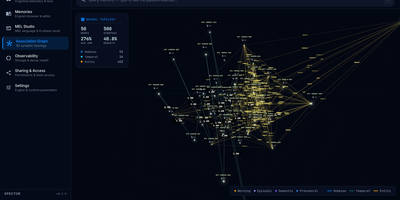
Spector is a cognitive memory engine for AI agents that remembers, forgets, consolidates, and links related memories rather than just storing vectors. Memories live in four tiers, working, episodic, semantic, and procedural, and sleep consolidation distills repeated events into lasting facts. Unused traces fade along a power-law forgetting curve, while reused ones stay reachable. Co-activation, temporal, and entity links join memories, so a query surfaces related context and not only close matches. Recall fuses dense, sparse, and keyword scores with importance and age, then reranks the candidates. Claude Desktop, Cursor, Windsurf, and Claude Code attach through Model Context Protocol tools for remembering, recalling, reinforcing, and forgetting, while apps use REST, gRPC, or client libraries. Each user, agent, or tenant gets its own encrypted on-disk namespace, and sharing runs through owner, admin, writer, and reader grants. The Cortex dashboard draws the association graph in 3D, browses and edits memories, and charts storage, index health, consolidation, and decay. A content-free admin console manages tenants, quotas, keys, and break-glass access without ever exposing memory text. Embeddings come from Ollama, OpenAI, Google, Mistral, Azure, Bedrock, or an ONNX model, and the project ships container images for amd64 and arm64 plus a Helm chart. Running on a dedicated VPS on RepoCloud with guaranteed CPU, RAM, and SSD, full root SSH access, and a browser serial console. Apache-2.0 licensed.
GlitchTip
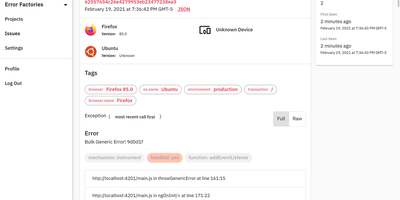
GlitchTip speaks Sentry's protocol without Sentry's operational weight - open-source error tracking that your existing SDKs already understand. The pitch is pragmatic: instrument your application with the official Sentry SDKs you already know - any language they cover - and point the DSN at your own GlitchTip instance instead. Errors, exceptions, log messages, and Content Security Policy violations flow into one place for triage, grouped into issues with stack traces, with alerts delivered by email or webhook the moment things break. Where self-hosted Sentry has ballooned into a docker-compose stack of twenty-plus containers, GlitchTip is a deliberately lean Django and PostgreSQL application a small team can actually run. Beyond errors, it bundles three more monitoring concerns: performance monitoring takes a works-out-of-the-box approach - no dashboard building, just your slowest web requests, database queries, and transactions surfaced automatically; uptime monitoring pings your sites and alerts on failures, or runs in reverse as a dead-man's-switch heartbeat for cron jobs that must check in on schedule; and log search puts application logs alongside errors for faster debugging. Unlimited projects and team members, MIT-licensed, built by Burke Software - your event volume is limited only by your own hardware.
Offstage
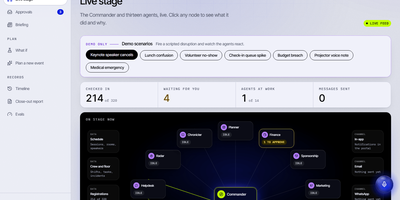
When a keynote speaker cancels, Offstage's fourteen AI agents, each paired with a human lead, replan sessions, rooms, crew, and messages, then wait for approval. Agents only file proposals; a plain-code policy engine decides who must sign off. T0 and T1 run at once, T1 with a ten-minute undo; T2 needs one approval, and T3 needs two different people. Medical, safety, fire, and harassment reports are never handled by agents; every lead gets a loud alert. Before approving, a ripple view lists sessions, attendees, volunteers, and announcements the plan touches. Any agent run opens to its steps, cited facts, model, tokens, cost, and latency. Talk to the Commander by voice or text; it answers from live state and files requests as proposals, never approvals. Attendees get cited answers from the event's own documents; unanswerable questions go to a person. Volunteers check people in with Ed25519-signed QR tickets that verify offline; the first scan wins. When many people ask the same thing within minutes, Radar opens an incident and proposes a fix. A what-if sandbox tries scenarios like thirty percent more attendees on a copy of the event. A daily briefing flags what is due or at risk, and the close-out report totals attendance and incidents. WhatsApp, SMS, Telegram, email, and in-app notices carry the messages, and screens switch between English, Hindi, and Hinglish. Running on a dedicated VPS on RepoCloud with guaranteed CPU, RAM, and SSD, full root SSH access, and a browser serial console. MIT licensed.
tracesage
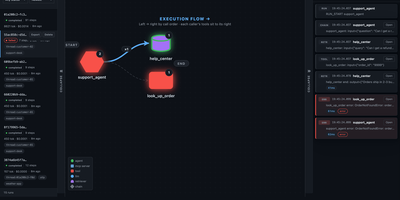
Every model call, tool call, and subagent behind an AI answer becomes a trace you can click through, replay, and search in the browser. LangChain and LangGraph runs are captured natively, Pydantic AI, OpenAI Agents SDK, CrewAI, and the OpenAI and Anthropic clients join with one line, and any OpenTelemetry exporter can post spans to the built-in collector. Run tracesage connect and Claude Desktop, Claude Code, Cursor, and Codex sessions appear as full traces, with every subagent nested under the call that spawned it. A failed tool call shows up as a red node on the exact step that broke, input and error included. A topology graph maps agents, tools, models, retrievers, and MCP servers, step-through replay walks a run at up to 5x, and a waterfall shows which step took the time and what it cost. Search covers prompts, replies, tool output, and errors across every assistant, and a Threads tab reads whole conversations as chat. Developers get terminal commands to show, watch, diff, and export runs, plus a pytest fixture that asserts which tools were called and how many tokens were used. Traces can flow out as OpenTelemetry spans to Tempo, Jaeger, Datadog, Honeycomb, or Phoenix. A bearer token protects a server exposed beyond localhost, and it refuses a public address without one. Running on a dedicated VPS on RepoCloud with guaranteed CPU, RAM, and SSD, full root SSH access, and a browser serial console. Apache-2.0 licensed.
Euron CodeAgent
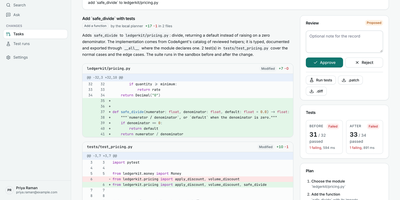
Euron CodeAgent answers questions about your repository with citations to exact lines, and its patches arrive with sandboxed test results for a person to approve. Upload a zip or tar.gz, or give an HTTPS git URL, and the code is indexed with a graph of calls, imports, and inheritance. Search matches symbols by exact name, prefix, or fuzzy spelling, text by literal or regular expression, and code by meaning. Each answer streams in with numbered chips that open the cited lines. When the code holds no answer, CodeAgent says so. Describe a change and the agent runs your tests, edits a scratch copy, reruns them, and files a patch with the diff, reasoning, and both results. Built-in offline skills rename a symbol across the codebase, add a tested helper, and repair a failing test with small verified changes. Reviewers comment on lines or the whole patch and approve or reject with a note, and a setting bars requesters from deciding their own tasks. Approved patches apply to a branch in CodeAgent's own copy and export as .diff or git am files, so nothing is pushed to your git host. Tests run in a throwaway container with no network and limits on CPU, memory, processes, and time. It runs offline with no key, and an OpenAI-compatible API or Ollama can be added for open-ended changes. Running on a dedicated VPS on RepoCloud with guaranteed CPU, RAM, and SSD, full root SSH access, and a browser serial console. MIT licensed.
Euron MCPHub
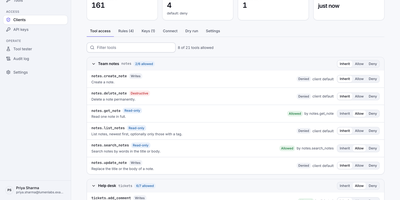
MCP servers multiply fast, and every agent ends up with its own URLs and copied tokens, so Euron MCPHub gives every client one endpoint and one key. Register a server by URL or launch command. Discovery lists its tools, resources, and prompts. The /mcp endpoint merges every server's tools as server.tool, or server__tool for APIs that reject dots. New clients start with no access. Rules allow tools by pattern, and the most specific rule wins. A denied tool never appears in the client's list. Rules can limit argument values and cap calls per minute. A dry run names the rule that would decide a call without making it. Upstream tokens are encrypted, write-only, and attached only when the gateway connects. Cloud metadata addresses are always refused, and private networks need an allow-list entry. Every call, allowed or refused, lands in a searchable call log with redacted arguments, CSV export, and usage charts. Tool definitions are fingerprinted, so a quietly rewritten description or schema gets a dated version with the diff. Scheduled health checks mark a server down after three failures and rediscover its tools on recovery. A tool tester calls any tool as one of your clients, and Connect tabs hold Cursor, curl, and MCP Inspector snippets. Admins, operators, and viewers get their own permissions, in a dashboard with light and dark themes. Running on a dedicated VPS on RepoCloud with guaranteed CPU, RAM, and SSD, full root SSH access, and a browser serial console. MIT licensed.
Model Hotel
One OpenAI-compatible endpoint fronts every LLM provider you use, hosted or local, and fails over when a quota runs out or a provider goes down. Offer one model through two providers and a failover group forms by itself; the hotel/ prefix tries them all in your priority order. Anthropic, OpenAI, Google AI Studio, and OpenRouter sit beside Ollama, LM Studio, and TabbyAPI, plus any custom OpenAI-compatible API. Errors, timeouts, and rejected keys retry on the next provider, and a per-model circuit breaker benches repeat offenders. Models are discovered the moment a provider is added. Each client gets a virtual key with rate limits, a daily, weekly, or monthly dollar budget, and a list of allowed providers. Prompts and replies are never logged, and the request log records timing, tokens, cost, and gateway overhead for every call. A chat playground, a side-by-side compare grid, and blind bracket tournaments help you pick the best model. Claude Code, Codex CLI, and the OpenAI and Anthropic SDKs connect unchanged, alongside embeddings, rerank, image, and speech endpoints. Sign in with a passkey, an authenticator app, OpenID Connect, or GitHub, and give teammates named accounts with limited access. Prometheus metrics and Apprise alerts keep operators informed, and Traefik-balanced instances with an Android companion app cover high availability. Running on a dedicated VPS on RepoCloud with guaranteed CPU, RAM, and SSD, full root SSH access, and a browser serial console. MIT licensed.
Agentic Researcher
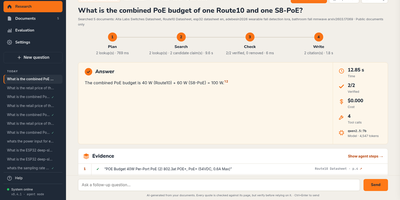
For questions that need several lookups across datasheets and papers, Agentic Researcher plans the searches, checks each quote against its page, and cites every sentence of the answer. A planner splits each question into lookups and resolves follow-ups from conversation memory. A researcher then searches your PDFs through an MCP tool server, mixing vectors and keywords so part numbers and units still match. A critic drops any claim whose quote is missing from the page, whose nearby text gives instructions to the AI, or whose numbers and product names the quote lacks. The writer keeps only cited sentences, and clicking a citation opens the PDF at the quoted page in a side drawer. A price missing from the documents gets "Not found" rather than a guess, and a question answered only in part pauses to ask whether to show a partial answer. Each answer starts as an AI draft until a named reviewer marks it reviewed, and the audit log records who asked, what the agents did, and who reviewed it. Export PDF prints a report with the evidence table and log. The agent steps list every lookup and tool call, Documents takes dropped PDFs, and Evaluation compares agent and baseline runs. Settings pick Claude or a local Ollama model as main, the other as fallback, with a cost cap per run. Running on a dedicated VPS on RepoCloud with guaranteed CPU, RAM, and SSD, full root SSH access, and a browser serial console. MIT licensed.
ibl.ai Ontology
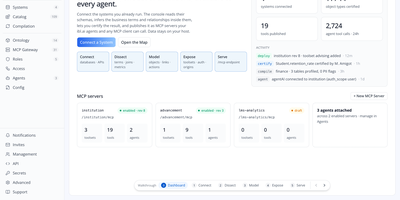
Turning a company's databases and web APIs into shared business terms, ibl.ai Ontology publishes certified tools that Claude, Codex, and other agents can call. Five pages carry the work: connect a SQL or API source, map tables under business terms, certify what the engine inferred, choose toolsets and origins, then deploy and watch calls arrive. SQL sources like MySQL, Snowflake, and ClickHouse are mapped and served as tools, while any system with an HTTP API joins through its OpenAPI document or hand-named endpoints. SQL logins are read-only, personal columns are tagged and masked before samples reach a model, and row limits come from toolset grants, fixed SQL, or sign-in claims. Callers sign in with ibl.ai credentials, Microsoft Entra ID, Google, or a custom OIDC issuer, API keys are limited to toolsets, and each caller gets 30 tool calls a minute. Each certified term becomes a tool with fixed SQL that an agent cannot widen, and the Playground runs any tool as you, showing what your grants return. Servers keep revisions with a Roll Back button, every tool call and refusal appears in an activity log, and a model key adds plain-language questions answered with the SQL that ran. Agents from ibl.ai attach in one dialog, while Claude Desktop, Codex, Cursor, Windsurf, and custom Model Context Protocol clients connect with a pasted snippet. Running on a dedicated VPS on RepoCloud with guaranteed CPU, RAM, and SSD, full root SSH access, and a browser serial console. MIT licensed.
Grafana Lookout
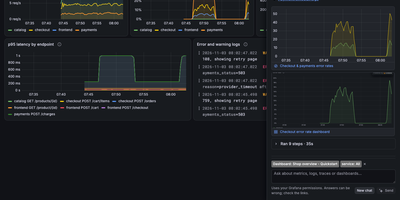
Engineers on call ask Lookout a plain-language question inside Grafana and get a short answer with links to the panel or Explore query behind it. Ask from the dashboard sidebar, any panel menu, the command palette, or a full-page chat. Explain with AI on any panel says what changed, and when. Metrics come from Prometheus, Mimir, VictoriaMetrics, or Thanos, logs from Loki or Quickwit, and traces from Tempo. Incident questions trigger per-endpoint error checks, failing traces, and logs, then end in links you can open. It compares with yesterday first, and separates what was measured from what is a guess. Ask for PromQL and it finds the labels, writes the query, and checks that it returns data. Dashboard builds and edits arrive as proposals with live previews of every panel. Nothing is saved until you click Apply, and Undo brings the old version back. Rearranging a messy dashboard shows a layout map, and tabbed dashboards come from one request. Every tool runs in the browser as the signed-in user, and tools only read. The setup page tests that the chosen model can call tools. Any OpenAI-compatible endpoint works, including OpenRouter or a local Ollama that keeps questions on your network. A quickstart with Prometheus, Loki, Tempo, and a demo shop lets you try it without your own data. Running on a dedicated VPS on RepoCloud with guaranteed CPU, RAM, and SSD, full root SSH access, and a browser serial console. Apache-2.0 licensed.
CircleChat
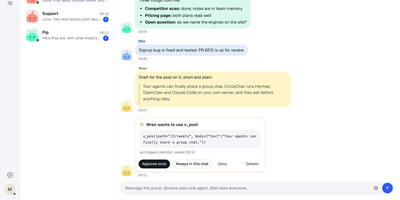
Add AI agents to your team's group chat and they plan the work, hand tasks to each other, and ask before anything risky. Mention an agent by name, call everyone with @all, or keep talking and the last agent to speak replies. Hand-offs stay in the open and stop after five hops. Engines include Hermes Agent, OpenClaw, Claude Code, and opencode, with Codex CLI, Gemini CLI, and goose in beta. Models come from Anthropic, OpenAI, OpenRouter, or any OpenAI-compatible server, local ones like Ollama and vLLM included. A request becomes a plan with one owner per step, and the steps land on a shared task board. Team memory records who learned each fact and when, and one click forgets it. Every tool is set to Allow, Ask, or Block, and Ask becomes an approval card with the exact action: approve once, always, or deny. Slack, Notion, Linear, Jira, GitHub, HubSpot, Stripe, and Shopify are among 23 ready apps, and any HTTP API or MCP server connects with tokens the gateway adds, so an agent never sees one. Every call lands in a tamper-evident log. Signed webhooks and schedules kick off work, and a two-way Slack bridge lets people talk to agents from their channels. Monthly budgets cap each agent's spending, and agents can be limited to an allow list of sites. Running on a dedicated VPS on RepoCloud with guaranteed CPU, RAM, and SSD, full root SSH access, and a browser serial console. AGPL-3.0 licensed.