Categories
Self-Hosted Developer Tools Knowledge Graph Model Context Protocol Vector Search LLM Infrastructure AI Agent Memory Hybrid RetrievalDeveloper links
Spector
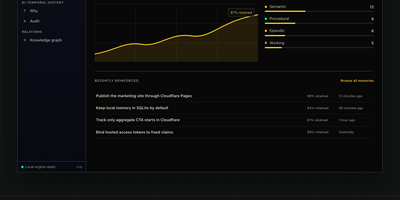
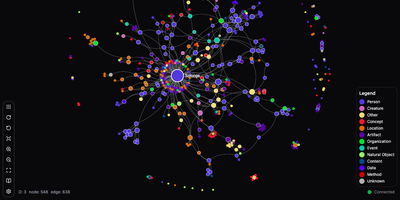
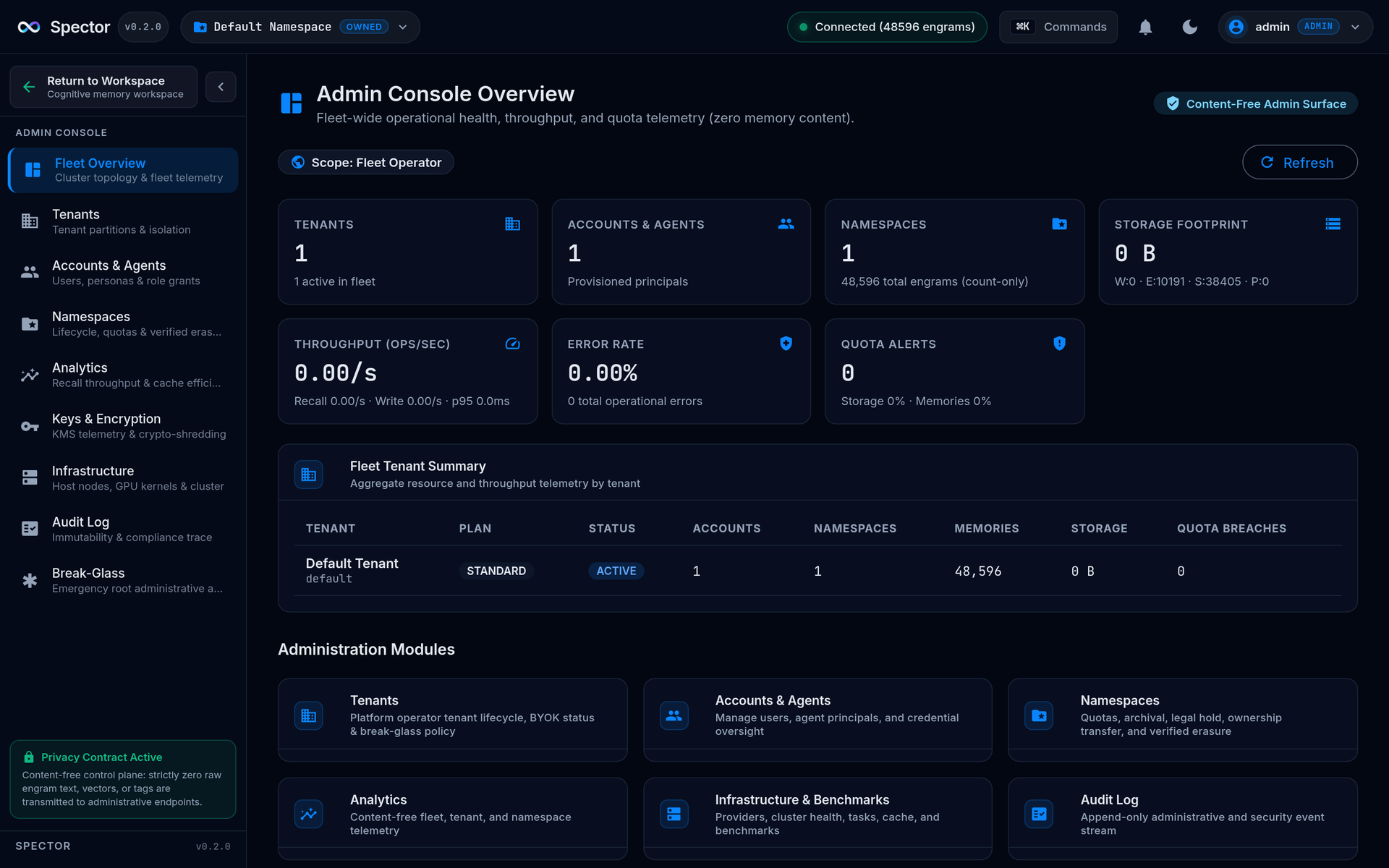
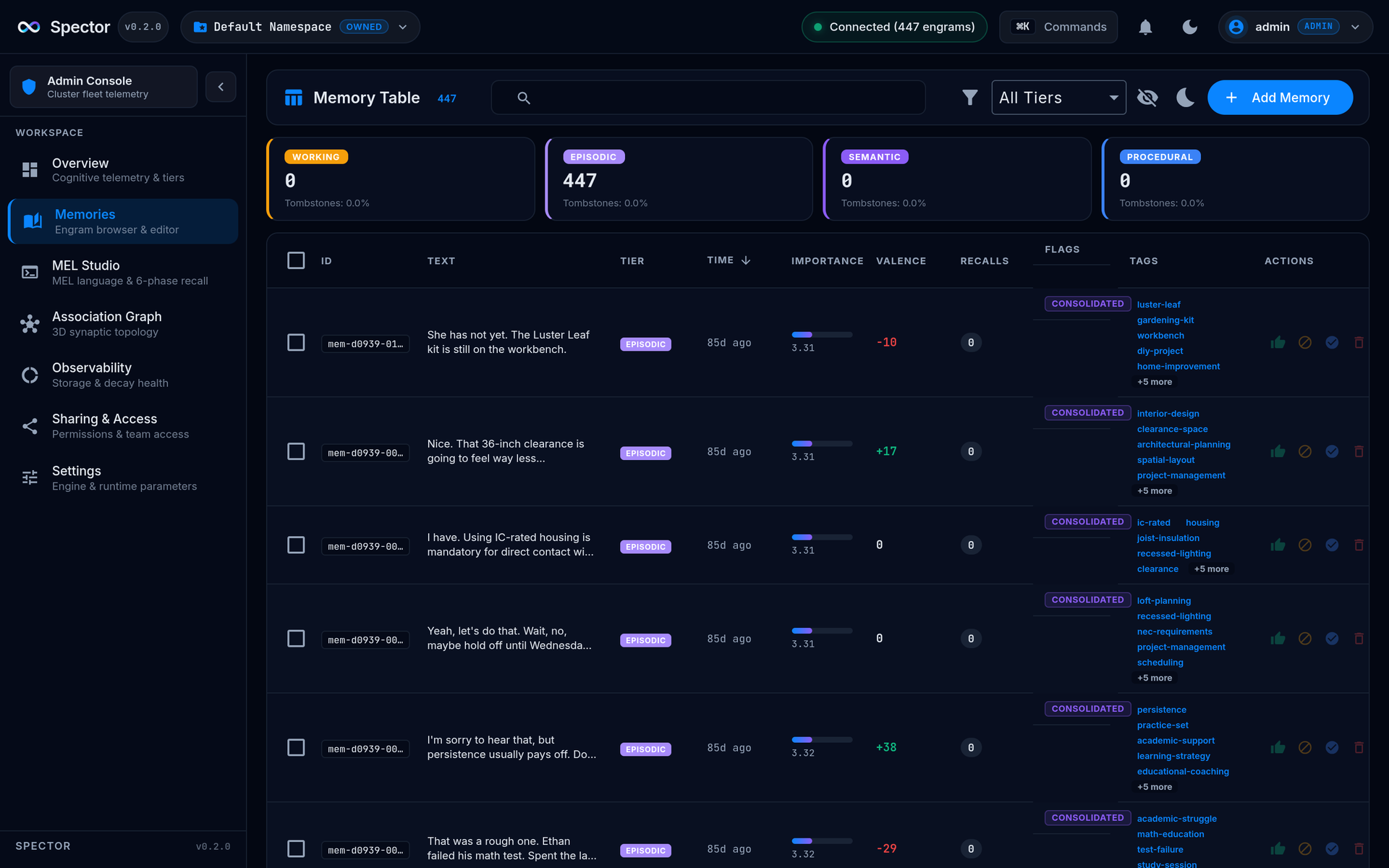
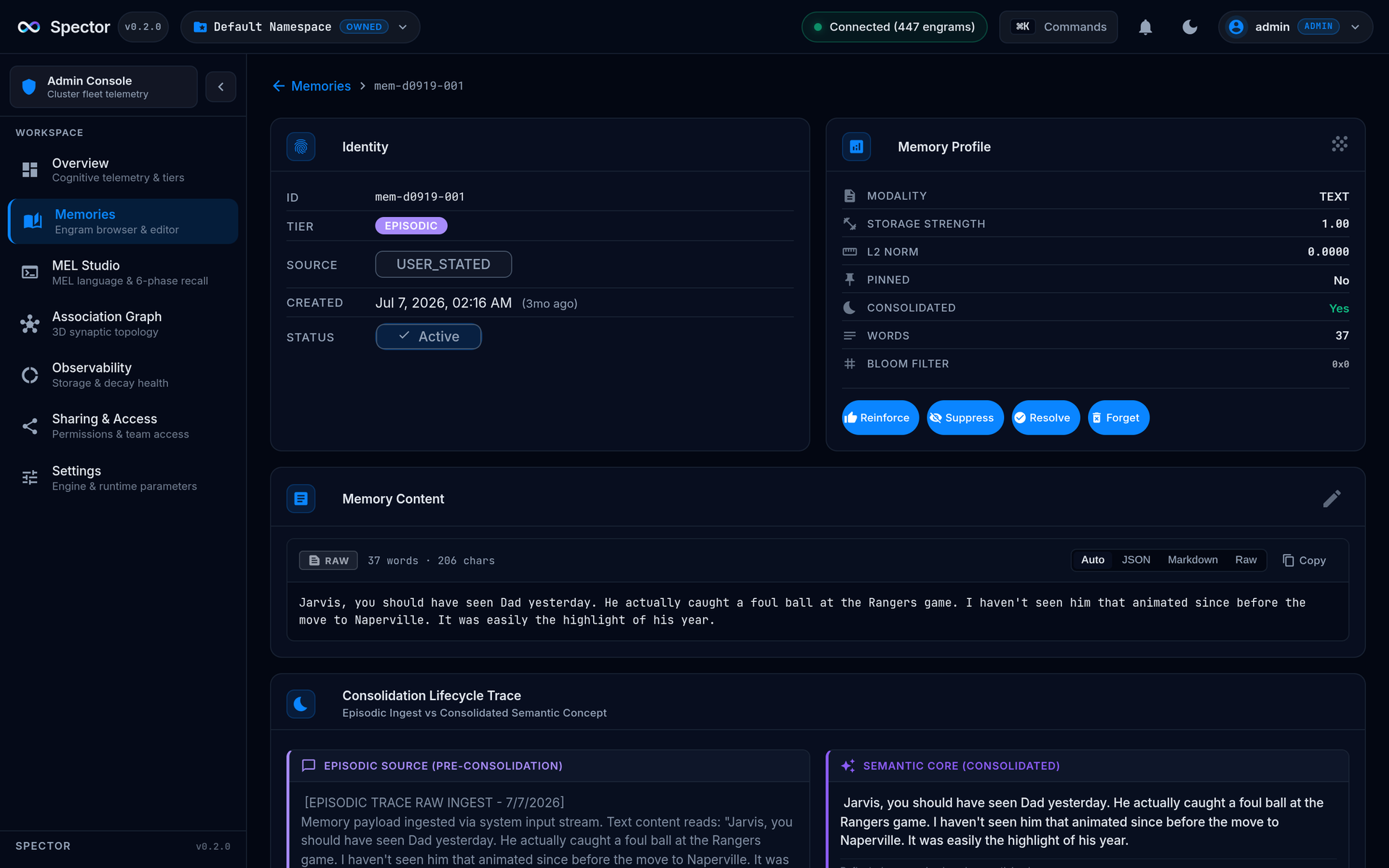
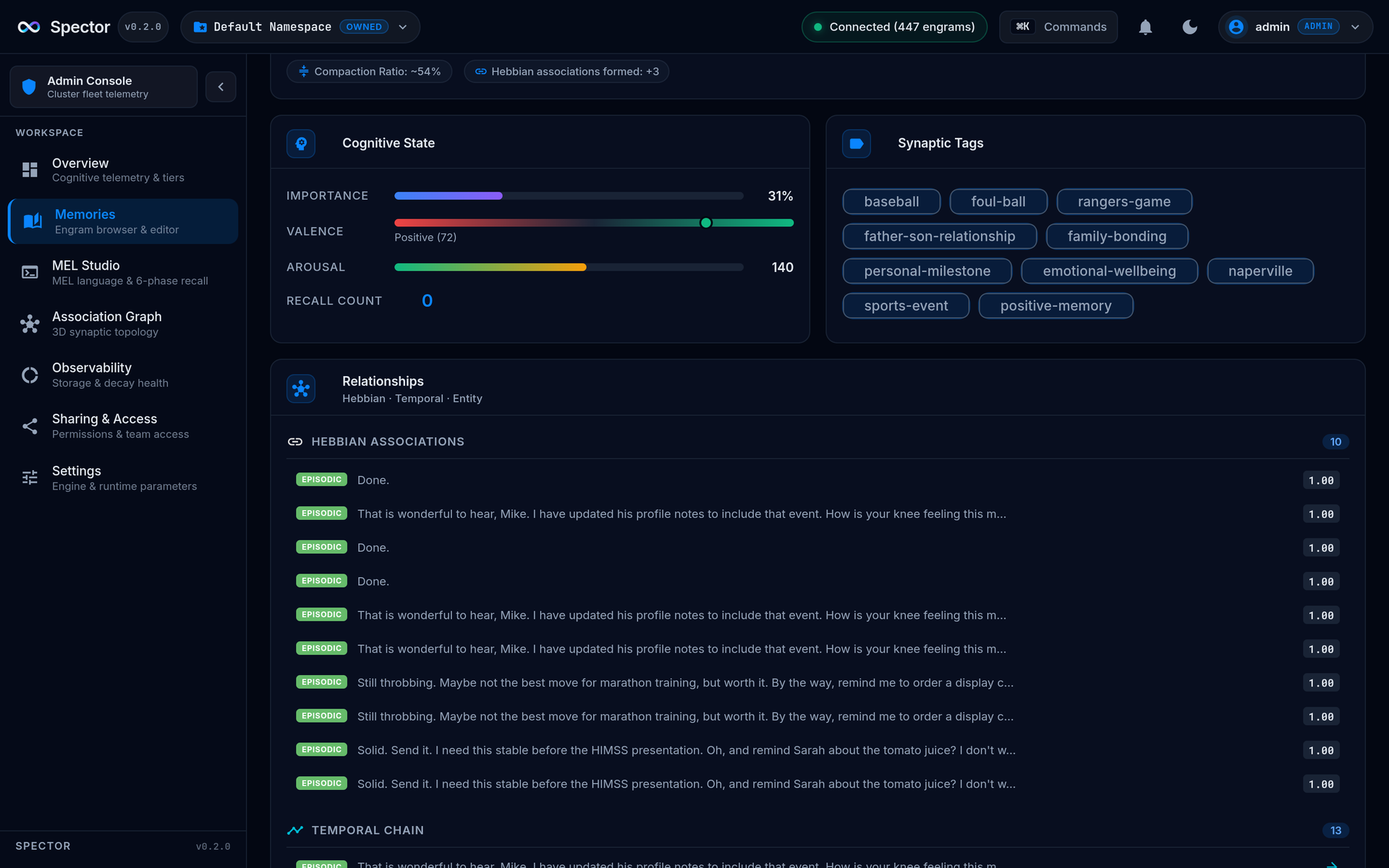
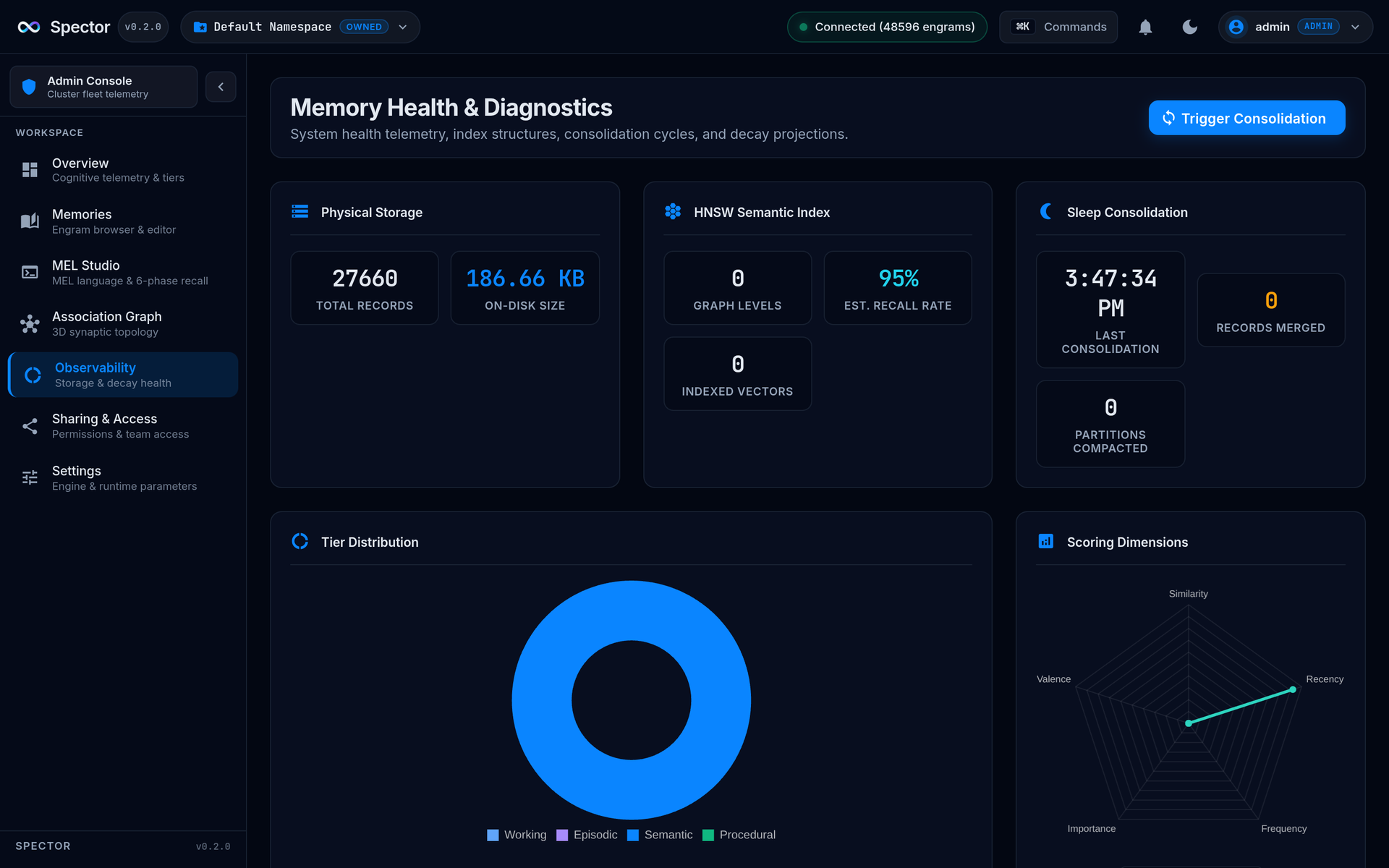
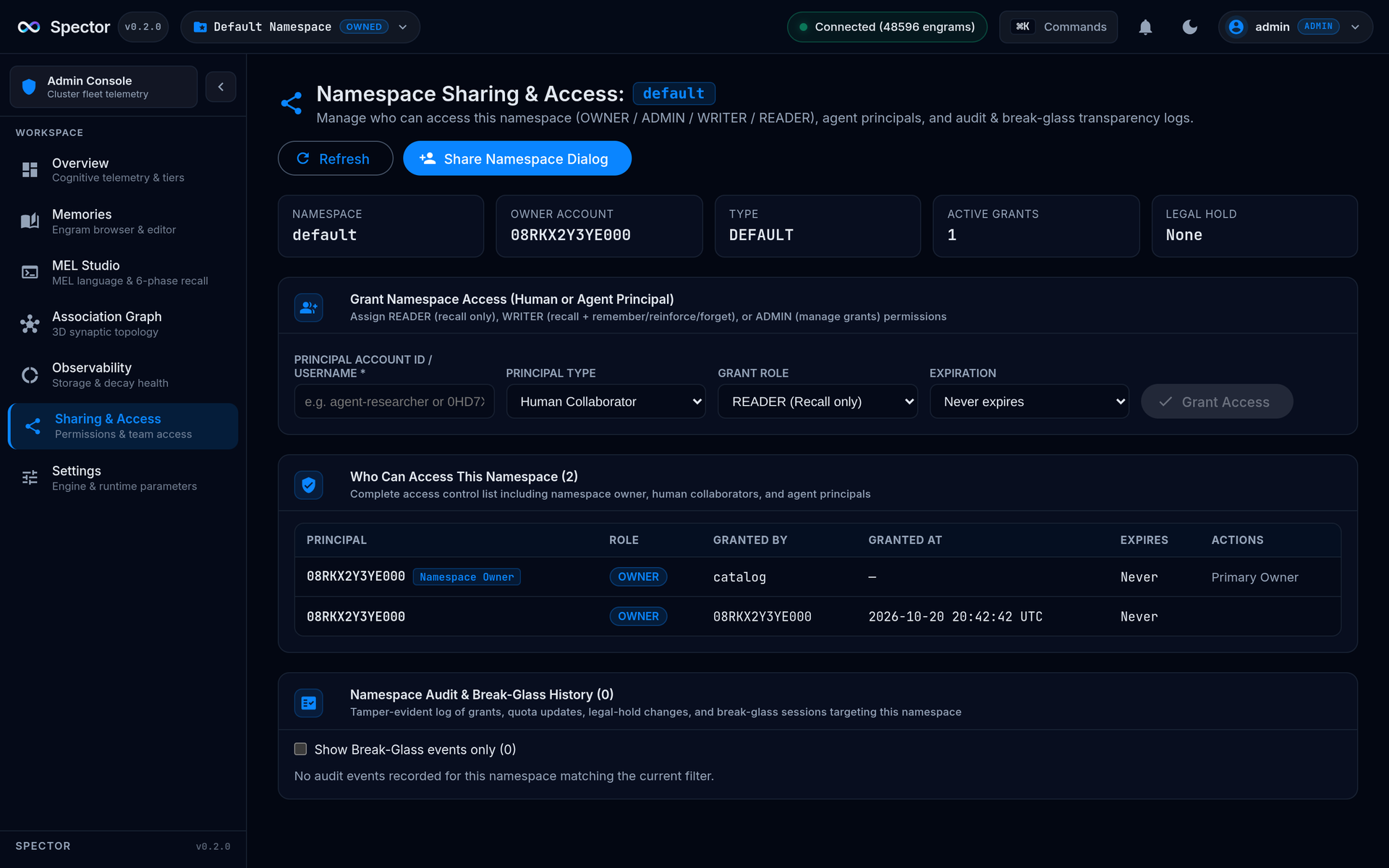
Spector is a cognitive memory engine for AI agents that remembers, forgets, consolidates, and links related memories rather than just storing vectors. Memories live in four tiers, working, episodic, semantic, and procedural, and sleep consolidation distills repeated events into lasting facts. Unused traces fade along a power-law forgetting curve, while reused ones stay reachable. Co-activation, temporal, and entity links join memories, so a query surfaces related context and not only close matches. Recall fuses dense, sparse, and keyword scores with importance and age, then reranks the candidates. Claude Desktop, Cursor, Windsurf, and Claude Code attach through Model Context Protocol tools for remembering, recalling, reinforcing, and forgetting, while apps use REST, gRPC, or client libraries. Each user, agent, or tenant gets its own encrypted on-disk namespace, and sharing runs through owner, admin, writer, and reader grants. The Cortex dashboard draws the association graph in 3D, browses and edits memories, and charts storage, index health, consolidation, and decay. A content-free admin console manages tenants, quotas, keys, and break-glass access without ever exposing memory text. Embeddings come from Ollama, OpenAI, Google, Mistral, Azure, Bedrock, or an ONNX model, and the project ships container images for amd64 and arm64 plus a Helm chart. Running on a dedicated VPS on RepoCloud with guaranteed CPU, RAM, and SSD, full root SSH access, and a browser serial console. Apache-2.0 licensed.

Benefits
- Memory that fades and consolidates
- Recall scores weigh similarity, importance, valence, and age, unused traces decay along a power-law curve, and sleep consolidation promotes clusters of repeated episodes into semantic facts, so agent memory stays relevant.
- Agents connect with one command
- Claude Desktop, Cursor, Windsurf, and Claude Code register Spector through npx -y @spectrayan/spector mcp, while remote agents reach the same tools over Streamable HTTP at the /mcp endpoint on port 7070.
- Each tenant gets isolated storage
- Every user, agent, or tenant keeps memories in its own on-disk directory tree, hash-sharded and encrypted with AES-256-GCM at rest, so separation is physical rather than a query filter.
- Admins never see memory content
- The admin console covers tenants, accounts, namespaces, quotas, keys, infrastructure, and break-glass access, while a privacy contract keeps raw memory text, vectors, and tags out of administrative endpoints.
Features
- Java 25 Memory Kernel
- Project Panama off-heap storage with a write-ahead log and Vector API SIMD scoring run in one Java 25 process, with no external database.
- REST, gRPC, and MCP Gateway
- Spring Boot and Armeria serve REST and gRPC plus MCP over stdio and Streamable HTTP, with client packages on PyPI and npm for Python and TypeScript.
- Hybrid Retrieval Pipeline
- HNSW dense vectors, SPLADE sparse terms, BM25 keywords, and late-interaction reranking merge through reciprocal rank fusion, with SVASQ and IVF-PQ quantization and optional CUDA.
- Angular and Three.js Cortex
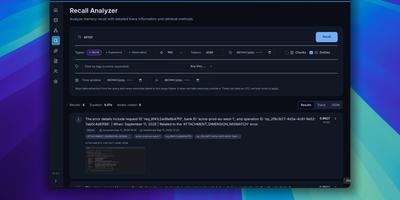
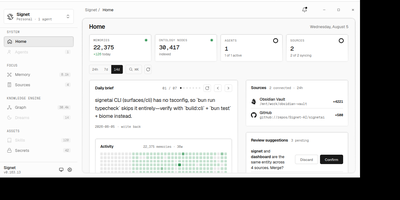
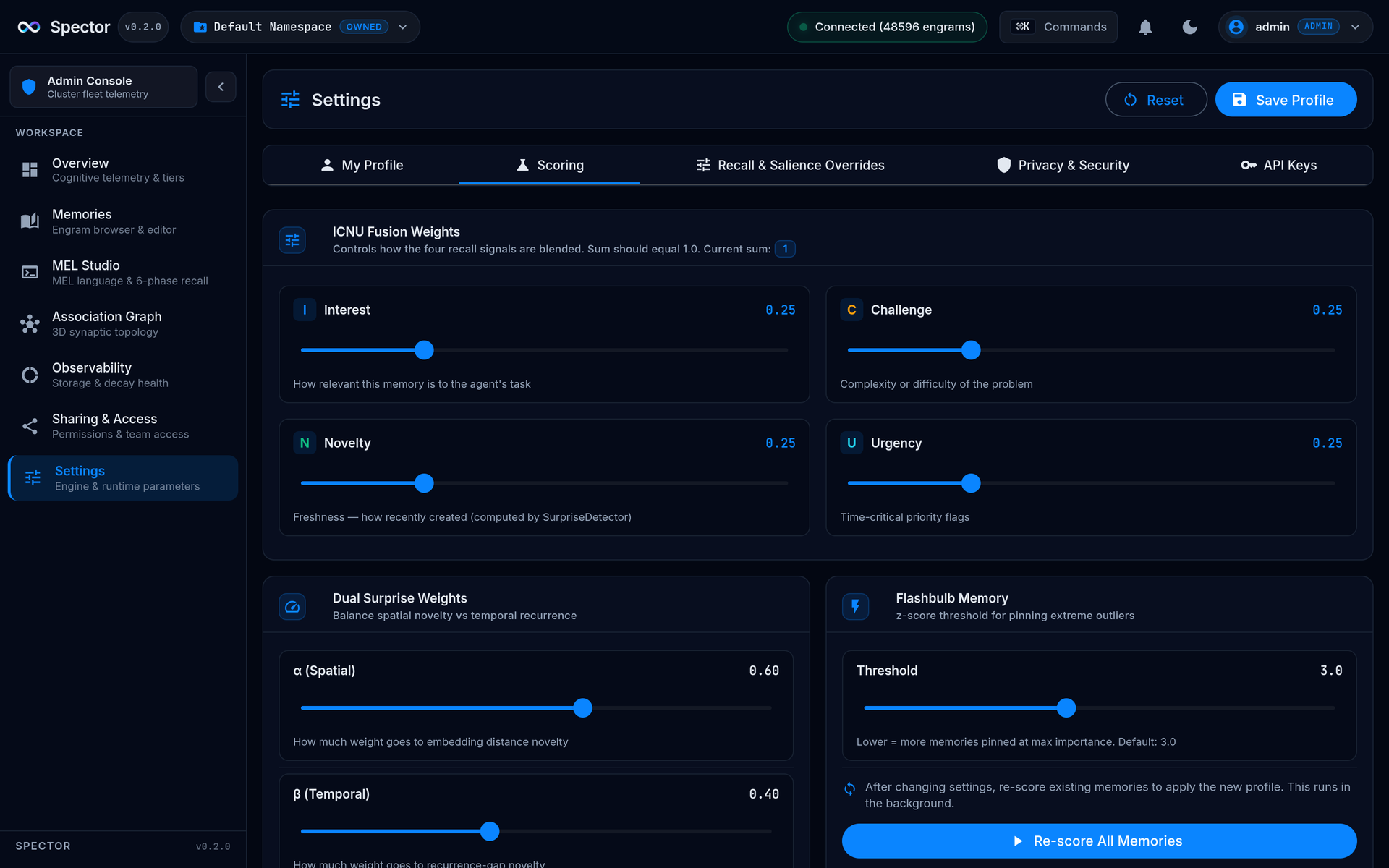
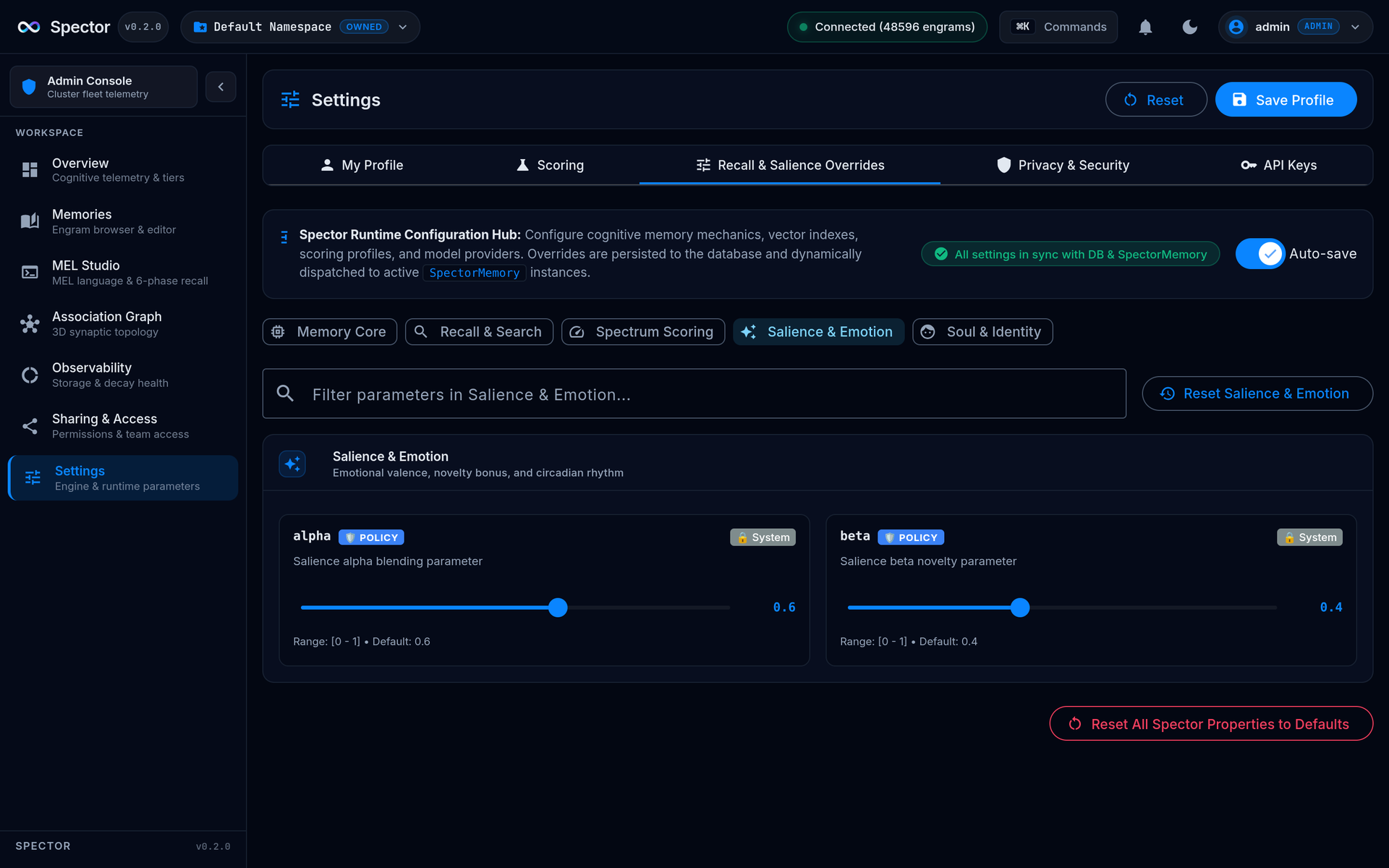
- An Angular 22 dashboard with Three.js renders the 3D association graph, memory table and detail views, MEL Studio recall workbench, health diagnostics, and scoring, salience, and soul settings.
- Provider-Agnostic Embeddings
- Ollama, OpenAI, Google, Mistral, Azure, Bedrock, and ONNX embedding providers are set through SPECTOR_EMBEDDING_PROVIDER, with nomic-embed-text at 768 dimensions as the default.
- Compose and Helm Deployment
- A compose file starts the engine on port 7070 and Cortex on 7700, with an optional Ollama profile, and an OCI Helm chart on GHCR deploys Spector to Kubernetes.