Dashy
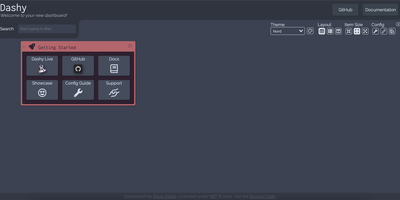
Every service you run, behind one polished start page: Dashy is the most customizable homelab dashboard, built as a Vue.js homepage. Configuration lives in a single YAML file, but you never have to hand-edit it: an integrated UI editor with real-time validation writes changes back to disk, so both config-as-code and point-and-click camps are served. Status indicators put a live health dot next to every app - HTTP checks or pings on custom intervals, with response time and status details on hover - giving you an at-a-glance uptime overview before anything breaks. Over 50 built-in widgets pull dynamic content from the services you already run: Pi-hole and AdGuard block stats, Proxmox lists, Nextcloud status, Netdata CPU/memory history, Prometheus data, plus weather, RSS, crypto prices, and generic iframe/API-response widgets for anything with an endpoint. Instant fuzzy search launches any app as you type, with customizable hotkeys and web-search fallthrough. Theming is deep: dozens of built-in themes, a UI color palette editor, and custom CSS over CSS variables. Alternate views include a fast-loading minimal startpage and a workspace view that embeds apps side-by-side without leaving the dashboard. Icons resolve from Font Awesome, homelab icon packs, emojis, or auto-fetched favicons. Built-in authentication, multi-page support, cloud backup/sync, and multi-language round out an MIT project with a massive community.

Kaneo
With nearly 8,000 GitHub stars since its December 2024 launch, Kaneo has rapidly gained traction as the minimalist alternative to bloated project management platforms like Jira and Linear. Built on TypeScript with React and Hono, the interface strips away complexity to focus on execution — plan in list view, track in kanban board, and schedule on interactive Gantt chart timelines where dragging bar handles adjusts start and due dates with optimistic UI updates. Native GitHub integration synchronizes issues bidirectionally, links pull requests to tasks, and keeps product planning aligned with development execution without context switching. The built-in Model Context Protocol server at /api/mcp enables AI tools like Claude and Cursor to manage tasks, projects, and labels directly, while the official @kaneo/mcp npm package provides stdio access for local MCP clients. Authentication supports password, magic link, GitHub OAuth, and Google sign-in with organization-level access management. Rich text editing for task descriptions and comments, label-based initiative grouping, priority levels, assignee management, and due date tracking provide focused planning without ceremony. Deploy with the drim CLI for automatic HTTPS and database setup, Docker Compose for custom configurations, or Helm charts for Kubernetes clusters — all requiring just 2GB RAM and PostgreSQL. Running on a dedicated VPS on RepoCloud with guaranteed CPU, RAM, and SSD, full root SSH access, and a browser serial console. MIT licensed.
LibreTranslate
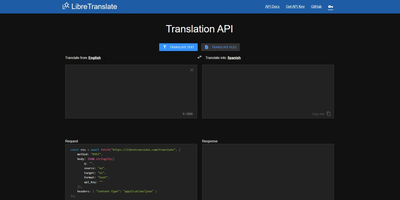
Machine translation with no Google, no Azure, no per-character billing, and no text leaving your infrastructure: LibreTranslate is a free, open-source translation API that runs entirely on your own server. The engine underneath is Argos Translate, which runs OpenNMT neural models with SentencePiece tokenization and Stanza sentence-boundary detection, all offline. Models install as portable .argosmodel packages covering dozens of languages - English, Spanish, French, German, Chinese, Japanese, Russian, Arabic, Hindi, Portuguese, and many more - and Argos handles automatic pivoting: with es-to-en and en-to-fr installed, it chains them to translate es-to-fr without a direct model. The API is a straightforward HTTP POST to /translate with source and target language codes, returning JSON - simple enough that the ecosystem has clients in every major language and integrations across tools like Weblate and Mastodon. Beyond plain text it translates HTML while preserving markup and handles whole file uploads (documents in, translated documents out), plus automatic language detection when the source is unknown. A clean bundled web UI serves interactive translation for end users, and optional API keys with rate limits control access. AGPL-licensed and trainable with custom models, it is the standard answer when translation must be private, unmetered, and self-contained - GDPR-sensitive text never touches a third party.
CubeJS
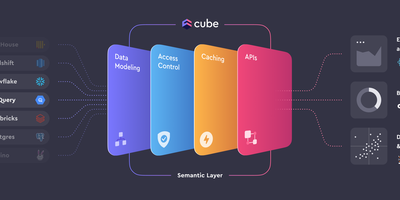
Between your databases and everything that consumes data - BI tools, embedded analytics, AI agents - sits Cube (formerly Cube.js), an open-source semantic layer. Metrics, dimensions, joins, and access rules are defined once as code in YAML, JavaScript, or Python, forming a governed data model that every downstream consumer shares, so "revenue" means the same thing in every dashboard. Caching is two-level: an in-memory cache absorbs bursts of identical queries, and declared pre-aggregations - rollup tables built in the warehouse or in Cube Store, Cube's distributed columnar engine, and refreshed in the background - deliver sub-second latency while cutting warehouse compute costs. The query planner routes each request to cache, rollup, or source automatically. Consumers connect through a Postgres-compatible SQL API (any tool that speaks Postgres works), plus REST, GraphQL, and a Meta API for model introspection. Row-level security and multi-tenancy are enforced in the layer itself, upstream of every client. Sources include Snowflake, BigQuery, Databricks, Postgres, MySQL, Presto, and Athena. Headless by design - bring your own UI.
Zitadel
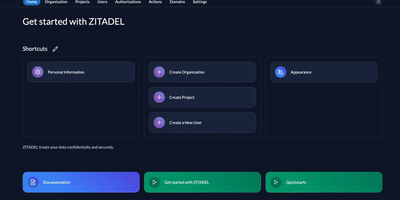
Securing a SaaS product, running B2B onboarding, or replacing Auth0 and Keycloak with a stack they own - teams needing more than basic auth reach for ZITADEL, an open-source identity and access management platform built in Go. Its multi-tenancy model is the differentiator: a strict Instance, Organization, Project hierarchy isolates data and scopes policy at each level, with identity brokering (pre-built templates for Google, GitHub, Microsoft, Apple, plus generic OIDC, OAuth, SAML, and LDAP), domain discovery that routes users to the right organization by email domain, and delegated management so customers administer their own users and roles. Authentication covers OpenID Connect (certified, including device authorization and token exchange), SAML 2.0 as both IdP and SP, SCIM, FIDO2 passkeys for phishing-resistant passwordless login, and MFA via OTP, email, SMS, and U2F; machine-to-machine flows support JWT profile, PATs, and client credentials. The architecture is event-sourced - every mutation is an immutable event, yielding a complete audit trail - with relational projections for queries and no external session store, so it scales horizontally. API-first with gRPC and REST, extensible via Actions webhooks, and the same codebase self-hosted (Docker Compose or Helm on PostgreSQL) as in the cloud.
Evolution API
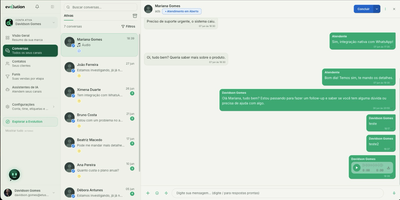
Evolution API gives your applications a production-ready REST interface to WhatsApp, supporting both free Baileys-based Web connections and Meta's official Business Cloud API from the same server. With 9,200+ stars and 7,100+ forks, it is the most widely deployed WhatsApp integration layer available. Each installation handles unlimited isolated instances (one per phone number) with independent auth, webhooks, and database separation via Prisma ORM against PostgreSQL or MySQL, cached through Redis. Message types include text, images, audio, video, documents, contacts, locations, interactive buttons, list messages, carousel cards, and PIX payment links through unified endpoints. Native integrations connect to Typebot for chatbot flows, Chatwoot for multi-agent support, Dify and OpenAI for AI conversations, N8N and Flowise for workflow automation, and RabbitMQ, Kafka, or SQS for enterprise event streaming. Socket.io delivers real-time message and connection events. Amazon S3 or MinIO handles media offloading. The Evolution Manager v2 dashboard provides visual instance creation, QR code scanning, connection monitoring, and integration configuration without touching the API directly. Docker Compose bundles the server, PostgreSQL, and Redis with environment-variable-driven setup. Running on a dedicated VPS on RepoCloud with guaranteed CPU, RAM, and SSD, full root SSH access, and a browser serial console. Apache 2.0 licensed.
QM
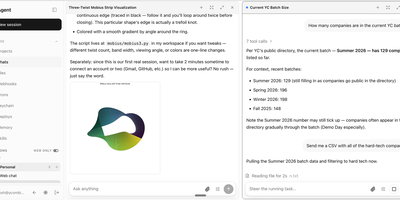
QM is Y Combinator's internal multiplayer agent infrastructure that shifts AI agents from personal assistants to shared company operating layer. The headless TypeScript core runs on Node.js with Fastify handling HTTP, Slack integration via Bolt, and a web UI built with Vite and Lit. PostgreSQL stores sessions, memory, queue state, and audit logs. Every person and every Slack channel gets an isolated sandbox with its own durable file system, installed tools that persist across runs, private memory, keychain view, permissions, and background crons. The harness-agnostic architecture routes agent tasks through Pi, OpenCode, Codex, or Claude Code without vendor lock-in, with production implementations swapping via a single wiring file. Three org-level security postures gate execution: Strict requires human approval for every tool call, Auto applies automated content screening, and Dangerous removes all pauses. Skills are scope-owned and shareable by grant, with admin-gated promotion to the entire organization and skill packs importable from Git repositories. The web apps feature lets agents spin up custom internal applications published to specific users. The qm CLI bootstraps operator-owned deployment directories with digest-pinned release images, infrastructure rendering, secret management, and live verification checks for Docker, Fly.io, or AWS ECS Fargate targets. On RepoCloud, deploy QM on a dedicated VPS with PostgreSQL persistence, Docker socket access, root SSH access, and complete control over your multiplayer agent infrastructure, all under the MIT license.
MaxKB
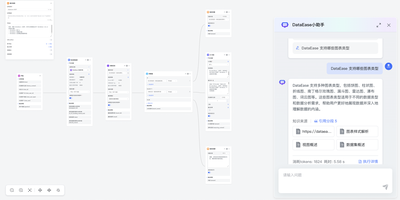
Support teams, IT departments, and researchers can put their own documents behind chatbots and AI agents built with MaxKB, an open-source platform that grounds answers in private knowledge. A support lead starts by uploading Markdown, DOCX, PDF, TXT, HTML, XLSX, XLS, or CSV files, or by syncing a web site, and MaxKB splits, vectorizes, and indexes the content on its own. An IT department can place the finished agent in any third-party site or internal tool with no coding, as a full-screen page, a mobile view, or a floating chat window. Researchers get replies that show, and let them download, the knowledge sources behind each answer. Simple agents pick tools, skills, and MCP connections from the question itself, while advanced agents are drawn as workflows with branching, multi-path recall, loops, and variables. Custom scripts, which AI can help write, plus schedules and event triggers extend what an agent can do. The model manager registers local models such as DeepSeek, Llama, and Qwen beside providers such as OpenAI, Claude, and Gemini, across language, embedding, reranking, vision, speech, and image generation. Conversation logs feed analysis for operations. Dozens of ready-made agent templates, knowledge base templates, tools, and skills in the template center and tool store shorten the first build. Running on a dedicated VPS on RepoCloud with guaranteed CPU, RAM, and SSD, full root SSH access, and a browser serial console. GPL-3.0 licensed.

Calibre-Web
With over 17,700 GitHub stars and continuous development since 2015, Calibre-Web has become the definitive self-hosted digital library solution for book enthusiasts who want beautiful web access to their Calibre collections. The responsive Bootstrap 3 interface delivers instant browsing, searching, and filtering across titles, authors, tags, series, book formats, and languages, with custom shelves for organizing personal reading collections. In-browser reading supports EPUB, PDF, TXT, CBR, CBT, CBZ, and DJVU formats with a configurable EPUB reader featuring multiple themes and page location tracking, while one-click email delivery sends books directly to Kindle, Kobo, and other E-Readers without leaving the interface. Native Kobo sync lets Kobo device owners synchronize their entire Calibre library wirelessly, maintaining reading progress and bookmarks across devices. Metadata management includes editing capabilities with automatic metadata downloading from Google Books, Amazon, and other configurable sources, plus eBook format conversion through Calibre binaries for on-the-fly EPUB, MOBI, AZW3, and PDF conversion. User management provides fine-grained per-user permissions controlling download access, upload rights, editing capabilities, and content visibility based on categories or Custom Column values. Authentication supports local accounts, LDAP directory integration, Google and GitHub OAuth, proxy authentication, and Magic Link login for easy E-Reader access. The OPDS catalog feed enables any compliant E-Reader app to browse and download from the library. Running on a dedicated VPS on RepoCloud with guaranteed CPU, RAM, and SSD, full root SSH access, and a browser serial console. GPL-3.0 licensed.
Akaunting
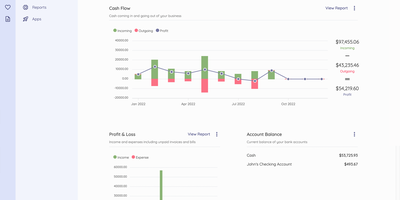
Akaunting is an online accounting software for small businesses and freelancers. The double-entry accounting engine provides a full Chart of Accounts, journal entries, and balance sheet reporting, eliminating the manual errors inherent in single-entry systems. Unlimited invoice creation with customizable templates, automatic payment reminders, and client portal access lets businesses present professional documents and accept payments through PayPal, Stripe, and other gateway integrations. Expense tracking captures operational costs with category-based organization, receipt scanning, and vendor bill management with overdue payment alerts. Bank Feeds auto-syncs transactions from connected bank accounts and matches them against invoices and bills for streamlined reconciliation. The dashboard displays receivables, payables, cash flow summaries, profit and loss charts, expenses by category, and account balances at a glance with configurable date ranges. Quotes and estimates convert directly into invoices upon client approval, while recurring invoices and bills automate periodic billing without manual intervention. The modular architecture built on Laravel with the Akaunting Module package enables an App Store where developers publish extensions for payroll, inventory, projects, and CRM functionality. Multi-company support manages separate books from a single installation with per-company user roles. Running on a dedicated VPS on RepoCloud with guaranteed CPU, RAM, and SSD, full root SSH access, and a browser serial console. BSL licensed.
FireFlyIII
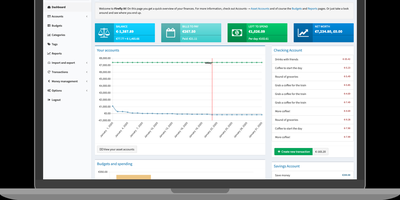
With over 24,000 GitHub stars and active development since 2014, Firefly III is the self-hosted personal finance manager that gives you complete control over your financial data without ever contacting external servers. The double-entry bookkeeping system tracks every transaction with source and destination accounts, ensuring accurate balance calculations and audit trails across checking, savings, credit card, cash, and asset accounts. Budget management sets monthly spending limits by category with visual progress tracking and rollover support for unused allocations. Rule-based transaction automation applies categorization, tags, and budget assignments automatically based on configurable conditions matching description, amount, source, and destination patterns. Recurring transactions schedule regular bills, subscriptions, and income entries with automatic creation on configured dates. Piggy banks divide savings accounts into virtual sub-accounts for goal tracking with target amounts and deadlines. Financial reports include income versus expense summaries, budget performance charts, category breakdowns, tag reports, and net worth tracking with weekly, monthly, and yearly time ranges. Multi-currency support handles any currency with configurable exchange rates for international finance tracking. The REST JSON API covers nearly every feature for integration with external tools, import utilities, and the companion Firefly III Data Importer for bank statement processing. Two-factor authentication provides account security. Self-hosting deploys via Docker containers or directly on PHP 8.5+ with MySQL or PostgreSQL. Running on a dedicated VPS on RepoCloud with guaranteed CPU, RAM, and SSD, full root SSH access, and a browser serial console. AGPL-3.0 licensed.
Local Deep Research
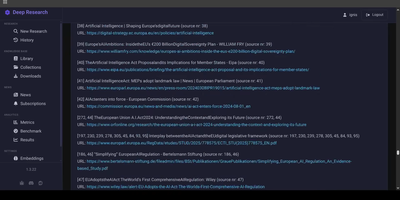
Execute comprehensive multi-angle investigations across scientific journals and web repositories using Local Deep Research, an autonomous intelligence engine designed for researchers, analysts, and knowledge workers. Users can submit complex analytical questions through a self-hosted web console to initiate agentic research cycles powered by LangGraph workflows. The application dynamically queries search providers including SearXNG, arXiv, PubMed, Wikipedia, and Google, iteratively evaluating discovered content to formulate targeted follow-up queries. Discovered academic papers and web sources can be indexed into an encrypted personal library to combine internal documentation with external search intelligence. Reports are synthesized with structured outlines, section headings, and verifiable academic citations that link directly to source references. Individual research sessions, system logs, and user credentials remain isolated in per-user SQLCipher databases protected by AES-256 encryption. Automated subscriptions deliver scheduled news digests and topic monitoring summaries directly to connected notification channels. Running on a dedicated VPS on RepoCloud with guaranteed CPU, RAM, and SSD, full root SSH access, and a browser serial console. MIT licensed.
OpenSearch
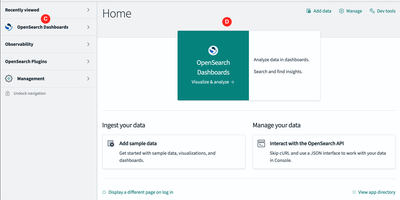
OpenSearch is a search and analytics platforms, powering full-text search, log analytics, observability, and AI-powered vector retrieval at petabyte scale. The distributed engine provides BM25 full-text search alongside k-NN vector search using NMSLIB, Faiss, and Lucene libraries, enabling semantic search, hybrid search combining keyword and vector scoring through normalization processors, neural sparse search, and retrieval-augmented generation workflows with built-in ML Commons for model hosting. OpenSearch Dashboards delivers interactive visualization with Discover for log exploration, custom dashboards, alerting, anomaly detection using Random Cut Forest algorithms, and Security Analytics with detection rules mapped to MITRE ATT&CK. Native Prometheus integration with full PromQL support unifies metrics alongside logs and traces in a single observability interface, while Data Prepper handles telemetry ingestion from OpenTelemetry collectors, Fluent Bit, and Logstash-compatible pipelines. SQL and Piped Processing Language queries with a visual PPL builder enable analysts to query data without learning the native DSL. Index State Management automates index lifecycle with rollover, shrink, and delete policies, while cross-cluster replication and searchable snapshots on S3-compatible storage provide disaster recovery. Scoped API keys, field-level security, document-level security, and audit logging deliver enterprise-grade access control. Docker Compose deploys multi-node clusters alongside the Kubernetes operator for orchestrated production environments. Running on a dedicated VPS on RepoCloud with guaranteed CPU, RAM, and SSD, full root SSH access, and a browser serial console. Apache 2.0 licensed.
OpenTakeoff
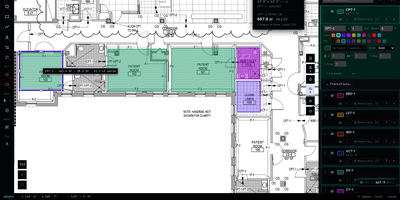
From a PDF plan set to a waste-adjusted material order takes one browser tab: OpenTakeoff measures floors, walls, and fixtures at the drawn scale and never uploads a single drawing. Drag in a PDF, image, or zip plan set, view up to four sheets side by side, and search sheet text, while stitching joins floors split across a match line. Scale comes from the drawn scale note or a known dimension, and a check tool reports percent error before a wrong scale can skew a bid. Area, linear, and count tools carry condition colors, CAD hatches, waste percentages, and wall heights, and a marquee over the architect's finish schedule turns approved rows into conditions. Supporting materials convert coverage rates into rounded-up order quantities, and roll-goods mode lays out lanes, seams, and cuts to scale. Totals in SF, SY, LF, and EA export to CSV, JSON, Excel, print, or a marked-set PDF, while named revisions compare addenda as quantity deltas. Highlighters, revision clouds, callouts, and notes mark up sheets on a layer that is never counted, and dimension lines label measured lengths at the sheet scale. An MCP server with more than 50 tools lets AI agents open plans, set scale, and measure rooms, and each shape they draw stays a dashed proposal until a person accepts it. Running on a dedicated VPS on RepoCloud with guaranteed CPU, RAM, and SSD, full root SSH access, and a browser serial console. AGPL-3.0 licensed.
Securo
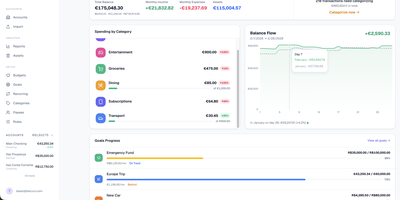
Securo is a privacy-first personal finance platform that keeps all your financial data in your own PostgreSQL instance while connecting to 2,500+ banks across three continents for automated transaction sync. The FastAPI backend with React/TypeScript frontend deploys via Docker Compose on ports 3000 and 8000, with Redis-backed Celery workers handling background synchronization. Bank connections span approximately 2,500 European PSD2 institutions through Enable Banking across 29 countries, US and international banks via SimpleFIN's open protocol, and Brazilian banks through Pluggy, all refreshing automatically every four hours. Multi-account management tracks checking, savings, credit cards, and investments with running balances. The auto-categorization rules engine applies pattern-matching across merchants and amounts. Goal tracking monitors savings targets with progress visualization, asset management handles stocks and custom instruments with configurable valuation growth rules, and reports generate Net Worth and Income vs Expenses charts with category sparklines. Optional AI Agents provide LLM chat with tool-use over your financial data through MCP, supporting OpenAI, Anthropic, Ollama, and compatible providers with per-agent RAG knowledge bases accessible via a global command palette. Multi-user support includes OIDC login, passkey authentication, TOTP two-factor, privacy mode, and multi-currency FX conversion via Open Exchange Rates. 1,500+ stars since March 2026. Running on a dedicated VPS on RepoCloud with guaranteed CPU, RAM, and SSD, full root SSH access, and a browser serial console. AGPL-3.0 licensed.
Chroma
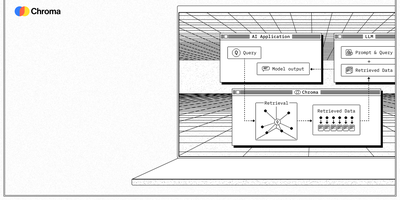
With over 29,000 GitHub stars and deep integrations into LangChain, LlamaIndex, and CrewAI, Chroma has become the default vector database for developers building retrieval-augmented generation pipelines and AI agent memory systems. Its core API consists of just four functions — create, add, query, and delete — making it the fastest path from zero to semantic search, while the underlying Rust engine handles tokenization, embedding, HNSW indexing, and similarity scoring automatically. Chroma supports dense vector search via HNSW with configurable distance metrics including L2, cosine similarity, and inner product, sparse vector search using SPLADE, full-text BM25 keyword search, and regex matching, all combinable in hybrid queries through a single unified interface. Metadata filtering at query time uses MongoDB-style operators including $eq, $ne, $gt, $lt, $in, and logical combinators $and and $or, enabling precise result scoping without post-processing. The multimodal pipeline powered by OpenCLIP embeds text and images into a shared vector space, allowing cross-modal retrieval where text queries return relevant images and vice versa. Deployment options range from embedded mode via PersistentClient for notebooks and prototypes, to client-server mode with Docker for production, to Chroma Cloud for serverless scalability. Official Python and JavaScript SDKs provide identical APIs, and embedding function integrations support OpenAI, Cohere, Hugging Face, Google, Ollama, and custom models. Running on a dedicated VPS on RepoCloud with guaranteed CPU, RAM, and SSD, full root SSH access, and a browser serial console. Apache 2.0 licensed.
Zammad
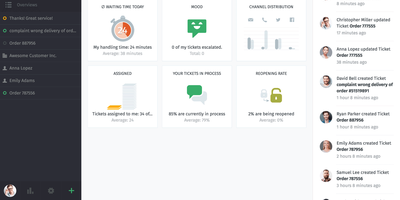
With 5,700+ GitHub stars and over a decade of active development since 2012, Zammad is the open-source helpdesk platform that unifies every customer communication channel — email, live chat, telephone, WhatsApp, Telegram, Facebook, SMS, and web forms — into a single ticket management interface backed by PostgreSQL, Elasticsearch, and Redis. Version 7.0 introduced native AI features including automated ticket categorization, priority assignment, and title rewriting via AI agents that plug into triggers, macros, and scheduler jobs, plus one-click AI ticket summaries and a writing assistant — all configurable with your choice of LLM provider: OpenAI, Anthropic, Mistral AI, Azure AI, Ollama for local models, or any custom OpenAI-compatible endpoint with full audit logging of every AI action. Define service level agreements with first response, update, and solution time tracking tied to business hours calendars, with automatic escalation notifications. The knowledge base provides multilingual FAQ management with internal and public visibility. Core workflows enable dynamic ticket masks with conditional field dependencies per group. Text modules let agents insert predefined responses via the double-colon shortcut, while macros execute multi-step actions with one click. Security includes two-factor authentication, S/MIME and PGP email encryption, and single sign-on via SAML or OpenID Connect. Integrations connect to GitHub, GitLab, Microsoft 365, LDAP with nested group support, and Exchange. Deploy via Docker Compose, Kubernetes with the official Helm chart, or DEB/RPM packages. Running on a dedicated VPS on RepoCloud with guaranteed CPU, RAM, and SSD, full root SSH access, and a browser serial console. AGPLv3 licensed.
Semaphore
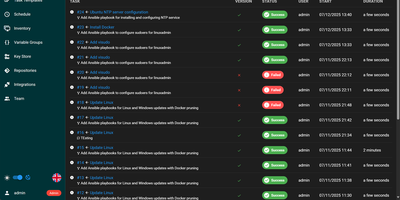
With nearly 14,000 GitHub stars and over 200 releases, Semaphore UI has established itself as the lightweight yet powerful alternative to enterprise automation platforms like Ansible AWX and Jenkins. Unlike AWX's heavyweight Kubernetes-dependent architecture, Semaphore ships as a single Go binary with zero external runtime dependencies — install it, run setup, and you have a production-ready automation server in minutes. The platform natively orchestrates Ansible playbooks, Terraform and OpenTofu infrastructure code, Terragrunt configurations, PowerShell scripts, Bash commands, and Python automation, all from a clean Vue.js web interface that displays task history, execution logs, and scheduling status at a glance. Semaphore supports concurrent task execution across multiple servers using distributed project runners, enabling horizontal scaling of automation workloads without complex clustering. The built-in inventory management system handles both static and dynamic inventory sources, while four-level RBAC (Owner, Manager, Task Runner, Guest) provides granular access control for team environments. Notifications flow to Slack, Microsoft Teams, Telegram, email, Rocket.Chat, and Gotify, keeping operators informed of failed tasks and deployment status. Integration with HashiCorp Vault secures sensitive credentials, and the comprehensive REST API with built-in Swagger documentation enables programmatic automation. Deploy via Docker Compose, Helm chart for Kubernetes, or native packages for Debian, Ubuntu, and RHEL-based distributions. Running on a dedicated VPS on RepoCloud with guaranteed CPU, RAM, and SSD, full root SSH access, and a browser serial console. MIT licensed.