Categories
Self-Hosted Developer Tools Analytics API Business Intelligence Data Engineering Data Infrastructure Semantic LayerStars
Forks
Watchers
Developer links
CubeJS
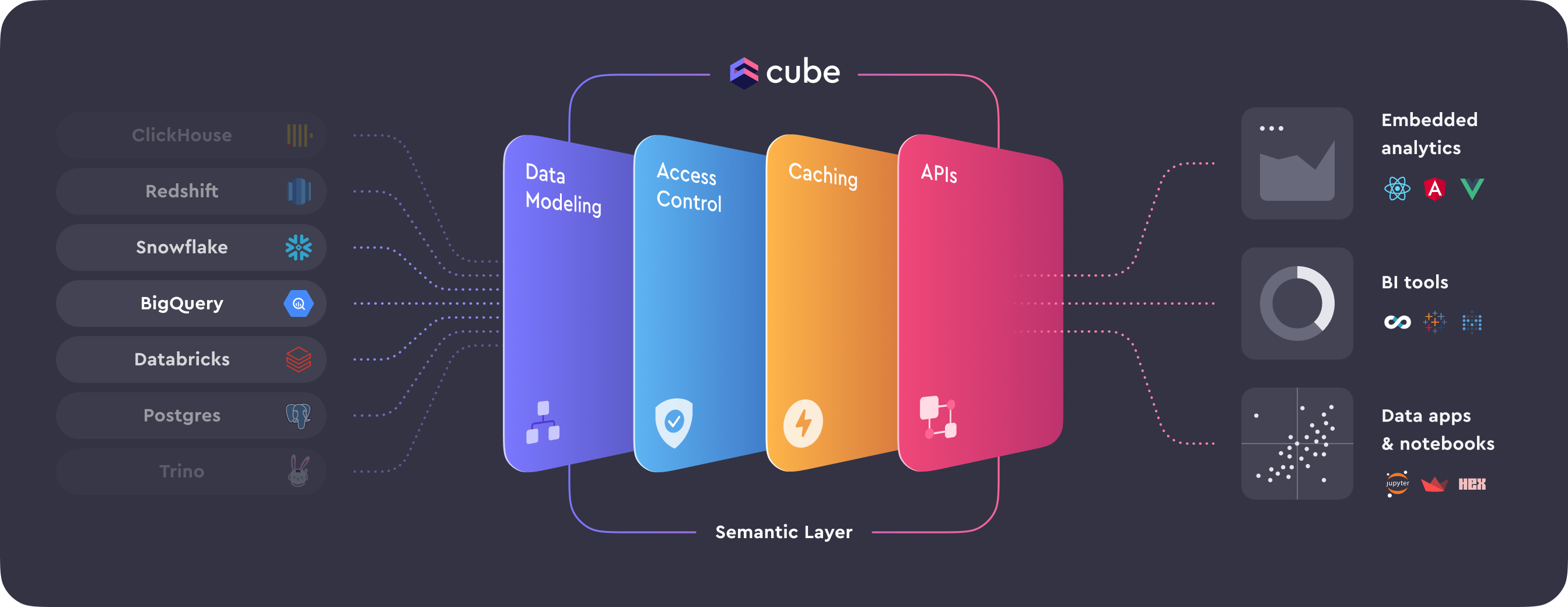
Between your databases and everything that consumes data - BI tools, embedded analytics, AI agents - sits Cube (formerly Cube.js), an open-source semantic layer. Metrics, dimensions, joins, and access rules are defined once as code in YAML, JavaScript, or Python, forming a governed data model that every downstream consumer shares, so "revenue" means the same thing in every dashboard. Caching is two-level: an in-memory cache absorbs bursts of identical queries, and declared pre-aggregations - rollup tables built in the warehouse or in Cube Store, Cube's distributed columnar engine, and refreshed in the background - deliver sub-second latency while cutting warehouse compute costs. The query planner routes each request to cache, rollup, or source automatically. Consumers connect through a Postgres-compatible SQL API (any tool that speaks Postgres works), plus REST, GraphQL, and a Meta API for model introspection. Row-level security and multi-tenancy are enforced in the layer itself, upstream of every client. Sources include Snowflake, BigQuery, Databricks, Postgres, MySQL, Presto, and Athena. Headless by design - bring your own UI.
Benefits
- One Definition of Every Metric
- Metrics defined once in the model serve every BI tool, embedded dashboard, and AI agent identically - ending the drift where each tool computes revenue differently.
- Sub-Second Dashboards, Smaller Warehouse Bills
- Pre-aggregations answer repeated queries from rollup tables instead of rescanning the warehouse, cutting both latency and per-query compute spend.
- Access Control Above the Data
- Row-level security and multi-tenant isolation are enforced in the semantic layer, so policies hold across every consumer rather than being re-implemented per tool.
- Analytics Your Product Can Embed
- Headless architecture with REST, GraphQL, and SQL APIs makes customer-facing analytics a frontend problem, not a data-infrastructure project per feature.
Features
- Data Modeling as Code
- Cubes and views defined in YAML, JavaScript, or Python with measures, dimensions, and joins - versioned in git.
- Two-Level Caching
- In-memory cache for hot queries plus background-refreshed pre-aggregations in Cube Store or the warehouse.
- Postgres-Compatible SQL API
- Tableau, Power BI, Metabase, or anything that connects to Postgres queries the semantic layer directly.
- REST, GraphQL, and Meta APIs
- Programmatic access for custom apps, plus model introspection so tools and AI agents discover what is queryable.
- Row-Level Security and Multi-Tenancy
- Query-time policies and per-tenant contexts applied deterministically to every request.
- Broad Source Support
- Snowflake, BigQuery, Databricks, Redshift, Postgres, MySQL, Presto, Athena, and more.