Folivox
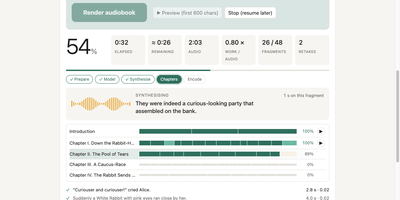
Folivox turns an ebook sitting on your server into a finished audiobook read aloud in a voice you choose, cloned from a short sample, or performed by a whole cast of characters. Drop in an FB2, EPUB, DOCX, PDF, or TXT file and the studio detects the book language, restores chapters, poems, and epigraphs, cleans page furniture away, and spells numbers, dates, money, and abbreviations out in full for nine fully supported languages. Narration runs locally through CosyVoice 3 or the multi-speaker Fish Audio Drama 3, which can give each character their own voice like a radio play, or through ElevenLabs, OpenAI, Gemini, or Cartesia with your own key after a cost estimate you approve. A markup editor finds the dialogue, assigns lines to speakers, and lets you fix mistakes and listen before committing to a ten-hour render. Every fragment is listened back to with Whisper and re-read until the best take survives, while a crash-safe journal means a stopped render resumes where it left off and edited chapters redo only what changed. The finished book arrives as one chaptered M4B with cover and metadata, or one MP3 per chapter, loudness-normalised and ready for any player. Running on a dedicated VPS on RepoCloud with guaranteed CPU, RAM, and SSD, full root SSH access, and a browser serial console. Apache-2.0 licensed.
Canvix
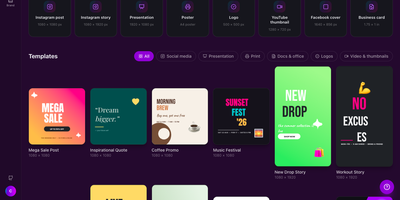
Canvix is a self-hosted design studio that lets anyone create social posts, presentations, posters, logos, and thumbnails in the browser with a drag-and-drop editor, 110 ready-made templates, and exports with no watermarks. You start from a template sized for the platform you are publishing to, then drag in shapes, lines, stickers, and your own images, moving, resizing, and rotating everything directly on the canvas. Text gets proper typography controls, with bundled fonts, styles, spacing, alignment, and curved text that arcs across the design. Layers can be reordered and locked while smart guides snap elements into alignment, and a full undo history plus autosave means a closed tab never costs you the work. Finished designs export as PNG, JPG, SVG, PDF, or video at up to three times resolution, ready to publish anywhere. Free accounts keep each person's designs private to them, while share links open a design for anyone to view or continue editing. Version snapshots let you roll a design back when an experiment goes wrong. The AI tools, magic edit, magic write, background removal, and translation, run against your own API keys, so nothing is metered. An optional MCP endpoint even lets AI assistants create and edit designs for you. Running on a dedicated VPS on RepoCloud with guaranteed CPU, RAM, and SSD, full root SSH access, and a browser serial console. MIT licensed.
Platypus
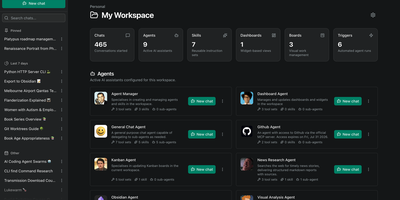
Platypus gives a whole team always-on AI agents that reason, call tools, and keep working on your own servers while everyone is offline. Build an agent once by choosing a provider and model, writing its instructions, and capping its tool-calling loop, then reuse that preset across chats and scheduled runs. Agents load reusable Skills on demand and delegate specialist work to sub-agents that appear to the parent as tools. Connect local and remote data through Model Context Protocol servers, or expose an agent to outside agents and chat platforms through A2A endpoints with a token per client. Triggers run agents on a cron schedule, as one-off jobs, or when workspace events such as a card moving on a board occur, and every run records its result. Kanban boards give agents work they can move and update themselves, while notifications and HMAC-signed webhooks push board and workspace events into your own systems with filtering and retries. Facts and preferences are extracted from conversations in the background and injected into future chats, so returning users are remembered. Sandbox backends give agents shell and filesystem access inside an isolated per-workspace environment instead of the host. Organizations and workspaces keep each team's agents and data separate, and blueprints package shared agents, skills, MCP servers, and providers so a new workspace starts pre-equipped. Running on a dedicated VPS on RepoCloud with guaranteed CPU, RAM, and SSD, full root SSH access, and a browser serial console. MIT licensed.
Dopbase
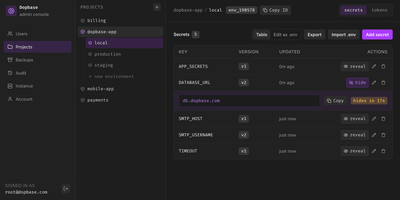
Dopbase keeps your application secrets out of scattered .env files and stores them, encrypted one by one, in a single self-hosted server you run as one file. You organize everything by project and environment, so the payment service has its own development, staging, and production values, and the same key can hold a different encrypted value in each place. Every secret is an individual record that can be updated, revealed, versioned, or rolled back without touching the others, and reading metadata never exposes a value. When an application starts, one command asks the server for an environment and injects exactly those values into the process, removing its own token before the child process runs. People sign in to the Admin UI with roles for root, admins, members, and even AI agents that can read metadata but change nothing. CI jobs and servers use runner tokens scoped to a single environment, so a staging credential can never read production. You can import and export .env files, edit secrets as a table or as raw env text, connect single sign-on through providers like Keycloak, and read an audit history of checks, reveals, and changes. Full-instance backups and the master key stay under your control on your own disk. Running on a dedicated VPS on RepoCloud with guaranteed CPU, RAM, and SSD, full root SSH access, and a browser serial console. Apache-2.0 licensed.
ScribeCrate
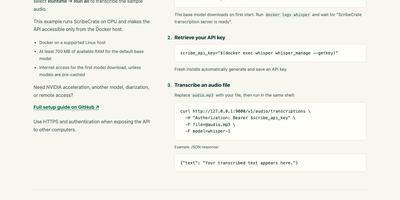
ScribeCrate is a self-hosted speech-to-text API that turns recordings into transcripts, subtitles, and English translations on your own server. It speaks the OpenAI Whisper API fluently: point any compatible client at your server's address, swap in your API key, and uploads come back as text. Ask for plain text, JSON with timestamps, or ready-to-publish SRT and WebVTT subtitle files, and for long recordings the segments can stream back over SSE as they are decoded. Turn on speaker diarization and every segment is labeled with who is speaking, which makes interview and meeting transcripts readable at a glance. Choose the model that fits the job, from tiny for quick drafts to large-v3 for maximum accuracy, and run it on a modest CPU, a Raspberry Pi class ARM board, or an NVIDIA GPU. Almost any recording works: MP3, M4A, WAV, WebM, OGG, and FLAC are all accepted, and with models cached in advance the server keeps transcribing with no internet connection at all. Running on a dedicated VPS on RepoCloud with guaranteed CPU, RAM, and SSD, full root SSH access, and a browser serial console. MIT licensed.
Attic
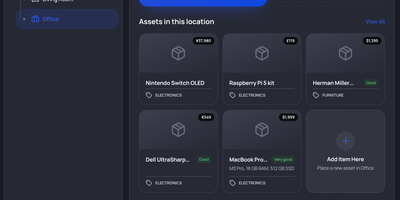
Somewhere in your home sits a box nobody has opened since the move, and Attic is the self-hosted home inventory that turns its contents from a mystery into a searchable record. You catalog appliances, tools, electronics, books, games, and furniture as assets, each with photos, receipts, manuals, purchase date and price, condition, and warranty dates attached. Nested locations mirror the house itself, rooms containing cupboards containing boxes, with photo galleries so you recognize a storage space on sight. Categories carry their own custom fields, inherited by subcategories, so electronics can demand a serial number while books ask for an ISBN. Items stored inside other items, like tools in a toolbox, are tracked as asset contents and move with their container. Collections group a game library or a moving box across locations, while tags label anything that needs repair or is out on loan. Adding stock is fast: import plugins pull metadata and cover images from Google Books, TMDB, BoardGameGeek, IGDB, and Rebrickable for LEGO sets. Search combines full-text with nested match-all and match-any filters, and saved searches pin to the sidebar as shortcuts. A history timeline records repairs and maintenance per asset, and the dashboard totals purchase value across currencies while flagging expiring warranties. OIDC single sign-on, scoped API keys, a REST API, and an MCP server connect Attic to scripts and agents. Running on a dedicated VPS on RepoCloud with guaranteed CPU, RAM, and SSD, full root SSH access, and a browser serial console. MIT licensed.
Glean
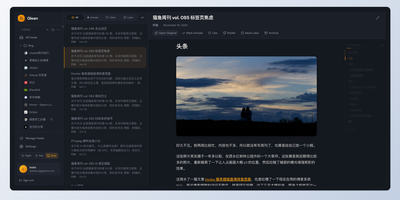
Information overload is the default state of the modern internet, and Glean exists to tame it by pulling every blog, newsletter, and news source you follow into a single, organized reading experience with an interface that prioritizes clarity over clutter. Subscribe to RSS and Atom feeds, import your existing subscriptions via OPML, and organize everything into multi-level folders with a flexible tagging system that lets you slice your reading list by topic, priority, or mood. A three-pane layout presents your feed list, article summaries, and full content side by side, with one-click actions for marking articles as read, saving them for later, bookmarking favorites, or archiving what you have already processed. Background workers fetch new articles every 15 minutes so your feeds stay current without manual refreshes. The preference learning engine (backed by Milvus vector embeddings) scores incoming articles against your reading history and surfaces a personalized Smart Feed of content you are most likely to care about, reducing the time spent scrolling past irrelevant posts. A built-in MCP server lets AI assistants like Claude Desktop search and interact with your feed library directly. The admin dashboard on a separate port provides user management, system monitoring, and configuration controls for multi-user deployments. Bookmark external URLs from any browser with the Chrome extension, or access your feeds on mobile through the Progressive Web App. Running on a dedicated VPS on RepoCloud with guaranteed CPU, RAM, and SSD, full root SSH access, and a browser serial console. AGPL-3.0 licensed.
Deft
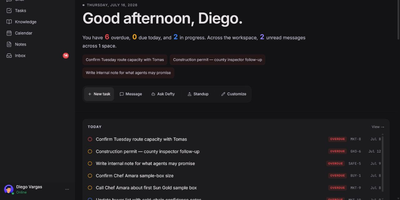
One self-hosted workspace holds your team's chat, tasks, notes, and calendar, and Deft lets AI agents work in it beside your people. People get real-time chat with spaces, direct messages, threads, mentions, reactions, files, and presence. Tasks open as Board, Table, Timeline, or Calendar views, with dependencies, subtasks, recurrence, and bulk actions. Notes, decisions, and channel memory become durable knowledge, with graph views and links back to the source conversation. Native calendar events sit beside read-only ICS subscriptions. Agent employees can join channels and receive task assignments. Tag the built-in assistant Defty to draft a task, answer a workspace question, or take a governed action, then review the proposal in an approval card before anything changes. Personal connections let Codex, Claude, ChatGPT, and other streamable HTTP MCP clients act as the signed-in user within revocable scopes. Approval tiers, trust levels, token scopes, revocation, activity history, and action receipts record who or what acted and what changed. OpenAI, Anthropic, OpenRouter, OpenAI-compatible endpoints, and local Ollama-style models are supported providers. Chat, tasks, notes, and calendars keep working with no AI key. Modules add company-specific records, relationships, and views, with a bundled Contacts module as the first example. Running on a dedicated VPS on RepoCloud with guaranteed CPU, RAM, and SSD, full root SSH access, and a browser serial console. AGPL-3.0-only licensed.
Tymeslot
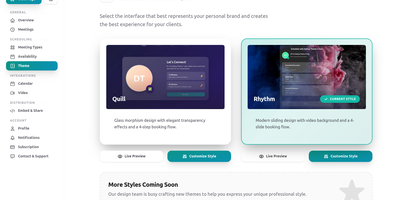
Built on Elixir's fault-tolerant OTP runtime, Tymeslot delivers the complete scheduling toolkit that Calendly charges for and Cal.com relicensed away from open source in 2026. Share one booking link and let clients pick available slots — your calendar stays synchronized and double-bookings disappear automatically through real-time availability checking against Google Calendar, Microsoft Outlook, and any CalDAV server including Nextcloud. Meeting types support configurable durations, buffer times, and availability windows that clients can book without email back-and-forth. Phoenix LiveView powers the real-time UI with WebSocket connections that update instantly as bookings arrive, without client-side JavaScript framework overhead. The platform attaches Zoom video rooms to confirmed bookings through your own Marketplace app credentials, sends confirmation and reminder emails via SMTP, Postmark, SendGrid, Mailgun, or AhaSend, and supports custom booking page themes with embed options for integration into existing websites. Circuit breakers, connection pooling, and graceful degradation maintain availability during provider outages. Authentication supports local accounts, GitHub OAuth, and reCAPTCHA protection on public booking forms. Self-hosting deploys as a single container with PostgreSQL embedded — no separate database container required. Two named volumes persist uploads and database state, while the same image powers the managed cloud at tymeslot.app so self-hosted users get identical features without a crippled community edition. Deploy via Docker, Cloudron with automatic updates, or Railway from a community template. Running on a dedicated VPS on RepoCloud with guaranteed CPU, RAM, and SSD, full root SSH access, and a browser serial console. AGPL-3.0 licensed.
Pictaria Server
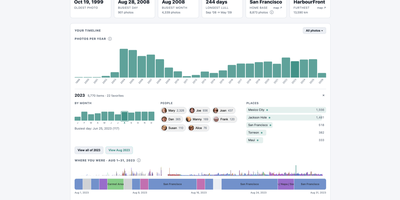
Pictaria Server sits beside your Immich instance and makes a photo library of thirty thousand images legible again, surfacing the trips, people, and best shots buried under duplicate bursts and forgotten folders. It starts with Insights: a clickable timeline of your years, detected trips, a people constellation linked by who appears together, place and camera rankings, and records like your busiest day. Click any number and you land on the actual photos, ready to open in Immich, turn into an album, or send onward. Enrich puts an AI to work describing what it sees, writing captions, menu-driven tags, and quality scores for every photo using a local model through Ollama or LM Studio, or a cloud provider with your own key, on a scheduled daily budget. Those tags can sync back into Immich, so searching improves everywhere, not just here. Curate then collapses bursts and near-duplicates into stacks with a suggested keeper, and one keystroke keeps the best and skips the rest. Smart Albums compose rules from people, places, dates, cameras, and tags, preview the result count, and maintain real Immich albums on a schedule. Frame owners get remote control, display metrics, and voice photo questions, while the Activity feed and runtime-editable Settings keep the whole box manageable from the browser. It connects with a limited-permissions API key and cannot delete a single photo. Running on a dedicated VPS on RepoCloud with guaranteed CPU, RAM, and SSD, full root SSH access, and a browser serial console. AGPL-3.0 licensed.
Campfire Rust
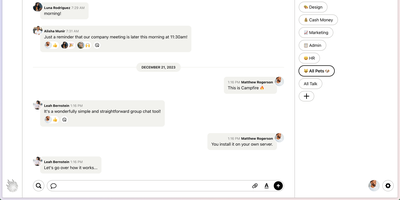
Your team chat can be one executable on your own server: Campfire Rust runs rooms, direct messages, attachments, and search as a single binary that replaces the whole Ruby, Puma, Redis, Resque, and Thruster stack. Create rooms with access controls for projects, departments, or a private board discussion, and keep direct messages beside them for quick questions. File attachments arrive with previews, mentions pull the right person into a thread, and search finds the decision someone made months ago. Web Push notifications reach browsers and phones, so a quiet room still finds its people when it matters. Chatbots connect through a simple HTTP API for sending and receiving messages and attachments, which makes Campfire a home for build alerts, deploy notices, and support pings. Existing Campfire installs upgrade in place because the Rust binary reads the same SQLite database, storage layout, and signed cookies, with no data migration and no mass sign-out. Automatic TLS with Let's Encrypt certificates, HTTP/2, and Action Cable-compatible WebSockets are built in, and the whole system works on air-gapped networks that never touch the internet. Run it as your primary chat, as a backup for the day a hosted service goes down, or as a walled garden for executives and events. Running on a dedicated VPS on RepoCloud with guaranteed CPU, RAM, and SSD, full root SSH access, and a browser serial console. MIT licensed.
Imp
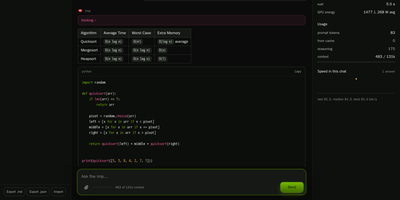
Imp runs large AI chat models privately on one NVIDIA RTX 50 or RTX PRO graphics card, exposing them through OpenAI and Anthropic compatible APIs plus a built-in browser chat. Start it with a single Docker command, point it at a model, and the chat opens in your browser with saved conversations and a live readout of generation speed. Coding agents such as Claude Code and Codex connect by changing one base URL, so your editor talks to the model on your own hardware instead of a rented cloud endpoint. Tool calls, structured JSON output, streaming responses, and reasoning models all work over the wire, and requests can be protected with an API key, per-IP rate limits, and concurrency caps. Load GGUF files you already have or NVFP4 and FP8 SafeTensors checkpoints straight from Hugging Face with no conversion step before the first answer. When a model is bigger than the card, mixture-of-experts weights stay in system RAM while the busiest experts are cached on the GPU, so a 123.6 GiB model still answers from a 32 GB card. Supported models can also read images alongside text, and tokenize, health, and model listing endpoints make the server easy to wire into scripts and monitors. Running on a dedicated VPS on RepoCloud with guaranteed CPU, RAM, and SSD, full root SSH access, and a browser serial console. MIT licensed.
37Studio
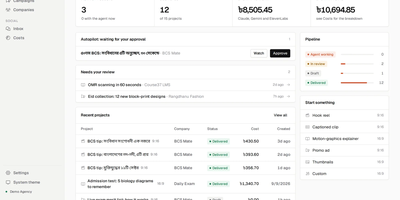
37Studio is a self-hosted AI video studio and social media desk that turns a short brief into on-brand videos, posts them to nine social platforms, and drafts replies to the messages that come back. Paste a company website and it builds a brand library of logos, photos, fonts, and colours, plus a knowledge base every later video and reply draws on. An editor agent builds each video as an animated composition, checks its own rendered frames, and takes revision requests in plain words. The same workflow yields hook reels, captioned clips, explainers, podcast clips, promo ads, and thumbnails, and any finished video can become a template. A two-hour recording becomes a shelf of short clips: transcription runs locally in about 100 languages at no cost, and YouTube or Drive links import directly. Publishing reaches Facebook Pages, Instagram, YouTube, TikTok, LinkedIn, X, Pinterest, Bluesky, and Mastodon in one action, now or scheduled, each with its own caption. Autopilot goes further: state a content plan in one sentence and a fresh video is made before every slot, waiting for one-click approval. Messenger, Instagram, and WhatsApp messages and social comments land in one inbox, with replies drafted in the customer's language under rules each brand sets. Exact AI spend shows on every project, and an MCP server lets your own AI tools run the studio. Running on a dedicated VPS on RepoCloud with guaranteed CPU, RAM, and SSD, full root SSH access, and a browser serial console. MIT licensed.
Inference Gateway
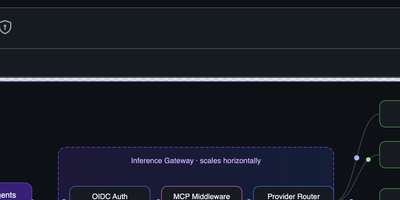
Inference Gateway puts a single OpenAI-compatible API endpoint in front of OpenAI, Anthropic, Groq, Cohere, Ollama, DeepSeek, Google, Mistral, MiniMax, Moonshot, Nvidia, and llama.cpp, so your application code never changes when you switch models or providers. The Go binary starts on port 8080 and normalizes authentication, streaming protocols, and response formats across all backends transparently. Native Model Context Protocol support auto-discovers tools from connected MCP servers and injects them into LLM requests without client-side management, enabling server-side tool execution across any provider that supports function calling. Agent-to-Agent protocol integration allows distributed agent communication through a declarative Agent Definition Language that generates production-ready Go or Rust servers from a single YAML manifest. The dedicated Kubernetes Operator manages Gateway, Agent, MCP, and Orchestrator custom resources with automatic HPA scaling, OIDC authentication, and service discovery that rebuilds MCP configurations when the discovered server set changes. Prometheus metrics and OpenTelemetry tracing provide full request-level observability across the entire inference pipeline. Middleware controls enable per-request provider selection, model routing, and fallback strategies. Official SDKs in Go, Python, TypeScript, and Rust provide typed client interfaces with streaming support. Docker Compose deployment requires only environment variables for API keys. A CNCF Sandbox applicant. Running on a dedicated VPS on RepoCloud with guaranteed CPU, RAM, and SSD, full root SSH access, and a browser serial console. Apache 2.0 licensed.
Lalabase
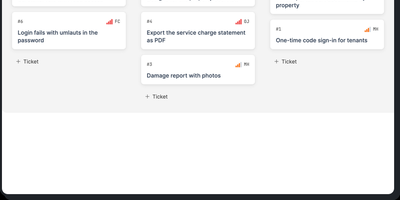
Lalabase is project management built for developers who work with clients, putting tickets, time tracking, documentation, and meetings in one workspace instead of five separate tools. Each client gets an organisation with its own projects and its own access, and roles decide exactly what clients can see. Tasks run as a list or a board with the statuses, priorities, and fields you define per project, rather than the workflow a vendor chose for you. Time tracking records several sessions per ticket, each billable on its own, with exports that go straight into the invoice. Documentation lives beside the work: notes and documents sit in the project, and a folder in your GitHub or GitLab repository becomes the project's docs automatically. Meetings keep their transcript, an AI summary, and the tasks that follow from what was actually said. When you need an answer, the AI assistant takes one question across tickets, comments, documents, hours, and meetings, and it cites the ticket, page, or conversation every answer came from. It even reads your repository's indexed code structurally, so questions about what is implemented get answered against the code. The assistant stays off until you enable it with your own provider key or a model in your own network. An MCP server and REST API let your own agents list, create, and update tickets, comment, and log time. Running on a dedicated VPS on RepoCloud with guaranteed CPU, RAM, and SSD, full root SSH access, and a browser serial console. AGPL-3.0 licensed.
Initiative
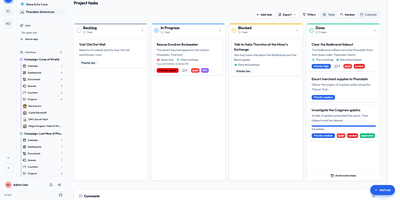
Initiative is a self-hosted, multi-tenant project management platform that organizes projects, tasks, collaborative documents, and schedules into strictly isolated community workspaces without enterprise complexity. Users create distinct communities where data remains strictly partitioned across separate database schemas, allowing agencies, volunteer groups, and gaming guilds to manage multiple client environments from a single deployment. Within each community, initiatives group related projects and documents while interactive drag-and-drop Kanban boards track task progression across custom columns, priorities, and deadlines. Integrated collaborative documents enable team members to co-author notes, project briefs, and meeting minutes in real time with threaded inline discussions and user mentions. Granular role-based permissions let administrators specify exact view and edit privileges down to individual items, while a recoverable trash system prevents accidental deletions from interrupting live operations. Curated marketplace apps supply customizable analytics dashboards, and optional bring-your-own-key artificial intelligence integrations generate task suggestions and summarize lengthy discussion threads. Running on a dedicated VPS on RepoCloud with guaranteed CPU, RAM, and SSD, full root SSH access, and a browser serial console. GNU AGPLv3 licensed.
Oh My CPA
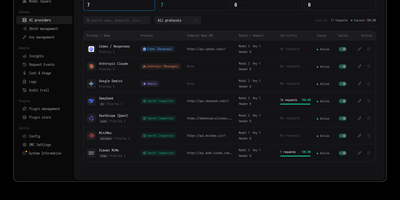
Oh My CPA gives a CLIProxyAPI gateway a proper control room, where providers, OAuth credentials, client keys, model routing, and the cost of every request are managed and watched from one self-hosted console. You add providers such as Codex, Claude, Gemini, xAI, DeepSeek, Vertex AI, and OpenAI-compatible services, each with credentials, retry and error policies, priority, weight, and an enable switch the gateway actually enforces. OAuth accounts are signed in from the console, with quota window readings, refresh schedules, and per-credential model aliases kept next to the keys they belong to. Client keys can be created, named, and revoked, and those names follow the traffic into request records and filters so you always know which key spent what. The dashboard follows request volume, token throughput, cache hit rate, and cost from the last fifteen minutes out to ninety days, with a year-long token heatmap for the long view. Insights compare keys, models, providers, and credentials against the previous period, while the live routing view shows which credential each request travelled to and whether it was rerouted. Every request stays searchable, with duration, time to first token, token breakdown, and the raw log in a detail drawer. A playground tests any routed model with text and images before your users do. Running on a dedicated VPS on RepoCloud with guaranteed CPU, RAM, and SSD, full root SSH access, and a browser serial console. MIT licensed.
Quantum
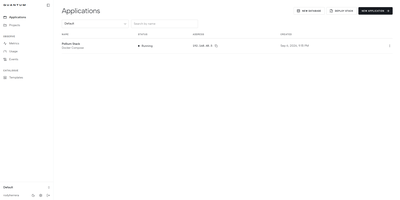
From a bare Linux server, Quantum builds and runs GitHub repositories, multi-service Docker Compose stacks, and managed databases through a self-hosted PaaS dashboard with automated webhook deployments and live container telemetry. Connect a GitHub account, pick a branch, and let the build engine compile from a Dockerfile or custom install, build, and start commands on every git push or release tag. Multi-service Compose files can be pulled from a repository or pasted into the editor, with automatic `${VAR}` placeholder detection and isolated internal networks so containers communicate by service name. Provision PostgreSQL, MySQL, MariaDB, MongoDB, and Redis instances with one-click backups, or deploy pre-configured templates for n8n, Directus, WordPress, Uptime Kuma, and Ollama. Live log streams, an interactive browser terminal, `.env` secret management, persistent volume mounts, and private registry credentials come built into every service view. Need to patch a file quickly? Clicking Open in VS Code launches a sidecar `code-server` instance mounted directly to the container filesystem. Organization and project roles enforce granular access while real-time CPU, memory, and network charts track health across 15-minute to 24-hour windows. Running on a dedicated VPS on RepoCloud with guaranteed CPU, RAM, and SSD, full root SSH access, and a browser serial console. MIT licensed.