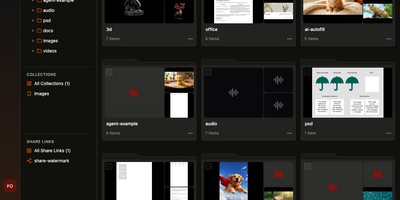
Shumai
Creative teams use Shumai to review video, images, 3D models, and documents with feedback pinned to the exact frame, on a server they control instead of a rented review cloud. Pause on any frame, draw on the picture, and leave a timecoded comment with the markup attached, then let threaded replies, mentions, and resolve states carry it to a decision. Every cut stacks into a version stack, and any two versions open side by side to compare changes. Layered PSDs and camera RAW review at full resolution, 3D models spin with comments pinned to the viewing angle, and documents page through as converted PDFs. Clients open a share link with a password and expiry date, downloads switchable, and can comment as guests with no account. Watermarks render into the media on your server rather than layering in the browser, so they stay put wherever the file travels. Comments export as Premiere Pro XML, DaVinci Resolve EDL, Final Cut Pro, or Avid files with correct drop-frame timecode for the editor. Mention the AI agent in a comment and it examines the same frame under discussion, or chat privately about a folder using your own OpenAI, Anthropic, or Gemini key. Originals live on local disk or any S3-compatible bucket, with GPU transcoding and workers that scale up for a delivery and back to zero. Running on a dedicated VPS on RepoCloud with guaranteed CPU, RAM, and SSD, full root SSH access, and a browser serial console. MIT licensed.
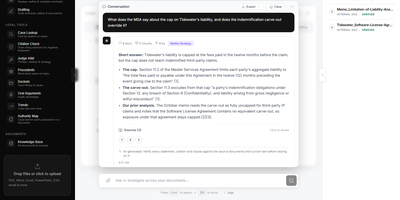
CaseCite
CaseCite puts a law firm's own files under questioning, returning cited answers, contract reviews, and drafted agreements without surrendering a single document to an outside legal platform. Ask a question across the indexed corpus and receive answers tied to the exact source passage, then narrow the search to selected files or a folder when only those should count. For bigger questions, deep research lays out a plan of sub-questions you can edit first, verifies every quote against its source, and keeps a step log of what was searched. Contracts can be analyzed, questioned one at a time, or compared clause by clause across two to four agreements against a baseline, with redlines exported as native Word tracked changes. Tabular review extracts the fields you define from hundreds of contracts at once, shows the supporting passage and estimated cost beside each value, and exports to Excel or CSV. Drafting starts from up to four precedent documents, and long agreements get a section plan for your approval before each section is written and reconciled. Each client engagement lives in its own matter workspace with controlled access and an activity feed, while case lookup, citation checking, judge analytics, dockets, oral arguments, and authority maps cover the caselaw side. Running on a dedicated VPS on RepoCloud with guaranteed CPU, RAM, and SSD, full root SSH access, and a browser serial console. Apache 2.0 licensed.
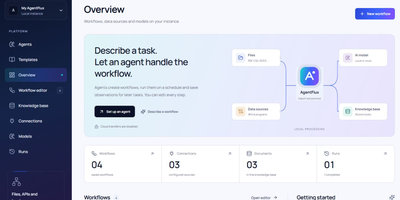
AgentFlux
Describe the task in plain words, pick the sources and model it may use, and an agent plans the workflow before running it. That is the core loop: agents build editable visual workflows from a task description, execute them on demand or on a schedule, and keep everything traceable. Prefer building by hand and the canvas offers 17 preconfigured steps, branching, undo and redo, JSON import and export, plus eight starter templates. Feed it real work by importing PDF, DOCX, XLSX, CSV, JSON, and text files, or by connecting folders, HTTP endpoints, and approved local programs. Upload a screen recording and it identifies the actions with timestamps, turning a demonstrated process into an editable workflow you can refine. Model calls go to the endpoint you choose: Ollama, LM Studio, vLLM, or any OpenAI-compatible service, local or cloud with your own credentials. Every run can be inspected step by step, cancelled mid-flight, and exported as JSON, CSV, or Markdown reports. Observations from completed runs land in a knowledge and learnings store, where you review them and promote the useful ones into reusable skills for the next task. The Docker release bundles the application with FFmpeg and local Whisper support, and your documents stay on your own machine. Running on a dedicated VPS on RepoCloud with guaranteed CPU, RAM, and SSD, full root SSH access, and a browser serial console. Apache License 2.0 licensed.
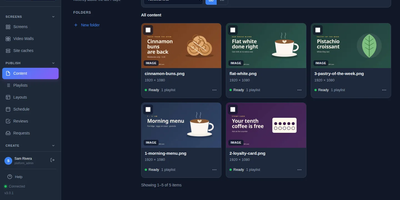
ScreenTinker
Run every TV, menu board, kiosk, and video wall from one browser dashboard with ScreenTinker, a digital signage CMS you host yourself, with no per-screen license fees. Players cover Android TV, Fire TV, Samsung Tizen, LG webOS, Amazon Vega OS, Roku, Raspberry Pi, Windows, ChromeOS, and any web browser. Upload images and video, turn each PDF page into a slide, or design animated decks in the slide editor with templates, optional voiceover, a music bed, and an optional AI designer that works from a prompt using your own model endpoint. Widgets add clocks, weather, RSS tickers, moderated social walls, live IPTV streams, and iCal or JSON data bound straight into a slide. A weekly calendar handles recurring schedules, priorities, and time zones, and Preview at shows what a given screen will play at any chosen moment. Group screens to push playlists and bulk commands, split displays into zones, or join several panels into a video wall with bezel compensation. Live remote control, CSV proof-of-play reports, and offline email alerts keep a fleet in check, while web and Android players cache content and keep playing through outages. Workspaces, six role levels, optional approval before publishing, OIDC single sign-on, white-label branding on your own domain, and a scoped REST API serve agencies and larger teams. Running on a dedicated VPS on RepoCloud with guaranteed CPU, RAM, and SSD, full root SSH access, and a browser serial console. MIT licensed.
MikroTik Manager
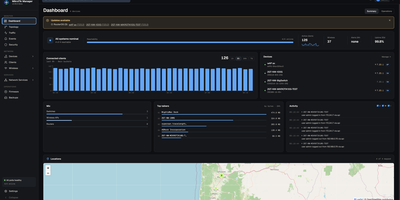
MikroTik Manager is a web control plane for whole RouterOS fleets, built so that a bad VLAN change reverts itself instead of costing you a drive to the site. Before any risky edit, Change Guard saves a restore point on the device and arms a scheduler; if a fresh connection cannot reach the router afterwards, it rolls itself back. Lockout prediction simulates each change against live device state and refuses one that would cut management access, naming the exact port and VLAN at fault. Config Health audits for settings RouterOS accepts but silently ignores. Day to day, a live dashboard tracks availability, wireless clients, and alerts delivered by email, Slack, Discord, Telegram, or ntfy. Switch faceplates, per-port client views, VLAN copy wizards, bulk SSID deployment, RF health charts, rogue AP detection, and a guest Wi-Fi captive portal wizard cover the wired and wireless side. A rule builder handles firewall and NAT, topology maps come from LLDP, CDP, and MNDP, and a built-in NetFlow collector attributes traffic to clients and applications. Firmware rolls out in canary waves that halt on failure, and every configuration snapshot supports diffs and one-click rollback. OIDC single sign-on, TOTP two-factor, role-based access, and scoped API tokens protect the console, while sites group devices per customer network. Running on a dedicated VPS on RepoCloud with guaranteed CPU, RAM, and SSD, full root SSH access, and a browser serial console. AGPL-3.0 licensed.
NetsGo
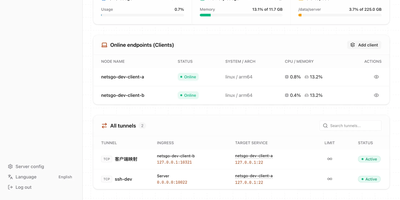
Created to eliminate the configuration fragmentation plaguing multi-device Homelab setups and small-team infrastructures, NetsGo merges what typically requires three separate tools — a tunnel daemon, a management panel, and a monitoring stack — into a single Go binary that starts with one command and listens on one port. The server exposes HTTP, TCP, and UDP tunnels, a built-in Web console for node management, a REST API for automation, and real-time traffic statistics with per-client bandwidth limiting, all sharing default port 9527 so firewalls and reverse proxies need only a single rule. Version 0.1.11 introduced Client-to-Client P2P tunnels via WebRTC DataChannel with three selectable transport strategies — Server relay, Prefer P2P with automatic fallback, and P2P only — reducing latency for direct connections while maintaining the centralized control plane. The management console displays every connected client's online status, authentication tokens, tunnel configuration, active transport mode, P2P candidate gathering progress, and cumulative byte-level traffic counters updated every second. Unlike frp or rathole which delegate management to external plugins or configuration files, NetsGo provides built-in client key generation, tunnel target migration between nodes, SOCKS5 proxying, IP-whitelist console access, and one-command server upgrades. Running on a dedicated VPS on RepoCloud with guaranteed CPU, RAM, and SSD, full root SSH access, and a browser serial console. Apache 2.0 licensed.
Tagr
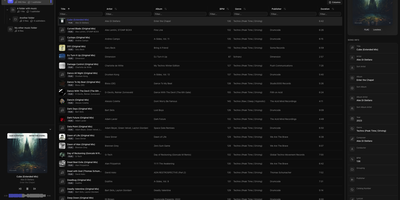
When a music library is full of wrong tags, missing covers, and blank ratings, Tagr lets you fix the whole collection from any browser, on desktop or phone. Three roles divide the work on your own server. Admins mount a music folder, press scan, and get a searchable table of every track, with sortable and filterable columns, more than 40 editable fields, and room for custom tags. Taggers make the changes: edit fields inline, swap album art, and match one song or a whole selection against MusicBrainz, ticking which fields to overwrite. Mistakes are cheap, because every edit is stored in a persistent change history with a revert action, viewable per song or per folder. Rule-based smart playlists, such as every track with an empty comment, show what still needs attention. Listeners browse and play without edit rights, using the waveform player, a Recently played view, and optional ListenBrainz scrobbling that each person connects to their own account. Supported formats include MP3, FLAC, WAV, AAC, OGG, M4A, M4B, WMA, AIFF, and Opus, with changes written straight back into the files. Swipe-friendly panels, an installable PWA, and five interface languages make the phone a comfortable place to work. Running on a dedicated VPS on RepoCloud with guaranteed CPU, RAM, and SSD, full root SSH access, and a browser serial console. AGPL-3.0 licensed.
PRISM
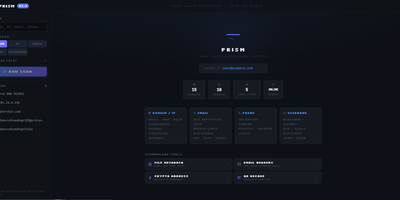
PRISM consolidates passive reconnaissance, credential leak detection, and network asset mapping into a unified operational dashboard to replace fragmented command-line security tools. Analysts can launch simultaneous multi-source investigations against domains, internet protocol addresses, email mailboxes, phone numbers, and online handles to uncover domain registrations, open network ports, cryptographic certificates, and historical web archives. The platform interrogates threat feeds and leak repositories to expose credential leaks, dark web mirrors, and email routing anomalies with automated SMTP mailbox verification. Cross-platform identity engines crawl thousands of social networks and public registries to correlate aliases, discover leaked commit identities, and trace digital footprints across the web. Discovered assets render into interactive entity relationship graphs alongside geographic internet protocol maps to help investigators visualize infrastructure clusters and ownership links. An automated operational security calculator evaluates exposure vulnerabilities across identity, web, and infrastructure vectors, producing an aggregated risk score with granular hardening recommendations. Scheduled watchlists continually monitor target infrastructure, dispatching webhook notifications to chat channels whenever new subdomains, ports, or credential leaks appear. Investigators can export comprehensive audit dossiers as self-contained HTML files, styled PDF documents, or structured spreadsheets. Running on a dedicated VPS on RepoCloud with guaranteed CPU, RAM, and SSD, full root SSH access, and a browser serial console. MIT licensed.
Meridian
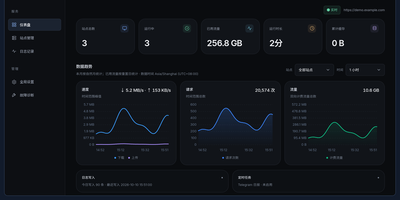
Meridian puts all of your Emby reverse proxy sites, playback routes, and day to day operations into one clean management panel instead of a pile of hand-written proxy configs. Each Emby site gets its own entry through a path, a dedicated port, or a subdomain, with primary and backup routes that switch automatically when one goes down. Three playback modes let video stream directly to clients while logins, posters, and API calls continue through the proxy, so bandwidth lands where it should. Accounts for each site are stored with passwords and expiry dates, renewal reminders arrive ahead of time, and account details can be imported or exported as JSON and CSV. Traffic trends, per-site quotas, rate limits, and static resource caching keep busy sites under control, while log filtering and connection diagnostics show exactly where a request went wrong. Certificates are handled through Cloudflare wildcard issuance and renewal, or by uploading your own, and encrypted backups protect the whole configuration. Routine administration can even happen from Telegram, checking daily reports, adding or pausing sites, and renewing accounts from chat. The whole panel runs as one small program with a built-in database and works comfortably from a phone. Running on a dedicated VPS on RepoCloud with guaranteed CPU, RAM, and SSD, full root SSH access, and a browser serial console. MIT licensed.
PandaDOS
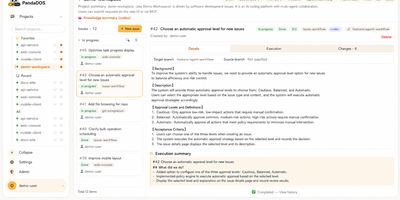
PandaDOS is a self-hosted control plane that turns Claude Code and Codex into long-running coding agents you direct through an issue queue from any browser, instead of babysitting a terminal. You file an issue with the outcome and acceptance criteria, and PandaDOS clarifies missing requirements, plans the work, picks the agent, and drives implementation, verification, and delivery in stages. Three approval levels, cautious, balanced, and automatic, decide which actions proceed alone; safe reversible steps continue automatically while destructive, irreversible, production, or secret-related decisions always come back to you. The browser workspace shows the real agent conversation, a native terminal, project files, Git history and diffs, and an execution summary, so you can inspect or intervene at any moment from a phone or laptop. Agents run on local or SSH-connected executor machines inside tmux sessions, and work sharing one repository is serialized while independent projects proceed in parallel without conflicting edits. Modules keep one assigned agent and durable project knowledge, so context from finished issues carries into the next task instead of evaporating when a chat ends. Teams can sign in through Feishu, ask the project manager questions in chat, and receive subscription notifications and approval cards on their phones. Running on a dedicated VPS on RepoCloud with guaranteed CPU, RAM, and SSD, full root SSH access, and a browser serial console. Apache-2.0 licensed.
Dock-Dploy
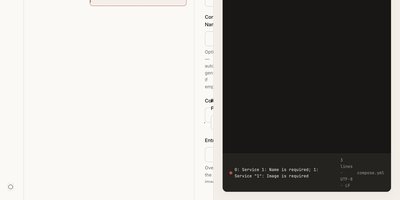
Visual drag-and-drop assembly replaces manual text editing in Dock-Dploy, a Docker Compose builder and configuration management suite that turns complex multi-service container topologies into validated YAML manifests. DevOps engineers and self-hosters can visually assemble application stacks by selecting container base images, defining healthcheck probes, mapping bridge networks, and assigning persistent volume mounts through a reactive web interface. An integrated marketplace catalog allows teams to search, preview, and import battle-tested templates for services like PostgreSQL, Redis, and Nginx with one click. Real-time Zod schema validation inspects every service parameter as you type, flagging port collisions, missing environment variables, and malformed volume syntax before deployment. A split-screen CodeMirror editor provides continuous synchronization between graphic form fields and generated YAML definitions with automatic code sanitization and clipboard exports. Beyond Compose stacks, operators can design blueprint templates, generate reverse proxy routing profiles, and assemble recurring cron schedules for automated backup and maintenance routines. Running on a dedicated VPS on RepoCloud with guaranteed CPU, RAM, and SSD, full root SSH access, and a browser serial console. AGPL-3.0 licensed.
Tryton
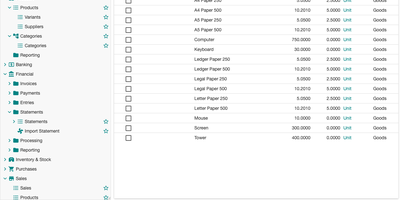
In Tryton, an invoice knows its shipment and a production order knows its stock, since accounting, inventory, purchasing, and sales are modules of one ERP rather than separate programs exchanging exports. Financial accounting posts customer and supplier invoices, reconciles bank statements imported from SEPA or configured CSV formats, manages dunning and direct debits, and produces Factur-X electronic invoices, while analytic accounting splits results across cost centers. Stock tracks goods through warehouses and locations with lots, shipments, inventories that warn when counts drift beyond tolerance, and automatic period closing, and production consumes bill-of-material inputs into finished goods with quantity checks. Sales quotations become orders, shipments, and invoices without retyping; purchases calculate real supplier lead times; point of sale records lot numbers at the till; subscriptions bill recurring services on schedule. Multi-company installations share the same database with per-company wizards, tax rules can be defined per organization for European trade, and parties, products, carriers, currencies, and customs duties are managed as shared reference data. Access happens through the browser web client, a desktop client, or scripting and REST libraries, so integrations read and write the same business objects your staff see. Running on a dedicated VPS on RepoCloud with guaranteed CPU, RAM, and SSD, full root SSH access, and a browser serial console. GPL-3.0-or-later licensed.
Meshlan
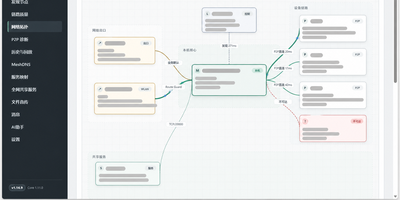
Meshlan turns your own Linux server into the control plane for a private virtual LAN that connects remote Windows devices as if they sat on the same router. Devices pair through your server, receive their certificates, and then talk directly to each other over encrypted tunnels whenever NAT allows, using dual-stack hole punching, UPnP, and STUN diagnostics to find a path. When a direct connection is impossible, traffic falls back to relays, and multiple relay nodes are chosen automatically by latency, jitter, packet loss, and health. You can publish a service that only listens on localhost, a local API, a web panel, a database, a game server, to the mesh on a custom port, with direct access or manual approval by its creator. Names stay stable while addresses change: devices answer to names like alice.mesh and services to api.alice.mesh, and an HTTPS gateway serves mesh websites without port numbers. Files move directly between devices over the encrypted link while the server only distributes metadata. The console shows the live topology with P2P and relay paths, latency, and service health, and local history keeps traffic and events for replay with a time slider. Optional AI automation keeps model keys on the server, encrypts context end to end, and asks for your confirmation before changing anything. Signed updates verify and roll back automatically when a health check fails. Running on a dedicated VPS on RepoCloud with guaranteed CPU, RAM, and SSD, full root SSH access, and a browser serial console. MIT licensed.

Nowen Video
Nowen Video turns the hard drive of films and series sitting on your NAS into a streaming service your family actually wants to open, posters, seasons, and all. Point it at your media folders and it scans the usual formats, reads streams with FFprobe, and scrapes rich metadata from TMDb, Douban, TheTVDB, Bangumi, and Fanart.tv, recognizing movie, season, and episode naming as it goes. NFO files and external subtitles are honored, filesystem watching keeps the library current, and collections plus episode navigation make a big archive feel curated rather than dumped. Pressing play is where the engineering shows: a server-side planner decides per client whether to direct play, remux, or transcode to HLS on demand, with automatic fallback when the first choice fails. Hardware acceleration through the GPU keeps transcoding cheap, subtitle and speed controls ride along in the player, and a local analysis pass can surface highlight clips from your own footage. Every family member gets favorites, watch history, and continue-watching progress under their own account, while library permissions decide who sees what. An Emby-compatible API even lets clients like Infuse connect as if it were an Emby server. Running on a dedicated VPS on RepoCloud with guaranteed CPU, RAM, and SSD, full root SSH access, and a browser serial console. GPL-3.0 licensed.
BitRouter
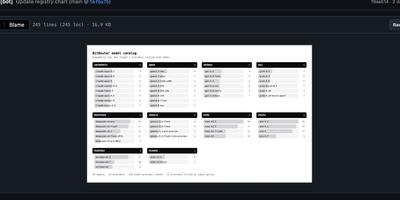
BitRouter is a context-aware LLM router that learns which model delivers the cheapest successful outcome per workflow step, cutting agent costs by up to 80% while maintaining 96% quality versus all-frontier baselines. Point any agent runtime at http://localhost:4356 with a one-line OPENAI_BASE_URL change and BitRouter routes to OpenAI, Anthropic, Google, Groq, DeepSeek, Mistral, Moonshot, MiniMax, Nvidia, and any OpenAI-compatible endpoint simultaneously, normalizing authentication, streaming, and cross-protocol translation between wire formats. The act-observe-evaluate-learn loop traces every hop with cost, tokens, and latency attribution, scores each decision against a versioned policy-lock.yaml, then tightens routes automatically with no LLM judge in the path. Native MCP gateway auto-discovers tools from connected servers and makes them routable and governed alongside model calls. Agent Client Protocol integration enables the TUI to manage Claude Code, Codex, OpenCode, OpenClaw, Gemini, and Copilot sessions in real time with inline tool-call approval and live streaming. Built-in guardrails inspect, redact, or block risky content before requests leave your network. Virtual keys scope API access per agent or user without exposing upstream credentials. Per-agent spend caps and loop guards contain runaway cost automatically. Multi-account failover reroutes mid-run so rate limits never re-pay completed work. Ships as a single Rust binary via npm or Cargo. Running on a dedicated VPS on RepoCloud with guaranteed CPU, RAM, and SSD, full root SSH access, and a browser serial console. Apache 2.0 licensed.

Telegram Archive
Telegram Desktop's export is a file you make once by hand; Telegram Archive is a self-hosted backup that keeps saving your chats on a schedule and in real time, then lets you read them in a viewer that looks like Telegram. After one login with the code Telegram sends you, it stores messages, photos, videos, voice notes, stickers, documents, and link previews, saving each file once even when several chats share it. A live listener captures new messages, edits, and reactions as they happen, and a daily full pass fills any gaps. Every edit keeps its earlier text as a version, and with deletion tracking switched on, deleted messages stay in the archive marked as deleted. The viewer offers folders, forum topics, archived chats, pinned messages, polls, shared media, and search across every chat, plus a What changed feed of deletions, edits, and transcripts. Voice notes can be transcribed into searchable text by a server you run or rent. Family or colleagues get logins limited to chosen chats, or a share link that opens a single chat. One archive holds several accounts, a Telegram Desktop export can be imported for older history, and twelve themes suit phones and desktops. Running on a dedicated VPS on RepoCloud with guaranteed CPU, RAM, and SSD, full root SSH access, and a browser serial console. GPL-3.0-or-later licensed.
Freshrss
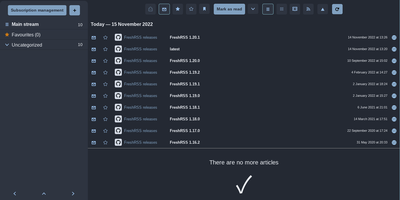
Where Miniflux strips reading down, FreshRSS gives you knobs - the feature-rich pole of self-hosted RSS, comfortable with thousands of feeds. It's a multi-user PHP aggregator (host family and friends on one instance, with an anonymous reading mode) with the reading workflow refined over a decade: favorites, custom tags, powerful filter and search queries, three reading views, and statistics that reveal each site's publishing frequency - useful for pruning subscriptions. Two properties make it the standard choice. First, the Google Reader-compatible API (plus a Fever API) syncs with virtually every serious RSS client - Reeder, NetNewsWire, ReadYou, FeedMe, Fluent Reader - so your phone reads from your server. Second, native WebSub support means compatible sources (WordPress, Blogger, Medium, Friendica) push new articles instantly instead of waiting for polling. A 50+ extension ecosystem adds what truncated feeds omit - full-text content fetching, reading-time estimates, trending views, auto-unsubscribe for dead feeds - alongside community themes and custom CSS. OPML import/export keeps subscriptions portable, a CLI handles administration, and article sharing posts to many services. AGPL-licensed, running on SQLite, MySQL, or PostgreSQL. Feedly Pro's feature set, minus Feedly's subscription and its algorithms.

Imagor Studio
Imagor Studio is a photo workspace where browsing a huge library and editing what you find happen in the same place, and the originals never get touched. The gallery scrolls virtually through thousands of images with no indexing wait, while drag-and-drop moves files between folders and multi-select handles bulk work. Open any image and the editor lets you stack layers: other images as overlays or watermarks, text layers you can style inline, and solid color layers with blend modes and opacity. Adjust color, apply effects, and crop with a live preview, then copy the generated transformation URL and use that rendition anywhere without exporting a file. A look you build once can be saved as a template in portable JSON and applied across the whole library, so a watermark, a resize, and a color grade become one reusable recipe. You can also start from a blank canvas at any dimensions and compose from scratch. Storage stays yours throughout: point it at a local folder, S3, MinIO, or Cloudflare R2 and manage the same library the same way. Running on a dedicated VPS on RepoCloud with guaranteed CPU, RAM, and SSD, full root SSH access, and a browser serial console. AGPL-3.0 licensed.