Promptfoo
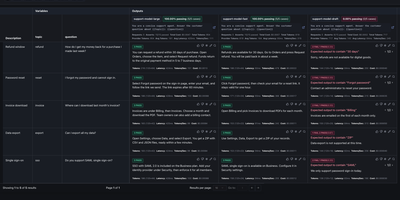
Promptfoo replaces vibes-based prompt tweaking with measurable tests, then attacks your AI app the way a hostile user would. An evaluation matrix lines up every prompt and model side by side, with pass or fail badges, assertion messages, latency, token counts, and cost in each cell. A red team wizard walks through the target, application details, plugins, and strategies, then probes for prompt injection, data exposure, broken access control, and harmful content. Preset bundles map plugins to the OWASP LLM Top 10, NIST AI RMF, MITRE ATLAS, GDPR, ISO 42001, and the EU AI Act. Meta Agent and Hydra Multi-Turn strategies adapt attacks across a whole conversation instead of firing one-shot prompts. Providers span OpenAI, Anthropic, Gemini, Bedrock, Azure, and local Ollama models, and any HTTP endpoint, Python script, or JavaScript function can be tested as a target. The history page lists every run with pass rates and raw scores, and prompt and dataset pages show which templates and test sets each run used. A provider allowlist file narrows the models offered in the web editor for cost control. Running on a dedicated VPS on RepoCloud with guaranteed CPU, RAM, and SSD, full root SSH access, and a browser serial console. MIT licensed.
OSRM
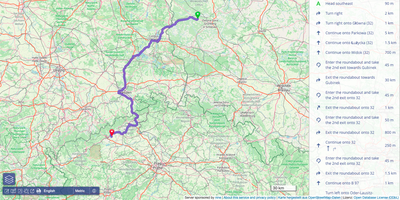
OSRM computes the fastest route between any two points, the travel time between every pair of stops, and the road a noisy GPS trace really followed, all from OpenStreetMap data on your own server. Feed it a map extract for your city or the whole planet, preprocess it with the car, bicycle, or foot profile, and the HTTP API starts answering. The route service returns turn-ready paths with distances, durations, and geometry between any coordinates. The table service computes the full duration or distance matrix between all pairs of points, which is the raw material for dispatching, territory planning, and pickup optimization. Map matching snaps noisy GPS traces onto the road network in the most plausible way, cleaning fleet and fitness data into actual driven streets. The trip service orders a set of stops into an efficient round trip, and the nearest service snaps raw coordinates to the closest road segments. A tile service exposes routing metadata as vector tiles for debugging and visualization, and a public demo frontend shows routes on a live map. Running on a dedicated VPS on RepoCloud with guaranteed CPU, RAM, and SSD, full root SSH access, and a browser serial console. BSD-2-Clause licensed.
Cadence Workflow
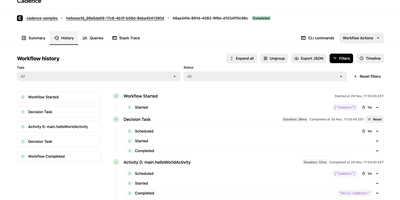
An order that waits days for a payment or a manager's approval survives crashes, restarts, and deployments in Cadence, a workflow engine that resumes each process exactly where it stopped. Developers write the order's logic as ordinary Go or Java code. The engine records every step in an event history and replays it to rebuild state on any worker. Activities send the emails, call the APIs, and write the database rows, each with its own retry policy, timeout, and heartbeat. A durable timer waits seconds or months without holding a thread, a cron schedule launches recurring runs, and a signal delivers the payment confirmation into the running workflow. Queries read its state without changing it, child workflows split big processes into reusable parts, and versioning allows code changes while older executions are still in flight. Domains separate teams and applications, task lists carry their own rate limits and priorities, global domains replicate across clusters and fail over between them, and archival retains closed histories. Cadence Web finds executions with SQL-like queries, lays out event history as a grouped table or a timeline, and exposes payloads, pending activities, and stack traces. It can start, reset, signal, cancel, or terminate runs, with batch actions for thousands of workflows at once. Running on a dedicated VPS on RepoCloud with guaranteed CPU, RAM, and SSD, full root SSH access, and a browser serial console. Apache-2.0 licensed.
TDuck
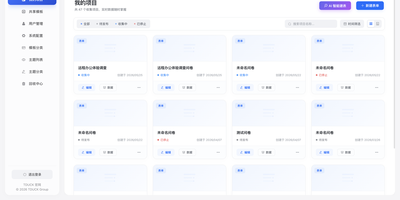
Describe the survey you need in one sentence, and TDuck drafts the questions for you. This open-source form platform replaces hosted tools like Typeform with a version you run on your own server, so responses never leave your hands. The visual designer offers over 27 field types, from text, dates, and ratings to file uploads, signatures, cascading selects, sub-forms, and matrix scales. Logic rules show or hide questions based on earlier answers, and imported question lists save time on long forms. Appearance settings cover header images, backgrounds, colors, and button text. Each form can be limited by device, account, IP, or WeChat identity, with an answer window you set. Finished forms publish as links or QR codes, and a recycle bin recovers deleted ones. Statistics show views, completion rate, weekly trends, submission maps, and per-question pie or bar charts that export as images. Responses can be edited, exported, printed, or zipped with attachments. Webhooks fire on new, changed, or deleted entries, a sync API exposes all data, and email, SMS, and WeChat notices keep owners informed. Running on a dedicated VPS on RepoCloud with guaranteed CPU, RAM, and SSD, full root SSH access, and a browser serial console. MIT licensed.
HRConvert2
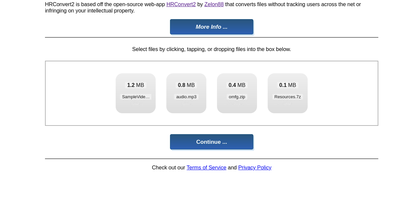
Stop pasting your files into ad-riddled online converters and handing strangers copies of your documents: HRConvert2 runs the whole conversion workshop on your own server instead. Drop a file onto the browser page and pick an output format from a catalogue of 488, covering documents, spreadsheets, presentations, ebooks, comics, images, audio, video, subtitles, and archives. Built-in OCR reads scanned PDFs and images and hands back editable text documents you can search and reuse. It converts 3D models and CAD drawings, renders OpenSCAD projects with their multi-file assemblies resolved, and can even build bootable ISO disk images for x86 and ARM machines from ordinary uploads. Live streams are captured and re-encoded straight from .m3u8 playlists, and every uploaded file can be virus-scanned with ClamAV before or after conversion. Finished files go back out through temporary share links that expire on their own, so sending a converted video to a client takes one click. Each visitor works in an isolated scratch space, files delete themselves when they age out, and nobody needs an account, ever. When traffic spikes, the server watches its own CPU and memory, throttles conversions, and spreads storage across disks so it stays upright. Three interfaces, seven color schemes, and 26 languages let each user shape the page to taste, and the whole thing runs happily on a Raspberry Pi with no database at all. Running on a dedicated VPS on RepoCloud with guaranteed CPU, RAM, and SSD, full root SSH access, and a browser serial console. GPL-3.0 licensed.
Swagger UI
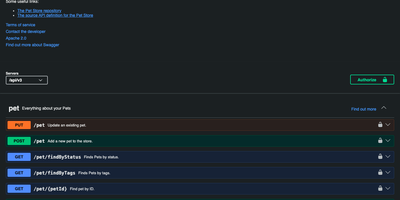
An OpenAPI file is precise but unfriendly to anyone who did not write it, and Swagger UI turns that file into a browsable page where every endpoint is documented and can be called on the spot. Operations are grouped by tag and color coded by HTTP method, and each one lists its parameters, request bodies, example payloads, response codes, and the schemas behind its models. Pressing Try it out unlocks the parameter fields and an Execute button that sends a real request from the browser and shows the response, so front-end developers, testers, and partners can explore an API before writing any client code. The Authorize dialog accepts API keys, HTTP basic credentials, bearer tokens, and OAuth2 flows including PKCE, an optional filter box narrows the page by tag name or path, deep links open a specific tag or operation, and a dropdown switches between several definitions. OpenAPI 2.0, 3.0, 3.1, and 3.2 files are all understood, including 3.1 webhooks, and the page follows the browser's light or dark color scheme with a toggle in the top bar. The Docker image loads a definition from a mounted file or a remote URL, serves it under a custom base path, and exposes most display options as environment variables, which suits an internal developer portal, a public API reference, or a staging sandbox for partners. Running on a dedicated VPS on RepoCloud with guaranteed CPU, RAM, and SSD, full root SSH access, and a browser serial console. Apache-2.0 licensed.
Neon
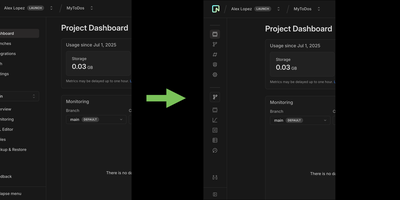
Neon reimagines PostgreSQL with a serverless architecture that decouples storage from compute, enabling instant copy-on-write database branching, autoscaling under load, and scale-to-zero when idle with sub-second cold starts. The lakebase architecture distributes durability across three layers: stateless compute nodes running unmodified PostgreSQL, safekeepers providing Paxos-based WAL quorum replication, and a pageserver that materializes pages on demand while offloading immutable history to S3-compatible object storage via MinIO or AWS S3. Copy-on-write branching creates full database clones as metadata operations without duplicating data, enabling developers to spin up isolated test environments, run parallel CI/CD pipelines, or recover from data loss through point-in-time restore across the configurable history window. Autoscaling dynamically adjusts CPU and memory based on live traffic without manual capacity planning, while scale-to-zero ensures costs drop to storage-only during idle periods. Neon maintains 100% PostgreSQL compatibility with broad extension support including PostGIS, pg_cron, pgvector, pg_stat_statements, and hundreds more, so existing applications connect with standard PostgreSQL drivers and ORMs unchanged. The API-first control plane enables programmatic provisioning, branch management, and multi-tenant fleet operations for platform builders and AI agent integrations. Acquired by Databricks in May 2025 and backed by over 22,800 GitHub stars. Deploys via Docker Compose with pageserver, safekeepers, storage broker, and compute nodes backed by MinIO object storage. Running on a dedicated VPS on RepoCloud with guaranteed CPU, RAM, and SSD, full root SSH access, and a browser serial console. Apache 2.0 licensed.
Docling Studio
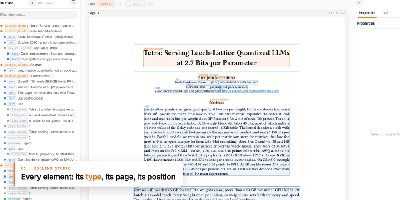
Docling Studio shows you exactly what a document parser sees, drawing a colored box around every title, paragraph, table, and picture it extracts from your PDFs. Import a PDF, run an analysis, and the result opens with three linked panels: the document tree on the left, the paged preview in the center, and the selected element on the right with its type, page, position, and text or table. Click any box on the page and the same element lights up in the tree and properties panel as other boxes fade away. The layers bar counts each element type and toggles boxes per type, or hides them all to reveal the bare page. You can analyze several documents at once from the list, watch progress percentages on long files, and queue work three analyses at a time. Ask a question and a local model answers from the document, with a reasoning timeline that links each step back to the passage it read. Finished results download as the original PDF, clean Markdown, or Docling JSON for downstream pipelines. AI agents connect over MCP to read and cite your documents, and an optional connection to your own Docling Serve server handles heavier parsing loads. Running on a dedicated VPS on RepoCloud with guaranteed CPU, RAM, and SSD, full root SSH access, and a browser serial console. MIT licensed.
Plane
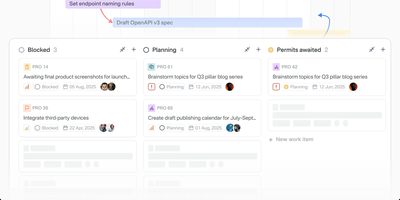
The most-starred open-source project management platform on GitHub with over 55,000 stars, Plane delivers what Jira, Linear, Monday, and ClickUp charge thousands per year for — issue tracking, sprint planning, documentation, and AI-powered workflows in one unified workspace that you own and control entirely. Work items feature a rich text editor with file uploads, sub-properties, custom states, priorities, labels, assignees, and cross-referencing, organized across five customizable layout views (list, board, table, spreadsheet, Gantt) with Command-K navigation for instant access to anything. Time-boxed Cycles provide sprint planning with automatic burn-down charts, velocity tracking, and scope change detection, while Modules break complex projects into manageable deliverables with progress aggregation. Built-in Pages combine AI-powered documentation with rich formatting, image embedding, and one-click conversion of notes into actionable work items. The AI layer reads across every project, cycle, document, and thread in the workspace — agents take real assignments, triage incoming requests, assign owners, track blockers, and ship status updates automatically. Native integrations connect GitHub, GitLab, Slack, Sentry, Figma, and 50+ tools with bidirectional issue sync and PR tracking, while import pipelines migrate entire workspaces from Jira, Linear, Asana, ClickUp, or Monday in minutes. The REST API with OAuth 2.0, HMAC-signed webhooks, typed SDKs in Node.js and Python, and a native MCP server enable custom automations. Running on a dedicated VPS on RepoCloud with guaranteed CPU, RAM, and SSD, full root SSH access, and a browser serial console. AGPL-3.0 licensed.
OpenAdServer
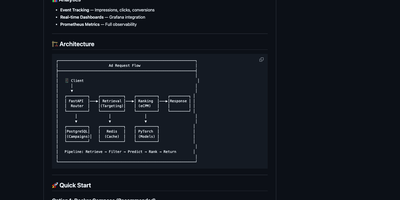
OpenAdServer runs your own ad network on your own infrastructure, ranking every request with machine-learned click predictions instead of static rotation. A request arrives with a slot, user, device, and geo context; the pipeline retrieves matching campaigns, filters them by targeting, budget, and frequency caps, predicts click probability, and ranks survivors by eCPM before responding in milliseconds. You serve banner, native, video, and interstitial formats with geo, device, operating system, demographic, and interest targeting, plus daily and hourly frequency limits per user. Budget pacing smooths delivery across the day so campaigns do not exhaust spend in the first hour. Three prediction models ship ready to train and swap without downtime: logistic regression for speed, factorization machines for feature interactions, and DeepFM for deep learning on your click logs. Automatic feature engineering processes sparse and dense fields, and hot-swapping lets a retrained model replace the live one mid-flight. Impressions, clicks, and conversions stream into event tracking, Prometheus metrics expose full observability, and Grafana dashboards visualize performance in real time. Advertisers, campaigns, and creatives are managed through CRUD APIs, and bid types cover CPM, CPC, CPA, and optimized CPM. Training scripts prepare data from your logs, train a model in a few commands, and report AUC before you promote it. Running on a dedicated VPS on RepoCloud with guaranteed CPU, RAM, and SSD, full root SSH access, and a browser serial console. Apache-2.0 licensed.
Redmine
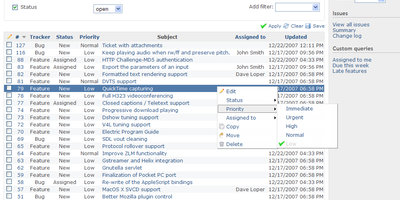
Nearly two decades running engineering organizations: Redmine is the veteran open-source project management and issue tracker, a Ruby on Rails application (GPLv2) still in active development. Its core strength is configurability: define your own trackers (bug, feature, task, or anything else), issue statuses, and role-based workflows that control exactly which transitions each role may perform, then extend records with custom fields of every type. Issues support subtasks, relations (blocks, precedes, duplicates), watchers, categories, and full journaled history, with saved custom queries and cross-project filtering for slicing the backlog any way you need. Around the tracker sit Gantt charts and calendars, a roadmap driven by versions, per-project wikis, forums, news, and document repositories, plus time tracking with estimated versus spent hours and activity-based reporting. Multi-project support runs deep - subprojects, per-project modules, and granular role-based permissions - and repository integration (Git, Subversion, Mercurial) links commits to issues automatically. Email notifications, inbound email-to-issue creation, LDAP authentication, a REST API, and a large plugin and theme ecosystem round it out. Recent 6.x releases brought substantial query and rendering optimizations. Self-hosting keeps your entire project history in your own database, free of per-seat licensing.
WoodPecker CI
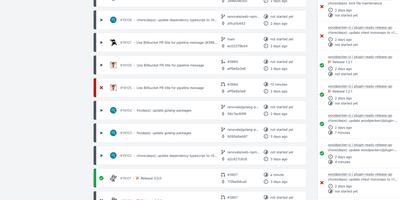
With 7,300+ GitHub stars and active releases through version 3.17, Woodpecker CI is the community-driven fork of Drone CI that kept the entire platform open source under Apache 2.0 — delivering a lightweight, container-native CI/CD engine that runs on minimal resources while providing enterprise-grade pipeline automation. Every pipeline step executes in an isolated Docker container, ensuring reproducible builds with zero host contamination and clean teardown after each run. Define workflows in simple YAML configuration files with step dependencies, conditional execution via when filters, service containers for databases and caches, and matrix builds that test across multiple language versions, platforms, or database engines simultaneously. Deep forge integration connects to GitHub, GitLab, Gitea, Forgejo, and Bitbucket via OAuth and webhooks, triggering pipelines on push, pull request, tag, deployment, and cron events. The plugin ecosystem inherits compatibility with the Drone plugin library — over 100 plugins for Docker builds, S3 uploads, SSH deployment, Slack and Telegram notifications, Helm deployments, and more. The server-agent architecture separates the web UI, API, and scheduler from pipeline execution, enabling horizontal scaling by adding agents across multiple machines or architectures including ARM. Secrets management supports global, organization, and repository-level scopes with approval workflows for forked repository pipelines. The admin web UI provides user management, agent monitoring, and queue control. Docker Compose deployment provisions the complete stack in under five minutes. Running on a dedicated VPS on RepoCloud with guaranteed CPU, RAM, and SSD, full root SSH access, and a browser serial console. Apache 2.0 licensed.
kkRepo
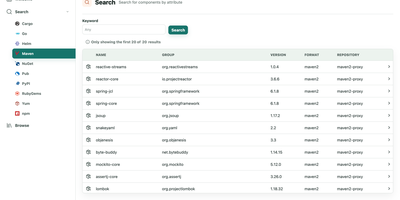
One trusted home for every package your build pipeline consumes: kkRepo hosts, proxies, and groups artifacts for Maven, npm, PyPI, Docker and OCI, Helm, Cargo, Go, NuGet, Composer, Terraform, Conda, APT, Conan, RubyGems, Yum, and more than twenty formats in total. Point your existing Nexus clients at it and nothing changes, because repository domains, the /repository/ URL layout, and the permission model carry over, and a one-click migration moves hosted data while clients keep building. Upstream proxies can be tuned per repository with their own outbound proxy and credentials, group repositories present many sources as one endpoint, and cleanup policies retire old artifacts before disks fill. Every stored artifact can be scanned against known vulnerabilities with SBOM generation and download enforcement, while Local, LDAP, and OIDC sign-in with fine-grained permissions decides who may publish or pull. Prometheus metrics and ready Grafana dashboards show throughput and storage, and multi-replica deployments share state through MySQL or PostgreSQL with blobs in S3-compatible storage. Running on a dedicated VPS on RepoCloud with guaranteed CPU, RAM, and SSD, full root SSH access, and a browser serial console. Apache 2.0 licensed.
Omni
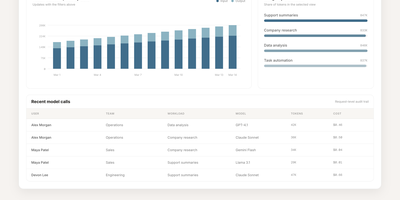
Omni is an open-source workplace AI agent and enterprise search platform that unites your company's scattered tools into a single context-aware workspace where team members can find answers and automate cross-application workflows. Employees can query connected knowledge sources including Google Drive, Gmail, Slack, Jira, GitHub, Confluence, and HubSpot to locate project specifications, customer records, and operational documents without jumping across tabs. The integrated AI assistant answers complex multi-step inquiries, summarizes lengthy email threads, and cites exact source passages so workers can verify factual accuracy before making business decisions. Granular permission inheritance mirrors existing access controls across every connected service, guaranteeing that sensitive personnel files, financial statements, and confidential repositories remain hidden from unauthorized staff. Engineers can construct bespoke data connectors and define automated agent skills through the extensible Python and TypeScript software development kits, triggering multi-service actions directly from interactive chat dialogues. Administrators can monitor background synchronization jobs, inspect audit trails, manage single sign-on access, and configure custom extraction pipelines using centralized operational dashboards. Running on a dedicated VPS on RepoCloud with guaranteed CPU, RAM, and SSD, full root SSH access, and a browser serial console. Apache 2.0 licensed.
Google Webfonts Helper
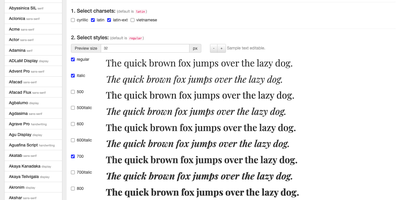
Self-hosting a Google font takes four steps in Google Webfonts Helper: pick a family, choose charsets and styles, copy the @font-face CSS, and download the files. The family list can be filtered by typing part of a name or category and ordered by family, category, popularity, last modified date, number of styles, or number of charsets. Each family page shows its styles and charsets beside an editable live preview with adjustable size, and ticking charsets and styles decides which files are generated. CSS comes in three modes: Modern Browsers with WOFF2 only, Legacy Support adding TrueType, and Historic Support adding EOT, WOFF, and SVG. A folder prefix field rewrites every url() to match where the files will live, and each rule sets font-display: swap. A zip download bundles the files in the selected mode's formats, named after the family, version, and charsets. A public JSON API lists families, returns font file URLs, and serves zips filtered by subsets, variants, and formats. Serving the files from your own domain keeps font requests off Google's servers, which helps sites with strict privacy requirements. To run the helper yourself, start one Docker container with a Google Fonts API key and publish port 8080; the image runs rootless. Running on a dedicated VPS on RepoCloud with guaranteed CPU, RAM, and SSD, full root SSH access, and a browser serial console. MIT licensed.
ExtendDB
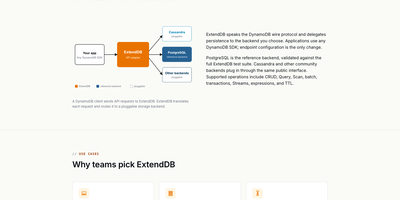
ExtendDB is a DynamoDB-compatible database server that answers the DynamoDB wire protocol from your own infrastructure, so applications written for DynamoDB run unchanged against a database you operate. Any AWS SDK, the AWS CLI, or DynamoDB tooling points at the ExtendDB endpoint and keeps working: tables, items, Query and Scan with key conditions and filters, batch reads and writes, and transactions all behave as the SDK expects. Streams feed change data to your own consumers, TTL expires items on schedule, vector indexes add cosine, Euclidean, and dot product search to on-demand tables, and point-in-time export and import move data in and out. Storage is pluggable, with PostgreSQL as the reference backend, SQLite embedded for small installs, and MongoDB and Cassandra for teams already running them. Every request is SigV4-signed and evaluated by a built-in IAM-style engine with users, groups, roles, policies, permission boundaries, and access keys, and TLS is mandatory on every connection. A web management console administers accounts and credentials, and a JSON metrics endpoint reports DynamoDB-style CloudWatch metric names and dimensions. The server runs as a daemon or in the foreground under Docker, Kubernetes, or systemd, healthchecks without extra tooling, and keeps serving in air-gapped environments with no internet connection at all. Running on a dedicated VPS on RepoCloud with guaranteed CPU, RAM, and SSD, full root SSH access, and a browser serial console. Apache-2.0 licensed.
Sim Studio
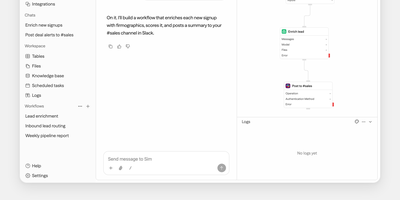
Sim Studio lets teams build, deploy, and monitor AI agent workflows by dragging blocks onto a visual canvas and wiring them into executable pipelines, backed by over 1,000 integrations. The React Flow editor represents each step as a node: LLM calls, tool invocations, conditional branches, and data transformations form directed acyclic graphs that run as complete agent pipelines. Every major LLM provider works natively, including OpenAI, Anthropic, Google Gemini, Groq, and Cerebras, plus local models through Ollama and vLLM. Integrations span Gmail, Slack, Microsoft Teams, Telegram, WhatsApp, Notion, Google Workspace, Airtable, GitHub, Jira, Linear, Perplexity, Firecrawl, PostgreSQL, Supabase, Pinecone, and Qdrant. Built-in tables provide a database layer, a file store offers shared team storage, and knowledge bases powered by PostgreSQL with pgvector enable retrieval-augmented generation. Finished workflows deploy as REST API endpoints, scheduled jobs, or Slack bots, with block-by-block execution traces for full observability. Real-time collaborative editing via Socket.io supports simultaneous multi-user construction. Alternatively, describe agent behavior in natural language and Sim assembles the workflow automatically. Built on Next.js App Router, Bun runtime, Drizzle ORM, and Tailwind CSS. 29,400+ GitHub stars and 100,000+ builders. Apache-2.0 licensed.
metacubexd
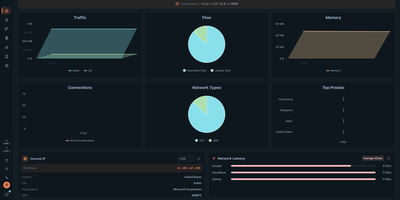
metacubexd gives your Mihomo proxy kernel a proper control room in the browser, from live traffic graphs to a full YAML profile editor. Real-time panels show upload and download speed, totals, active connections, memory use, and the busiest proxies, plus your current exit IP and latency to Google, Cloudflare, and GitHub. Proxy groups appear as cards with per-node latency bars, so switching a selector or running a latency test takes one click. Every connection is listed with its host, process, matched rule chain, and traffic, and can be closed or exported to CSV or JSON. Rules are searchable and filterable by type, and individual rules can be toggled on or off. Live logs stream by level, ready to search or download. With the all-in-one server image, you can also create profiles, import subscriptions by URL, edit configuration with schema-aware completion, validate it, and restart the kernel from the same page. Thirty-two themes, custom CSS, keyboard shortcuts, a responsive mobile layout, and seven interface languages make it comfortable to use anywhere. Running on a dedicated VPS on RepoCloud with guaranteed CPU, RAM, and SSD, full root SSH access, and a browser serial console. MIT licensed.