Commento++
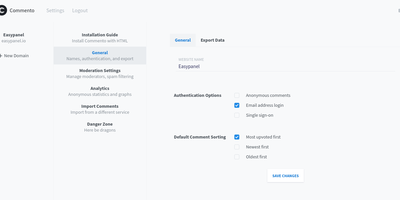
When Commento's original maintainer went quiet, Commento++ bundled the community's bug fixes and stalled merge requests into a batteries-included release of the beloved Go-based Disqus alternative - and kept building. The core promise is unchanged: an embeddable comments box that is orders of magnitude lighter and faster than Disqus, with no ads, tracking, or data sales - two lines of HTML and a PostgreSQL database. On top of Markdown comments, voting, Disqus import, OAuth login (Google, GitHub, Twitter) plus SSO, sticky comments, thread locking, and email notifications, the fork's additions are substantial: WebSocket-powered live comment updates with permalinks and highlight animations for new arrivals, guest commenting with a name, a cross-domain moderation dashboard for approving and deleting comments in one place, MathJax rendering support, wildcard domain matching, a reInit hook that makes single-page-application integration clean, and Perspective API spam scoring alongside the existing Akismet integration. Optional page-view logging graphs traffic on the dashboard, native SSL termination works without a proxy, and script-tag data attributes control fonts, CSS overrides, deleted-comment visibility, and polling-versus-WebSocket behavior.
DumbBudget
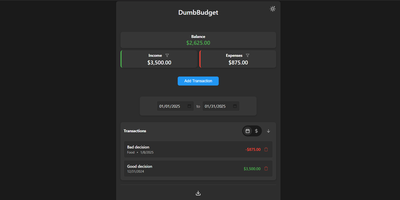
"Stupid simple software" is the entire philosophy at DumbWare.io, and DumbBudget delivers it: no over-engineering, no complexity, no accounts, no bank connections - just a clean, modern ledger for money in and money out. Log income and expenses, assign categories, and watch real-time balance calculations update as you type. Finding transactions is quick: filter by type, narrow by date range, sort by date or amount. When tax season or spreadsheet analysis calls, everything exports to CSV. Access control matches the philosophy - a single PIN (set via one environment variable) gates the app, backed by real security engineering: rate limiting on PIN attempts, temporary lockout after failures, secure session handling, and no sensitive data in browser storage. Multi-currency support covers the ISO codes, and a SITE_TITLE variable names each instance - deliberately useful, because running separate instances per account or family member is the intended pattern for multi-user needs. The responsive UI ships light and dark themes and installs as a PWA on phones, where expense logging actually happens. Configuration is five environment variables; data persists in one folder. If Actual Budget and Firefly III feel like accounting software, this is the notepad that gets used. GPL-licensed.
Substreamer
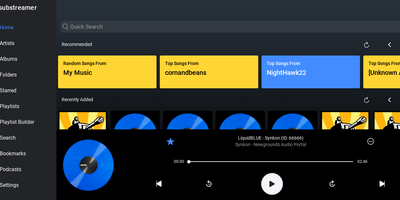
A free, polished web client for Subsonic-compatible music servers: Substreamer is the browser-based frontend you point at your existing streaming backend to play your own library from anywhere. It speaks the Subsonic API (v1.13 and higher), which makes it compatible with the whole ecosystem that has grown around that protocol: the original Subsonic server, its forks Airsonic and Madsonic, and modern implementations like Navidrome and Ampache. That decoupling is the point - your music files, transcoding, and library indexing live on whichever server you prefer, while Substreamer provides the listening experience: browse by artist, album, and genre, build and manage playlists, search your collection, and stream on demand. This RepoCloud deployment runs the containerized web edition, so the same interface is available from any browser without installing a native app, and it pairs with the Substreamer mobile apps that made the client popular. For anyone assembling a self-hosted Spotify replacement - typically Navidrome for the backend plus a good client - Substreamer fills the client half with a clean, familiar player UI. Because it is a stateless client, the container is lightweight and low-maintenance: connect it to your server's URL and credentials, and your entire collection is streaming in minutes, with no subscription and no catalog that can disappear.
Githome
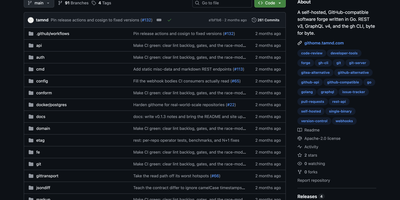
Point the gh CLI at your private Githome server and it works identically to github.com, because every REST v3 and GraphQL v4 endpoint returns byte-for-byte compatible JSON shapes, headers, Link pagination, and ETag caching. A single compiled Go binary serves the REST API under /api/v3, GraphQL under /api/graphql, git smart-HTTP transport, and a server-rendered web UI implementing the GitHub Primer design system with full functionality when JavaScript is disabled. The web interface provides repository browsing with Markdown rendering and syntax highlighting, issue tracking, pull requests with unified diffs and inline code review threads, full-text search, user profiles, and a notifications inbox. Authentication supports personal access tokens with prefix-based identification, OAuth device and web flows, and scoped permissions on every response header with only token hashes stored. The pull request system implements the complete lifecycle including async mergeable state computation, squash, merge, and rebase strategies, commit statuses, check runs, and statusCheckRollup fields. Webhooks deliver events with X-Hub-Signature-256 verification, SSRF protection, and at-least-once retry semantics. Storage supports SQLite for single-node deployments or PostgreSQL for production configurations. Performance optimizations include batch loaders replacing N+1 queries, keyset pagination, FTS-backed search, and GraphQL dataloaders. Docker deployment pulls the official multi-arch container image from GitHub Container Registry. Running on a dedicated VPS on RepoCloud with guaranteed CPU, RAM, and SSD, full root SSH access, and a browser serial console. Apache-2.0 licensed.
Gray Duck Mail
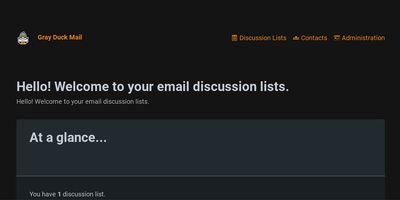
Email discussion lists - the venerable listserv pattern where one address relays to a whole group - without the notorious setup pain of Mailman or Sympa: that is Gray Duck Mail. Its architectural trick is requiring no mail server of your own: the C#/ASP.NET Core app monitors a POP3 inbox at any external email host supporting POP3/SMTP and aliasing, relays each incoming message to all list members via SMTP, and archives it for browsing in the web interface. Replies route back to the entire group automatically. The tedious parts of list management are handled by convention: dedicated aliases process join requests, subscription confirmations, and unsubscribes, while a bounce alias in the return-path catches delivery failures so dead addresses get handled instead of silently rotting. The web administration interface creates and removes lists, manages contacts, browses message archives, and imports or exports the local database for backup. GPLv3-licensed, Docker-distributed, and fully code-documented, it targets exactly the groups email still serves best - neighborhoods, schools, congregations, workplaces, and families - where one message keeping everyone in the loop beats yet another app nobody wants to install.
Oxigen
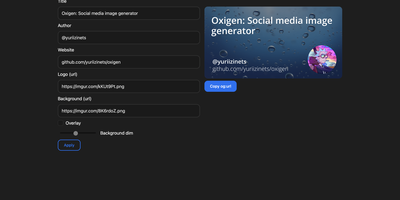
The social preview cards shown when links hit Twitter, LinkedIn, Slack, or Discord, generated on the fly: Oxigen is a small Go service for dynamic Open Graph images, no designer required per page. Instead of exporting static images per page, you compose a card once and drive it with parameters: title, author, website, logo, background image, and background dimming all arrive as URL query arguments, so your og:image meta tag simply points at the Oxigen endpoint with the page's own values substituted in. Every blog post, product page, and doc gets a branded, correctly sized preview generated on the fly. A built-in web UI covers interactive composition - tweak the text and imagery, watch the preview update, copy the resulting URL - while the same rendering path serves programmatic API use from static site generators, CMS templates, or build pipelines. Rendering is pure Go using the gg 2D graphics library, freetype fonts, and the imaging package, built on the kyoto framework by that project's author. Deployment is one stateless container on port 80 with no database and no external dependencies, so instances scale and restart freely.
GlitchTip
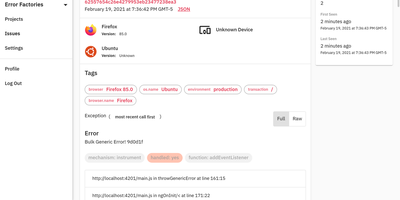
GlitchTip speaks Sentry's protocol without Sentry's operational weight - open-source error tracking that your existing SDKs already understand. The pitch is pragmatic: instrument your application with the official Sentry SDKs you already know - any language they cover - and point the DSN at your own GlitchTip instance instead. Errors, exceptions, log messages, and Content Security Policy violations flow into one place for triage, grouped into issues with stack traces, with alerts delivered by email or webhook the moment things break. Where self-hosted Sentry has ballooned into a docker-compose stack of twenty-plus containers, GlitchTip is a deliberately lean Django and PostgreSQL application a small team can actually run. Beyond errors, it bundles three more monitoring concerns: performance monitoring takes a works-out-of-the-box approach - no dashboard building, just your slowest web requests, database queries, and transactions surfaced automatically; uptime monitoring pings your sites and alerts on failures, or runs in reverse as a dead-man's-switch heartbeat for cron jobs that must check in on schedule; and log search puts application logs alongside errors for faster debugging. Unlimited projects and team members, MIT-licensed, built by Burke Software - your event volume is limited only by your own hardware.