Developer links
Paqet
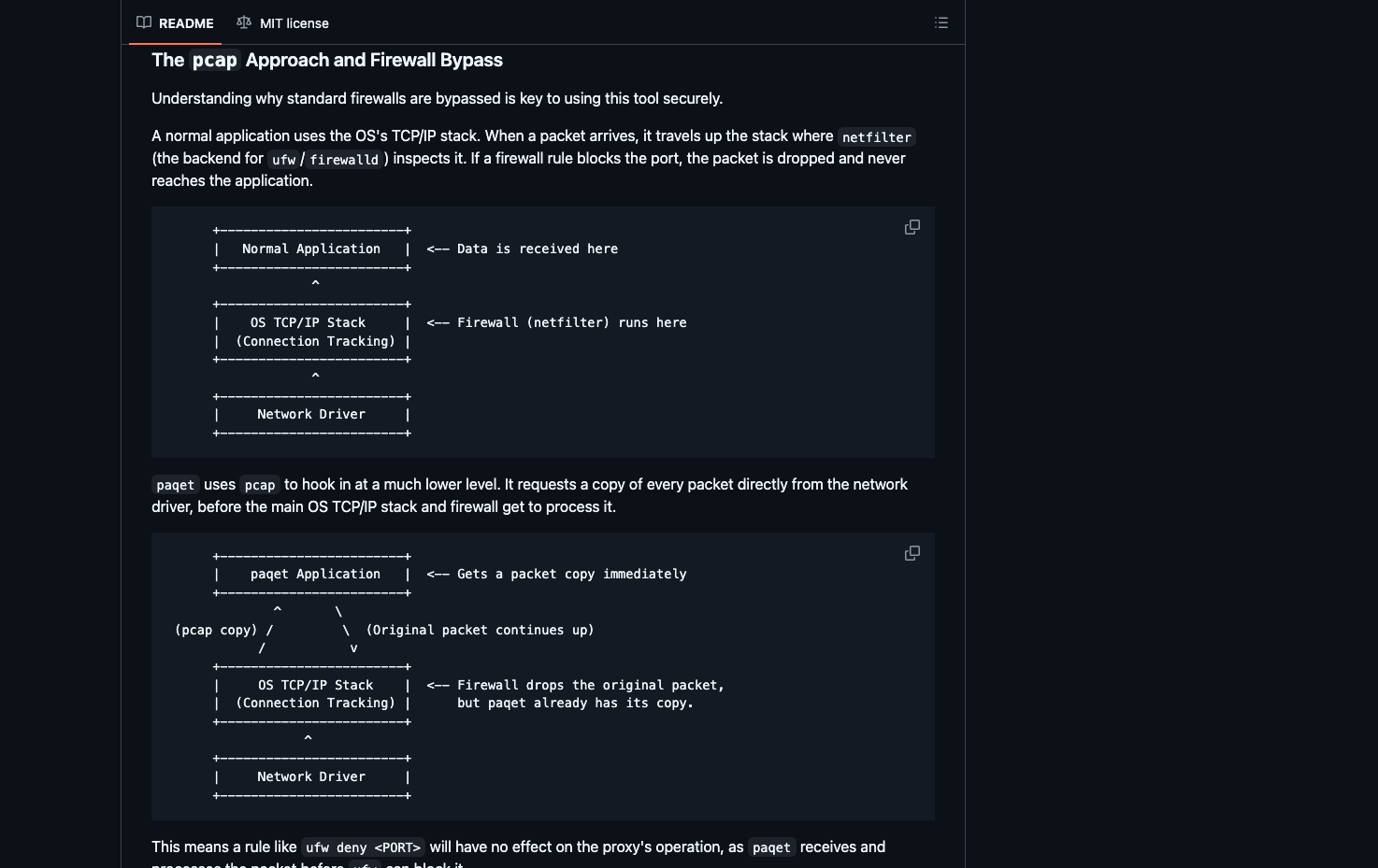
Most proxies ask the operating system nicely for a socket; paqet skips the conversation, building its own TCP packets byte by byte to tunnel traffic between your machine and your server. The server end listens on a port you choose and speaks only in raw packets it crafts and captures itself through pcap, before the kernel's connection tracking ever sees them. On your machine, the client presents an ordinary SOCKS5 proxy on localhost plus optional port forwards, so browsers and command-line tools connect exactly as they would to any proxy. Between the two ends, KCP with smux multiplexing turns a stream of self-contained packets into fast, reliable, encrypted sessions, with AES or lighter modes selected per deployment. TCP flag cycling varies how packets present themselves on the wire, giving operators control over the traffic pattern the tunnel produces. Built-in utilities generate the shared secret, ping the server with a single test packet, and dump live traffic decoded, so a silent tunnel gets diagnosed in minutes rather than by packet-capture archaeology. One YAML file per side declares the role, network interface, gateway MAC, and keys, and the same binary runs both ends. It suits security research, hostile networks, and anyone whose ordinary proxies keep getting reset. Running on a dedicated VPS on RepoCloud with guaranteed CPU, RAM, and SSD, full root SSH access, and a browser serial console. MIT licensed.
Benefits
- Below the stack, beyond filters
- Because packets are captured at the driver level, connection-tracking firewalls that never see a handshake cannot reason about the flow. The tunnel keeps working where stack-based proxies get reset or dropped.
- Reliable transport over raw packets
- Raw packets alone would lose and reorder data, so KCP adds acknowledgments and retransmission while smux multiplexes many sessions into one stream. Applications see ordinary, ordered connections end to end.
- Ordinary proxy for your tools
- The client side is a standard SOCKS5 endpoint plus optional TCP and UDP port forwards. Point a browser, curl, or an entire VM at localhost and the raw-packet machinery disappears.
- One binary, both ends
- Server and client are the same binary with a role line in YAML, statically linked for Linux and available for macOS and Windows. Releases are single files you copy and run.
Features
- Raw packet engine
- Traffic travels in TCP packets crafted with gopacket and captured through libpcap at the network driver. The host kernel's stack and its connection tracking never enter the data path.
- KCP encrypted transport
- KCP provides the reliable, encrypted session layer, with block modes from AES down to none, and smux multiplexes sessions over it. Keys are generated by the built-in secret command.
- SOCKS5, port forwarding
- Clients accept applications through a SOCKS5 listener and can forward chosen local ports to targets through the server, for TCP and UDP. Both modes can run at the same time.
- Packet-level diagnostics
- A ping command sends one test packet to verify the path, and dump captures and decodes the tunnel's own packets like a purpose-built tcpdump. YAML configuration stays human-readable throughout.