Rackpad
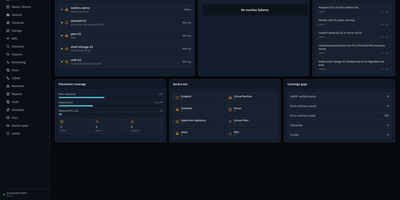
Every cable, switch port, VLAN, and rack unit in a homelab or small server room gets a documented place in Rackpad, a self-hosted inventory and operations workspace. Rack elevations show mounted gear, including paired half-width appliances. Switch-panel port maps and aggregate ports show what is patched where. Cables carry type, length, and color, editable in bulk. VLANs, subnets, DHCP scopes, reservations, and zones sit in one Networks workspace, with gateway and DNS protection and a mismatch review for IP assignments. Storage topology follows drives, bays, and pools that span several devices. Wi-Fi controllers, access points, hypervisor hosts, and virtual machines have pages of their own, and Proxmox and Hyper-V hosts can be imported after review. Discovery scans a subnet or any CIDR and stages every finding in an inbox. Per-device checks over ICMP, TCP, HTTP, HTTPS, and SNMP raise alerts by email, Discord, or Telegram. Everything feeds a movable topology map. Markdown runbooks attach to devices, and an audit log records every change. Admin, editor, and viewer roles control access, and OpenID Connect login is optional. Running on a dedicated VPS on RepoCloud with guaranteed CPU, RAM, and SSD, full root SSH access, and a browser serial console. MIT licensed.
E2A
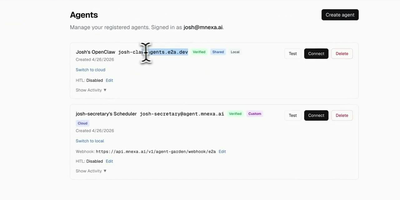
E2A is an open-source email API that lets any application send transactional email and gives AI agents real two-way inboxes of their own, so an assistant can hold a conversation over email without borrowing a person's mailbox. Register an agent and it gets a working address on a shared domain in seconds, or verify your own domain for branded addresses, then connect through the hosted MCP server, a coding-agent plugin with browser OAuth, signed webhooks, a WebSocket stream, REST polling, or the TypeScript and Python SDKs. A local agent behind a firewall needs no public URL at all: it listens over WebSocket and replies in-thread with conversation identifiers keeping multi-turn exchanges coherent across humans and other agents. Every inbound message arrives with structured SPF, DKIM, and DMARC evidence, with the DMARC alignment verdict included, so your agent can judge how far to trust a sender instead of trusting the From header. Flip on the human-in-the-loop gate per agent and outbound messages pause for a person to approve, edit, or reject from the dashboard, the SDK, MCP tools, or magic links in their own inbox, with expiry rules and recipient allowlists narrowing which sends get held. Inbound content screening flags prompt-injection payloads before the agent ever sees them. Support bots triage intake, scheduling agents coordinate meetings, and commerce agents answer order questions from one persistent address. Running on a dedicated VPS on RepoCloud with guaranteed CPU, RAM, and SSD, full root SSH access, and a browser serial console. Apache-2.0 licensed.
Routerly
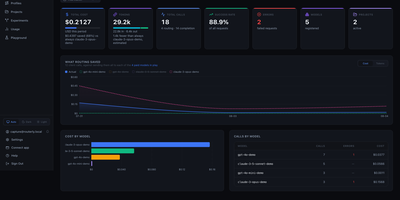
Routerly is the one front door for every AI model your apps use: point your OpenAI or Anthropic client at it, and it chooses the right model for each request, enforces your budget, and keeps the receipts. Nothing in your code changes except the base URL, and from that moment streaming chat completions and messages flow to OpenAI, Anthropic, Gemini, Mistral, Cohere, xAI or your own Ollama models behind a single token. Nine routing policies score every candidate in parallel: cheapest, fastest, healthiest, most capable, biggest context, least rate-limited, fairest, most budget left, and one that asks a small model to judge which model fits the task. When the winner errors or times out, the next candidate takes over automatically, and the recorded routing trace shows exactly why each model won or lost. Guardrails can block or log content that breaks your rules, and phone numbers, card numbers, SSNs, IBANs and emails can be scrubbed out before anything reaches a provider. Every call is logged with tokens, USD cost and latency, and hard limits per model, project and token reject overspending requests before a provider can charge for them. Projects keep separate tokens, model lists and budgets for each team or tool, role-based permissions decide who may change what, and alerts land in Slack, email, webhooks or PagerDuty when budgets or providers misbehave. Running on a dedicated VPS on RepoCloud with guaranteed CPU, RAM, and SSD, full root SSH access, and a browser serial console. AGPL-3.0 licensed.
Doorman
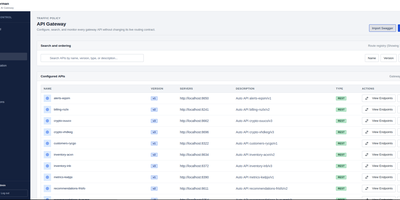
Doorman puts one controlled front door in front of every API you run, instead of teaching each service to reinvent keys, quotas, and abuse protection. It routes REST, SOAP, GraphQL, gRPC, gRPC-Web, and AI traffic through a single gateway while its control plane handles the surrounding work. Catalog APIs in a visual builder, configure protocols and endpoints, validate schemas, and manage semantic versions with deprecation and sunset dates as interfaces evolve. Control who may call what through users, roles, groups, and subscriptions, then attach credit tiers and quotas so heavy consumers stay inside the plan you sold them. Slow abusive clients with rate limits, throttling, and bandwidth caps, and keep flaky upstreams from cascading through retries and circuit breaking. Follow every request in searchable logs, review security controls and audit activity, and move configuration between environments with import and export. Start in a self-contained in-memory mode for a small deployment, then switch to shared MongoDB and Redis when several gateway instances need the same counters, revocations, and routing state. Running on a dedicated VPS on RepoCloud with guaranteed CPU, RAM, and SSD, full root SSH access, and a browser serial console. Apache 2.0 licensed.
Nixopus
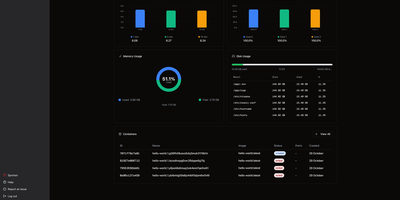
Tell an AI agent to deploy your app and watch it actually happen. Nixopus connects to your GitHub repo, analyzes the codebase to detect your framework, generates the right Docker configuration, resolves dependency conflicts, and ships the whole thing to your server with HTTPS enabled. When something breaks, the agent reads the logs, creates a pull request with a fix, and redeploys without waking you up. The chat interface lets you deploy, add custom domains, check logs, roll back, and troubleshoot in plain English from the web dashboard or directly from your VS Code or Cursor editor. Extensions bring one-click installs for 100+ self-hostable apps like Appwrite, Excalidraw, and Ollama, each showing you exactly what it runs on your server before installation. Connect multiple servers and monitor CPU, memory, disk, and running containers across your entire fleet from a single dashboard with draggable widget layouts. The built-in terminal opens SSH sessions right in the browser with split-pane support, so you can watch logs in one pane while running commands in another. Framework detection covers Next.js, Django, Rails, Go, FastAPI, and anything else that fits a container image. Every deployment gets automatic TLS via Caddy with Let's Encrypt certificates provisioned and renewed silently. Previous container images are retained so rollbacks skip the rebuild step entirely. Deploy on a dedicated VPS on RepoCloud with guaranteed CPU, RAM, and SSD, full root SSH access, and a browser serial console. AGPL-3.0 licensed.
Depl0y
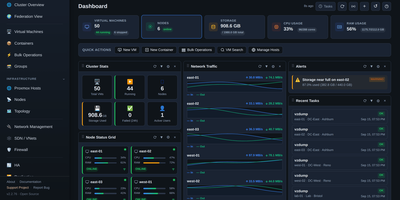
Three Proxmox sites, a lab host in the corner, and a rack of Dell and HPE servers can all share one screen when Depl0y runs the show. The dashboard totals virtual machines, containers, CPU, RAM, storage, and network traffic across every registered endpoint, with draggable widgets, alerts, and recent task feeds. Virtual machine pages cover start, stop, restart, snapshots, cloning, migration, templates, and a browser console, and node pages add metric charts, storage, networking, and update status. A guided failover wizard checks quorum, storage, and disks, then protects a guest so it restarts on another node if its host fails. A topology view maps hosts, guests, bridges, storage, and BMCs, with PNG, SVG, and draw.io export. Hardware pages poll iDRAC and iLO for health, temperature, power draw, DIMMs, drives, and firmware, and power controls reach machines that are fully off. Deployment tools build VMs from cloud images, import OVA, VMDK, and QCOW2 files, and launch self-hosted LLM guests. Admin, Operator, and Viewer roles, TOTP, host pinning, and a searchable audit log keep access tidy. MSPs managing client clusters, homelabs with several nodes, and data center teams that want hypervisor and hardware status together are the target audience. Running on a dedicated VPS on RepoCloud with guaranteed CPU, RAM, and SSD, full root SSH access, and a browser serial console. MIT licensed.
Terrapod
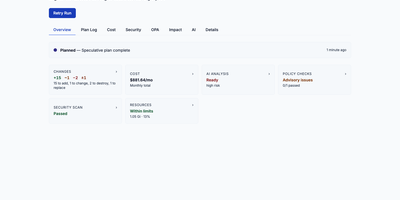
Terrapod gives you the Terraform Enterprise control plane on your own Kubernetes cluster, with remote state, run approvals, and policy checks, and no per-resource bill at the end of the month. Point your existing cloud block at it and terraform or tofu keep working unchanged, because Terrapod answers the same backend protocol the CLI already speaks. Workspaces isolate state, variables, and runs per team or environment, with versioned state you can lock, inspect, and roll back. Server-side agent pools execute plans and applies on ephemeral Kubernetes jobs, while CLI-driven runs stay available for local workflows. Approvals gate every apply, and conditional auto-apply only proceeds when a plan adds or updates resources without destroying anything. Label-based RBAC decides who may read, plan, write, or administer each workspace, with OIDC and SAML single sign-on on top. A private registry hosts your own modules and providers with GPG signing, and OPA Rego policy sets enforce rules as mandatory or advisory checks before apply. Drift detection flags infrastructure that wandered from its state, run triggers chain dependent workspaces, and an interactive impact graph shows a plan's blast radius before you approve it. Optional AI review summarizes each plan's changes and risks, and an MCP server lets AI assistants inspect workspaces and runs under the same permissions. Running on a dedicated VPS on RepoCloud with guaranteed CPU, RAM, and SSD, full root SSH access, and a browser serial console. MPL-2.0 licensed.
SpatiumDDI
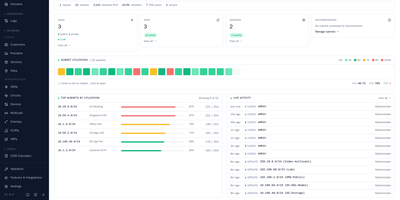
SpatiumDDI is the open alternative to commercial DDI platforms that charge by the IP, by the appliance, and by the feature, then lock every zone and subnet you own inside a renewal cycle. It does not just render configuration for servers somebody else runs, but deploys and operates BIND9, PowerDNS, Technitium, and Kea itself. Manage zones and records with per-server sync state, hand out DHCP scopes, pools, and static reservations per server group, and watch live leases reported back by the Kea agents. The IPAM side keeps spaces, blocks, and subnets in a tree with per-address DNS and DHCP sync, while the dashboard shows utilization, capacity, and platform health at a glance. Bring an existing estate with you through importers for BIND, Windows, PowerDNS, Technitium, Kea, ISC, and NetBox, and manage Windows DNS and DHCP agentlessly over WinRM when a full cutover is not on the table. Delegate safely with group-based roles over LDAP, OIDC, SAML, RADIUS, or TACACS+, search every object globally, and keep an append-only audit log of who changed what. Running on a dedicated VPS on RepoCloud with guaranteed CPU, RAM, and SSD, full root SSH access, and a browser serial console. Apache 2.0 licensed.
Topolograph
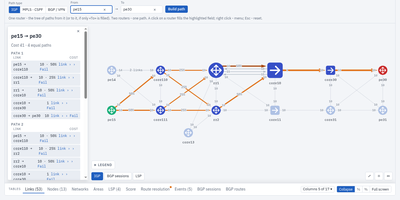
Before the maintenance window, know exactly where the traffic will go: Topolograph rebuilds your network the way its routing protocols see it and lets you break it safely on screen. Upload one router's LSDB output, from Cisco, Juniper, Arista, FRRouting, MikroTik, and a dozen other vendors, and the whole area's topology appears as an interactive graph, because the protocol already flooded it everywhere. Compute the shortest path between any two routers and see every equal-cost alternative with per-link loads, then fail a link or a node and watch SPF recalculate: which pairs moved to backup, which are left with none, and how the load shifted on every surviving link. Search the graph for prefixes, MAC addresses, or any network element, plan an MPLS TE path against real bandwidth attributes, and compare snapshots from different moments to answer what changed before the incident. Collectors can stream live OSPF, IS-IS, and BGP events over GRE, BGP-LS, or BMP so the timeline replays the network at the moment things broke, and a REST API, Python SDK, and MCP server let your own tooling and AI agents ask the same questions. Running on a dedicated VPS on RepoCloud with guaranteed CPU, RAM, and SSD, full root SSH access, and a browser serial console. MIT licensed.
Flexisip
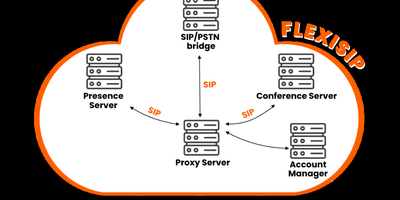
A SIP phone system lives or dies on the unglamorous middle. Something has to route every call, know who is registered, wake phones that are asleep, and translate between networks that disagree. Flexisip is that middle, built as a modular server suite where you deploy only the pieces your service needs. The proxy routes calls and messages, relays media with ICE, STUN, and TURN support, and authenticates users by digest, TLS certificates, or OpenID Connect. Its push gateway speaks RFC 8599 to Apple and Google, so incoming calls ring phones whose app is closed, and it can lend that gift to an existing Asterisk or FreeSWITCH platform that lacks push of its own. The presence server tracks who is reachable and shares contact lists, the back-to-back user agent bridges SIP networks to PSTN gateways and trunks with codec transcoding and caller identity translation, and a registration event server notifies peer domains when users register. Instances cluster with load balancing for services that outgrow one box, the same suite shrinks onto a Raspberry Pi class intercom, and it has quietly powered the public linphone.org SIP service for over a decade. Running on a dedicated VPS on RepoCloud with guaranteed CPU, RAM, and SSD, full root SSH access, and a browser serial console. AGPL-3.0 licensed.
Thruk
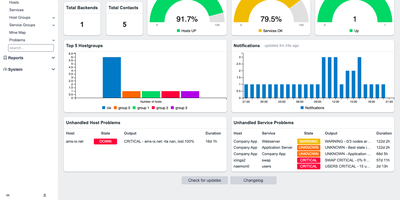
Thruk gives operations teams one fast web interface for watching hosts and services across several monitoring servers, with live status, dashboards, reports, and configuration in one place. One view combines Naemon, Icinga, Nagios, and Shinken servers, groups them by site, and reads them live. A home page of widgets shows host and service totals, gauges, notification charts, and unhandled problems, and a tactical overview adds outages and network health. Users filter, bookmark, and export status tables to Excel, and a mine map shows every host against its services as colored squares. A host page lists performance data beside actions to reschedule a check, submit a passive result, send a custom notification, or schedule downtime. Panorama dashboards place icons, graphs, and widgets on a free canvas or an OpenStreetMap, then share them with contact groups. A business process editor models an application as a tree of nodes with worst-of or best-of rules, and notifications can fire for individual steps. SLA reports in HTML and PDF go out by email on a schedule, and any page can become a recurring email report. A config tool edits hosts, services, commands, and contacts, manages users and teams, and reloads the monitoring core. Scripts reach status and commands through the REST API with API keys or through the command-line client. Running on a dedicated VPS on RepoCloud with guaranteed CPU, RAM, and SSD, full root SSH access, and a browser serial console. Artistic-1.0-Perl OR GPL-1.0-or-later licensed.
Containarium
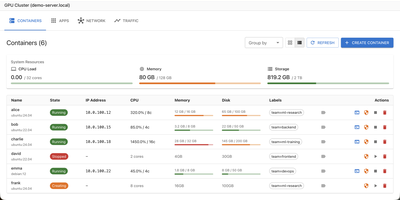
Containarium gives every AI agent a persistent Linux box of its own, reachable over SSH and driven through structured tools instead of a fragile terminal session. One command creates a named sandbox, syncs the SSH configuration, and wires the box into Claude Code, Codex, Gemini or Cursor through an MCP server that runs inside the container. From there the agent can execute shell commands, read and write files, install services, and expose a port on a public hostname with TLS terminated by a Caddy sentinel. Detached code runs keep working after a laptop sleeps or a connection drops, and the operator reattaches to the same byte-exact log later, checks status, or stops the run without losing output. An optional per-tenant eBPF egress policy limits outbound traffic per box, logs denied attempts for audit, and keeps provider API keys inside a model gateway rather than inside the agent environment. Boxes run on LXC or Kubernetes, keep state between agent sessions, support GPU passthrough for local model work, and stay separate from the host operating system and the cluster control plane. The dashboard presents containers, traffic, security events, audit records, GPU state and monitoring in one place. Running on a dedicated VPS on RepoCloud with guaranteed CPU, RAM, and SSD, full root SSH access, and a browser serial console. Apache-2.0 licensed.
BackupX
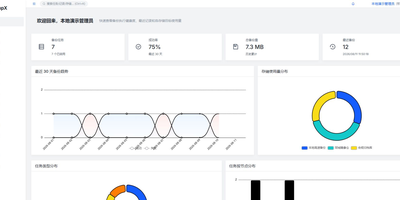
BackupX puts every server backup you are responsible for into one web console, so cron lines scattered across machines become scheduled, visible, and verifiable tasks. Files and directories from multiple sources, MySQL, PostgreSQL, SQLite, SQL Server, and SAP HANA databases all back up on cron schedules you can also build in a visual editor, with automatic retention by days or count cleaning up what expires. More than seventy destinations are reachable through rclone, from S3 and other object stores to Google Drive, WebDAV, FTP, SFTP, Azure Blob, Dropbox, and OneDrive, and storage targets show connection health and live capacity before a job ever fails against a full disk. A master and agent design lets remote servers poll outward only, even through proxies, private certificate authorities, or SSH bastions, so agents run tasks locally with no inbound connectivity to defend. Per-node bandwidth caps and concurrency limits keep a small node polite and a big node busy, each at its own pace. Success and failure notifications arrive by email, webhook, or Telegram, while Prometheus metrics, health probes, an SLA breach gauge, and a full audit log keep the platform observable, and signed audit webhooks forward events to SIEM or WORM storage for compliance records. Running on a dedicated VPS on RepoCloud with guaranteed CPU, RAM, and SSD, full root SSH access, and a browser serial console. Apache-2.0 licensed.
HAProxy Manager
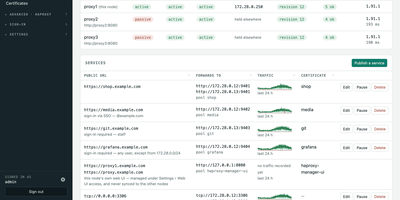
HAProxy Cluster Manager puts a web console on top of HAProxy, so you publish services, issue certificates, and cluster nodes from forms instead of hand-editing haproxy.cfg. Publishing a service takes two inputs, the public URL and the backend address, and the wizard builds the frontend, backend pool, host condition, routing rule, HTTPS listener, certificate, and HTTP redirect, with a preview of the exact configuration before anything applies. Every change is rendered and checked with haproxy -c before it is written, and a failed reload rolls back to the previous file automatically. Certificates come from Let's Encrypt through acme.sh, using HTTP-01 or DNS-01 with about 190 DNS providers, and renewals reload HAProxy and push the new certificate to every node on their own. Any number of nodes share one virtual IP through Keepalived: configuration and certificates sync between them, only the node holding the address is editable, and the dashboard flags split brain, an unclaimed virtual IP, or a node running stale configuration. You can gate services behind basic sign-in or OIDC single sign-on enforced by HAProxy itself, watch traffic statistics and logs, take transition alerts by email, Pushover, or webhook, and expose Prometheus metrics and Home Assistant entities. Running on a dedicated VPS on RepoCloud with guaranteed CPU, RAM, and SSD, full root SSH access, and a browser serial console. GPL-3.0 licensed.
FastLLM Proxy
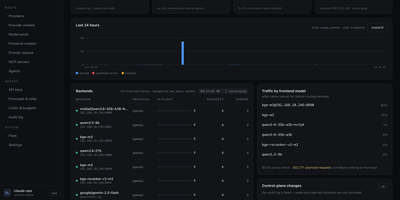
Local vLLM and llama.cpp boxes and hosted providers like OpenRouter, Anthropic, Bedrock, and Gemini all answer to one OpenAI-compatible address once FastLLM Proxy sits in front of them. Clients ask for a frontend model by name, and ordered rules pick the target by caller, prompt size, headers, budget spent, time of day, or how busy a backend is. Prompts that share a prefix return to the node holding their cache, and semantic routing sends coding questions one way and chat another using example prompts you write. API keys carry per-model grants, rate limits, and token or spend budgets, and the management console shows traffic, usage and spend, an append-only audit log, and a fleet topology. Failures fall through to the next target before a byte reaches the caller, and an admission gate turns a flooded engine into a bounded queue. An MCP gateway and an A2A agent endpoint put tool servers and agents behind the same address. Existing LiteLLM configs import unchanged. Running on a dedicated VPS on RepoCloud with guaranteed CPU, RAM, and SSD, full root SSH access, and a browser serial console. Apache-2.0 licensed.
OmniSight
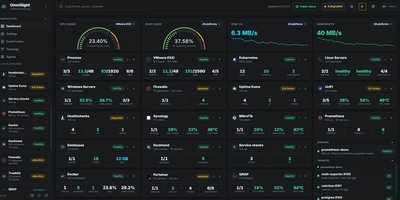
OmniSight ends the homelab ritual of a dozen admin panels open in a dozen tabs, each with its own login and its own idea of what healthy looks like. It folds all of them into one page that answers the only question you actually have: is everything fine? Watch Proxmox nodes with their VMs, containers, backup status, and Ceph health next to VMware hosts and datastores, Linux and Windows servers, and Kubernetes pods with live log viewing. Add Docker hosts and see container status, ports, resource use, and image updates, check OPNsense firewalls, TrueNAS and QNAP storage, and PostgreSQL, MySQL, and MongoDB databases without leaving the dashboard. A small push agent installs with one copied command and self-registers within seconds, needing no inbound firewall rules, so machines behind NAT report in on their own. Follow relationships on the topology map, restart a service from the detail view, export a full backup, and publish a read-only public status page for anyone who asks how things are running. Running on a dedicated VPS on RepoCloud with guaranteed CPU, RAM, and SSD, full root SSH access, and a browser serial console. GPL-2.0 licensed.
WildDuck
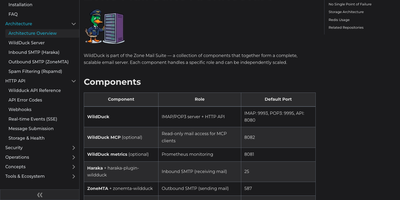
For operators running email at real scale, WildDuck moves accounts and messages into MongoDB and scales by adding stateless servers behind a load balancer. Any standard mail app connects over IMAP with IDLE push, CONDSTORE sync, compression, quota reporting, and special-use folders, or over POP3 for simple download-and-delete reading. International addresses and folder names work natively, so mailboxes written in Cyrillic, Arabic, or Chinese scripts are first-class citizens rather than encoding errors. Everything an operator touches is an API call: create users, set quotas, edit filters and auto-replies, publish DKIM keys, read audit logs, and move messages between mailboxes without editing a config file. Accounts defend themselves with two-factor authentication by authenticator app or security key, application passwords for older clients, and optional PGP encryption of stored mail. Pair it with Haraka to receive SMTP mail and ZoneMTA to send it, and the three services form a complete mail platform with no single point of failure. Attachments spill into GridFS or S3 storage and Redis keeps sessions and queues moving, so a failed node interrupts nothing that a replica cannot resume. Running on a dedicated VPS on RepoCloud with guaranteed CPU, RAM, and SSD, full root SSH access, and a browser serial console. EUPL-1.2 licensed.
Huf
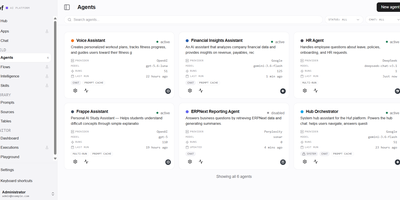
Give your team one console to build agents, ground them in real data, and reach them through email, Telegram, Slack, and WhatsApp: Huf is a self-hosted multi-agent AI platform running on servers you operate. Create agents visually, assign each one a provider and model, and watch runs, last activity, and status from a grid that shows every agent at a glance; the same console manages prompts, skills, flows, data tables, and knowledge sources. Connect agents to Gmail and email, Telegram, Slack, WhatsApp, and custom HTTP webhooks, and inbound messages trigger runs whose replies route back to the original channel automatically. Agents read, create, update, and delete any Frappe document, work ERPNext data, and call external systems through Model Context Protocol servers with managed OAuth credentials. Code-heavy tasks run in hardened execution profiles: a local Python environment, an isolated venv, direct SSH, a Frappe SSH connection, or a Docker container, each gated by role-based permissions for agents, tools, data tables, and MCP servers. Teams package prompt templates, tools, and MCP configurations into shareable skills and Huf Apps, run models from cloud providers, or keep everything local with Ollama, LM Studio, or any OpenAI-compatible endpoint. Running on a dedicated VPS on RepoCloud with guaranteed CPU, RAM, and SSD, full root SSH access, and a browser serial console. AGPL-3.0 licensed.