Open Source App Cloud Marketplace
Deploy, host, and scale with one click, at half the cost. Then customize with AI agents.
Colspan
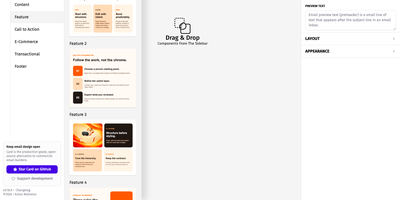
Hand-coding HTML emails means wrestling nested tables and Outlook quirks for hours; Colspan turns that work into dragging ready-made blocks onto a canvas and exporting code that holds together in Gmail, Outlook, and Apple Mail. The component catalog holds 78 blocks grouped into Menu, Header, Content, Feature, Call to Action, E-Commerce, Transactional, and Footer sets, so newsletters, receipts, and promotional campaigns all start from structured pieces instead of a blank file. You edit text inline with rich formatting and Google Fonts, arrange blocks in a synchronized component tree, and adjust each row for stacking order and visibility on mobile. Desktop and mobile previews render side by side, and the preview stays isolated from the editor chrome, so what you check is what recipients open. Finished designs export as responsive HTML with inline styles, or as JSON you can store, version, and re-import later in replace or append mode. Import validation and sanitization guard templates received from teammates or clients before they enter your workspace. Your work saves automatically in the browser and reloads where you left off, and undo and redo cover every edit during experimentation. Agencies can host the editor on a client-facing domain, marketing teams can produce campaign emails without developer time, and product teams can standardize receipts and notifications as reusable templates. Running on a dedicated VPS on RepoCloud with guaranteed CPU, RAM, and SSD, full root SSH access, and a browser serial console. AGPL-3.0 licensed.
CoreObs
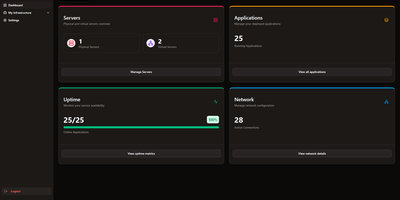
CoreObs delivers a unified self-hosted dashboard that replaces the typical combination of Uptime Kuma, Homer, and separate monitoring tools with a single interface for managing your entire server infrastructure. The Next.js frontend with shadcn components provides a modern dark-themed UI displaying server hardware metrics collected by a lightweight Go agent that leverages Glances for hardware abstraction — streaming real-time per-core CPU load, RAM utilization, NVIDIA GPU statistics, disk usage, system uptime, and load averages via WebSocket connections. The application registry tracks all self-hosted services with configurable uptime monitoring, availability history charts, and instant notifications through Discord, Telegram, Pushover, and email when services go down or recover. Quick-access links provide one-click navigation to each application's management panel directly from the dashboard. The network visualization module built on React Flow enables creating visual topology maps of your infrastructure with drag-and-drop nodes representing servers, switches, and services connected by labeled edges. Server data can be organized with tags, copied between entries, and monitored with configurable pagination and compact view modes. Deploy via Docker Compose with three containers — the Next.js web interface, the Go monitoring agent, and PostgreSQL 17 for persistent storage. Running on a dedicated VPS on RepoCloud with guaranteed CPU, RAM, and SSD, full root SSH access, and a browser serial console. MIT licensed.

Bloglite
Most blogging platforms demand a database server, a cache layer, and a healthy slice of RAM before you publish a single sentence; Bloglite runs a complete personal microblog in a few megabytes of memory. You write and edit posts directly in the web interface from a phone or a desktop browser, see the rendered result within seconds, and skip the commit, build, and deploy cycle that static site generators impose on every small update. Posts are written in Markdown with built-in syntax highlighting for code and rendered LaTeX for math expressions, so technical notes, recipes, snippets, and reading highlights all sit comfortably in the same public notebook. Upload images and files to embed them in posts, follow RSS feeds from inside the service, and retrieve anything later through the built-in search or an external search engine. Share posts through short numeric links or longer descriptive slug URLs, and keep ownership of everything: posts live in one SQLite database on your server, and automatic backups export the whole site to plain text files that can be downloaded through the API and committed to a Git repository on a schedule. Running on a dedicated VPS on RepoCloud with guaranteed CPU, RAM, and SSD, full root SSH access, and a browser serial console. MIT licensed.
Traggo
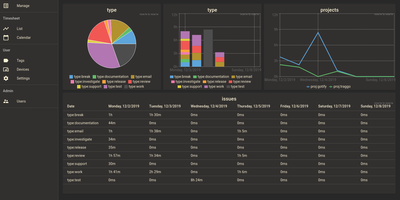
With over 1,600 GitHub stars and a design philosophy that fundamentally rethinks how time tracking should work, Traggo abandons the traditional project-task hierarchy that forces your work into rigid categories and instead lets you tag time spans with arbitrary key-value pairs — project:website, type:coding, client:acme, billable:yes — enabling cross-dimensional analysis that conventional trackers cannot replicate. The Go backend compiles into a single binary that runs alongside a SQLite database and embedded web UI in under 10MB total, consuming approximately 50MB of RAM at runtime and starting in seconds on even the smallest VPS. Tags are the fundamental data model: create any tag key with any set of values, then apply multiple tags to each time span simultaneously to track by project, client, task type, energy level, or any other dimension your workflow demands. Customizable dashboards render pie charts, bar charts, and line graphs from tag-aggregated data, letting you visualize time distribution across any combination of dimensions over configurable date ranges. The calendar view displays time spans as colored blocks across days and weeks, while the list view provides chronological entry browsing with inline editing. Multiple themes including light and dark modes adapt the interface to personal preference, and simple user management with role-based access supports small team deployments. Docker deployment runs a single container exposing port 3030 with multi-architecture support for amd64, arm64, and arm v7. Running on a dedicated VPS on RepoCloud with guaranteed CPU, RAM, and SSD, full root SSH access, and a browser serial console. GPL-3.0 licensed.

KoShelf
Your e-reader already knows everything about your reading life, and KoShelf turns that KOReader metadata into a beautiful dashboard you can browse from any browser. The library overview gathers currently reading, completed, and unread books and comics, while each item's page collects your highlights, annotations, ratings, and review notes in one place. Reading statistics chart your time and pages with customizable activity heatmaps and weekly breakdowns, and per-item statistics reveal session counts, average session length, and reading speed for every book. A monthly calendar shows what you read on each day, and the yearly recap celebrates completions with monthly summaries of finished items and hours read. Supported books open right inside KoShelf's own reader, with keyboard navigation, a progress scrubber, and inline highlight notes. Metadata entries survive even when the original document disappears, because library archives preserve covers and reading data until the source returns. With writeback enabled in server mode, you can edit annotations, ratings, status, and covers from the browser, protected by revision checks and recoverable backups so external changes are never overwritten blindly. Search by title, author, or series, filter by reading status, and download original files whenever you need them. Running on a dedicated VPS on RepoCloud with guaranteed CPU, RAM, and SSD, full root SSH access, and a browser serial console. EUPL-1.2 licensed.
TLSPROXY
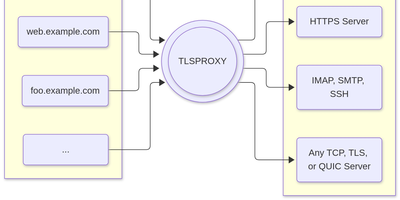
TLSPROXY puts automatic Let's Encrypt TLS in front of every service on your server, so many names can share one port while each backend gets exactly the encryption treatment it needs. Terminate TLS and hand plain text to a local service. Pass raw TLS straight through when the proxy should see nothing. Or terminate and re-encrypt towards a TLS backend, with client certificates checked on the way in. QUIC and HTTP/3 connections terminate here too, and Encrypted Client Hello keeps even the handshake private. Certificates arrive and renew by themselves through http-01 and tls-alpn-01 challenges, PROXY protocol headers preserve real client addresses, and SNI routing with round-robin balancing spreads names across backends. People get in with OpenID Connect, SAML, or passkeys; the same sign-in can mint short-lived SSH user certificates, and built-in certificate authorities manage client and backend credentials for you. Static sites can be served straight from disk, TPM-backed keys keep private material in hardware, and a built-in console shows what the proxy is doing. Running on a dedicated VPS on RepoCloud with guaranteed CPU, RAM, and SSD, full root SSH access, and a browser serial console. MIT licensed.
Shelve
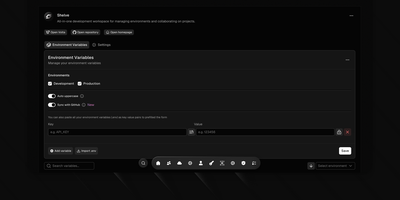
Eliminate scattered configuration files and leaked credentials across development teams with Shelve, an open-source secrets management platform that secures environment variables across development, staging, and production tiers. Engineering teams can organize sensitive database passwords and third-party API credentials within a centralized vault protected by AES-256 encryption and SHA-256 integrity verification. The platform synchronizes configurations directly to GitHub Actions and repository secret stores through an official GitHub App integration. Developers can inject encrypted variables directly into local processes using the dedicated CLI without saving plain-text secrets to disk. The built-in sharing vault creates self-destructing, password-protected links to exchange sensitive credentials securely with external contractors. Administrators can define custom workspace teams with granular role-based access controls, track change audit logs across configuration histories, and navigate management views using a keyboard-driven command palette. Automated schema validation engines detect missing parameters and enforce uniform uppercase naming standards across application tiers. Running on a dedicated VPS on RepoCloud with guaranteed CPU, RAM, and SSD, full root SSH access, and a browser serial console. Apache 2.0 licensed.
Nuclio
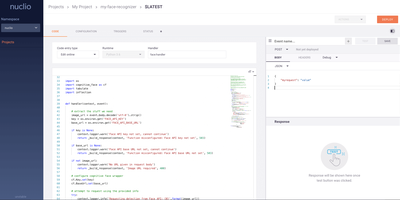
Serverless platforms promise to run your code only when it is needed; Nuclio adds the part they usually skip, raw throughput for data-heavy work, with a single function instance able to process hundreds of thousands of HTTP requests or records per second. You write functions in Python, Go, Node.js, Java, .NET, or plain Shell, and deploy them from the dashboard on port 8070, from the nuctl command line, or from Jupyter through the Nuclio SDK. Events reach your code through HTTP calls, cron schedules, Kafka and Kinesis streams, MQTT and NATS messages, RabbitMQ queues, or Azure Event Hubs, so the same function model covers APIs, stream processors, and scheduled jobs. Each function ships as its own container, built securely with Kaniko, and scales on plain Docker for a single server or on Kubernetes when the workload outgrows one machine, with GPU support for inference and media pipelines. Projects organise functions with shared configuration, secrets, and API gateways, and the dashboard shows invocations, logs, and metrics while templates for common jobs get a first function running in minutes. Data science teams plug Nuclio into MLRun and Kubeflow Pipelines to serve models and automate ML workflows without a separate serving tier. Running on a dedicated VPS on RepoCloud with guaranteed CPU, RAM, and SSD, full root SSH access, and a browser serial console. Apache-2.0 licensed.
Redd-Archiver
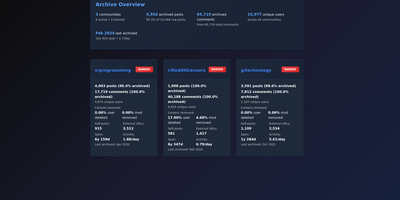
Redd-Archiver builds you a private, permanent copy of Reddit's history: feed it public data dumps and it returns a browsable, full-text-searchable archive of the communities you choose. The source material is enormous and already public: the full Pushshift and Arctic Shift Reddit datasets hold over 2.38 billion posts from 40,000 subreddits, the complete Voat archive adds 3.81 million posts, and Ruqqus contributes another half million, all importable by community instead of wholesale. One import into PostgreSQL becomes three possible websites: a static export that runs on any host down to a USB stick, the default hybrid of static pages plus a live search server, or a fully dynamic site that renders straight from the database with flair, domain, score and date filters. Search understands keywords, subreddit, author, date and score operators, and the same archive answers scripts and AI agents through thirty-plus REST endpoints and an MCP server with 29 tools. Monthly Arctic Shift dumps keep everything current: updates import only your tracked subreddits, skip themselves by checksum when re-run, refresh scores, and never let a later deletion overwrite text you preserved. Subreddit rules, descriptions and wiki pages ride along with the posts, eleven themes restyle the result, and the whole thing can hide behind a Tor hidden service or stand on HTTPS with its own domain. Running on a dedicated VPS on RepoCloud with guaranteed CPU, RAM, and SSD, full root SSH access, and a browser serial console. Unlicense licensed.
Kuzzle
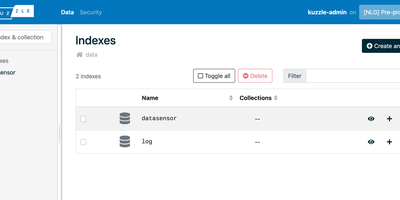
Kuzzle ships a production-ready backend from day one: data storage with Elasticsearch search, real-time pub/sub notifications, user authentication, role-based permissions, and a multi-protocol API serving HTTP, WebSocket, and MQTT simultaneously on port 7512. Rather than rebuilding these standard features from scratch for each project, you get a ready-made backend that accepts connections from web applications, mobile clients, and IoT devices through one unified API surface. Elasticsearch provides persistent document storage with full-text search, geospatial queries, and aggregation pipelines, while Redis handles internal caching and memory storage operations. The Koncorde real-time engine powers pub/sub messaging and database notifications, enabling clients to subscribe to document changes with filter conditions that trigger instant updates when matching data is created, modified, or deleted. User management includes JWT-based authentication, role-based access control with granular permissions at the controller and action level, and pluggable authentication strategies via Passport.js. The extensible plugin framework allows developing custom business logic, additional authentication providers, storage connectors, and protocol handlers. Client SDKs for JavaScript, Dart, Kotlin, and C++ accelerate frontend development, while the Kourou CLI provides command-line API access and project scaffolding. The Vue.js Admin Console offers a web interface for managing indexes, collections, documents, users, profiles, and roles. Horizontal scaling through masterless cluster mode targets 99.99% uptime without single points of failure. Running on a dedicated VPS on RepoCloud with guaranteed CPU, RAM, and SSD, full root SSH access, and a browser serial console. Apache 2.0 licensed.
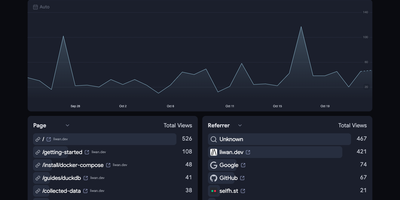
Liwan
When you want honest traffic numbers without tracking cookies or stored IP addresses, Liwan puts a real-time analytics dashboard on your own server. The dashboard ranks pages, referrers, countries, browsers, platforms, and devices, charts visitors over time, and filters out bot traffic by default. Session metrics add bounce rate, average time on site, and entry and exit pages, while UTM fields attribute visits to campaigns. Collection is adjustable globally and per site: choose how visitors are grouped, whether to store country and city, country only, or no location, and how long events are kept. Drop rules discard internal, test, and local traffic before storage, and a pruning tool applies new settings to history after a dry-run preview. Tracking is one line of HTML, or your own server can send events with custom names and properties. Location can come from a MaxMind database or from Cloudflare, Vercel, and other proxy headers. One instance holds several projects and sites, with team accounts and single sign-on through Google Workspace, Microsoft Entra ID, or an OpenID Connect provider such as Keycloak or Dex. Running on a dedicated VPS on RepoCloud with guaranteed CPU, RAM, and SSD, full root SSH access, and a browser serial console. Apache-2.0 licensed.
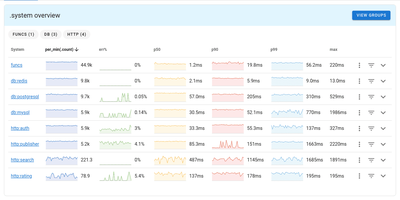
Uptrace
Pinpoint distributed system bottlenecks across polyglot microservices using Uptrace, an open telemetry monitoring platform that correlates traces, metrics, and logs inside a unified diagnostic dashboard. Engineers can track end-to-end request flows across polyglot microservices, inspecting database queries, third-party API calls, and internal function calls with sub-millisecond precision. The platform automatically aggregates spans into high-level latency percentiles, highlighting p50, p90, and p99 bottlenecks while calculating baseline error rates across production deployments. Integrated log correlation links log entries directly to parent trace spans, eliminating the friction of manual search across separate monitoring tools during active outages. You can construct custom dashboard views using a visual query builder, monitor cluster nodes, and map out upstream and downstream service dependencies with interactive topological graphs. Automated alerting channels notify on-call teams via Slack, Telegram, webhooks, or email whenever error budgets or metric thresholds trigger an incident. Running on a dedicated VPS on RepoCloud with guaranteed CPU, RAM, and SSD, full root SSH access, and a browser serial console. AGPL-3.0 licensed.

Rachoon
Named after the Bosnian word for invoice (račun) with a raccoon twist, Rachoon provides a clean self-hosted invoicing platform that handles the complete billing cycle from quotation to payment reconciliation without touching a third-party SaaS subscription. The Nuxt.js frontend serves a dashboard that surfaces revenue totals, pending balances, overdue items, and client statistics at a glance, while the AdonisJS backend manages all business logic against a PostgreSQL 16 database with TypeScript throughout the full stack. Invoice templates use Nunjucks with full HTML and CSS control—including conditional logic, loops, and custom formatting—so the rendered PDFs actually match your design intent. This is possible because Rachoon delegates PDF generation to Gotenberg, which renders invoices through headless Chrome rather than a restricted drawing API, producing output that faithfully preserves complex layouts, web fonts, and CSS grid. Client records stay organized and searchable, each linked to their invoice and quotation history with payment status tracking across pending, paid, and overdue states. Multi-currency billing with flexible tax configuration supports international operations, and all data remains on your own infrastructure. The monorepo is managed by Turborepo with a CI pipeline covering linting, PostgreSQL integration tests, build verification, and multi-platform Docker image creation for both amd64 and arm64 architectures. Running on a dedicated VPS on RepoCloud with guaranteed CPU, RAM, and SSD, full root SSH access, and a browser serial console. AGPL-3.0 licensed.
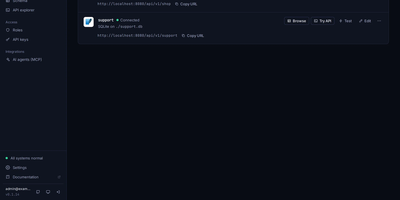
Faucet
One binary and one command is all it takes: the SQL database you already run gains a secure REST API and MCP server, with no code generation and no ORM boilerplate. Point it at PostgreSQL, MySQL, MariaDB, SQL Server, Oracle, Snowflake, or SQLite and it introspects the schema at runtime, generating full CRUD endpoints with filtering, ordering, and pagination plus a live OpenAPI 3.1 specification. The embedded admin UI connects databases with plain host, port, user, and password fields, tests the connection before saving, and tells you exactly what to fix when it fails. You browse tables, columns, keys, and data, build roles with per-table verb permissions, and issue API keys that are SHA-256 hashed with a role assigned to each. Schema contract locking watches for drift that would silently break your API, with none, auto, and strict modes managed from the UI or CLI. The API explorer builds filtered, paginated requests and copies them out as curl, JavaScript, or Python. An MCP server on the same port gives Claude Code, Cursor, VS Code, Windsurf, and other AI tools governed access to your data under exactly the same roles and keys as any API client. Legacy databases such as SQL Server 2012 or PostgreSQL 9.6 gain a modern API without code changes or migration. Running on a dedicated VPS on RepoCloud with guaranteed CPU, RAM, and SSD, full root SSH access, and a browser serial console. MIT licensed.

Knock-Knock
Bots that knock on your server's login ports are always turned away by Knock-Knock, a multi-protocol honeypot that shows every attempt on a live dashboard. Honeypots answer on the standard ports for SSH, Telnet, FTP, RDP, SMB, SIP, HTTP, and SMTP, with MQTT, Node-RED, Modbus, S7, and SNMP as optional extras. Authentication is always rejected, so no bot ever gets a shell. Who is knocking? The live feed shows each attempt's country, username, password, ISP, IP, and protocol. From where? A 3D globe marks the origin in one of six styles, including an extruded country heat map. Trying what? Leaderboards rank countries, usernames, passwords, ISPs, and IP addresses, and a trivia panel explains why bots favor certain credentials. A protocol filter re-slices the feed, globe, and leaderboards together; SIP shows dialed numbers and toll-call destinations, and RDP shows hostnames and accounts. Too fast? Press the space bar to pause, right-click any knock for details, or switch on a virtual Geiger counter that clicks as attacks arrive. Want to fight back? Download hourly 30-day and 365-day blocklists with recipes for CSF, CrowdSec, ipset, nftables, and pfSense, or query the optional API for any IP, CIDR range, or ASN. Several honeypot servers can stream into one aggregated dashboard. Running on a dedicated VPS on RepoCloud with guaranteed CPU, RAM, and SSD, full root SSH access, and a browser serial console. MIT licensed.
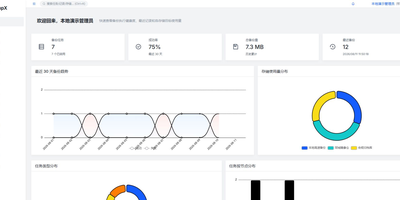
BackupX
BackupX puts every server backup you are responsible for into one web console, so cron lines scattered across machines become scheduled, visible, and verifiable tasks. Files and directories from multiple sources, MySQL, PostgreSQL, SQLite, SQL Server, and SAP HANA databases all back up on cron schedules you can also build in a visual editor, with automatic retention by days or count cleaning up what expires. More than seventy destinations are reachable through rclone, from S3 and other object stores to Google Drive, WebDAV, FTP, SFTP, Azure Blob, Dropbox, and OneDrive, and storage targets show connection health and live capacity before a job ever fails against a full disk. A master and agent design lets remote servers poll outward only, even through proxies, private certificate authorities, or SSH bastions, so agents run tasks locally with no inbound connectivity to defend. Per-node bandwidth caps and concurrency limits keep a small node polite and a big node busy, each at its own pace. Success and failure notifications arrive by email, webhook, or Telegram, while Prometheus metrics, health probes, an SLA breach gauge, and a full audit log keep the platform observable, and signed audit webhooks forward events to SIEM or WORM storage for compliance records. Running on a dedicated VPS on RepoCloud with guaranteed CPU, RAM, and SSD, full root SSH access, and a browser serial console. Apache-2.0 licensed.

Lunarr
Lunarr turns the movie and TV folders you already store into a private streaming service with posters, progress tracking, and play-anywhere convenience. Point it at local disks or at libraries living on SFTP and WebDAV servers, and it scans, identifies, and decorates everything with TMDb artwork, cast pages, similar titles, and because-you-watched recommendations. Press play and the file either streams directly or is transcoded on the fly into seekable HLS, generating only the segments around the moment you are watching instead of converting whole films up front. Continue watching follows you between sessions, sidecar subtitles are picked up automatically, and known intros and credits can be skipped. Send the picture to the big screen with Chromecast or AirPlay, pair new devices without typing passwords, and hand a guest a share link instead of your account. Underneath, an admin console manages users, roles, and which libraries each person may see, watches background jobs, and holds API keys and registration settings. Rescans run on schedules you set from minutes to a month, local folders can be watched live for new arrivals, and metadata refreshes itself on a timer. Running on a dedicated VPS on RepoCloud with guaranteed CPU, RAM, and SSD, full root SSH access, and a browser serial console. Apache-2.0 licensed.
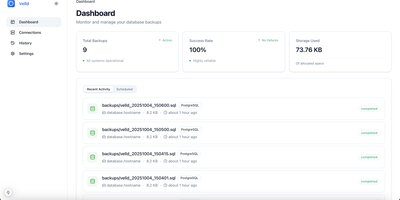
Velld
Database administrators and backend engineers managing production PostgreSQL, MySQL, MariaDB, MongoDB, and Redis instances use Velld to centralize scheduled backups, storage retention, and disaster recovery in a single self-hosted control plane. You can register multiple database connections across staging and production environments, test connectivity with one click, and route traffic through encrypted SSH bastion tunnels using password or private-key authentication to reach isolated private subnets. Flexible cron schedules and preset hourly, daily, weekly, or monthly intervals automate snapshot creation, while configurable retention policies purge expired archives from local volumes or S3-compatible object storage buckets after seven, fourteen, thirty, or ninety days. An integrated backup comparison tool renders split or unified line-by-line diffs between any two snapshots so you can inspect schema changes or data drift before triggering a guided database restore or downloading compressed dump files. The real-time monitoring dashboard tracks backup completion rates, total storage consumption, and execution histories alongside automated email and webhook alerts that notify your team immediately if a scheduled job fails. Running on a dedicated VPS on RepoCloud with guaranteed CPU, RAM, and SSD, full root SSH access, and a browser serial console. MIT licensed.