Open Source App Cloud Marketplace
Deploy, host, and scale with one click, at half the cost. Then customize with AI agents.
ZaneOps
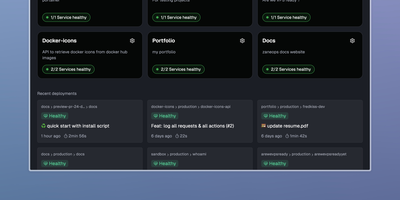
Shipping a Git repository to a live HTTPS URL takes one dashboard and one server with ZaneOps, an open-source alternative to Heroku, Railway, and Render. Linked GitHub or GitLab repositories build with a Dockerfile, Nixpacks, Railpack, or a static directory builder. Deploys start by hand, on git push, or from a CI webhook. Blue/green releases keep the previous version serving traffic while the new one starts. Each pull request or merge request can open its own preview environment, and the API can create one on demand. Configuration edits queue up as changes that you review before a new version deploys. A pasted docker-compose.yml or a ready-made template (Postgres, Redis, WordPress) deploys a whole stack with blue/green rollouts. Every domain gets a free SSL certificate that renews itself. Wildcard hosts, permanent or temporary redirects, and several services under one domain all work. Runtime logs, request logs, metrics, and health checks gather in the dashboard. Services get CPU and memory limits and volumes, and environment variables import or export as .env files. Viewer, Member, Admin, and Owner roles decide who can see and change what; the free tier allows one workspace and three users. A web terminal opens a shell inside any running deployment, and a second one reaches the server itself over SSH. Running on a dedicated VPS on RepoCloud with guaranteed CPU, RAM, and SSD, full root SSH access, and a browser serial console. MIT licensed.
Lab Dash
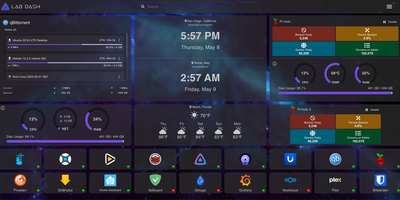
Every homelab deserves a control center that looks as good as the services it manages. Lab Dash gives you a customizable, drag-and-drop dashboard where every tile earns its spot. Add shortcut widgets linking to your Plex, Grafana, Nextcloud, or any service with automatic health check indicators showing green or red status at a glance. The system monitoring widget displays real-time CPU usage, memory consumption, network throughput, disk utilization, and temperature readings by mounting the host /sys directory as a read-only volume. Integrate Pi-hole stats, qBittorrent download progress, and media server widgets for Jellyfin, Plex, or Emby directly on your grid. Multiple pages let you organize services by category, and the search bar finds any tile instantly. Customize the background image from a local upload or URL, set a custom title and tab name, and choose your preferred search provider including self-hosted options like SearXNG. All sensitive configuration data is encrypted locally with AES-256-CBC, and only administrator accounts can modify the layout. Install Lab Dash as a Progressive Web App on desktop, phone, or tablet for a native app experience with offline capability. Configurations export as backup files for easy migration between instances. On RepoCloud, deploy Lab Dash on a dedicated VPS with root SSH access and Docker socket connectivity under the GPL-3.0 license.
Clay Studio
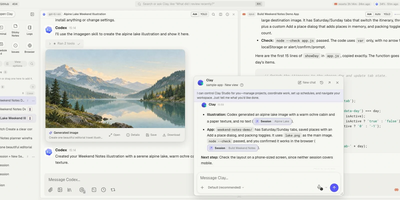
Clay Studio is a self-hosted workspace where your team and its coding agents share projects, live sessions, and project knowledge in one browser interface instead of scattering them across terminals. You organize several repositories in one sidebar and run sessions in parallel while teammates watch live activity, enter the same session, hand work off, and answer permission requests from wherever they are. Ten agent runtimes plug into the same workspace, Claude Code, Codex, Grok Build, Kimi Code, GitHub Copilot CLI, Qwen Code, Junie CLI, Antigravity CLI, OpenCode, and Kiro CLI, each keeping its own authentication and models. Persistent Mates give AI collaborators an identity, instructions, memory, direct messages, and roles in structured debates that survive beyond a single chat. Worktrees, paired sessions, spawned workers, scheduled tasks, and Ralph Loops let background jobs proceed without losing sight of what is running. You browse and edit files, inspect diffs and history, open terminals, install skills, connect MCP servers, and manage project knowledge without leaving the workspace. The installable PWA works on mobile and pushes notifications for approvals, failures, and finished work. Sessions and knowledge stay on your disk as portable JSONL and Markdown, so switching providers never means migrating your workspace. Running on a dedicated VPS on RepoCloud with guaranteed CPU, RAM, and SSD, full root SSH access, and a browser serial console. AGPL-3.0-only licensed.
Scrumboy
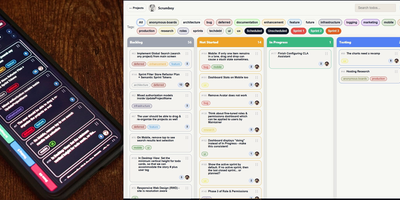
Scrumboy is a Kanban and sprint management tool that ships as a single Go binary backed by SQLite, deploys in under ten seconds via Docker, and uniquely integrates with AI coding agents through a standards-compliant MCP JSON-RPC endpoint. The dual-mode architecture supports Full mode with bootstrapped authentication, TOTP two-factor auth, OIDC/SSO integration through Keycloak, Authentik, Auth0, or Entra ID, role-based access control across Owner, Admin, User system tiers plus per-project Maintainer, Contributor, and Viewer roles, and Anonymous mode that generates instant shareable boards accessible via unique URLs with zero signup requirement. Custom workflows allow user-defined lane configurations per project including designated "Done" lanes, while sprints with configurable one or two-week cycles include board-level sprint filtering and the ability to disable and re-enable sprint tracking without losing history. Real-time Server-Sent Events power instant multi-user board updates, and outbound webhooks deliver JSON payloads to registered URLs when domain events fire with HMAC signature verification. The MCP endpoint at /mcp/rpc enables native integration with Cursor, Claude Code, and other AI agents through OAuth 2.1 with PKCE authorization, while API access tokens support CLI automation and CI/CD pipelines. Additional capabilities include VoiceFlow voice commands, per-project sticky-note walls, Markdown and Mermaid diagram support in task notes, append-only audit trails, VAPID Web Push notifications, SMTP password reset, Trello import, JSON backup with merge/replace/copy strategies, and 22-language internationalization. Running on a dedicated VPS on RepoCloud with guaranteed CPU, RAM, and SSD, full root SSH access, and a browser serial console. AGPL v3.0 licensed.
Upvote RSS
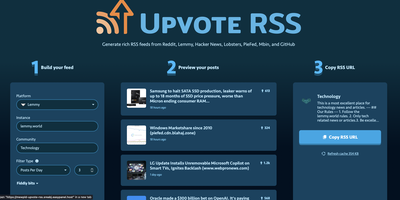
The antidote to doomscrolling: Upvote RSS turns Reddit, Hacker News, Lemmy, Lobsters, PieFed, Mbin, and trending GitHub repositories into calm, filtered RSS feeds. The MIT-licensed PHP app's killer feature is intelligent filtering: beyond simple score thresholds, the "posts per day" filter analyzes a community's recent history and computes the score cutoff that yields your target volume - say, exactly three r/technology posts daily - while a percentage-based threshold mode stays consistent as communities grow. Feeds are rich, not bare links: parsed full-article content via Readability (with optional Readability.js, Mercury, or Browserless for JavaScript-heavy pages), embedded videos and image galleries, top-voted comments with pinned-moderator filtering, scores, reading-time estimates, and optional AI summaries through Ollama, OpenAI, Gemini, Anthropic, Mistral, DeepSeek, or any OpenAI-compatible endpoint - with automatic provider fallback. A web UI builds the feed URL interactively with live preview; paste the result into any RSS reader. Reddit support includes custom domains like old.reddit.com plus NSFW filtering and blurring. Caching via filesystem, Redis, or APCu keeps repeated fetches cheap and avoids re-running paid summarizations.
PenX
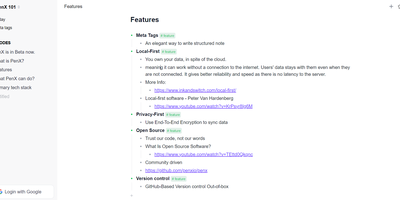
PenX delivers an open-source structured note-taking application that functions as a personal database disguised as an elegant editor — combining the outline workflow of Workflowy and Roam Research with the structured data capabilities of Tana through MetaTags that transform every note into a queryable database record. The local-first architecture stores all data on-device using PGLite, an in-process PostgreSQL-compatible engine, ensuring data ownership regardless of cloud connectivity. End-to-end encryption protects all synchronized data so that even the sync server cannot read your notes, tasks, ideas, or documents. GitHub-based version control provides out-of-the-box backup and history with full commit-level recovery. MetaTags are the core innovation — attaching structured tags to any note converts it into a database entry with typed fields, enabling table views, filters, and queries across your knowledge base without imposing rigid folder hierarchies. The daily notes workflow encourages free-form capture while MetaTags handle organization automatically, letting you record thoughts without deciding physical location upfront. AI-driven features assist with content generation, summarization, and intelligent search across your personal data hub. Real-time sync keeps web, desktop, and mobile in perfect alignment. Cross-platform availability includes web, desktop for Windows, macOS, and Linux, iOS, and Chrome extension. Deploy the web service via Next.js with pnpm using tRPC and Prisma. Running on a dedicated VPS on RepoCloud with guaranteed CPU, RAM, and SSD, full root SSH access, and a browser serial console. AGPL-3.0 licensed.
Revolt
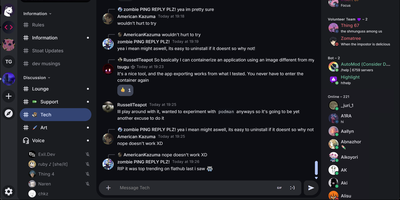
Revolt gives communities the full Discord experience without ads, behavioral tracking, or subscription fees: servers with text and voice channels, direct messages, group conversations, roles, bots, and custom emoji at zero cost per user. The Rust microservices backend splits responsibilities across Delta for REST API and authentication, Bonfire for persistent WebSocket real-time event delivery, Autumn for file upload routing to MinIO S3-compatible object storage, and January for link preview proxy and embed generation. Voice chat operates through LiveKit with WebRTC audio streaming supporting multiple concurrent participants per channel. Server administrators configure hierarchical role-based permissions at the server, channel, and per-role level, controlling who can send messages, manage channels, kick members, and access moderation tools. Text channels support Markdown formatting, custom emoji, file attachments up to 20 MB, GIF search via Tenor integration, and message reactions. The bot API enables automated moderation, entertainment, and custom workflow integration with community-maintained libraries available in JavaScript, Python, and Rust. The TypeScript and Solid.js web frontend provides a responsive interface with theme customization. Docker Compose deployment spins up the complete stack including MongoDB for message and user storage, Redis for caching, and MinIO for attachments, providing complete data sovereignty over all conversations and files. Running on a dedicated VPS on RepoCloud with guaranteed CPU, RAM, and SSD, full root SSH access, and a browser serial console. AGPL-3.0 licensed.
GeoLook
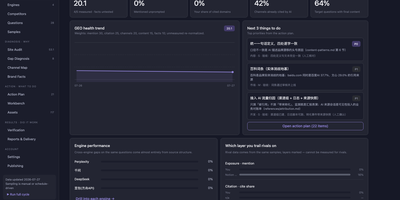
GeoLook shows you what AI search engines actually say about your brand, then turns that uncomfortable answer into a fix list you can work through and verify. You sample real answers across a wide matrix of AI engines and watch mention rate, ranking, and citation share appear per engine, with raw answer replay when a number looks suspicious. Competitor tables reveal which rival each engine prefers and which citation sources they rely on that you do not. A structured question bank sorts buyer, education, and probing questions, flagging the ones where you are absent, outranked, or described negatively. The site audit checks whether crawlers can reach, understand, and quote your pages, in the order those failures actually block visibility. Findings become tickets with an owner, effort estimate, risk grade, and acceptance check, and later sampling rounds confirm whether a fix worked or reopen the ticket when results slip. A content workbench ranks the topics most worth writing, checks drafts for citability, and prepares assets such as llms.txt and structured data snippets for publishing. Running on a dedicated VPS on RepoCloud with guaranteed CPU, RAM, and SSD, full root SSH access, and a browser serial console. MIT licensed.
Wiki-Go
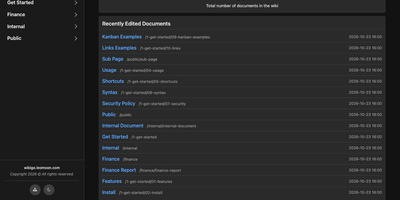
Wiki-Go turns a folder of Markdown files into a searchable team wiki with page history, comments, and access rules, and never asks you to run a database. Pages live in a nested tree with a sidebar and breadcrumbs, and an editor with a preview toggle handles emoji shortcodes, highlighted code, LaTeX math, Mermaid diagrams, collapsible sections, GitHub-style alerts, and embedded YouTube, Vimeo, or MP4 video. Full-text search supports exact phrases in quotes and term inclusion or exclusion, and highlights each match. Each save keeps a revision, up to a configurable limit, and any stored version can be restored later. Attachments such as PDFs, spreadsheets, images, and archives sit beside the page they belong to. Drop a Kanban board into any document for drag-and-drop task tracking with nested tasks, or build a categorized link library that fills in page metadata automatically. Signed-in users comment in Markdown, and admins can remove comments. Admin, editor, and viewer roles, user groups, path-based public or private rules, and an optional private-wiki mode decide who sees what. Branding comes from a custom logo, banner, and favicon, shortcodes such as stats insert live site statistics, and readers can switch between dark and light themes or print any page. A REST API opens content to scripts, and a community tool imports Notion exports. Running on a dedicated VPS on RepoCloud with guaranteed CPU, RAM, and SSD, full root SSH access, and a browser serial console. GPL-3.0 licensed.
Highlight
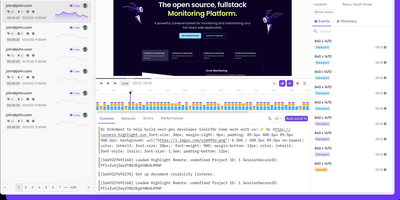
With over 9,000 GitHub stars and a focus on developer experience over legacy monitoring complexity, Highlight.io delivers a unified observability platform that correlates frontend user behavior with backend performance data in a single interface. The session replay engine captures high-fidelity DOM recordings showing exactly what users experienced, including console logs, network requests, page transitions, and user interactions, with configurable privacy redaction for sensitive content. Error monitoring automatically groups and deduplicates errors, surfaces affected user sessions, and provides full stack traces with source map support for minified production code. The logging pipeline ingests structured and unstructured logs from any backend service with automatic property extraction, full-text search, and configurable alerting thresholds. Distributed tracing tracks request flows across microservices with embedded links to associated sessions, errors, and logs for complete request lifecycle visibility. The metrics system collects custom application metrics alongside built-in web vitals and performance data for trend analysis and anomaly detection. Search across all telemetry types uses a unified query language with automatic attribute discovery and saved views for recurring investigations. Integrations connect with Slack, Discord, Linear, Jira, Vercel, and dozens of other developer tools for notification routing and workflow automation. SDKs cover React, Next.js, Vue, Angular, Python, Go, Ruby, Java, PHP, and Elixir with framework-specific instrumentation. Self-hosted deployment runs via Docker Compose with ClickHouse for analytics storage. Running on a dedicated VPS on RepoCloud with guaranteed CPU, RAM, and SSD, full root SSH access, and a browser serial console. Apache 2.0 licensed.
Aimeos
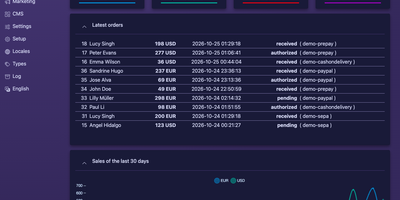
One admin backend can run a single online shop or a whole marketplace of independent sellers. The dashboard shows the latest orders and sales graphs. Panels cover products, stock, customers, subscriptions, orders, suppliers, and coupons. Aimeos handles bundle, voucher, virtual, configurable, custom, and event products. Block and tier pricing work out of the box. Discounts, vouchers, and a flexible basket rule system are built in. Subscriptions renew through recurring payments. Checkout offers more than 100 payment gateways. Storefronts come in 30+ languages, with full right-to-left support and AI-based text translation. Rich snippets help search engines read product pages, and layouts are optimized for phones and tablets. Switch on multi-vendor mode and sellers can register themselves, then manage their own site as administrators or as editors with limited rights. A JSON REST API following jsonapi.org feeds custom frontends, progressive web apps, and native mobile apps. A GraphQL API handles administration. The built-in MCP server lets AI assistants such as Claude or ChatGPT search, create, update, and delete products, orders, and customers within the permissions of the account that connects. Prisma brings AI into the admin interface to write product descriptions, translate content, generate images, and remove backgrounds with the provider you choose. Every component is modular, so any part can be extended or replaced. Running on a dedicated VPS on RepoCloud with guaranteed CPU, RAM, and SSD, full root SSH access, and a browser serial console. MIT and LGPLv3 licensed.
Websoft9
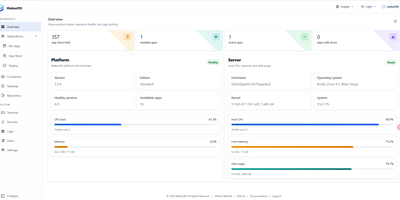
One server, three hundred applications, zero Kubernetes: Websoft9 is a self-hosted platform that turns a single VPS into your private app store, with a web console for finding, installing, and running open source software. Browse the catalog, click install, and applications arrive as containers with their databases and settings wired up, ready behind your domain. Bind domains and issue free Let's Encrypt certificates through the built-in proxy, schedule local backups for apps and databases, and open a browser terminal or file manager when you need hands-on control. The overview shows what is running and what it uses, My Apps keeps every service one click from start, stop, or rebuild, and updates roll out from the same console. Small teams use it to stand up WordPress, GitLab, Mattermost, and internal tools on one machine instead of renting a separate hosted plan for each, and everything stays on hardware you own. Running on a dedicated VPS on RepoCloud with guaranteed CPU, RAM, and SSD, full root SSH access, and a browser serial console. LGPL-3.0 licensed.
Freshrss
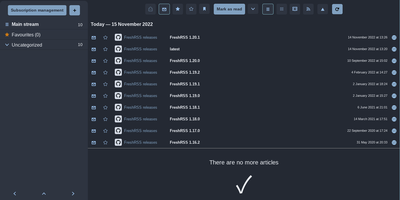
Where Miniflux strips reading down, FreshRSS gives you knobs - the feature-rich pole of self-hosted RSS, comfortable with thousands of feeds. It's a multi-user PHP aggregator (host family and friends on one instance, with an anonymous reading mode) with the reading workflow refined over a decade: favorites, custom tags, powerful filter and search queries, three reading views, and statistics that reveal each site's publishing frequency - useful for pruning subscriptions. Two properties make it the standard choice. First, the Google Reader-compatible API (plus a Fever API) syncs with virtually every serious RSS client - Reeder, NetNewsWire, ReadYou, FeedMe, Fluent Reader - so your phone reads from your server. Second, native WebSub support means compatible sources (WordPress, Blogger, Medium, Friendica) push new articles instantly instead of waiting for polling. A 50+ extension ecosystem adds what truncated feeds omit - full-text content fetching, reading-time estimates, trending views, auto-unsubscribe for dead feeds - alongside community themes and custom CSS. OPML import/export keeps subscriptions portable, a CLI handles administration, and article sharing posts to many services. AGPL-licensed, running on SQLite, MySQL, or PostgreSQL. Feedly Pro's feature set, minus Feedly's subscription and its algorithms.

Immich Insights
Immich Insights turns the photo library you already keep in Immich into a year-in-review style dashboard of how you actually shoot. Connect it with your own Immich API key and it reads your asset metadata into a local snapshot, without copying your original photos, then builds the overview Immich itself never shows: total photos and videos, storage used, favorites, albums, and your newest additions. Pick any year or a custom date range and see that period's shooting volume, favorites, albums, and devices. Camera statistics break your library down by device and manufacturer, with leaderboards you can correct when the same camera appears under different names. Exposure analysis shows your ISO, focal length, and shutter speed distributions, the focal lengths you reach for most, and how your settings shift by hour of day. Rhythm charts map your shooting by month, weekday, and hour, with a calendar heatmap of your most active days. A zoomable timeline marks the moments that matter: first photo, a new device joining the library, your longest gap, your busiest day ever. People and location views count faces and mapped places by country and continent, and a photography profile scores your habits. Clicking any chart value opens the matching photo thumbnails, and reports export as PDF, CSV, or JPG. Running on a dedicated VPS on RepoCloud with guaranteed CPU, RAM, and SSD, full root SSH access, and a browser serial console. MIT licensed.
Codel
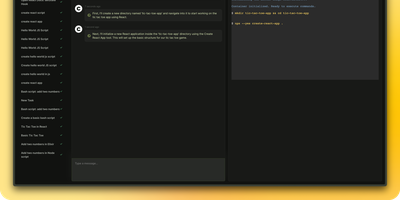
Meet your new digital sidekick, the Fully Autonomous AI Agent! This isn't just any AI; it's like having a superhero in your terminal, browser, and editor. Ready to tackle complex tasks and projects with a single command, this AI Agent is your go-to for making tech magic happen. And with RepoCloud, you're not just saving on costs, you're also joining a league of extraordinary users harnessing the power of open-source collaboration. Get ready to elevate your productivity to legendary levels!
DockPanel
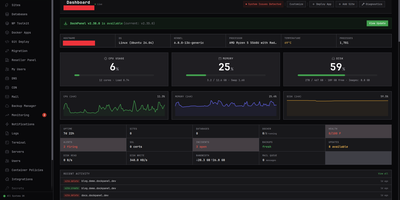
Created in March 2026 and rapidly gaining traction in self-hosting communities, DockPanel delivers the most feature-dense free server panel available — 811 API endpoints, 153 one-click Docker app templates across 14 categories, and full multi-server management, all running on three Rust binaries consuming under 50MB of combined RAM. The panel handles the complete server lifecycle: sites with automatic SSL via Let's Encrypt, MySQL and PostgreSQL databases in Docker containers, Git push-to-deploy using Nixpacks for automatic language detection without Dockerfiles, blue-green zero-downtime deployments with automatic rollback on failed health checks, DNS management, mail servers, monitoring dashboards, and encrypted backups to S3, SFTP, Backblaze B2, or Google Cloud Storage. Security receives production-grade attention with per-image CVE scanning that gates deployments, a built-in WAF, passkey authentication alongside Argon2 password hashing, HttpOnly JWT sessions with blacklist-on-logout, rate limiting on auth endpoints, and fail2ban integration — all verified through an 18-vulnerability pentest with zero remaining issues. Infrastructure as Code support exports your entire server configuration to YAML, and the developer CLI provides status, diagnose, and export commands for automation. GPU passthrough enables AI workload hosting, reseller accounts support white-label branding for agencies, and ARM64 compatibility covers Raspberry Pi and Oracle Cloud free-tier deployments. Running on a dedicated VPS on RepoCloud with guaranteed CPU, RAM, and SSD, full root SSH access, and a browser serial console. AGPL-3.0 licensed.
ivfi
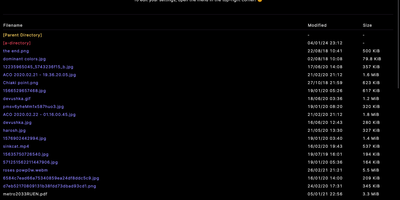
IVFi-PHP turns folders on your server into browsable media galleries: drop one PHP file into a web root and every directory of photos, videos, and audio becomes a polished, searchable index page. Hovering a filename previews the image or video inline, and clicking opens the gallery view where you can move through a whole directory's media, download originals, or reverse-search an image. Audio files play in place with a live visualiser, seeking, and their own volume control. Finding things is instant: filter filenames or file types with plain text, wildcards, or full regular expressions, sort by name, date, or size with settings that persist between visits, and dates automatically match the visitor's timezone. Select any set of files and download them as a single ZIP archive, or share direct download links file by file. Directories can render their README files as documentation pages, listings can hide sensitive entries through server-side filters, and optional Digest authentication keeps a listing private without any account database. Themes and per-visitor display preferences restyle the index, basic listings work even with JavaScript disabled, and the whole application also ships as a Docker image for a one-container deployment. Running on a dedicated VPS on RepoCloud with guaranteed CPU, RAM, and SSD, full root SSH access, and a browser serial console. GPL-3.0 licensed.
Domain Monitor
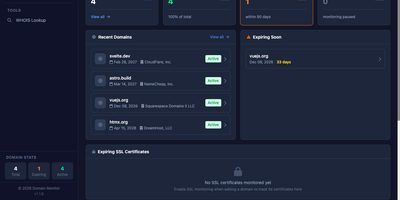
The renewal notice always seems to land in an inbox nobody checks anymore, so Domain Monitor tracks every domain you own from your own server and warns you long before each expiry date arrives. It pulls expiration dates and registrar details automatically through WHOIS and RDAP across more than 1,400 supported TLDs, keeping the whole portfolio current without anyone remembering to look. Add domains one at a time or import them in bulk, group them with tags and watchlists, and let scheduled cron checks refresh the data on their own. Alerts escalate on your schedule, at 60, 30, 21, 14, 7, 5, 3, 2, and 1 day before expiry, and arrive through email, Telegram, Discord, Slack, Mattermost, Pushover, or webhooks, routed by notification groups so the right people hear about the right domains. Each domain also gets tabbed views for its DNS records, SSL certificate validity, billing notes, notification history, and raw WHOIS output, with per-domain toggles for DNS and certificate monitoring. The dashboard surfaces what expires soon, how domains distribute across registrars, and whether every domain is actually covered by an alert channel. Multiple users get their own accounts with two-factor authentication, tracked sessions, and an in-app notification center. Running on a dedicated VPS on RepoCloud with guaranteed CPU, RAM, and SSD, full root SSH access, and a browser serial console. MIT licensed.