DAC
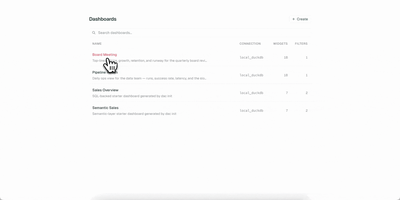
Your dashboards deserve version control, code review, and reproducible builds, just like the rest of your stack. DAC lets you define interactive data dashboards in YAML or TSX, validate them in CI, and serve them from a single Go binary that embeds a full React frontend. Choose from 21 chart types including line, bar, area, pie, scatter, bubble, funnel, sankey, heatmap, calendar, sparkline, waterfall, gauge, treemap, radar, and candlestick, plus metric cards, data tables, text blocks, and image widgets. The built-in semantic layer lets you define metrics and dimensions once in reusable model files, then reference them from any widget while DAC generates the SQL automatically. Connect to Postgres, MySQL, Snowflake, BigQuery, Redshift, Databricks, and DuckDB through standard Bruin connection configs. Interactive filters with date pickers, dropdowns, multiselects, and search inputs inject values via Jinja templating and re-execute only affected widgets. Live reload via Server-Sent Events refreshes connected browsers instantly when you save a file. Export dashboards as self-contained static HTML with baked-in query results for S3, GitHub Pages, or offline sharing, and render slide decks via the Google Slides export command. On RepoCloud, deploy DAC on a dedicated VPS with root SSH access and persistent storage for your dashboard definitions and database connections under the AGPL-3.0 license.
Pictaria Server
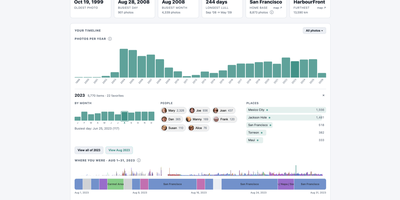
Pictaria Server sits beside your Immich instance and makes a photo library of thirty thousand images legible again, surfacing the trips, people, and best shots buried under duplicate bursts and forgotten folders. It starts with Insights: a clickable timeline of your years, detected trips, a people constellation linked by who appears together, place and camera rankings, and records like your busiest day. Click any number and you land on the actual photos, ready to open in Immich, turn into an album, or send onward. Enrich puts an AI to work describing what it sees, writing captions, menu-driven tags, and quality scores for every photo using a local model through Ollama or LM Studio, or a cloud provider with your own key, on a scheduled daily budget. Those tags can sync back into Immich, so searching improves everywhere, not just here. Curate then collapses bursts and near-duplicates into stacks with a suggested keeper, and one keystroke keeps the best and skips the rest. Smart Albums compose rules from people, places, dates, cameras, and tags, preview the result count, and maintain real Immich albums on a schedule. Frame owners get remote control, display metrics, and voice photo questions, while the Activity feed and runtime-editable Settings keep the whole box manageable from the browser. It connects with a limited-permissions API key and cannot delete a single photo. Running on a dedicated VPS on RepoCloud with guaranteed CPU, RAM, and SSD, full root SSH access, and a browser serial console. AGPL-3.0 licensed.
ScribeCrate
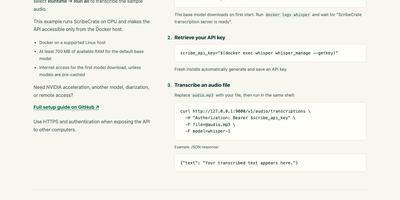
ScribeCrate is a self-hosted speech-to-text API that turns recordings into transcripts, subtitles, and English translations on your own server. It speaks the OpenAI Whisper API fluently: point any compatible client at your server's address, swap in your API key, and uploads come back as text. Ask for plain text, JSON with timestamps, or ready-to-publish SRT and WebVTT subtitle files, and for long recordings the segments can stream back over SSE as they are decoded. Turn on speaker diarization and every segment is labeled with who is speaking, which makes interview and meeting transcripts readable at a glance. Choose the model that fits the job, from tiny for quick drafts to large-v3 for maximum accuracy, and run it on a modest CPU, a Raspberry Pi class ARM board, or an NVIDIA GPU. Almost any recording works: MP3, M4A, WAV, WebM, OGG, and FLAC are all accepted, and with models cached in advance the server keeps transcribing with no internet connection at all. Running on a dedicated VPS on RepoCloud with guaranteed CPU, RAM, and SSD, full root SSH access, and a browser serial console. MIT licensed.
Zeabur
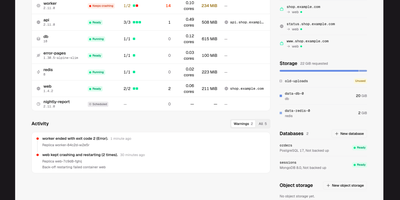
Zeabur is a self-hosted web platform that deploys and runs your services on your own Kubernetes cluster, presenting the cluster as simple projects and services instead of raw manifests. Every change starts as a readable plan listing the exact fields it will write and who owns them today, and nothing is applied until you confirm it. When something breaks, Zeabur says so in plain words and points at the fix: a worker that restarted fourteen times gets a button straight to the logs from the run before the restart. You deploy from Git repositories, from an uploaded folder or ZIP archive, or directly in the dashboard, then follow live logs, open a terminal inside a container, and watch CPU and memory move over time. Projects are namespaces and all state lives in Kubernetes objects, so there is no Zeabur database to back up, and uninstalling the platform leaves your Deployments, Services, and Ingresses running untouched. Companion pieces add passkey sign-in for kubectl with tokens that expire in minutes, image builds from Git through a BuildKit operator, and a catalog of cluster components and app templates. Running on a dedicated VPS on RepoCloud with guaranteed CPU, RAM, and SSD, full root SSH access, and a browser serial console. Apache-2.0 licensed.
Imp
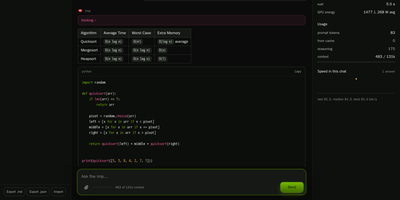
Imp runs large AI chat models privately on one NVIDIA RTX 50 or RTX PRO graphics card, exposing them through OpenAI and Anthropic compatible APIs plus a built-in browser chat. Start it with a single Docker command, point it at a model, and the chat opens in your browser with saved conversations and a live readout of generation speed. Coding agents such as Claude Code and Codex connect by changing one base URL, so your editor talks to the model on your own hardware instead of a rented cloud endpoint. Tool calls, structured JSON output, streaming responses, and reasoning models all work over the wire, and requests can be protected with an API key, per-IP rate limits, and concurrency caps. Load GGUF files you already have or NVFP4 and FP8 SafeTensors checkpoints straight from Hugging Face with no conversion step before the first answer. When a model is bigger than the card, mixture-of-experts weights stay in system RAM while the busiest experts are cached on the GPU, so a 123.6 GiB model still answers from a 32 GB card. Supported models can also read images alongside text, and tokenize, health, and model listing endpoints make the server easy to wire into scripts and monitors. Running on a dedicated VPS on RepoCloud with guaranteed CPU, RAM, and SSD, full root SSH access, and a browser serial console. MIT licensed.
Inference Gateway
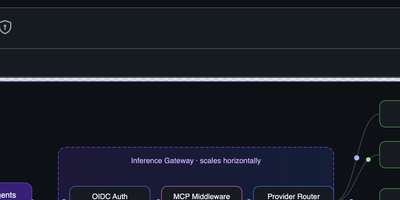
Inference Gateway puts a single OpenAI-compatible API endpoint in front of OpenAI, Anthropic, Groq, Cohere, Ollama, DeepSeek, Google, Mistral, MiniMax, Moonshot, Nvidia, and llama.cpp, so your application code never changes when you switch models or providers. The Go binary starts on port 8080 and normalizes authentication, streaming protocols, and response formats across all backends transparently. Native Model Context Protocol support auto-discovers tools from connected MCP servers and injects them into LLM requests without client-side management, enabling server-side tool execution across any provider that supports function calling. Agent-to-Agent protocol integration allows distributed agent communication through a declarative Agent Definition Language that generates production-ready Go or Rust servers from a single YAML manifest. The dedicated Kubernetes Operator manages Gateway, Agent, MCP, and Orchestrator custom resources with automatic HPA scaling, OIDC authentication, and service discovery that rebuilds MCP configurations when the discovered server set changes. Prometheus metrics and OpenTelemetry tracing provide full request-level observability across the entire inference pipeline. Middleware controls enable per-request provider selection, model routing, and fallback strategies. Official SDKs in Go, Python, TypeScript, and Rust provide typed client interfaces with streaming support. Docker Compose deployment requires only environment variables for API keys. A CNCF Sandbox applicant. Running on a dedicated VPS on RepoCloud with guaranteed CPU, RAM, and SSD, full root SSH access, and a browser serial console. Apache 2.0 licensed.
Lalabase
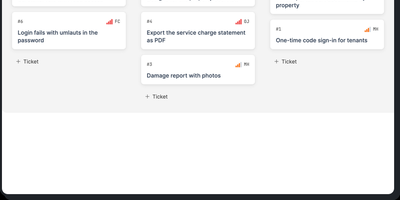
Lalabase is project management built for developers who work with clients, putting tickets, time tracking, documentation, and meetings in one workspace instead of five separate tools. Each client gets an organisation with its own projects and its own access, and roles decide exactly what clients can see. Tasks run as a list or a board with the statuses, priorities, and fields you define per project, rather than the workflow a vendor chose for you. Time tracking records several sessions per ticket, each billable on its own, with exports that go straight into the invoice. Documentation lives beside the work: notes and documents sit in the project, and a folder in your GitHub or GitLab repository becomes the project's docs automatically. Meetings keep their transcript, an AI summary, and the tasks that follow from what was actually said. When you need an answer, the AI assistant takes one question across tickets, comments, documents, hours, and meetings, and it cites the ticket, page, or conversation every answer came from. It even reads your repository's indexed code structurally, so questions about what is implemented get answered against the code. The assistant stays off until you enable it with your own provider key or a model in your own network. An MCP server and REST API let your own agents list, create, and update tickets, comment, and log time. Running on a dedicated VPS on RepoCloud with guaranteed CPU, RAM, and SSD, full root SSH access, and a browser serial console. AGPL-3.0 licensed.
Oh My CPA
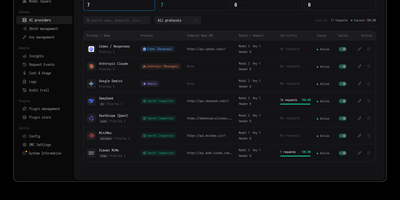
Oh My CPA gives a CLIProxyAPI gateway a proper control room, where providers, OAuth credentials, client keys, model routing, and the cost of every request are managed and watched from one self-hosted console. You add providers such as Codex, Claude, Gemini, xAI, DeepSeek, Vertex AI, and OpenAI-compatible services, each with credentials, retry and error policies, priority, weight, and an enable switch the gateway actually enforces. OAuth accounts are signed in from the console, with quota window readings, refresh schedules, and per-credential model aliases kept next to the keys they belong to. Client keys can be created, named, and revoked, and those names follow the traffic into request records and filters so you always know which key spent what. The dashboard follows request volume, token throughput, cache hit rate, and cost from the last fifteen minutes out to ninety days, with a year-long token heatmap for the long view. Insights compare keys, models, providers, and credentials against the previous period, while the live routing view shows which credential each request travelled to and whether it was rerouted. Every request stays searchable, with duration, time to first token, token breakdown, and the raw log in a detail drawer. A playground tests any routed model with text and images before your users do. Running on a dedicated VPS on RepoCloud with guaranteed CPU, RAM, and SSD, full root SSH access, and a browser serial console. MIT licensed.
ShipShipShip
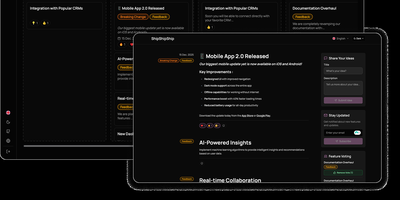
Keeping users informed about software releases while gathering community feedback on upcoming roadmap items becomes effortless with ShipShipShip, a self-hosted changelog, release notes, and feature voting platform. Product managers can draft rich release announcements using a formatting editor that supports Markdown, embedded media uploads, color-coded category tags, and exact publication timestamps. Instead of juggling disconnected feedback spreadsheets, teams organize backlog proposals, active development tasks, and shipped updates across a drag-and-drop Kanban board or a filterable list view. Visitors browsing the public roadmap can upvote proposed features to help prioritize the next sprint and react to announcements using eight expressive emoji reactions. When an item moves into a shipped status, the built-in newsletter engine automatically dispatches formatted release emails over SMTP to subscribers using customizable per-event templates and one-click unsubscribe links. Design-conscious organizations can install manifest-driven public themes, map internal workflow statuses to public roadmap columns, and tailor brand colors and logos. International audiences can navigate the interface in seven languages, including full right-to-left layout support, while engineering teams automate event creation through the REST API. Running on a dedicated VPS on RepoCloud with guaranteed CPU, RAM, and SSD, full root SSH access, and a browser serial console. Apache-2.0 licensed.
Vanilla Cookbook
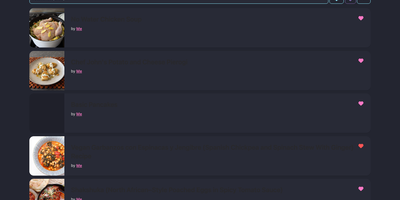
Every family recipe, bookmarked food blog post, and meal-prep formula stays organized inside Vanilla Cookbook, a self-hosted culinary library that converts volumetric measurements into precise gram weights and scales servings on the fly. Paste a URL or click the browser bookmarklet to scrape recipes from hundreds of cooking websites. Plain-text ingredient strings split automatically into structured quantities, units, preparation notes, and optional or to-serve badges. Home bakers switch effortlessly between US cups, imperial ounces, and metric grams across thousands of ingredient density profiles. Inline oven temperatures, fractions, and numeric ranges adjust automatically as serving counts change. Nutritional text parses into a structured per-serving breakdown, while integrated shopping lists, cooking logs, and equipment lists keep weekly grocery planning synchronized across desktop browsers and Progressive Web App mobile devices. Connecting an optional OpenAI, Anthropic, Google Gemini, Ollama, or LiteLLM endpoint unlocks AI fallback scraping for pages lacking Schema.org markup, automatic recipe translation, verbose direction summarization, photo-to-recipe extraction, and vector-based semantic search. Multi-user accounts, OAuth authentication, public recipe sharing links, and bulk import or export tools give households full control over their cookbook data. Running on a dedicated VPS on RepoCloud with guaranteed CPU, RAM, and SSD, full root SSH access, and a browser serial console. GPL-3.0 licensed.

Quackback
Quackback unifies customer feedback boards, feature voting, public roadmaps, release changelogs, help centers, status pages, and a multi-channel support inbox into a single self-hosted workspace that replaces Canny, Productboard, and Intercom. Product teams use its branded boards to collect feature requests and bug reports, merge duplicate submissions, and rank demand by user votes or customer segments. When a request moves into development, two-way integrations with Linear, GitHub, and Jira automatically update the card across customizable Kanban status columns or quarterly timeline views on your public roadmap. Support agents work out of a shared inbox that brings real-time Messenger web chat, inbound email threads, and durable support tickets together under one roof, complete with SLA timers, office hours, saved macros, and CSAT surveys. Conversations that uncover a feature gap convert directly into votes on existing feedback posts without losing thread context. Quinn, the built-in AI assistant, answers common questions from your Help Center articles, drafts agent replies, and exposes a Model Context Protocol server so external AI tools can triage posts or manage tickets. Once features ship, publishing a scheduled changelog entry automatically notifies every voter via email and in-app alerts. Running on a dedicated VPS on RepoCloud with guaranteed CPU, RAM, and SSD, full root SSH access, and a browser serial console. AGPL-3.0 licensed.
NutriTrace
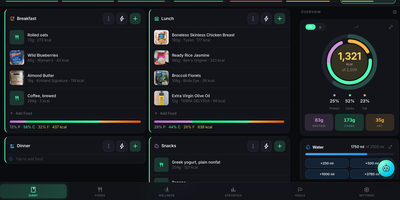
Stop handing your daily food diary, body weight history, and biometric sleep data to ad-funded fitness clouds: NutriTrace brings complete calorie, macro, micronutrient, and wellness tracking to your own server with an offline-capable web PWA and native Android app. Log meals across customizable slots using live Open Food Facts and USDA FoodData Central lookups, barcode scanning, AI nutrition label OCR, or direct recipe imports from Mealie and CookTrace. Calorie and macro targets adjust automatically through three goal engines, including an inspectable Adaptive TDEE algorithm that regresses 35 days of intake against scale weight at 7,700 kcal per kilogram. Connect Fitbit via Google Health, Garmin, Withings, and Android Health Connect to pull steps, heart rate variability, sleep stages, and body composition into unified Sleep, Readiness, and Resilience scores. An integrated Trace AI assistant and Smart Log let you log meals by voice, text, or meal photo, while the opt-in Model Context Protocol server exposes 20 read, write, and management tools to Claude Desktop, Cursor, and Codex. Multi-user households get OpenID Connect SSO and one-step migration from MyFitnessPal, Cronometer, Lose It, and Waistline. Running on a dedicated VPS on RepoCloud with guaranteed CPU, RAM, and SSD, full root SSH access, and a browser serial console. AGPL-3.0 licensed.
Nowen Note
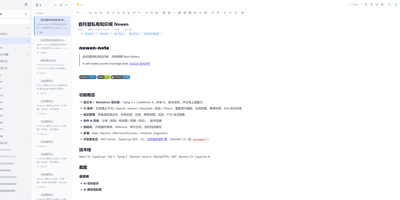
Nowen Note is a self-hosted knowledge base where your notes, tasks, daily journals, and mind maps live in one private workspace you control. One tree holds folders, rich-text documents, and Markdown notes side by side, with drag-and-drop ordering, unlimited nesting, colored tags, pinning, and full-text search across everything. Each note can switch between a rich-text editor and Markdown with live preview, split view, outlines, tables, code blocks, math formulas, diagrams, comments, and version history. Connect the AI provider you prefer, such as an OpenAI-compatible API, Gemini, DeepSeek, or local Ollama, to continue drafts, rewrite passages, translate, summarize, and ask questions answered from your own notes. Tasks get list, board, calendar, and timeline views with dependencies, recurring rules, reminders, and templates, while daily journals capture short entries, moods, and photos and roll them into AI weekly and monthly reviews. Teammates edit together in real time, and folder-level permissions, passwords, allow and deny rules, share links with expiry dates, and guest comments decide exactly who sees what. Imports arrive from Obsidian, SiYuan, Word documents, web pages, and plain Markdown, attachments can live on local disk or S3-compatible storage, and scheduled backups travel to email or WebDAV. Keep working offline with a cached workspace that syncs when you reconnect, clip pages from the browser extension, and connect other tools through the OpenAPI, SDK, webhooks, and MCP server. Running on a dedicated VPS on RepoCloud with guaranteed CPU, RAM, and SSD, full root SSH access, and a browser serial console. GPL-3.0 licensed.
Garage UI
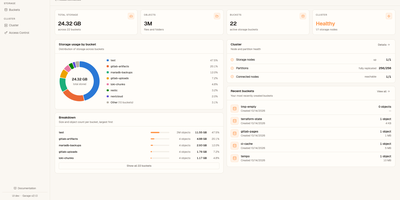
Garage UI is the web dashboard that Garage object storage never shipped, turning an admin API that speaks JSON over HTTP into screens your whole team can use. Create and configure buckets, browse objects with drag-and-drop uploads, and preview images, video, PDFs, and text inline instead of downloading files just to check what they are. A recursive search finds objects across a whole bucket, and bucket settings carry size and object-count quotas so one tenant cannot quietly eat the cluster. Access keys are created in the UI and assigned per-bucket permissions, replacing error-prone command-line key surgery. The cluster overview watches node status, layout configuration, and storage usage, so a degrading node shows up in the dashboard before it shows up as an outage. Sign-in flexes to your setup: no auth on a trusted network, basic admin credentials, the Garage admin token, or OIDC single sign-on through providers like Keycloak and Authentik. With OIDC teams enabled, access control maps token claims to bucket prefixes with named permission presets, and unmatched users are denied by default rather than promoted. Zero-config startup reads your existing garage.toml, so the first login takes minutes. Running on a dedicated VPS on RepoCloud with guaranteed CPU, RAM, and SSD, full root SSH access, and a browser serial console. MIT licensed.
Knock-Knock
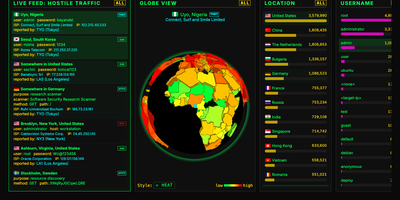
Bots that knock on your server's login ports are always turned away by Knock-Knock, a multi-protocol honeypot that shows every attempt on a live dashboard. Honeypots answer on the standard ports for SSH, Telnet, FTP, RDP, SMB, SIP, HTTP, and SMTP, with MQTT, Node-RED, Modbus, S7, and SNMP as optional extras. Authentication is always rejected, so no bot ever gets a shell. Who is knocking? The live feed shows each attempt's country, username, password, ISP, IP, and protocol. From where? A 3D globe marks the origin in one of six styles, including an extruded country heat map. Trying what? Leaderboards rank countries, usernames, passwords, ISPs, and IP addresses, and a trivia panel explains why bots favor certain credentials. A protocol filter re-slices the feed, globe, and leaderboards together; SIP shows dialed numbers and toll-call destinations, and RDP shows hostnames and accounts. Too fast? Press the space bar to pause, right-click any knock for details, or switch on a virtual Geiger counter that clicks as attacks arrive. Want to fight back? Download hourly 30-day and 365-day blocklists with recipes for CSF, CrowdSec, ipset, nftables, and pfSense, or query the optional API for any IP, CIDR range, or ASN. Several honeypot servers can stream into one aggregated dashboard. Running on a dedicated VPS on RepoCloud with guaranteed CPU, RAM, and SSD, full root SSH access, and a browser serial console. MIT licensed.
Deft
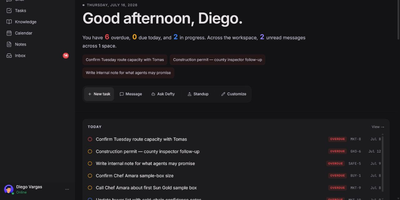
One self-hosted workspace holds your team's chat, tasks, notes, and calendar, and Deft lets AI agents work in it beside your people. People get real-time chat with spaces, direct messages, threads, mentions, reactions, files, and presence. Tasks open as Board, Table, Timeline, or Calendar views, with dependencies, subtasks, recurrence, and bulk actions. Notes, decisions, and channel memory become durable knowledge, with graph views and links back to the source conversation. Native calendar events sit beside read-only ICS subscriptions. Agent employees can join channels and receive task assignments. Tag the built-in assistant Defty to draft a task, answer a workspace question, or take a governed action, then review the proposal in an approval card before anything changes. Personal connections let Codex, Claude, ChatGPT, and other streamable HTTP MCP clients act as the signed-in user within revocable scopes. Approval tiers, trust levels, token scopes, revocation, activity history, and action receipts record who or what acted and what changed. OpenAI, Anthropic, OpenRouter, OpenAI-compatible endpoints, and local Ollama-style models are supported providers. Chat, tasks, notes, and calendars keep working with no AI key. Modules add company-specific records, relationships, and views, with a bundled Contacts module as the first example. Running on a dedicated VPS on RepoCloud with guaranteed CPU, RAM, and SSD, full root SSH access, and a browser serial console. AGPL-3.0-only licensed.
Rackula
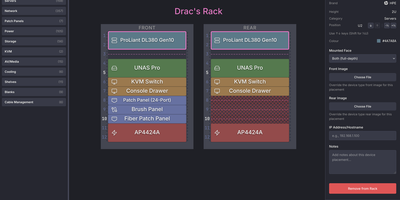
Before lifting a heavy four-unit storage server or rewiring a cramped network closet, you can map every unit of cabinet space in Rackula, an interactive drag-and-drop rack layout designer and capacity planner. Instead of staring at generic grey rectangles in a spreadsheet, you pull switches, routers, patch panels, UPS battery banks, and rackmount chassis from a hardware catalog populated with authentic front and rear faceplates from the NetBox device library. Equipment snaps cleanly to standard EIA-310 rack unit boundaries, while half-width gear and mini PCs nest inside one-unit carrier shelves and mounting brackets. Audiovisual technicians can group bayed cabinets side by side to plan amplifier racks, signal processor chains, and patch bays across multi-rack installations. Network engineers and data center operators can rearrange hardware with full undo and redo history, attach custom device graphics, and export crisp diagrams as PNG, SVG, or PDF files for runbooks and change control tickets. Sharing a proposed cabinet topology with a colleague in the field takes seconds using an encoded URL or a scannable QR code that opens on mobile browsers. Server-side persistence stores your rack definitions as portable YAML files and supports optional local accounts or OpenID Connect single sign-on for shared infrastructure teams. Running on a dedicated VPS on RepoCloud with guaranteed CPU, RAM, and SSD, full root SSH access, and a browser serial console. MIT licensed.
DumbBudget
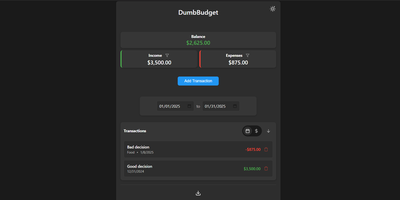
"Stupid simple software" is the entire philosophy at DumbWare.io, and DumbBudget delivers it: no over-engineering, no complexity, no accounts, no bank connections - just a clean, modern ledger for money in and money out. Log income and expenses, assign categories, and watch real-time balance calculations update as you type. Finding transactions is quick: filter by type, narrow by date range, sort by date or amount. When tax season or spreadsheet analysis calls, everything exports to CSV. Access control matches the philosophy - a single PIN (set via one environment variable) gates the app, backed by real security engineering: rate limiting on PIN attempts, temporary lockout after failures, secure session handling, and no sensitive data in browser storage. Multi-currency support covers the ISO codes, and a SITE_TITLE variable names each instance - deliberately useful, because running separate instances per account or family member is the intended pattern for multi-user needs. The responsive UI ships light and dark themes and installs as a PWA on phones, where expense logging actually happens. Configuration is five environment variables; data persists in one folder. If Actual Budget and Firefly III feel like accounting software, this is the notepad that gets used. GPL-licensed.