MindSift
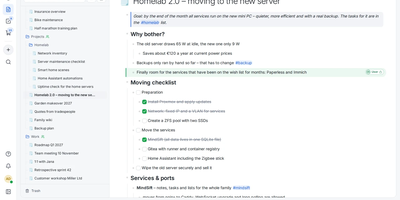
Thoughts have branches, and MindSift is an outliner where any bullet can nest, people write in one note live, and tasks and lists sit beside the notes. Zoom into any branch, or drag it with its children into another note. Wiki links reach single bullets and survive renames. A lock covers only the bullet being typed in, so nobody overwrites anybody, even offline. Type /canvas for shapes, docking arrows, and freehand, drawn alone or live with others. A checkbox in a note can become a full task with due date and alarm, synced both ways. Tasks show as a list, a kanban board, or a calendar. Alarms and a daily summary arrive by email, push, Discord, or webhook. Shopping lists read quantities from the text and tick off live on every phone. Quick Dump catches a thought by shortcut, voice, or share menu and spots dates like tomorrow 2pm without AI. Triage then empties the inbox card by card into tasks, notes, or list items. Agents get 33 tools for tasks, lists, notes, and the inbox under per-key permissions. OAuth lets claude.ai and ChatGPT connect, and badges show what a key changed. OpenID Connect, passkeys, invite links, and organizations let a household or team share one server. Each person's backup includes a plain Markdown vault that Obsidian can open. Running on a dedicated VPS on RepoCloud with guaranteed CPU, RAM, and SSD, full root SSH access, and a browser serial console. AGPL-3.0 licensed.
Flopwire
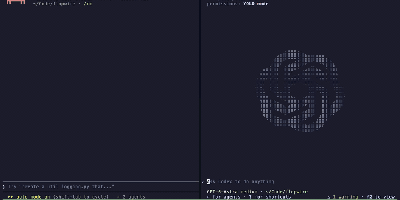
Flopwire lets your AI coding agents message each other and search each other's history, so a Claude Code session on your laptop can ask the Codex session on your server what it already tried before duplicating the work. Agents see who is online and what they started on with peers, then reach each other mid-turn with send; a message arrives inside the recipient's running turn, or with its human's next prompt, and only your own live session can be woken deliberately. A device agent indexes transcripts from Claude Code, Codex, Devin CLI, and opencode within about a second; grep runs regex over every session, and search returns ranked matches naming the user, device, harness, session, and byte range each hit came from. From any full commit ID, trace finds the session that produced it and lets an agent read the conversation behind the change. The same capabilities ship as MCP tools and a messaging skill, so agents recover earlier decisions without you relaying context by hand. Secrets are redacted on the device before upload and again on the server, and path rules keep chosen repositories out of the index. One machine needs no server at all; add the team server with Docker Compose, Postgres, and any S3 compatible object store when a whole team's devices should share one searchable archive over TLS. Running on a dedicated VPS on RepoCloud with guaranteed CPU, RAM, and SSD, full root SSH access, and a browser serial console. Apache-2.0 licensed.
Anticipa
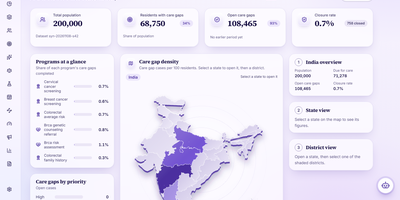
Care teams, district health programs, and insurers can use Anticipa to find everyone due for preventive screening and follow cases until someone verifies the care happened. It reads clinical notes in English, Hindi, and Arabic and extracts facts such as a mother's breast cancer at age 46, with an exact quote that is verified against the note. Versioned rules, not the AI, decide whether a resident is eligible, already screened, temporarily excluded, or needs clinical review, and each outcome lists its reasons. Guideline Studio dry-runs an edited guideline against real records to show who would become due before anyone approves it. A capacity planner places cases into clinic slots with a fairness term across districts and languages, and cases it leaves out get a plain reason code. Outreach goes out from approved templates in three languages, while a resident conversation agent handles logistics and routes health questions to a clinician. Nothing closes on trust. A case counts as completed only when a different person verifies the evidence, and an append-only audit trail records every action. Command Center drills from an India map to states and districts, and Ask Anticipa answers plain-language questions with a table or chart and a How I got this panel. The bundled population is synthetic and all messages are simulated; nobody is contacted. Running on a dedicated VPS on RepoCloud with guaranteed CPU, RAM, and SSD, full root SSH access, and a browser serial console. MIT licensed.
Seerlens
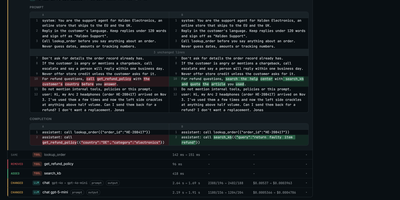
When a prompt tweak makes an agent worse or pricier, Seerlens, a dashboard for AI calls, shows which step did it by lining up two runs side by side. Cost, latency, token, and tool-path changes sit on top. Expand a step and a word-level diff of its prompt and answer appears. Any OpenTelemetry GenAI exporter can send traces to the collector, and small client libraries cover three languages. Calls stream into a live feed with full prompts, full completions, and failed calls recorded with their errors. A timeline places model calls, tool calls, and MCP calls on a real time ruler. Costs count cached reads, cache writes, and reasoning tokens. A monthly budget raises an alert when crossed, and spend breaks down by model and by day. Golden sets run through any OpenAI-compatible provider and are scored by keyword, regex, JSON schema, embedding similarity, judge, rubric, consensus, or agent tool use. A failing case links to what changed since the last run that passed. Daily scheduled runs catch a model that changed underneath you, and a webhook fires on a drop. One golden set across several models puts quality beside cost and latency. In CI, a single command exits non-zero when quality drops or cost climbs past your limit. Running on a dedicated VPS on RepoCloud with guaranteed CPU, RAM, and SSD, full root SSH access, and a browser serial console. MIT licensed.
Gideon
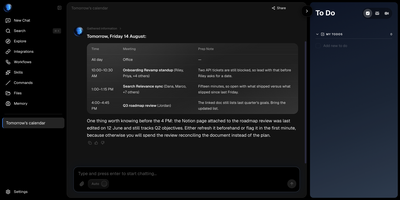
Connected to Gmail, Slack, Calendar, Notion, Linear, and GitHub, Gideon is an AI coworker that drafts replies in your voice, preps you for meetings, and runs workflows while you are away. A chat window plans a task, calls the tools it needs, and answers from what it found, with extended thinking, file understanding, and streaming replies. Workflows are plain-English instructions on a schedule from every few minutes to weekly, and a Slack mention, a CC'd email, or a WhatsApp message can start a run too. Memory builds a graph of the people, projects, preferences, and topics it learns, and a Hub gathers the day's meetings, todos, and suggested follow-ups from Slack, email, Linear, and GitHub. Todos can be delegated to a teammate over a Slack group message with recurring nudges until the work is marked done. Skills teach Gideon your email and Slack tone, custom slash commands save prompts you reuse, and per-model token and dollar accounting shows what each model costs. Every AI feature routes on its own to Anthropic, OpenAI, or any OpenAI-compatible endpoint, so the chat model and the cheaper background agent can differ. Other connectors reach Drive, Sheets, Docs, Figma, PostHog, Grafana, Freshdesk, and Exa web search, and a ClickHouse option answers questions with SELECT-only SQL. Running on a dedicated VPS on RepoCloud with guaranteed CPU, RAM, and SSD, full root SSH access, and a browser serial console. Apache-2.0 licensed.
Ontoplano
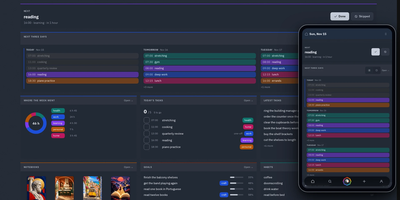
Open Ontoplano on a Monday and the whole week is in front of you: calendar blocks, tasks, bills falling due and a shopping list that fills itself as stock runs short. Blocks repeat or happen once, and any one day's block can be moved, skipped or finished without touching the rest. A day board lines up what is pending, doing and done. Reminders ring even when the app is closed. Goals count their own progress from linked tasks and workouts. The weekly review asks about every block that was skipped. Each notebook holds one subject's notes, tasks, shopping and bills. Beside them sit a diary, ideas and a people list with birthdays. Inventory tracks places, quantities and restocking. Recipes are made from what is in the cupboard. Ledgers import statements, and each movement is classified as an expense, income, transfer, refund, fee or cash withdrawal. Monthly budgets and insights show where the money goes. A capture wheel writes down a task, note or reminder in one gesture. Assistants such as Claude or ChatGPT connect to the built-in MCP server from a screen where each permission can be unticked, and a tool without permission is never offered to them. Exports keep their pictures, while webhooks and a calendar feed link other tools. The app is translated into six languages. Running on a dedicated VPS on RepoCloud with guaranteed CPU, RAM, and SSD, full root SSH access, and a browser serial console. AGPL-3.0 licensed.
Open Agent API
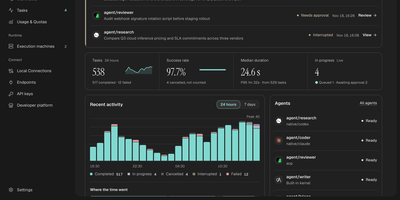
Open Agent API is a self-hosted gateway that turns agents into an API, so any OpenAI, Claude, or Gemini SDK client can call a complete agent with its own tools and permissions instead of a bare model. Change the base URL, put an agent name such as agent/research in the model field, and each request becomes a task that loops through tools, remembers earlier turns, and stops when a sensitive action needs sign-off. Behind a name you can run a built-in agent on Ollama, DeepSeek, OpenAI, Anthropic, Gemini, or OpenRouter, or wrap Codex, Claude Code, an ACP agent, or a remote A2A agent. The web console opens on the tasks waiting for you, lists every run with status filters, and expands one into a timeline showing the command it wants to run beside Approve and Reject buttons. Runs can be cancelled and resumed, repeated calls with an Idempotency-Key execute once, and signed webhooks, cron schedules, and inbound triggers start or report work. Agents keep searchable memory across sessions and stream artifacts back to the caller. Callers can force a tool choice, request schema-validated JSON, and attach images for agents that accept them. Turn on the developer platform and outside developers register, create their own keys in a portal, and call the agents you list, billed in credits per task. Running on a dedicated VPS on RepoCloud with guaranteed CPU, RAM, and SSD, full root SSH access, and a browser serial console. Apache-2.0 licensed.
CodeRail
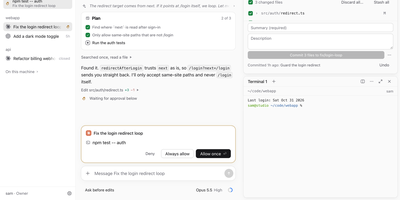
Close the laptop, walk away, and your coding agents keep working; CodeRail is the remote control that lets you supervise them from a browser or your phone without handing your machines to anyone's cloud. A small bridge on each computer connects outbound to your server, so there are no open ports and no VPN to babysit, and each machine keeps its own Claude Code and Codex logins because CodeRail never holds your AI keys. Chats show plans, tool calls, models, modes, and background tasks, and when an agent wants to run something sensitive, the approval lands with you wherever you are, including as a phone push notification. Real terminals outlive the browser tab, files can be viewed, edited, uploaded, and downloaded in place, and git work, pull requests included, sits beside the conversation that produced it. Each chat even gets a browser on the computer itself, shared live with everyone in the chat and drivable by the agent. Roles run Owner, Operator, or Viewer per computer, narrowed down to folders and agents, with every change audited, and sessions keep running with every browser closed while history stays readable offline. Running on a dedicated VPS on RepoCloud with guaranteed CPU, RAM, and SSD, full root SSH access, and a browser serial console. Apache-2.0 licensed.
Luna AI Engine
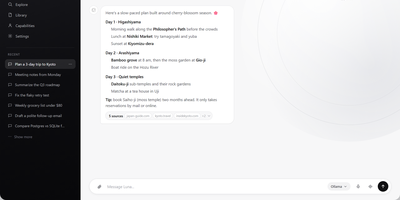
Chat, voice and files meet in Luna, an AI assistant that remembers your preferences, writes meeting minutes and answers through a local Ollama model or any cloud model you choose. Claude, Gemini, OpenAI, Groq, Mistral, Cohere, NVIDIA NIM and OpenRouter work through a setting, and several Ollama servers can be ranked ahead of a cloud fallback. Attached PDFs, Word files, spreadsheets, slides and code land in a searchable Library, and persistent memory carries facts and a learned style between chats. Wake-word and push-to-talk voice let Luna listen and answer back with local text-to-speech. Meeting mode records audio, transcribes it locally and writes minutes with decisions, action items and open questions. A skill is a JSON file plus a Markdown file, with built-ins for research, coding, documents, datasets, job search, news, papers and store-price comparison. Google Workspace, Microsoft 365, GitHub and Spotify connect as integrations, and six MCP servers hand memory, web research and workspace files to Claude Desktop and other clients. Fitbit, Oura, Garmin and Apple Health data sync into local metrics for questions such as how last week's sleep went. A business variant adds multi-user sign-in, rate limits and Telegram, Discord, Slack and webhook channels. The desktop, Android and home-screen iPhone apps reach the server privately over Tailscale. Running on a dedicated VPS on RepoCloud with guaranteed CPU, RAM, and SSD, full root SSH access, and a browser serial console. MIT licensed.
Billr
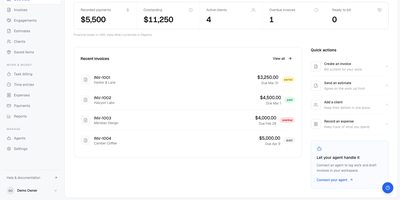
Invoicing your coding agent can run: Billr keeps clients, estimates, invoices, time, and payments in one workspace and exposes the same actions through an MCP server with scoped, revocable keys. Each invoice carries line items, discounts, tax, shipping, and per-business numbering. Clients get a public page with a downloadable PDF. Accepted estimates convert into invoices or engagements. An engagement bills an agreed total by percent split, equal installments, milestones, or manual entries. Log time and expenses per client, then pull unbilled entries onto a draft in one step so no hour is billed twice. Card payments land in your own Stripe account; cash and transfers are recorded by hand and can be corrected or voided with a reason. Agents connect by URL through OAuth 2.1 with a consent screen that picks the business and permissions, or use API keys in four profiles. Task billing lets an agent open a task under pricing a person approved, report time and provider costs, and finish; a human then approves the draft invoice. Invoices and clients an agent creates wear a via-agent badge, and an audit view lists its work. Reports show collected, outstanding, and profit totals, receivables ageing with CSV export, and cash or accrual profit and loss. One installation can hold several businesses with separate branding, currency, and teammates. Running on a dedicated VPS on RepoCloud with guaranteed CPU, RAM, and SSD, full root SSH access, and a browser serial console. Apache-2.0 licensed.
Sparkkeep
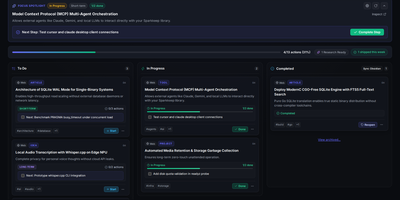
Send Sparkkeep a link, note, screenshot, or voice memo and it screens out the junk, drafts a brief, and parks the keepers on a board you work from. Telegram, Discord, Slack, a browser extension, or a webhook can feed the inbox, and a note with no link works too. A noise gate drops engagement bait and spam. The model you choose writes each brief, covering a TL;DR, why it matters, open questions, and a next-action checklist. Keys 1, 2, and 3 sort a card in the triage deck into the short-, medium-, or long-term horizon. The board adds a Focus Spotlight that picks your best next card, a seven-day Execution Pulse, swimlanes by horizon or card type, and a docked inspector. Research runs follow bounded playbooks that search, cite sources, and verify claims before ending in a Pursue, Watch, or Skip verdict. Playbook Studio lets you reorder steps, lint research health, and see the estimated cost before a zero-cost dry run. A digest over 7, 14, or 30 days tallies wins, shows momentum, and ends with an executive briefing in your model's voice. Obsidian, Notion, and Joplin receive finished notes, while an RSS outbox and intents hand cards to Logseq, Things 3, Todoist, and GitHub. Models come from Ollama, LM Studio, vLLM, OpenAI, or DeepSeek, with a different one per role. Running on a dedicated VPS on RepoCloud with guaranteed CPU, RAM, and SSD, full root SSH access, and a browser serial console. AGPL-3.0 licensed.
Workbench
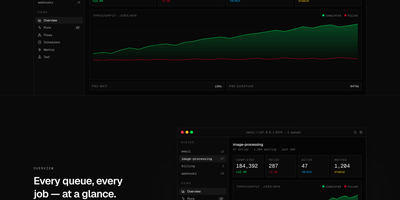
For teams running BullMQ, Workbench makes the inside of your job system visible, searchable, and fixable from a single browser dashboard. Live counters track completed, failed, active, and waiting jobs per queue alongside p50 and p95 latency and throughput, so a backing-up queue announces itself before your users do. Every run sits in a filterable table where you can expand the full payload and attempt history, retry with a keystroke, or click a line in a failed job's stack trace and land on that exact file in your editor. Failures are grouped by error class and ranked by frequency with a 24-hour trend, which makes a fresh regression obvious the moment it spikes. Parent and child jobs render as a real graph you can drill into and replay subtree by subtree, schedulers can be paused or edited without a redeploy, and new jobs can be enqueued from a form that validates the payload first. Running on a dedicated VPS on RepoCloud with guaranteed CPU, RAM, and SSD, full root SSH access, and a browser serial console. MIT licensed.
OpenGMB
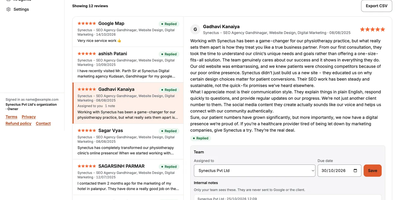
Built for agencies and local businesses that run Google Business Profiles, OpenGMB lets AI agents draft replies and posts, then holds the drafts for a person's approval before Google sees them. Ask Claude, Cursor, or any MCP client for this week's replies to low-rated reviews across every location, and the drafts wait in an approvals inbox. Reviews from all locations land in one inbox with topic and sentiment filters, assignees, due dates, internal notes, bulk replies, and CSV export. Write a post once, send it to one location or many. A calendar shows what is scheduled, published, or made directly on Google, and CSV files import in bulk. Health scores list the checks behind them, and hours, categories, and services change across many locations in one edit. Performance pages show calls, website clicks, direction requests, and impressions per location, with white-label reports that clients open from a shareable link. Rank tracking runs on a geo-grid around each location, next to its competitors, and keyword research returns up to 300 ideas per seed. Guardrail packs for general, healthcare, and legal copy screen links, emails, phone numbers, offers, and bad hours before approval and again before sending. Replies to reviews rated three or lower never publish on their own, and human-in-the-loop tokens can draft and submit but never approve or publish. Running on a dedicated VPS on RepoCloud with guaranteed CPU, RAM, and SSD, full root SSH access, and a browser serial console. MIT licensed.
Monitor
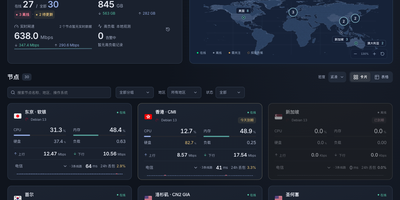
Monitor watches your servers the way a status page should: second by second, from one small binary you run yourself. A lightweight Linux agent on each machine reports CPU, memory, disks, network throughput, connections, and processes to your hub over a persistent connection, and the hub pushes a fresh snapshot to your browser every two seconds. History is kept for charting, so node pages show how load, traffic, and latency behaved over days. Ping tasks run from the hub's side too: define targets once and every agent measures latency to them on its own interval, drawing the curves next to the machine metrics. The public face is a status page you can reskin without touching the server: themes install from the panel, run as static pages against a small public API, and anonymous visitors see only the nodes you marked public, with addresses and hostnames stripped out. Node management stays practical: registration windows hand out tokens safely, installing an agent is one command, and replacing a token disconnects the old connection immediately. When a node goes offline, crosses its traffic allowance, approaches expiry, or someone signs in, alerts go out through Telegram or any webhook. The hub listens only on localhost behind your HTTPS proxy, signs in by password or GitHub OAuth allowlist, and lists revocable sessions. Running on a dedicated VPS on RepoCloud with guaranteed CPU, RAM, and SSD, full root SSH access, and a browser serial console. MIT licensed.
PlainBoard
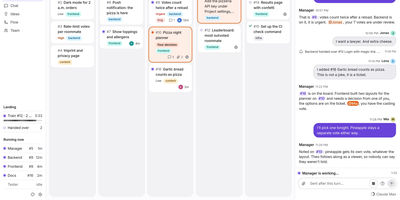
Tell PlainBoard's manager agent what software you want, and a team of AI agents builds it while PlainBoard checks the finished branches and lands them on main. The manager turns chat messages into tickets, builds a team per project with its own roles, models and tools, and gives every agent a complete assignment. A live board shows which agent works on each ticket and for how long, with Markdown, labels, priorities, attachments and comments on every card. Claude and Codex agents work side by side on API keys or personal subscriptions, and local servers like Ollama or vLLM and hosts like OpenRouter and Groq are supported too. Finished branches join one merge train that runs your check command once, so ten changes cost a single test run and a failed train gets one agent to repair it. When an agent needs a decision, its ticket asks with clickable options and pictures while the rest of the team keeps working. An Ideas pinboard sorts loose thoughts into topics, and the Flow view follows every repository from agent to main branch. Teammates join with viewer, member or owner roles, mention each other with @name, and share subscriptions. Claude skills and MCP servers extend the agents, and PlainBoard itself serves as an MCP server for Claude Desktop, Claude Code and Cursor. Running on a dedicated VPS on RepoCloud with guaranteed CPU, RAM, and SSD, full root SSH access, and a browser serial console. MIT licensed.
Euron Open TestForge
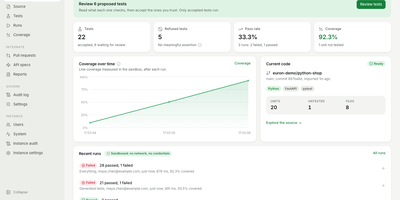
Because a generated test that asserts nothing is worse than no test, Euron Open TestForge refuses it, then runs every accepted test in a sandbox with no network. Connect a GitHub repository at a branch, tag, or commit, import a pull request, or upload a ZIP, and it reads the code without ever running it. Unit, edge-case, negative, and API tests are written from each function's signature, docstring, documented examples, and raise conditions, plus tests for every operation in an OpenAPI document. Every test lists what it asserts, and you accept or regenerate tests one at a time. Runs have no network or credentials, and a run that crosses its CPU, memory, output, or time limit is stopped with the limit named. A failure shows the actual and expected values from that same run, with a plain-language explanation. Coverage is tracked per file and function over time, and reports export as HTML or CSV. Pull request mode writes tests for exactly the functions a change touches, and the CLI exits non-zero unless every test passes. Teams get roles, scoped API keys, signed webhooks, and an append-only audit log. Use OpenAI, Anthropic, Gemini, Ollama, or any compatible endpoint, or start with the built-in mock model and no key. Running on a dedicated VPS on RepoCloud with guaranteed CPU, RAM, and SSD, full root SSH access, and a browser serial console. MIT licensed.
Euron Open AgentOS
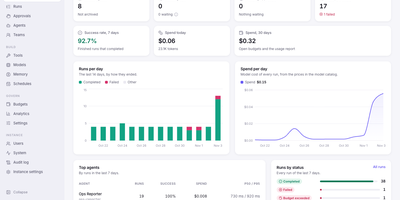
Euron Open AgentOS is a runtime for AI agents that checks every model call against a budget before it is sent and pauses risky tool calls for human approval. Define an agent with instructions, tools, memory, limits, and a model from OpenAI, Anthropic, Gemini, Ollama, or any OpenAI-compatible endpoint, then start it from the dashboard, the API, the Python SDK, a schedule, or a webhook. Budgets cap tokens and cost for a run, an agent's day, a project's day or month, and an organization's month, and a delegated team shares one pool. Any tool can require approval always or only when its arguments match a rule, and reviewers can approve, reject, or edit its arguments. Code, shell, git, and browser tools run in a separate sandbox that holds no credentials and limits browsing to an allowlist of domains. Every step is checkpointed, so a crash or a pause resumes the run where it stopped instead of repeating finished work. Teams work in sequence, in parallel, under a supervisor, or in collaborative rounds, and the Run Inspector shows every delegation as a child run. Built-in tools cover web search, files, CSV and JSON queries, read-only SQL, and email; custom HTTP tools and MCP servers add more. Organizations, projects, roles, API keys, OIDC sign-in, and an audit trail keep teams apart. Running on a dedicated VPS on RepoCloud with guaranteed CPU, RAM, and SSD, full root SSH access, and a browser serial console. MIT licensed.
NodePilot
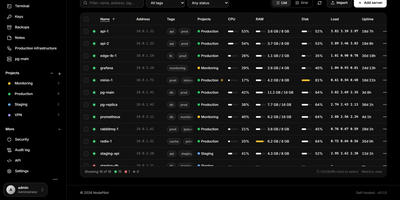
Admins who juggle dozens or hundreds of servers over SSH can run them all from one self-hosted browser panel, and let AI agents drive the same controls over MCP. Servers are grouped into projects, a server can belong to several, and a keychain holds the keys. The panel includes a web terminal, an SFTP file manager, process and systemd service controls, reboot and shutdown, and Markdown notes for runbooks. Agentless stats chart CPU, RAM, disks, network, and load history for every server, polled in parallel with backoff for unreachable hosts. One command can run on many servers at once, and infrastructure graphs map API, database, and VPN nodes with cascade links and notes on the canvas. Backups of files and PostgreSQL or MySQL databases run on schedules to the panel or to S3, encrypted to an age public key. AI agents reach 66 tools over MCP, through remote HTTP or a local stdio command, including persistent terminal sessions and graph editing, and an API token decides which tools each agent sees. Tokens can be full, read-only, or limited per area with an optional expiry, and every agent call is written to the audit log. Two-factor sign-in, a master key that can be sealed in a TPM, and pinned SSH host keys protect the credentials the panel stores. Running on a dedicated VPS on RepoCloud with guaranteed CPU, RAM, and SSD, full root SSH access, and a browser serial console. Apache-2.0 licensed.