Categories
Self-Hosted Productivity Knowledge Management Second Brain Deep Research Bookmark Manager Read It Later AI TriageStars
Forks
Watchers
Developer links
Sparkkeep
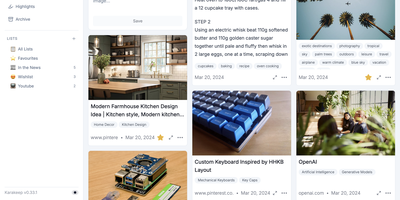
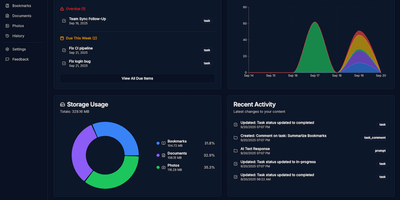
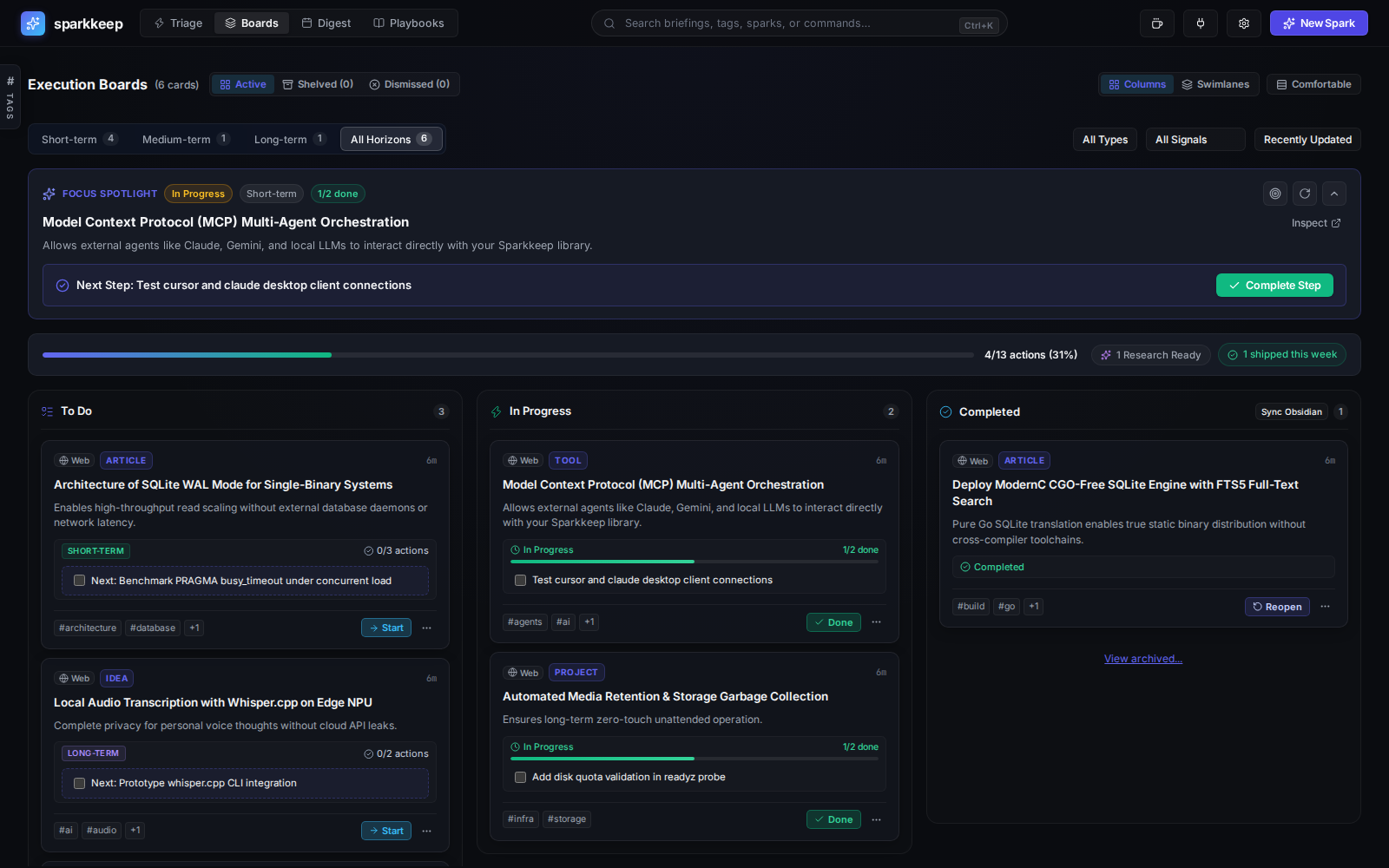
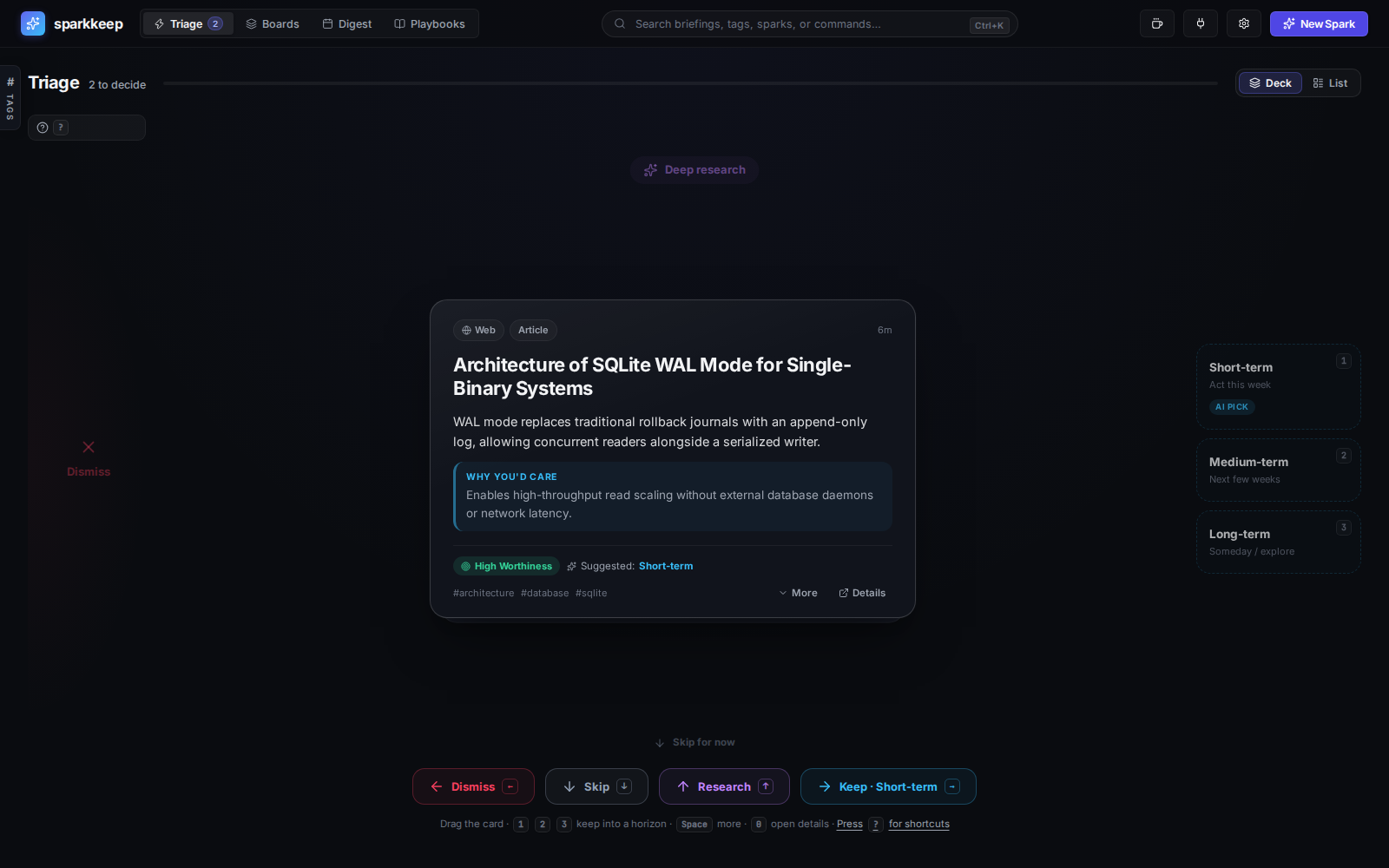
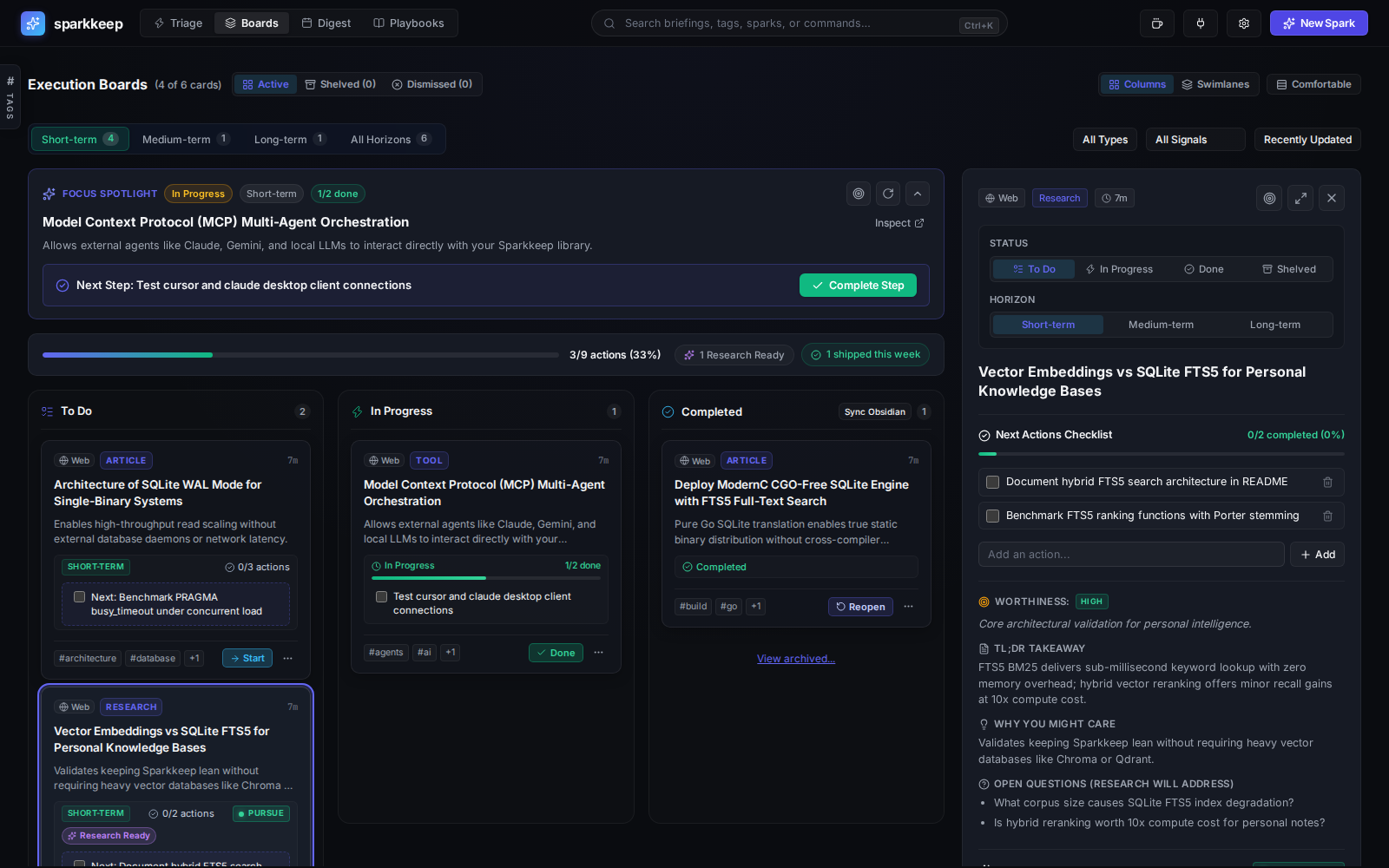
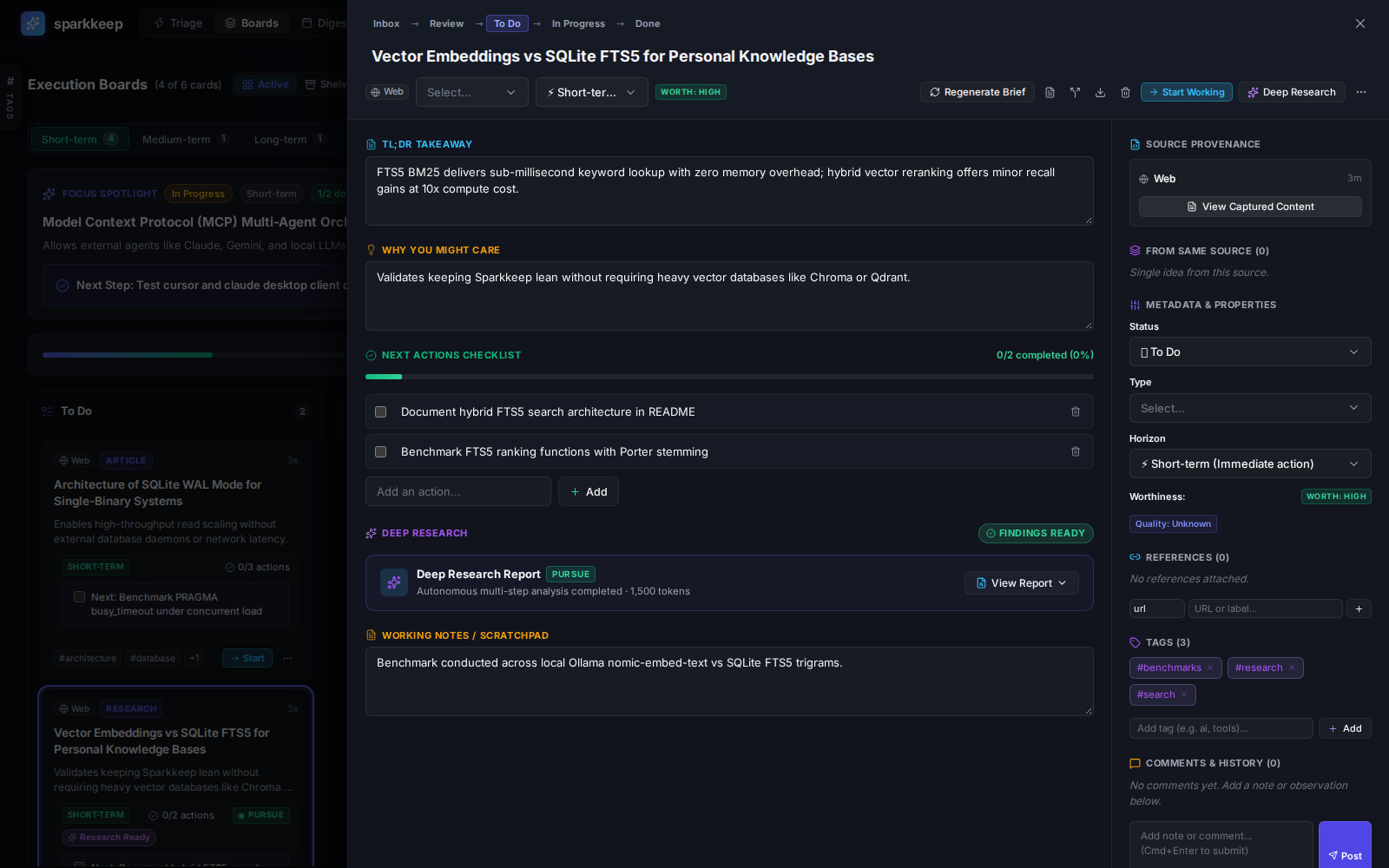
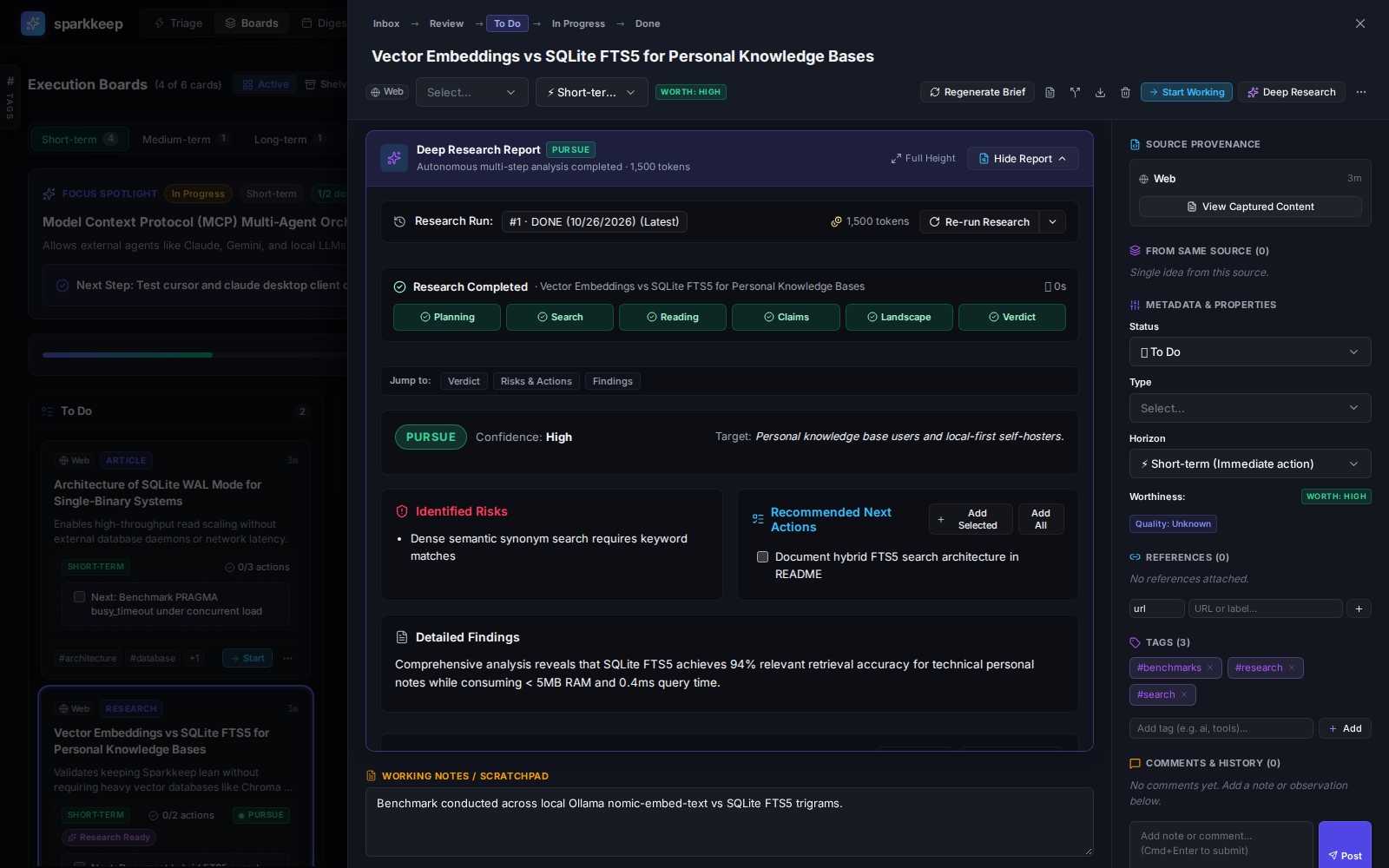
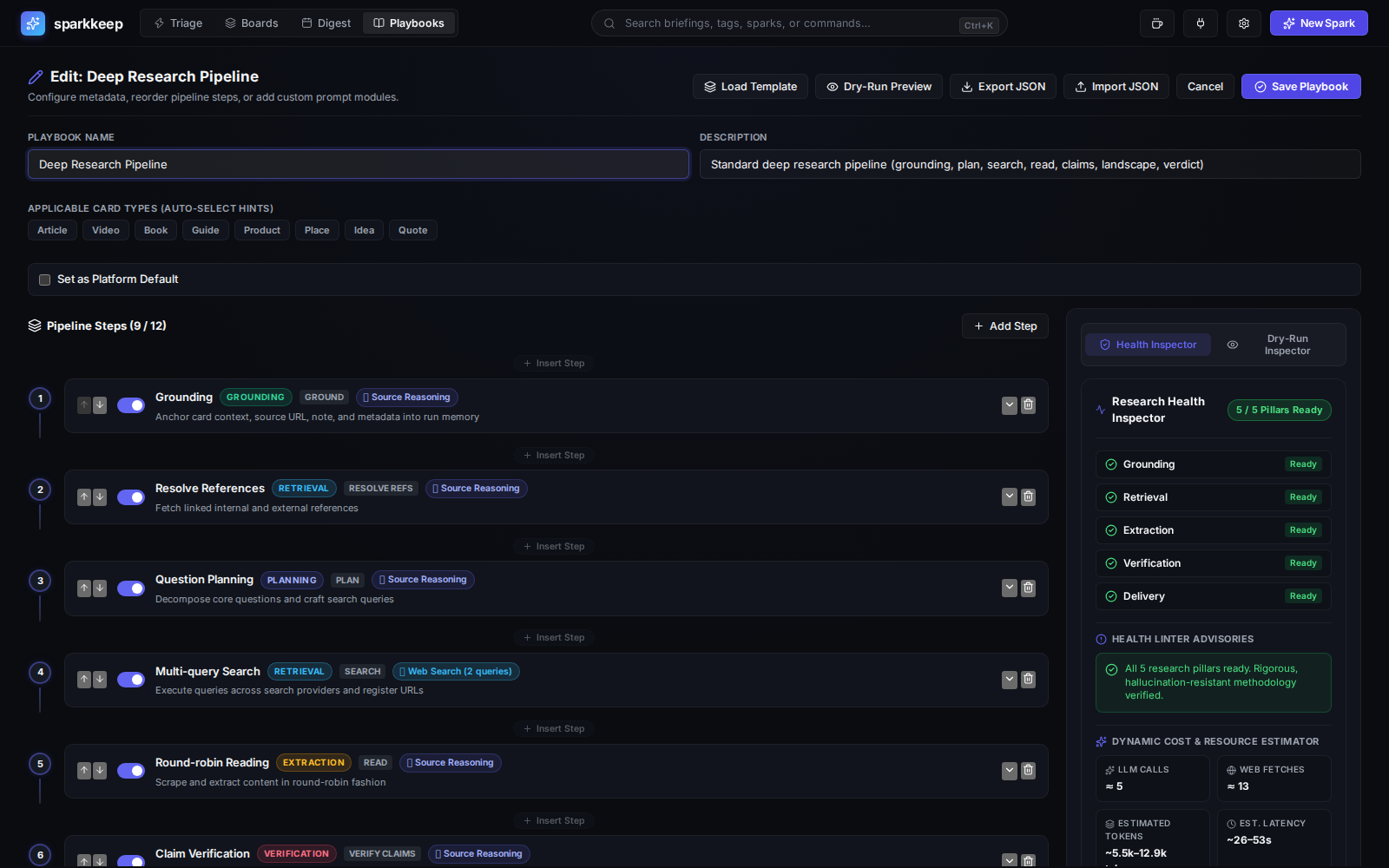
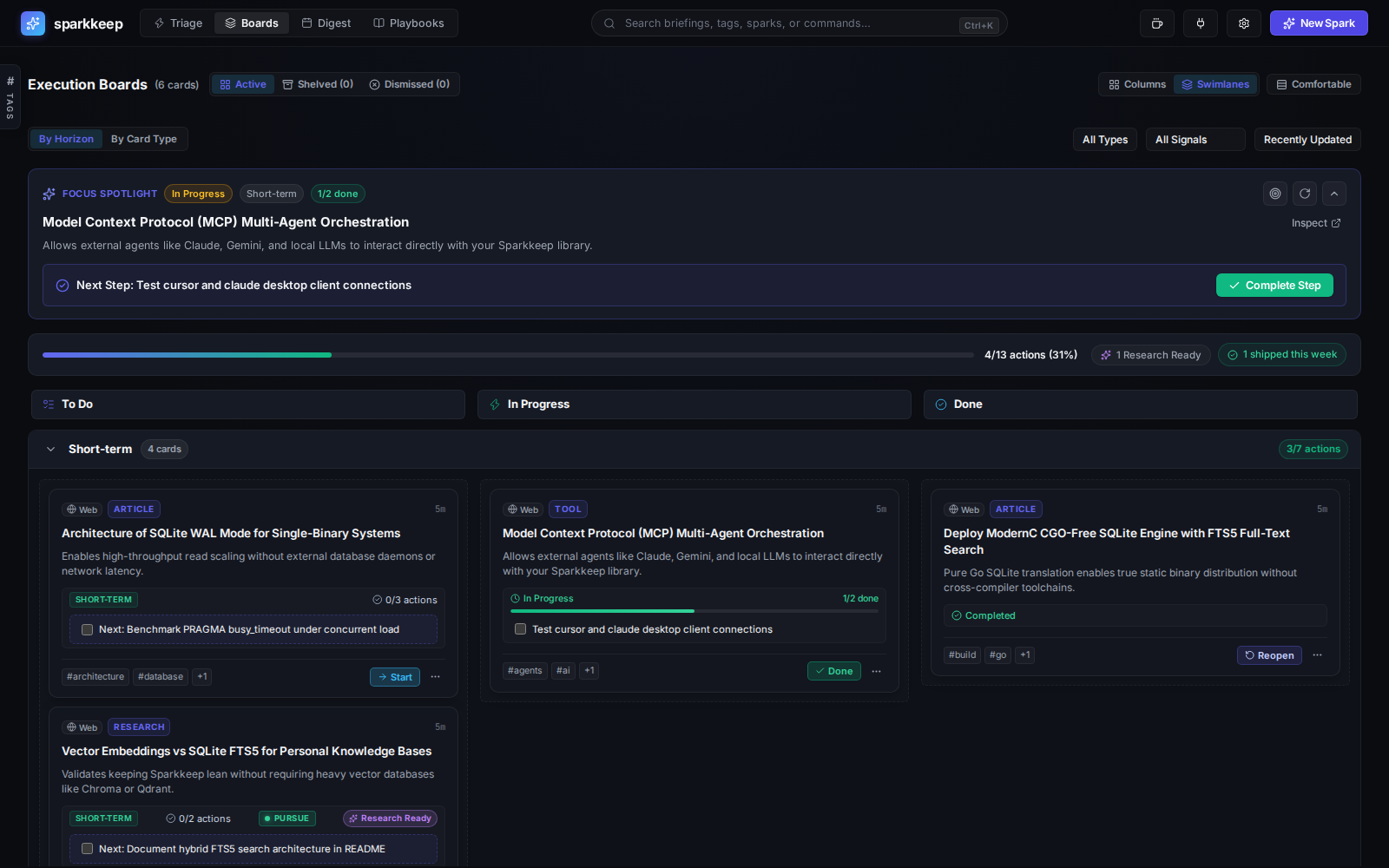
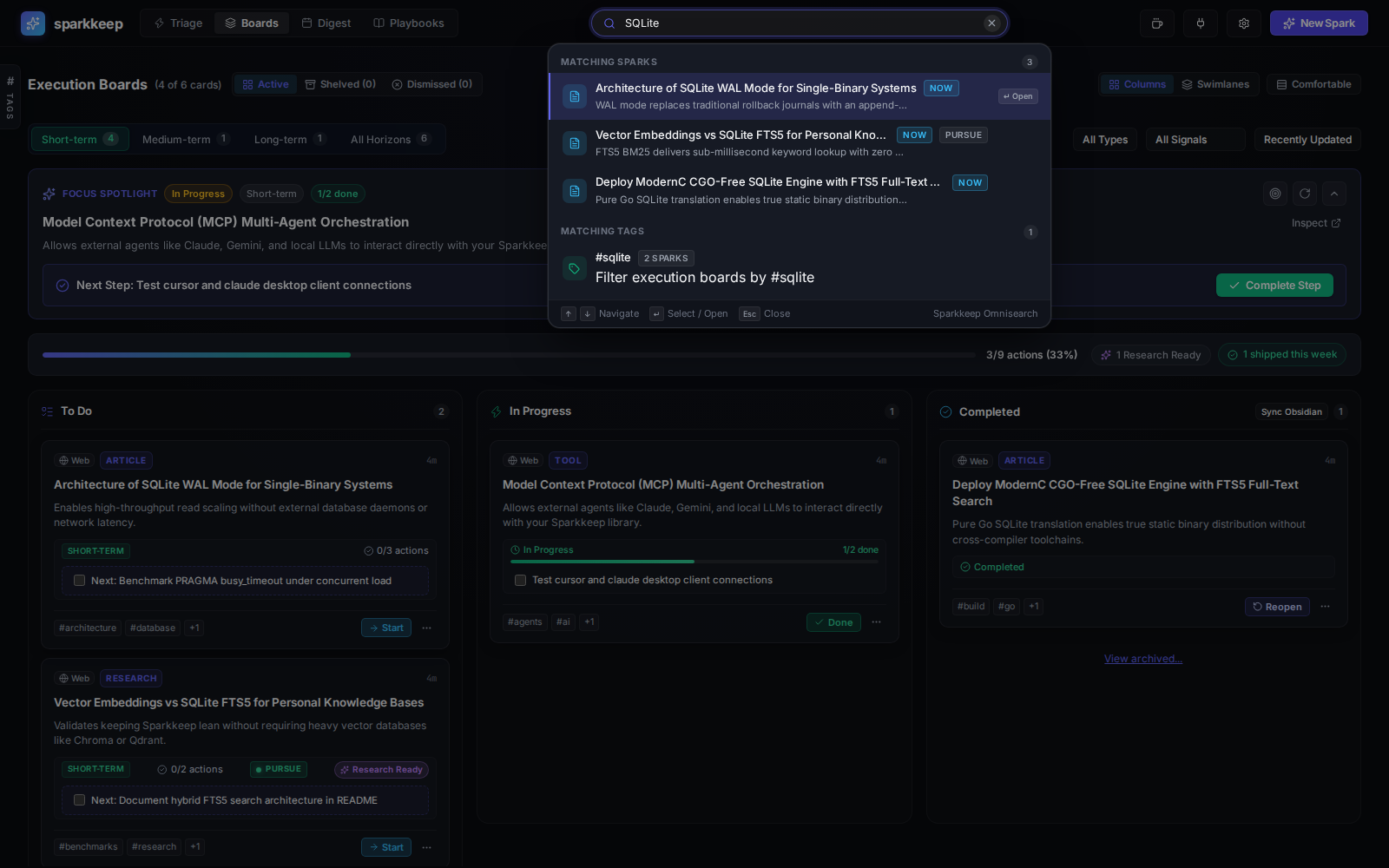
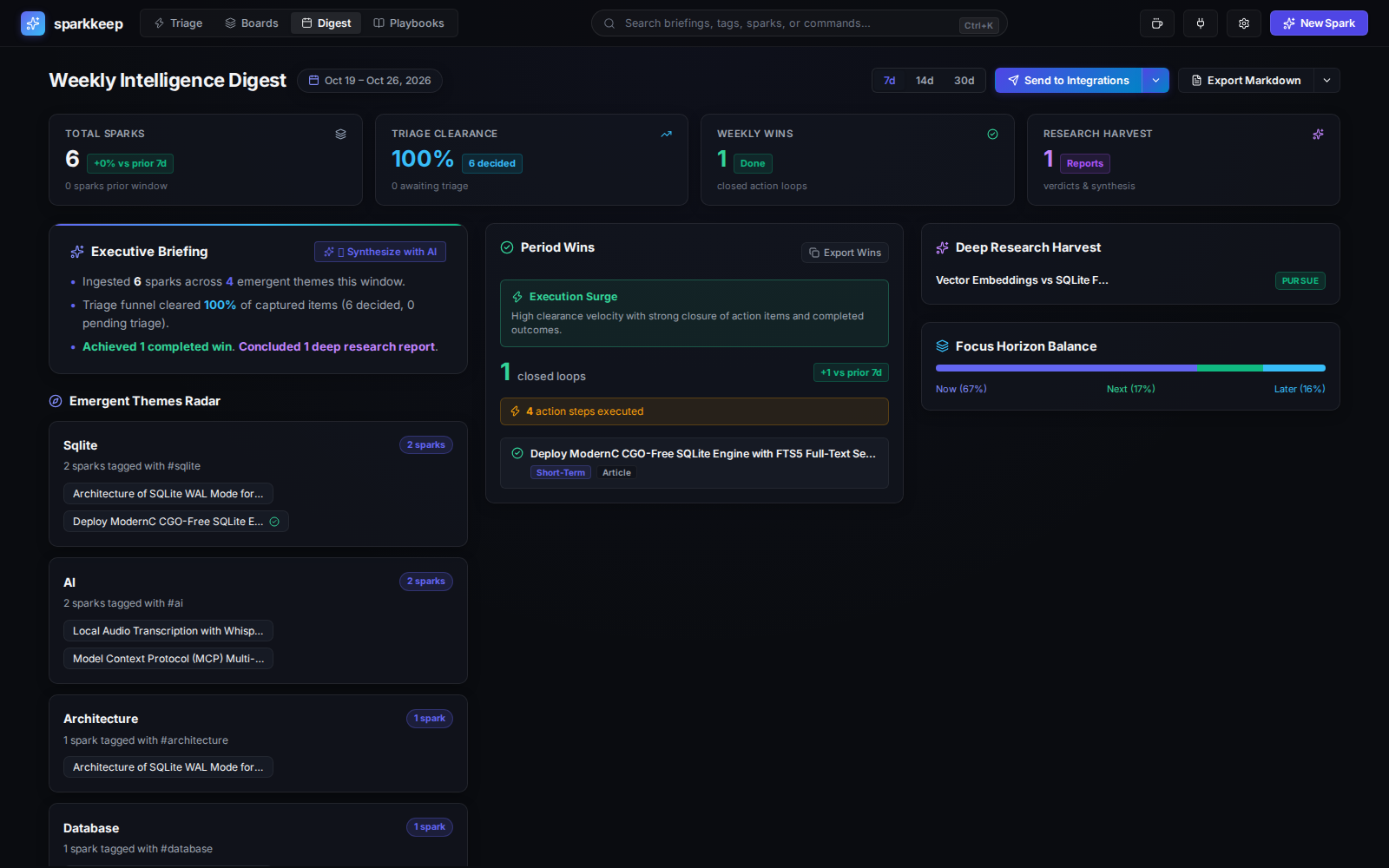
Send Sparkkeep a link, note, screenshot, or voice memo and it screens out the junk, drafts a brief, and parks the keepers on a board you work from. Telegram, Discord, Slack, a browser extension, or a webhook can feed the inbox, and a note with no link works too. A noise gate drops engagement bait and spam. The model you choose writes each brief, covering a TL;DR, why it matters, open questions, and a next-action checklist. Keys 1, 2, and 3 sort a card in the triage deck into the short-, medium-, or long-term horizon. The board adds a Focus Spotlight that picks your best next card, a seven-day Execution Pulse, swimlanes by horizon or card type, and a docked inspector. Research runs follow bounded playbooks that search, cite sources, and verify claims before ending in a Pursue, Watch, or Skip verdict. Playbook Studio lets you reorder steps, lint research health, and see the estimated cost before a zero-cost dry run. A digest over 7, 14, or 30 days tallies wins, shows momentum, and ends with an executive briefing in your model's voice. Obsidian, Notion, and Joplin receive finished notes, while an RSS outbox and intents hand cards to Logseq, Things 3, Todoist, and GitHub. Models come from Ollama, LM Studio, vLLM, OpenAI, or DeepSeek, with a different one per role. Running on a dedicated VPS on RepoCloud with guaranteed CPU, RAM, and SSD, full root SSH access, and a browser serial console. AGPL-3.0 licensed.
Benefits
- Runs lean on one binary
- A single Go binary with pure-Go SQLite in WAL mode and FTS5 search needs no Postgres or Redis; the project reports it runs in under 30 MB of RAM.
- Keep prompts on your own hardware
- Per-role model routing can send triage, vision, research, and digest work to Ollama, LM Studio, or vLLM, keeping prompts and saved content off cloud models.
- Research that cites its sources
- Bounded playbooks run ordered steps for search, reading, claim checks, and verdict, with a health linter and cost estimate, so each dossier ends in cited sources and a Pursue, Watch, or Skip call.
- Notes land where you already work
- Cards can export idempotently to Obsidian vaults, Notion databases, and Joplin when they move into active work or finish research, so the board never becomes another silo.
Features
- Multi-channel capture hub
- A two-way Telegram bot, Discord embeds with buttons, Slack Block Kit, a universal inbound webhook, and a Chrome and Firefox extension all feed one capture inbox.
- Execution boards and swimlanes
- Columns or horizon swimlanes show To Do, In Progress, and Completed work, with a Focus Spotlight, a seven-day Execution Pulse, inline checklists, and a docked inspector with keyboard navigation.
- Playbook Studio
- A visual step sequencer with grounding, search, read, verify, landscape, and verdict steps, a five-pillar Research Health Linter, token cost estimator, and zero-cost dry-run preview.
- Knowledge sinks and RSS
- Idempotent one-way export to Obsidian vaults, Notion databases, and Joplin Server or Desktop, plus an authenticated RSS outbox and web intents for Logseq, Things 3, Todoist, and GitHub Issues.
- Single binary with SQLite
- Go standard-library HTTP, pure-Go SQLite with FTS5 search, and a React 19 and Vite dashboard embedded through go:embed ship as a roughly 24 MB static binary.
- Backup and health probes
- A backup and restore CLI uses VACUUM INTO while the daemon runs, with /livez, /readyz, and a dependency-free Prometheus /metrics endpoint for orchestrators.