Atlantis Diagrams
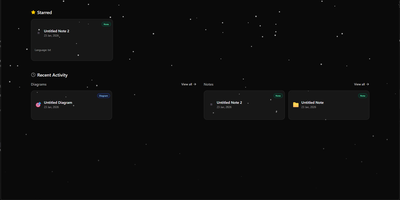
Technical teams frequently struggle to keep software architecture diagrams synchronized with evolving codebases and documentation repositories. Atlantis Diagrams delivers a unified self-hosted workspace that couples code-driven Mermaid.js diagramming with structured Markdown knowledge bases in a responsive web interface. Engineers can compose flowcharts, sequence diagrams, state machines, entity-relationship models, and Gantt schedules using split-view CodeMirror editors with real-time SVG rendering. An integrated version history tracker automatically captures revision checkpoints across the last 15 document states, letting authors compare modifications and restore previous iterations without data loss. The linked notes environment supports rich Markdown editing, LaTeX mathematical formulas, interactive task checklists, tag indexing, and full-text keyword searches across personal documentation libraries. Canvas controls allow users to pan, zoom, inspect individual nodes, and export finalized graphics directly into vector SVG, high-resolution PNG, or printable PDF documents. Storage engines adapt to deployment scale, running on zero-configuration SQLite databases out of the box with optional PostgreSQL, MySQL, and Redis caching layers for high-concurrency environments. Running on a dedicated VPS on RepoCloud with guaranteed CPU, RAM, and SSD, full root SSH access, and a browser serial console. MIT licensed.
Markus
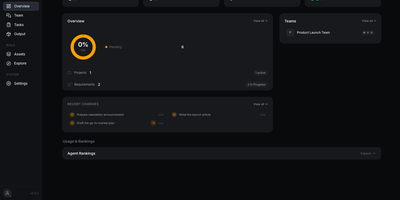
Markus is an AI workforce you run yourself: describe a goal in plain language and a team of specialist agents plans it, splits it into tasks, does the work, and reports back. A built-in Secretary agent hires agents from role templates, groups them into teams, and turns requirements into dependency-linked tasks. Work runs in parallel, each task in its own workspace, and a peer reviewer approves or sends back every delivery before it counts as done. Follow progress on a backlog table, a kanban board, or a dependency graph that shows which task unblocks which. Agents keep persistent memory, patrol their own task board around the clock, and can join team group chats or take direct messages. Connect Slack, Telegram, Discord, WhatsApp, or Feishu so people can reach agents where they already talk, and give agents browser and desktop automation through an optional Chrome extension. Pick any model provider, including Anthropic, OpenAI, Google, DeepSeek, OpenRouter, or a local Ollama server, and import skills from MCP servers or community hubs. A REST and WebSocket API, usage rankings, and an audit trail round out the control room. Running on a dedicated VPS on RepoCloud with guaranteed CPU, RAM, and SSD, full root SSH access, and a browser serial console. Apache-2.0 licensed.
Ovumcy
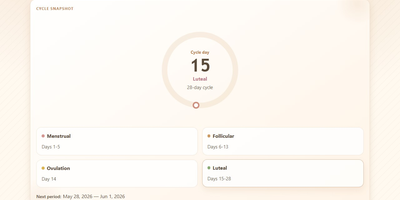
Your cycle history is among the most personal data you will ever record, and Ovumcy keeps it on a server you control instead of a tracker's cloud. Log period days, flow intensity, symptoms, and free-form notes in seconds from any browser, and define your own custom symptoms when the preset list misses something you feel. The calendar view lays out your month with predicted period, ovulation, and fertile-window days marked, while statistics views surface cycle length trends and patterns across months. Predictions come from your own logged history, refined when temperature or cervical-mucus entries sharpen the estimate. Reminders reach you three ways: a dashboard banner before an expected period, a webhook ping to your own ntfy or Gotify server, or a private read-only calendar subscription that drops estimates into the calendar app you already use. Install it to your phone home screen and it opens like a native app, in English, Russian, Spanish, French, German, or Italian. Export the full history as CSV or JSON whenever you want a backup or a change of tools. Optional OIDC sign-in and TOTP two-factor authentication protect access, and the app makes no analytics or telemetry calls at all. Running on a dedicated VPS on RepoCloud with guaranteed CPU, RAM, and SSD, full root SSH access, and a browser serial console. AGPL-3.0 licensed.
Nimbus
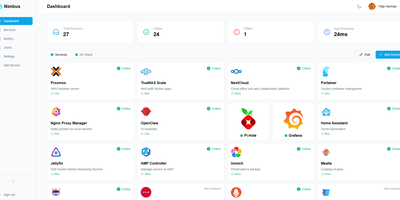
Nimbus is a self-hosted homelab dashboard that turns your scattered pile of services into a polished, organized command center with real-time health monitoring for every endpoint you care about. The dashboard displays live status cards for each registered service, tracking response times down to the millisecond and graphing uptime history so you can spot degradation before it becomes an outage. Health checks run on configurable intervals with smart self-signed certificate handling, meaning your internal services with self-issued TLS do not trigger false alarms. Multi-user support comes standard: local accounts authenticate via JWT, while OAuth2 integration with Google, GitHub, and Discord lets team members sign in with existing credentials. Role-based access control and a built-in admin panel give you granular authority over who sees what. Each user personalizes their view with custom backgrounds, light or dark mode, accent color themes, and drag-and-drop service tile arrangement. Services group into named categories and cards resize to fit your preferred layout, with both grid and list view modes available. Prometheus metrics export feeds your existing Grafana stack, and webhook notifications alert you instantly when a service goes offline. Custom service icons upload directly or auto-fetch from the Dashboard Icons collection. Zero-config Docker deployment gets you running in under 30 seconds with a single docker-compose command. Running on a dedicated VPS on RepoCloud with guaranteed CPU, RAM, and SSD, full root SSH access, and a browser serial console. AGPL-3.0 licensed.
Turtle Wiki
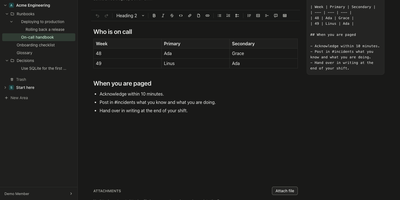
To keep a team's runbooks and handbooks current, Turtle Wiki gives teammates and AI agents the same pages to edit, and every change shows who made it. Read, Write, and Admin roles are granted on Areas to members, agents, or all members, and workspace admins invite people by email or link. Inside an Area, pages and folders nest into trees, and a Quick Note box catches thoughts that have no home yet. The editor works live for several people at a time and supports tables, task lists, callouts, colored status markers, and page links that keep working after a rename. Page history names who made each change, compares two states, and restores an older one; deleted pages and folders wait in a 30-day Trash. Search highlights the matching words. Claude and other MCP clients connect by pasting the /mcp address, signing in, and clicking Allow, with access optionally limited to reading or chosen Areas. Connected agents never exceed the access of the member who connected them, and their edits carry that member's name, as in Ada Example via Claude. Export an Area or subtree as a ZIP of Markdown or a typeset PDF with a cover, contents page, and uploaded fonts; zipped Markdown folders import back. Turtle is early software: OIDC sign-in, comments, and guest access are still on the roadmap. Running on a dedicated VPS on RepoCloud with guaranteed CPU, RAM, and SSD, full root SSH access, and a browser serial console. AGPL-3.0 licensed.
Agentic Researcher
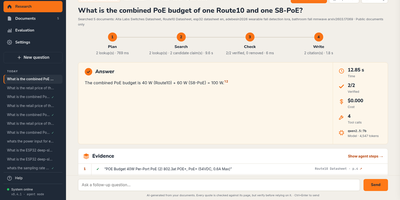
For questions that need several lookups across datasheets and papers, Agentic Researcher plans the searches, checks each quote against its page, and cites every sentence of the answer. A planner splits each question into lookups and resolves follow-ups from conversation memory. A researcher then searches your PDFs through an MCP tool server, mixing vectors and keywords so part numbers and units still match. A critic drops any claim whose quote is missing from the page, whose nearby text gives instructions to the AI, or whose numbers and product names the quote lacks. The writer keeps only cited sentences, and clicking a citation opens the PDF at the quoted page in a side drawer. A price missing from the documents gets "Not found" rather than a guess, and a question answered only in part pauses to ask whether to show a partial answer. Each answer starts as an AI draft until a named reviewer marks it reviewed, and the audit log records who asked, what the agents did, and who reviewed it. Export PDF prints a report with the evidence table and log. The agent steps list every lookup and tool call, Documents takes dropped PDFs, and Evaluation compares agent and baseline runs. Settings pick Claude or a local Ollama model as main, the other as fallback, with a cost cap per run. Running on a dedicated VPS on RepoCloud with guaranteed CPU, RAM, and SSD, full root SSH access, and a browser serial console. MIT licensed.
Subpool
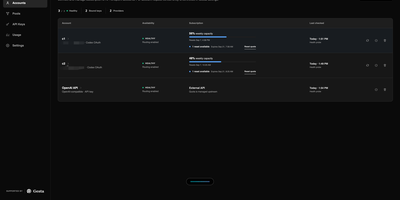
Your company pays for AI subscriptions nobody can see, scattered across personal accounts and team plans, and Subpool is the self-hosted control plane that pools that authorized capacity and hands every employee one key with limits you govern. Administrators combine subscription and API accounts into pools behind a single managed endpoint, then allocate employee-specific keys across whichever provider accounts are healthy. The console watches account health, remaining subscription capacity, and when each plan window resets, and routing prefers subscription capacity first, falling back to paid API accounts under the very same employee key when a window runs dry. Rate-limit, expire, or revoke any person's access independently, and keep every key-to-account assignment visible and auditable instead of buried in a shared credential nobody can trace. The employee API speaks OpenAI-compatible Responses and Chat Completions, so existing tools point at your pool unchanged, while aggregate input and output token telemetry is tracked per key in provider-native units. For OpenAI accounts, a Costs API estimate shows the remaining grant balance; Bailian Token Plan accounts display their five-hour, weekly, or monthly quota windows. Upstream credentials stay encrypted, and prompts, responses, and source code are never persisted. One Go service with an embedded console and PostgreSQL runs from Docker Compose, with sign-in on port 8081 and the employee API on 8080. Running on a dedicated VPS on RepoCloud with guaranteed CPU, RAM, and SSD, full root SSH access, and a browser serial console. Apache-2.0 licensed.
Offstage
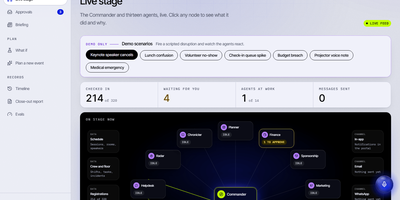
When a keynote speaker cancels, Offstage's fourteen AI agents, each paired with a human lead, replan sessions, rooms, crew, and messages, then wait for approval. Agents only file proposals; a plain-code policy engine decides who must sign off. T0 and T1 run at once, T1 with a ten-minute undo; T2 needs one approval, and T3 needs two different people. Medical, safety, fire, and harassment reports are never handled by agents; every lead gets a loud alert. Before approving, a ripple view lists sessions, attendees, volunteers, and announcements the plan touches. Any agent run opens to its steps, cited facts, model, tokens, cost, and latency. Talk to the Commander by voice or text; it answers from live state and files requests as proposals, never approvals. Attendees get cited answers from the event's own documents; unanswerable questions go to a person. Volunteers check people in with Ed25519-signed QR tickets that verify offline; the first scan wins. When many people ask the same thing within minutes, Radar opens an incident and proposes a fix. A what-if sandbox tries scenarios like thirty percent more attendees on a copy of the event. A daily briefing flags what is due or at risk, and the close-out report totals attendance and incidents. WhatsApp, SMS, Telegram, email, and in-app notices carry the messages, and screens switch between English, Hindi, and Hinglish. Running on a dedicated VPS on RepoCloud with guaranteed CPU, RAM, and SSD, full root SSH access, and a browser serial console. MIT licensed.
Tuff
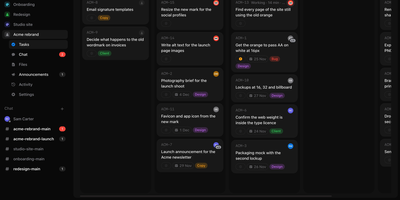
Tuff gives every project its own tasks, chat, files and announcements in one workspace, so a decision made in a thread is never lost between a tracker and a wiki. Tasks switch between list and board, with labels, due dates, priorities, sub-tasks, blockers and sprints, and My Tasks gathers everything assigned to you. Chat rooms, direct messages and threads sit beside the board, and any message can name a task or become one. Files hold documents that several people write at once, plus pictures, uploads and links, with version history and drafts. Hours logged on tasks add up by person and project, and ⌘K searches across all of it. AI agents such as Claude Code, Codex and Cursor connect over MCP and work as the person who connected them, show up in Activity under their own name, never delete anything, and leave questions in a Needs you list. Give a list to an agent and new unassigned tasks go straight to it, while its page shows tasks taken, questions answered and spend. Branches, pull requests and commits that name a task show on it, GitHub issues sync both ways, and imports bring over Asana, Jira, Linear, Slack and GitHub Issues. Sign-in takes email with a second factor or Google, Apple and GitHub, and the interface speaks English and French. Running on a dedicated VPS on RepoCloud with guaranteed CPU, RAM, and SSD, full root SSH access, and a browser serial console. AGPL-3.0 licensed.
Atrium
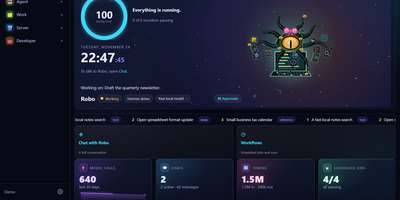
Private, installable, and run on your own hardware, Atrium is a web app that gives a Hermes agent one home for chat, scheduled jobs, a memory graph, and a kanban board. The home screen acts as mission control, with a health ring, what needs you, today's focus, and a radar of things worth a look. Chat streams answers beside the tools the agent used, keeps past conversations, takes pictures and documents, speaks replies aloud, and asks for your yes on risky actions right in the conversation. Workflows lists scheduled jobs in plain words with run now, pause, resume, history, and the last answer, while Memory draws the agent's Obsidian-style notes as a graph you can search and edit. A kanban board tracks the agent's work and your ideas, and the coding workspace adds restore points, diffs, a terminal, and a shared browser. Optional pages add email with remote images blocked until you choose, Nextcloud files and calendar, and a Jellyfin or Emby player for video and music. Owners can install package updates, update container groups with an automatic rollback if the new build is unhealthy, and reboot the machine behind a cancel countdown. Everyone signs in with their own account and role, phones get push notifications, and seven dark themes change the look. Running on a dedicated VPS on RepoCloud with guaranteed CPU, RAM, and SSD, full root SSH access, and a browser serial console. MIT licensed.
Pi-Remote
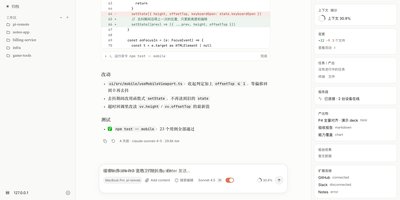
Your pi agent is mid-refactor on the server at home, you are on a train with only a phone, and Pi-Remote is the self-hosted relay that puts that live session in your browser so the work does not wait for your desk. Output, tool calls, and status changes sync in real time, with incremental catch up after a reconnect, and the session itself never leaves the local pi process. Send messages while pi is busy and they queue or steer, with delivery confirmed; switch the model or thinking level, compact the context, fork or clone a session, and walk the session tree, all executed locally. Several machines share one relay, and the UI lists each device, its online state, and its sessions, and can start a new session on the device you pick. Link a device by scanning a QR code, checking the 2 digit code on the confirmation page, and approving with the admin token. Desktop and mobile get separate layouts with six skins in Cursor, Claude, and Codex looks, dark and light, and token and cost usage updates in the status area. At home the relay can run serverless over the LAN, with a Cloudflare Tunnel switched on when you leave; on a server it runs under systemd or Docker Compose, and a device stays reachable only while its attach window is open. Running on a dedicated VPS on RepoCloud with guaranteed CPU, RAM, and SSD, full root SSH access, and a browser serial console. MIT licensed.
Nemofy Agent
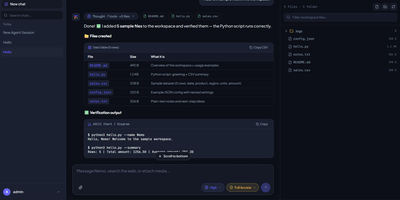
A private AI assistant with its own workspace: Nemofy Agent gives Nemo a file drawer, a code sandbox, and live web research, and by default pauses for your approval before anything sensitive runs. Ask Nemo to create files, crunch numbers, or test a script, and it builds them in a confined /workspace folder and runs verification commands. Files appear in a drawer beside the chat, where each opens to view, edit, save, or delete. For research, Nemo searches, fetches, and crawls the web through Firecrawl Local. PDF, Word, spreadsheet, and slide files are parsed natively. Pick a provider and model per conversation, from OpenRouter, River AI, OpenAI, Anthropic, Gemini, DeepSeek, Groq, NVIDIA, local Ollama, or a custom endpoint. A faster worker model takes parallel research and coding sub-tasks, with timeouts, retries, and a fallback model when a provider stalls. A context gauge shows what fills the window, and at 80% capacity older turns are summarized automatically. Reusable Markdown skills like code_and_data and deep_research load on demand, and external MCP tools connect from the same settings tab. In default mode, read-only actions run freely while sensitive ones pause to approve, edit, or reject, and paused runs resume after a restart. Access sits behind an admin login, and API keys are encrypted at rest per user profile with AES-256-GCM. Running on a dedicated VPS on RepoCloud with guaranteed CPU, RAM, and SSD, full root SSH access, and a browser serial console. Apache-2.0 licensed.
Model Hotel
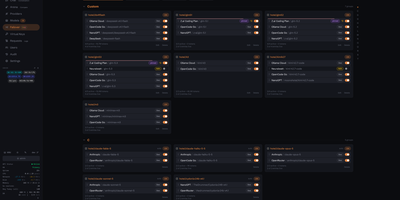
One OpenAI-compatible endpoint fronts every LLM provider you use, hosted or local, and fails over when a quota runs out or a provider goes down. Offer one model through two providers and a failover group forms by itself; the hotel/ prefix tries them all in your priority order. Anthropic, OpenAI, Google AI Studio, and OpenRouter sit beside Ollama, LM Studio, and TabbyAPI, plus any custom OpenAI-compatible API. Errors, timeouts, and rejected keys retry on the next provider, and a per-model circuit breaker benches repeat offenders. Models are discovered the moment a provider is added. Each client gets a virtual key with rate limits, a daily, weekly, or monthly dollar budget, and a list of allowed providers. Prompts and replies are never logged, and the request log records timing, tokens, cost, and gateway overhead for every call. A chat playground, a side-by-side compare grid, and blind bracket tournaments help you pick the best model. Claude Code, Codex CLI, and the OpenAI and Anthropic SDKs connect unchanged, alongside embeddings, rerank, image, and speech endpoints. Sign in with a passkey, an authenticator app, OpenID Connect, or GitHub, and give teammates named accounts with limited access. Prometheus metrics and Apprise alerts keep operators informed, and Traefik-balanced instances with an Android companion app cover high availability. Running on a dedicated VPS on RepoCloud with guaranteed CPU, RAM, and SSD, full root SSH access, and a browser serial console. MIT licensed.
AutoMorph
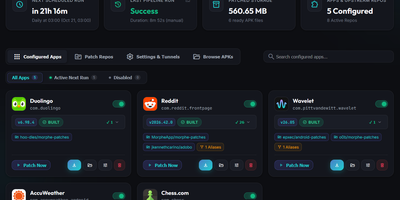
Patching the same Android apps by hand every time a patch repository updates is a chore with your name on it, and AutoMorph is the self-hosted patcher that takes the chore over and rebuilds your apps on schedule. It monitors patch repositories such as ReVanced, Morphe, and community repos for updates, downloads base APKs automatically with Google Play first and APKCombo, Uptodown, and APKPure as fallbacks, and applies your chosen patches without you touching a command line. The Add Package wizard walks you from a package name through suggested repositories, patch selection with per-patch options, and aliases that map same-role patches across repositories so two repos stop fighting over the same job. Builds run once a day at a time you choose, or start manually from the web portal while live build logs stream to your browser. The Patcher Control Center shows every tracked app's version, patch status, and download links, and email alerts carry direct download links whenever a patch succeeds. Distribution goes further: one-tap Obtainium import by QR code or deep link, plus an F-Droid compatible feed for Obtainium and Neo Store, deliver updates straight to your phone, and a custom keystore keeps them seamless. A low-spec mode trims heap and thread limits for small servers, retention settings clean up old builds, and Pangolin, Tailscale Funnel, or Cloudflare Tunnels expose the portal over HTTPS. Running on a dedicated VPS on RepoCloud with guaranteed CPU, RAM, and SSD, full root SSH access, and a browser serial console. MIT licensed.
Narralume
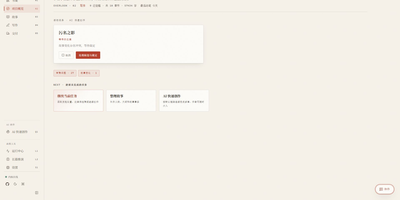
NarraLume is a writing studio for long novels where the AI proposes and you dispose, so a book stays yours across tens of thousands of words. Everything lives around the story bible: your stated intent, outline, entities, confirmed facts, relationships, chronology, and foreshadowing, kept as the single source of truth that planning, drafting, and review all read from. You can write chapters by hand in the studio, save versions and comments, ask for a selection edit, or delegate a chapter, a run of chapters, or a whole quick-creation plan to a model; whatever comes back arrives as a candidate with diffs, never as silent edits to your manuscript or canon. Review findings come with evidence you can accept, reject, or mark as false positives, and when generated prose collides with a locked fact the task stops and waits for your ruling instead of improvising around it. The run center keeps every AI job's steps, model calls, and checkpoints recoverable, the long-form lab searches story memory and previews plot impact without touching the book, and delivery ends with quality checks, exports, snapshots, and full-library backups. Running on a dedicated VPS on RepoCloud with guaranteed CPU, RAM, and SSD, full root SSH access, and a browser serial console. Apache-2.0 licensed.
Euron Open LogMind
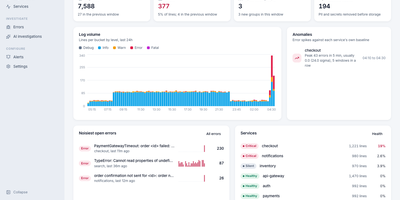
When production breaks, Euron Open LogMind searches and groups your logs, then returns a root cause where every claim cites a real stored log line you can open and re-check. Services send lines over HTTP, the Python or Node.js SDK, or any OpenTelemetry exporter. Credentials, emails, card numbers, and personal data are masked or hashed before storage, so secrets never reach a disk, a model, or a browser. The explorer filters by keyword, service, environment, level, trace, and request. It also draws a level histogram, shows the lines around any entry, and streams new lines live. Errors collapse by fingerprint: a timeout thrown 230 times for 230 different orders becomes one group. Service health, volume, and error rate come from the logs alone. An investigation collects the first failure, earlier warnings, other services' errors, deploys, and the failing request's trace. Statements that cite nothing real are removed and shown as removed. A single click re-reads every cited line from storage, and follow-up questions reuse the same evidence. Reports show their token cost, and OpenAI, Anthropic, Gemini, Ollama, or an OpenAI-compatible endpoint can write them. Search, grouping, live logs, and alerts work without any model, and threshold or anomaly rules notify by email, signed webhook, or Slack. Organizations, projects, and viewer, admin, and owner roles keep each team's data separate. Running on a dedicated VPS on RepoCloud with guaranteed CPU, RAM, and SSD, full root SSH access, and a browser serial console. MIT licensed.
tracesage
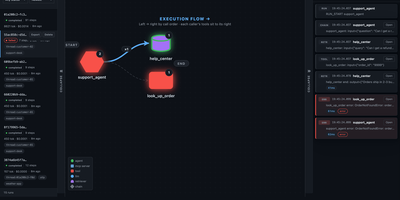
Every model call, tool call, and subagent behind an AI answer becomes a trace you can click through, replay, and search in the browser. LangChain and LangGraph runs are captured natively, Pydantic AI, OpenAI Agents SDK, CrewAI, and the OpenAI and Anthropic clients join with one line, and any OpenTelemetry exporter can post spans to the built-in collector. Run tracesage connect and Claude Desktop, Claude Code, Cursor, and Codex sessions appear as full traces, with every subagent nested under the call that spawned it. A failed tool call shows up as a red node on the exact step that broke, input and error included. A topology graph maps agents, tools, models, retrievers, and MCP servers, step-through replay walks a run at up to 5x, and a waterfall shows which step took the time and what it cost. Search covers prompts, replies, tool output, and errors across every assistant, and a Threads tab reads whole conversations as chat. Developers get terminal commands to show, watch, diff, and export runs, plus a pytest fixture that asserts which tools were called and how many tokens were used. Traces can flow out as OpenTelemetry spans to Tempo, Jaeger, Datadog, Honeycomb, or Phoenix. A bearer token protects a server exposed beyond localhost, and it refuses a public address without one. Running on a dedicated VPS on RepoCloud with guaranteed CPU, RAM, and SSD, full root SSH access, and a browser serial console. Apache-2.0 licensed.
Dispatch
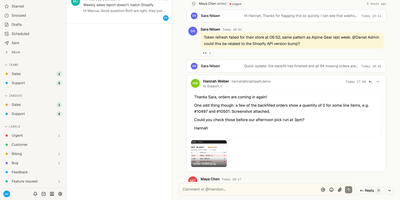
Dispatch turns the Gmail, Microsoft 365, and IMAP mailboxes your team already has into shared inboxes where every conversation gets an owner, a discussion thread, and a status. Teammates assign a conversation, leave internal comments with @mentions right next to the email, and watch presence and typing indicators so nobody answers the same customer twice. Labels, snooze, send later, undo send, signatures, and canned responses with variables keep daily triage quick, while full-text search digs up old threads. Rules label, assign, move, archive, notify, or call a webhook when conditions match, and the analytics view tracks volume, first-reply time, resolution time, and workload per teammate. An optional assistant summarizes long threads and drafts replies with your own Anthropic or OpenAI key. Group chats, direct messages, tasks linked to conversations, and contacts built from your mail sit beside the inbox. A REST API with workspace keys and signed webhooks connects it to the rest of your stack. One instance hosts many workspaces with custom roles, passwordless magic-link sign-in, and an audit log. Support desks, agencies, and small companies use it to replace per-seat tools such as Front, Missive, and Hiver. Running on a dedicated VPS on RepoCloud with guaranteed CPU, RAM, and SSD, full root SSH access, and a browser serial console. AGPL-3.0 licensed.