Silicon Notes
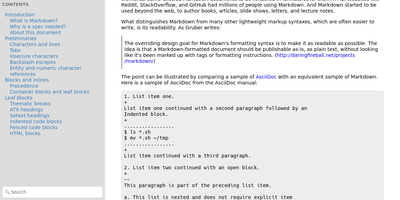
"Somewhat lightweight, low-friction" is how Silicon Notes' author describes the personal knowledge base - written after DokuWiki's editor "drove me mad" and no existing wiki quite fit. The philosophy is that small frequent annoyances compound into cognitive load with no return, so everything here is optimized for frictionless daily use. Notes are written in plaintext Markdown and rendered as clean HTML with Pygments syntax highlighting for code blocks; pages get bi-directional relationships (backlinks), so the knowledge base becomes a connected web rather than a folder tree; and full-text plus title search retrieves anything fast. A table of contents lives in the left sidebar - "where it belongs" - editable while you read without scrolling away. Page history tracks revisions for auditing and rollback, JSON export/import keeps everything portable, and the mobile layout is genuinely usable. The stack is deliberately minimal: Python and Flask with Mistune for Markdown and SQLite for storage - no big frameworks, just a few small dependencies. One honest caveat: there is no built-in authentication, so deploy it behind a VPN, private network, or reverse-proxy auth layer. For a solo engineer's brain, it is exactly enough.

QMReader
QMReader is a self-hosted reading workbench that treats RSS as raw material for knowledge you keep, not a pile of unread badges waiting to be cleared. Subscribe to RSSHub routes, direct feeds, sitemaps, Hacker News, Product Hunt, GitHub Trending, and Hugging Face Papers, and new items land in the article list immediately while translation and rewriting finish in the background. English headlines gain Chinese translations automatically, and full articles can be read as the original, a Chinese translation, or a plain-language rewrite, all kept side by side on the same page. Highlight passages, attach your own commentary, and open an AI conversation scoped to the article in front of you instead of starting from a blank chat box. Work you produce becomes a public reading asset with a stable link: translations, rewrites, comments, and dialogues collect on contributor pages and flow out through asset catalogs and RSS feeds for the next reader. Split background workers keep fast feed fetching separate from slower AI processing, and search, unread, popular, favorites, and history views keep a heavy reading habit navigable. Running on a dedicated VPS on RepoCloud with guaranteed CPU, RAM, and SSD, full root SSH access, and a browser serial console. MIT licensed.
ISMS Builder
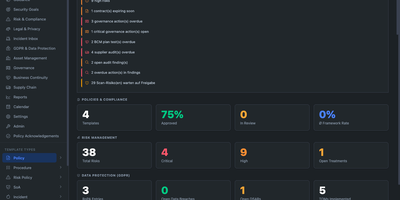
For teams that need ISO 27001, NIS2, and GDPR evidence without handing compliance data to a SaaS vendor, ISMS Builder is a self-hosted information security management system for policies, risks, assets, audits, and incidents. Compliance managers move policies from draft through review to approved and archived, and recipients confirm each one through a token link that needs no login. Security officers close gaps in a Statement of Applicability that cross-maps BSI IT-Grundschutz, NIS2, EUCS, the EU AI Act, and the Cyber Resilience Act, with ISO 27001 controls imported from their own licensed copy. Risk owners keep treatment plans, turn Greenbone and OpenVAS reports into risk drafts, and score assets for confidentiality, integrity, availability, and authenticity. Data protection officers run records of processing, processor agreements, impact assessments, data subject requests, a 72-hour timer, and a deletion log with email alerts. The CISO inbox collects incidents, including reports from a public form that needs no login, beside a 30-item NIS2 Article 21 checklist and Article 23 deadline alerts. Auditors work from a findings register, a compliance matrix, and an exportable audit log of every create, update, delete, and login. Administrators enforce TOTP two-factor sign-in, choose among German, English, French, and Dutch, run semantic search locally through Ollama, and publish approved policies to Nextcloud or ownCloud as PDFs. Running on a dedicated VPS on RepoCloud with guaranteed CPU, RAM, and SSD, full root SSH access, and a browser serial console. AGPL-3.0 licensed.
MulmoTerminal
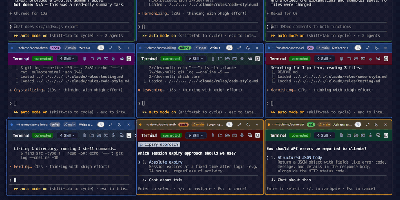
MulmoTerminal is a browser cockpit for running many AI coding agents at once, laying every session out in a color-coded grid so you can see at a glance which agents are working, which are finished, and which are sitting idle waiting on you. Each cell is a real terminal running Claude Code, Codex, Muse, GitHub Copilot CLI, Cursor CLI, Grok, or Antigravity, and its border turns amber with a chime the moment a permission prompt or question blocks progress. Zoom into one session and the cockpit roster keeps the rest in view as one-line summaries with your last prompt, the agent's latest reply, and each branch's pull request phase. Agents hand you more than text: a Canvas panel renders documents, forms, charts, and generated images they produce, while per-session context, token, and cost readouts keep spending legible. Isolate parallel work in one-click git worktrees, review the diff, then commit, push, and open the pull request without leaving the grid. Sessions persist through tmux across restarts, Web Push pings your phone when a task finishes or needs input, and per-directory themes and name badges keep a wall of agents readable. Running on a dedicated VPS on RepoCloud with guaranteed CPU, RAM, and SSD, full root SSH access, and a browser serial console. MIT licensed.
OpenAdServer
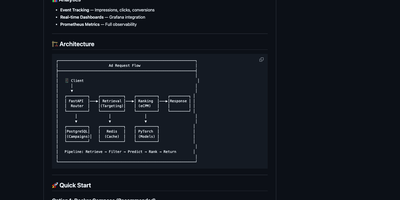
OpenAdServer runs your own ad network on your own infrastructure, ranking every request with machine-learned click predictions instead of static rotation. A request arrives with a slot, user, device, and geo context; the pipeline retrieves matching campaigns, filters them by targeting, budget, and frequency caps, predicts click probability, and ranks survivors by eCPM before responding in milliseconds. You serve banner, native, video, and interstitial formats with geo, device, operating system, demographic, and interest targeting, plus daily and hourly frequency limits per user. Budget pacing smooths delivery across the day so campaigns do not exhaust spend in the first hour. Three prediction models ship ready to train and swap without downtime: logistic regression for speed, factorization machines for feature interactions, and DeepFM for deep learning on your click logs. Automatic feature engineering processes sparse and dense fields, and hot-swapping lets a retrained model replace the live one mid-flight. Impressions, clicks, and conversions stream into event tracking, Prometheus metrics expose full observability, and Grafana dashboards visualize performance in real time. Advertisers, campaigns, and creatives are managed through CRUD APIs, and bid types cover CPM, CPC, CPA, and optimized CPM. Training scripts prepare data from your logs, train a model in a few commands, and report AUC before you promote it. Running on a dedicated VPS on RepoCloud with guaranteed CPU, RAM, and SSD, full root SSH access, and a browser serial console. Apache-2.0 licensed.
Ziit
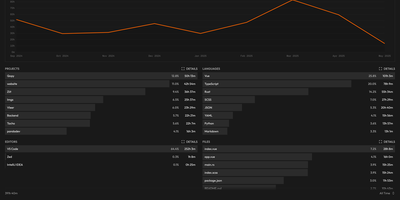
Ziit tracks where your coding hours actually go and shows the answer in a dashboard you host yourself. Install the extension in VS Code, any of its forks, or a JetBrains IDE, and every editing session streams to your instance with its project, language, editor, file, branch, and operating system attached. The dashboard filters by time range and breaks your work down by project and language, so a week of effort becomes a readable chart instead of a vague memory. You sign in with GitHub or email and password, import existing history from WakaTime or a WakAPI instance, and keep building on years of data instead of starting over. README badges embed live coding time for a project into any repository page, turning your profile into a quiet proof of work. A public stats page summarizes the whole instance, and a public leaderboard ranks who logged the most coding hours, which makes self-hosted instances double as community scoreboards. Because the server, the database, and the extensions are all yours, no third-party service sees which files you opened or how long a private project took. Teams can run one instance for everyone and compare effort across projects with the same filters. Running on a dedicated VPS on RepoCloud with guaranteed CPU, RAM, and SSD, full root SSH access, and a browser serial console. AGPL-3.0 licensed.
Shumai
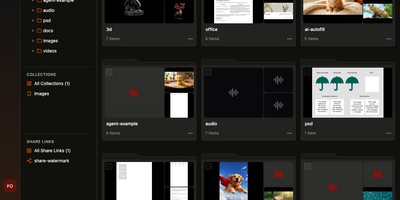
Creative teams use Shumai to review video, images, 3D models, and documents with feedback pinned to the exact frame, on a server they control instead of a rented review cloud. Pause on any frame, draw on the picture, and leave a timecoded comment with the markup attached, then let threaded replies, mentions, and resolve states carry it to a decision. Every cut stacks into a version stack, and any two versions open side by side to compare changes. Layered PSDs and camera RAW review at full resolution, 3D models spin with comments pinned to the viewing angle, and documents page through as converted PDFs. Clients open a share link with a password and expiry date, downloads switchable, and can comment as guests with no account. Watermarks render into the media on your server rather than layering in the browser, so they stay put wherever the file travels. Comments export as Premiere Pro XML, DaVinci Resolve EDL, Final Cut Pro, or Avid files with correct drop-frame timecode for the editor. Mention the AI agent in a comment and it examines the same frame under discussion, or chat privately about a folder using your own OpenAI, Anthropic, or Gemini key. Originals live on local disk or any S3-compatible bucket, with GPU transcoding and workers that scale up for a delivery and back to zero. Running on a dedicated VPS on RepoCloud with guaranteed CPU, RAM, and SSD, full root SSH access, and a browser serial console. MIT licensed.
Statewave
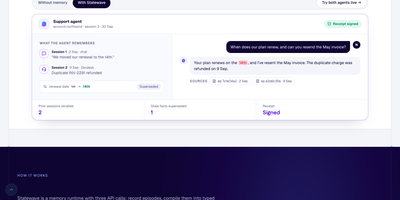
Statewave is the memory runtime that compiles what your AI agents experience into typed, provenance-tagged memories, so the same subject asked the same question receives the same context every time. Recording is append-only: your application writes events as episodes (chat, ticket, commit), and a compiler distills them into structured memories with confidence scores, each traceable to its source episodes. When an agent needs context, Statewave assembles a ranked bundle inside the token budget you set; the same request at the same moment returns identical bytes, so retrieval sampling noise never leaks into an answer. Every bundle leaves an HMAC-signed receipt that a replay endpoint can re-evaluate under the same rules. Memories carry sensitivity labels for personal data, financial details, and secrets, and YAML policies deny or redact them per tenant. One instance serves many products: tenants are isolated by header, pinned to a region for residency with cross-region requests refused, and erasable by subject on request. The default compiler runs fully local on regex heuristics with no API key, or point extraction at any of 100+ LiteLLM providers. Reach it over REST from any language, through typed Python and TypeScript SDKs, LangChain, CrewAI, and AutoGen integrations, or the built-in MCP server that lets Copilot, Claude, and Cursor share one memory. Support agents recognize returning customers across sessions, and coding agents keep project decisions between conversations. Running on a dedicated VPS on RepoCloud with guaranteed CPU, RAM, and SSD, full root SSH access, and a browser serial console. Apache 2.0 licensed.
Hasty Paste
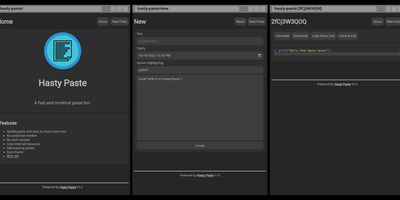
Paste some text, hit save, share the link - Hasty Paste is a fast, minimal pastebin written in Python on the async Quart framework, named, by its author's own admission, "because you use it so fast without a care in the world." No accounts, no authentication, no friction - built for the everyday case of handing a debug log, config snippet, or stack trace to someone in tech support or a chat channel. Pastes get randomly generated IDs, with an optional "long" ID mode that makes brute-force URL guessing impractical, and expiry times ensure throwaway content actually gets thrown away. Optional Pygments syntax highlighting makes code readable, a dark theme spares your eyes, and the whole interface works without JavaScript - it renders in terminal browsers and under the strictest script blockers. Storage is a custom flat-file system (no database), caching runs internally or through Redis for busier instances, and a REST API plus the companion "Hastily Paste It" CLI script enable piping command output straight into a paste from the terminal. The Alpine-based Docker image is tiny, resource usage is minimal, and the license is AGPL.
ScreenTinker
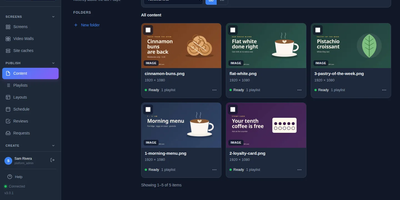
Run every TV, menu board, kiosk, and video wall from one browser dashboard with ScreenTinker, a digital signage CMS you host yourself, with no per-screen license fees. Players cover Android TV, Fire TV, Samsung Tizen, LG webOS, Amazon Vega OS, Roku, Raspberry Pi, Windows, ChromeOS, and any web browser. Upload images and video, turn each PDF page into a slide, or design animated decks in the slide editor with templates, optional voiceover, a music bed, and an optional AI designer that works from a prompt using your own model endpoint. Widgets add clocks, weather, RSS tickers, moderated social walls, live IPTV streams, and iCal or JSON data bound straight into a slide. A weekly calendar handles recurring schedules, priorities, and time zones, and Preview at shows what a given screen will play at any chosen moment. Group screens to push playlists and bulk commands, split displays into zones, or join several panels into a video wall with bezel compensation. Live remote control, CSV proof-of-play reports, and offline email alerts keep a fleet in check, while web and Android players cache content and keep playing through outages. Workspaces, six role levels, optional approval before publishing, OIDC single sign-on, white-label branding on your own domain, and a scoped REST API serve agencies and larger teams. Running on a dedicated VPS on RepoCloud with guaranteed CPU, RAM, and SSD, full root SSH access, and a browser serial console. MIT licensed.
Pagesift
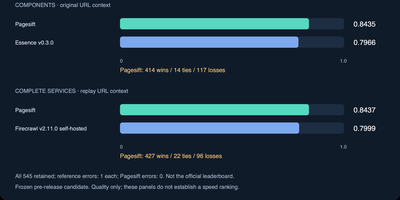
Pagesift converts messy web pages, PDFs, and Office documents into clean Markdown and structured JSON that language models can actually use, from one self-hosted binary you run yourself. Call it the way you already call Firecrawl: the HTTP API speaks the Firecrawl v1 and v2 formats, so existing scrape, crawl, and batch jobs point at your server instead, and a Jina Reader style endpoint answers simple /r/ URL requests. Scrape a single page, submit batches, or crawl whole sites with sitemap support, focused crawling by query, robots.txt respect, and per-host rate limits by default. Headless rendering kicks in only when a page needs JavaScript, keeping plain pages fast. Documents work offline too: Word, Excel, PowerPoint, EPUB, and CSV files become Markdown with titles, links, images, and publication metadata attached. Jobs persist so long crawls survive restarts, webhooks report completions, and per-API-key limits and quotas keep multi-tenant use civilized, with Prometheus metrics and a health endpoint for operators. AI agents can drive the same engine directly through the bundled MCP server over stdio or HTTP, while developers get Python, Node, and Rust libraries. Memory stays bounded under load by design, sized from container limits rather than hope. Running on a dedicated VPS on RepoCloud with guaranteed CPU, RAM, and SSD, full root SSH access, and a browser serial console. AGPL-3.0 licensed.
LLM Wiki v2
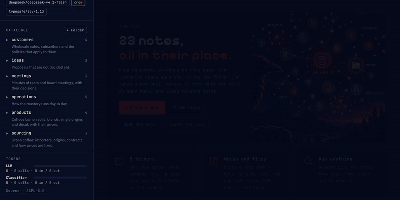
Instead of burying your documents in a vector index you cannot inspect, LLM Wiki v2 files them into a Markdown wiki you can read, browse, and question. Drop text, Markdown, or PDF files anywhere on the page and each one is catalogued automatically, filed into a folder that says what it holds, and linked to the notes it relates to. Ask a question and the answer cites the exact notes it used, with clickable sources you can open, verify, and correct. New documents update the note on their subject instead of piling up as disconnected chunks, so what you teach it stays taught. A small classifier routes filing and questions through the folder tree, keeping the wiki quick and cheap as it grows, and you can browse the tree, follow see-also links, move or delete notes, and watch the tokens spent by both the model and the classifier. Connect OpenRouter, OpenAI, Gemini, a local Ollama, or any compatible endpoint, and expose the same wiki to Claude Code or Codex as long-term memory they can recall from and write to. Because every note is plain Markdown in a folder you own, the whole knowledge base can live in git beside your other files. Running on a dedicated VPS on RepoCloud with guaranteed CPU, RAM, and SSD, full root SSH access, and a browser serial console. AGPL-3.0 licensed.
KoShelf
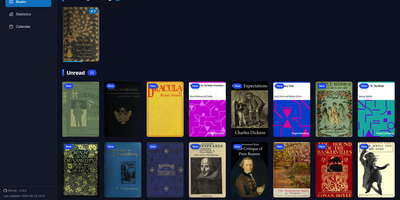
Your e-reader already knows everything about your reading life, and KoShelf turns that KOReader metadata into a beautiful dashboard you can browse from any browser. The library overview gathers currently reading, completed, and unread books and comics, while each item's page collects your highlights, annotations, ratings, and review notes in one place. Reading statistics chart your time and pages with customizable activity heatmaps and weekly breakdowns, and per-item statistics reveal session counts, average session length, and reading speed for every book. A monthly calendar shows what you read on each day, and the yearly recap celebrates completions with monthly summaries of finished items and hours read. Supported books open right inside KoShelf's own reader, with keyboard navigation, a progress scrubber, and inline highlight notes. Metadata entries survive even when the original document disappears, because library archives preserve covers and reading data until the source returns. With writeback enabled in server mode, you can edit annotations, ratings, status, and covers from the browser, protected by revision checks and recoverable backups so external changes are never overwritten blindly. Search by title, author, or series, filter by reading status, and download original files whenever you need them. Running on a dedicated VPS on RepoCloud with guaranteed CPU, RAM, and SSD, full root SSH access, and a browser serial console. EUPL-1.2 licensed.
MikroTik Manager
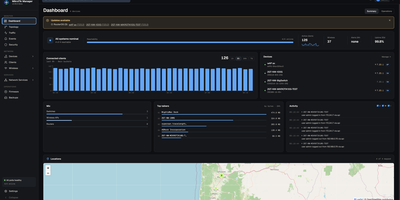
MikroTik Manager is a web control plane for whole RouterOS fleets, built so that a bad VLAN change reverts itself instead of costing you a drive to the site. Before any risky edit, Change Guard saves a restore point on the device and arms a scheduler; if a fresh connection cannot reach the router afterwards, it rolls itself back. Lockout prediction simulates each change against live device state and refuses one that would cut management access, naming the exact port and VLAN at fault. Config Health audits for settings RouterOS accepts but silently ignores. Day to day, a live dashboard tracks availability, wireless clients, and alerts delivered by email, Slack, Discord, Telegram, or ntfy. Switch faceplates, per-port client views, VLAN copy wizards, bulk SSID deployment, RF health charts, rogue AP detection, and a guest Wi-Fi captive portal wizard cover the wired and wireless side. A rule builder handles firewall and NAT, topology maps come from LLDP, CDP, and MNDP, and a built-in NetFlow collector attributes traffic to clients and applications. Firmware rolls out in canary waves that halt on failure, and every configuration snapshot supports diffs and one-click rollback. OIDC single sign-on, TOTP two-factor, role-based access, and scoped API tokens protect the console, while sites group devices per customer network. Running on a dedicated VPS on RepoCloud with guaranteed CPU, RAM, and SSD, full root SSH access, and a browser serial console. AGPL-3.0 licensed.
OneGlanse
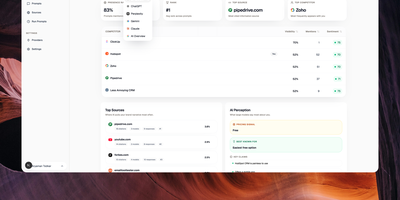
OneGlanse tracks how ChatGPT, Perplexity, Gemini, Claude, and Google AI Overview mention, rank, and recommend your brand, using the same product interfaces your customers actually see. You add your brand, competitors, and the questions buyers ask, then start prompt runs against one AI product or all five in a single pass. Every run stores the complete answer text together with the citations and source domains the answer relied on, so you can open any response later and read exactly what was said. A model you connect with your own OpenAI or Anthropic key reads each saved answer and records mentions, ranking position, sentiment, and recommendation strength. The dashboard rolls those readings up into presence rate, average rank, top source, and top competitor views that update as new runs land. Competitor tables show which rival brands appear beside you, how often they show up, and how their sentiment compares across providers. Source reports rank the publishers and pages that AI answers cite most, down to citation share per domain. Perception panels collect the claims, pricing language, and strengths that answers repeat about your brand. Self-hosted deployments schedule recurring runs, transfer your signed-in provider sessions to the server, and keep prompts, answers, and scores in your own database. Running on a dedicated VPS on RepoCloud with guaranteed CPU, RAM, and SSD, full root SSH access, and a browser serial console. MIT licensed.
MakersVault
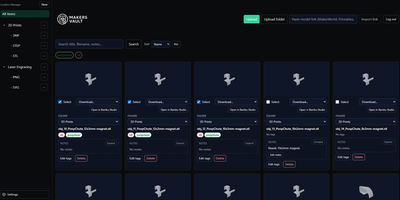
MakersVault gives your scattered 3D print files and creative artwork one searchable home, so you stop loading models into a slicer just to remember what they are. You create folders and subfolders for projects, then drag and drop single files, batches, or whole folders straight into the library from your browser. Every model tile carries a rendered preview, and double-clicking opens an interactive 3D view you can rotate and inspect before downloading anything. Tags attach to any file, batch tagging covers many selected models at once, and tag tabs plus sorting by name, size, type, or folder keep large collections browsable. Notes on individual files record print settings, filament choices, or assembly reminders right beside the model they describe. Imports pull models directly from MakerWorld, Thingiverse, and Printables links, and zip archives prompt you to keep only the files you actually want. Supporting documents ride along with each model and travel inside its ZIP downloads, and prepared print data surfaces printer, material, nozzle, and time estimates on the card. The Open in Slicer button hands a model to your configured slicer through the desktop bridge, and themes from light and dark to neon accents restyle the whole workspace. Running on a dedicated VPS on RepoCloud with guaranteed CPU, RAM, and SSD, full root SSH access, and a browser serial console. MIT licensed.
FreeFrame
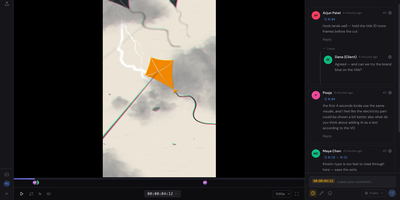
Client feedback that arrives as "the bit near the middle feels off" becomes frame-accurate when FreeFrame hosts your media review on your own server. Reviewers drop timecoded comments on the exact frame, sketch drawing annotations over the picture, and thread replies with mentions, reactions, and attachments until each note is resolved. Video streams adaptively while audio assets get waveform review, and approval workflows track every reviewer's status so a project never waits on a mystery sign-off. When a new cut lands, version compare puts any two revisions side by side or under a draggable wipe slider, playing in sync with per-side audio and offset trim while each version keeps its own comment thread. Finished notes travel back into the edit as timeline markers for DaVinci Resolve, Final Cut Pro, and Premiere Pro, or as a plain CSV, landing on the exact frames they describe. Clients never need accounts: password-protected share links with expiry dates and watermarking let them browse and comment, while you control downloads and permissions per link. Studios can white-label the whole experience with their own name, logos, favicon, and accent color across the app, share pages, and outgoing email. Running on a dedicated VPS on RepoCloud with guaranteed CPU, RAM, and SSD, full root SSH access, and a browser serial console. MIT licensed.
Tagr
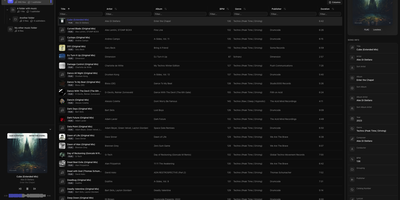
When a music library is full of wrong tags, missing covers, and blank ratings, Tagr lets you fix the whole collection from any browser, on desktop or phone. Three roles divide the work on your own server. Admins mount a music folder, press scan, and get a searchable table of every track, with sortable and filterable columns, more than 40 editable fields, and room for custom tags. Taggers make the changes: edit fields inline, swap album art, and match one song or a whole selection against MusicBrainz, ticking which fields to overwrite. Mistakes are cheap, because every edit is stored in a persistent change history with a revert action, viewable per song or per folder. Rule-based smart playlists, such as every track with an empty comment, show what still needs attention. Listeners browse and play without edit rights, using the waveform player, a Recently played view, and optional ListenBrainz scrobbling that each person connects to their own account. Supported formats include MP3, FLAC, WAV, AAC, OGG, M4A, M4B, WMA, AIFF, and Opus, with changes written straight back into the files. Swipe-friendly panels, an installable PWA, and five interface languages make the phone a comfortable place to work. Running on a dedicated VPS on RepoCloud with guaranteed CPU, RAM, and SSD, full root SSH access, and a browser serial console. AGPL-3.0 licensed.