Stars
Forks
Watchers
Developer links
Pagesift
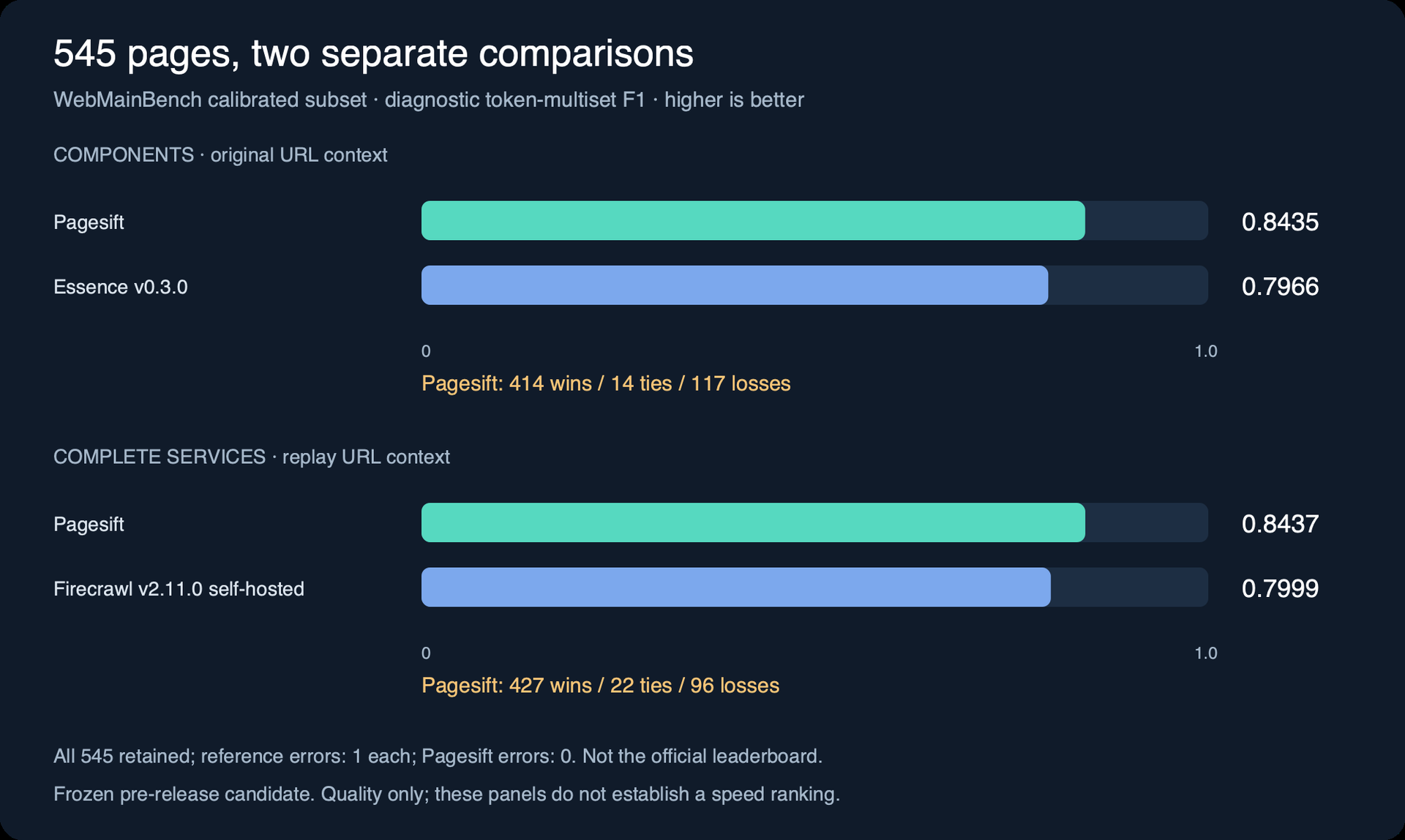
Pagesift converts messy web pages, PDFs, and Office documents into clean Markdown and structured JSON that language models can actually use, from one self-hosted binary you run yourself. Call it the way you already call Firecrawl: the HTTP API speaks the Firecrawl v1 and v2 formats, so existing scrape, crawl, and batch jobs point at your server instead, and a Jina Reader style endpoint answers simple /r/ URL requests. Scrape a single page, submit batches, or crawl whole sites with sitemap support, focused crawling by query, robots.txt respect, and per-host rate limits by default. Headless rendering kicks in only when a page needs JavaScript, keeping plain pages fast. Documents work offline too: Word, Excel, PowerPoint, EPUB, and CSV files become Markdown with titles, links, images, and publication metadata attached. Jobs persist so long crawls survive restarts, webhooks report completions, and per-API-key limits and quotas keep multi-tenant use civilized, with Prometheus metrics and a health endpoint for operators. AI agents can drive the same engine directly through the bundled MCP server over stdio or HTTP, while developers get Python, Node, and Rust libraries. Memory stays bounded under load by design, sized from container limits rather than hope. Running on a dedicated VPS on RepoCloud with guaranteed CPU, RAM, and SSD, full root SSH access, and a browser serial console. AGPL-3.0 licensed.
Benefits
- Drop-In Firecrawl API Compatibility
- Existing Firecrawl v1 and v2 clients keep working by changing the base URL, moving scraping spend and data onto your own server without rewriting integrations or learning a new request format.
- One Binary, Bounded Memory
- A single Rust binary or Docker image replaces a fleet of scraping services, sizing worker capacity from container memory limits and holding peak usage between tens and hundreds of megabytes per worker.
- Pages And Documents Alike
- Web pages, PDFs, Word documents, spreadsheets, presentations, EPUB, and CSV files all become Markdown through the same API, so document pipelines and web crawlers share one service.
- Built For Agents And Operators
- An MCP server lets AI agents scrape and crawl directly, while persistent jobs, webhooks, per-key quotas, Prometheus metrics, and health checks keep long-running production work observable.
Features
- Firecrawl-Compatible HTTP API
- Serves Firecrawl v1/v2 scrape, batch, and crawl routes plus a Jina Reader /r/ endpoint, returning Markdown, HTML, links, images, and metadata as JSON.
- Whole-Site Crawling Controls
- Crawls follow sitemaps, honor robots.txt and per-host rate limits by default, support query-focused crawling, and warn callers when results are incomplete or suspicious.
- Document To Markdown Conversion
- Reads the text layer of PDFs and Office files including DOCX, XLSX, PPTX, EPUB, and CSV, extracting main content in under a millisecond per typical page.
- Persistent Jobs And Webhooks
- Batch and crawl jobs are stored so they resume after restarts, with webhook notifications on completion and audit logs that record every fetch for later review.
- MCP Server Included
- Exposes the scraping engine to AI agents as MCP tools over stdio or HTTP, reusing the same job management as the REST API for crawl status checks.