Bookshelf
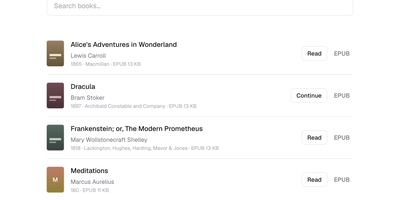
Bookshelf turns a folder of EPUBs and PDFs you already own into a private library you can browse and read from any browser, at home or on your own server. Drop books into a folder, run the sync, and the shelf appears with covers extracted, titles searchable, and accents forgiven, so typing Bronte finds Brontë. Each reader in the house gets a profile that remembers their place in every book, and picking a book up on your phone resumes where the laptop left it, with a Continue button waiting on the shelf. EPUBs open chapter by chapter instead of downloading the whole archive, and PDFs stream in small ranged reads, so even a large scanned book opens quickly. Choose a two-page spread, a single page, or continuous scroll, then set paper, sepia, or night tints for longer sessions. E-readers join through the OPDS catalog, which lets a Kobo or Kindle-side client browse and download from the same shelf. There is no database to run and no account system to manage; the library is plain files you can back up with the volume. Running on a dedicated VPS on RepoCloud with guaranteed CPU, RAM, and SSD, full root SSH access, and a browser serial console. MIT licensed.
MyCompany
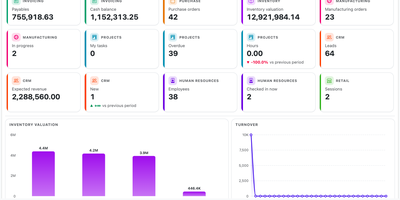
MyCompany runs the whole back office of a small business, sales, stock, production, invoices, projects, payroll, and the shop till, as one application sharing one database. A lead arrives and moves across a kanban board with calls and emails logged on its card, then becomes a sales order and an invoice without retyping a single field. Purchasing raises supplier orders, receives goods into the right warehouse, and watches stock move between locations with full movement history, reservations, lots, and serial numbers. Manufacturing plans production orders from bills of materials with operations and work centers, tracking the materials actually consumed and what each finished batch cost. Projects track tasks and time with supervisor timesheets, HR keeps employee records, hourly rates, and payslips, and the retail point of sale handles barcodes, payments, register sessions, and discounts. Because every module reads and writes the same records, the invoice knows what the warehouse shipped and the project knows what the customer was billed. When your business outgrows a standard screen, customizations live in separate extension modules, so vendor updates never collide with the workflows you adapted. Running on a dedicated VPS on RepoCloud with guaranteed CPU, RAM, and SSD, full root SSH access, and a browser serial console. Apache-2.0 licensed.
NutriTrace
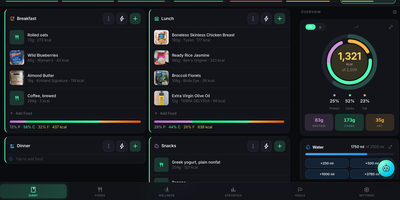
Stop handing your daily food diary, body weight history, and biometric sleep data to ad-funded fitness clouds: NutriTrace brings complete calorie, macro, micronutrient, and wellness tracking to your own server with an offline-capable web PWA and native Android app. Log meals across customizable slots using live Open Food Facts and USDA FoodData Central lookups, barcode scanning, AI nutrition label OCR, or direct recipe imports from Mealie and CookTrace. Calorie and macro targets adjust automatically through three goal engines, including an inspectable Adaptive TDEE algorithm that regresses 35 days of intake against scale weight at 7,700 kcal per kilogram. Connect Fitbit via Google Health, Garmin, Withings, and Android Health Connect to pull steps, heart rate variability, sleep stages, and body composition into unified Sleep, Readiness, and Resilience scores. An integrated Trace AI assistant and Smart Log let you log meals by voice, text, or meal photo, while the opt-in Model Context Protocol server exposes 20 read, write, and management tools to Claude Desktop, Cursor, and Codex. Multi-user households get OpenID Connect SSO and one-step migration from MyFitnessPal, Cronometer, Lose It, and Waistline. Running on a dedicated VPS on RepoCloud with guaranteed CPU, RAM, and SSD, full root SSH access, and a browser serial console. AGPL-3.0 licensed.
Noisedash
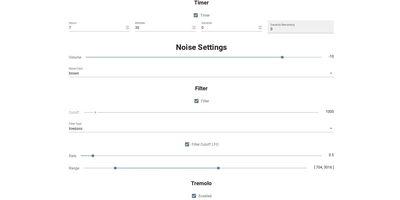
Noisedash is a self-hosted soundscape studio that generates the ambient noise you wish your surroundings made, from steady fan hums to layered rainstorms, and plays it in any browser. Start from white, pink, or brown noise and shape it with filters, LFOs, and effects until the hum in your head goes quiet. Upload your own recordings of rain, wind, thunder, or a café at noon, set loop points and fade-ins, and drop them into the mix as a continuous bed or an occasional sprinkle. Add reverb to a sample, let a thunderclap wander in every few minutes instead of looping, and balance every layer until the room feels right. Save the result as a noise profile, keep one for sleeping and another for deep work, and switch between them with a tap. Profiles travel: export one to share with a friend, import theirs, or record the generated audio to take the soundscape somewhere else entirely. An instance can host the whole household, with admin tools managing users, and the interface works as happily on a phone beside the bed as on a desktop. Running on a dedicated VPS on RepoCloud with guaranteed CPU, RAM, and SSD, full root SSH access, and a browser serial console. AGPL-3.0 licensed.
QuickStack
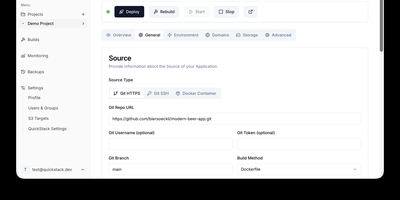
QuickStack transforms your standalone Linux server or cluster into a self-hosted platform-as-a-service that automatically compiles, deploys, and monitors full-stack applications and relational databases without vendor lock-in. Developers can trigger instant deployments directly from public or private Git repositories, upload custom Dockerfiles, or pull container images straight from private registries with automated webhook synchronization. The built-in application catalog enables one-click provisioning of production databases including PostgreSQL, MySQL, MariaDB, MongoDB, and Redis with preconfigured internal network isolation. Administrators can route traffic across custom domains with automated Let's Encrypt SSL certificate issuance, inspect real-time CPU and memory telemetry, stream container runtime logs, and launch in-browser web terminals. Teams can configure granular role-based access controls with single sign-on authentication, establish zero-trust ingress and egress network security policies, and orchestrate automated volume snapshots directly to S3 object storage. When infrastructure requirements expand, operators can attach additional worker nodes using lightweight join tokens to distribute workloads seamlessly across high-availability compute pools. Running on a dedicated VPS on RepoCloud with guaranteed CPU, RAM, and SSD, full root SSH access, and a browser serial console. GNU GPL v3.0 licensed.
MiroTalk WebRTC
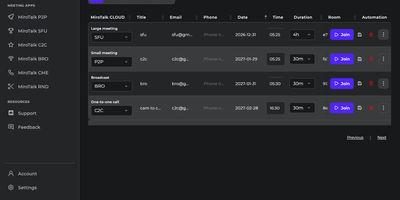
MiroTalk WebRTC is the front desk for your own video meeting platform, where users register, schedule rooms across your MiroTalk servers, and invite guests by email or link. Each account gets a personal dashboard of upcoming, recurring, and past meetings, with room links ready to copy the moment a call needs to happen. Scheduling works for the whole MiroTalk family, SFU group calls, P2P chats, and broadcast or direct-call rooms, so one calendar front door serves every meeting style you run. Invitations travel by email or plain shareable links, and guests join from any modern browser with no account and no downloads. Turn on SaaS mode and the same platform sells access, with monthly, annual, and lifetime plans handled by Stripe checkout and webhooks while free mode stays completely open. A documented REST API lets your own systems create rooms and manage users, and the official Docker image with MongoDB gets the whole front desk online in minutes. Running on a dedicated VPS on RepoCloud with guaranteed CPU, RAM, and SSD, full root SSH access, and a browser serial console. AGPL-3.0 licensed.
Lyftr
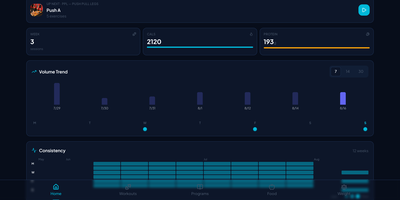
Lyftr delivers a self-hosted workout and nutrition tracker that runs on a small VPS — no subscriptions, no vendor lock-in, no "export is a Pro feature" paywalls. The Go backend with Gin framework provides JWT authentication and a REST API while storing everything in a single SQLite database file you can back up with one copy command. The exercise library ships with 800+ movements auto-seeded on first run, letting you build reusable workout programs with target sets, reps, and weights from day one. Active workout mode provides a guided set-by-set flow through your session while Gym Mode offers a full-screen card layout showing one exercise at a time with an integrated rest timer for focused training. The React frontend built with TypeScript and Tailwind delivers a mobile-first interface featuring a dashboard with weekly session KPIs, daily calorie and protein tracking, 12-week consistency heatmap, volume trend charts, and muscle balance visualization with sparklines. Nutrition tracking connects to Open Food Facts for food search with camera-based barcode scanning, logging calories and macros across customizable meal sections. Bodyweight logging with trend graphs supports both lbs and kg units across all data. An Android APK connects to your self-hosted instance for native mobile access. Running on a dedicated VPS on RepoCloud with guaranteed CPU, RAM, and SSD, full root SSH access, and a browser serial console. MIT licensed.
Nora
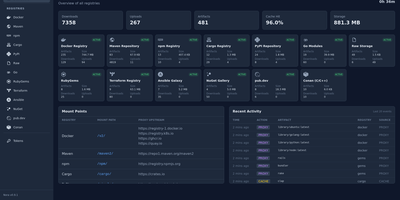
Public registries rate-limit your CI, log every pull, and pick the worst moment to go down; Nora replaces that dependency with a self-hosted artifact registry that hosts and caches seventeen package formats behind a single address. Point Docker, Maven, npm, pip, Cargo, and eleven other clients at one endpoint, and Nora serves your private artifacts while transparently caching upstream packages fetched from Docker Hub, Maven Central, npmjs, and crates.io. Each base image or library downloads once and is then served locally, so builds get faster, stop tripping rate limits, and survive upstream outages. Curation rules decide what is allowed to reach your builds: allowlists and blocklists filter packages by name, minimum release-age rules hold back freshly published versions, and new digests can wait in quarantine until approved. Anything you publish keeps its name: a hosted package is never silently replaced by an upstream package sharing it. Pipelines publish without stored secrets through OIDC identity from GitHub Actions and GitLab CI, and API tokens with read, write, and admin roles cover the rest. A web dashboard shows downloads, cache hit rates, storage usage, and recent activity for every registry, and audit logs plus Prometheus metrics feed your monitoring. For disconnected networks, a mirror command prefetches whatever your lockfiles name, an import tool migrates Artifactory or Nexus repositories, and backup and restore keep a spare copy. Running on a dedicated VPS on RepoCloud with guaranteed CPU, RAM, and SSD, full root SSH access, and a browser serial console. MIT licensed.
ShopNex
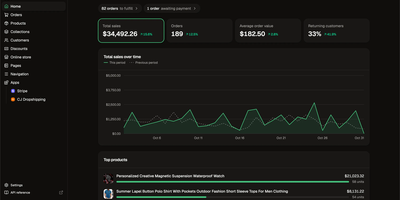
ShopNex is a self-hosted ecommerce platform that gives merchants a browser admin, themeable storefront, hosted checkout, and app integrations without paying a platform subscription or per-sale software fee. You manage products with options, variants, SKUs, stock per variant, collections, product images, and clean URLs, then sell through a bundled Astro storefront using Liquid themes or a custom frontend connected to the typed Storefront SDK. The hosted checkout collects shipping rates, manual payment methods, discount codes, and Stripe Checkout payments, while order records keep payment and fulfillment status, shipping lines, transactions, and price snapshots separate for clean operations. Customer accounts and guest orders are matched by email, staff access is invite-only with owner, admin, and staff roles, and discounts, shipping, taxes, and store settings are controlled from the admin. Integrations receive signed Standard Webhooks with retries and admin redelivery, scoped API tokens grant only the resources an app needs, and OAuth apps clean up tokens and webhooks when uninstalled. You can run one shop by default or switch to multi-shop by domain without migrating data, and every admin and storefront procedure is also exposed as REST under /api/v1 with a live OpenAPI document. Running on a dedicated VPS on RepoCloud with guaranteed CPU, RAM, and SSD, full root SSH access, and a browser serial console. MIT licensed.
House Planner
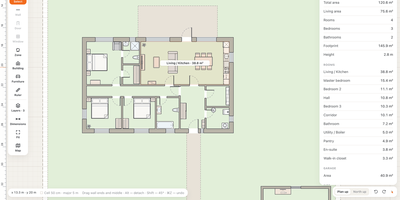
House Planner holds the design of your house in one browser workspace, from true-scale floor plans drawn over a satellite photo of your plot to costed wiring, plumbing, sewer, and heating layouts. Draw walls at true scale in millimetres with thickness and materials, add doors, windows, garage gates, and furniture with true dimensions, and watch room areas and plot coverage total as you work. Flip into 3D for a massing model or the house finished with material textures and facade colours, with cut-down walls for reading the layout from above. Every utility network gets an engineering layer: route sewer lines to a septic tank with slopes and cleanouts, auto-route electrical circuits with breaker and voltage-drop checks, and run water piping from well and boiler to each fixture. Underfloor heating loops lay out room by room, split before 80 metres, and balance flow against heat loss. The bill of materials computes quantities from the plan and networks, producing a priced estimate you can print, tick off as you buy, or export to CSV. Every save is a numbered version with restorable snapshots, tabs cannot overwrite each other, and the JSON plan can be edited by an AI assistant through the same API. One password guards the project, phones get a read-only view for on-site checks, and the whole thing runs in one Docker container with no database. Running on a dedicated VPS on RepoCloud with guaranteed CPU, RAM, and SSD, full root SSH access, and a browser serial console. MIT licensed.
LaraOwl
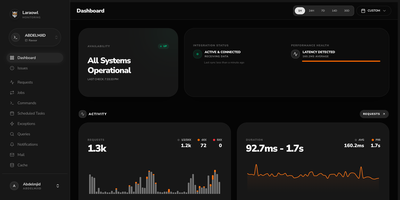
LaraOwl watches your Laravel applications from your own server, streaming every request, exception, slow query, and attack attempt into one live dashboard. Install one Composer package in each app, point it at your LaraOwl server, and requests arrive with method, path, status, duration, and middleware timing attached. Exceptions group themselves by fingerprint with stack traces, occurrence counts, and first and last seen times, so a resolved bug that comes back announces itself. Slow queries and N+1 patterns are flagged with execution times, jobs report failures and retries, and scheduled tasks check in like heartbeats that complain when they stop. A built-in security lens scores threats such as SQL injection, cross-site scripting, and path traversal, tracks hostile IPs, and can push a block into your Cloudflare firewall in one click. Uptime checks run every thirty seconds, alerts fan out to Slack, Discord, Telegram, email, or any webhook, and throttles keep a bad night from becoming a thousand messages. Teams organize multiple projects with their own tokens, thresholds, and retention policies, and daily pruning keeps last quarter's noise from filling the disk. Running on a dedicated VPS on RepoCloud with guaranteed CPU, RAM, and SSD, full root SSH access, and a browser serial console. Apache-2.0 licensed.
PicPeak
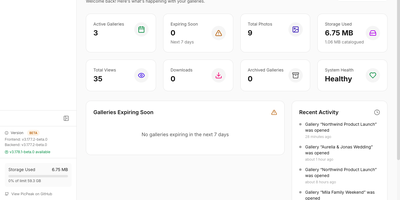
PicPeak is a self-hosted gallery platform where photographers deliver event photos to clients through private, branded links that expire on their own schedule. Every gallery gets a share link, an optional password, and a QR code that exports as PNG, SVG, an A6 table card, or an A4 poster, so a reception can put the gallery on every table. Guests browse in one of seven layouts, from grid and masonry to carousel and timeline, and react with likes, favorites, star ratings, comments, emoji reactions, or color labels. For a party, open the gallery to guest uploads, hold the finished edit back with Reveal Mode until a scheduled moment, and put the optional Live Slideshow link on a projector so new photos appear as they arrive. Theme presets, custom colors, logos, fonts, CSS, and CMS pages keep the studio's brand in front, while bulk ZIP downloads, capped download sizes, watermarking, and right-click blocking control what guests take home. An analytics dashboard tracks views, unique visitors, and downloads. Beta modules add face grouping that runs in a separate container on your own server, plus quotes, contracts, invoices, and customer accounts for studios. Media sits on local disk or any S3-compatible bucket, OIDC single sign-on lets a team log in through an identity provider, and API tokens and webhooks connect PicPeak to automations. Running on a dedicated VPS on RepoCloud with guaranteed CPU, RAM, and SSD, full root SSH access, and a browser serial console. MIT licensed.
MindRoom
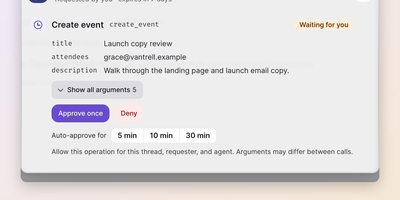
Your team's group chat could have a colleague who has read every email, ticket, and document, remembers all of it, and answers in seconds; MindRoom puts AI agents like that into your chat rooms as full participants. Each agent is a real user on the open Matrix protocol, so you talk to it in MindRoom Chat on web or mobile, in any other Matrix client, or through bridges in Slack, Telegram, WhatsApp, and Discord. Give every agent its own model: a local model for private rooms, a frontier model for hard coding problems, and switch per room or thread whenever the work changes. Agents connect to more than 100 tools, including Gmail, calendars, GitHub, Google Drive, Home Assistant, and any MCP server, and they search your own documents and knowledge bases for answers with sources. Memory persists across conversations and platforms, so an agent remembers people, preferences, and project context months later and can turn repeated work into reusable skills. Before an agent sends an email or runs a command, an approval card shows exactly what will happen; you tap once to allow it, and sandboxed workers keep executed code away from your credentials. Schedule morning briefings, silent inbox checks, and recurring digests in plain language, or wake an agent from any other system with a single HTTP request. Running on a dedicated VPS on RepoCloud with guaranteed CPU, RAM, and SSD, full root SSH access, and a browser serial console. Apache-2.0 licensed.
LightPost
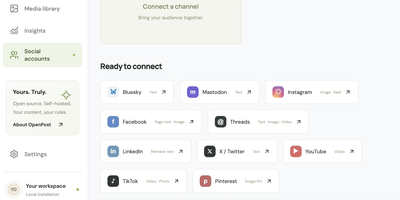
Write a post once in LightPost and it goes out to Bluesky, Mastodon, X, Instagram, Threads, Discord, LinkedIn, Telegram, and Facebook Pages on your schedule, with YouTube video uploads handled in the same workspace, from a dashboard running on your own server. The composer fans one message out to every connected account, including several accounts on the same platform, and each destination can receive text, images, or both within that network's limits. Drafts can be saved, edited, and duplicated, and scheduled times follow your browser's timezone so a week of announcements can be queued in one sitting. Images come in from public JPEG links or a saved library, with alt text and a preview before anything ships. Every delivery is tracked per account with links to the published posts, and when one network fails you retry just that destination instead of blasting the successful ones twice. The queue persists across restarts and overdue posts resume on their own, so an overnight reboot never eats a scheduled campaign. Built-in setup guides walk you through eligibility, credentials, and permissions for each platform, account connections can be verified or reconnected from the same panel, and your credentials stay encrypted on your disk with optional password protection and exportable post history. Running on a dedicated VPS on RepoCloud with guaranteed CPU, RAM, and SSD, full root SSH access, and a browser serial console. MIT licensed.
Redd-Archiver
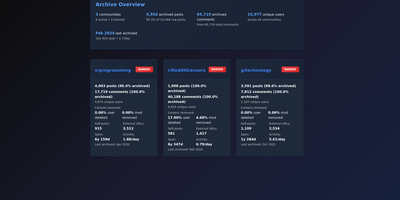
Redd-Archiver builds you a private, permanent copy of Reddit's history: feed it public data dumps and it returns a browsable, full-text-searchable archive of the communities you choose. The source material is enormous and already public: the full Pushshift and Arctic Shift Reddit datasets hold over 2.38 billion posts from 40,000 subreddits, the complete Voat archive adds 3.81 million posts, and Ruqqus contributes another half million, all importable by community instead of wholesale. One import into PostgreSQL becomes three possible websites: a static export that runs on any host down to a USB stick, the default hybrid of static pages plus a live search server, or a fully dynamic site that renders straight from the database with flair, domain, score and date filters. Search understands keywords, subreddit, author, date and score operators, and the same archive answers scripts and AI agents through thirty-plus REST endpoints and an MCP server with 29 tools. Monthly Arctic Shift dumps keep everything current: updates import only your tracked subreddits, skip themselves by checksum when re-run, refresh scores, and never let a later deletion overwrite text you preserved. Subreddit rules, descriptions and wiki pages ride along with the posts, eleven themes restyle the result, and the whole thing can hide behind a Tor hidden service or stand on HTTPS with its own domain. Running on a dedicated VPS on RepoCloud with guaranteed CPU, RAM, and SSD, full root SSH access, and a browser serial console. Unlicense licensed.
Jetlog
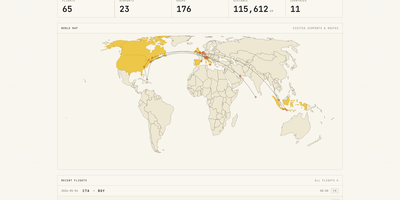
A personal flight logbook you host yourself, Jetlog draws every route you have flown on a pannable world map and turns the totals into charts. The home page opens with counts of flights, airports, hours, distance, and countries above that map, where dots mark visited airports and lines trace each trajectory. Settings let markers and lines grow with visit frequency and shade the countries where you have landed. Logging a flight takes only two airports and a date. Type a flight number and press Fetch to pre-fill the origin, destination, and airline, and a utility links connection flights automatically. Duration and distance are calculated for you and stay editable, with an option to use airport time zones. The All Flights table lists route, times, duration, distance, seat, class, and airline with filters and configurable columns, and each flight opens a detail page with airport data, a route map, tail number, and aircraft. A Statistics page charts flights per month, cumulative distance, most visited airports, most common airlines, ticket class, and seat for any time frame. History arrives through MyFlightRadar24 or custom CSV imports and leaves as CSV or iCal. Family members can share one install with separate logbooks, an admin manages the accounts, and the responsive layout works on a phone at the gate. Running on a dedicated VPS on RepoCloud with guaranteed CPU, RAM, and SSD, full root SSH access, and a browser serial console. GPL-2.0 licensed.
HabitSync
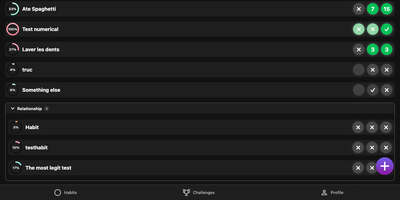
HabitSync treats habit tracking as a team sport, because willpower alone rarely survives February. Set each habit up the way life actually works: daily, weekly, monthly, on chosen weekdays, or at a custom interval, with a target value to reach or a ceiling to stay under for the habits you are trying to quit. Logging takes one tap, or a long press when today's effort deserves a custom number or a stopwatch. Share a habit with a partner, a sibling, or the whole household and everyone's progress sits side by side, which turns "did you go to the gym" into a question the dashboard answers. Monthly challenges raise the stakes with community voting, leaderboards, and medals for the top performers, while gentle automation watches your back: scheduled reminders when a habit goes unlogged, an alert when your completion slips under a threshold, and a quiet nudge when a friend overtakes you. Years of Loop Habit Tracker history import instead of being abandoned, and the installable web app keeps the streak one tap away on any device. Running on a dedicated VPS on RepoCloud with guaranteed CPU, RAM, and SSD, full root SSH access, and a browser serial console. BSD-3-Clause licensed.
Aurelio Finance
Your net worth is scattered across banks, brokers, a pension, and a mortgage, and no single screen shows all of it at once. Aurelio Finance gathers those pieces on your own server: record each institution's cash and holdings as dated situations, then let later transactions roll them forward so today's balance always traces back to a photograph of what you held and the events after it. Every position is priced from the market with its cost basis, gain, and dividends, while the look through view opens your ETFs and funds to show real exposure by country, sector, company, and currency, so overlapping funds stop hiding concentration. Recurring investment plans, homes and other real assets, and the loans against them sit beside income, expenses, and your savings rate, and each financial goal shows the return it needs to be reached. When you want a second opinion, Ask Aurelio reads your own records, can search the web, and proposes changes as cards you confirm or reject, never silently editing your data. Its analysis mode goes further, letting an analyst and a confidant argue over your portfolio before a synthesis tells you what to look at first, and surviving ideas land on a watchlist that your totals never count. Running on a dedicated VPS on RepoCloud with guaranteed CPU, RAM, and SSD, full root SSH access, and a browser serial console. MIT licensed.