NitroMTA
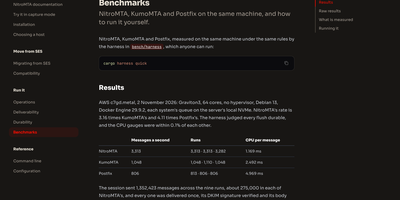
Your application already knows how to send mail through Amazon SES; NitroMTA lets it keep that code, change the endpoint and keys, and deliver from IP addresses you actually control. The engine answers a submission only after the message is committed to disk, so accepted mail survives a crash, a power cut, and even the loss of its host when the disk survives. Capture mode runs the whole engine locally and shows each message in a browser at port 9090 instead of sending it, which makes testing painless before any DNS exists. Out in production, new IPs warm up receiver by receiver from fifty messages a day, rising after clean days and backing off when complaints, bounces, or throttling climb. Each provider gets its own connection limits and cooldowns, hard bounces and spam complaints suppress the address automatically, and outgoing mail is DKIM-signed and sent over TLS with MTA-STS and DANE verified where published. Templates, identities, configuration sets, tenants, dedicated IPs, and SES-shaped events through an SNS subset cover the SES surface your tooling expects, and a CLI explains why any given message is still waiting. Running on a dedicated VPS on RepoCloud with guaranteed CPU, RAM, and SSD, full root SSH access, and a browser serial console. Apache-2.0 licensed.
OpenArtifact
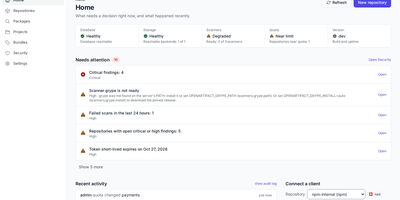
One registry for every package your builds produce: OpenArtifact stores and serves 23 artifact formats behind a single URL scheme and permission model on infrastructure you control. Create hosted repositories for the packages you publish, proxy repositories that cache upstream registries and keep serving when they go down, and group repositories that merge members in order behind one address. Point Maven, npm, PyPI, Docker and OCI clients, Helm, Cargo, NuGet, Go, RubyGems, Debian, RPM, and a dozen more tools at it with their native protocols, no plugins or wrappers. Control who can publish and pull with users, groups, permission targets, and API tokens, sign people in through OIDC or SAML single sign-on, and give CI tokenless login through OIDC token exchange. Scan what you store: software bills of materials in CycloneDX and SPDX, vulnerability findings from OSV, Trivy, and Grype, license compliance checks, and secret detection run against your artifacts. Set cleanup policies and storage quotas so old snapshots stop eating disk, attach custom properties to artifacts, and promote release bundles through your pipeline stages. Store blobs on a local filesystem, S3, Google Cloud Storage, Azure, Garage, SeaweedFS, or an OCI registry, federate selected formats between instances, and import an existing Nexus or Artifactory server with the oa command line tool. Running on a dedicated VPS on RepoCloud with guaranteed CPU, RAM, and SSD, full root SSH access, and a browser serial console. AGPL-3.0 licensed.
FlecBlog
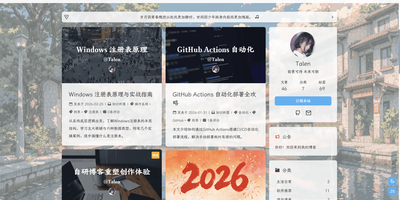
FlecBlog is a complete blogging system for people who want their own corner of the web to look considered, not cobbled together. Readers get a fast public site with server-rendered pages that search engines can actually read, per-article sharing cards, a sitemap that updates itself, and a feed for subscribers who still use readers. Writers get a separate admin console with a Markdown editor that previews as you type, syncs scrolling between the panes, uploads a pasted image without a detour, and estimates reading time while counting words. Posts can carry custom blocks like callouts, tabs, collapsible panels, link cards, and photo walls, so tutorials and essays do not all flatten into the same shape. The dashboard turns your archive into charts: visit trends by day or month, category breakdowns, a tag cloud, and a contribution calendar of your writing streak. Comments support guests and signed-in readers with nested replies and emoji, friend links handle the blogroll exchange, and short moments publish the small updates that are not full articles. Running on a dedicated VPS on RepoCloud with guaranteed CPU, RAM, and SSD, full root SSH access, and a browser serial console. MIT licensed.
Jellydash
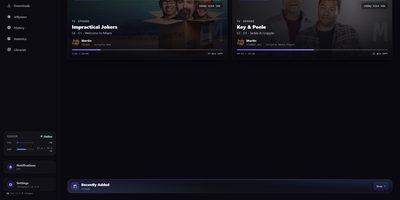
Jellydash answers the questions every Jellyfin admin asks, starting with who is watching right now and whether that stream is transcoding. Live cards show each session's artwork, user, quality, progress, and playback method, including the reason a transcode was needed, and live TV channels appear with real program progress. Behind the scenes, a background poller records every play even when nobody has the dashboard open, building a history you can search, filter by user or library, and export to CSV with poster art intact. Older Jellyfin or Emby Playback Reporting backups import in seconds, so years of viewing are not lost when you switch. Statistics turn that history into watch-time trends, top users, device and client activity, codec breakdowns, and transcode reasons, and clicking a chart opens the exact plays behind it. A monthly recap looks back at a finished month with rankings and daily activity, while trending and all-time most-watched strips show what your household actually loves. Optional pages follow Jellyseerr requests as they arrive and read the status of SABnzbd, qBittorrent, Transmission, Deluge, and NZBGet clients without ever touching their queues. Server activity, maintenance tasks, and system status stay one click away, and selected users can be excluded from monitoring entirely. When someone presses play, a notification can reach your phone through Telegram, Pushover, Discord, ntfy, Gotify, or Web Push. Running on a dedicated VPS on RepoCloud with guaranteed CPU, RAM, and SSD, full root SSH access, and a browser serial console. MIT licensed.
LinkSift
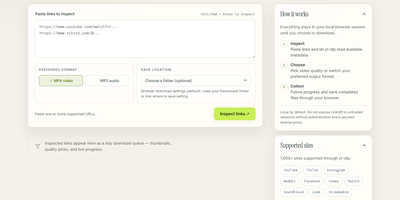
LinkSift is a self-hosted media downloader that turns pasted links into finished MP4 or MP3 files through a calm browser queue you run on your own server. Paste one URL or a whole batch and it first inspects the metadata, showing titles and available qualities before a single byte of media moves. You pick MP4 or MP3, choose the video height the source actually offers, and can even request both outputs from the same link, in which case the audio is extracted from the downloaded video instead of fetched twice. Every job reports its phase, percentage, downloaded bytes, speed, and ETA live, including real encoding progress while the audio is being packaged. Reloading or reopening the tab restores the queue exactly where it was, because a running server job is never re-submitted or cancelled by a closed browser. Finished files save through the normal browser download flow, or into a folder you pick in Chromium-based browsers. A configurable concurrency limit keeps a long batch from saturating your connection, and light, dark, and system themes keep long queues easy on the eyes. There is deliberately no account system or telemetry, so the queue stays a private tool on your network. Running on a dedicated VPS on RepoCloud with guaranteed CPU, RAM, and SSD, full root SSH access, and a browser serial console. MIT licensed.
Overclick
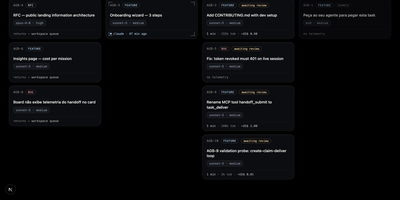
OverClick is the task board where your AI agents clock in: you write the assignments, they claim the work, and you stamp what actually got done. A card here is a contract, not a ticket: what should happen, why it matters, and a plain-language test script that says how to confirm it, all written before anyone starts. You tell your agent to grab the next task, and it claims the card over MCP, declares the CLI and model it really runs on, receives a self-contained briefing with the mission context and branch convention, and the card slides into progress. When it finishes, the handoff lands with a summary, evidence, branch and pull request links, and measured telemetry, the tokens per model and minutes the run actually took, read from the session transcript rather than guessed. Every card keeps three roles straight, who asked, who executed, and who reviews, and only a human can mark it validated; reopening with a comment puts your note in front of the agent's next claim. Big decisions can start as RFC cards whose approval spawns the execution cards, and insights roll up what each project, mission, and model consumed. Running on a dedicated VPS on RepoCloud with guaranteed CPU, RAM, and SSD, full root SSH access, and a browser serial console. MIT licensed.
PNLCS
Hosting companies sell, invoice, provision, and support hosting, domains, SSL certificates, and VPS servers from PNLCS, a free self-hosted billing platform with one client portal at the center. Customers browse your catalog, configure services, apply coupons, and check out, and the moment an order is paid a server module creates the account or machine on Panelica, cPanel, Plesk, DirectAdmin, HestiaCP, Proxmox VE, or Vultr. Renewals then run themselves: invoices are generated ahead of the due date, stored cards are charged with retries, reminders and late fees follow, and unpaid services suspend automatically and restore themselves once payment lands. Domain registration, transfers, renewals, WHOIS and EPP codes, and SSL issuance run through the same checkout, while customers manage their actual hosting from the portal itself, including files, mailboxes, databases, FTP accounts, subdomains, DNS records, cron jobs, and backups. Eight payment gateways share one engine, so partial payments, refunds, and credit balances behave the same everywhere. Support tickets route by department with priorities and attachments, a searchable knowledge base deflects repeat questions, and affiliates track referrals and commissions. Operators get revenue dashboards, client management with impersonation, bulk invoicing and mail, and twenty-seven reports covering income, MRR, churn, domains, and tax, all in thirty languages and sixteen themes. Running on a dedicated VPS on RepoCloud with guaranteed CPU, RAM, and SSD, full root SSH access, and a browser serial console. MIT licensed.
JSPWiki
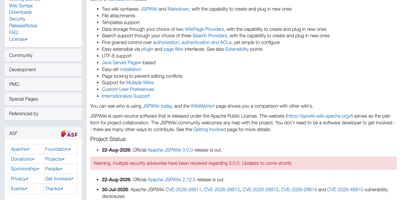
Knowledge scattered across chat threads, tickets, and shared drives gets one permanent, searchable home in JSPWiki, a wiki engine that any team member can edit from the browser. Pages can be written in classic JSPWiki markup or in Markdown, and new syntaxes plug in alongside. Every page carries its own history through the versioning file provider, so edits can be compared and rolled back, and page locking keeps two editors from colliding. Files attach directly to pages, templates restyle the whole wiki, and three interchangeable search providers, including full-text indexing, make old decisions findable again. Access stays precise: authentication and per-page access control lists decide who can view or edit each page, which suits mixed audiences of staff, partners, and the public. Plugins and page filters extend rendering with dynamic content, and one installation can host multiple separate wikis for different teams. Readers get custom preferences and internationalized interfaces. Run it as a WAR on Tomcat or pull the Docker image and open port 8080. Running on a dedicated VPS on RepoCloud with guaranteed CPU, RAM, and SSD, full root SSH access, and a browser serial console. Apache License 2.0 licensed.
Revel
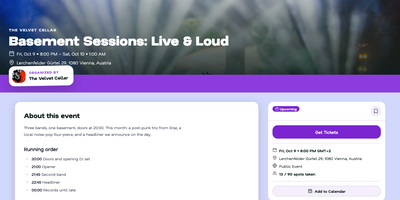
Yoga studios, comedy clubs, choirs, and bands use Revel to sell tickets, memberships, and season passes from their own server with no platform fee. Studios and clubs sell monthly or yearly memberships through Stripe and offer series passes that cover a class pack, a course, or a season, with wallet cards that a door scan verifies. Venues design seat maps with sectors, individual seats, and accessible seats, and buyers pick seats on an interactive map while the seats are held at checkout. Bands and DJs sell their own shows with no promoter in between, set pay-what-you-can tiers, open presales to invitation-link holders, and export every buyer's name and email. Communities that vet who comes screen requests with questionnaires reviewed automatically, manually, or both, and keep private guest lists, invitation-only events, and a fuzzy-matched blacklist. Buyers check out a multi-tier cart without an account, using discount codes and fixed-price, free, or pay-at-the-door tiers. Tickets arrive as QR PDFs or Apple Wallet and Google Wallet passes, and door staff check guests in by scanning. Organizers run waitlists with time-limited offers, announcements, reminders, and a Telegram bot for RSVPs and invitations. Revenue and VAT reports export as XLSX or PDF, and VIES checks buyer VAT IDs. The web app speaks English, German, Italian, French, Spanish, and Portuguese. Running on a dedicated VPS on RepoCloud with guaranteed CPU, RAM, and SSD, full root SSH access, and a browser serial console. MIT licensed.
ENZO
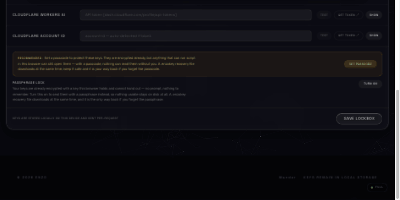
ENZO is a self-hosted AI workspace where you bring your own provider API keys and chat with more than 300 models from nine providers in one streaming interface with normal, thinking, research, and coding modes. You describe an agent in plain English and a two-pass builder drafts its full operating manual, picks the tools the task needs, and keeps improving from your activity through a per-agent neural layer you can inspect. Seventy-four bundled skills give agents ready-made domain playbooks, and a skill editor lets you write your own. Agents can read Gmail, check Calendar, search the web, and run a deep-research loop that writes its own queries under hard budgets so it cannot burn your key. Coding mode writes a multi-file project, boots it, and previews it live while telling you when something is broken. A unified model marketplace compares providers with live health checks, download counts, and benchmarks, and a built-in music player streams songs with a five-band equalizer. Your keys stay sealed in a passphrase-encrypted browser vault and travel only to the provider you picked, so there is no ENZO account, usage meter, or subscription taking a cut. Running on a dedicated VPS on RepoCloud with guaranteed CPU, RAM, and SSD, full root SSH access, and a browser serial console. Apache-2.0 licensed.
ADHDev
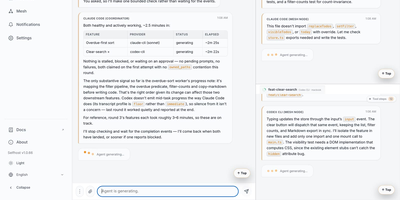
Your laptop, a desktop, and a build box each have a coding agent installed, and until now nothing has coordinated them. ADHDev is a self-hosted control plane that puts Claude Code, Codex, Kimi, Cursor CLI, Antigravity CLI, Grok CLI, and OpenCode behind one shared task queue and one web and mobile dashboard. Machines pair directly with an address and a one-time code on your own network, and a mesh binds to a single repository. Idle nodes claim tasks themselves. Dependencies order the queue, retries absorb failures, and missions group the work that belongs together. Every task gets an isolated git worktree the moment it starts. Agents build in parallel without touching each other's files, and the coordinator's prompt is rendered from live mesh state at launch, with events pushed in as they happen. Difficulty tags route easy work to cheap models and hard work to strong ones. The dashboard also reads how much of each subscription window remains, skips plans that are nearly empty, and shows the routing forecast before anything runs. Finished work enters the Refinery. Your repository's gates decide, the branch is rebased onto main, and the merge happens only when main has not moved, followed by automatic worktree cleanup. Running on a dedicated VPS on RepoCloud with guaranteed CPU, RAM, and SSD, full root SSH access, and a browser serial console. AGPL-3.0 licensed.
Trina AX
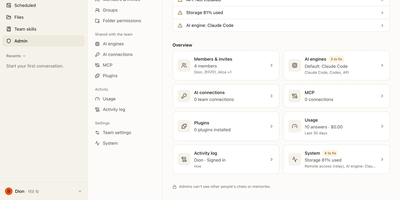
Trina AX is a self-hosted AI workspace where your team chats with real Claude Code and Codex agents that work from your company's own folders, so answers arrive in your formats, with your figures, in your house style. Picture the first morning of a new hire: she asks for a client proposal, and the draft that comes back already reads like the team lead wrote it, because the agent found the same templates and numbers everyone else uses. Admins stock shared, group, and project folders once; everyone else just opens a browser chat on desktop or phone and asks. Nothing leaks sideways in the process, since every file an agent opens is permission-checked as the person asking, and a folder someone cannot see does not exist for their agent in answers, search, previews, or trash. The know-how that makes answers sound right becomes SKILL.md playbooks, governed like ordinary files, and the agent asks a person before editing one. Agents can run up to 150 tool rounds per answer, search the web, spawn sub-agents, and follow scheduled tasks, while admins read an activity log of files touched, never the private conversations themselves. Bring the company Claude or OpenAI account, set per-person usage limits, or route through an Anthropic-compatible gateway to models such as DeepSeek, Kimi, or GLM. Running on a dedicated VPS on RepoCloud with guaranteed CPU, RAM, and SSD, full root SSH access, and a browser serial console. AGPL-3.0 licensed.
Subpool
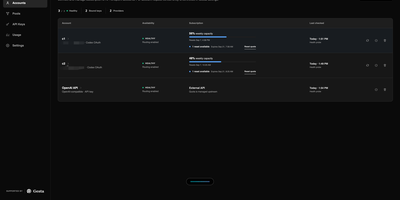
Your company pays for AI subscriptions nobody can see, scattered across personal accounts and team plans, and Subpool is the self-hosted control plane that pools that authorized capacity and hands every employee one key with limits you govern. Administrators combine subscription and API accounts into pools behind a single managed endpoint, then allocate employee-specific keys across whichever provider accounts are healthy. The console watches account health, remaining subscription capacity, and when each plan window resets, and routing prefers subscription capacity first, falling back to paid API accounts under the very same employee key when a window runs dry. Rate-limit, expire, or revoke any person's access independently, and keep every key-to-account assignment visible and auditable instead of buried in a shared credential nobody can trace. The employee API speaks OpenAI-compatible Responses and Chat Completions, so existing tools point at your pool unchanged, while aggregate input and output token telemetry is tracked per key in provider-native units. For OpenAI accounts, a Costs API estimate shows the remaining grant balance; Bailian Token Plan accounts display their five-hour, weekly, or monthly quota windows. Upstream credentials stay encrypted, and prompts, responses, and source code are never persisted. One Go service with an embedded console and PostgreSQL runs from Docker Compose, with sign-in on port 8081 and the employee API on 8080. Running on a dedicated VPS on RepoCloud with guaranteed CPU, RAM, and SSD, full root SSH access, and a browser serial console. Apache-2.0 licensed.

OpenMail
Your entire mail system can live in one self-hosted suite with OpenMail, from SMTP, IMAP, and POP3 delivery to three-pane webmail and the admin console that runs it. Standard clients such as Thunderbird, Apple Mail, and phone apps connect over SMTP ports 25, 587, and 465, IMAP ports 143 and 993, and POP3 ports 110 and 995, while people use the three-pane webmail with folder tree, conversation list, and reading pane at port 3000. You read, write, reply, forward, batch-organize, drag messages between folders, filter stars, search sender, subject, and body text, and follow conversations threaded automatically by their References headers. The rich-text composer autocompletes recipients, accepts dragged attachments and pasted screenshots, saves drafts every 12 seconds, sends on a schedule, and inserts reusable templates imported from HTML or generated with AI. Any OpenAI-compatible endpoint can draft replies, translate mail into twelve languages, and summarize messages, with provider keys encrypted on your server. Administrators get real-time mail statistics with 14-day send and receive trends, user quotas and bans, multi-domain aliases and catch-all addresses, outgoing queue visibility, and audit logs. Adding a domain generates DKIM keys and copy-ready SPF, DKIM, and DMARC DNS records with one-click checks, while rule-based spam scoring, TOTP two-factor authentication, and role-based permissions protect accounts in ten interface languages including right-to-left Arabic and Urdu. Running on a dedicated VPS on RepoCloud with guaranteed CPU, RAM, and SSD, full root SSH access, and a browser serial console. MIT licensed.
Edi Life OS
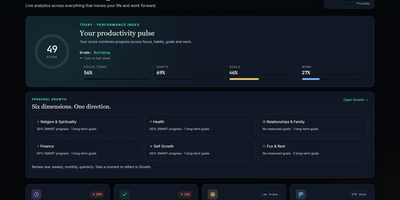
Edi Life OS puts the habits, goals, projects, money, focus sessions, and notes that usually live in five separate apps into one calm dashboard on your own server. Start the day from an Overview that rolls focus, habit trends, goals, finances, and the week ahead into one readable score. Connect long-term goals to six life areas, drive progress from a checklist, a measure, or a habit you actually keep, and use weekly, monthly, or quarterly reviews to choose the next honest step. Log daily habits with streaks and monthly progress, run timed focus sessions with short and long breaks, and keep a history of the deep work you finished. Track expenses, income, budgets, debts, and credits in your chosen currency, including recurring entries that land straight in the ledger. Plan projects on draggable Kanban boards with labels, priorities, due dates, checklists, comments, and attachments, then see card deadlines and money dues together in one calendar. Capture Markdown notes with preview and export, pin sticky notes with colors and connections, and give each account its own private workspace, theme, and currency. Ask an AI assistant through the optional MCP server to read your dashboard, create goals, log habits, or record expenses through a token-protected API that never touches the database directly. Running on a dedicated VPS on RepoCloud with guaranteed CPU, RAM, and SSD, full root SSH access, and a browser serial console. MIT licensed.
AliangBoard
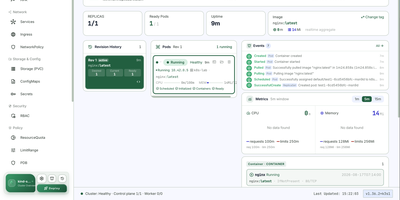
AliangBoard puts every Kubernetes cluster you run behind one web panel, where you manage resources yourself or ask an AI agent to do it with your approval. Connect each cluster with a bearer token or basic auth and the panel persists the connection, so switching clusters, namespaces, and workloads takes one click instead of another kubeconfig. More than thirty resource types stay in sync: create workloads, services, ingress, config, storage, and RBAC through structured forms, edit anything as YAML, apply multi-document manifests at once, and delete optimistically with automatic rollback when the API refuses. Pod work goes deep: a tmux-backed exec terminal survives browser refreshes, port-forwards resolve services to their backend pods, files move up and down with progress, and debug containers inject into running pods without restarting them. Day-two operations are buttons, not flag memorization: scale, rolling restart, rollout undo, manual CronJob triggers, and node cordon or drain. Global search, a layered namespace topology, live event streams, and CPU and memory metrics keep orientation effortless. Then there is the operator: an Agent workbench and MCP server let your LLM read logs, debug containers, and propose changes in natural language, while every write waits for a human click and lands in an audit log that names who did what. Running on a dedicated VPS on RepoCloud with guaranteed CPU, RAM, and SSD, full root SSH access, and a browser serial console. Apache-2.0 licensed.
LibrePaper
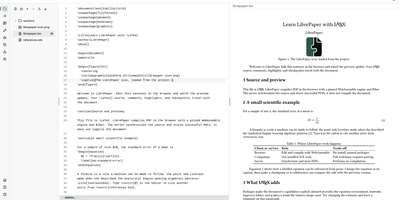
Emailed copies of the same document, each with a different filename and a different set of edits, are where collaborative writing goes to die. LibrePaper keeps one living document in the browser instead: start a project in HTML, Markdown, Typst, LaTeX, or Quarto, or upload an existing one, and the editor renders the compiled result beside the source as you type. Readers highlight the exact passage they mean and comment on it, suggested edits land as tracked changes, and threads resolve on the text in real time. Finished work publishes to its own separate host, so scripts and interactive figures inside a document can never reach a reader's sign-in session. Nobody manages another password: sign-in runs through GitHub, Google, Microsoft Entra ID, ORCID, or any OpenID Connect provider, per-provider lists decide who may publish and who may only comment, and anonymous comments can be switched on for outside reviewers. Every project exports as a complete, independent copy from the command line, which also administers the deployment and can serve a document's tools to an AI agent over MCP. Operators get graphs, account management, and moderation, with per-account storage quotas, upload limits, and retention rules keeping a public instance under control. Four Docker containers behind Caddy with automatic HTTPS, one configuration file, and nightly backups of database and files complete the deployment. Running on a dedicated VPS on RepoCloud with guaranteed CPU, RAM, and SSD, full root SSH access, and a browser serial console. MIT licensed.
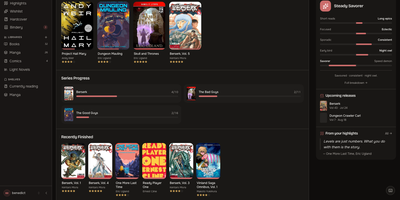
Tome
Tome is a self-hosted ebook library that knows how you read, not just what you own, syncing your place between an e-reader and the browser while turning every session into statistics. Its TomeSync plugin for KOReader records time on page, pages turned, and device, then syncs positions bidirectionally and works fully offline, queuing sessions until you reconnect. Browse and bulk-download whole series from the e-reader menu, with stable book IDs keeping history intact when files change. Reading stats grow sharper the more you read: streaks, time-of-day heatmaps, pace, completion estimates, author affinity, and per-book breakdowns fill three insight tabs. The built-in reader opens EPUBs with themes and font controls, manga in page, spread, or webtoon scroll modes with RTL support, and PDFs directly. Volumes group into series with arcs and status badges, so a forty-volume saga reads as one story. Metadata arrives from Hardcover, Google Books, and OpenLibrary with a side-by-side diff and cover picker. A Bindery inbox reviews incoming files before they join the library, and the OPDS catalog serves KOReader, Panels, or any OPDS client with per-user PINs. Admin, member, and guest roles govern per-book visibility behind API tokens. Running on a dedicated VPS on RepoCloud with guaranteed CPU, RAM, and SSD, full root SSH access, and a browser serial console. AGPL-3.0 licensed.