Open Report
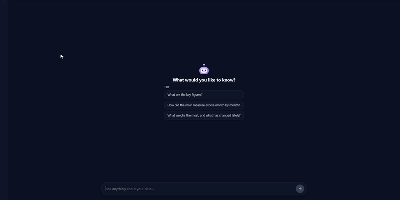
Open source reporting where an AI answers questions in plain words, builds whole dashboards page by page, and shows where a number comes from, while the data stays in your own databases. Ask what weighs the most and what has changed lately, in any language, and the answer arrives with its chart, a table view, and a button that adds it to a report. Describe the report you need and the assistant asks which pages you want, then builds the visuals, measures, data model, and look, ready to fine-tune on the canvas. Bring a local model through Ollama or LM Studio, any OpenAI-compatible API, Anthropic, or your Claude subscription, and decide how much of your data it may read: the schema only, cached aggregates, or query results. Connect Snowflake, BigQuery, Databricks, ClickHouse, Oracle, SQL Server, and MySQL, or load CSV, Excel, Parquet, and JSON files, then define joins with cardinality, dimensions, measures, and row-level security once for every report. The free canvas offers more than fifteen visual types, custom visuals, multi-page layouts, themes, cross-filtering, drill-down, and scheduled cache refreshes. Workspaces with viewer, editor, and admin roles, public links, PDF, PNG, and Excel export, and scoped API tokens cover sharing and automation, while OpenMetadata lineage maps a figure back through its bronze, silver, and gold tables. Running on a dedicated VPS on RepoCloud with guaranteed CPU, RAM, and SSD, full root SSH access, and a browser serial console. AGPL-3.0 licensed.
Duniya
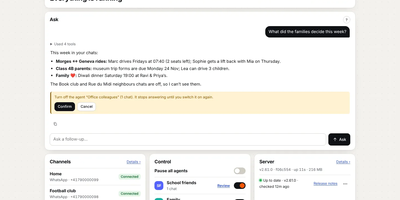
Duniya links to a spare WhatsApp number, plus a Telegram bot if you like, and runs AI helpers only in the family, school, and club chats you choose. Every other chat stays silent and is never stored. Start an agent from a template, such as car pooling, school friends, or neighbours, or describe it in a sentence and review every change as a visual diff. Corrections you make while reviewing answers become lessons the agent follows once you approve them. The owner gets an assistant too, with a morning brief, a catch-up on missed messages, and an Ask box that answers questions about people, events, and orders. A People page keeps families, kids, notes, and consent, Events track registrations, duties, and who has paid, and surveys follow up only with people who have not answered. Choose any model, from OpenRouter's free ones to a ChatGPT or Claude plan, OpenAI, Copilot, or Ollama, with a backup model and spending caps. It runs on a 1 GB server, installs with one command, and backs up encrypted to GitHub or S3. Updates arrive overnight by themselves, and a release that fails to start rolls itself back. The panel installs on a phone's home screen, in light or dark, with nothing from a store. Running on a dedicated VPS on RepoCloud with guaranteed CPU, RAM, and SSD, full root SSH access, and a browser serial console. MIT licensed.
Wiki4AI
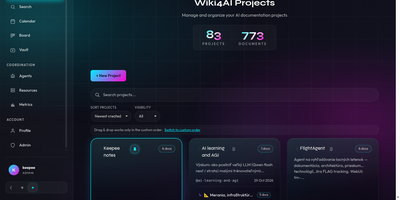
One wiki, two kinds of authors: Wiki4AI lets a team and its AI agents read, write and search one Markdown knowledge base under identical permissions. Projects nest five levels deep, and each project or document is public or private, with private pages answering 404 to anyone but the owner and admins. The editor shows Markdown beside a live preview, autosaves, and rejects a conflicting save with a 409 instead of overwriting it. Mermaid diagrams render in the browser, PlantUML renders through an optional kroki sidecar, and wiki links build backlinks and a relationship graph. Search fuses literal text matching with semantic similarity from a local embedding model; results stay useful even when nobody typed the exact words. Claude Desktop, OpenCode or any MCP client can create pages, search and manage the calendar as a signed-in user through a server with 52 tools over stdio or SSE. Work items move through eight board states; an agent claims one with a lease that expires after 45 minutes by default, and finishing requires a result comment. Agents poll an inbox for what changed and reserve scarce resources, such as a GPU slot, with a time limit. Dedicated pages show agents, resource holds and actor metrics. The calendar offers month and week views with all-day and timed events, custom event types and per-event visibility. Running on a dedicated VPS on RepoCloud with guaranteed CPU, RAM, and SSD, full root SSH access, and a browser serial console. MIT licensed.
NodePilot
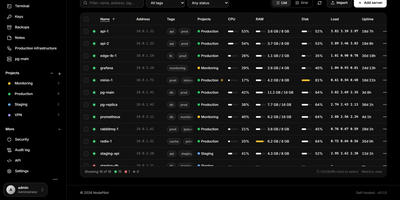
Admins who juggle dozens or hundreds of servers over SSH can run them all from one self-hosted browser panel, and let AI agents drive the same controls over MCP. Servers are grouped into projects, a server can belong to several, and a keychain holds the keys. The panel includes a web terminal, an SFTP file manager, process and systemd service controls, reboot and shutdown, and Markdown notes for runbooks. Agentless stats chart CPU, RAM, disks, network, and load history for every server, polled in parallel with backoff for unreachable hosts. One command can run on many servers at once, and infrastructure graphs map API, database, and VPN nodes with cascade links and notes on the canvas. Backups of files and PostgreSQL or MySQL databases run on schedules to the panel or to S3, encrypted to an age public key. AI agents reach 66 tools over MCP, through remote HTTP or a local stdio command, including persistent terminal sessions and graph editing, and an API token decides which tools each agent sees. Tokens can be full, read-only, or limited per area with an optional expiry, and every agent call is written to the audit log. Two-factor sign-in, a master key that can be sealed in a TPM, and pinned SSH host keys protect the credentials the panel stores. Running on a dedicated VPS on RepoCloud with guaranteed CPU, RAM, and SSD, full root SSH access, and a browser serial console. Apache-2.0 licensed.
AgentTape
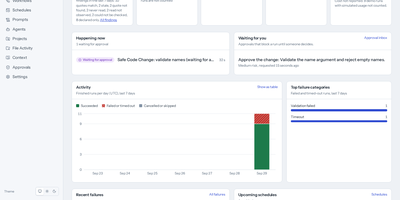
When a coding agent says the tests already cover a case, AgentTape checks the lines it cites against a recording of the run and shows a verdict beside them. The verdicts are Quote matches, Quote not found, Never read, Read not observed, and Stale, where the file changed after the read and both hashes are displayed. A finding with no citation reads Declared only. Matching is deterministic and no model judges anything: line endings, Unicode, and trailing spaces are normalized before each quote is compared. Confidence climbs a ladder from declared, to commands re-run, to a person's confirmation, and a second agent can challenge a finding, labeled as judgment. Today Claude Code findings are verified, while Codex CLI and any allowlisted command are recorded alongside them. Runs launched from the UI, CLI, API, a schedule, a webhook, or a workflow leave an ordered record of the prompt, commands, output, files read, and files changed. Any run can be replayed as recorded or forked with one variable changed, and the two are compared side by side. Workflows chain agent steps, commands, evaluation gates, and approval nodes that pause for a person, and evaluators check exit codes, diffs, regex, JSON schema, duration, and cost. Work happens in a separate Git worktree and commits locally only after approval. Running on a dedicated VPS on RepoCloud with guaranteed CPU, RAM, and SSD, full root SSH access, and a browser serial console. MIT licensed.
Inkling
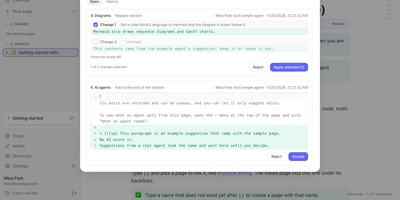
Built for small teams whose members each bring their own AI agent, Inkling keeps one shared set of notes that agents read by the section and change only through edits people can review. An agent asks a question and receives just the sections that answer it, packed into a token budget. It then edits one section against the version it read; if a teammate changed that section meanwhile, the agent gets the current text to merge instead of overwriting it. Edits can wait as suggestions that people accept in part or reject, and anything an agent changed can be reverted, one change or everything a connection touched on a page. A comment or database cell can hand a task to one member's agent, and a Team agents board shows what each connection is working on. The notes themselves cover Notion-style databases with table, board, calendar, gallery, timeline, chart, form and list views, plus wikilinks, backlinks, a graph, JSON Canvas whiteboards, Dataview-style query blocks and daily notes. Live co-editing shows cursors and presence, while roles, guests, edit locks and expiring password links control who sees what. Claude, Cursor and VS Code connect through OAuth to a built-in MCP server with 48 tools, and Slack or webhooks announce changes. Running on a dedicated VPS on RepoCloud with guaranteed CPU, RAM, and SSD, full root SSH access, and a browser serial console. MIT licensed.
Mulebox
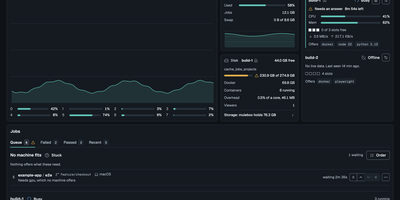
Send your AI coding agents' builds and tests to a Linux box instead of your laptop, and let them wait in one shared queue. An agent types mulebox check. Output and exit code come back as if the command ran locally. Your working copy travels as it is, committed or not. Only changed files move, and anything that looks like a secret stays home. Same files, same result: a repeat returns the earlier answer, and a second agent joins the job already running. Jobs run in private Compose services and ports that vanish when the job ends. Package caches and Playwright browsers stay warm. A pass must prove its tests ran. A long job asks its agent whether all is well instead of timing out. Detached jobs can be collected later with mulebox wait. GitHub Actions runners for private repositories queue in the same line, and results can post as commit statuses. Queue rules set levels per project or branch, with aging and fair turns. Lanes, stage waterfalls, and streaming logs update live on the dashboard. Pause, freeze, boost, reorder, or cancel any job. Agents ask for more disk, and you approve it from a strip on every page. Open the dashboard from your phone behind a password. Jobs travel over ssh to machines you own; no cloud service sits between. Running on a dedicated VPS on RepoCloud with guaranteed CPU, RAM, and SSD, full root SSH access, and a browser serial console. MIT licensed.
HostPog
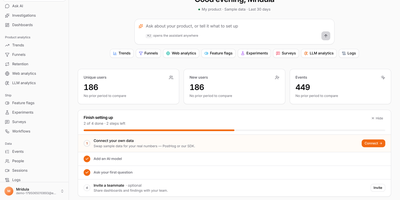
Product analytics that explains why a metric dropped instead of only charting the drop: HostPog pairs trends, funnels, retention, and web analytics with an AI analyst that runs the queries and shows the chart behind every answer. Funnels are built by naming the steps, then broken down by any property with drill-down to the people who dropped off. Web analytics tracks visitors, bounce rate, top pages, referrers, and UTM campaigns. The assistant keeps one conversation per user and can set up feature flags, experiments, surveys, and workflows, though anything it creates starts switched off until reviewed. Flags support percentage rollouts, person conditions, variants, and payloads, with bucketing that matches PostHog so users keep their variant. Experiments report a Bayesian chance to win, and surveys offer NPS, ratings, choices, and open text through the posthog-js widget you already ship. LLM analytics breaks down cost, tokens, latency, and errors by model and user, while logs arrive over OpenTelemetry or JSON and link each error to the person who hit it. Teams get workspaces, roles, invite links, and an audit log, and the assistant works with OpenAI, Anthropic, Gemini, OpenRouter, or a local Ollama model on your own key. Leaving PostHog takes five steps, starting with a read-only connection; nothing changes for your users until the last one, which can be undone. Running on a dedicated VPS on RepoCloud with guaranteed CPU, RAM, and SSD, full root SSH access, and a browser serial console. MIT licensed.
Euron BrowserAgent
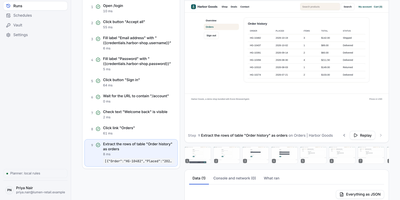
Turning a repeated browser chore into a reviewed list of steps lets Euron BrowserAgent run it the same way every time, on demand or on a schedule. Tasks are lists of steps (open, click, fill, choose, wait, extract text or a table, check, screenshot) and each target lists up to five selectors as ordered fallbacks. Describe a job in a sentence and the planner drafts steps from the real page, offline or through an OpenAI-compatible model or Ollama. Pick from page offers a page's fields, buttons, and tables as ready steps. A run opens a fresh headless Chromium context and keeps a screenshot of every step, the page's console and network errors, and extracted data as JSON or CSV. The replay steps through any run beside the page after each action, and a failed run names the step and the reason. Runs start by hand, from an API key, or on cron schedules in any time zone, with overlap rules and missed fires merged into one run. Logins are sealed in a vault, typed into pages by the worker, masked in screenshots, and scrubbed from records, with TOTP codes for two-factor sign-ins. An egress policy blocks cloud metadata and private networks unless a host is allowed. Workspaces add owner, editor, and viewer roles, an activity log, and run limits. Running on a dedicated VPS on RepoCloud with guaranteed CPU, RAM, and SSD, full root SSH access, and a browser serial console. MIT licensed.
GuardNous
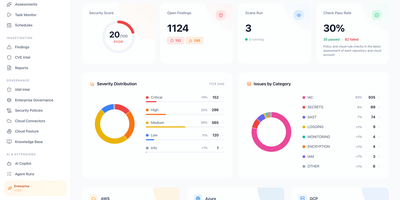
Point GuardNous at your repositories and AWS account, and your existing scanners feed one triaged list of findings that AI agents can fix only with a person's approval. Nine scanner adapters, from Semgrep and Trivy to Checkov and Gitleaks, share one format, and SARIF carries in results from any other tool. Triage, assignment, notes, and severity-based deadlines stay attached to findings across rescans. AWS connects through OIDC federation with no stored keys, and 44 rules check the account, show internet exposure, and offer five reversible fixes. Twenty agents with 72 tools answer questions from live data and run in the background within step and token budgets. A fix pull request, a cloud fix, or a Slack message runs only after a person approves the exact change. Bring your own model: OpenAI, Azure OpenAI, Anthropic, or a local Ollama. Six compliance frameworks, 21 built-in policies, SBOM export, and scheduled PDF reports cover governance. Tenants, seven roles, two-factor sign-in, and an audit trail keep teams separated and accountable. GitHub, GitLab, Bitbucket, and Azure DevOps connect to scan on push and open fix pull requests. Running on a dedicated VPS on RepoCloud with guaranteed CPU, RAM, and SSD, full root SSH access, and a browser serial console. Apache-2.0 licensed.
RabiRoute
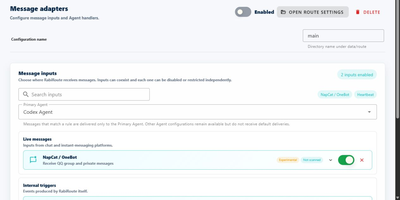
Which agent should answer a question that just arrived in your QQ group, and how much of the conversation should it see? RabiRoute is the self-hosted message gateway that answers those routing questions before your agent ever wakes up. Chat messages from QQ groups and direct chats (through NapCat and OneBot), webhooks, schedules, voice, desktop selections, and device events all arrive at one gateway, and message Routes decide which agent or local program receives each one. Every role keeps its own message history plus references to plans, memories, and skills, while each Route limits how many recent messages travel with a delivery. Roles can also fire agents on interval, time-window, daily, or one-time schedules, or run a configured local script, so recurring checks and reports happen without anyone typing a prompt. Replies to QQ, RabiLink, and other channels leave through a single sending API that validates targets, quoted messages, and sender identity, then records receipts for everything delivered. The Windows desktop side adds selected-text actions, screenshots, and annotations; speech, phone, glasses, wearable, and remote-computer clients connect as experimental integrations, and the Linux Host serves the Manager and browser WebGUI from a Node.js process. Running on a dedicated VPS on RepoCloud with guaranteed CPU, RAM, and SSD, full root SSH access, and a browser serial console. MIT licensed.
Euron MemoryVault
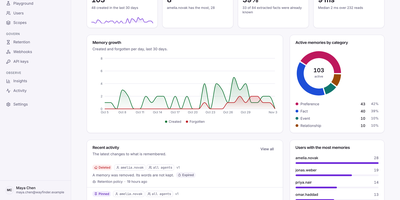
Long-term memory for AI assistants lives in Euron MemoryVault, which stores conversations as atomic facts like "Lives in Lisbon" and hands back the ones that fit the next prompt. Repeated facts reinforce the old memory. Changed facts supersede it and keep the history. A "forget that" message deletes it. Extraction runs on a rule engine with no key, and an OpenAI-compatible API or Ollama can replace it. Scopes cover organization, project, user, agent and session. Keys tied to one agent never see another project. Retention policies set half-lives, time to live per category and a per-user cap. Live previews show what would be forgotten before anything is saved. Hybrid search blends vectors with full text. The context endpoint packs the strongest memories into a token budget. Playground runs preview what a conversation would create, merge, ignore or supersede. Dry runs store nothing. The dashboard shows decay curves, version history and source conversations for each memory. Users, API keys, insights and an activity feed sit beside it. Signed webhooks announce created, updated and deleted memories, with retries, a dead-letter queue and a delivery log. Erasing a user removes memories, history, messages and queued deliveries in one transaction and returns a receipt. A client SDK offers blocking and asyncio versions. Running on a dedicated VPS on RepoCloud with guaranteed CPU, RAM, and SSD, full root SSH access, and a browser serial console. MIT licensed.
Open Agent API
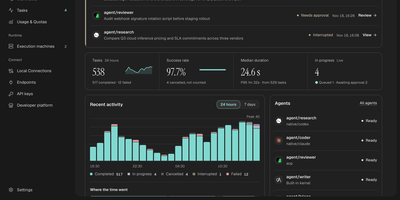
Open Agent API is a self-hosted gateway that turns agents into an API, so any OpenAI, Claude, or Gemini SDK client can call a complete agent with its own tools and permissions instead of a bare model. Change the base URL, put an agent name such as agent/research in the model field, and each request becomes a task that loops through tools, remembers earlier turns, and stops when a sensitive action needs sign-off. Behind a name you can run a built-in agent on Ollama, DeepSeek, OpenAI, Anthropic, Gemini, or OpenRouter, or wrap Codex, Claude Code, an ACP agent, or a remote A2A agent. The web console opens on the tasks waiting for you, lists every run with status filters, and expands one into a timeline showing the command it wants to run beside Approve and Reject buttons. Runs can be cancelled and resumed, repeated calls with an Idempotency-Key execute once, and signed webhooks, cron schedules, and inbound triggers start or report work. Agents keep searchable memory across sessions and stream artifacts back to the caller. Callers can force a tool choice, request schema-validated JSON, and attach images for agents that accept them. Turn on the developer platform and outside developers register, create their own keys in a portal, and call the agents you list, billed in credits per task. Running on a dedicated VPS on RepoCloud with guaranteed CPU, RAM, and SSD, full root SSH access, and a browser serial console. Apache-2.0 licensed.
mcpspan
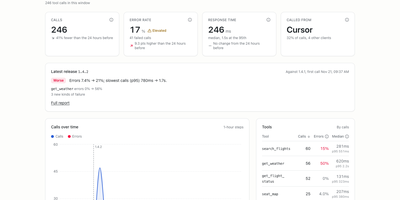
Every tool call, resource read, and prompt get an agent makes on your MCP server lands in mcpspan, with the client that asked, the response time, and the reason for any failure. One line added at startup sends them, with SDKs for eight languages or a proxy that wraps any server without touching its code. The overview charts calls, error rate, and median and 95th-percentile response time per tool, and failures are told apart as crashed handlers, reported errors, refused arguments, and tools an agent asked for that the server does not have. Sessions replay each connection step by step, mark repeated calls, and show what the agent did after every failure: retried, tried something else, or gave up. Release reports set each server version against the one before it, and client versions show whether a client's newest release gets its arguments refused more often. A tool-definition view shows what the tool list costs in tokens each session and which tools agents never call. Alerts go to Slack, Discord, or any webhook, and read tokens let an MCP client such as Claude Code answer questions about the numbers. Anything you can see exports as CSV or NDJSON, calls forward to OpenTelemetry, and README badges show usage. Running on a dedicated VPS on RepoCloud with guaranteed CPU, RAM, and SSD, full root SSH access, and a browser serial console. MIT licensed.
Seerlens
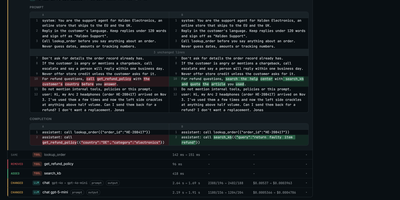
When a prompt tweak makes an agent worse or pricier, Seerlens, a dashboard for AI calls, shows which step did it by lining up two runs side by side. Cost, latency, token, and tool-path changes sit on top. Expand a step and a word-level diff of its prompt and answer appears. Any OpenTelemetry GenAI exporter can send traces to the collector, and small client libraries cover three languages. Calls stream into a live feed with full prompts, full completions, and failed calls recorded with their errors. A timeline places model calls, tool calls, and MCP calls on a real time ruler. Costs count cached reads, cache writes, and reasoning tokens. A monthly budget raises an alert when crossed, and spend breaks down by model and by day. Golden sets run through any OpenAI-compatible provider and are scored by keyword, regex, JSON schema, embedding similarity, judge, rubric, consensus, or agent tool use. A failing case links to what changed since the last run that passed. Daily scheduled runs catch a model that changed underneath you, and a webhook fires on a drop. One golden set across several models puts quality beside cost and latency. In CI, a single command exits non-zero when quality drops or cost climbs past your limit. Running on a dedicated VPS on RepoCloud with guaranteed CPU, RAM, and SSD, full root SSH access, and a browser serial console. MIT licensed.
Geo-Monitor
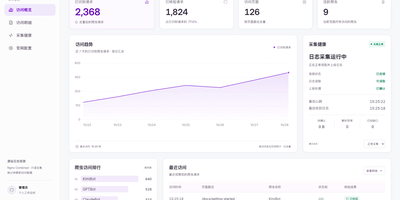
Search is being answered by AI crawlers first and humans second, yet most site owners cannot name a single bot that read their pages last week; Geo-Monitor answers that from the access logs you already have. A small collector sits beside Nginx or OpenResty, mounts the log read-only, and streams only new lines in batches, resuming after outages and surviving log rotation without ever touching your site's code. The console separates today, the last week, and the last month into identified requests, crawled pages, active crawlers, and trend lines, then drills into every visit with time, path, method, status code, claimed identity, and verification state. Identification and verification are deliberately different things here: a user agent only proves what a request claims to be, while a verified badge requires trusted log addresses and official IP evidence to agree. Twenty built-in identities cover OpenAI, Anthropic, Perplexity, Kimi, and Bytespider crawlers, and you can add, edit, or disable rules as new bots appear. Your sitemap syncs or imports as the content catalog, so coverage views show which pages crawlers actually reached, and collector health exposes heartbeat, backlog, and parsing problems. Running on a dedicated VPS on RepoCloud with guaranteed CPU, RAM, and SSD, full root SSH access, and a browser serial console. Apache-2.0 licensed.
Githome
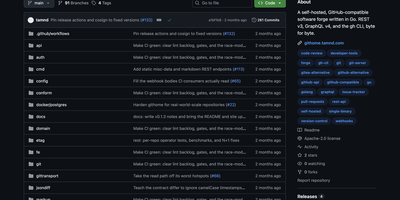
Point the gh CLI at your private Githome server and it works identically to github.com, because every REST v3 and GraphQL v4 endpoint returns byte-for-byte compatible JSON shapes, headers, Link pagination, and ETag caching. A single compiled Go binary serves the REST API under /api/v3, GraphQL under /api/graphql, git smart-HTTP transport, and a server-rendered web UI implementing the GitHub Primer design system with full functionality when JavaScript is disabled. The web interface provides repository browsing with Markdown rendering and syntax highlighting, issue tracking, pull requests with unified diffs and inline code review threads, full-text search, user profiles, and a notifications inbox. Authentication supports personal access tokens with prefix-based identification, OAuth device and web flows, and scoped permissions on every response header with only token hashes stored. The pull request system implements the complete lifecycle including async mergeable state computation, squash, merge, and rebase strategies, commit statuses, check runs, and statusCheckRollup fields. Webhooks deliver events with X-Hub-Signature-256 verification, SSRF protection, and at-least-once retry semantics. Storage supports SQLite for single-node deployments or PostgreSQL for production configurations. Performance optimizations include batch loaders replacing N+1 queries, keyset pagination, FTS-backed search, and GraphQL dataloaders. Docker deployment pulls the official multi-arch container image from GitHub Container Registry. Running on a dedicated VPS on RepoCloud with guaranteed CPU, RAM, and SSD, full root SSH access, and a browser serial console. Apache-2.0 licensed.
Task Panel
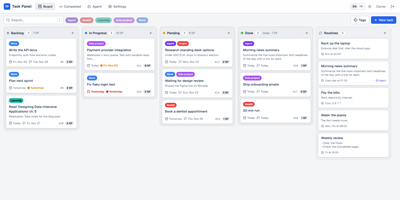
A self-hosted kanban board for personal tasks, Task Panel can pass any card to an optional AI agent that works on it and reports back in a comment. Planning a day means dragging cards between Backlog, In Progress, Pending and Done with a mouse, a finger or the keyboard. Cards carry tags, story points and a due date that glows amber two days out and red once it passes. Anyone with a standing chore, like a morning news summary, sets a routine on a daily, weekday or cron schedule and lets the agent handle each task. Someone who wants a task researched clicks Hand to agent, sets a model, thinking level, time limit and token budget, and reads the answer in a comment. Finished work leaves the board at midnight and appears on a Completed page grouped by day, covering 7 days, 30 days or a month. The agent runs on a Claude subscription or a provider API key, and OpenClaw's own interface lets you chat with it and pick its tools. Web Push alerts, with no third-party account, announce when a run finishes or needs you. One JSON file backs up the whole panel and restores it in one step. The interface comes in English and Turkish, with light and dark themes. Running on a dedicated VPS on RepoCloud with guaranteed CPU, RAM, and SSD, full root SSH access, and a browser serial console. MIT licensed.