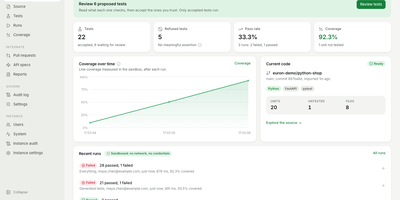
Euron Open TestForge
Because a generated test that asserts nothing is worse than no test, Euron Open TestForge refuses it, then runs every accepted test in a sandbox with no network. Connect a GitHub repository at a branch, tag, or commit, import a pull request, or upload a ZIP, and it reads the code without ever running it. Unit, edge-case, negative, and API tests are written from each function's signature, docstring, documented examples, and raise conditions, plus tests for every operation in an OpenAPI document. Every test lists what it asserts, and you accept or regenerate tests one at a time. Runs have no network or credentials, and a run that crosses its CPU, memory, output, or time limit is stopped with the limit named. A failure shows the actual and expected values from that same run, with a plain-language explanation. Coverage is tracked per file and function over time, and reports export as HTML or CSV. Pull request mode writes tests for exactly the functions a change touches, and the CLI exits non-zero unless every test passes. Teams get roles, scoped API keys, signed webhooks, and an append-only audit log. Use OpenAI, Anthropic, Gemini, Ollama, or any compatible endpoint, or start with the built-in mock model and no key. Running on a dedicated VPS on RepoCloud with guaranteed CPU, RAM, and SSD, full root SSH access, and a browser serial console. MIT licensed.
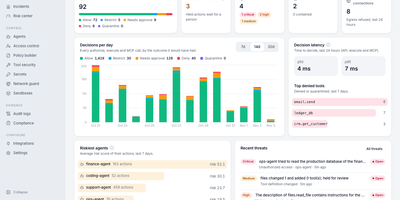
Euron Open AgentGuard
Euron Open AgentGuard decides every action an AI agent takes before it happens, so a poisoned web page cannot talk one into refunding the wrong account. Credentials for HTTP tools, MCP calls, and sandboxed code never reach the agent: AgentGuard runs them itself, and agents authenticate with short-lived identities. A YAML policy answers allow, restrict with row limits or field redaction, hold for a person, deny, or quarantine the agent, and an explicit deny always wins. Drafts can be dry-run on one request, replayed over recorded decisions, or tried in audit mode, which logs what enforcement would have done. Approvals are tied to a hash of the agent, tool, action, and parameters, and one changed byte starts a new request. Nobody approves their own. Once a run reads content that tries to command the agent, it is tainted and its next high-risk action waits for a human. Registered MCP servers share one governed endpoint that hides forbidden tools, scans outputs for injected instructions, and holds a changed tool definition for review. Secrets are written once and injected only for the hosts they are bound to, and an egress proxy limits each agent's destinations. Records are hash-chained and verifiable on demand, with incident reports and an OWASP agentic Top 10 report. SDKs for LangGraph, CrewAI, and Express treat any error as a deny. Running on a dedicated VPS on RepoCloud with guaranteed CPU, RAM, and SSD, full root SSH access, and a browser serial console. MIT licensed.
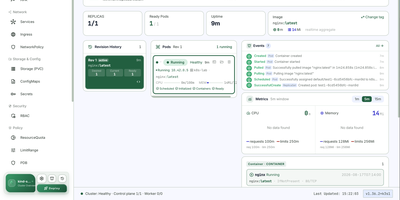
AliangBoard
AliangBoard puts every Kubernetes cluster you run behind one web panel, where you manage resources yourself or ask an AI agent to do it with your approval. Connect each cluster with a bearer token or basic auth and the panel persists the connection, so switching clusters, namespaces, and workloads takes one click instead of another kubeconfig. More than thirty resource types stay in sync: create workloads, services, ingress, config, storage, and RBAC through structured forms, edit anything as YAML, apply multi-document manifests at once, and delete optimistically with automatic rollback when the API refuses. Pod work goes deep: a tmux-backed exec terminal survives browser refreshes, port-forwards resolve services to their backend pods, files move up and down with progress, and debug containers inject into running pods without restarting them. Day-two operations are buttons, not flag memorization: scale, rolling restart, rollout undo, manual CronJob triggers, and node cordon or drain. Global search, a layered namespace topology, live event streams, and CPU and memory metrics keep orientation effortless. Then there is the operator: an Agent workbench and MCP server let your LLM read logs, debug containers, and propose changes in natural language, while every write waits for a human click and lands in an audit log that names who did what. Running on a dedicated VPS on RepoCloud with guaranteed CPU, RAM, and SSD, full root SSH access, and a browser serial console. Apache-2.0 licensed.
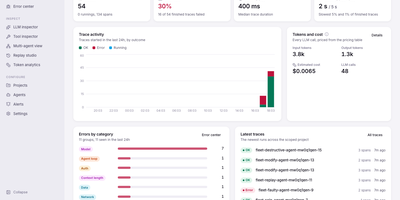
Euron Open AgentDebugger
When an AI agent gives the wrong answer on step three, Euron Open AgentDebugger shows which prompt went out, which tool the model chose and where the run broke. Decorated Python or Node functions become traces of agent, LLM and tool spans, and any OpenTelemetry exporter can post to the OTLP/JSON endpoint with no SDK. A zoomable timeline and an execution graph with highlighted delegation edges show every span, filterable by agent, kind, model, tool and status. A supervisor calling a child agent over HTTP still produces one correctly parented trace, and the multi-agent view lists each agent's share of time and tokens. The LLM inspector shows provider, model, tokens, latency, finish reason and cost, and the tool inspector shows arguments, results, errors and retries. The error center sorts failures into ten categories and groups repeats by fingerprint, while a loop detector flags a stuck agent without stopping it. Replay studio reconstructs a past run with zero new calls, re-runs it with recorded tool results, or changes one input and runs live side by side, and side-effect steps are refused unless allowed. Prompt and response text stays off unless a project turns on content capture. Alerts on error rate, latency or cost reach signed webhooks, and token analytics break spend down by model and agent. Running on a dedicated VPS on RepoCloud with guaranteed CPU, RAM, and SSD, full root SSH access, and a browser serial console. MIT licensed.
Euron AgentStudio
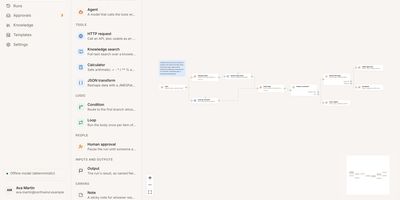
Euron AgentStudio lets you draw an AI agent workflow on a canvas, run it, and watch every step report its inputs, outputs, tokens, and cost live. Twelve node types cover prompts, tool-calling agents, HTTP requests, knowledge search, a calculator, JSON transforms, conditions, loops, human approvals, and sticky notes. Typed connections, inline validation, undo and redo, and autosave keep the editor honest. Branches run in parallel with timeouts, retries, and cancellation, and the run inspector shows the graph as it ran beside a timeline of loop iterations. A human approval step pauses a run for days without tying up a worker. Reviewers decide from an inbox, comment for the record, and let deadlines expire into the rejected branch. Start flows from the editor, a workspace API key that waits for the result, or a signed webhook. Every template runs on a built-in offline model with no API key, and any OpenAI-compatible endpoint or Ollama can take over step by step. Knowledge bases of Markdown and text feed the search steps. Any flow exports as JSON or as a standalone script you own, and published versions can be restored. Owners, editors, and viewers share a workspace with write-only secrets, expiring keys, an activity log, and a dashboard of runs, success rate, and spend. Running on a dedicated VPS on RepoCloud with guaranteed CPU, RAM, and SSD, full root SSH access, and a browser serial console. MIT licensed.
Sara
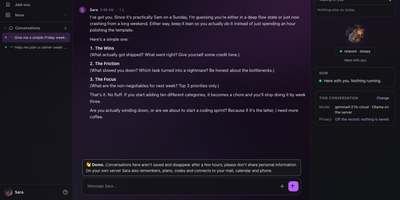
Meet Sara, an AI companion with a personality you design and a coding partner that writes, runs, and tests real software, using any model you choose. Pick a name and pronouns, start from a character or set dials for playfulness and bluntness, and keep memories you can inspect, correct, and forget. Chat from the web app, Windows and Mac apps, Android, iPhone, Telegram, Discord, Signal, or email, and talk through live voice calls you can interrupt or video calls with her moving portrait. A planner turns plain sentences into to-dos, reminders, and notes, with a board, a Today home screen, and routines such as a morning briefing. The library reads PDFs, scans, Word, Excel, PowerPoint, and e-books, then answers with the document and page it came from. For code, each project gets a sandboxed workspace with files, a shell, and git; Sara asks before risky commands, shows test results as cards, and lists every command and its output under each reply. Goals finish only when your own check passes. Use Ollama, vLLM, or llama.cpp locally, connect OpenAI, Anthropic, xAI, or OpenRouter, or reuse the ChatGPT and Claude plans you already pay for. Connect coding agents over MCP, call an OpenAI-compatible API, and add plugins from a signed store. Business workspaces add passkeys, roles, and shared workspaces. Running on a dedicated VPS on RepoCloud with guaranteed CPU, RAM, and SSD, full root SSH access, and a browser serial console. MIT licensed.
Palimpsest Gateway
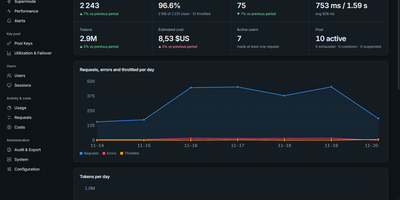
Swap one base URL and Palimpsest Gateway turns the LLM keys you own into a single OpenAI-compatible endpoint that fails over by itself. Apps keep their OpenAI client and use a gateway key of their own; provider keys stay encrypted and are never shown again. Teams that mix free and paid keys cap the free ones, leave the paid ones uncapped, and the gateway spends the free allowance first. When a key hits a rate limit, empty quota, outage or refusal, the same call moves to the next suitable key. Clients send only the new message, because the gateway keeps per-user session history and carries it through a failover. Asking for palimpsest/supermode picks the strongest model the pool can serve right now and skips any that cannot take the prompt, images or tools. A circuit breaker skips a provider in a real outage, and a concurrency gate caps in-flight requests per provider. Per-user daily caps and a pool low-water mark throttle demand before the keys run dry. Live Flow traces each request through the gateway, retries included, and key tests find the models an account can use. Spend appears against the per-model prices and monthly budget you enter, by day, model and user, with a projection. An audit trail, CSV exports and Prometheus metrics cover operations. The dashboard never shows message content. Running on a dedicated VPS on RepoCloud with guaranteed CPU, RAM, and SSD, full root SSH access, and a browser serial console. MIT licensed.
Hoprig
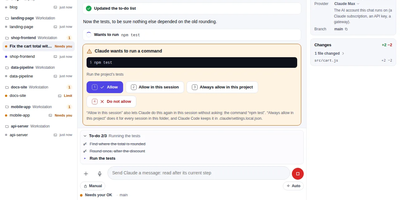
One install line later, Hoprig has turned a spare Linux PC or small server into an always-on AI coding machine, with every Claude Code and OpenCode session on one page, phone included. Each project opens as a chat that streams replies, shows every change as a diff, offers Allow or Deny when the tool asks permission, and keeps the real terminal one tap away. At a usage limit, one tap moves the same conversation to another provider (a subscription of yours, an API key, or a gateway), or Auto mode does it for you. One git repository holds the rules, skills, and memory both coding tools share, and a new computer gets your projects back after an install and a git sign-in. The page also holds a code editor with Explorer, Search, and Source Control, and a browser desktop for terminal, files, processes, services, and logs. Computers behind a router connect out by themselves into one list, and one switch makes the dashboard reachable from anywhere through a Cloudflare tunnel behind a sign-in. Schedules start AI work by itself at set times, on a branch of its own, and an Operator page lists whatever stopped or waits on you. Tia, an experimental assistant that stays off until switched on, asks by card before she changes your computer. Running on a dedicated VPS on RepoCloud with guaranteed CPU, RAM, and SSD, full root SSH access, and a browser serial console. Apache-2.0 licensed.
SEO OS
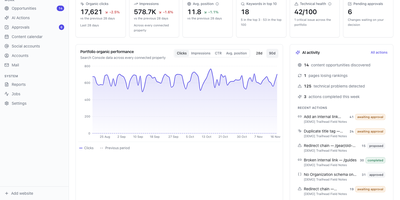
Instead of juggling a crawler, a rank tracker and a folder of spreadsheets, SEO OS audits your websites, proposes fixes, applies the ones you approve and measures whether they worked. Its crawler honors robots.txt, follows redirects and canonicals, avoids crawl traps and can render JavaScript. Sixty-one technical rules grade crawlability, indexability, metadata, content, links, structured data and security, each finding with evidence and a recommendation. Scores come with their factors, weights and a sentence explaining each one. Keyword reports flag striking-distance queries, CTR gaps, content decay and cannibalization, ranked by an explainable opportunity score. A content engine declines to create pages an existing one could cover, and a 14-stage pipeline takes approved ideas from research to publication. Internal-link suggestions come from PageRank over the site's link graph, with orphan detection and anchor-text auditing. GEO readiness scores pages across eleven machine-readability dimensions, while AI-visibility tracking checks whether assistants mention or cite the brand. Social listening watches Reddit, Hacker News and Bluesky for people describing the problem a site solves and drafts disclosed replies for approval. An approval queue groups changes by risk and shows each exact diff with the agent's reasoning, and adapters for WordPress, Git, Shopify, Webflow and webhooks apply only what you approve. Applied changes open experiments that report likely positive, inconclusive or likely negative, steering the next recommendations. Running on a dedicated VPS on RepoCloud with guaranteed CPU, RAM, and SSD, full root SSH access, and a browser serial console. MIT licensed.
RAGOps Observatory
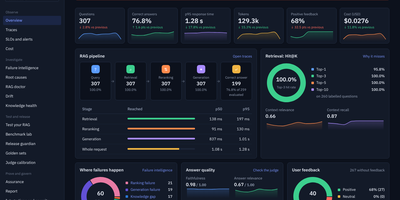
Between a RAG demo that looks fine and an assistant that fails quietly in production sits RAGOps Observatory, a platform that names the broken pipeline stage and blocks worse releases. Failed answers are assigned to one of seven stages, from knowledge gap and chunking to ranking and generation. An evidence graph links documents, retrieved passages, and answer claims, marking claims supported, contradicted, or sourceless. Failure intelligence groups recurring problems as new, growing, steady, or shrinking, so one fix can retire a whole pattern. The release guardian compares a candidate with the current version on the same questions and answers Pass, Review, or Block against your gates, logging every decision. A metric regression blocks only when statistically significant. The benchmark lab sets two to five runs side by side across models, retrievers, rerankers, or chunk sizes. The assurance report writes tests from your documents, including prompt-injection probes, then issues a sealed Ready or Not ready verdict with supporting evidence mapped to the EU AI Act. When answers go wrong, the RAG doctor re-runs your pipeline with candidate fixes and recommends only the one that verifiably helps. SLOs with error budgets, drift checks, cost tracking, and Slack, Teams, PagerDuty, or e-mail alerts cover monitoring. Use it to explain a quality drop, prove a new chunk size is safe, or give a reviewer evidence. Running on a dedicated VPS on RepoCloud with guaranteed CPU, RAM, and SSD, full root SSH access, and a browser serial console. MIT licensed.

Pisha
When one Claude Code session is not enough, Pisha puts a coordinator in charge of a whole team of them and shows every agent live in your browser. Tell the coordinator what you want and it splits the work among workers, tracks their reports, and approves their harmless actions. Only the decisions that matter reach your inbox, each with options and a recommended pick you can answer by typing or speaking. A mosaic view lays every terminal and conversation side by side, with a timeline of orders, edits, tests, and commits for each agent. Teams appear as cards on an org chart, and dragging one onto another links their coordinators so they can trade work. Task boards with custom columns, subtasks, priorities, and due dates sync both ways with GitHub Projects, and merging a pull request that names a task moves it to done. Signed webhooks from GitHub, GitLab, or Stripe wake a coordinator with your standing instructions, such as reviewing each new pull request. Permission profiles described in plain words limit each agent, and Codex CLI or Grok CLI sessions can join a team beside Claude Code. Add any computer with one command; agents connect out, so their machines open no ports. Running on a dedicated VPS on RepoCloud with guaranteed CPU, RAM, and SSD, full root SSH access, and a browser serial console. MIT licensed.
CodeRail
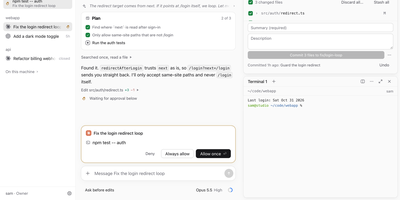
Close the laptop, walk away, and your coding agents keep working; CodeRail is the remote control that lets you supervise them from a browser or your phone without handing your machines to anyone's cloud. A small bridge on each computer connects outbound to your server, so there are no open ports and no VPN to babysit, and each machine keeps its own Claude Code and Codex logins because CodeRail never holds your AI keys. Chats show plans, tool calls, models, modes, and background tasks, and when an agent wants to run something sensitive, the approval lands with you wherever you are, including as a phone push notification. Real terminals outlive the browser tab, files can be viewed, edited, uploaded, and downloaded in place, and git work, pull requests included, sits beside the conversation that produced it. Each chat even gets a browser on the computer itself, shared live with everyone in the chat and drivable by the agent. Roles run Owner, Operator, or Viewer per computer, narrowed down to folders and agents, with every change audited, and sessions keep running with every browser closed while history stays readable offline. Running on a dedicated VPS on RepoCloud with guaranteed CPU, RAM, and SSD, full root SSH access, and a browser serial console. Apache-2.0 licensed.
Genkan
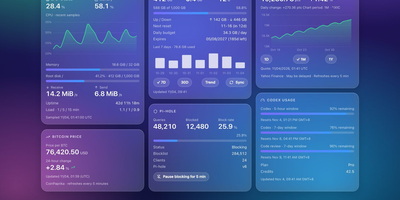
Your homelab home page can take orders from an AI assistant: ask Claude or Cursor to add Jellyfin, Sonarr and Radarr to Media with health checks, and Genkan updates the page on the spot. Other requests work the same way: group services by type, pin the five used most, or move dead links to an Archive category. The AI tab in Settings offers a one-click prompt for the Agent Skill, which calls the REST API, and a built-in MCP server with 29 tools. Links sit on a wallpaper as frosted-glass capsules, grouped into workspaces and categories, with a pinned row and sorting by use, recency or dragging. Slash or Ctrl+K searches every workspace and falls back to a web search. Seventeen bundled plugins add resizable widgets for weather, world clocks, countdowns, Pi-hole stats, RSS, Hacker News, a to-do list and Markdown notes, plus wallpaper feeds such as NASA APOD. Plugins from other authors show their permissions and source in a market before you enable one, and each runs in a sandbox with time and memory limits. A green or red dot beside each link reports its health, and favicons download on their own. Editing needs the admin login, a read-only guest mode shares the page, and JSON export and import carry everything to another instance. Running on a dedicated VPS on RepoCloud with guaranteed CPU, RAM, and SSD, full root SSH access, and a browser serial console. MIT licensed.
APEX Content Engine
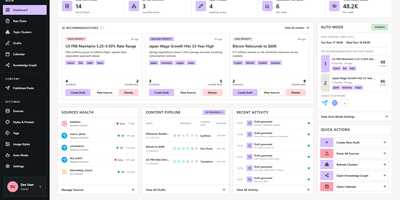
Telegram channels, RSS feeds, YouTube videos, and web articles go in, and researched, fact-checked posts for Telegram, LinkedIn, X, and email come out of APEX Content Engine. Collected posts are summarized, tagged, and embedded, then grouped by similarity into topic clusters that rank by priority, freshness, and source diversity. A cluster or a hand-chosen set of posts, a style preset, languages, and formats go into a pipeline that researches, writes, styles, translates, fact-checks, and optionally illustrates the draft, while a gate can block publishing as long as fact-check issues stay open. Drafts go out immediately or on a schedule, with X posts as a single tweet or a thread, and a month, week, or list calendar lays out everything planned. Auto Mode can run unattended inside chosen days, times, topics, and daily limits, either publishing once a fact-check comes back clean or stopping at a ready draft. A knowledge graph links raw and published posts by topic, continuation, contradiction, and supplement, and drafts export as PDF or PPTX. Provider keys for AI, Telegram, X, LinkedIn, and email can be pasted into the app and are encrypted at rest. Admin, editor, and viewer roles control access, Telegram alerts announce a ready draft, and a daily AI budget per organization stops spending once it is reached. Running on a dedicated VPS on RepoCloud with guaranteed CPU, RAM, and SSD, full root SSH access, and a browser serial console. MIT licensed.
Euron Open LogMind
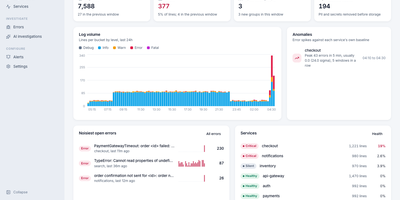
When production breaks, Euron Open LogMind searches and groups your logs, then returns a root cause where every claim cites a real stored log line you can open and re-check. Services send lines over HTTP, the Python or Node.js SDK, or any OpenTelemetry exporter. Credentials, emails, card numbers, and personal data are masked or hashed before storage, so secrets never reach a disk, a model, or a browser. The explorer filters by keyword, service, environment, level, trace, and request. It also draws a level histogram, shows the lines around any entry, and streams new lines live. Errors collapse by fingerprint: a timeout thrown 230 times for 230 different orders becomes one group. Service health, volume, and error rate come from the logs alone. An investigation collects the first failure, earlier warnings, other services' errors, deploys, and the failing request's trace. Statements that cite nothing real are removed and shown as removed. A single click re-reads every cited line from storage, and follow-up questions reuse the same evidence. Reports show their token cost, and OpenAI, Anthropic, Gemini, Ollama, or an OpenAI-compatible endpoint can write them. Search, grouping, live logs, and alerts work without any model, and threshold or anomaly rules notify by email, signed webhook, or Slack. Organizations, projects, and viewer, admin, and owner roles keep each team's data separate. Running on a dedicated VPS on RepoCloud with guaranteed CPU, RAM, and SSD, full root SSH access, and a browser serial console. MIT licensed.
Jane Avenue
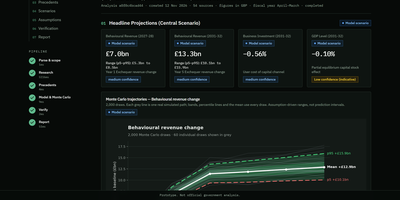
Eighteen independent checks decide whether Jane Avenue shows you a forecast of a UK tax change at all. Type a reform in plain English, such as corporation tax from 25% to 28%, and every parsed assumption appears as an editable field. A scope gate turns away negative rates, non-UK taxes, devolved rates, and steps beyond historical bounds. Research reads only official sources such as gov.uk, the OBR, and ONS, and matches each quoted number word for word against a saved copy of its page. Precedents from 16 corporation tax reforms since 1983 and 1,736 wider fiscal ones are ranked by similarity, with official costings kept apart from outcomes. The simulation reports revenue, investment, GDP, and the cost of capital across three scenarios, plus a 2,000-draw Monte Carlo whose ranges widen over time. Nineteen assumption sliders re-run it in milliseconds, and a ready reckoner covers 17 HMRC measures, including income tax, VAT, and fuel duty. The verifier recomputes the engine and audits every citation and every digit in the report. Reports carry numbered sections, traceable figures, and a source directory, and export to Markdown or PDF. An evaluation page shows the backtest and interval coverage, so you can judge the results. Cached mode replays recorded research with no API key, mock mode runs offline fixtures, and live mode uses your own Gemini key. Running on a dedicated VPS on RepoCloud with guaranteed CPU, RAM, and SSD, full root SSH access, and a browser serial console. MIT licensed.
Kvitok
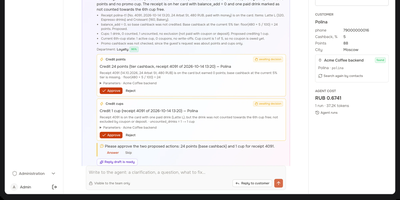
Kvitok is a helpdesk where an AI agent reads your backend, drafts the reply, and lines up the fix, so by the time an operator opens a ticket only the decision is left. Take a guest whose loyalty points never arrived: the agent finds her in your system, reads her receipts, and queues the missing credit for one click of approval. Requests arrive by mailbox or API channel, and your backend matches customers by phone, email, card number, or any identity it exposes. Rules you write run first and can set a department, priority, or tags, or skip the agent for senders such as partners. The agent calls tools your backend publishes, follows your playbooks, and picks a department with a confidence score, while your backend validates every action it proposes. Operators talk to the agent inside the ticket: say the receipt was really 540 and it revises only what that changes. Approved actions run exactly once, and the reply goes out by email or back through the channel the request came from. Each workspace picks its own model from any OpenAI-compatible endpoint, hosted or local, and every ticket shows what the agent spent. Test scenarios run against a real model, so policy or model changes get checked before reaching customers. Claude Code can tune rules and playbooks over MCP. Running on a dedicated VPS on RepoCloud with guaranteed CPU, RAM, and SSD, full root SSH access, and a browser serial console. AGPL-3.0 licensed.
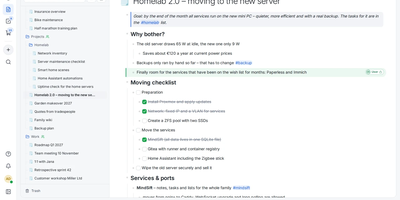
MindSift
Thoughts have branches, and MindSift is an outliner where any bullet can nest, people write in one note live, and tasks and lists sit beside the notes. Zoom into any branch, or drag it with its children into another note. Wiki links reach single bullets and survive renames. A lock covers only the bullet being typed in, so nobody overwrites anybody, even offline. Type /canvas for shapes, docking arrows, and freehand, drawn alone or live with others. A checkbox in a note can become a full task with due date and alarm, synced both ways. Tasks show as a list, a kanban board, or a calendar. Alarms and a daily summary arrive by email, push, Discord, or webhook. Shopping lists read quantities from the text and tick off live on every phone. Quick Dump catches a thought by shortcut, voice, or share menu and spots dates like tomorrow 2pm without AI. Triage then empties the inbox card by card into tasks, notes, or list items. Agents get 33 tools for tasks, lists, notes, and the inbox under per-key permissions. OAuth lets claude.ai and ChatGPT connect, and badges show what a key changed. OpenID Connect, passkeys, invite links, and organizations let a household or team share one server. Each person's backup includes a plain Markdown vault that Obsidian can open. Running on a dedicated VPS on RepoCloud with guaranteed CPU, RAM, and SSD, full root SSH access, and a browser serial console. AGPL-3.0 licensed.