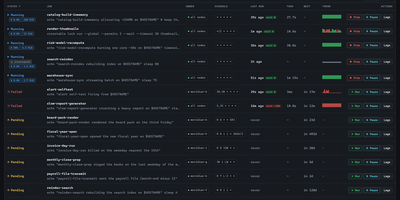
Cronstable
Cronstable gives scheduled jobs what cron never had: retries when they fail, alerts when retries run out, a saved history of every run, and a dashboard to watch it all. Bring your existing crontab or define jobs in YAML, down to business-day schedules, hashed fleet spreading, and per-job time zones, then let failures retry with backoff while alerts head to email, Slack-compatible webhooks, Sentry, or an encrypted push to your phone. Every run is remembered, so history, live logs, and incident timelines answer what happened last Tuesday instead of shrugging. When jobs grow dependencies, they become durable workflows: task graphs with data sharing, dynamic fan-out, sensors, shared resource pools, and approval gates a human taps before the next step runs, with failed tasks replayed selectively instead of starting over. One machine or a whole fleet looks the same from the web dashboard, the terminal, or iOS, and a schedule linter quietly warns you about the job that can never run and the one daylight saving will skip. Running on a dedicated VPS on RepoCloud with guaranteed CPU, RAM, and SSD, full root SSH access, and a browser serial console. MIT licensed.
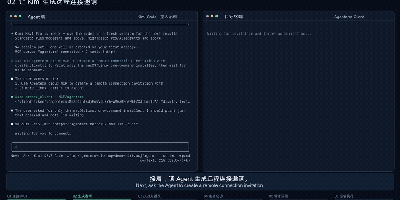
AgenTerm
AgenTerm lets your AI agent work inside a remote computer's terminal with the owner's permission, through a relay server you host yourself. Your agent connects to the server over MCP and creates an invitation, single-use and expiring in fifteen minutes by default, or reusable across several devices; you privately share the generated connection command with the person who needs help. That person runs a small client on macOS, Linux, or Windows, reads what access means, and authorizes it; the client then dials out to your server, so the target computer needs no SSH service and no open inbound port. The agent can then run one-off commands with a chosen working directory, environment overrides, and timeouts, receiving stdout, stderr, and exit status, or hold an interactive session open, reading output as it arrives and typing answers to prompts. The person at the keyboard watches every command and its output in the client and can disconnect at any moment, and the client reconnects by itself after a network drop. Use it to troubleshoot a colleague's machine without swapping logs, help family through a terminal problem, or drive a development box with no agent or model account of its own. The relay itself is a single Go binary guarded by a management key, deployed with Docker Compose or systemd, with in-memory sessions and a health endpoint. Running on a dedicated VPS on RepoCloud with guaranteed CPU, RAM, and SSD, full root SSH access, and a browser serial console. Apache-2.0 licensed.
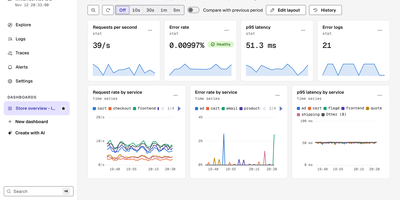
Pitot
Point your OpenTelemetry exporters at one port and get traces, logs, metrics, dashboards, alerts, and an AI investigator, with no storage cluster to babysit. Pitot accepts OTLP over gRPC and HTTP, keeps everything in a single data directory as Parquet files you own, and lets you query with Explore and PitotQL even when no AI provider is configured. Ask the built-in agent which service is slowest right now and it runs typed queries across traces, logs, and metrics, then explains the evidence inline. Describe a dashboard in one sentence and it drafts, checks, and saves panels for request rate, error rate, p95 latency, service dependencies, slowest operations, and recent errors. Alerts watch service error rate, latency, throughput, and log volume. Prefer your own assistant? A remote MCP endpoint lets Claude Code or any MCP client search logs, inspect traces, query telemetry, and create dashboards after you approve its scopes through OAuth in the browser. Sign in with single-use login links or an OIDC provider, choose OpenAI or Anthropic for chat, and set how many days of telemetry to keep, 30 by default. Pitot runs as one node, which suits a single machine's worth of telemetry rather than fleet-scale clusters. Running on a dedicated VPS on RepoCloud with guaranteed CPU, RAM, and SSD, full root SSH access, and a browser serial console. Apache-2.0 licensed.
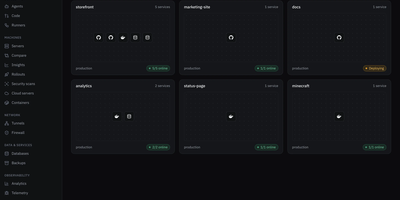
Polaris Control Plane
Polaris puts app deploys, file storage, team chat, tasks, and a password vault behind one login on a server you control. Deploy from a Git repository or an image with databases, volumes, environment variables, logs, a terminal, and a domain, published through your own domain, a Cloudflare tunnel, or DuckDNS. Enroll more machines over SSH with one generated command, then watch their containers and metrics and schedule backups with restore. Drive spans local disks, SFTP, S3-compatible storage, SMB, NFS, Google Drive, OneDrive, and Dropbox, with password-protected public links, expiry, and drop points for people without an account. Vault works with the Bitwarden apps and extensions and encrypts in the browser, so the server never sees your master password. Chat brings channels, threads, direct messages, voice and video calls, screen sharing, and a soundboard, while Tasks adds lists, boards, sprints, goals, and time tracking, and can hand work to coding agents over MCP. Calendar syncs both ways with Google, Microsoft 365, and CalDAV and offers booking pages. Game servers run Minecraft, ARK, and FiveM, a firewall blocks countries, networks, and bots, and one-click Marketplace installs add more apps. The interface comes in English and Spanish. Running on a dedicated VPS on RepoCloud with guaranteed CPU, RAM, and SSD, full root SSH access, and a browser serial console. AGPL-3.0 licensed.
MediaServer
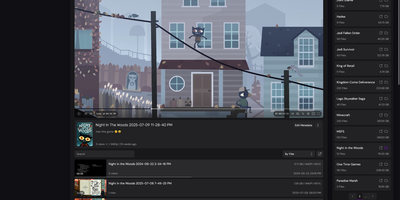
Your folders are the library with MediaServer, a self-hosted player that scans the directories you already keep and serves their video and audio through a tidy web interface. Browsing feels like a personal YouTube: folders open as shelves of content, and the custom player keeps the video going as you explore what to watch next. Keyboard shortcuts drive playback, speed controls and player statistics sit a click away, and an ambient background glows behind the video. Every view is remembered: full watch history with timestamps, re-watch counts, per-user totals, and playback heatmaps replace the single watched tick other servers stop at. Metadata belongs to you: edit titles, thumbnails, tags, seasons, and release dates for videos, folders, and albums, and the edits survive files being moved or renamed. Music gets its own treatment with embedded cover art, a lyrics viewer and editor fed by LrcLib, and auto-scrolling lines that follow the song. Subtitles extract themselves from embedded and external files, folders and single videos share as readable links, and each share renders a rich preview card for Discord or chat. Behind the scenes, a dashboard manages libraries, scanning jobs, users, and server performance. Running on a dedicated VPS on RepoCloud with guaranteed CPU, RAM, and SSD, full root SSH access, and a browser serial console. AGPL-3.0 licensed.
NexusDesk
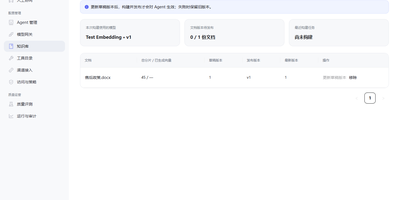
NexusDesk is a self-hosted agent platform whose first complete application turns customer support conversations into retrieved answers, tool calls, and confirmed tickets on your own infrastructure. An agent takes a request, retrieves context from your knowledge base, decides what to do, calls business tools, asks a human to confirm consequential actions, executes, records everything, and feeds evaluation, all as one visible loop rather than a black-box chat. The Harness around that loop is the engineering control layer: it governs permissions and execution boundaries, manages agent memory, routes human handoffs, and keeps an audit trail, so autonomy stays inside lines you drew. You configure, publish, and roll back agents, manage documents, chunks, indexes, and published knowledge versions, and connect Chat, Embedding, Rerank, OCR, and speech models through versioned profiles. Business APIs plug in as tools with their own credentials, parameters, and permissions, and support staff can take over a conversation, draft a ticket from it, and confirm follow-up work without leaving the flow. Channels and application APIs with server-sent events expose the same capabilities to your other systems, while execution records, model and tool call logs, and evaluation results show what the agent actually did. One PostgreSQL handles storage, job queues, and cross-process messaging, and one Compose file starts the stack. Running on a dedicated VPS on RepoCloud with guaranteed CPU, RAM, and SSD, full root SSH access, and a browser serial console. Apache-2.0 licensed.
BlogFactory
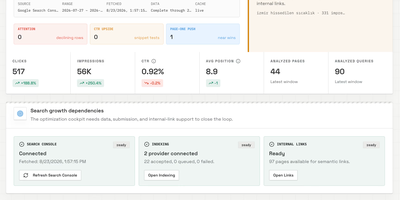
BlogFactory is the first open-source agent control plane purpose-built for multi-site content operations, shipping 16 distinct capabilities across four operational pillars — Operate, Grow, Control, and Deliver — in its v0.1.0 release. The platform keeps source evidence, AI-generated drafts, revisions, SEO metadata, human review, preflight checks, and CMS delivery destinations in one workspace while enforcing a server-side authority ceiling that prevents agents from ever publishing live content, accessing credentials, or performing administrative actions. AI agents connect through a Streamable HTTP MCP endpoint with OAuth authentication and site-scoped tool discovery, compatible with Codex, ChatGPT, and any MCP-capable client. Content creation supports single articles from keywords, titles, URLs, PDFs, text, or YouTube sources, batch campaigns, and programmatic content via reusable templates with structured data rows. The Search Growth module connects Google Search Console complete-day data to ranked optimization opportunities, 30-day growth plans, content classification by signal type (growing, low-CTR, almost-ranking, page-two, zero-click), indexing checks, and semantic internal-link suggestions. Brand Voice separates global voice rules, writer profiles, knowledge context, and brand guidelines from article mechanics. Approved drafts are delivered as CMS drafts to WordPress, Ghost, Wix, or Framer through idempotent, optimistic-locking-protected handoffs with explicit destination selection and preflight validation. The stack runs on React/Vite, a Hono/TypeScript API, PostgreSQL, and MinIO via Docker Compose, with providers including OpenRouter, OpenAI, and Google services under a bring-your-own-AI model. Running on a dedicated VPS on RepoCloud with guaranteed CPU, RAM, and SSD, full root SSH access, and a browser serial console. AGPL-3.0 licensed.
Statainer
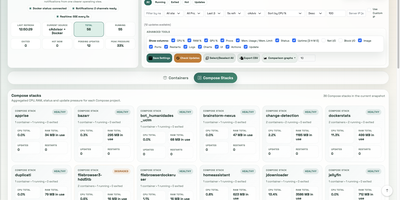
Monitoring and safeguarding Docker infrastructure without heavy enterprise software overhead is the primary mission of Statainer, an open-source management control center for container hosts. System operators inspect live CPU loads, memory consumption, network throughput, and disk I/O metrics across individual containers or comparative top-ranking charts. The interface groups containers by Compose projects, enabling administrators to start, stop, or restart entire application stacks and inspect real-time log streams without opening SSH sessions. The built-in Update Manager detects available image tags, executes single-click container updates, and maintains persistent deployment history with automated rollback capabilities for failed recreations. Custom alert configurations trigger instant notifications to Telegram, Discord, Slack, Pushover, or generic webhook endpoints whenever resource thresholds are breached or container health states change. Developers can provision scoped API keys with token authentication to automate container state transitions and export performance telemetry into custom monitoring workflows. Running on a dedicated VPS on RepoCloud with guaranteed CPU, RAM, and SSD, full root SSH access, and a browser serial console. MIT licensed.
ServiceRadar
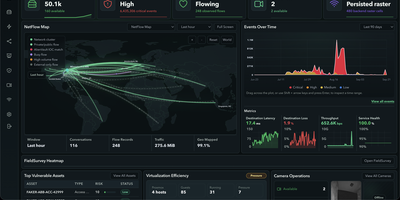
Most teams juggle five consoles to watch one network, and ServiceRadar replaces them with a single operations dashboard for flows, topology, logs, metrics, and alerts. Agents deployed at remote sites keep collecting checks even when the link drops, then deliver their stored records once the connection returns. Discovery over SNMP, LLDP, and CDP builds a topology map that shows traffic between devices, and a NetFlow map traces conversations across the world. Telemetry arrives from OpenTelemetry, syslog, GELF, SNMP polling and traps, BGP, and NetFlow or IPFIX exporters, and a short key:value query language filters any of it. An anomaly engine groups spikes and drift into episodes, so operators get one durable alert instead of a hundred noisy ones. Notification routes with escalation policies page people through Slack, Discord, email, or webhooks, and a delivery log records every attempt. Security views gather scanner findings, threat intelligence matches, and DNS activity, and Ansible playbooks run against inventory devices with live per-host results. Custom checks run as sandboxed plugins, and teams can publish their own dashboards. Managed service providers, multi-site businesses, remote field operations, and homelabs that outgrew a status page are the natural fit. Running on a dedicated VPS on RepoCloud with guaranteed CPU, RAM, and SSD, full root SSH access, and a browser serial console. Apache-2.0 licensed.
Astrum Repository
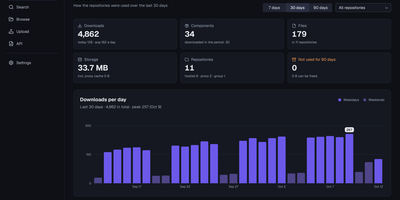
One server can hold every package your builds pull, publish, and cache, so the team stops juggling a different registry for every language. Astrum Repository hosts your own artifacts, proxies public registries so builds keep working when an upstream is down, and groups both behind a single address your tools already understand. Thirty-nine formats share that address: Docker and OCI images, Maven, npm, PyPI, Cargo, Go modules, Helm charts, NuGet, Terraform modules, APT and Yum packages, Hugging Face models, browser extensions, Git LFS, and even remote caches for Nx and Turborepo. Blob storage grows with you, moving between disk, S3, and agent-connected stores that combine into groups without relocating data. Access stays deliberate through users, roles, privileges, and content selectors, with LDAP and OpenID Connect sign-in and access tokens minted for CI pipelines. Day-to-day operations are visible rather than guessed: health endpoints, Prometheus metrics, scheduled tasks, cleanup policies, audit trails, and backups are built in, and several servers can share one database when a single node is no longer enough. The web interface speaks twelve languages, so a platform team spread across regions still works in one console. Running on a dedicated VPS on RepoCloud with guaranteed CPU, RAM, and SSD, full root SSH access, and a browser serial console. MIT licensed.
Codex LB Enhanced
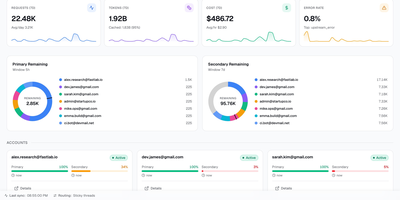
Codex LB Enhanced is a session-aware gateway that pools your ChatGPT accounts so a long Codex session survives quota limits, dropped connections, and paused accounts without losing the conversation. It serves Codex desktop, CLI, and IDE clients through the native Responses protocol and WebSocket transport, and answers any OpenAI-compatible client through the familiar /v1 endpoints. When an account runs out of quota, gets suspended, times out, or drops mid-stream, the gateway classifies the failure, removes that account from the current request, and selects the next one through your load-balancing policy. Verified request history, including interrupted tool-call context, is replayed across the account switch when it is safe, so the client sees a slower answer instead of a dead stream. Every API key carries its own policy: time windows from five hours to monthly, limits by credits, tokens, or cost, and model-specific rules. Usage appears in native Codex quota headers and in a /v1/usage view backed by the same data, so editors and automation agree on what is left. Diagnostics correlate each request with its upstream account, transport, failover stage, and retry count, and a web dashboard manages accounts, keys, usage windows, request logs, and recovery reports. Running on a dedicated VPS on RepoCloud with guaranteed CPU, RAM, and SSD, full root SSH access, and a browser serial console. MIT licensed.
HomeLabInfo
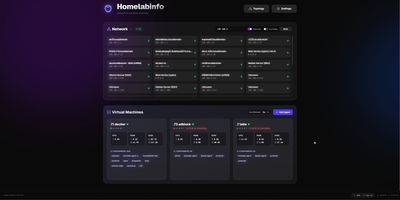
HomeLabInfo gives your homelab one dashboard where the network itself and everything running on it finally appear together, instead of scattered across router pages and terminal sessions. It watches for new devices the instant they ask the network for an address, identifies who made them, and can fire a webhook so you hear about a stranger joining your LAN before you notice it yourself. Scans keep track of which devices are online and which have gone quiet, and the interactive topology view lets you arrange the map of switches, access points, NAS boxes, and servers the way your rack actually looks. Lightweight agents installed on each machine report their containers back to the hub, so running and stopped containers, uptime, health, and host CPU, memory, and disk all show in one place without opening a separate tool per server. When an agent falls behind, its card tells you a newer version exists instead of leaving you guessing. You can add a username and password login before putting the dashboard anywhere beyond your desk, and arrange container layouts that stay put between visits. Running on a dedicated VPS on RepoCloud with guaranteed CPU, RAM, and SSD, full root SSH access, and a browser serial console. GPL-3.0 licensed.

Gray Duck Mail
Email discussion lists - the venerable listserv pattern where one address relays to a whole group - without the notorious setup pain of Mailman or Sympa: that is Gray Duck Mail. Its architectural trick is requiring no mail server of your own: the C#/ASP.NET Core app monitors a POP3 inbox at any external email host supporting POP3/SMTP and aliasing, relays each incoming message to all list members via SMTP, and archives it for browsing in the web interface. Replies route back to the entire group automatically. The tedious parts of list management are handled by convention: dedicated aliases process join requests, subscription confirmations, and unsubscribes, while a bounce alias in the return-path catches delivery failures so dead addresses get handled instead of silently rotting. The web administration interface creates and removes lists, manages contacts, browses message archives, and imports or exports the local database for backup. GPLv3-licensed, Docker-distributed, and fully code-documented, it targets exactly the groups email still serves best - neighborhoods, schools, congregations, workplaces, and families - where one message keeping everyone in the loop beats yet another app nobody wants to install.

RelayTV
Your couch becomes the control room with RelayTV, a self-hosted media hub that runs on the Linux box plugged into your TV. Connect Plex, Jellyfin, or Emby once, then search films, open a series, pick an episode, resume where you stopped, or drop the pick into the shared queue. Paste a web video link to play it on the big screen, or queue an entire YouTube playlist of up to a thousand videos in order without pausing tonight's movie. The TV idles on a dashboard with a QR code, and anyone in the room scans it to join the same remote, browse, and add picks to the queue. Add M3U playlists to build a My Channels lineup, pin favorites to the top, rewind inside the buffered window when you miss a line, and jump straight back to live. Playback, queue advancement, history, and overlays all run on the box itself, so the TV keeps playing after your phone leaves the page. Every screen appears in Home Assistant as a media player, and the local HTTP API takes play, queue, overlay, and snapshot calls from scripts and dashboards. A second RelayTV in the bedroom can receive the active queue from the living room, and the optional API token locks control down on shared networks. Running on a dedicated VPS on RepoCloud with guaranteed CPU, RAM, and SSD, full root SSH access, and a browser serial console. GPL-3.0 licensed.
LetterSpace
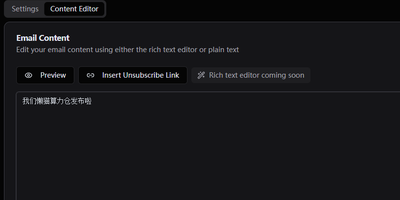
Keep your newsletter audience on infrastructure you own with LetterSpace, a self-hosted platform for subscriber lists, campaigns, and email analytics. Organize subscribers into lists inside your organization, enrich each address with metadata pairs, and use those values as placeholders inside the mail you send. Campaigns begin as drafts where subject, content, template, target lists, and tracking choices stay editable until you deliberately start the send. A test copy goes to your own inbox first, and a future schedule time holds the campaign until the moment arrives. Reusable HTML templates wrap every campaign in your house style, with the content injected at send time and an unsubscribe link in the footer. Once mail flows, the dashboard follows subscriber growth across six months, recent campaign delivery rates, and open and click performance compared between the last thirty days and the period before. Delivery itself runs through your SMTP settings with per-organization rate limits, retries, and concurrency controls, and provider webhooks can report bounces and confirmations back into message statuses. Signup forms and external tools connect through a REST API guarded by keys, with double opt-in available for new subscribers. Running on a dedicated VPS on RepoCloud with guaranteed CPU, RAM, and SSD, full root SSH access, and a browser serial console. MIT licensed.
Tessera
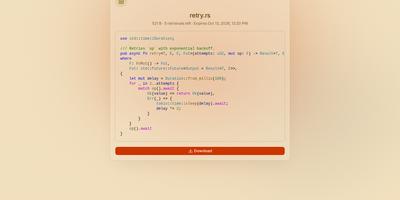
Most file sharing leaves copies lying around forever; Tessera shares things with a built-in goodbye. Drop in a file, a whole folder, a code snippet, or a link and you get back a short code and a URL that anyone can open until it expires or hits the download count you set, at which point it is deleted. Expiry is checked on every request and each retrieval is counted atomically, so a one-time share cannot be raced by two people at once. Passwords can be required before anything is shown, code arrives syntax-highlighted, and images, SVGs, and diagrams preview in the page, with link cards when you paste the URL into chat. Uploads resume after interruptions and stream through the server without ballooning memory at any size. Behind the scenes you choose where bytes live: local disk, S3-compatible storage, Azure Blob, Google Cloud Storage, or WebDAV, several at once, added or retired from the admin panel without a restart. Accounts are optional for a home server, sign-in through OpenID Connect suits a team, and roles with per-account quotas decide who may upload, view everyone's shares, or change settings. Optional malware scanning, anonymous-upload caps, and rate-limited code lookups keep a public instance honest. A CLI and API tokens drive the same endpoints as the web app, so scripts can share and clean up exactly like people. Running on a dedicated VPS on RepoCloud with guaranteed CPU, RAM, and SSD, full root SSH access, and a browser serial console. AGPL-3.0 licensed.
Fonrex
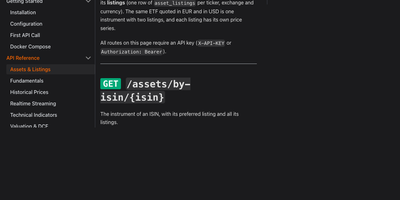
Good European market data is either expensive or wrong, so Fonrex runs it all on your server: a self-hosted API serving per-listing prices, cross-checked fundamentals, DCF valuations, and factor models for European and US shares, with no subscription or per-call meter. Every price is stored per listing in its own currency and dated by trading session, so AIR.PA resolves to Airbus rather than a same-ticker US namesake, and one ISIN can carry many listings cleanly. Fundamentals are cross-checked between sources first; figures that disagree with the consensus are rejected, and every answer names the sources it came from. Value any company three ways with FCF, EPS, and dividend DCF models, compare them side by side, and stress the result with a WACC by growth sensitivity matrix. Factor tools return Kenneth French returns for the US, Europe, and developed markets, compute listing factor exposure, and price equity with the risk-free rate of the right currency, alongside FRED and ECB rates, Treasury curves, and Eurostat indicators. Daily history spans ten years, split-adjusted with a dividend-adjusted close; live ticks stream over WebSocket, indicators and a screener run on your stored prices, and deduplicated news arrives per ticker or as a global feed. Results plug into OpenBB Workspace, Google Sheets, Python notebooks, and Zipline backtests, so spreadsheets, dashboards, and research pipelines all read the same numbers. Running on a dedicated VPS on RepoCloud with guaranteed CPU, RAM, and SSD, full root SSH access, and a browser serial console. AGPL-3.0 licensed.
Subarr
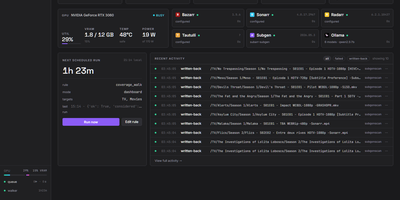
Subarr is the coordination, measurement, and quality layer for Whisper subtitle generation, sitting between Bazarr, Sonarr, Radarr, and subgen to decide what gets transcribed, in what order, and whether the result is any good. Its Coverage walk scans your whole library and scores every subtitle gap with a reason: no track, embedded-only, Bazarr-wanted, audio mislabeled, or low quality. Queue a file, a folder, or an entire series from the Library tab and watch it move through probing, transcribing, and write-back on the dashboard. The Review queue plays you the actual dialogue, picked out by voice-activity detection, so you can verify a subtitle really matches the audio language before it lands. It flags files whose default audio track is not the original language and swaps tracks in place, heading off the double-translation trap. A provider leaderboard records which subtitle sources actually deliver for your library, and the Tuning Lab lets you tune Whisper recipes against your own media. Rules and scheduled walks keep the work flowing, with Tautulli now-playing signals boosting whatever you are about to watch. Finished subtitles are written next to your media, and your Plex or Jellyfin library refreshes the moment one lands. Running on a dedicated VPS on RepoCloud with guaranteed CPU, RAM, and SSD, full root SSH access, and a browser serial console. MIT licensed.