GitHub Release Monitor
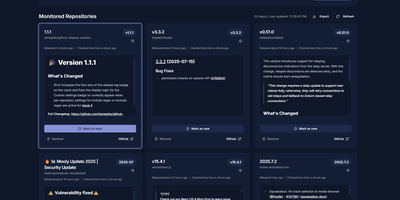
GitHub Release Monitor turns release day into a notification instead of a discovery, watching GitHub, GitLab, Codeberg, and self-hosted Forgejo repositories in the background and reporting each new release to the channels you already read. Your watchlist is the whole interface. Add the projects your stack depends on, and scheduled checks compare what is published against what you have seen. Email carries the full notes over SMTP. Apprise carries them further, to Discord, Telegram, Slack, and dozens of other services, either one message per release or bundled into a digest for each check. Filtering happens at two levels. Global rules decide which release types count, and any repository can override them with its own channels, its own include and exclude regular expressions on tags, and its own choice of alpha, beta, or release candidate lines. A pattern the current engine no longer supports is flagged in settings rather than silently passing nothing. The list itself is portable JSON, ready to export from one install and import into another. When the alerts stop, the diagnostics page separates suspicion from evidence by testing forge connectivity, SMTP, and Apprise in one place. Accounts protect the app, dark mode and nineteen languages shape it, and the layout works on a phone. Running on a dedicated VPS on RepoCloud with guaranteed CPU, RAM, and SSD, full root SSH access, and a browser serial console. AGPL-3.0 licensed.
ghstats
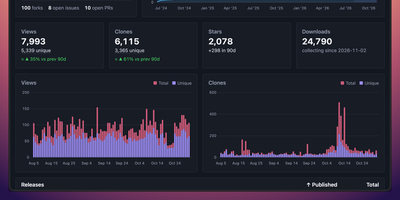
GitHub forgets your traffic after fourteen days; ghstats remembers it for years. This self-hosted dashboard polls the GitHub API every hour and keeps views, clones, stars, forks, issues, and pull requests for every repository in its own database, long after the built-in traffic tab has rolled over. Open a repository to see its charts for stars, clones, and views next to top referrers and popular paths, filter the list by owner, name, forks, or archived status, and include private repositories when your token allows it. Public stats pages and portfolios reuse the same numbers through a JSON API, embeddable SVG badges for views, clones, and star velocity, and cards ranking your top repositories or showing star history across projects. Release download counts accumulate as daily snapshots too, so a launch spike stays visible months later. The whole service is one small Docker image on port 8080 with a single file for storage, easy to back up and easy to move. Running on a dedicated VPS on RepoCloud with guaranteed CPU, RAM, and SSD, full root SSH access, and a browser serial console. MIT licensed.
OvertChat
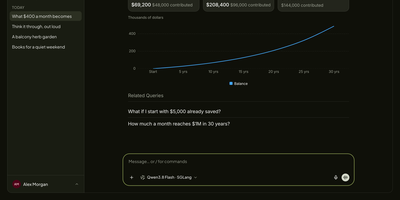
Your household gets one private chat front door for the models you already run, local or hosted, with voice, search, and coding agents included from the same server. Point it at Ollama, vLLM, llama.cpp, SGLang, or LM Studio, then add OpenAI, Anthropic, Gemini, DeepSeek, Bedrock, or OpenRouter beside them. Models that support tools can answer with charts, tables, forms, and follow-up buttons instead of plain paragraphs. Ask for a live conversation and speak, hear the reply, cut in mid-sentence, and keep going; Parakeet handles recognition and Kokoro speaks back on CPU or GPU. Documents open beside the chat for drafting and revising Markdown, code, web pages, SVG, and Mermaid diagrams. Attach spreadsheets, PDFs, images, Word, Excel, CSV, or source files and run Python on them in an offline sandbox that returns charts, cleaned data, or finished documents. Search the web through bundled SearXNG or Brave, read pages with inline citations, connect MCP servers, and set thinking controls per local model. Replies keep streaming after you close the tab, full-text search finds old answers, and read-only links share a conversation. Coding agents run on your machines or over SSH and stay reachable from browser, desktop, Android, or iOS. Running on a dedicated VPS on RepoCloud with guaranteed CPU, RAM, and SSD, full root SSH access, and a browser serial console. MIT licensed.
Warpdrive
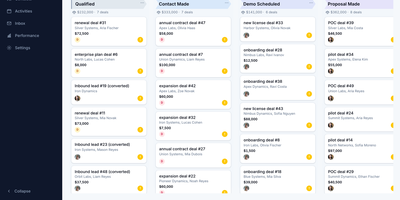
Warpdrive is a self-hosted sales CRM that gives business-development teams the complete Pipedrive workflow, pipelines, deal timelines, and two-way Gmail, on infrastructure they own outright. Drag deals across a Kanban board with custom stages while per-stage weighted totals, rotting-deal warnings, and saved filters keep the forecast honest without a weekly cleanup meeting. Every deal opens into one workspace where activities, notes, files, emails, and the full change history share a single timeline, with participants, followers, labels, and lost reasons attached. People and organizations carry custom fields, firmographics, and org-to-org relationships, and a leads inbox plus CSV import with an undo step keeps new data from corrupting the book. Contact enrichment from Apollo, RocketReach, and GetProspect fills empty people and organization fields, and every enriched value waits behind an explicit review step before it lands. Two-way Gmail sync threads every message onto its deal and contact automatically, and templates, signatures, merge fields, scheduled sends, and open tracking live in the same inbox. Boards, inboxes, and notifications update in real time across the team, while funnel and activity stats show exactly where deals stall and who is carrying the pipeline. An MCP server lets AI assistants query the pipeline and log activity under the same permissions, and role-based access keeps every seat scoped to its own work. Running on a dedicated VPS on RepoCloud with guaranteed CPU, RAM, and SSD, full root SSH access, and a browser serial console. MIT licensed.
Daily Stars Explorer
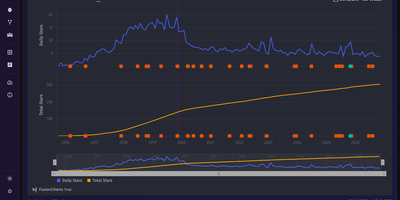
From a one-day Hacker News spike to a decade of steady growth, Daily Stars Explorer charts any GitHub repository's star history day by day, next to the releases and mentions that explain it. Type an owner and repository name, and daily and cumulative stars appear. Range shortcuts: 10Y, 5Y, YTD, QTD, MTD, and All. Zoom with a draggable lower navigator, switch to a Log Y axis, and read the stars gained inside the selected window. Transforms reshape the series. A trend line projects 30 days ahead. Yearly, monthly, or weekly grouping. Peak normalization. LOESS smoothing. Running average and median. First and second derivatives. Weekly growth rate. Feed overlays, enabled by optional provider credentials, mark releases and mentions from Hacker News, Reddit, GitHub, and YouTube right on the curve. Compare two already-fetched repositories on shared axes, with an aggregate selector, Log Y, and optional star milestones, then copy the link. With a GitHub token, separate pages chart commits, with the longest gap highlighted on demand, plus pull requests, issues, forks, and contributors. Global activity counts the public repositories or pull requests created on GitHub each day. Featured repos lists Hacker News and Reddit posts that link to GitHub projects, sortable by points, comments, or date. Star history, commit, and activity charts export to CSV or JSON. Favorite repositories can be pinned. Running on a dedicated VPS on RepoCloud with guaranteed CPU, RAM, and SSD, full root SSH access, and a browser serial console. MIT licensed.
LogForge
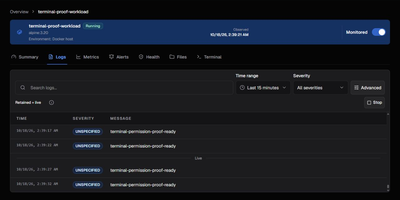
LogForge puts container logs, metrics, events, alerts, and guarded fixes behind one self-hosted web UI for Docker. The overview gathers container health, status, logs, metrics, Docker events, and file access for its host, so a sick container gets inspected without juggling docker commands across terminals. Logs stream in real time, interactive terminals open into running containers, and collected logs, metrics, and events are stored for later review and trend checks. Alert rules watch logs, metrics, and container events, and one-click templates cover stability, performance, log, and security signals. Fired rules notify through Email, Slack, Teams, Discord, Telegram, Gotify, or webhooks, and alert history records acknowledgements plus delivery attempts. A rule can also act: restart, stop, start, kill, or run a script, throttled by cooldowns, rate limits, backoff, and verification delays so automation cannot thrash a host. Other Docker hosts join through mTLS-protected agent enrollment, letting one console watch a small fleet. Running on a dedicated VPS on RepoCloud with guaranteed CPU, RAM, and SSD, full root SSH access, and a browser serial console. Apache-2.0 licensed.
PrettyPleasePrint
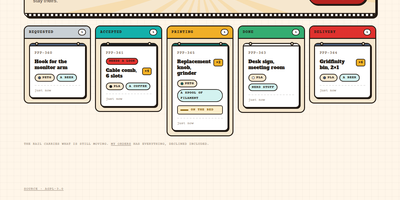
Pretty Please Print turns one office's shared 3D printer into an invite-only request board: colleagues upload a model and follow it from request to delivery. Requesters upload an STL or 3MF file, or start from a Printables link the owner enabled, and the mesh renders in the browser, auto-framed and draggable, so everyone checks the geometry first. Every request becomes a ticket that the printer owner moves through Requested, Accepted, Printing, and Delivery, or declines with a reason, and requesters can withdraw their own print before it reaches the bed. Slicer specifics like layer height, infill, supports, and temperatures ride along as notes on the ticket, a low, medium, or high priority keeps the owner's queue ordered, and a conversation thread on each ticket replaces lost chat threads. The owner curates the materials and colours on the shelf, with swatches and a rainbow whatever option, and defines the tips requesters can offer, preferred ones starred. Finished jobs collect in a filterable history: Print again reopens the form with the model copied server-side and fields adjustable, and one click sends a model straight to PrusaSlicer. Accounts are invitation-only; access can be revoked with a global sign-out, every change lands in an audit trail that cannot be edited, and the same tickets are exposed over a JSON API documented in OpenAPI 3.1 with a Swagger console. Running on a dedicated VPS on RepoCloud with guaranteed CPU, RAM, and SSD, full root SSH access, and a browser serial console. AGPL-3.0 licensed.
Tunnet
One encrypted network for every machine you run: Tunnet links laptops, home servers, cloud instances, and CI runners into a private mesh that behaves like a single LAN. Each enrolled machine gets an overlay IP and a hostname, so ordinary tools like ping, curl, SSH, and the browser just work across home servers, cloud instances, and laptops. Publish an internal app to your peers with Serve, or expose a local service to the public internet with an HTTPS tunnel when you need a shareable link. Send files directly between machines without detouring through cloud drives, email attachments, or fragile copy commands. SSH access follows identity instead of scattered key files, with session recording and no bastion host to maintain. Device posture checks gate which machines may join, and subnet routes, exit nodes, and high-availability gateways extend the fabric to whole networks. Write your ACLs, groups, tags, and SSH rules as Policy as Code in Git, simulate changes offline, review semantic diffs on pull requests, and roll back revisions when a change misbehaves. The Kubernetes operator advertises cluster networks, publishes services to peers, and exposes public HTTPS endpoints through custom resources. Run the full stack yourself, control plane, dashboard, management API, relays, and audit logs included, or skip the server entirely with Direct mode for a zero-server peer-to-peer mesh. Running on a dedicated VPS on RepoCloud with guaranteed CPU, RAM, and SSD, full root SSH access, and a browser serial console. AGPL-3.0 and MPL-2.0 licensed.
Airbroke
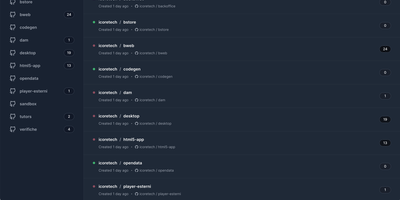
Engineering teams use Airbroke to catch application exceptions in one self-hosted error tracker where they can triage issues, replay failing requests, and debug without a per-event bill. Your existing Airbrake or Sentry clients point at its compatible HTTP collector endpoints, so instrumented applications keep reporting with no new SDK to adopt, and every occurrence lands in storage where the footprint stays small even under heavy ingestion. The web interface groups errors into issues you can triage, bookmark important occurrences for follow-up, and read occurrence charts that show whether a bug is a one-off or a slow-building wave. When an HTTP exception looks suspicious, you can replay the original request directly or copy a generated cURL command that reproduces it exactly, turning vague log complaints into debuggable cases. An AI assistant answers questions about issues in context, an MCP API lets LLM agents query your error data programmatically, and multiple OAuth providers secure sign-in for the team. It runs as a small service needing only a database, a single core, and a few hundred megabytes of memory. Running on a dedicated VPS on RepoCloud with guaranteed CPU, RAM, and SSD, full root SSH access, and a browser serial console. MIT licensed.
HotHost
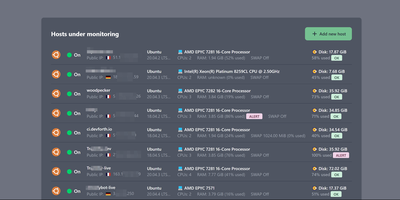
HotHost answers the only two questions that matter about every server you own, is it up and is the disk about to fill, before your users ask them instead. One web container collects metrics from a tiny agent you paste onto each host as a Docker or shell snippet, and the fleet lands in a single table: hostname, public IP, RAM and disk usage, CPU model and cores, swap state, and country. Disk and RAM get loud ALERT badges at a configurable threshold, ninety percent by default, and notifications fire on failure and again on recovery, so a resolved incident closes its own loop. The same console watches your websites directly, requesting each URL on your interval and checking the status code, a required keyword in the response, or basic auth behavior. SSL certificates get an expiration reminder fourteen days out by default, long before the browser warnings start. When memory climbs, the top ten RAM-consuming processes are charted over the last two days, turning "something is eating the box" into a named culprit. Alerts route through Email, Slack, Telegram, or Gmail plugins, and the plugin system accepts your own notifiers. Running on a dedicated VPS on RepoCloud with guaranteed CPU, RAM, and SSD, full root SSH access, and a browser serial console. MIT licensed.
Coral by Subgentic
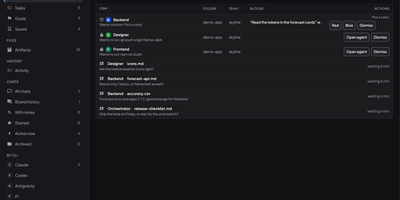
No more hunting through terminal tabs for the coding agent that stalled on a permission prompt, because Coral queues every question, approval, and file review in one Inbox. Claude Code, Codex, and Antigravity run side by side as one team, each in its own terminal session, sharing a message board and a task queue where dependencies wait on outcomes and required artifacts. Goals carry a checkable Done when line, and review gates hold dependent tasks until a reviewer approves. Files an agent produces open in a versioned viewer where you comment on passages, mark up images with a pen, arrow, or box, compare version two against version one, then approve, approve with a note, or request changes. A changed-files panel shows each agent's diff beside its chat, and optional git worktrees keep the main checkout clean. Idle agents sleep and wake when a message arrives, and whole teams can sleep through a restart. Scheduled jobs and multi-step workflows run regression suites and audits on a cron, resource queues keep concurrent agents off the same build rig, and analytics break token spend down by provider, model, thinking level, team, and task. A QR-paired phone client approves prompts on the go, and a self-hosted hub follows agents across computers. Running on a dedicated VPS on RepoCloud with guaranteed CPU, RAM, and SSD, full root SSH access, and a browser serial console. Apache-2.0 licensed.
Bookshelf
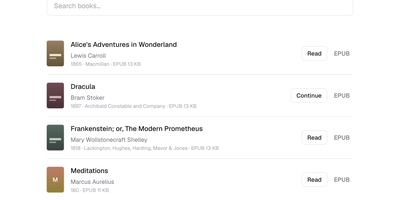
Bookshelf turns a folder of EPUBs and PDFs you already own into a private library you can browse and read from any browser, at home or on your own server. Drop books into a folder, run the sync, and the shelf appears with covers extracted, titles searchable, and accents forgiven, so typing Bronte finds Brontë. Each reader in the house gets a profile that remembers their place in every book, and picking a book up on your phone resumes where the laptop left it, with a Continue button waiting on the shelf. EPUBs open chapter by chapter instead of downloading the whole archive, and PDFs stream in small ranged reads, so even a large scanned book opens quickly. Choose a two-page spread, a single page, or continuous scroll, then set paper, sepia, or night tints for longer sessions. E-readers join through the OPDS catalog, which lets a Kobo or Kindle-side client browse and download from the same shelf. There is no database to run and no account system to manage; the library is plain files you can back up with the volume. Running on a dedicated VPS on RepoCloud with guaranteed CPU, RAM, and SSD, full root SSH access, and a browser serial console. MIT licensed.

Clu Comics
Comic Library Utilities (CLU) is a self-hosted comic library manager that converts, repairs, tags, downloads, and reads your entire comic collection from one web interface. Convert whole folders or libraries from CBR to CBZ in bulk, turn PDFs into CBZ with JPEG or WebP output, and rename thousands of files to one consistent pattern without touching a terminal. Open any CBZ in the browser editor to reorder pages, add or delete images, crop covers, split merged multi issue archives, and adjust contrast and brightness issue by issue. Write ComicInfo.xml from Metron, ComicVine, Grand Comics Database, AniList, MangaDex, MangaUpdates, or Bedetheque, then bulk apply tags across a directory with review before saving and a history log that can revert any change. Browse your library by publisher, series, or folder, read page by page in the built in reader that remembers your place, and follow weekly release calendars with a pull list and Wanted tracker for issues you do not own yet. Download new issues from Direct Download sources, Usenet through Newznab indexers with SABnzbd or NZBGet, and DC++, while folder monitoring unpacks, converts, renames, and files new arrivals automatically. Add Reader, Clerk, and Store Owner accounts with per folder permissions, publish OPDS feeds for reader apps, and sync reading history with Komga. Running on a dedicated VPS on RepoCloud with guaranteed CPU, RAM, and SSD, full root SSH access, and a browser serial console. GPL-3.0 licensed.
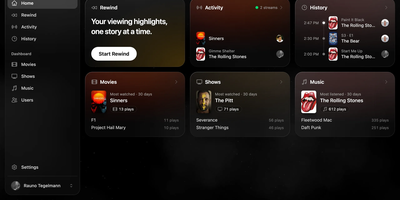
Rewindarr
Spotify gets a Wrapped; your media server deserves one too. Rewindarr is an open-source companion for Plex and Jellyfin that turns play history into a story your users step through, card by card: total watch time, how it split across movies, shows, and music, how they rank against the average viewer, and the viewing personality their habits earn them, ending in a summary they can save as an image and share. The same deployment doubles as an everyday dashboard for the whole server, with watch time, requests, library size, and per-library leaderboards for movies, shows, music, and users across a week, a month, a year, or all time. Live activity shows what is streaming right now, and searchable history groups binges together so a weekend disappears into one tidy entry. Ratings from TMDB, IMDb, and Rotten Tomatoes sit beside every title, request buttons reconnect viewers with deleted favourites through Seerr, and anonymisation trims user details when you share the dashboard wider. Statistics flow in from Tautulli or Tracearr for Plex and from Tracearr for Jellyfin, everyone signs in with the Plex or Jellyfin account they already have, and the installable app works on the TV-side phone as happily as on a desktop. Running on a dedicated VPS on RepoCloud with guaranteed CPU, RAM, and SSD, full root SSH access, and a browser serial console. GPL-3.0 licensed.

ShowAI
Your coding agent answers a question, and instead of a wall of Markdown you get a page you can actually use. ShowAI turns replies into interactive pages built from text, tables, charts, flow diagrams, sliders, and boards, so you can drag a weight, compare options, or step through an idea and watch the result change. Every page is saved as versioned files in a local project, with undo, retained drafts, and conflict protection, and the agent reads your edits before it continues. Select any text, cell, or board object to ask the agent to expand, reorganize, or visualize it, and run several conversations on one project in parallel. When a needed component is missing, the agent builds it, and pages that work can be distilled into templates. Export a page as standalone HTML, an inline fragment, or a static site. Connect a self-hosted ShowAI Server for projects shared by administrators, editors, and viewers, with account login and device management. Running on a dedicated VPS on RepoCloud with guaranteed CPU, RAM, and SSD, full root SSH access, and a browser serial console. MIT licensed.
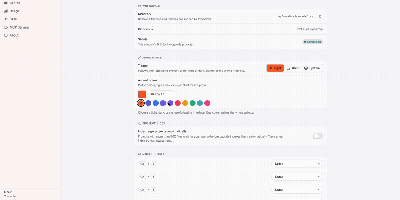
Ogcode
Ogcode puts a full AI coding agent in a browser tab pointed at your own server, where it maps your codebase semantically before reading it, plans changes across files, runs your builds and test suites, and answers with diagrams and documents alongside the shipped code. Before reading files it maps the project with a semantic index, outlines what matters with exact line ranges, and reads only the parts that count, so unfamiliar code becomes navigable in one session. Ask it to implement a feature or chase a failing test and it plans the work, edits across files, runs your builds and test suites, and investigates failures instead of retrying blindly. You stay in control through per-session permission modes: Ask approves each step, Auto gates by risk, and Yolo lets it run, with every decision remembered when you want it to be. Past decisions are recalled instead of replaying whole transcripts, so long sessions stay focused and affordable, and the agent can research as it goes with built-in web search, reusable SKILL.md workflows, and external MCP servers. Answers come back richer than text when the work calls for it, with diagrams, rendered documents, charts, and downloadable artifacts in the same session. Connect Anthropic, OpenAI, OpenRouter, or a local Ollama endpoint and start working. Running on a dedicated VPS on RepoCloud with guaranteed CPU, RAM, and SSD, full root SSH access, and a browser serial console. AGPL-3.0 licensed.
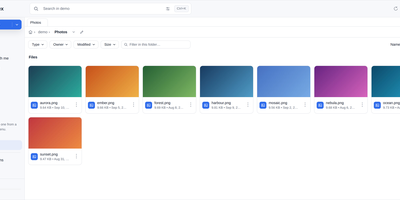
Filex
Your files already live in five places; filex puts them in one tree and serves that tree back out through almost any protocol. Mount local disks, S3 buckets, SFTP servers, WebDAV shares, FTP sites, and SMB network drives side by side, then copy in one storage and paste into another without thinking about where anything physically sits. The same tree is reachable as S3, SFTP, FTPS, NFS, and WebDAV, so rclone, restic, the AWS CLI, WinSCP, or FileZilla all work against it with the same per-user and per-folder permissions as the web interface. Sharing leaves the server under your control: public links carry a PIN, an expiry, and a download limit, and file-request links let people upload into a folder without seeing its contents. Anything deleted stays recoverable inside a retention window, overwritten files keep version snapshots, and encrypted folders are sealed in the browser so the server never receives a key. People sign in with OIDC single sign-on, LDAP or Active Directory, or the host machine's own accounts, with roles, groups, and tenants plus folder-level exceptions. A desktop app keeps chosen folders in sync within about a second, the file manager embeds into other products as a web component, and an MCP server plus REST API let agents work the same tree. It runs from one static binary or container on port 5212. Running on a dedicated VPS on RepoCloud with guaranteed CPU, RAM, and SSD, full root SSH access, and a browser serial console. MIT licensed.
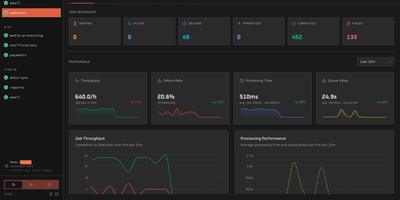
bullstudio
bullstudio turns a pile of opaque Redis keys into a live control panel for your BullMQ and Bull queues, so you can see what is stuck, failing, or delayed without opening a Redis CLI. Point it at a Redis URL and it discovers every queue and prefix on its own, including Redis Cluster setups. The overview page tracks waiting, active, delayed, prioritized, completed, and failed counts next to throughput, failure rate, processing time, and queue delay charts. Open any job to read its input data, logs, return value, and stack trace, then retry, promote, or remove it in one click. Flow view draws parent and child jobs as a color-coded dependency graph, which makes it easy to spot the step where a multi-stage job stalled. Separate screens list connected workers with their concurrency and heartbeat, and show repeatable and cron schedules with their next run time. Pause, resume, drain, or clean a queue directly from the header. Basic authentication, a read-only mode, and a base path for reverse proxies keep access under control. Running on a dedicated VPS on RepoCloud with guaranteed CPU, RAM, and SSD, full root SSH access, and a browser serial console. MIT licensed.