OSIRIS
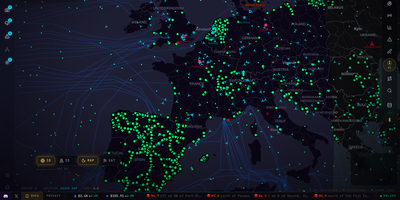
Plotting live flights, earthquakes, wildfires, satellites, and news streams on one night-mode map, OSIRIS gives open-source intelligence work a single browser tab to live in. Sixteen layers toggle on and off with live entity counts. Aviation covers commercial, private, and military traffic. Ports and chokepoints, severe weather, space weather, and 15 hand-curated conflict zones get layers too. More than 17,000 public cameras open in a viewer when you click a pin. Draw a region, list every camera inside it, and export the set as GeoJSON. Twenty-three live news streams open from dots on the map. Double right-click anywhere for a Region Dossier with the place, country facts, head of state, and a Wikipedia summary. A Markets terminal follows indices, stocks, oil, commodities, currencies, and crypto, with a watchlist. Live Alerts sorts headlines, warnings, and quakes into searchable tabs. The Recon toolkit runs DNS, WHOIS, certificate, and subdomain lookups, searches the OFAC sanctions list, and traces BTC and ETH wallets. OI, the built-in assistant, flies the map to a place and switches layers on from typed or spoken requests. Its Forecast mode plays competing actors against each other in parallel simulated worlds and writes a sourced prediction on your own model key. Six preset themes restyle the whole interface. Running on a dedicated VPS on RepoCloud with guaranteed CPU, RAM, and SSD, full root SSH access, and a browser serial console. MIT licensed.
Warracker
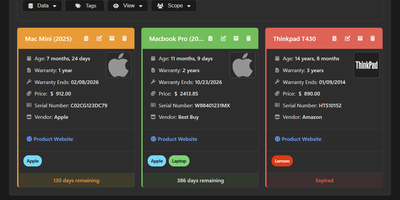
Stop losing money on out-of-pocket repairs for appliances and electronics that are still covered under manufacturer protection: Warracker gives households and organizations a centralized web platform to track product warranties, store purchase receipts, and manage active claims before coverage expires. You can log purchase dates, multi-part warranty durations in years, months, or days, lifetime coverage flags, vendor details, purchase prices, and multiple comma-separated serial numbers per item alongside product photos. When a coverage window approaches its end date, the platform dispatches automated reminders through email or more than 100 push notification services, including Discord, Slack, Telegram, Pushover, and ntfy. Receipts, invoices, and user manuals can be stored locally or routed directly into an existing Paperless-ngx archive with per-document storage selection and automatic tagging. A dedicated warranty claim tracker records claim submission dates, current statuses, and final resolutions across the entire repair lifecycle. Visual status dashboards chart active, expiring, and expired coverage alongside spending breakdowns across multiple currencies. Role-based multi-user accounts, OIDC single sign-on, persistent cross-device search filters, CSV bulk import and export, and localization across 20 languages make administration effortless. Running on a dedicated VPS on RepoCloud with guaranteed CPU, RAM, and SSD, full root SSH access, and a browser serial console. AGPL-3.0 licensed.
HomeTube
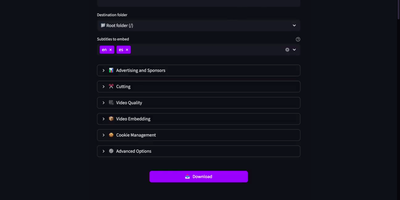
Archiving online videos, creator channels, and curated playlists directly into a personal Plex, Jellyfin, or Emby library becomes effortless with HomeTube, a self-hosted web downloader supporting more than 1,800 streaming platforms. Users paste a single video or playlist URL into the web interface, where an intelligent format analyzer evaluates available codecs and automatically selects the highest resolution video and audio streams such as 4K AV1 or VP9 paired with Opus audio. Built-in SponsorBlock integration detects crowd-sourced sponsor segments, intros, outros, and self-promotions during the download process so saved videos play back completely ad-free without manual editing. When synchronizing playlists, the engine tracks entries by unique video ID rather than mutable titles, downloads only newly added items, preserves upstream ordering with customizable filename templates, and optionally moves removed videos into an archive folder. A visual processing panel lets operators trim specific time ranges with keyframe or frame-precise cutting, embed primary and secondary subtitle tracks alongside chapter markers, and create nested destination directories directly from the browser. Browser cookie file support unlocks age-restricted or member-only streams, while custom yt-dlp argument pass-through accommodates proxy routing and filesize caps. Once processing finishes, completed files move into watched media folders and can trigger an immediate Jellyfin library rescan via API key. Running on a dedicated VPS on RepoCloud with guaranteed CPU, RAM, and SSD, full root SSH access, and a browser serial console. AGPL-3.0 licensed.
WatchState
Instead of relying on third-party cloud trackers to keep watched history aligned across Plex, Jellyfin, and Emby, WatchState synchronizes playback state and watch progress directly between your own self-hosted media servers. Household administrators can map multiple family members across independent backend accounts using isolated user identities, configuring either one-way mirroring from a primary server or full many-to-many synchronization across every connected instance. A unified generic webhook endpoint captures play, pause, stop, and watched events from Plex, Tautulli, Jellyfin, and Emby for near-instant state propagation, while scheduled background import and export tasks reconcile any missed updates automatically. When libraries grow across multiple servers, the built-in Media Health diagnostic engine audits the database for external GUID conflicts, duplicate file references, metadata disagreements, weak matches, and missing local files, complete with exportable reports and per-record action hints. Users can also search backend metadata, inspect detailed item event logs, and export portable JSON backups of their entire watch history for safe server migrations. Running on a dedicated VPS on RepoCloud with guaranteed CPU, RAM, and SSD, full root SSH access, and a browser serial console. MIT licensed.
Calagopus
When hosting multiplayer game servers for communities or friends requires container isolation and low-overhead administration, Calagopus steps in as a modern game server management panel. Server operators use it to deploy and control Minecraft, Rust, ARK, Valheim, FiveM, and any other Linux containerized workload while reusing existing Pterodactyl and Pelican eggs without modification. From the live WebSocket console, administrators monitor real-time CPU, memory, and network graphs, autocomplete saved command snippets, inspect per-layer Docker image pull progress bars, and pop the terminal out into a secondary window. Managing configuration files and modpacks happens directly in the browser through a split-pane tabbed editor featuring real-time collaborative editing, side-by-side revision diffs with one-click rollback, a visual disk usage treemap, in-place archive browsing, and VS Code workspace mounting. Database workflows are equally streamlined: you can provision MySQL, PostgreSQL, MongoDB, or Redis instances, browse and edit rows or SQLite files in a built-in data explorer, and run read-only or writable SQL queries without external database clients. Automated schedules support conditional if-else branching, regex variable extraction from console output, crash-detection triggers, and eight backup storage drivers including S3, Restic, Kopia, ZFS, Btrfs, and Proxmox Backup Server. Running on a dedicated VPS on RepoCloud with guaranteed CPU, RAM, and SSD, full root SSH access, and a browser serial console. MIT licensed.
ProjectSend
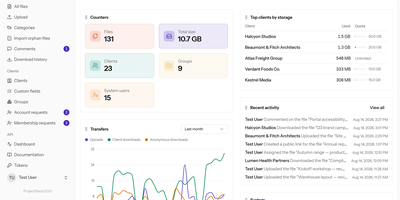
ProjectSend gives every client a private, signed-in page on your own server where only the files you assigned to them appear, so contracts, photo shoots, and quarterly reports skip the third-party file-sharing service. You upload once, then share a file or a whole folder with one client, a group, or anyone holding a public link, with an optional expiry date or download limit. Clients search, preview, and download files one by one or as a zip, whole folders included, comment on a document so questions stay beside it, and send files back within the quota you set. Uploads of up to 2 GB travel in resumable pieces, so a dropped connection pauses a transfer instead of ruining it. Folders, categories, custom client fields, and linked file versions keep a growing library tidy, while roles with granular permissions let staff work without becoming administrators. The activity log and download history record who received what and when, and the log exports to CSV. Sign-in works with email and password, LDAP, or Google and Microsoft accounts, with optional two-factor authentication. Your logo, watermark, themes, and editable email templates carry your brand, and the interface is translated into 16 languages. Optional virus scanning quarantines suspicious uploads, and a REST API with scoped tokens automates uploads, sharing, and account management. Running on a dedicated VPS on RepoCloud with guaranteed CPU, RAM, and SSD, full root SSH access, and a browser serial console. GPL-2.0-or-later licensed.
Sure
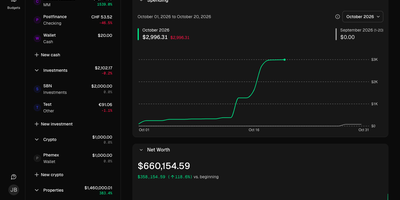
When your bank balances, brokerage holdings, credit cards, loans, and crypto wallets sit scattered across a dozen institutional portals, Sure brings your entire financial life into one private, self-hosted wealth management workspace. You can track checking, savings, real estate, vehicles, and multi-currency investment portfolios while monitoring real-time net worth charts and thirty-day account sparklines. Automated account synchronization connects through Plaid, SimpleFIN, Enable Banking, Lunch Flow, SnapTrade, Questrade, and native Bitcoin, EVM, or Solana wallet integrations, alongside manual CSV, XLSX, and PDF statement imports. A built-in statement vault parses date ranges and opening or closing balances directly from uploaded PDF statements in seven languages to reconcile your ledger against bank records. Day-to-day transactions support nested subcategories, merchants, tags, receipt attachments, and automated categorization rules with regular expression matching. Monthly budgets let households run shared family budgets alongside individual member budgets while automatically excluding 401(k) and IRA retirement contributions from spending limits. Portfolio tracking pulls market prices from Yahoo Finance, Tiingo, Twelve Data, and Alpha Vantage, calculates or locks per-share cost basis, and labels buys, sells, and dividends. An optional AI assistant sidebar answers natural-language questions about your cash flow and spending habits. Running on a dedicated VPS on RepoCloud with guaranteed CPU, RAM, and SSD, full root SSH access, and a browser serial console. AGPL-3.0 licensed.
AKHQ
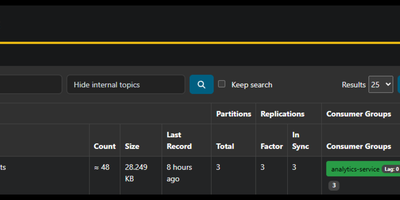
AKHQ puts every Kafka cluster your team runs into one browser console, so topics, messages, consumer lag, schemas, and connectors stop being command-line archaeology. Browse live data inside any topic with search and Live Tail, inspect records by key or partition, and produce test messages without touching a console producer. Consumer group views show lag per partition, and offset resets take a couple of clicks instead of a maintenance window. Multiple clusters sit side by side in the same interface, each with its own Schema Registry, Kafka Connect, and ksqlDB connections attached. Schemas can be created, updated, and versioned from the UI, and Connect clusters report connector and task status you can pause, restart, or reconfigure. Administrators manage ACLs and cluster configuration from the same screens developers use to explore data. Access control goes deep: roles bundle resources and actions, groups scope them with topic patterns and cluster restrictions, and sign-in plugs into OIDC, LDAP, or basic authentication. Point it at your brokers with one configuration file, run it as a single container, and the whole platform team shares one safe window into production Kafka. Running on a dedicated VPS on RepoCloud with guaranteed CPU, RAM, and SSD, full root SSH access, and a browser serial console. Apache-2.0 licensed.
Koillection
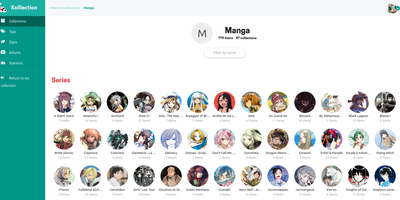
Koillection is a self-hosted physical collection and inventory manager that organizes books, vinyl records, video games, stamps, trading cards, and any custom hobby catalog using hierarchical folders, reusable metadata templates, wishlists, and loan tracking. Collectors can structure nested sub-collections like a file system and attach tailored attributes to each item, ranging from star ratings, purchase dates, and country flags to autographs, PDF manuals, and video clips. Reusable item templates and choice lists standardize data entry across uniform categories so adding a new comic issue or board game takes seconds rather than repetitive typing. Custom HTML and JSON scrapers let you pull item titles, cover art, and structured fields directly from external catalog websites into your forms using XPath or JMESPath selectors. Cross-collection tags link related pieces across separate folders, while dedicated photo albums store supplementary event galleries or condition photographs alongside your main inventory. Built-in wishlists track desired acquisitions with target prices and currencies, and a loan manager records which friend borrowed an item and when it was returned. Granular visibility settings let households run independent multi-user accounts or share read-only collection pages with guests, and a REST API exposes every catalog entity for external automation. Running on a dedicated VPS on RepoCloud with guaranteed CPU, RAM, and SSD, full root SSH access, and a browser serial console. MIT licensed.
Budget Board
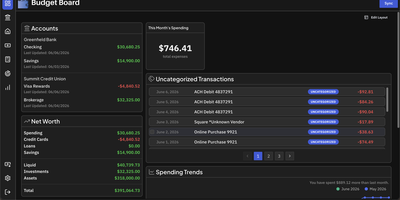
Budget Board is an open-source personal finance dashboard built to replace Mint by unifying checking accounts, credit cards, property assets, monthly category budgets, and long-term savings goals under your own roof. Households can connect their financial institutions through SimpleFIN for North American banks or LunchFlow for international accounts so balances and daily transactions sync automatically on a configurable schedule. If you prefer offline statement management, the bulk CSV importer parses custom date and amount formats while mapping rows directly to your accounts. Once transactions arrive, you can train the built-in machine learning auto-categorizer on your historical spending with a customizable confidence threshold, or define deterministic rules that match merchant descriptions, dates, and amounts. Monthly budget cards track hierarchical parent and child categories against spending limits, and the goals workspace calculates progress toward paying down debt or building an emergency fund. Interactive trends charts let you filter cash flow, net worth, and category breakdowns across custom date ranges and accounts. Multi-user households can secure their financial records with local two-factor authentication or external OpenID Connect single sign-on, alongside localized date and currency formatting in English, German, French, and Simplified Chinese. Running on a dedicated VPS on RepoCloud with guaranteed CPU, RAM, and SSD, full root SSH access, and a browser serial console. AGPL-3.0 licensed.
Domain Locker
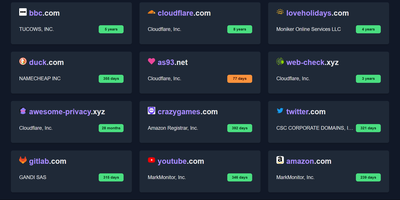
Domain Locker provides an all-in-one domain portfolio dashboard that consolidates expiration tracking, DNS records, and infrastructure health across every registrar you use. Add your domains to automatically harvest registration dates, name servers, SSL validity windows, IP allocations, and subdomains without manual data entry. Customizable notification rules broadcast renewal warnings and configuration change alerts through webhooks, email, Telegram, Slack, or WhatsApp before services experience unintended downtime. Interactive timeline views map renewal deadlines and calculate historical acquisition costs against annual operating expenses to clarify portfolio valuations. Built-in monitoring tools ping endpoints to record response latencies, HTTP status codes, and server availability metrics for every registered address. Audit logs preserve historical snapshots of DNS modifications, WHOIS adjustments, and registrar migrations to simplify infrastructure troubleshooting across teams. Integrated tags and resource associations organize personal blogs, client projects, and staging environments into isolated workspaces with role-based permissions and two-factor authentication. Running on a dedicated VPS on RepoCloud with guaranteed CPU, RAM, and SSD, full root SSH access, and a browser serial console. MIT licensed.
ISMS Builder
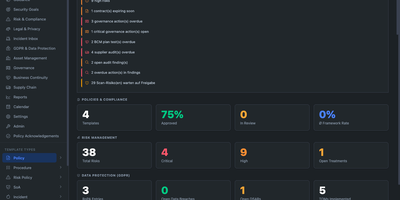
For teams that need ISO 27001, NIS2, and GDPR evidence without handing compliance data to a SaaS vendor, ISMS Builder is a self-hosted information security management system for policies, risks, assets, audits, and incidents. Compliance managers move policies from draft through review to approved and archived, and recipients confirm each one through a token link that needs no login. Security officers close gaps in a Statement of Applicability that cross-maps BSI IT-Grundschutz, NIS2, EUCS, the EU AI Act, and the Cyber Resilience Act, with ISO 27001 controls imported from their own licensed copy. Risk owners keep treatment plans, turn Greenbone and OpenVAS reports into risk drafts, and score assets for confidentiality, integrity, availability, and authenticity. Data protection officers run records of processing, processor agreements, impact assessments, data subject requests, a 72-hour timer, and a deletion log with email alerts. The CISO inbox collects incidents, including reports from a public form that needs no login, beside a 30-item NIS2 Article 21 checklist and Article 23 deadline alerts. Auditors work from a findings register, a compliance matrix, and an exportable audit log of every create, update, delete, and login. Administrators enforce TOTP two-factor sign-in, choose among German, English, French, and Dutch, run semantic search locally through Ollama, and publish approved policies to Nextcloud or ownCloud as PDFs. Running on a dedicated VPS on RepoCloud with guaranteed CPU, RAM, and SSD, full root SSH access, and a browser serial console. AGPL-3.0 licensed.

OpenVidu
For online classes, telehealth visits, and support calls, OpenVidu Meet is a video meeting app that anyone with a link can join from a browser, with no account or download. A room needs only a name, and an optional wizard adds limits on participants (up to 30) and meeting length (up to a day), plus microphone and camera defaults. A shared Moderator or Speaker link admits anonymous guests, a personal link identifies each invited guest, and registered users sign in with their accounts. Developers can embed a room with an iframe or web component, and webhooks report meeting events to as many endpoints as needed. A smart mosaic favors recent speakers and counts the participants it hides, and a status rail shows the recording light, an encryption badge, and the time left. Moderators mute one participant's microphone, camera, or screen share, switch them off for everyone, remove people, and promote others. Virtual backgrounds blur the room or swap in an image, before joining or mid-call. Recordings start by hand or when the first participant, the second participant, or a moderator joins, in grid, speaker, or single-speaker layout. Permitted members can play, download, delete, or share saved recordings by link. End-to-end encryption protects audio, video, chat, and names behind a shared passphrase, though encrypted rooms cannot be recorded. Running on a dedicated VPS on RepoCloud with guaranteed CPU, RAM, and SSD, full root SSH access, and a browser serial console. Apache-2.0 licensed.
Safebucket
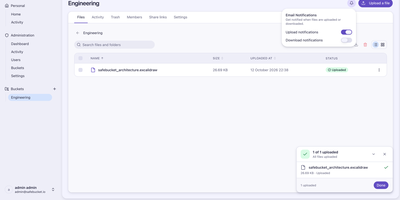
By routing file transfers directly between client browsers and S3-compatible object storage through time-limited presigned URLs, Safebucket enables organizations to share large files and folders without bottlenecking their application server. Teams organize documents into logical buckets with nested folder hierarchies, preview images, videos, audio tracks, and PDFs inside a sandboxed browser viewer, or bundle up to one hundred selected items into a single client-side ZIP download. Public Quick Share links let external recipients download files or entire folders from a browser or via command-line curl redirects, while Reverse Share turns any shared folder into a secure dropbox where guests can upload files back under size and count quotas. Every shared link supports optional password protection, expiration dates, and maximum view limits, complemented by per-file expiration timers and a soft-delete trash bin with configurable retention. Two-tier role-based access control pairs platform roles (Admin, User, and Guest) with bucket-level permissions (Owner, Contributor, and Viewer), allowing teams to invite external collaborators via challenge-verified email links. Authentication integrates with OpenID Connect identity providers and LDAP or Active Directory servers alongside TOTP multi-factor authentication. Administrators gain a four-view governance console covering platform storage metrics, user and bucket inventories, and searchable audit trails filtered by action, user, and date range. Running on a dedicated VPS on RepoCloud with guaranteed CPU, RAM, and SSD, full root SSH access, and a browser serial console. Apache-2.0 licensed.
Snitch
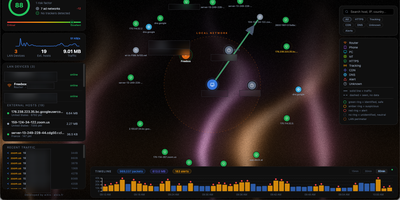
Snitch is a self-hosted network monitor and outbound firewall that shows every connection your server makes, which process opened it, and where in the world it goes, then lets you block it on the spot. A live force graph puts your machine at the center with each remote host as a node, while a world map plots geolocated destinations and a sliding timeline keeps the last day of traffic searchable. Every alert is actionable: block the IP, kill or suspend the process, or write a rule that firewalls matched hosts automatically by address, domain, port, country, or ASN. Detection covers port scans, beaconing, DNS tunneling, ICMP tunnels, cleartext ports, and self-signed or mismatched TLS certificates, and an isolation-forest model learns your normal flows and flags outliers. A lockdown switch cuts all public outbound traffic while the LAN stays up, for the moment something looks wrong. Findings can stream to Wazuh, Splunk, or Elastic as syslog and ECS events, or land in Discord, Slack, and Telegram as webhook alerts. Everything stays on your machine: history lives in a local database, geolocation works fully offline, and the interface speaks eight languages. Running on a dedicated VPS on RepoCloud with guaranteed CPU, RAM, and SSD, full root SSH access, and a browser serial console. AGPL-3.0 licensed.
Tracely
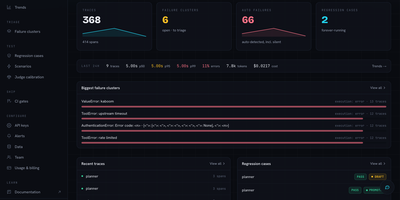
When an AI agent breaks in production, Tracely freezes that exact run into a replayable regression test and blocks the pull request that would ship the bug again. Span soup hides the failure. OTLP/HTTP traces group into conversation threads, and a waterfall marks the failing span in red with its input and output. Nobody knows if an answer was good. Evaluators sit as columns on the trace table, mixing model-free checks with LLM judges at conversation, run, or span level. Thirty-one broken runs, one issue. Clustering turns them into a single counted issue and can suggest the evaluator that would have caught it. A fix nobody can prove. One click promotes a failing trace into a hermetic case with recorded fixtures and a fail-to-pass contract, and scenarios send a red-team model after an adversarial goal. Model bills on every CI run. The suite replays offline with no API keys and no model spend, and tracely gate posts a commit status, comments on the pull request, and blocks regressions. No warning when it breaks again. Alert flows drawn on a canvas react to failed gates, broken conversations, unseen failure modes, or rising failure rates by messaging Slack, sending email, calling a webhook, or prompting an LLM. Coding agents can read traces and write evaluators through an MCP endpoint. Running on a dedicated VPS on RepoCloud with guaranteed CPU, RAM, and SSD, full root SSH access, and a browser serial console. MIT licensed.

Razzia
By turning any browser into an interactive trivia controller and live scoreboard, Razzia gives event hosts, educators, and communities a self-hosted multiplayer quiz platform that replaces Kahoot. Players join in seconds with a six-digit room PIN or scannable QR code on their smartphones, while the host drives the shared screen from a password-protected manager console. Build quizzes directly inside the browser-based editor or import portable JSON files with single-choice, multiple-choice, numeric estimation, and ungraded survey questions. Attach images, audio clips, or video files up to 100 MB to any prompt, group questions into themed round categories, and display explanatory notes when correct answers are revealed. Scoring adapts to your rules: reward fast responses with time-weighted points, apply strict, balanced, or lenient multi-select grading, deduct penalties for wrong guesses, or switch to survey mode to gather live audience polls without a leaderboard. Hosts can lock rooms mid-game, enable automatic nickname generation, hide question prompts on player screens, and configure auto-advance timers between rounds. Drop a custom theme file and logos into the branding folder to white-label colors, fonts, and backgrounds, or connect physical ESP32 hardware buzzers over the documented WebSocket protocol. Running on a dedicated VPS on RepoCloud with guaranteed CPU, RAM, and SSD, full root SSH access, and a browser serial console. MIT licensed.
Sirius Scan
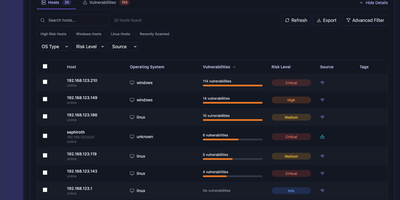
Point Sirius Scan at a network range and it finds live hosts, fingerprints their services, and lists every matching CVE with its CVSS score in a live web dashboard. The Vulnerability Navigator groups findings by severity, filters on CVSS, and exports results for remediation tracking. Scans run on Nmap with NSE scripts kept in sync with upstream, alongside Naabu port scanning. Lightweight remote agents connect back over gRPC from other networks, so segments the central scanner cannot reach still get assessed, and the same agents can run YAML detection templates locally in CLI mode with no server connection at all. An operator console runs PowerShell commands against connected agents and keeps command history beside the scan results. Real-time progress, severity trend charts, host detail pages, and an environment overview show what changed between scans. A REST API on port 9001 with API key authentication feeds results into existing security workflows, while service health monitoring and centralized logging confirm the platform itself is behaving. An installer generates fresh secrets and an initial admin password, and production overlays tighten the deployment further. Running on a dedicated VPS on RepoCloud with guaranteed CPU, RAM, and SSD, full root SSH access, and a browser serial console. MIT licensed.