
Omnivore
Self-hosted and built around long reading, Omnivore saves articles, newsletters, and PDFs, renders web pages as clean text, remembers your place, and keeps every highlight searchable. Pages arrive from the web app's Add button or from Chrome and Firefox extensions that authenticate with an API key. Newsletters arrive through generated email addresses once an IMAP watcher or another mail bridge is set up. PDFs open in the same reader and accept highlights and notes just like articles. Labels, saved searches, and filters such as subscription:"Name" make a big library easy to slice. The RSS section follows your feeds, lets you add a story to the library or hide it, and can sort stories into topics when an OpenAI key is configured. Custom extractors scroll lazy-loaded pages, follow paginated articles, and strip pop-ups before saving. Rules trigger webhooks when pages are created or updated, which suits automatic labelling and other custom workflows. E-ink reading settings add double-tap page turns and volume-button scrolling, and Android and iOS apps sync the same library. Running on a dedicated VPS on RepoCloud with guaranteed CPU, RAM, and SSD, full root SSH access, and a browser serial console. AGPL-3.0 licensed.

Frappe LMS
Frappe LMS is a learning management system built on the same Frappe Framework that powers ERPNext. The 3-level course hierarchy organizes content into courses, chapters, and lessons supporting videos, PDFs, SCORM packages, and rich HTML content with heading, code block, and list formatting through the redesigned inline lesson editor. Batch management groups learners by course and duration with scheduled instructor-led live sessions through integrated Zoom and Google Meet, where learners see upcoming classes on their batch dashboard. The assessment engine supports single-choice, multiple-choice, and open-ended quiz questions alongside assignment submissions as PDFs or documents, with progress tracking monitoring completion rates and quiz performance across all enrolled courses. Certificate generation uses built-in templates or custom designs to validate course completion, while the job board connects certified learners with opportunities. Course monetization integrates payment processing to transform courses into revenue streams with financial tracking. Role-based access controls assign Instructor, Learner, Admin, and Manager permissions, while course package import and export enables sharing structured content between instances. The platform integrates with ERPNext HR and CRM modules through the Frappe ecosystem with RTL language support and notification slide-overs. Running on a dedicated VPS on RepoCloud with guaranteed CPU, RAM, and SSD, full root SSH access, and a browser serial console. AGPLv3 licensed.
magpie
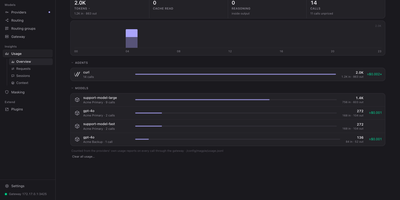
Point every coding agent and chat client at one self-hosted gateway, then choose which model answers from a single browser console. Add providers by preset or custom OpenAI-compatible URL, or sign in with the subscriptions you already pay for. Routing groups bundle several models into one name and move to the next member when a quota runs out, so the calling agent never sees the error. Create a gateway key per client, cap each with daily token or cost budgets, restrict its models, and watch usage counted separately. The Usage pages chart tokens, cost, request counts, cache hit rate, and a yearly heatmap, split by model, provider, or agent, with CSV export. A Routing view replays how each request was routed, with timing for masking, connecting, and the vendor. Masking swaps passwords, API keys, and tokens for placeholders before a prompt leaves your server and restores them in the answer. The browser page is protected by a key you set at launch. Running on a dedicated VPS on RepoCloud with guaranteed CPU, RAM, and SSD, full root SSH access, and a browser serial console. MIT licensed.
Maybe Finance
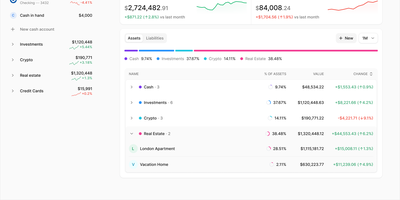
Roughly $1M of development work, open-sourced: Maybe Finance began as a $249/year commercial personal finance product before the company released it all. It aggregates bank accounts, credit cards, loans, investments, crypto, and real estate into a single net worth dashboard with historical trend charts - replacing the spreadsheet that usually glues a whole portfolio together. Transactions are categorized and tagged with rules, with merchant tracking and search across imported or synced activity; budgets track spending by category against plan; and the investment view follows holdings, cost basis, and returns across brokerage accounts. Multi-currency support converts accounts held in different currencies into a single reporting currency, bank synchronization works through Plaid where supported, and manual CSV import covers any institution. An optional AI assistant answers questions grounded in your own financial data. Because the app was built as a paid product with professional design before being open-sourced, its interface quality exceeds most community finance tools - and self-hosting means your balances and transactions are not monetized by a free app or gated behind an annual subscription. The stack is Ruby on Rails with Hotwire on PostgreSQL, licensed AGPL-3.0 and deployed via Docker. The original repository is archived; development continues in the community fork Sure, compatible with the same self-hosted setup.
Liaison
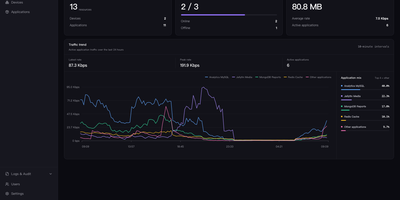
Liaison puts every private service you run behind one browser console, so a laptop, a homelab box, or a customer server becomes reachable without opening a single inbound port. Install a lightweight connector on each device and it dials out to the control plane, where administrators register applications over TCP, HTTP, HTTPS, WebSocket, and SSH and grant access per user. Browser workspaces cover audited Web SSH terminals, RDP and VNC desktops, SFTP file management, read-only S3 browsing, and database clients for MySQL, PostgreSQL, MariaDB, SQL Server, Oracle, MongoDB, and Redis, each with a session Agent that drafts commands and explains query results once you approve them. Local models are shared through authenticated APIs with a browser Playground, scoped keys, token quotas, and usage tracking, while Codex and Claude Code run on your own devices with resumable sessions and permission prompts. A built-in code-server IDE edits projects remotely, and on-demand TCP ports open for 5 to 300 seconds. Casbin-backed identity management, firewall policies by source IP or CIDR, and logs of management actions and supported sessions keep access accountable. Application discovery scans connector devices for existing services and registers them from the console. Running on a dedicated VPS on RepoCloud with guaranteed CPU, RAM, and SSD, full root SSH access, and a browser serial console. AGPL-3.0 licensed.
LLM Wiki v2
Instead of burying your documents in a vector index you cannot inspect, LLM Wiki v2 files them into a Markdown wiki you can read, browse, and question. Drop text, Markdown, or PDF files anywhere on the page and each one is catalogued automatically, filed into a folder that says what it holds, and linked to the notes it relates to. Ask a question and the answer cites the exact notes it used, with clickable sources you can open, verify, and correct. New documents update the note on their subject instead of piling up as disconnected chunks, so what you teach it stays taught. A small classifier routes filing and questions through the folder tree, keeping the wiki quick and cheap as it grows, and you can browse the tree, follow see-also links, move or delete notes, and watch the tokens spent by both the model and the classifier. Connect OpenRouter, OpenAI, Gemini, a local Ollama, or any compatible endpoint, and expose the same wiki to Claude Code or Codex as long-term memory they can recall from and write to. Because every note is plain Markdown in a folder you own, the whole knowledge base can live in git beside your other files. Running on a dedicated VPS on RepoCloud with guaranteed CPU, RAM, and SSD, full root SSH access, and a browser serial console. AGPL-3.0 licensed.
AI-Git-Bot
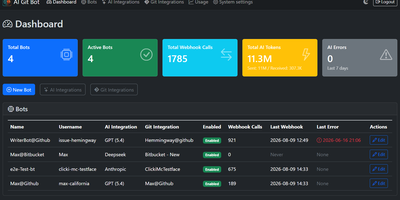
Inside your Git platform, AI-Git-Bot works as a self-hosted teammate that quietly handles the engineering chores everyone agrees matter and nobody has time for. Open a pull request and it reviews the diff with inline findings, re-reviews after a force-push, and answers questions when you mention it in the discussion, keeping the conversation context across updates. Assign it an issue and it can rewrite that issue with structure and acceptance criteria, route it to the right assignee with a stated reason, or implement it and open a pull request for you. It generates unit tests for new code, builds Playwright end-to-end suites and runs them against a preview environment, then posts the results back to the pull request. Documentation and locale files stop drifting, because README sync and translation coverage workflows update them as the code changes. Every run is observable through built-in metrics and signed outgoing webhooks, and you choose the brain behind it, from cloud models to a local model on your own hardware, so source code never has to leave your network. Running on a dedicated VPS on RepoCloud with guaranteed CPU, RAM, and SSD, full root SSH access, and a browser serial console. MIT licensed.
Pitot
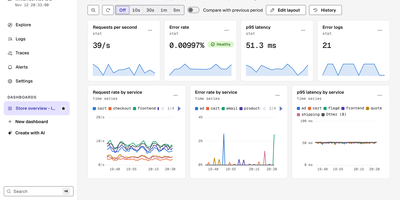
Point your OpenTelemetry exporters at one port and get traces, logs, metrics, dashboards, alerts, and an AI investigator, with no storage cluster to babysit. Pitot accepts OTLP over gRPC and HTTP, keeps everything in a single data directory as Parquet files you own, and lets you query with Explore and PitotQL even when no AI provider is configured. Ask the built-in agent which service is slowest right now and it runs typed queries across traces, logs, and metrics, then explains the evidence inline. Describe a dashboard in one sentence and it drafts, checks, and saves panels for request rate, error rate, p95 latency, service dependencies, slowest operations, and recent errors. Alerts watch service error rate, latency, throughput, and log volume. Prefer your own assistant? A remote MCP endpoint lets Claude Code or any MCP client search logs, inspect traces, query telemetry, and create dashboards after you approve its scopes through OAuth in the browser. Sign in with single-use login links or an OIDC provider, choose OpenAI or Anthropic for chat, and set how many days of telemetry to keep, 30 by default. Pitot runs as one node, which suits a single machine's worth of telemetry rather than fleet-scale clusters. Running on a dedicated VPS on RepoCloud with guaranteed CPU, RAM, and SSD, full root SSH access, and a browser serial console. Apache-2.0 licensed.
KitchenOwl
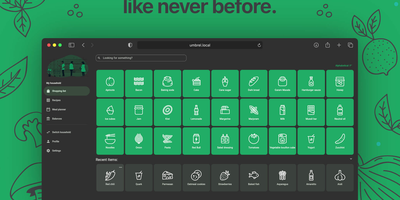
Your household's kitchen command center: shared grocery lists that sync in real-time across everyone's phones, a recipe book that imports from 500+ websites with one tap, a weekly meal planner that auto-generates shopping lists, and expense tracking that splits costs between roommates or family members. Native apps for Android, iOS, macOS, Windows, Linux, and web provide partial offline support so the list works even in store dead zones. The recipe-scrapers library with wild mode fallback handles imports from virtually any cooking site, extracting ingredients, steps, and images automatically — then converts recipe ingredients directly to shopping items with a single tap. Smart suggestions learn from your patterns over time, ordering items by your typical store route and recommending frequently purchased products. OpenID Connect authentication supports Google, Apple, Authelia, and custom providers. LLM-powered ingredient parsing uses configurable AI models for intelligent recipe text extraction. A Home Assistant integration enables voice-controlled list management via smart speakers. The REST API with a published Python client library allows third-party automation. Multi-language support covers 30+ languages through Weblate community translations. Running on a dedicated VPS on RepoCloud with guaranteed CPU, RAM, and SSD, full root SSH access, and a browser serial console. AGPL-3.0 licensed.
OpenBoxes
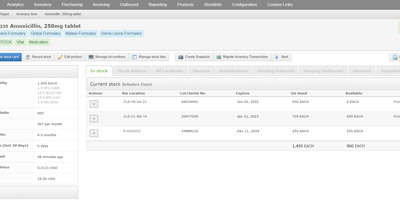
OpenBoxes is an open-source warehouse management system that keeps medication and supplies visible from central depot to clinic cabinet, so staff always know what is in stock, where it sits, and when it expires. The product catalog holds medications, medical devices, office supplies, and fixed assets, with suppliers, manufacturers, pricing, classifications, and custom attributes on every item. Inventory is tracked by facility and bin location down to lot and expiration date, and every adjustment, transfer, and removal leaves a full transaction history. Reorder points and stock alerts flag low stock, overstock, and expiring items before they become emergencies. Inbound, purchase orders, invoices, and budget codes manage procurement; goods receipt captures lots and expiry dates, and suggested putaway directs stock to the right bins. Outbound, requisitions and stock lists drive requests from upstream facilities, FEFO picking pulls the earliest-expiring lots first, and packing produces packing lists with customs documentation. Cycle counting keeps records honest without closing the warehouse, and dashboards surface stock value, fast movers, and expiring stock. Barcode scanners and a mobile-friendly interface speed up receiving and counting on the floor, and spreadsheet imports load products, locations, and opening stock in bulk. A REST API and webhooks connect OpenBoxes to ERPs, DHIS2 health information systems, and integration platforms like n8n and OpenFn, and location-restricted roles keep each facility on its own shelves. Running on a dedicated VPS on RepoCloud with guaranteed CPU, RAM, and SSD, full root SSH access, and a browser serial console. EPL-1.0 licensed.
Watcher
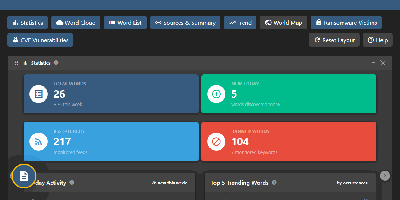
Six cyber threat monitoring modules share one dashboard in Watcher, covering trending advisories, CVEs and ransomware victims, leaked credentials, suspicious websites, DNS lookalikes, and approved domains. Threats Watcher reads RSS advisories from CERT-FR, CERT-EU, US-CERT, and the Australian Cyber Security Centre, ranks trending words, and raises a breaking-news alert when a keyword crosses a configurable threshold. An AI weekly digest condenses the top five topics, and on-demand summaries list the CVEs, threat actors, and organizations behind any keyword. Cyber Watch matches your watch rules against CVE and ransomware feeds from cve.circl.lu, ransomware.live, and ransomlook.io. Data Leak searches Pastebin, StackOverflow, GitHub, GitLab, Bitbucket, APKMirror, and npm for credentials and API keys matching your patterns. Website Monitoring tracks malicious domains for IP, mail record, and page-content changes using TLSH fuzzy hashes plus RDAP and WHOIS expiry checks, while DNS Threats hunts typosquatting and homograph lookalikes with dnstwist and Certificate Transparency streams. The Legitimate Domains register stores registrar, expiry, repurchase status, and UDRP cases, with a one-item-per-line bulk add that previews results before saving. Findings export to TheHive and MISP, alerts arrive by email, Slack, or Citadel, and sign-in works through LDAP, local accounts, or OpenID Connect. Running on a dedicated VPS on RepoCloud with guaranteed CPU, RAM, and SSD, full root SSH access, and a browser serial console. AGPL-3.0 licensed.
DFIR-IRIS
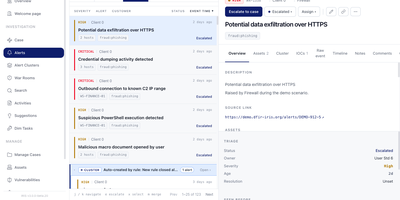
Incident response teams get one shared workspace for alerts, cases, evidence, and timelines in DFIR-IRIS, a free, self-hosted platform built for collaborative investigations. Alerts from SIEM and EDR tools arrive through an API, where analysts triage them, assign owners, and merge or escalate them into cases. Cases record a customer, classification, and SOC ticket ID, and case templates pre-fill the summary, tags, tasks, and note folders so every incident starts from your playbook. Assets, IOCs with TLP levels, tasks, notes, and uploaded evidence sit side by side in the case. The timeline orders events chronologically and files them under categories such as Initial Access, Lateral Movement, and Exfiltration. The case graph maps how assets, IOCs, and events connect. Modules enrich indicators with VirusTotal or MISP and push events to Slack, Microsoft Teams, Discord, or automation tools such as Shuffle. A datastore keeps case files organized, with IOC files wrapped in password-protected archives. Investigation and activity reports export to DOCX, Markdown, or HTML from templates your administrators manage. Customers, groups, and per-user rules decide who can see, read, or edit each case, and custom attributes extend any case object with the fields your team needs. Running on a dedicated VPS on RepoCloud with guaranteed CPU, RAM, and SSD, full root SSH access, and a browser serial console. LGPL-3.0 licensed.
Svix
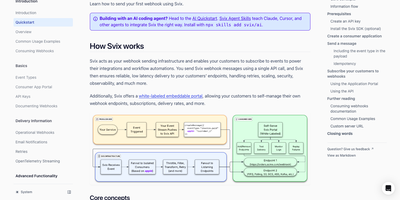
Development teams hand their outgoing webhooks to Svix, which delivers each event to customer endpoints with retries, signed payloads, and a delivery record for every attempt. Your app makes one API call when something happens, a user signs up, an invoice is paid, a build finishes, and Svix delivers the event to every subscribed endpoint your customers registered. Endpoints that fail get automatic retries on a schedule, deliveries are logged attempt by attempt, and failed messages can be resent instead of vanishing. Customers organize their integrations as applications, subscribe endpoints to the event types they care about, filter by channels, and verify signed payloads so forged requests get rejected. You define the event catalog once, and fanout, throttling, and endpoint bookkeeping stop being code you maintain. Official libraries for nine languages and a CLI make the first integration an afternoon task, and the whole service runs from a Docker Compose stack with Postgres and Redis when you want it on your own infrastructure. Your product gains the webhook system customers expect, without your team becoming a deliverability department. Running on a dedicated VPS on RepoCloud with guaranteed CPU, RAM, and SSD, full root SSH access, and a browser serial console. MIT licensed.
Elmo
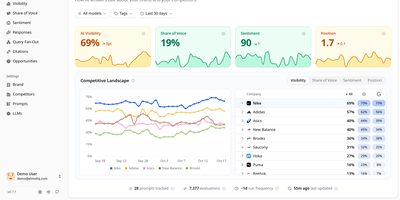
Tracking how ChatGPT, Claude, Gemini, Perplexity, and Google's AI answers talk about your brand, Elmo gives you a self-hosted dashboard for measuring and improving your AI search visibility. A setup wizard reads your website and suggests keywords, competitors, buyer personas, and tracking prompts. Behind the scenes, a worker reruns every tracked prompt on a schedule against the engines you connect, using scraping providers such as BrightData, Oxylabs, or SearchApi for real consumer experiences, or direct OpenAI, Anthropic, Mistral, and OpenRouter APIs. Each run feeds visibility scores per prompt and per model, mention tracking across names, aliases, and domains, sentiment from positive to negative, and each company's position in the answer. The Responses page filters answers by model, tag, prompt, or sentiment and highlights the passage behind each judgment. Citation analysis sorts cited URLs into your domains, competitors, social media, Google properties, and institutional sources. A share-of-voice leaderboard ranks competitors against you over time. Query fan-out shows the web searches engines ran before answering. Opportunities turns the numbers into a prioritized list of content to create, pitch, and seed. Shareable reports reach stakeholders without an account, and a REST API with TypeScript and Python SDKs plus an MCP server lets coding agents query the data. Raw engine output stays in your own database for later audit. Running on a dedicated VPS on RepoCloud with guaranteed CPU, RAM, and SSD, full root SSH access, and a browser serial console. MIT licensed.
CashPilot
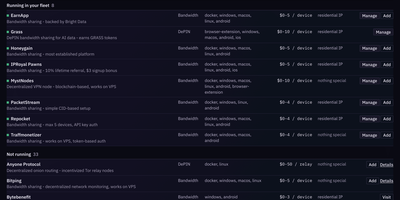
Idle bandwidth and spare hardware earn nothing sitting unused, so CashPilot deploys passive-income services across your servers and shows every balance in one web dashboard. From the catalog you start Docker earners such as Honeygain, Earn.fm, Traffmonetizer, PacketStream, ProxyRack, MystNodes, Storj, and Sia hostd with one click, no compose files to write, and you can add any service the catalog lacks by image name under the same container restrictions. Providers that run as browser extensions, desktop apps, or GPU nodes, 24 of them, are tracked alongside, while 15 built-in collectors read balances every hour into a single earnings history, so a service that runs without earning shows up as a flat line instead of a surprise. When a balance drops, CashPilot treats it as a probable payout and asks you to confirm rather than counting income by guesswork. One worker runs on each server under a single dashboard, with every figure broken down per server and per service. Extra copies of a service can earn through SOCKS5, HTTP CONNECT, or Tailscale exit-node proxies and stop dead if the proxy dies instead of leaking your real address. Earners are fenced off from your LAN, the host, your tailnet, and cloud metadata by default, and per-service guides flag restrictions such as providers that ban datacenter IPs. Running on a dedicated VPS on RepoCloud with guaranteed CPU, RAM, and SSD, full root SSH access, and a browser serial console. GPL-3.0 licensed.
Websurfx
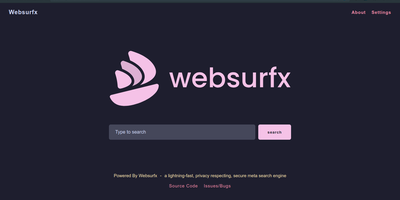
Websurfx aggregates results from multiple search engines into one private, ad-free interface that never tracks your queries. Written in Rust, the backend provides memory safety against buffer overflows and data races at the language level while handling concurrent requests across upstream providers like DuckDuckGo and Searx. A built-in re-ranking algorithm scores and merges results by relevance, producing a unified page that draws from many sources while appearing as one coherent search. Safe-search filtering operates across four levels from unrestricted to complete content blocking, with regex-based filter lists for parental controls in schools and organizations. Upstream requests route through configurable proxy chains or Tor, preventing search providers from correlating your queries with a specific IP address. Four Docker image variants target different caching strategies: hybrid Redis plus in-memory for maximum throughput, Redis-only, in-memory-only, or zero-persistence for environments where cached queries must never touch disk. The Lua configuration file controls engine selection, request timeouts, rate limiting thresholds, and production-mode delays that throttle upstream traffic to prevent abuse. Quick-result widgets handle calculations, currency conversions, and unit transformations inline without external redirects. Image search capabilities serve visual discovery for designers and researchers who need media results without surveillance. Runs on a RepoCloud VPS with dedicated resources and full root access. AGPL-3.0 licensed.
SilentSuite
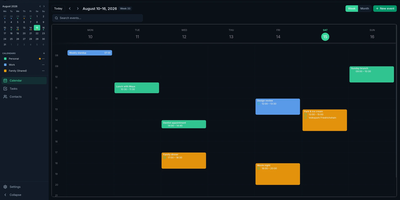
SilentSuite is an end-to-end encrypted sync service for your calendar, contacts, and tasks, where the server stores only ciphertext and cannot read a single event, name, or plan. Encryption happens on your devices with keys derived locally, so record contents are sealed before upload and opened only on another trusted device of yours. Manage everything in the web app, sync a phone through the Android adapter's system calendar, contacts, and task providers, or connect desktop apps like Thunderbird and GNOME Calendar through the local Bridge. The Bridge speaks CalDAV and CardDAV only on localhost, then forwards encrypted records upstream, so standard desktop clients work without ever exposing plaintext to the server. Import and export keep exit paths open, and because sync rides the open Etebase protocol, your data model stays inspectable rather than locked into a proprietary format. Self-hosting unlocks every feature at no cost: one Compose file starts the sync server and PostgreSQL, with open registration you can close after your own account exists, nightly backup tooling, and Umbrel packaging. Signing up hosted users is not required at all; the same web app, Android adapter, and Bridge run against your own server with your domain. Running on a dedicated VPS on RepoCloud with guaranteed CPU, RAM, and SSD, full root SSH access, and a browser serial console. AGPL-3.0 licensed.

ClipBucket
Start a video and photo sharing community on your own server with ClipBucket, a free platform that handles uploads, conversion, channels, playlists, and collections out of the box. Members publish videos and photos, group them into recursive collections, follow channels, and exchange friend requests and private messages. Uploads are converted once into MP4 or HLS, which keeps playback light on server resources, with 4K resolutions, subtitles managed from the admin area, remote play of externally hosted clips, and Chromecast casting to TVs. Film libraries can import movie details from TMDB straight from the upload form. Age restrictions and an AI NSFW check help keep a public site suitable for its audience. Visitors pick dark, light, or automatic themes and an interface in English, French, German, Portuguese, or Spanish, and a visual editor makes comment threads richer. Admins get a dashboard with live statistics, a video manager, an update checker, and a database updater, and multi-server hosting is supported when the catalog outgrows one machine. A tutorial channel can publish lessons, a film club its movie library, a school its lecture archive, and a family its home videos and photos. Running on a dedicated VPS on RepoCloud with guaranteed CPU, RAM, and SSD, full root SSH access, and a browser serial console. AAL licensed.