MakersVault
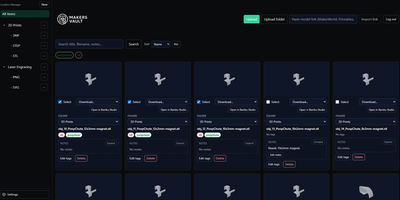
MakersVault gives your scattered 3D print files and creative artwork one searchable home, so you stop loading models into a slicer just to remember what they are. You create folders and subfolders for projects, then drag and drop single files, batches, or whole folders straight into the library from your browser. Every model tile carries a rendered preview, and double-clicking opens an interactive 3D view you can rotate and inspect before downloading anything. Tags attach to any file, batch tagging covers many selected models at once, and tag tabs plus sorting by name, size, type, or folder keep large collections browsable. Notes on individual files record print settings, filament choices, or assembly reminders right beside the model they describe. Imports pull models directly from MakerWorld, Thingiverse, and Printables links, and zip archives prompt you to keep only the files you actually want. Supporting documents ride along with each model and travel inside its ZIP downloads, and prepared print data surfaces printer, material, nozzle, and time estimates on the card. The Open in Slicer button hands a model to your configured slicer through the desktop bridge, and themes from light and dark to neon accents restyle the whole workspace. Running on a dedicated VPS on RepoCloud with guaranteed CPU, RAM, and SSD, full root SSH access, and a browser serial console. MIT licensed.
Doorman
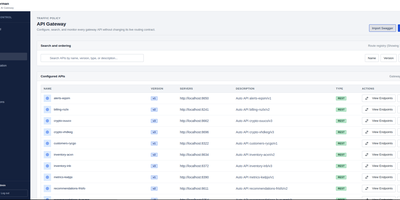
Doorman puts one controlled front door in front of every API you run, instead of teaching each service to reinvent keys, quotas, and abuse protection. It routes REST, SOAP, GraphQL, gRPC, gRPC-Web, and AI traffic through a single gateway while its control plane handles the surrounding work. Catalog APIs in a visual builder, configure protocols and endpoints, validate schemas, and manage semantic versions with deprecation and sunset dates as interfaces evolve. Control who may call what through users, roles, groups, and subscriptions, then attach credit tiers and quotas so heavy consumers stay inside the plan you sold them. Slow abusive clients with rate limits, throttling, and bandwidth caps, and keep flaky upstreams from cascading through retries and circuit breaking. Follow every request in searchable logs, review security controls and audit activity, and move configuration between environments with import and export. Start in a self-contained in-memory mode for a small deployment, then switch to shared MongoDB and Redis when several gateway instances need the same counters, revocations, and routing state. Running on a dedicated VPS on RepoCloud with guaranteed CPU, RAM, and SSD, full root SSH access, and a browser serial console. Apache 2.0 licensed.
DailyHub
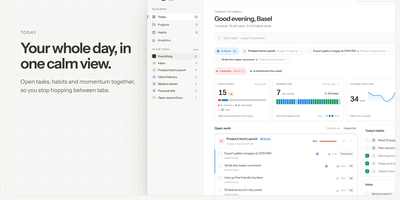
DailyHub is one calm page for a single person's whole day: today's open work grouped by project, the habits due this morning, and an inbox that catches everything that does not belong anywhere yet. The Today view greets you with a quick-add box, nudges about what is slipping, and a progress bar that fills as the day gets done. Focus mode pins the projects or tasks that matter and hides the rest until a date you pick or until you clear it, so the full list stops shouting. Projects carry status, due dates, and milestones, wear logos with accent colours derived from them automatically, and raise a banner when work stalls. Habits run on weekday schedules and report back with a 14-day consistency strip and a completion rate, so a streak is something you can see rather than guess. Analytics chart completions over time, break them down per project, and surface the weekday patterns that show when you actually get things done. A command palette jumps to any project, task, habit, or milestone from the keyboard, and light and dark themes keep long planning sessions easy on the eyes. An AI assistant can join through the built-in MCP endpoint: ask what is still open in the inbox, add a task to the website project for Friday, or mark today's workout done. Running on a dedicated VPS on RepoCloud with guaranteed CPU, RAM, and SSD, full root SSH access, and a browser serial console. MIT licensed.
DispatchSEO
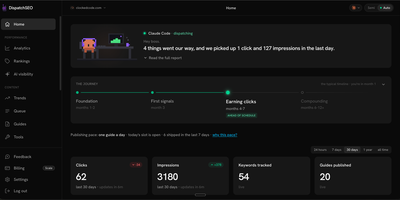
DispatchSEO runs an SEO program through your own AI agent: it researches keywords, queues ideas for your approval, and publishes a guide every morning. Connect Claude Code, Codex, Cursor, or the Claude app over MCP and the agent mines keywords from Search Console data and Google Autocomplete, then drops each idea into a queue showing volume, difficulty, and the reasoning behind it. Approve, reject, or drag to reorder, or switch on auto mode and skip the queue. Each morning the oldest approved idea becomes a real guide, delivered as a GitHub pull request or posted straight to a self-hosted WordPress site, checked against the live search results before it ships. Home greets you with a plain-language daily briefing, a journey tracker, publishing pace, and click and impression counters. Rankings charts daily positions with thirty-day sparklines, Search Traffic plots Search Console history, and an AI visibility page shows how often Claude cites your domain. A backlink playbook lists free and paid submissions with copy ready to paste. One deployment manages many sites, each with its own MCP token. Running on a dedicated VPS on RepoCloud with guaranteed CPU, RAM, and SSD, full root SSH access, and a browser serial console. AGPL-3.0 licensed.

Antragsgrün
When hundreds of delegates want to rewrite the same resolution, Antragsgrün keeps every proposed change visible, line-numbered, and ready to merge. Organizers define motion types for resolutions, statutes, and candidacies, each with its own sections, deadlines, and permissions, and members submit documents online with supporters, screening by administrators, and attachments such as images or PDFs. Amendments appear as tabs beside the paragraph they change and as red and green inline diffs; paragraph comments, likes, tags, and versions keep the discussion orderly. Administrators merge amendments into the final text by accepting or rejecting each change, with collisions flagged and drafts saved along the way. During the meeting, agenda items, speaking lists with separate queues, timed speakers, and votings with simple, absolute, or two-thirds majorities run on the same site, and a Currently Debated widget shows what is under discussion. Print-ready PDFs, OpenDocument texts, amendment spreadsheets, HTML, and RSS feeds cover every format a delegate asks for, and consultations can run in several languages in parallel. Custom themes, user groups, email notifications, and optional two-factor login adapt it to each organization. Running on a dedicated VPS on RepoCloud with guaranteed CPU, RAM, and SSD, full root SSH access, and a browser serial console. AGPL-3.0 licensed.
xEdit
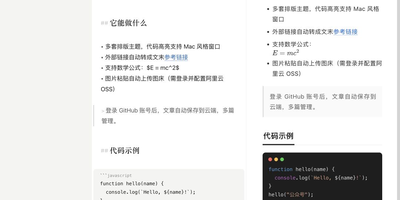
xEdit is a free, open-source Markdown editor that keeps your notes as plain text, on your device or on your own server, and hands AI clients a proper door instead of a scrape. Write in live preview, where headings, code and images render in place and only the line under your cursor shows its source, or flip to a split view when you want both sides visible. Slash commands insert headings, callouts, tables, to-dos, code blocks and media, and wiki links tie notes together by title, with renames updating every link that points at the note. Any checkbox in any note with a date rolls up into a Today view, and nested folders, global search and a recoverable trash keep a growing library tidy. Choose where notes live: browser storage, a local folder of Markdown files, or cloud sync with an offline mirror on every device. Cloud notes gain version history with line-by-line diffs and one-click rollback, share links that collect comments on selected passages, and exports to Markdown, HTML, PDF, PNG and Word. Pick one of thirteen layout themes and copy straight into WeChat or Zhihu with styles inlined and math intact, then connect Claude or Cursor through the built-in MCP server to search, organize and edit the whole library. Running on a dedicated VPS on RepoCloud with guaranteed CPU, RAM, and SSD, full root SSH access, and a browser serial console. MIT licensed.
Afflatus
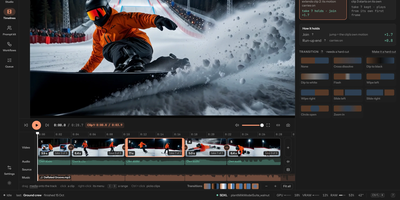
A studio with a library, a clean form for every model, and a timeline that makes real videos, Afflatus sits in front of your own ComfyUI so nobody wires a node graph. Forms cover SDXL, FLUX, Krea 2, Qwen Image, and Z-Image for pictures, plus MiniMax H3, LTX, and Wan 2.2 for video. A prompt designer writes in each model's own grammar through LM Studio, Ollama, or a hosted service. Renders land in a searchable library of projects and drafts that keeps seeds and settings, and one box finds anything by kind, model, LoRA, or words. Paint a mask and fix it, draw boxes for edits, or plot an X/Y/Z grid. The timeline chains any clip after any other and carries motion across the joins, with dissolves, wipes, and flashes where models change. Takes carry measured join scores with the smoothest marked, and exports are zips for DaVinci Resolve, Premiere Pro, or Kdenlive. One queue sends each job to whichever ComfyUI finishes first, a PC on your network or a RunPod pod rented with your key, ranking GPUs by cost per render and stopping idle ones. A Prompt kit keeps your cast, places, and styles consistent from render to render. Claude Code and other agents drive the studio over MCP with scoped tokens. Running on a dedicated VPS on RepoCloud with guaranteed CPU, RAM, and SSD, full root SSH access, and a browser serial console. AGPL-3.0 licensed.

Something
By the time you sit down each morning, your AI coworker can have read the inbox, checked the store for stuck orders, and drafted a plan for the day. You reach the same coworker in a web workspace, Chrome's side panel, Telegram, or Slack, and its memory follows you between them. A first-login interview learns what the company does, shows what it found online for you to fix, and proposes a starter plan of tools and routines. Memory keeps one fact per thing, tied to its source conversation; corrections add dated remarks, and outdated facts are struck through beside their replacements. Routines cover standing chores, from hourly inbox scans and stuck-order checks to weekly ad reviews and meeting prep, and a Marketplace tab suggests more for each connected tool. Tasks live on a list or board with owner, priority, and deadline. Skills are markdown playbooks you can edit in the browser. Dozens of services connect through a sign-in popup or a pasted key, among them Notion, Stripe, Linear, Shopify, and Google Workspace. It asks before anything goes out. In team mode, each person gets private files, memory, and routines, the board stays shared, and hand-offs reach teammates where they will see them. Claude Code or Codex can ask the coworker about the business and write back only after confirmation. Running on a dedicated VPS on RepoCloud with guaranteed CPU, RAM, and SSD, full root SSH access, and a browser serial console. AGPL-3.0 licensed.
Statainer
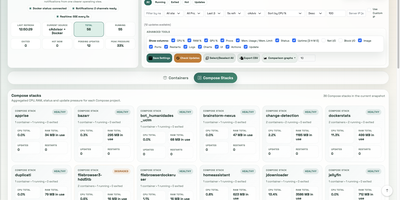
Monitoring and safeguarding Docker infrastructure without heavy enterprise software overhead is the primary mission of Statainer, an open-source management control center for container hosts. System operators inspect live CPU loads, memory consumption, network throughput, and disk I/O metrics across individual containers or comparative top-ranking charts. The interface groups containers by Compose projects, enabling administrators to start, stop, or restart entire application stacks and inspect real-time log streams without opening SSH sessions. The built-in Update Manager detects available image tags, executes single-click container updates, and maintains persistent deployment history with automated rollback capabilities for failed recreations. Custom alert configurations trigger instant notifications to Telegram, Discord, Slack, Pushover, or generic webhook endpoints whenever resource thresholds are breached or container health states change. Developers can provision scoped API keys with token authentication to automate container state transitions and export performance telemetry into custom monitoring workflows. Running on a dedicated VPS on RepoCloud with guaranteed CPU, RAM, and SSD, full root SSH access, and a browser serial console. MIT licensed.
Domain Monitor
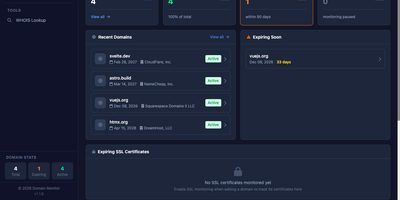
The renewal notice always seems to land in an inbox nobody checks anymore, so Domain Monitor tracks every domain you own from your own server and warns you long before each expiry date arrives. It pulls expiration dates and registrar details automatically through WHOIS and RDAP across more than 1,400 supported TLDs, keeping the whole portfolio current without anyone remembering to look. Add domains one at a time or import them in bulk, group them with tags and watchlists, and let scheduled cron checks refresh the data on their own. Alerts escalate on your schedule, at 60, 30, 21, 14, 7, 5, 3, 2, and 1 day before expiry, and arrive through email, Telegram, Discord, Slack, Mattermost, Pushover, or webhooks, routed by notification groups so the right people hear about the right domains. Each domain also gets tabbed views for its DNS records, SSL certificate validity, billing notes, notification history, and raw WHOIS output, with per-domain toggles for DNS and certificate monitoring. The dashboard surfaces what expires soon, how domains distribute across registrars, and whether every domain is actually covered by an alert channel. Multiple users get their own accounts with two-factor authentication, tracked sessions, and an in-app notification center. Running on a dedicated VPS on RepoCloud with guaranteed CPU, RAM, and SSD, full root SSH access, and a browser serial console. MIT licensed.

Subatic
Your own video hosting site that behaves like the big platforms: upload a file, share a link, and anyone can press play. Subatic takes care of everything between those two moments. Drop in a raw video and the transcoding pipeline converts it into web-ready formats, stores the finished files in S3-compatible storage, and publishes a clean watch page with the title and an animated thumbnail that previews the content before a click. Playback streams directly from the storage bucket, so a Cloudflare R2 bucket with caching turns your little server into a video host whose delivery costs stay close to zero as views climb. A public homepage grid showcases your latest uploads with those moving thumbnails, and visitor counts can flow into Umami or Plausible if you want audience numbers without handing viewers to a third-party tracker. Creator accounts handle uploading, and one Docker Compose file brings up the whole stack: the app, the transcoder, MinIO for local object storage and PostgreSQL. A teacher can post course videos without platform rules, a band can share rehearsal footage, and a homelab can keep family clips on hardware in the closet. Running on a dedicated VPS on RepoCloud with guaranteed CPU, RAM, and SSD, full root SSH access, and a browser serial console. GPL-3.0 licensed.
Unit7
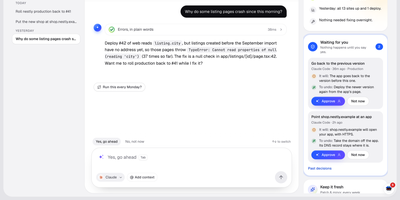
Unit7 manages the servers, Coolify apps, domains, databases, and backups behind software your AI wrote, taking its instructions in plain language. Ask it to deploy a repo, add a database, point a domain at production, or diagnose a slow site, and it does the work on your servers over SSH. Risky steps stop and ask first. The web app, CLI, and MCP server share one engine and one safety gate, and Claude Code, Cursor, Codex, Windsurf, and Antigravity all pass through it. Seven, the always-on agent, reviews the servers on a six-hour cycle and proposes from 24 named actions, never more than three per shift. Warden covers the routine without any AI, restarting crashed containers, rolling back bad deploys, blocking scanners, and running backups. The Map traces each domain to its app and database across Hostinger, Cloudflare, Vercel, and Supabase. It flags spoofable email, dangling DNS records, and records pointing elsewhere. Safety Net sends encrypted copies off the server, to your machine, a synced cloud folder, or S3, and schedules test restores to prove they work. Deploys detect the framework, switch traffic blue-green after a health check, and roll back instantly. Databases run as private containers, and their passwords go straight to an encrypted vault. An autonomy dial per environment runs from watch-only to full autopilot. One switch pauses everything. Running on a dedicated VPS on RepoCloud with guaranteed CPU, RAM, and SSD, full root SSH access, and a browser serial console. Apache-2.0 licensed.
Pisha
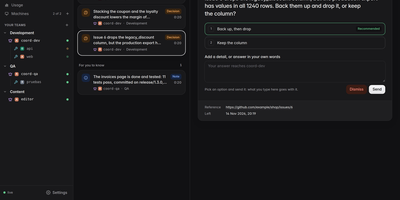
When one Claude Code session is not enough, Pisha puts a coordinator in charge of a whole team of them and shows every agent live in your browser. Tell the coordinator what you want and it splits the work among workers, tracks their reports, and approves their harmless actions. Only the decisions that matter reach your inbox, each with options and a recommended pick you can answer by typing or speaking. A mosaic view lays every terminal and conversation side by side, with a timeline of orders, edits, tests, and commits for each agent. Teams appear as cards on an org chart, and dragging one onto another links their coordinators so they can trade work. Task boards with custom columns, subtasks, priorities, and due dates sync both ways with GitHub Projects, and merging a pull request that names a task moves it to done. Signed webhooks from GitHub, GitLab, or Stripe wake a coordinator with your standing instructions, such as reviewing each new pull request. Permission profiles described in plain words limit each agent, and Codex CLI or Grok CLI sessions can join a team beside Claude Code. Add any computer with one command; agents connect out, so their machines open no ports. Running on a dedicated VPS on RepoCloud with guaranteed CPU, RAM, and SSD, full root SSH access, and a browser serial console. MIT licensed.
Depl0y
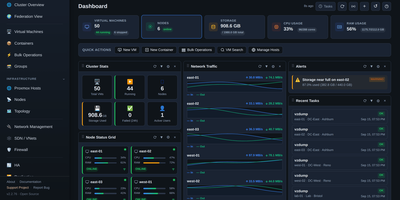
Three Proxmox sites, a lab host in the corner, and a rack of Dell and HPE servers can all share one screen when Depl0y runs the show. The dashboard totals virtual machines, containers, CPU, RAM, storage, and network traffic across every registered endpoint, with draggable widgets, alerts, and recent task feeds. Virtual machine pages cover start, stop, restart, snapshots, cloning, migration, templates, and a browser console, and node pages add metric charts, storage, networking, and update status. A guided failover wizard checks quorum, storage, and disks, then protects a guest so it restarts on another node if its host fails. A topology view maps hosts, guests, bridges, storage, and BMCs, with PNG, SVG, and draw.io export. Hardware pages poll iDRAC and iLO for health, temperature, power draw, DIMMs, drives, and firmware, and power controls reach machines that are fully off. Deployment tools build VMs from cloud images, import OVA, VMDK, and QCOW2 files, and launch self-hosted LLM guests. Admin, Operator, and Viewer roles, TOTP, host pinning, and a searchable audit log keep access tidy. MSPs managing client clusters, homelabs with several nodes, and data center teams that want hypervisor and hardware status together are the target audience. Running on a dedicated VPS on RepoCloud with guaranteed CPU, RAM, and SSD, full root SSH access, and a browser serial console. MIT licensed.
SerOps
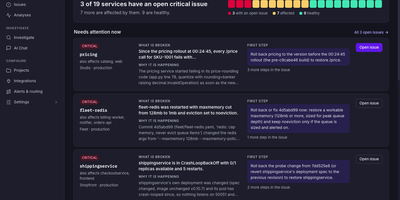
Root cause first, dashboards second: SerOps reads the logs, metrics, traces, deploys, and commits you already produce and explains why an incident happened, even when no alert fired. It plugs into Elasticsearch, Loki, Splunk, Datadog, and the big three clouds for logs, plus Prometheus, VictoriaMetrics, Jaeger, and Tempo. GitHub, GitLab, Bitbucket, Azure DevOps, Jenkins, Argo CD, and Flux supply the other half of the story: which change shipped, and when. Analyses come back as a plain-language root cause, the reasoning behind it, and numbered next steps, with the suspect commit linked beside it. Evidence, not guesses. The Overview page opens on what is broken, why, and the first thing to try, so whoever is on call starts at the fix. Issues are deduplicated and land in a table you can filter by severity, status, project, environment, or service, then resolve, mute, or acknowledge. Need an answer now? Run an investigation over a window you pick, then keep asking in AI Chat, which sees the same evidence. Choose Claude, Gemini, OpenAI, DeepSeek, or local Ollama, cap monthly spend, and re-run any analysis on a second model to compare answers. Regex masking strips secrets and personal data from what goes to the model, and quiet windows skip the AI call. Alerts reach Slack, Teams, PagerDuty, OpsGenie, or email, with routing rules, quiet hours, and digests. Running on a dedicated VPS on RepoCloud with guaranteed CPU, RAM, and SSD, full root SSH access, and a browser serial console. AGPL-3.0 licensed.
deco Studio
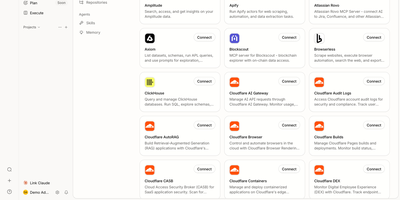
Roll out AI across a whole company without handing a single API key to anyone. deco Studio gives teams a shared chat workspace, and the admin keeps control of which models, tools, and data every agent can touch. Register MCP servers once from a catalog of ready-made connections, including Amplitude, Apify, Atlassian Rovo, ClickHouse, and a long list of Cloudflare services, then grant tool-level access by organization, role, or agent. Tokens stay in an encrypted vault, so teammates share capabilities and never credentials. Agents bundle instructions, skills, files, and approved tools, then publish as their own MCP endpoint that Cursor, Claude Desktop, or custom code can call. A built-in skills library ships with dozens of reusable playbooks, and Memory keeps facts the whole organization should remember. Model choice stays open through OpenRouter, Anthropic, OpenAI, Google Gemini, or any OpenAI-compatible server, and engineers can link a Claude Code or Codex session they already use. Projects group agents and connections around a goal, with Monitor dashboards for orders, visitors, logs, and deploys, and an Execute board for tasks and epics. Running on a dedicated VPS on RepoCloud with guaranteed CPU, RAM, and SSD, full root SSH access, and a browser serial console. MIT licensed.

Open Monograph Press
Monographs and edited volumes reach readers through a searchable catalog once Open Monograph Press (OMP) has carried them through its editorial workflow. Authors drag in chapter files, figures, and tables, and managing editors assign editors and track their assignments. Manuscripts move through Submission, Internal Review, External Review, Copyediting, and Production, with anonymous or open review rounds, due dates, automated reminders, and a flag for overdue reviews. Books publish in whatever formats a press needs: PDF, ePub, HTML, audio, video, datasets, or a printed edition with an ISBN. Files are set to Open Access or Direct Sales, and priced formats get a purchase button. Edited volumes list their chapters with separate contributors and downloadable files. Series with their own editors and nested subject categories organize the catalog, and featured and new-release flags decide which titles lead the home page. Readers search or browse by series or category on a responsive site that a press can restyle with a custom theme. Catalog entries carry ONIX metadata for books and chapters, DOIs, ORCID, and ROR affiliations, with OAI-PMH and Google Scholar support for discovery. Usage charts track catalog-entry and file views over time, a per-monograph table lists abstract, file, PDF, and HTML counts, and COUNTER R5 reports are built in. Configurable roles cover editors, copyeditors, and production assistants. Publication metadata is multilingual. Running on a dedicated VPS on RepoCloud with guaranteed CPU, RAM, and SSD, full root SSH access, and a browser serial console. GPL-3.0 licensed.

RERO ILS
A network of libraries can run cataloguing, lending, acquisitions, and a public catalogue from one system with RERO ILS, an integrated library system built for consortia as well as single libraries. Configuration lives at organization and library levels, and the Admin menu holds circulation policies, item types, patron types, templates, and a permissions matrix; the cataloguing editor follows RDA and BIBFRAME and offers an Add field list, a Jump to index, and templates. Record pages list holdings with barcode, call number, and status, a Related Entities tab links authors and subjects to French and German authority records, and periodicals get subscriptions, issue predictions, and a Late issues list. At the desk, staff check items out and in by patron card number or item barcode, handle requests and interlibrary loans, manage exhibitions and courses, and review current loans and fees; acquisitions covers vendors, orders, budgets, and accounts, with fund transfers and CSV export. Patrons search a public catalogue by document, author, or subject, switch on full-text search, filter by online or physical resources, document type, and library, and see availability at a glance; records download as JSON or RIS for Zotero, and a REST API exposes the BIBFRAME-based data. Running on a dedicated VPS on RepoCloud with guaranteed CPU, RAM, and SSD, full root SSH access, and a browser serial console. AGPL-3.0 licensed.