Kaeso
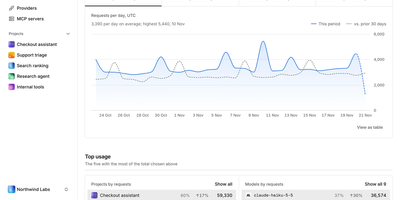
Point every app, SDK, and coding tool at one endpoint, and Kaeso routes each request to the provider or self-hosted model that should answer it, with budgets, logs, and access control built in. Apps keep speaking the OpenAI, Anthropic, Gemini, or ElevenLabs format, and Kaeso translates each request, reply, and stream for whichever provider sits behind the model name. Beyond chat it serves embeddings, reranking, decision models that answer typed questions with probabilities, images, video, speech, transcription, music, and batches. Alias routes add conditions, weighted splits, fallbacks, and retries, key pools spread a project over several keys of one provider, and retiring models send Deprecation and Sunset headers, show who still calls them, and offer a one-click move to the replacement. Hard or soft budgets and rate limits per project, member, service account, or key are checked before the provider is called, and guardrails mask or block secrets, email addresses, IBANs, and card numbers before the model sees them. Teams get single sign-on over OpenID Connect, SCIM 2.0, roles, and request logs that keep content only where the organization, project, or request allows. A playground compares models side by side, and a per-project MCP portal lets claude.ai, ChatGPT, or Cursor call your MCP servers. Claude Code and Codex can use Kaeso as their model provider, so every session is logged and budgeted. Running on a dedicated VPS on RepoCloud with guaranteed CPU, RAM, and SSD, full root SSH access, and a browser serial console. MIT licensed.
Voicebox
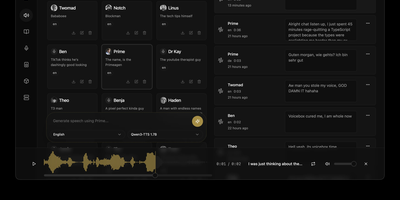
Voicebox is a voice studio that clones a voice from a few seconds of audio and then speaks any script in it, all on hardware you control. Eight speech engines cover multilingual cloning, preset voices, voices described in plain words, and expressive tags like laughs and sighs, across 23 languages. Long scripts are split at sentence boundaries and crossfaded, so chapters and articles render in one pass. A post-processing rack adds pitch shift, reverb, delay, chorus, compression, and filters, with presets like Robotic and Radio. The Stories editor lays voices on a multi-track timeline for podcasts and dialogues, then exports the mix. Voice profiles can be recorded in the app, imported, exported, and given personas that a bundled local language model uses to compose, rewrite, or respond. Global dictation turns a held hotkey into transcribed text with optional cleanup of filler words. A built-in MCP server and REST API let coding agents call a single speak tool and talk back in a cloned voice. Running on a dedicated VPS on RepoCloud with guaranteed CPU, RAM, and SSD, full root SSH access, and a browser serial console. MIT licensed.
Hindsight
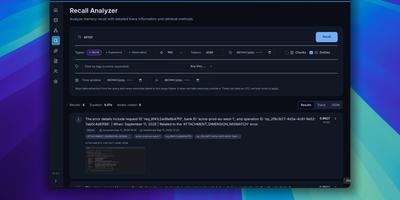
Memory that survives the session: Hindsight extracts facts, entities, and timestamps from everything an AI agent retains, then lets the agent search or reason over it later. Adding it to an existing LLM client takes a two-line wrapper, and more than 60 integrations cover Claude Code, Cursor, LangGraph, CrewAI, and n8n. Every bank also exposes its own MCP endpoint. Retain sends text, images, or files through an LLM that extracts facts, timestamps, entities, and relationships. Recall runs semantic, keyword, graph, and temporal searches in parallel, merges them with reciprocal rank fusion, reranks with a cross-encoder, and trims to a token budget. Reflect reasons across memories for questions that need synthesis, shaped by per-bank skepticism, literalism, and empathy traits. In the background, related facts consolidate into observations that keep exact quotes and proof counts and are refined, never silently overwritten. Mental models and wiki-style knowledge pages hold standing answers that rewrite themselves as the bank learns. Each user, agent, or project gets an isolated bank with no cross-bank leakage, and Memory Defense redacts or blocks secrets and PII against 45 patterns. The Control Plane adds a Recall Analyzer with traces, a memory constellation graph, and a knowledge page editor. Extraction and reasoning can run on 25+ LLM providers, including local Ollama and llama.cpp. Running on a dedicated VPS on RepoCloud with guaranteed CPU, RAM, and SSD, full root SSH access, and a browser serial console. MIT licensed.
Risk-Aware Trading Agents
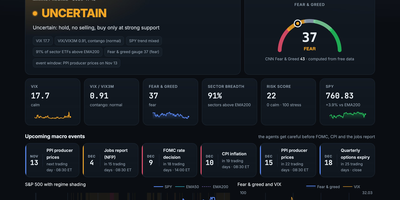
Risk-Aware Trading Agents gives a US-stock trader a patient robot that buys quality pullbacks, keeps a cash floor, and never sells in a panic. The Market page names the current regime, from risk-on to risk-off, beside a fear and greed gauge, VIX, sector breadth, and the coming FOMC, CPI, and jobs dates. Signals scans a watchlist and shows each idea with its conviction and reasons, and every score carries a question mark that explains how it was calculated. Agents runs several strategies side by side, each with its own simulated account, ranked against SPY every trading day. A decision opens into the setups found, the risk check, and an optional bull analyst, bear analyst, and risk judge from a language model. News shows which stories are confirmed by two outlets or an SEC filing. Backtest replays strategies with headlines arriving at the minute they were published and runs a look-ahead check on every research run. Claude, Codex, or Gemini can write and test a strategy through the built-in MCP server. Running on a dedicated VPS on RepoCloud with guaranteed CPU, RAM, and SSD, full root SSH access, and a browser serial console. MIT licensed.
Memora
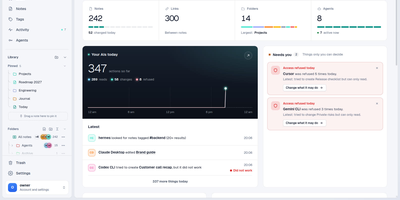
Memora is a self-hosted second brain where Claude Code, Cursor, ChatGPT, and your other AI agents share one memory made of plain Markdown notes that never leave your server. Agents read and write those notes through 77 tools on a Model Context Protocol endpoint, authenticating with a scoped API key per agent or with OAuth approved in the browser. Every change is committed to git, so any revision can be listed, diffed, and restored, and wikilinks and backlinks turn the vault into a navigable graph. The web UI shows a 3D brain with a region per folder, force, radial, and cluster graph layouts, and a canvas with a frame per folder, beside a reader and editor with reading settings. A live activity timeline records every read, write, search, and sign-in, with filters and JSON or CSV export. Mnemo, a built-in notes agent, finds, writes, tags, links, and tidies notes with your own OpenAI, Anthropic, or OpenAI-compatible key, shows every step, and hands tasks to sub-agents. Privacy rules hide folders from chosen agents, scopes and tool lists limit each key, and access rules allow or block by IP, CIDR, or domain. Images pasted into a note stay in its folder, and the interface installs as a PWA. Install with npm, Docker, or a systemd installer, then claim the instance with a one-time setup code. Running on a dedicated VPS on RepoCloud with guaranteed CPU, RAM, and SSD, full root SSH access, and a browser serial console. AGPL-3.0 licensed.
Hatamoto
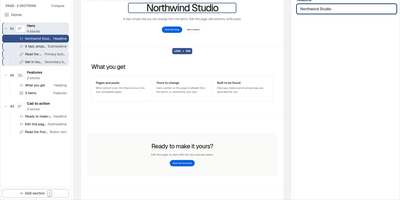
Hatamoto is a self-hosted CMS for site owners who want search engines and AI assistants to read their pages as well as people do. Pages come together on a visual canvas of sections and blocks, previewed at desktop, tablet, and phone widths, with undo and version history, while posts get a writing editor with SEO checks, scheduling, and suggested internal links. Every page is a typed record, so one edit updates the page, its structured data, its sitemap entry, and its llms.txt line together. Analytics count AI crawler fetches on the server, check each claimed bot against its operator's published IP ranges, flag impostors, and show visits sent by assistants as their own channel, all without cookies. You can allow or block crawlers by purpose, such as training, search, or user requests. Agents connect over MCP with scoped API keys that can expire, drafting and publishing pages, editing menus and redirects, and reading reports, while an audit log records every call. Moving from WordPress starts with a scan report predicting what imports cleanly, then copies content and menus and adds a permanent redirect for every changed address. Plugins and themes install as signed packages that list the permissions they request, and updates roll themselves back when the health check fails. Forms collect submissions with spam filtering and CSV export. Running on a dedicated VPS on RepoCloud with guaranteed CPU, RAM, and SSD, full root SSH access, and a browser serial console. Apache-2.0 licensed.
Token Bank
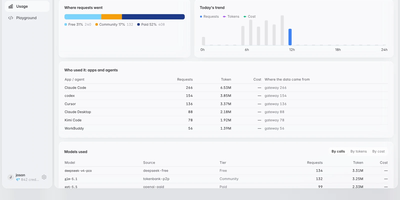
Run one local gateway and every AI coding agent you use shares the same address, key, and usage ledger. Token Bank onboards Claude Code, Codex CLI, Kimi Code, OpenCode, Claude Desktop, OpenClaw, and WorkBuddy in one click by injecting base-URL variables or patching configs, and Revert restores the official settings. Agents keep native model names while the gateway quietly reroutes requests to Ollama, Groq, Cerebras, or DeepSeek, converting between Anthropic Messages, OpenAI Chat, and Codex Responses. Route chains step from local models to free APIs, subscriptions, and pay-as-you-go keys with failover, scene and task presets, and optional lossless JSON compression. Every call is traced with route, model, tokens, latency, and cost, local session logs are imported, and signed-in devices merge into one dashboard. An assets library holds MCP servers, skills, prompts, and agent templates, projects them onto each installed runtime, and a rule-driven butler repairs broken projections. The unified agent API dispatches tasks to local apps, professional templates, external agents joined by pairing code, or agents hired per task, returning results synchronously, in the background, or as a stream. A credit-based market lets you rent out idle quota while keys stay on your machine. The container build serves the desktop interface in a browser on port 11431, with the gateway on 11430 and access control left to your firewall or proxy. Running on a dedicated VPS on RepoCloud with guaranteed CPU, RAM, and SSD, full root SSH access, and a browser serial console. Apache-2.0 licensed.
cvENGINE
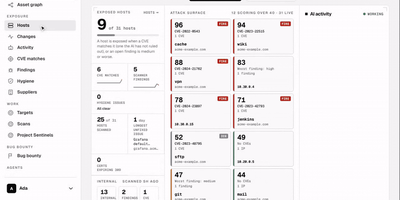
cvENGINE takes a domain name and returns a verdict on which of today's exploited vulnerabilities can actually reach you, with evidence attached. Continuous discovery builds a Shodan-style inventory of subdomains, IPs, ports, products, versions, certificates, and technologies, then rates every CVE as fire, smoke, or ice from real exploitation sources and scores each host from 0 to 100. Read-only validation reproduces a finding and records the exact command used. Optional AI triage sorts matches into confirmed, likely, or needs validation. A live dashboard, a change timeline with screenshot diffs, saved searches with alerts, and one-click PDF reports keep teams current. Sentinels run scans from other machines, including inside private networks, and an optional OpenVAS add-on extends coverage. Hygiene checks cover TLS, email and DNS records, exposed databases, cloud storage buckets, and WordPress sites. Organizations, roles, two-step sign-in, a REST API, and Slack, Discord, Telegram, and Lark alerts support shared use. A bug bounty workbench imports program scope and drafts reports. Running on a dedicated VPS on RepoCloud with guaranteed CPU, RAM, and SSD, full root SSH access, and a browser serial console. GPL-3.0 licensed.
Heym
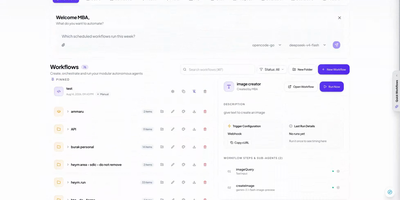
Heym lets you build AI agents and workflows on a visual canvas, run them from APIs, schedules, or chat, and watch every execution, token, and cost. Describe a system in text or voice and the AI Assistant draws the graph. Prefer hands-on? Compose it from LLM and Agent nodes, conditions, switches, loops, merges, and sub-workflows. An orchestrator calls named sub-agents in parallel. RAG runs on Qdrant or pgvector, and a knowledge graph keeps facts across runs. Triggers: cron, webhooks, messaging integrations, inbox events, WebSocket messages. Playwright nodes automate browsers, and Codex or OpenCode steps work on repositories. Checkpoints pause an agent so a person can accept, edit, or refuse before the run resumes. Every run lands in History. Traces list model requests, tool calls, tokens, latency, and USD cost, and alerts fire on errors, duration, spend, or run count. Evals compare prompts across models. OpenTelemetry exports reach Jaeger, Grafana Tempo, or Datadog. Publish workflows as REST or SSE endpoints, as MCP tools for Claude Desktop and Cursor, or as public Portal chat pages, then add dashboard widgets, Data Tables, a Kanban Board, and Drive file sharing. Running on a dedicated VPS on RepoCloud with guaranteed CPU, RAM, and SSD, full root SSH access, and a browser serial console. Source-available under the MIT License with the Commons Clause.
Overmind
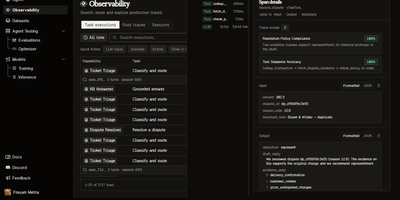
When an agent fails in production, Overmind scores the trace against your metrics and trains a specialized model on the evidence. Point it at the agent's repository and it maps capabilities, prompts, tools, and tasks into a graph, then matches every incoming OpenTelemetry trace to the capability that produced it and scores it on arrival. Auto-instrumentation picks up the LLM SDKs you already use, any OTel exporter can post to the API, and existing traces from Langfuse, LangSmith, Braintrust, or Galileo sync through connectors. Production traces and uploaded files become versioned datasets, with local English OCR for scanned PDFs and images, and optimisers run prompt, tool, and control-flow experiments in your repository and hand back the winner as a git diff. You fine-tune models whose weights you own, backtest them against the agent's own traces, and serve them, alongside optional OpenRouter frontier models, through one OpenAI-compatible API. Cursor, Claude Code, OpenCode, and Codex drive the whole loop through an MCP server and /overmind commands that cover tracing, datasets, fine-tuning, optimising, and backtesting. Self-hosting keeps traces and training data in your network: one Docker Compose file starts it, a seed command loads a demo workspace, and your own OpenRouter, Modal, and AWS keys power judging, training, and checkpoints. Running on a dedicated VPS on RepoCloud with guaranteed CPU, RAM, and SSD, full root SSH access, and a browser serial console. AGPL-3.0 licensed.
Pitot
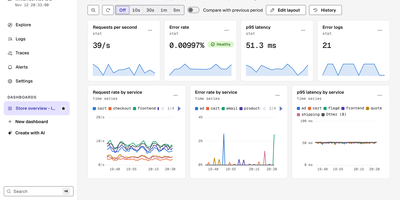
Point your OpenTelemetry exporters at one port and get traces, logs, metrics, dashboards, alerts, and an AI investigator, with no storage cluster to babysit. Pitot accepts OTLP over gRPC and HTTP, keeps everything in a single data directory as Parquet files you own, and lets you query with Explore and PitotQL even when no AI provider is configured. Ask the built-in agent which service is slowest right now and it runs typed queries across traces, logs, and metrics, then explains the evidence inline. Describe a dashboard in one sentence and it drafts, checks, and saves panels for request rate, error rate, p95 latency, service dependencies, slowest operations, and recent errors. Alerts watch service error rate, latency, throughput, and log volume. Prefer your own assistant? A remote MCP endpoint lets Claude Code or any MCP client search logs, inspect traces, query telemetry, and create dashboards after you approve its scopes through OAuth in the browser. Sign in with single-use login links or an OIDC provider, choose OpenAI or Anthropic for chat, and set how many days of telemetry to keep, 30 by default. Pitot runs as one node, which suits a single machine's worth of telemetry rather than fleet-scale clusters. Running on a dedicated VPS on RepoCloud with guaranteed CPU, RAM, and SSD, full root SSH access, and a browser serial console. Apache-2.0 licensed.
ClickHouse Loom
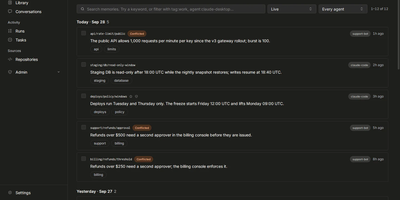
Give every AI agent you use the same memory, so what Claude Code learns on Monday is waiting for Codex or Cursor on Tuesday. Loom is a self-hosted server that stores memories, documents, conversations, and a code index, then serves them to agents over MCP, HTTP, and Python or TypeScript SDKs. Each fact is saved under a key with history and provenance, near-duplicates merge, and contradictions land in a review queue where a person keeps one side, drops one, or allows both. Search can abstain instead of guessing, and the Ask AI panel answers with numbered citations back to the memory or document behind each claim. A library indexes PDF, docx, and pptx files, and the repository explorer finds symbols, callers, and change impact with the commit it answers from. Namespaces, roles, and tokens let teams share memory safely, an audit log records every save, delete, and grant, and erasure requests are verified. Task inboxes pass work between agents with leases and retries. One installer script starts Loom and ClickHouse, and plugins connect Claude Code and Codex. Running on a dedicated VPS on RepoCloud with guaranteed CPU, RAM, and SSD, full root SSH access, and a browser serial console. Apache-2.0 licensed.
AI Team OS
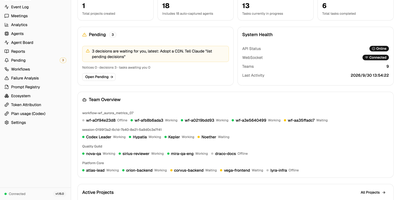
A shared project brain for Claude Code and Codex sessions: AI Team OS keeps tasks, decisions, memory, and reports in one record, so the next session can pick up where the last one stopped. Tasks sit on a live wall of pending, in-progress, and done work. Each one can carry an owner, parent and child links, dependencies, and an explicit wait on a person or an agent. Project memory holds your preferences and design decisions. One search box finds tasks, memos, reports, and workflow IDs without a model call. Agents talk through project, team, and global channels, with @mentions and acknowledgements. Eight meeting templates and four-round Advocate, Critic, Response, Judge debates end in recorded conclusions. The dashboard opens on a command center that shows every active team on one screen. Pending Decisions lists the questions agents raised for you, each with options and a recommendation. Claude Code Workflow runs get phase swim lanes with per-agent tokens, duration, and tool-call counts. Twenty-five role templates cover engineering, testing, research, and management. Guardrails flag seven dangerous patterns and two agents editing the same file. Storage, hooks, MCP tools, and the dashboard all run on your own server, so no hosted service of its own is needed. Running on a dedicated VPS on RepoCloud with guaranteed CPU, RAM, and SSD, full root SSH access, and a browser serial console. MIT licensed.
RocketRide
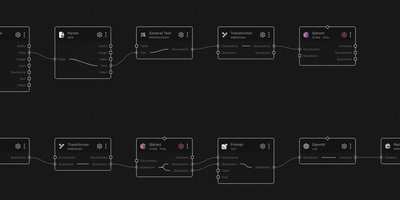
Building an AI pipeline in RocketRide means dragging nodes for models, vector stores, document parsers, and agents onto one visual canvas and wiring their typed lanes together, with no boilerplate in between. Press play on a webhook, chat, or file-dropper source node to start the pipeline. The catalog holds 170 nodes across 21 types, including 16 LLM nodes for OpenAI, Anthropic, Gemini, Mistral, and Ollama, vector stores such as Qdrant, Pinecone, Milvus, and pgvector, OCR, entity recognition, PII anonymization, reranking, and database connectors. Agent nodes run CrewAI, LangChain, LlamaIndex, or Deep Agents, and a persistent memory node carries context from one run to the next. Every pipeline is plain JSON. Commit it, diff it, review it, then run the identical file on a laptop, a server, or RocketRide Cloud. Tracing shows call trees, token usage, latency, and memory for each run, so you can compare models, agents, and tools before scaling up. Applications call pipelines through TypeScript and Python SDKs, and coding agents such as Claude and Cursor can build, change, and deploy them in plain language. Example pipelines cover document intake that reads text from scans and masks personal data, question answering over private files, and agent workflows, while Discord and Telegram source nodes feed chat bots into the pipeline. Running on a dedicated VPS on RepoCloud with guaranteed CPU, RAM, and SSD, full root SSH access, and a browser serial console. MIT licensed.
Calends
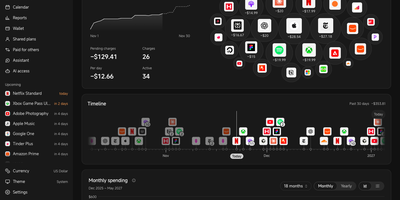
Subscriptions, family plans, and gift card balances share one private ledger in Calends, which shows what you pay, when it renews, and who still owes you. A subscription's history keeps its cycles, trials, intro prices, pauses, and plan switches, and a timeline plots each billing period by payment method or region. Past charges convert at historical exchange rates, forecasts use today's, and you pick the display currency. Shared plans follow each member's due dates, prepayments, waivers, and overdue days and suggest a prorated refund on exit, while Paid for others tracks what you front for friends. Wallet cards hold credit cards, store balances, and gift cards, and a balance runway shows when each runs dry and how much to top up. Reports total the year, set cash charged against true monthly cost, and draw a day-by-day heatmap and a money-flow diagram, while a checkup flags price hikes and duplicates. A calendar, a private ICS feed, and reminders to Telegram, Slack, Discord, ntfy, or any webhook show what is coming. A built-in assistant, running on your own model key, turns a pasted receipt or screenshot into a draft that waits for your confirmation. Claude Code, Codex, or Cursor can report what renews next week or record a price rise through 37 MCP tools behind read-only or read-write tokens, with dry-run previews. Running on a dedicated VPS on RepoCloud with guaranteed CPU, RAM, and SSD, full root SSH access, and a browser serial console. MIT licensed.
Tale
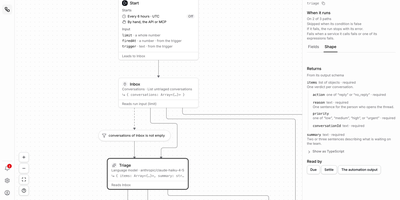
One workspace for the whole job: Tale puts your team and your AI agents on the same project board, so a question becomes an assigned task, a reviewed report, and files you can open. Describe the work with a brief, source files, and completion criteria, then assign it to a teammate or an agent. Agents get their own runtime (Claude Code, Codex, Cursor, Gemini CLI, Hermes, OpenClaw, OpenCode, Pi, or Qwen Code), model, skills, and tools, and work in a persistent sandbox; a manager agent can delegate ready tasks. Steer with @mentions in task comments, then accept the result or send it back. Chat shows the sources behind an answer and compares two models side by side in Arena. Knowledge holds documents, short entries, crawled websites, products, and contacts for retrieval within each team's access. Automations are versioned workflows with schedule, webhook, and event triggers, tests before deployment, playback of finished runs, and approval before protected writes; ready-made templates triage Gmail, Outlook, and IMAP inboxes, review pull requests, and send daily task digests. Coding agents connect over MCP with an access level you choose and can revoke. Roles, teams, budgets, guardrails, and a hash-chained audit log keep the work governed. Running on a dedicated VPS on RepoCloud with guaranteed CPU, RAM, and SSD, full root SSH access, and a browser serial console. MIT licensed.
Mirobody
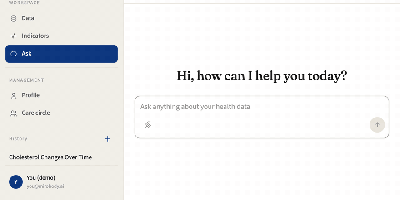
Three lab PDFs, a phone photo of a printed slip, and a spreadsheet become one cholesterol trend in Mirobody, a health data engine you host yourself, with the source file behind every number. Upload reports in 23 file types, import an Apple Health export, or connect Garmin, Oura, and Whoop, and every reading keeps a link to the page it was read from. Test names in English, Chinese, Japanese, and other languages resolve offline to LOINC codes and UCUM units, so HbA1c and Glycated Hemoglobin land on one series, and a name it cannot place stays unresolved instead of guessed. Ask questions in plain language and the agent shows each step as it works, charts the trend, and opens the reading and file behind every figure. A health journal turns one typed sentence into coded symptoms, blood pressure readings, and a medication entry, and a denied symptom like no fever is never logged. Genetic exports from 23andMe, AncestryDNA, and WeGene, or a VCF, can be queried by rsID, gene, or region. A care circle lets relatives share their own records on their own terms, and Claude Code, Codex, and Cursor can read your record through the built-in MCP endpoint. Choose OpenRouter, OpenAI, Gemini, Anthropic, or DeepSeek for answers, or keep every model on your own machine. Running on a dedicated VPS on RepoCloud with guaranteed CPU, RAM, and SSD, full root SSH access, and a browser serial console. Apache-2.0 licensed.
Arkon
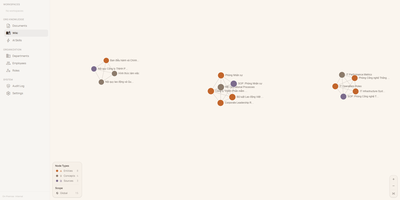
With 1,200+ GitHub stars since its April 2026 launch, Arkon provides an enterprise-grade knowledge management layer that turns scattered organizational documentation into AI-accessible structured context. The platform runs as a centralized MCP server, compiling your SOPs, policies, technical docs, and institutional knowledge into a versioned wiki with draft-approval workflows, then serving that wiki to Claude Desktop, Claude.ai, Cursor, and any MCP-compatible client through a single permission-scoped endpoint. OAuth 2.1 with PKCE authentication eliminates manual token management — employees authenticate through a browser login while the system discovers endpoints automatically via RFC 8414. The RBAC v2 system supports custom roles with granular permissions, department-scoped AI Skills, workspace isolation, and comprehensive audit logging so every query and access event is traceable. RAG retrieval powered by pgvector embeddings enables AI clients to search across all organizational documents with source attribution, while the AI Skills system lets teams define reusable instruction sets scoped to specific departments or roles. The architecture runs seven Docker containers coordinated by Compose: PostgreSQL with pgvector for embeddings and metadata, Redis for caching, MinIO for document storage, a FastAPI backend, two ARQ async workers for embedding generation and document processing, and a Next.js frontend portal accessible on port 3119. API keys are encrypted at rest with Fernet, and no telemetry leaves the deployment. Running on a dedicated VPS on RepoCloud with guaranteed CPU, RAM, and SSD, full root SSH access, and a browser serial console. PolyForm Internal Use licensed.