Categories
Self-Hosted AI Agents Knowledge Management Note Taking Markdown Agent Memory Second Brain MCP ServersStars
Forks
Watchers
Developer links
Memora
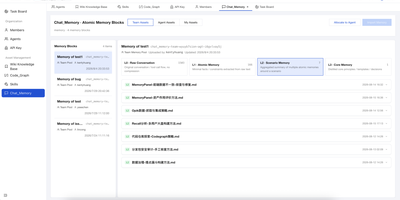
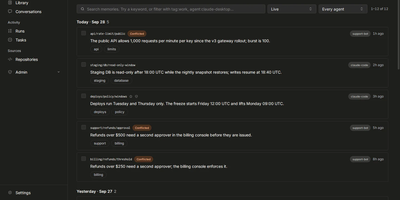
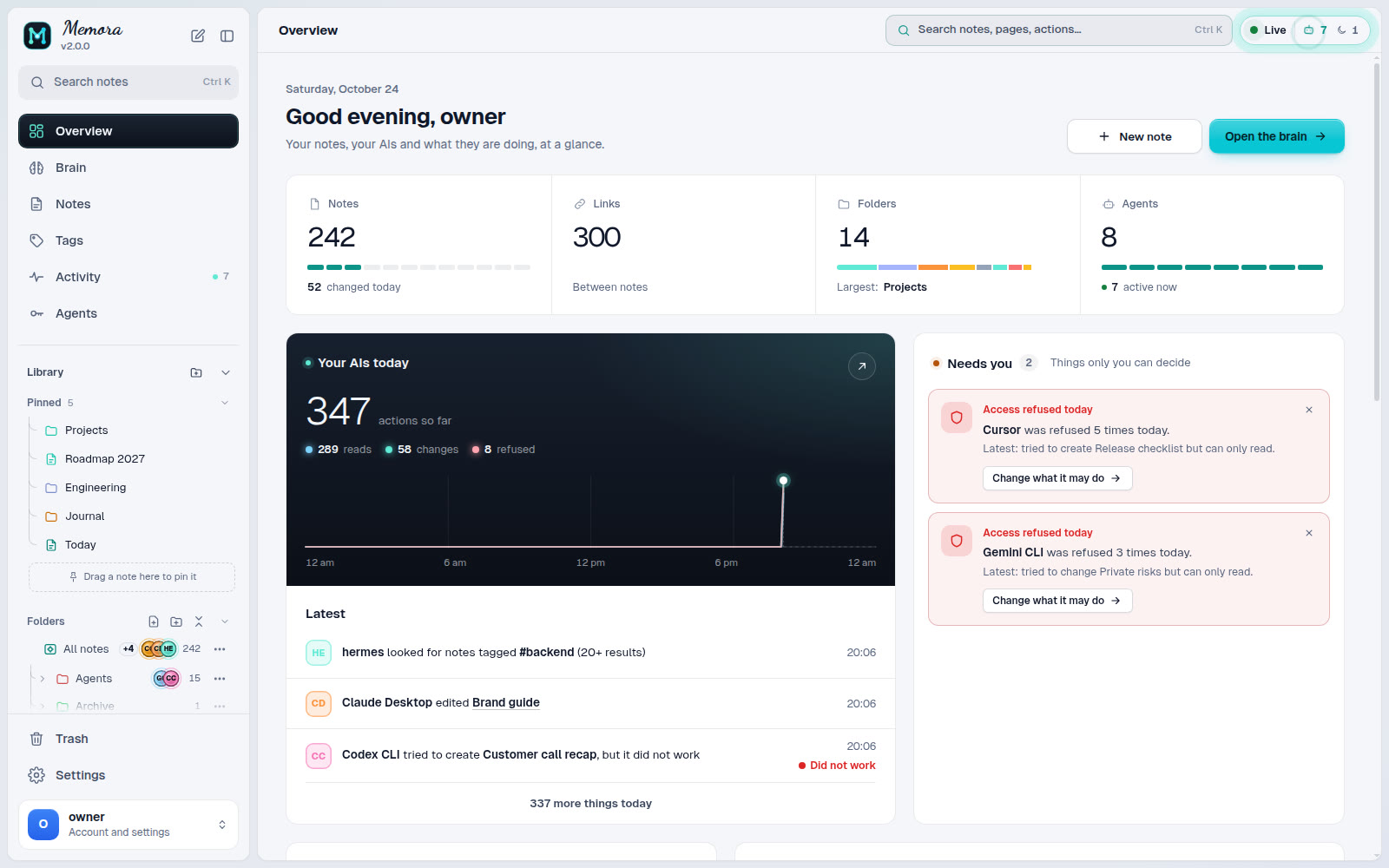
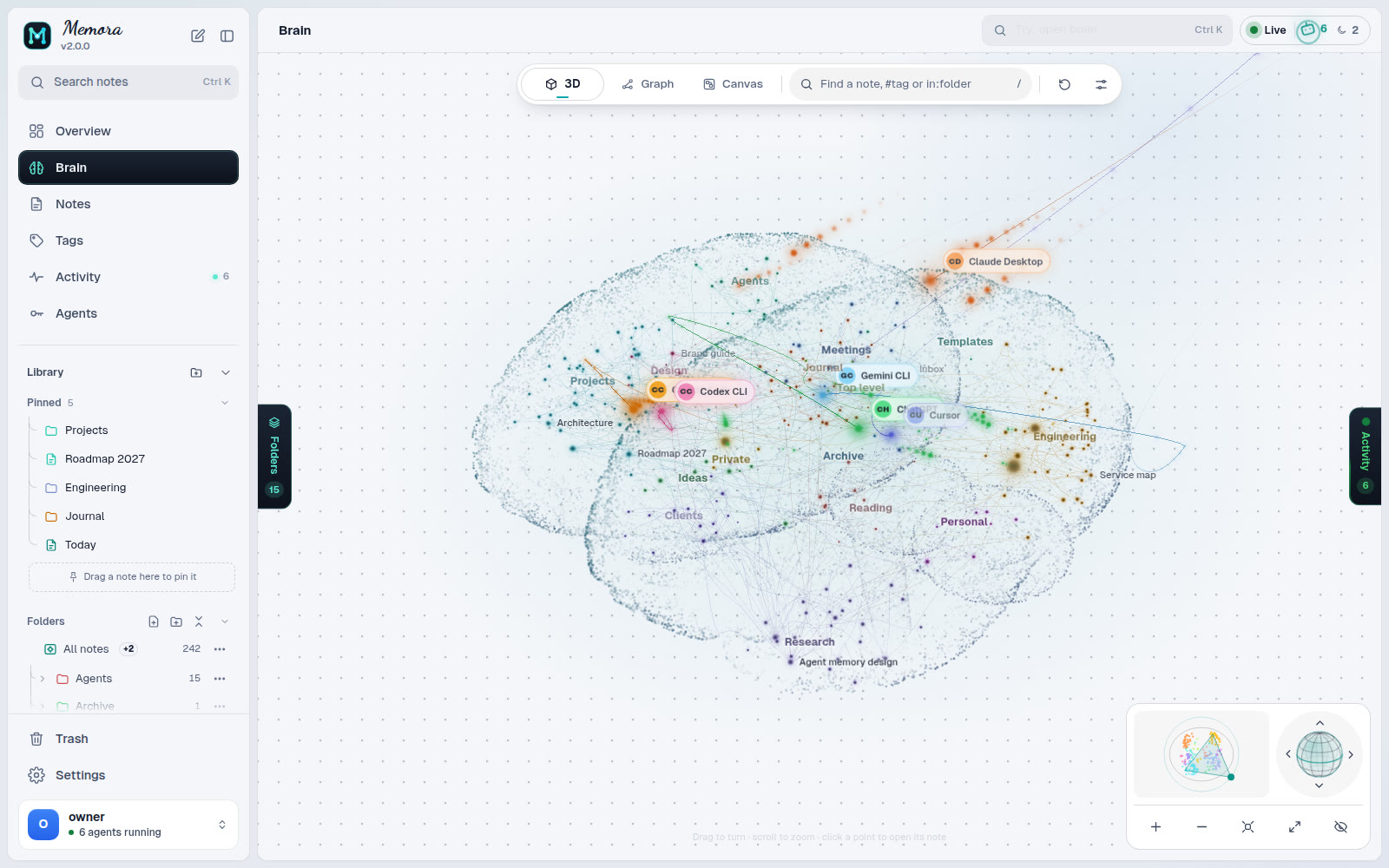
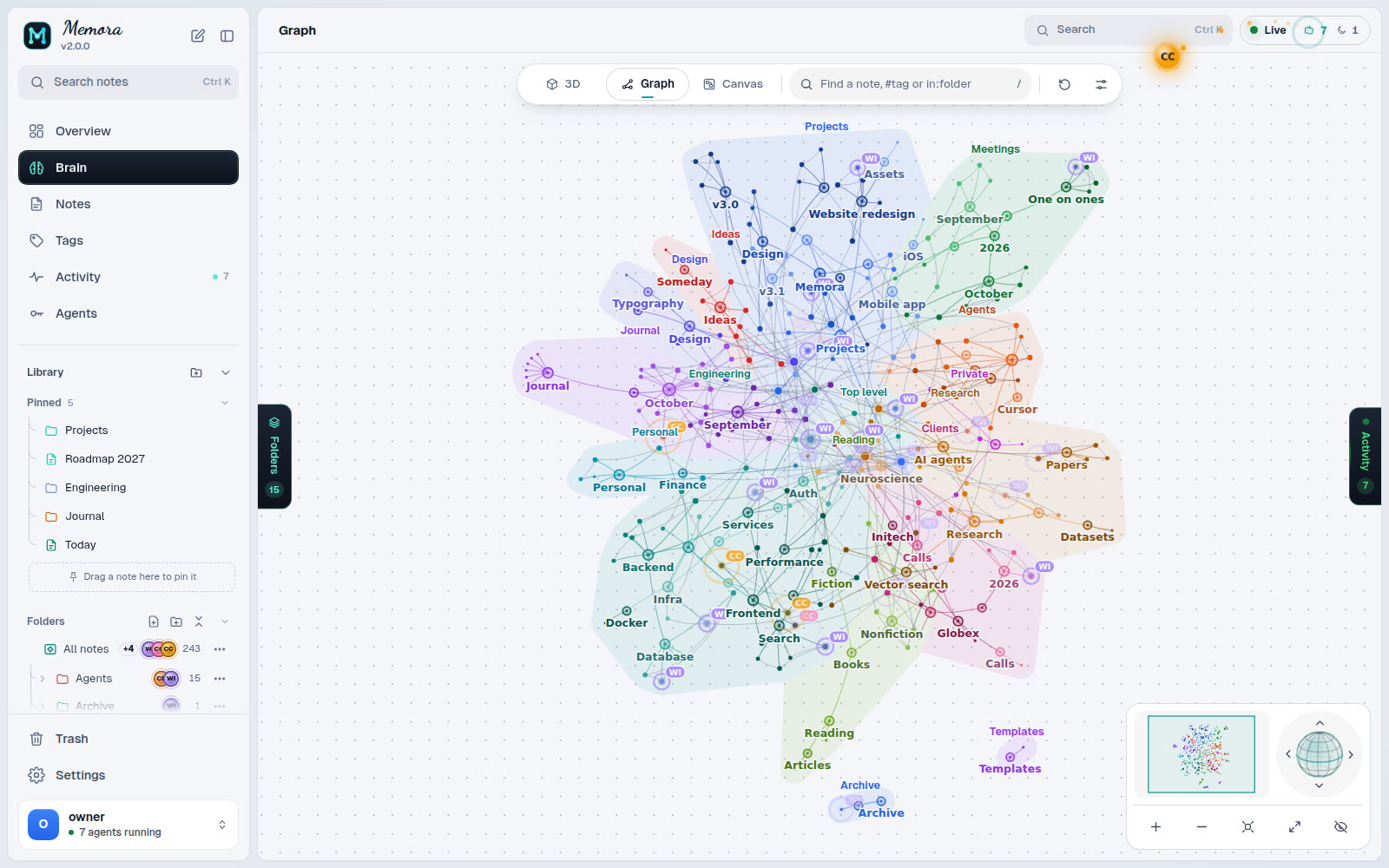
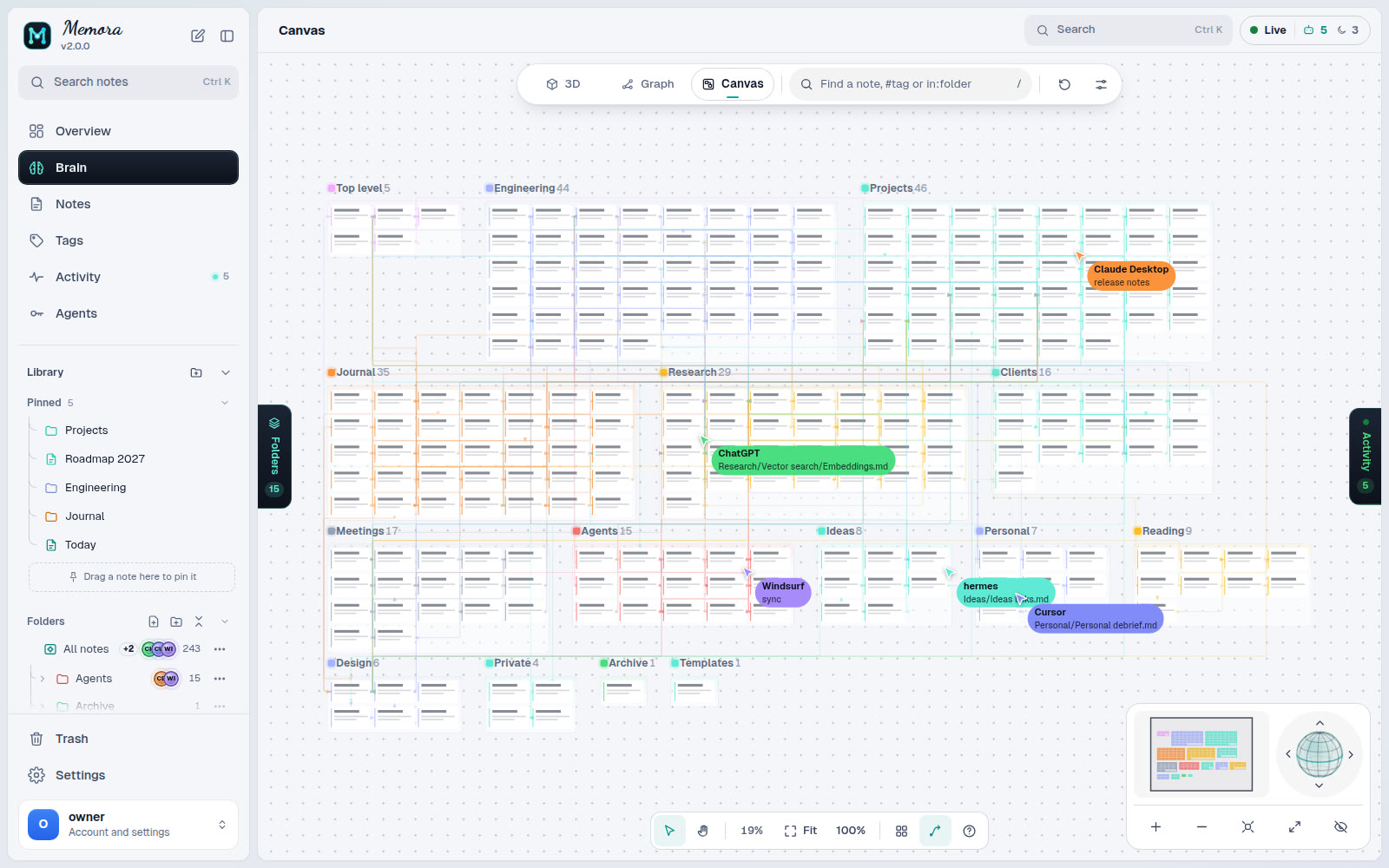
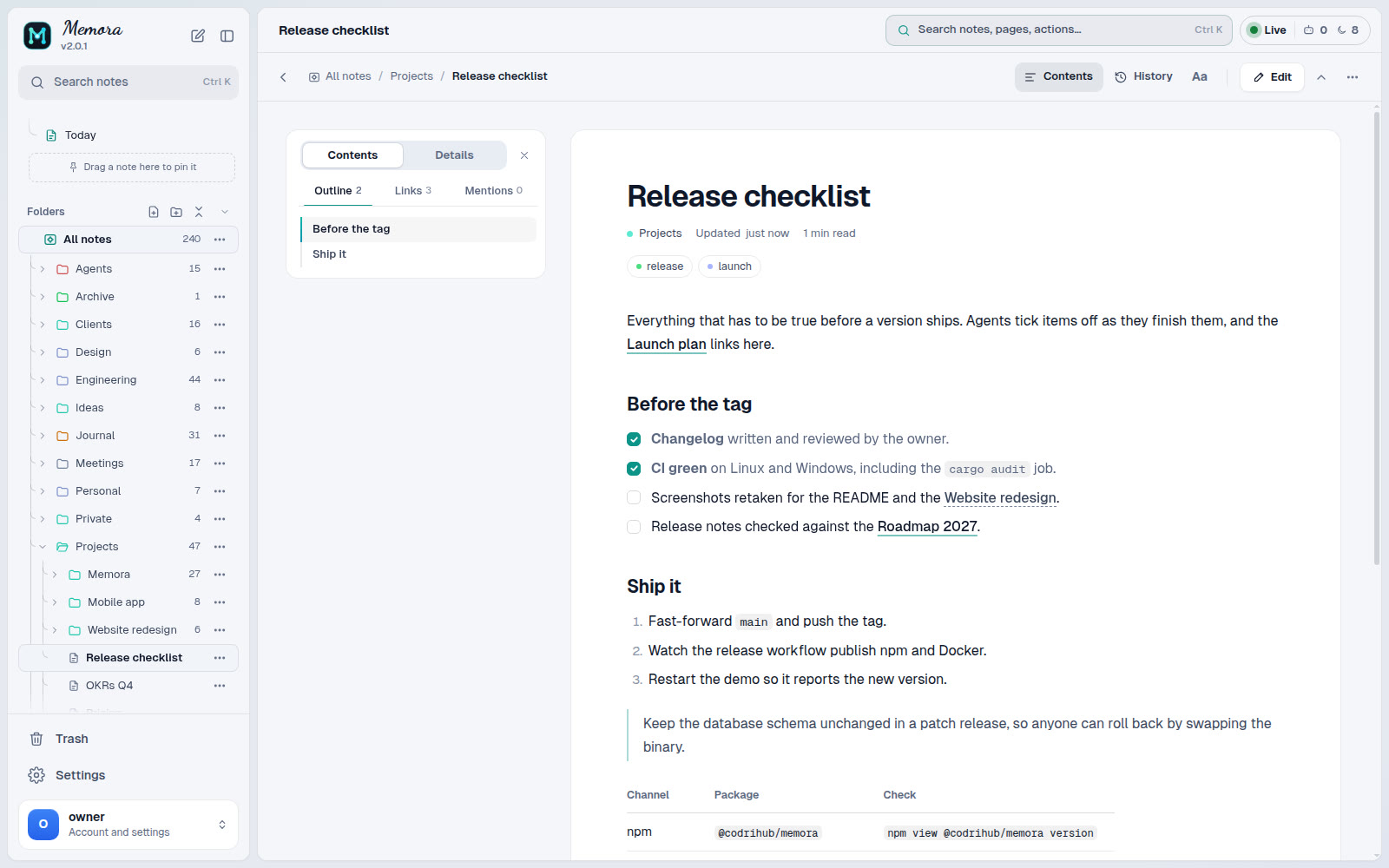
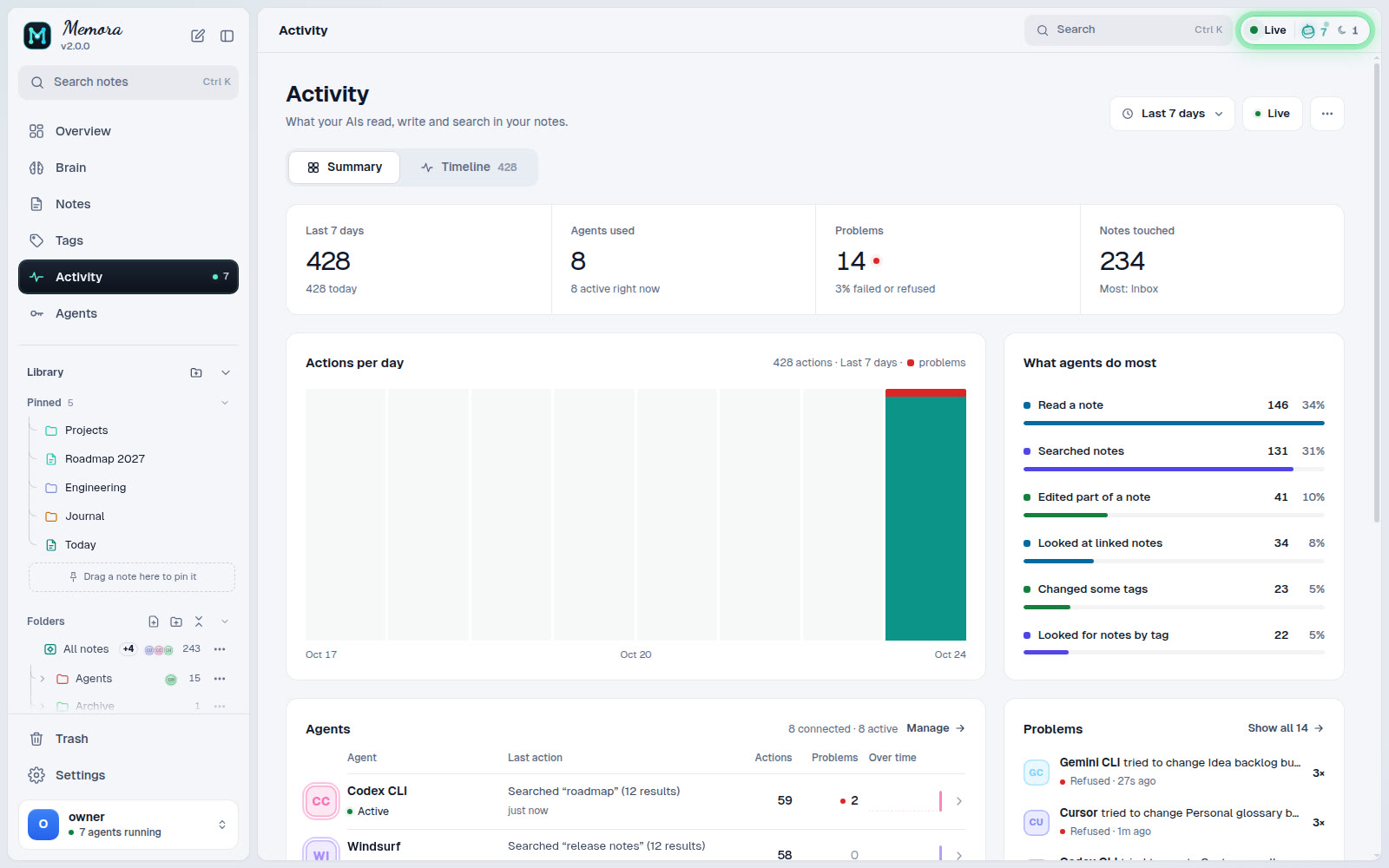
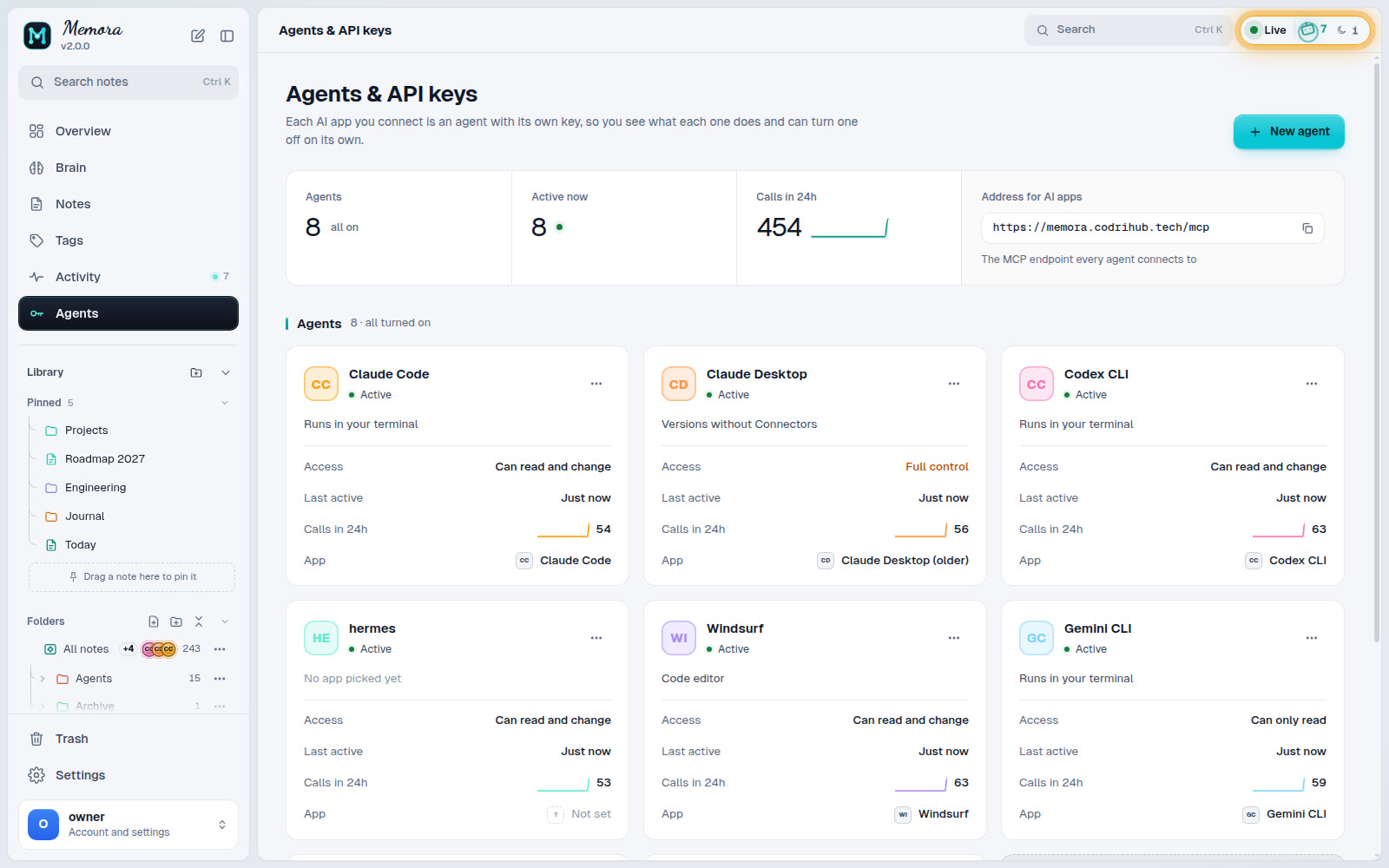
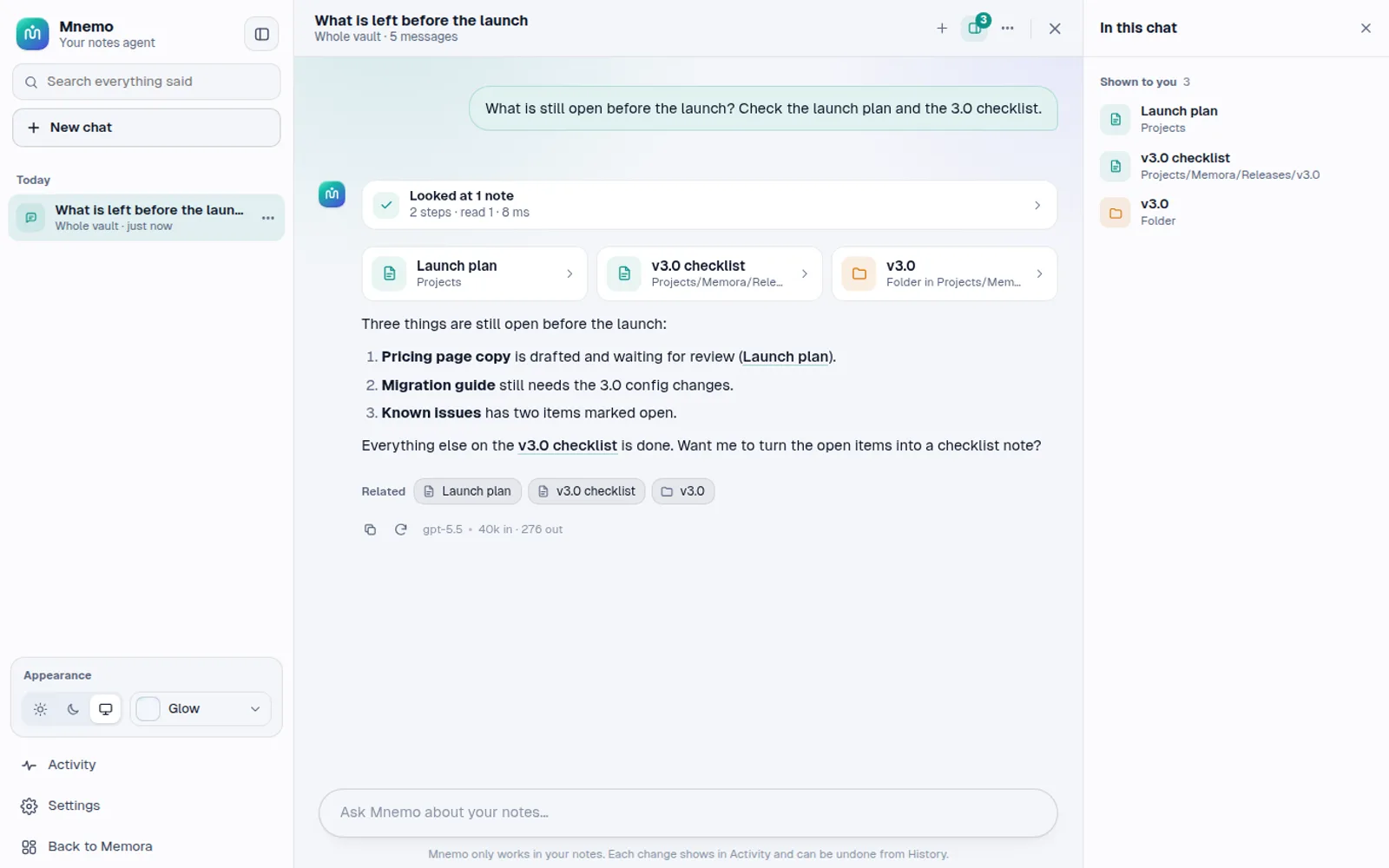
Memora is a self-hosted second brain where Claude Code, Cursor, ChatGPT, and your other AI agents share one memory made of plain Markdown notes that never leave your server. Agents read and write those notes through 77 tools on a Model Context Protocol endpoint, authenticating with a scoped API key per agent or with OAuth approved in the browser. Every change is committed to git, so any revision can be listed, diffed, and restored, and wikilinks and backlinks turn the vault into a navigable graph. The web UI shows a 3D brain with a region per folder, force, radial, and cluster graph layouts, and a canvas with a frame per folder, beside a reader and editor with reading settings. A live activity timeline records every read, write, search, and sign-in, with filters and JSON or CSV export. Mnemo, a built-in notes agent, finds, writes, tags, links, and tidies notes with your own OpenAI, Anthropic, or OpenAI-compatible key, shows every step, and hands tasks to sub-agents. Privacy rules hide folders from chosen agents, scopes and tool lists limit each key, and access rules allow or block by IP, CIDR, or domain. Images pasted into a note stay in its folder, and the interface installs as a PWA. Install with npm, Docker, or a systemd installer, then claim the instance with a one-time setup code. Running on a dedicated VPS on RepoCloud with guaranteed CPU, RAM, and SSD, full root SSH access, and a browser serial console. AGPL-3.0 licensed.
Benefits
- One memory shared by every agent
- Claude Code, Cursor, Codex CLI, Gemini CLI, and ChatGPT connect to one MCP endpoint, so what one agent learns is available to the others instead of starting from zero.
- Notes stay plain Markdown files
- Every note is a Markdown file with optional frontmatter and wikilinks in a folder you choose, so you can edit it with any tool and nothing is locked in a database.
- Control exactly what each agent sees
- Scopes, per-key tool lists, and privacy rules limit each agent to chosen notes and folders, and access rules allow or block clients by IP, CIDR, range, or domain.
- Every change can be undone
- Changes are committed to git so any revision can be diffed and restored, and every agent call appears live in an activity timeline you can filter and export.
Features
- MCP server with 77 tools
- A streamable HTTP endpoint at /mcp covers notes, folders, search, tags, graph traversal, history, locks, pins, and import or export, authenticated by API key or OAuth.
- Brain, graph, and canvas
- A 3D brain shows each folder as a region and each note as a node, with force, radial, and cluster graph layouts and a canvas with one frame per folder.
- Mnemo notes agent
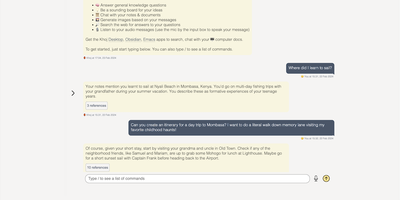
- Chat with your notes using your own OpenAI, Anthropic, or OpenAI-compatible key; Mnemo searches, writes, tags, links, and tidies notes, shows each step, and delegates to sub-agents.
- Git-backed version history
- Changes are committed automatically, so get_history, diff, and restore_memory list, compare, and roll back any revision of any note.
- Per-agent access control
- API keys carry mcp, read, write, or admin scopes and their own tool lists, while privacy rules hide chosen folders from chosen agents.
- Single-port Rust binary
- One binary serves the HTTP API, MCP endpoint, web UI, and WebSocket updates on port 8400, with server state in an embedded SQLite database.