Supabase
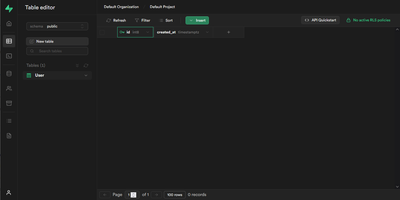
With over 107,000 GitHub stars and adoption by teams at Mozilla, 1Password, Peerlist, and thousands of startups, Supabase has become the most widely deployed open-source Firebase alternative — built entirely on PostgreSQL rather than a proprietary NoSQL store. Every project provisions a dedicated Postgres database with 40+ preinstalled extensions, auto-generating REST APIs via PostgREST, GraphQL via pg_graphql, and real-time change streams via an Elixir-based WebSocket engine that supports database change listeners, user presence tracking, and arbitrary broadcast messaging. Authentication covers email and password, phone OTP, magic links, and 20+ social providers including Google, GitHub, Apple, Azure, and SAML SSO, all enforced through Postgres Row Level Security policies that run inside the database itself. S3-compatible object storage delivers files through a CDN spanning 285+ cities with on-the-fly image transformations powered by imgproxy. Edge Functions run globally distributed TypeScript on the Deno runtime with Node.js compatibility and access to over two million NPM packages. The pgvector extension stores, indexes, and queries vector embeddings for AI-powered semantic search and retrieval-augmented generation workflows. Supabase Studio provides a browser-based dashboard with a table editor, SQL editor, schema visualizer, and log explorer. Official client SDKs ship for JavaScript, Python, Flutter, Swift, Kotlin, C#, Go, and Ruby. The self-hosted Docker Compose stack runs fourteen coordinated services including Kong API gateway, Supavisor connection pooler, and Logflare analytics. Running on a dedicated VPS on RepoCloud with guaranteed CPU, RAM, and SSD, full root SSH access, and a browser serial console. Apache 2.0 licensed.
Metabase
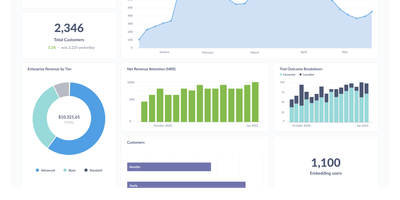
The most widely deployed open-source BI tool, Metabase is a visualization and query layer that sits on top of your existing databases without ingesting or copying data. Non-technical users ask questions through a visual query builder with drill-through menus that answer follow-ups like "broken down by month" without writing a new query, while analysts use the native SQL editor with variables and templates for complex work. Questions assemble into interactive dashboards with filters, auto-refresh, fullscreen mode, and custom click behavior, and dashboard subscriptions email or Slack scheduled reports to stakeholders. It connects to 20+ data sources including PostgreSQL, MySQL, MongoDB, SQL Server, BigQuery, Snowflake, Redshift, and ClickHouse - always querying in place, so there is no second data store to secure, sync, or pay for, and results are always current. Models and metrics let a data team define official, reusable starting points so self-service stays consistent, collections with permissions organize content, and alerts fire when a metric crosses a threshold. The practical effect is cutting the ad-hoc query queue that lands on the data team, since non-technical staff can answer their own questions. Written in Clojure, licensed AGPL, and shipped as a single JAR or Docker image with an embedded application database - a working BI instance runs before most tools finish their installer - the open-source edition has no limits on users, dashboards, or connected databases, where commercial BI platforms price per viewer as well as per creator.
Teable
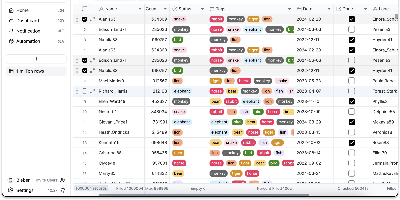
An Airtable-style spreadsheet interface directly on PostgreSQL: Teable is an open-source no-code database where every table is a real Postgres table. Unlike tools that store records in a metadata abstraction layer, every Teable table is a real Postgres table with standard column types, so filtering, sorting, and grouping run at database speed, million-row tables answer complex filters in roughly 200 milliseconds without index tuning, and any PostgreSQL-compatible tool - psql, BI dashboards, ETL pipelines - can query the same data directly. The interface offers Grid, Kanban, Gallery, Calendar, and Form views as non-destructive overlays with their own filters and hidden fields, plus 20+ field types, formulas, comments, attachments, batch editing, undo/redo, and edit history. Collaboration is real-time with live cursors and instant sync across views, backed by Redis, and a REST API is auto-generated per table, largely compatible with Airtable API clients - alongside native SQL access for BI tools, analytics pipelines, and your own applications to JOIN and query directly, with no exports, API rate limits, or sync jobs. Global search spans all records, chart plugins handle quick visualization, and CSV and Excel import/export cover migrations. Where Airtable caps paid plans at 100K-500K rows and charges roughly $20 per user per month, a self-hosted Teable instance has neither limit: the Postgres database itself is the export if you ever leave. Built in TypeScript with NestJS, deployed via Docker with PostgreSQL and Redis, and licensed AGPL-3.0.
Nocobase
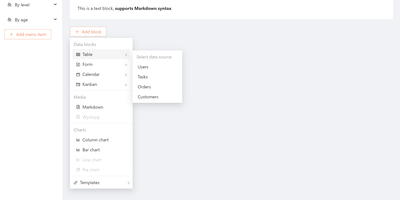
CRMs, project trackers, inventory tools - NocoBase is an open-source no-code/low-code platform for building business systems like these. Its architecture is data-model driven: you define collections and relationships first, then compose any number of interface blocks (tables, forms, kanban, charts) on top of the same model, so data structure is never coupled to a particular view. The core is a microkernel where every feature is a plugin, WordPress-style; you enable official plugins, install marketplace ones, or write your own as npm packages with server and client parts. Data sources include the main PostgreSQL or MySQL database, external databases, and third-party APIs - so you can build admin panels over existing production data instead of migrating it. Built-in infrastructure covers role-based permissions down to collection, record, and field level, workflow automation with approval steps and scheduled triggers, and audit logs; a one-click switch flips between usage and configuration modes. Because custom features live in isolated plugins with a documented lifecycle, core upgrades do not overwrite your customizations, and swapping UIs never requires data migrations since interfaces sit on independent models. Written in TypeScript on Node.js, Koa, and React under the AGPL license, it is light enough for one person to run and extend - and where no-code SaaS platforms charge per seat and per app, a self-hosted instance runs unlimited applications for unlimited users at hosting cost alone.
Baserow
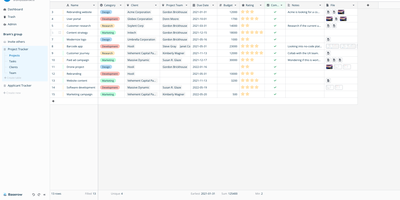
Airtable's spreadsheet-database model, self-hostable and open-source: that is Baserow. It presents data in a spreadsheet-style grid, but underneath each table is a real relational structure with typed fields, links between tables, filters, sorts, and multiple views (grid, gallery, form, kanban, calendar). Beyond the database core, it includes an application builder for composing pages and portals on your data, workflow automations, and dashboards. Everything is API-first: each table exposes a REST endpoint with token auth and webhooks, so it plugs directly into n8n, Zapier, or custom scripts. The stack is Django (Python) on the backend, Vue.js on the frontend, PostgreSQL for storage, with Redis for async tasks. Core features are MIT-licensed; premium features are a paid add-on. The self-hosted version has no row, storage, or API request limits - Airtable's per-base record caps and monthly API quotas simply don't exist here, and capacity is bounded only by your PostgreSQL database and disk. Existing Airtable bases, CSVs, and Excel files import directly with structure preserved, so migration doesn't start from a blank slate, and both the backend and frontend support plugins for custom field types and integrations without forking the core. For non-technical teammates the interface behaves like a spreadsheet; for engineers, the data model is the API.
OpnForm
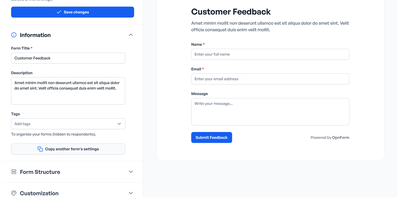
With 3,500+ GitHub stars and 100+ pre-built templates, OpnForm delivers a drag-and-drop form builder that handles everything from simple contact forms to multi-page surveys with conditional branching, calculations, and payment collection. The Laravel 11 API paired with a Nuxt 3 Vue frontend provides a responsive no-code editor supporting 20+ field types including text, date, file upload, signature capture, star ratings, phone numbers with country codes, and rich text. Conditional logic enables dynamic show/hide rules, required-field toggling, and calculated values that react to user input in real time. Submissions flow through configurable integrations — Slack notifications, Discord webhooks, Zapier connections to 5,000+ apps, Google Sheets sync, and custom webhook endpoints with full payload control. AI-powered form generation lets users describe a form in plain language and receive a ready-to-publish result. OIDC single sign-on with configurable state enforcement secures multi-user workspaces, while form-level passwords and CAPTCHA protection guard public-facing pages. Analytics dashboards track submission rates, completion times, and drop-off points. Forms embed via iframe on any website, Notion page, or custom domain with removable branding and custom CSS/JavaScript injection. The Docker Compose stack bundles the API, queue worker, scheduler, Nuxt client, PostgreSQL 16, Redis 7, and Nginx ingress proxy for a single-command deployment. Running on a dedicated VPS on RepoCloud with guaranteed CPU, RAM, and SSD, full root SSH access, and a browser serial console. AGPLv3 licensed.
n8n
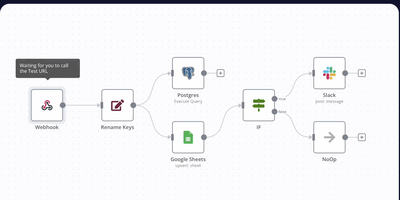
Webhooks, cron schedules, and app events trigger chains of nodes that fetch, transform, and route data: n8n is a workflow automation platform built around a visual, node-based editor. It ships with 400+ built-in integrations covering databases like Postgres, SaaS tools like Slack and HubSpot, and every major AI provider. When a pre-built node does not exist, the HTTP Request node calls any REST API, and the Code node runs JavaScript or Python inline, so you are never blocked by a missing connector. Workflows execute as directed graphs with branching, loops, error handling, and sub-workflows, and every run is logged for inspection and replay during debugging. It also includes LangChain-based nodes for building AI agents with tool calling and memory. Self-hosting on RepoCloud gives you unlimited workflow executions with no per-task pricing, and all data stays on your instance. Runs on Node.js with SQLite by default; add Postgres and Redis queue mode when you need to scale workers horizontally.
OpenBB
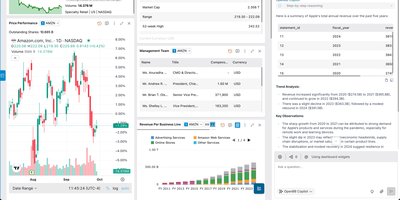
OpenBB stands as the world's most popular open-source finance repository — an Open Data Platform that evolved from a pandemic-era Reddit post into a full-blown infrastructure layer challenging Bloomberg's $25 billion empire. The "connect once, consume everywhere" architecture consolidates proprietary, licensed, and public financial data sources into multiple consumption surfaces simultaneously: Python environments for quants building models, OpenBB Workspace and Excel for analysts creating dashboards, MCP servers for AI agents performing automated research, and REST APIs for custom applications. The modular extension system supports dozens of data providers including Yahoo Finance, Alpha Vantage, FRED, Intrinio, Polygon, and Tradier with standardized schemas that normalize responses across vendors. The CLI offers a terminal-style interactive interface with autocomplete, parameter hints, and chart rendering for rapid data exploration. Provider routing handles authentication, rate limiting, and response normalization transparently so switching between free and premium data sources requires changing a single parameter. The platform covers equities, options, fixed income, crypto, forex, ETFs, mutual funds, economics, technical analysis, quantitative analysis, and alternative data across global markets. AI agent integration exposes every data endpoint as tool-callable functions with schema discovery enabling LLMs to query financial data programmatically. Install via pip with Python 3.9+ and deploy the REST API server for team access. Running on a dedicated VPS on RepoCloud with guaranteed CPU, RAM, and SSD, full root SSH access, and a browser serial console. AGPL-3.0 licensed.
OpenViking
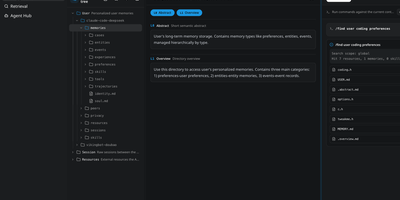
OpenViking is a self-hosted context database that gives AI agents persistent, structured memory by organizing knowledge, skills, and session history into a hierarchical virtual filesystem accessible through the viking:// URI protocol. Instead of dumping everything into a flat vector store and hoping semantic search finds the right chunks, agents navigate their context with familiar commands like ls, tree, and find, locating exactly the information they need through deterministic paths combined with semantic search. Every resource is automatically processed into three layers: a 100-token L0 abstract for quick filtering, a 2,000-token L1 overview for content navigation, and the full L2 detail loaded only when confirmed necessary. This tiered approach cuts token consumption by 83 to 96 percent compared to conventional RAG while improving task completion rates by 15 to 49 percent on benchmark tests. The built-in memory self-iteration loop automatically analyzes task execution and user feedback, updating agent memory directories so the system continuously learns and improves. You can connect to any LLM provider, including Ollama for fully local inference, OpenAI, or compatible gateways. The Web Studio UI at the /studio endpoint provides visual browsing of the entire context filesystem, and the REST API on port 1933 supports programmatic access. Deploy via Docker, Kubernetes with the included Helm chart, or as a standalone service. Running on a dedicated VPS on RepoCloud with guaranteed CPU, RAM, and SSD, full root SSH access, and a browser serial console. AGPL-3.0 licensed.
Nango
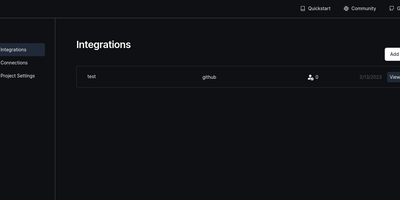
The integrations your SaaS product offers its own users - that is what Nango, an open-source product-integrations platform, exists to build. It solves the repetitive infrastructure work behind every third-party API connection: OAuth flows, API key handling, token refresh, encrypted credential storage, rate-limit backoff, retries, and multi-tenant connection management. It ships pre-built auth configurations for 800+ APIs. Your users connect their accounts through an embeddable, white-label Connect UI, and your backend then reads or writes data through Nango's proxy, SDKs, or REST API without ever touching raw credentials. Integration logic is written as TypeScript functions covering actions, scheduled data syncs, and webhook processing - all running on one runtime with retries, checkpointing, and per-connection logs built in. Syncs pull records incrementally on a schedule, one-way or two-way, which suits RAG pipelines, search indexing, and keeping local copies of external data current. Selected actions can also be exposed as tool schemas or through a built-in MCP server, so AI agents operate on user-connected accounts without ever handling provider credentials. Auth support spans OAuth 2.0, OAuth 1.0a, API keys, basic auth, and JWT, and observability - logs, metrics, failure detection, and a reconnect flow for expired credentials - is scoped per customer connection for easier support debugging. Works with any backend language. Self-hosting on RepoCloud keeps all customer credentials and synced data on infrastructure you control, which matters for data residency and compliance requirements.
InsForge
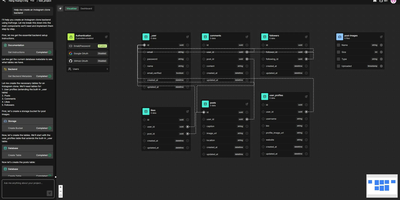
With 12,600 GitHub stars and 52 releases in under a year of development, InsForge is the fastest-growing open-source backend platform purpose-built for AI coding agents — giving Claude, Cursor, and any MCP-compatible tool direct access to database, authentication, storage, compute, and AI model infrastructure through a single self-hosted stack. The native MCP server exposes every InsForge operation as callable tools, letting coding agents autonomously create database tables, manage user authentication, upload files, deploy edge functions, and ship complete full-stack applications without human intervention. The Model Gateway provides an OpenAI-compatible API that routes requests across multiple LLM providers (OpenAI, Anthropic, Google, and open-source models) with unified billing, rate limiting, and fallback logic. PostgreSQL with pgvector handles both relational data and vector embeddings for RAG pipelines, while S3-compatible storage manages file uploads and static assets. Edge Functions run serverless TypeScript code on Deno with sub-millisecond cold starts for API endpoints, webhooks, and scheduled tasks. The authentication system provides user management, OAuth2 flows, sessions, and magic links with JWT token handling built in. Site Deployment builds and serves frontend applications with automatic SSL and custom domain configuration. The CLI paired with Agent Skills enables terminal-based workflows where agents invoke InsForge operations directly from the command line. Deploy via Docker with PostgreSQL as the only required external dependency. Running on a dedicated VPS on RepoCloud with guaranteed CPU, RAM, and SSD, full root SSH access, and a browser serial console. Apache-2.0 licensed.
Valkey
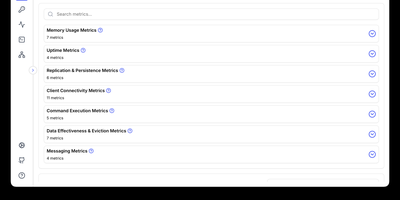
With 26,600 GitHub stars, 50 contributing companies including AWS, Google Cloud, Oracle, and Ericsson, and governance under the Linux Foundation ensuring the BSD 3-Clause license can never be revoked by a single entity, Valkey delivers a truly open-source Redis-compatible key-value datastore that reached 1.19 million requests per second in version 8.0 through redesigned asynchronous I/O threading across CPU cores while maintaining single-threaded data structure operations for predictability. Native data structures include strings, hashes, lists, sets, sorted sets, bitmaps, HyperLogLogs, streams, and geo-spatial indices with JSON support through modules. Valkey 9.0 shipped full-text search and aggregation via Valkey Search, enabling tag queries, numeric filtering, and text matching directly within the datastore without external search engines. Cluster mode provides horizontal scaling with automatic sharding, replication for high availability, and per-slot metrics for granular monitoring. Lua scripting enables complex atomic operations, while the module plugin system extends the server with custom commands and data types including probabilistic Bloom filters. Client libraries for Python, Java, Go, Node.js, and PHP maintain full Redis OSS protocol compatibility — existing Redis applications work without code changes. Deploy as a standalone daemon or in clustered mode with Docker, supporting persistent and ephemeral workloads on any Linux host. Running on a dedicated VPS on RepoCloud with guaranteed CPU, RAM, and SSD, full root SSH access, and a browser serial console. BSD 3-Clause licensed.
Apache Airflow
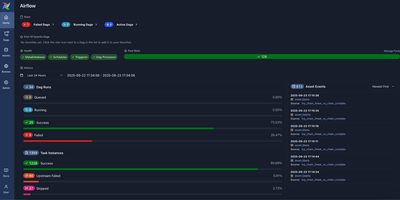
With over 46,000 GitHub stars and one of the largest communities in data engineering, Apache Airflow is the workflow orchestration platform that lets teams define, schedule, and monitor complex data pipelines as Python code through directed acyclic graphs. Airflow 3.x introduced a modernized architecture with a task execution API, the Language Task SDK for writing task implementations in Java and Go alongside Python, asset-based partitioning with FanOutMapper and FixedKeyMapper for data-driven scheduling, a first-class state store for tasks and assets, pluggable retry policies, and a redesigned React-based web UI built on FastAPI. The provider ecosystem ships 80+ packages covering AWS, Google Cloud, Azure, Snowflake, Databricks, Apache Spark, Apache Kafka, PostgreSQL, MySQL, MongoDB, Slack, HTTP, SSH, Docker, Kubernetes, and dozens more, enabling a single deployment to orchestrate jobs across multi-cloud and on-premises infrastructure. The scheduler supports cron expressions, timetable plugins, data-aware scheduling triggered by asset events, and dynamic task generation through Python loops and conditionals. Built-in operators include BashOperator, PythonOperator, DockerOperator, KubernetesPodOperator, and sensor operators that poll external systems. The web UI provides DAG visualization with Gantt charts, grid views, and graph views, task instance logs, SLA monitoring, connection and variable management, and role-based access control. Deployment options include standalone mode, Docker Compose with CeleryExecutor or KubernetesExecutor, Helm charts for Kubernetes, and managed cloud services. Running on a dedicated VPS on RepoCloud with guaranteed CPU, RAM, and SSD, full root SSH access, and a browser serial console. Apache License 2.0 licensed.
OpenSearch
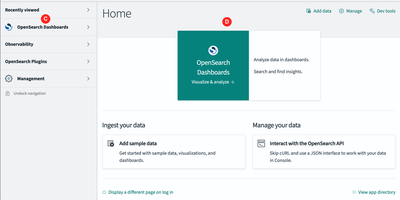
OpenSearch is a search and analytics platforms, powering full-text search, log analytics, observability, and AI-powered vector retrieval at petabyte scale. The distributed engine provides BM25 full-text search alongside k-NN vector search using NMSLIB, Faiss, and Lucene libraries, enabling semantic search, hybrid search combining keyword and vector scoring through normalization processors, neural sparse search, and retrieval-augmented generation workflows with built-in ML Commons for model hosting. OpenSearch Dashboards delivers interactive visualization with Discover for log exploration, custom dashboards, alerting, anomaly detection using Random Cut Forest algorithms, and Security Analytics with detection rules mapped to MITRE ATT&CK. Native Prometheus integration with full PromQL support unifies metrics alongside logs and traces in a single observability interface, while Data Prepper handles telemetry ingestion from OpenTelemetry collectors, Fluent Bit, and Logstash-compatible pipelines. SQL and Piped Processing Language queries with a visual PPL builder enable analysts to query data without learning the native DSL. Index State Management automates index lifecycle with rollover, shrink, and delete policies, while cross-cluster replication and searchable snapshots on S3-compatible storage provide disaster recovery. Scoped API keys, field-level security, document-level security, and audit logging deliver enterprise-grade access control. Docker Compose deploys multi-node clusters alongside the Kubernetes operator for orchestrated production environments. Running on a dedicated VPS on RepoCloud with guaranteed CPU, RAM, and SSD, full root SSH access, and a browser serial console. Apache 2.0 licensed.
Firecrawl
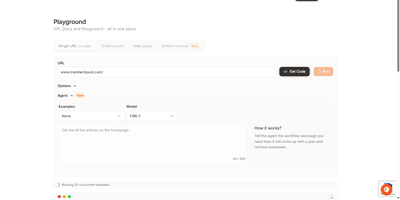
With over 164,000 GitHub stars and one of the fastest-growing open-source projects in the AI tooling ecosystem, Firecrawl is the web context API that turns any website into clean markdown, structured JSON, or screenshots optimized for large language models. The Scrape endpoint converts a single URL into LLM-ready output with approximately 67% fewer tokens than raw HTML, handling JavaScript rendering, rotating proxies, anti-bot bypasses, and dynamic content extraction with zero configuration. The Crawl endpoint recursively scrapes entire websites from a single request with configurable depth, URL filters, and concurrent page limits. The Map endpoint discovers all URLs on a domain instantly for sitemap generation. The Search endpoint performs web searches and returns full page content from results. The Interact endpoint scrapes a page then continues working with it — clicking buttons, filling forms, and extracting dynamic content using AI prompts or code. The Agent endpoint provides autonomous web data gathering where users describe what they need in plain English. SDKs are available for Python, Node.js, Go, Rust, Ruby, PHP, Java, C#/.NET, and Elixir, with an MCP server for connecting to any AI agent or MCP client. Self-hosting deploys via Docker Compose and requires Redis and a Playwright-based browser service for JavaScript rendering. Running on a dedicated VPS on RepoCloud with guaranteed CPU, RAM, and SSD, full root SSH access, and a browser serial console. AGPL-3.0 licensed.
Redash
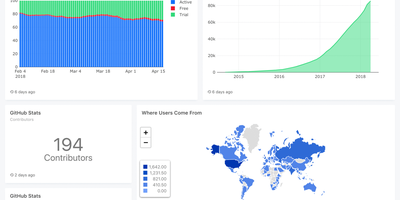
Used by millions of users at thousands of organizations worldwide and holding 29,000+ GitHub stars, Redash is the most established open-source SQL-first business intelligence tool — enabling anyone from analysts to executives to query databases, visualize results, and share dashboards without writing a single line of application code. The browser-based query editor supports SQL and NoSQL with schema browsing, auto-complete, query snippets, and parameterized queries that turn static reports into interactive data applications. Native connectors span 35+ data sources including PostgreSQL, MySQL, Amazon Redshift, Google BigQuery, Snowflake, ClickHouse, MongoDB, Elasticsearch, Databricks, Apache Presto, Microsoft SQL Server, and REST APIs — with an extensible data source API for custom integrations. Visualization types cover line, bar, area, pie, scatter, box plot, funnel, cohort, sankey, sunburst, choropleth map, and pivot tables, all draggable onto shared dashboards with cross-filtering parameters. Scheduled refreshes automatically update query results at configurable intervals, while threshold-based alerts notify teams via email, Slack, or webhook when metrics cross defined boundaries. SAML and Google OAuth SSO integration, role-based access control, API key management, and query-level permissions ensure enterprise-grade security for sensitive datasets. The self-hosted stack deploys via Docker Compose with PostgreSQL for metadata storage, Redis for job queuing, and Celery workers for background task execution. Running on a dedicated VPS on RepoCloud with guaranteed CPU, RAM, and SSD, full root SSH access, and a browser serial console. BSD 2-Clause licensed.
Parse Server
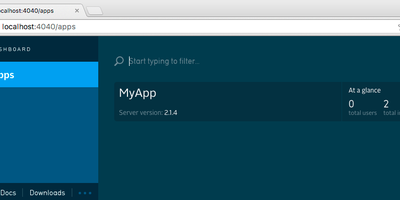
With 21,400 GitHub stars, 500+ contributors, and battle-tested since its 2016 open-source release after powering Facebook's mobile backend infrastructure, Parse Server delivers production-grade Backend-as-a-Service that eliminates months of custom API development. The platform generates REST and GraphQL endpoints automatically from your data schema with class-level permissions and object-level ACLs providing granular access control. Cloud Code enables server-side JavaScript execution for triggers (beforeSave, afterSave, beforeDelete, afterDelete), custom functions, and scheduled jobs — all deployable without restarting the server. Live Queries push realtime data changes to subscribed clients via WebSockets, powering chat applications, collaborative editors, and live dashboards. Push notification support spans APNs for iOS, FCM for Android, and web push for browsers with audience segmentation, scheduling, and delivery analytics. The Parse Dashboard provides a comprehensive admin interface with a data browser featuring configurable info panels, graph visualization, custom canvas builder with draggable elements, AI agent integration via OpenAI, data import/export, and multi-factor authentication. Database flexibility supports MongoDB 6-8 and PostgreSQL 13-18 with PostGIS for geospatial queries. Native SDKs cover JavaScript, iOS (Swift/Objective-C), Android, Flutter/Dart, .NET/Xamarin, Unity, PHP, and Arduino for IoT devices. Deploy via npm, Docker, or the official Express template with automatic schema migration. Running on a dedicated VPS on RepoCloud with guaranteed CPU, RAM, and SSD, full root SSH access, and a browser serial console. Apache 2.0 licensed.
NocoDB
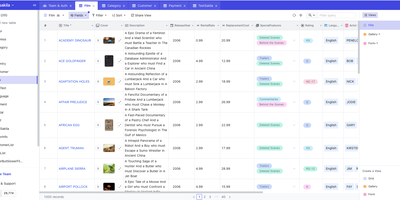
Any existing relational database becomes a collaborative, Airtable-style smart spreadsheet under NocoDB. It connects to PostgreSQL, MySQL, MariaDB, SQL Server, or SQLite, introspects the schema - tables, relationships, indexes - and renders it as interactive Grid, Gallery, Kanban, Calendar, and Form views without migrating a single row. Your business data stays in your database; NocoDB keeps only its own metadata (view configs, permissions, webhooks) in a separate store. Every connected table automatically gets REST APIs with Swagger documentation, effectively turning legacy databases into modern backends. The spreadsheet layer adds 20+ field types including formulas, lookups, rollups, links, attachments, and currency, plus sorting, filtering, grouping, and multi-field editing. Views can be locked or shared publicly with password protection, role-based access control scopes permissions per user, and webhooks plus CSV, Excel, and Airtable import round out integration. An ERD view visualizes the schema. Built with Node.js and Vue, deployed via Docker, handling millions of rows.