Open Source App Cloud Marketplace
Deploy, host, and scale with one click, at half the cost. Then customize with AI agents.
Observal
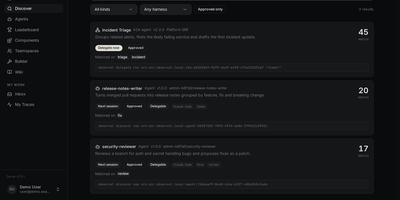
To pull a team's skills, MCP servers, hooks, prompts, and agent files out of scattered Git repositories, Observal keeps them in one reviewed registry and traces real sessions to show which ones help. Build an agent visually, with a live config preview for every harness. Submissions wait in an admin review queue, where reviewers inspect side-by-side version diffs before approving a release. Teamspaces give each team its own namespace, and approved releases can be forked into independent drafts. One pull command then writes the right config for Claude Code, Cursor, Kiro, Codex, Copilot, Pi, OpenCode, Antigravity, or Goose. Every approved resource is discoverable through the open Agentic Resource Discovery standard, and a running agent can hand part of its task to another approved agent or a remote Agent2Agent service. Hooks record each session as a trace of prompts, tool calls, MCP round trips, tokens, and errors, with turn-by-turn replay for debugging and audits. Insight reports, generated through providers such as Anthropic, OpenAI, or Ollama, list what is working, what is hindering, and quick wins. A dashboard follows adoption, cost, and department usage, a leaderboard ranks agents by downloads, and audit logs, SAML single sign-on, and SCIM provisioning are included. Running on a dedicated VPS on RepoCloud with guaranteed CPU, RAM, and SSD, full root SSH access, and a browser serial console. Apache-2.0 licensed.
Piik
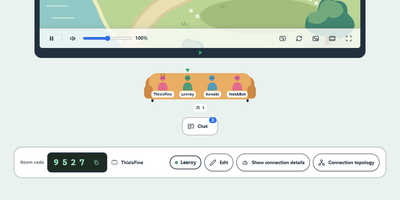
Share a game, a film, or your holiday photos with up to 20 friends, and let them watch from a browser tab with nothing to install. The host picks a screen, window, browser tab, or camera, then sends an invite link or a four-digit room code, with an optional room password. Friends open it on a desktop or phone, press Play, and chat or react while it runs, with optional on-screen chat. A microphone switch adds spoken commentary, with a choice of input device and voice volume. Video travels directly between participants where possible, and a self-hosted server can add automatic forwarding for networks that block direct links. Sharing settings cap resolution from 480p to 1440p, frame rate up to 60 fps, and audio at 64, 128, or 192 kbps, with Clarity, Balanced, and Fluency presets and a choice of VP8, H264, or automatic codecs. Viewers get playback controls, picture-in-picture, fullscreen, light and dark themes, and a connection topology view. The interface follows the system language in Chinese or English, with a visual-only mode for a text-free look. Piik App adds native capture on Windows, macOS, and Linux, while a hosted site works from any desktop browser. A self-hosted site can set a site passphrase, a viewer limit per room, and automatic cleanup of empty rooms. Running on a dedicated VPS on RepoCloud with guaranteed CPU, RAM, and SSD, full root SSH access, and a browser serial console. MIT licensed.
Colanode
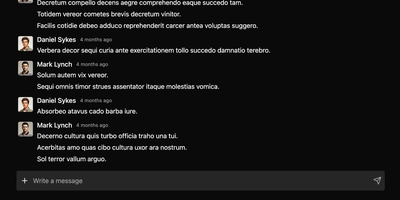
With nearly 5,000 GitHub stars and a Hacker News launch that garnered 147 points, Colanode delivers the first genuinely local-first alternative to both Slack and Notion in a single self-hosted workspace — writing every operation to a client-side SQLite database before syncing to your server, so teams work at full speed offline, on planes, or through intermittent connections without ever losing a draft. The real-time chat system provides channels and direct messages with instant delivery via WebSocket, while the rich text editor offers Notion-style block-based pages for documents, wikis, meeting notes, and knowledge bases with headings, code blocks, embeds, and nested hierarchies. Customizable databases organize structured data with custom fields and three dynamic views — table for spreadsheet-style browsing, kanban for visual workflow boards, and calendar for time-based planning. Conflict-free Replicated Data Types powered by Yjs handle concurrent editing across pages and database records: multiple users modify the same document simultaneously and the system merges changes automatically without manual conflict resolution. File management supports upload, sharing, and organization within workspaces using pluggable storage backends including local filesystem, S3-compatible services, Google Cloud Storage, and Azure Blob Storage with TUS resumable uploads for large files. The server runs Fastify with Zod validation on Node.js 20+, persists to PostgreSQL with pgvector extension, uses Redis for event broadcasting, and deploys via a single Docker image. Running on a dedicated VPS on RepoCloud with guaranteed CPU, RAM, and SSD, full root SSH access, and a browser serial console. Apache-2.0 licensed.
Docspell
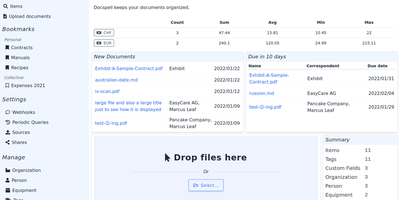
Convert paper archives, email attachments, and PDF records into an organized digital repository with Docspell, an open-source document management system that automates optical character recognition, metadata extraction, and full-text search. Users can ingest receipts and invoices through network scanners, monitored IMAP email mailboxes, mobile uploads, or drag-and-drop browser tools. The background processing pipeline executes optical character recognition via Tesseract, enhances image contrast with unpaper, and extracts text from Word documents and PDFs. Machine learning algorithms analyze document syntax to predict correspondents, suggest relevant organization tags, and identify due dates automatically. Team members can search their entire filing cabinet using complex Boolean queries and full-text indexing powered by Apache Solr or PostgreSQL. Administrators can configure multi-user collectives with isolated permissions, define custom metadata attributes, set up webhooks, and share time-limited document download links. Users can also merge multi-page scans, track processing job queues, and export curated document collections for tax filings or legal audits. Running on a dedicated VPS on RepoCloud with guaranteed CPU, RAM, and SSD, full root SSH access, and a browser serial console. GNU AGPL v3.0 licensed.
Pumpkin
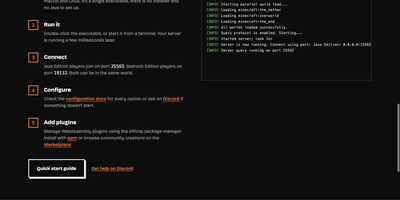
Why keep a Java runtime on the server just to host Minecraft, when Pumpkin runs from a single native executable and lets Java and Bedrock players share a world? Java Edition clients join on port 25565 and Bedrock clients on 19132, although Bedrock support is still marked work in progress. Builds exist for Windows, Linux, macOS, and Android. On launch, the console reports the worlds loaded and the server ready within milliseconds. Plugins are sandboxed WebAssembly modules that raise console permission prompts and pass signature checks, and authors can write them in Rust, Kotlin, Python, Go, C#, C/C++, D, Zig, or TypeScript. The ppm package manager searches and installs community plugins from the Pumpkin Market, and PatchBukkit loads some Bukkit and Paper plugins, with expected gaps. One pumpkin.toml file holds ports, MOTD, view distance, whitelist, authentication, compression, PvP, chat, resource packs, and world options, while chunks save in Anvil, Linear, or the native Pump format. Velocity and BungeeCord forwarding fit proxy networks, and the Query protocol plus Minecraft Server Management Protocol cover monitoring and remote administration. A public parity tracker lists every vanilla block, entity, item, and command as implemented, partial, or planned, so gaps are easy to spot before a world moves. Today it suits private survival worlds, test servers, and plugin development. It is early software, so the project advises backups. Running on a dedicated VPS on RepoCloud with guaranteed CPU, RAM, and SSD, full root SSH access, and a browser serial console. GPL-3.0 licensed.

CubeSandbox
CubeSandbox gives every AI agent its own hardware-isolated MicroVM with a dedicated Linux kernel — not a shared-kernel container but a true KVM virtual machine — booting in under 60ms with less than 5MB of memory overhead per instance, enabling thousands of concurrent sandboxes on a single server via kernel sharing and Copy-on-Write memory. The Rust-built CubeProxy exposes an E2B SDK-compatible REST API on Axum, so existing E2B Cloud applications switch by changing one environment variable with zero client code changes. CubeMaster orchestrates cluster-level scheduling in Go while Cubelet manages node-local sandbox lifecycles including create, run, pause, resume, snapshot, and destroy operations. CubeVS, the eBPF-powered network layer, enforces per-sandbox isolation with LPM trie-based egress policies entirely in kernel space — no userspace context switches — while CubeEgress provides an L7 security proxy with per-domain, per-path, and per-method allowlists plus automatic credential injection that keeps secrets invisible to sandbox code. Hundred-millisecond-granularity snapshots enable checkpoint, rollback, and parallel fork from any saved state. The volume framework supports E2B-compatible pluggable storage with independent lifecycle and cross-sandbox sharing. Production deployment uses Terraform on Tencent Cloud or Helm charts on Kubernetes, K3s, or TKE, with full ARM64 support alongside x86_64 and AutoPause/AutoResume for cost optimization. Running on a dedicated VPS on RepoCloud with guaranteed CPU, RAM, and SSD, full root SSH access, and a browser serial console. Apache 2.0 licensed.
MetaMCP
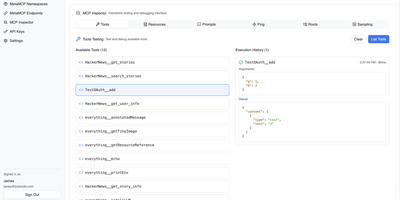
With 2,600+ GitHub stars, MetaMCP solves the MCP server sprawl problem by aggregating any number of upstream servers into a single authenticated endpoint that any MCP client connects to once. Group servers into namespaces — development tools in one, data sources in another — then publish each namespace as its own SSE, Streamable HTTP, or OpenAPI endpoint with API-key authentication in headers or query parameters, or full OAuth per the MCP Spec 2025-06-18 standard. The aggregation engine discovers tools, resources, and prompts from all active servers in parallel, prefixes tool names with server identifiers to prevent collisions, and applies configurable middleware including tool filtering to reduce context-window bloat and description overrides to improve LLM comprehension. The web management UI lets you configure MCP servers with stdio, SSE, or Streamable HTTP transports, toggle servers active or inactive per namespace, create and revoke API keys per endpoint, and inspect discovered tools with their schemas. Nested MetaMCP support enables hierarchical architectures where one MetaMCP instance consumes another, creating multi-level tool organization with automatic name resolution. Compatible with Claude Desktop, Claude Code, Cursor, Open WebUI, and any MCP-compatible client through a single connection URL. The Docker container packages the TypeScript backend with PostgreSQL for configuration persistence, exposing the management UI on port 12005 and MCP endpoints on configurable ports. Running on a dedicated VPS on RepoCloud with guaranteed CPU, RAM, and SSD, full root SSH access, and a browser serial console. MIT licensed.
Cloudflare OS
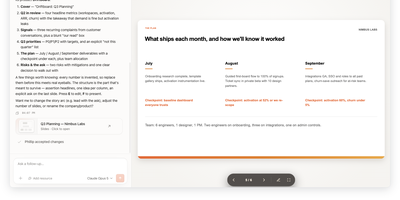
With over 7,700 GitHub stars and thousands of Cloudflare employees using it daily across every function, Cloudflare OS delivers an open-source AI workspace where every employee gets a personal agent grounded in company context, systems, and skills — not a generic chatbot but a programmable workspace that builds real applications, automates workflows, and connects to internal tools through governed access. The Code Mode agent writes and immediately executes code snippets to perform arbitrary tasks, build full-stack Gadgets with client code, server code, APIs, and durable SQLite state, debug errors, and test results within isolated sandboxes. Gadgets are private application instances running in separate sandboxes — each document, spreadsheet, or tool is its own secure runtime that cannot leak data even to attackers with access to other Gadgets. Blueprints enable sharing application code as templates that others instantiate with independent state, credentials, and resources. Gatekeepers provide security governance giving system owners precise control over what agents can see, change, and when human approval is required before actions execute. Built on Cloudflare Workers using Durable Objects for workspace persistence, Dynamic Workers for Gadget execution, and Facets for access management. Zero Trust security via Cloudflare Access verifies every user and request before granting access. Real-time collaboration lets colleagues use shared Gadgets. Deploy to your own Cloudflare account or self-host on workerd, the open-source Workers runtime, on your own servers. Running on a dedicated VPS on RepoCloud with guaranteed CPU, RAM, and SSD, full root SSH access, and a browser serial console. Apache-2.0 licensed.
code-server
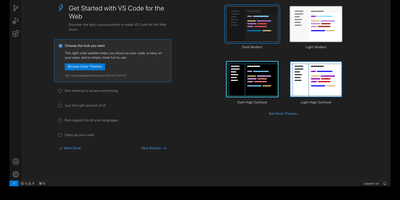
With over 78,000 GitHub stars, 270 contributors, and seven years of continuous development tracking upstream VS Code releases within days, code-server has become the definitive way to run a full Visual Studio Code IDE on any remote machine and access it from any browser on any device. The project applies a curated set of patches to Microsoft's VS Code codebase that add password authentication, sub-path hosting behind reverse proxies, self-contained web views that never call out to Microsoft servers, a built-in proxy for accessing ports on the remote machine directly through the VS Code ports panel, and on-disk settings persistence instead of browser storage. The extension ecosystem works with the Open VSX marketplace by default, giving access to thousands of extensions for Python, JavaScript, Go, Rust, Java, and every other language, along with themes, linters, formatters, and debuggers. The integrated terminal provides direct shell access to the server, Git integration handles version control without leaving the editor, and the debugger supports breakpoints, variable inspection, and step-through execution for Node.js, Python, Go, and other runtimes. DevContainer support enables reproducible development environments defined in JSON configuration files. Installation options include a one-line install script, manual package installation, Docker via the official codercom/code-server image, and DevContainer features. Minimum requirements are a Linux machine with 1GB RAM, 2 vCPUs, and WebSocket support. Running on a dedicated VPS on RepoCloud with guaranteed CPU, RAM, and SSD, full root SSH access, and a browser serial console. MIT licensed.
Ever Works
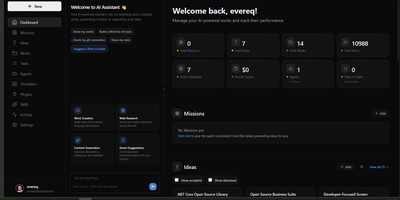
Ever Works transforms a single text prompt into a fully researched, written, coded, and deployed website through autonomous AI agents that operate on a configurable 15-step generation pipeline. Unlike one-shot builders, it continuously improves generated content on a schedule, keeping sites fresh without manual intervention. The platform integrates with six AI providers (OpenAI, Anthropic, Google, Groq, Mistral, Ollama) via gateways like OpenRouter and Vercel AI Gateway, while its plugin system connects ten search providers including Tavily, Brave, Exa, SerpAPI, and Perplexity for deep autonomous research. Every generation is Git-native — code and content live in your own GitHub repositories as commits, providing full version control, portability, and zero vendor lock-in. The monorepo ships a NestJS 11 REST API with JWT authentication, a Next.js 16 web dashboard for managing works, a CLI for terminal operations, an MCP server for AI agent integration, and admin tooling. Content management supports items, categories, tags, and collections, while deployment targets include Vercel and Kubernetes. Background processing runs on Trigger.dev with BullMQ scheduling, and monitoring leverages Sentry plus PostHog for error tracking and product analytics. The platform supports OAuth via GitHub and Google, subscription billing, email notifications, and AI chat conversations for natural-language interaction with your generated works. Running on a dedicated VPS on RepoCloud with guaranteed CPU, RAM, and SSD, full root SSH access, and a browser serial console. AGPL-3.0 licensed.
Moocup
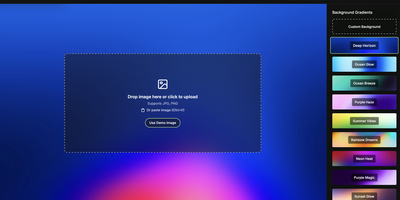
Drop your screenshot, a base style is applied, style it however you wish, and export - "that's basically it," says Moocup's own author, and the description holds. The workflow is genuinely seconds long. Drag an image in and it lands on an attractive backdrop immediately; from there you adjust backgrounds, gradients, padding, borders, shadows, and framing with live preview until it matches your taste, then export a high-quality image ready for a portfolio page, README, blog post, tweet, or slide deck. There are no accounts, no watermarks, and no upload to anyone's cloud - as a self-hosted static app, your screenshots never leave your infrastructure, which matters when the screenshot shows a proprietary dashboard or unreleased product. It runs entirely in the browser from a tiny nginx container, works on any device, and requires zero design skill: the smart defaults do the heavy lifting, and everything else is optional tinkering.
GoatCounter
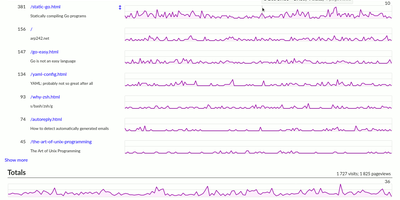
GoatCounter delivers meaningful web traffic insights — pageviews, referrers, browsers, screen sizes, country-level geolocation — without setting a single cookie, without collecting personal data, and without forcing GDPR consent banners on your visitors. Written entirely in Go and distributed as a single compiled binary consuming roughly 25MB of RAM, it adds just 3.5KB to your pages via the tracking script, with a JavaScript-free tracking pixel alternative for sites that avoid scripts entirely, plus backend middleware integration and log file import for server-side collection. The dashboard displays pageview counts per path with hourly resolution, referrer sources grouped by domain with full URL on hover, browser and OS version breakdowns, screen size distributions, and country-level location data derived from IP addresses that are immediately discarded after geolocation. Campaign tracking supports UTM parameters and custom data attributes. A public stats option exposes your dashboard at a shareable URL for build-in-public transparency. SQLite serves as the default database requiring zero administration, while PostgreSQL handles higher-traffic deployments with multi-site setups. Built-in ACME and TLS certificate management eliminates reverse proxy requirements for HTTPS — no Nginx or Caddy needed. The REST API provides programmatic access to all analytics data. Deploy as a single binary, via Docker with the official arp242/goatcounter image, or through native packages. Running on a dedicated VPS on RepoCloud with guaranteed CPU, RAM, and SSD, full root SSH access, and a browser serial console. EUPL-1.2 licensed.
Glass Keep
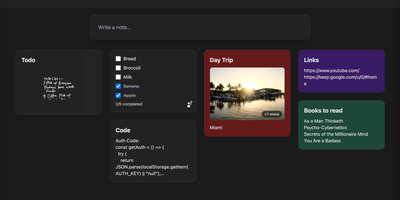
With nearly 600 GitHub stars and a feature set that rivals commercial note apps, Glass Keep is the self-hosted Google Keep alternative that wraps a full-featured notes system in a glassmorphism UI with blurred backdrops, translucent modals, and smooth transitions. The React and Vite frontend renders notes in a masonry card grid with pinning, color themes, tag chips, and drag-and-drop reordering. Text notes support Markdown with headings, bold, italic, strikethrough, blockquotes, and fenced code blocks, while checklists offer inline editing, drag-to-reorder items, and direct toggle from the grid without opening the note. A freehand drawing mode provides customizable brush sizes and colors for handwritten notes. The private AI assistant runs an optimized Llama 3.2 (1B) model entirely inside the Docker container using RAG over your own notes, answering queries like "what are my AWS commands?" without any data leaving your server. Deep search spans titles, Markdown text, tags, checklist items, and image names. Import notes from Google Keep via Takeout JSON files or export your entire vault as JSON with per-note Markdown downloads. The Express backend with better-sqlite3 requires no external database. Real-time collaboration enables shared checklists with live item toggling. Dark and light themes persist across sessions, and the PWA manifest supports installation on any device. Running on a dedicated VPS on RepoCloud with guaranteed CPU, RAM, and SSD, full root SSH access, and a browser serial console. MIT licensed.
TeslaMate
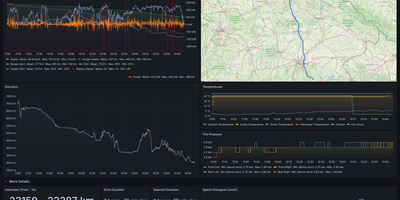
Logging every drive, charge, and idle stretch of a Tesla to a database you own, TeslaMate shows where the battery went, including degradation, vampire drain, and charging cost. Battery health comes first: the dashboard estimates usable capacity, range lost, and degradation against mileage. Idle losses come next, with Vampire Drain listing how much charge disappears during every idle period and a States view recording every online, asleep, and offline stretch. The car is left alone to fall asleep, so logging adds no extra vampire drain. Charging sessions show curves, energy added and used, efficiency, and cost, using per-location prices attached to geo-fences drawn on a map. Each drive records second-by-second speed, power, elevation, and temperature, plotted on a route map beside tire pressure and consumption charts. Trip, Drives, Efficiency, Drive Stats, Mileage, Updates, Statistics, and a lifetime driving map fill in the rest. Live vehicle data goes out over MQTT to Home Assistant, Node-RED, and Telegram, and old history imports from TeslaFi or tesla-apiscraper. Several vehicles on one Tesla account work together, addresses are looked up automatically, and the web interface offers light, dark, or system themes in 19 languages. Sign-in uses Tesla access and refresh tokens that TeslaMate encrypts with a key you set. It works best on an always-on server. Running on a dedicated VPS on RepoCloud with guaranteed CPU, RAM, and SSD, full root SSH access, and a browser serial console. AGPL-3.0 licensed.
PostgreSQL
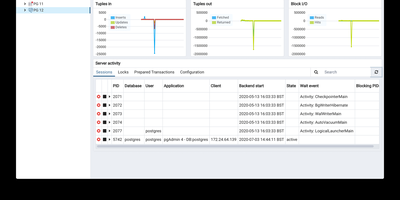
Consistently ranked the most loved and most wanted database in developer surveys, PostgreSQL powers mission-critical workloads at Apple, Instagram, Spotify, and the U.S. Federal Aviation Administration with an architecture refined over nearly four decades since its origins at UC Berkeley. Its native JSONB type stores JSON in an indexed binary format with GIN and GiST index support, enabling document-store capabilities that eliminate the need for a separate NoSQL database in many architectures. The extension ecosystem exceeds 1,000 add-ons: PostGIS provides ISO-compliant geospatial queries, pgvector enables AI embedding similarity search, TimescaleDB adds time-series hypertable compression, and Citus distributes tables across nodes for horizontal scaling. PostgreSQL supports declarative partitioning by range, list, or hash, parallel query execution across multiple CPU cores, and four transaction isolation levels including full Serializable. Streaming replication provides physical standby servers with synchronous or asynchronous modes, while logical replication enables selective table-level change data capture through the Write-Ahead Log. Stored procedures run in PL/pgSQL, PL/Python, PL/Perl, and PL/V8 JavaScript, and advanced indexing includes B-tree, GIN, GiST, SP-GiST, BRIN, and hash types. Full-text search is built in with tsvector and tsquery, and row-level security policies enforce fine-grained access control. Running on a dedicated VPS on RepoCloud with guaranteed CPU, RAM, and SSD, full root SSH access, and a browser serial console. PostgreSQL License (MIT-like permissive) licensed.
GoAccess
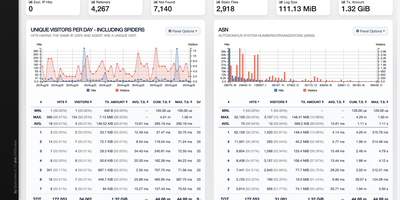
GoAccess processes millions of web log entries in seconds and renders the results as interactive dashboards that update every 200 milliseconds in the terminal or every second via WebSocket-connected HTML reports. Written entirely in C with only ncurses as a dependency, it achieves exceptional performance even on resource-constrained servers, reducing memory usage by approximately 20% and parsing time by 35% in recent releases through optimized in-memory hash tables with on-disk persistence support. The analyzer parses virtually every web log format out of the box (Apache Combined and Common, Nginx, Amazon CloudFront, Amazon S3, AWS Elastic Load Balancing, Google Cloud Storage, Squid, W3C IIS, Caddy JSON, and Traefik) while supporting fully custom log format strings for non-standard configurations. The self-contained HTML dashboard displays 15+ interactive panels covering unique visitors, requested files, static files, 404 errors, referring sites, search keyphrases, geographic location with city-level GeoIP resolution, operating systems, browsers, HTTP status codes, time distribution, and virtual host metrics. WebSocket authentication via JWT provides secure remote access, and incremental log processing ensures data continuity across daemon restarts. Docker deployment requires a single command with volume-mapped access logs. Over 20,800 stars with active development since 2010. Running on a dedicated VPS on RepoCloud with guaranteed CPU, RAM, and SSD, full root SSH access, and a browser serial console. MIT licensed.
Airi
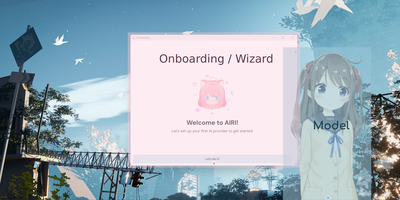
Project AIRI is the most popular open-source AI companion platform — a self-hosted recreation of Neuro-sama that brings AI-powered virtual characters into your world across web, desktop, and mobile. The system renders Live2D, Spine, and VRM 3D character models with auto-blink, eye tracking, and lip-sync driven by real-time voice synthesis, while the xsAI abstraction layer connects to 40+ LLM providers including OpenAI GPT-4, Anthropic Claude, Google Gemini, DeepSeek, and local models via Ollama and OpenRouter. Built from day one on WebGPU, WebAudio, Web Workers, WebAssembly, and WebSocket technologies, the browser version runs entirely client-side with PWA offline support while the server runtime enables persistent memory via PostgreSQL with pgvector embeddings and DuckDB WASM for client-side storage. The Minecraft agent plays autonomously using mineflayer with pathfinding, and a Factorio integration provides cooperative gameplay. Social integrations deploy your companion as a Discord bot joining voice channels, a Telegram bot, and a Twitter/X agent posting and replying autonomously. The desktop Stage Tamagotchi app provides an always-on-screen companion for Windows and macOS, while Stage Pocket brings the experience to mobile. Voice features include client-side speech recognition via VAD, multiple TTS providers including ElevenLabs, and screen vision capabilities. Running on a dedicated VPS on RepoCloud with guaranteed CPU, RAM, and SSD, full root SSH access, and a browser serial console. MIT licensed.
Redpanda
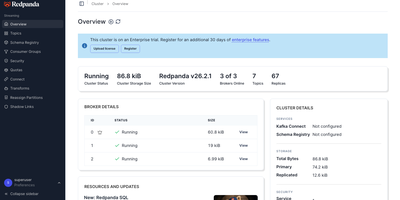
With 12,400 GitHub stars and adoption across enterprises processing billions of events daily, Redpanda delivers a complete Kafka wire protocol implementation in C++ that existing Kafka producers, consumers, Kafka Connect connectors, and Kafka Streams applications connect to without code changes — eliminating JVM garbage collection pauses and ZooKeeper coordination overhead through a single binary architecture built on the Seastar framework's thread-per-core model. The integrated schema registry supports Avro, Protobuf, and JSON Schema validation directly within the broker without separate infrastructure. Tiered storage automatically offloads cold data to object storage while maintaining seamless consumer access across the full retention window. Redpanda Console provides a web-based management interface for topic inspection, consumer group monitoring, schema management, and ACL configuration. Redpanda Connect extends the platform with 200+ pre-built connectors for data pipelines between databases, cloud services, and streaming systems. Exactly-once semantics with idempotent producers and transactional guarantees ensure data integrity for financial, healthcare, and compliance workloads. The Adaptable Data Plane in version 26.1 enables per-topic performance profiles balancing throughput, latency, and durability within a single cluster. Deploy via Docker or Kubernetes with official Helm charts — a three-node cluster starts with a single rpk command. Running on a dedicated VPS on RepoCloud with guaranteed CPU, RAM, and SSD, full root SSH access, and a browser serial console. BSL 1.1 licensed (converts to Apache 2.0 after four years).