Open Source App Cloud Marketplace
Deploy, host, and scale with one click, at half the cost. Then customize with AI agents.
BlogFactory
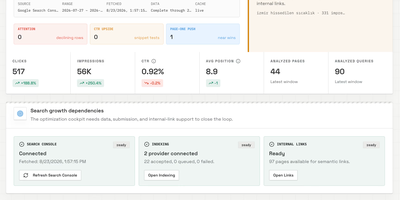
BlogFactory is the first open-source agent control plane purpose-built for multi-site content operations, shipping 16 distinct capabilities across four operational pillars — Operate, Grow, Control, and Deliver — in its v0.1.0 release. The platform keeps source evidence, AI-generated drafts, revisions, SEO metadata, human review, preflight checks, and CMS delivery destinations in one workspace while enforcing a server-side authority ceiling that prevents agents from ever publishing live content, accessing credentials, or performing administrative actions. AI agents connect through a Streamable HTTP MCP endpoint with OAuth authentication and site-scoped tool discovery, compatible with Codex, ChatGPT, and any MCP-capable client. Content creation supports single articles from keywords, titles, URLs, PDFs, text, or YouTube sources, batch campaigns, and programmatic content via reusable templates with structured data rows. The Search Growth module connects Google Search Console complete-day data to ranked optimization opportunities, 30-day growth plans, content classification by signal type (growing, low-CTR, almost-ranking, page-two, zero-click), indexing checks, and semantic internal-link suggestions. Brand Voice separates global voice rules, writer profiles, knowledge context, and brand guidelines from article mechanics. Approved drafts are delivered as CMS drafts to WordPress, Ghost, Wix, or Framer through idempotent, optimistic-locking-protected handoffs with explicit destination selection and preflight validation. The stack runs on React/Vite, a Hono/TypeScript API, PostgreSQL, and MinIO via Docker Compose, with providers including OpenRouter, OpenAI, and Google services under a bring-your-own-AI model. Running on a dedicated VPS on RepoCloud with guaranteed CPU, RAM, and SSD, full root SSH access, and a browser serial console. AGPL-3.0 licensed.
Palimpsest Gateway
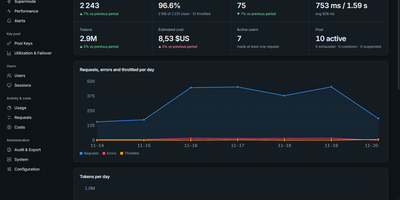
Swap one base URL and Palimpsest Gateway turns the LLM keys you own into a single OpenAI-compatible endpoint that fails over by itself. Apps keep their OpenAI client and use a gateway key of their own; provider keys stay encrypted and are never shown again. Teams that mix free and paid keys cap the free ones, leave the paid ones uncapped, and the gateway spends the free allowance first. When a key hits a rate limit, empty quota, outage or refusal, the same call moves to the next suitable key. Clients send only the new message, because the gateway keeps per-user session history and carries it through a failover. Asking for palimpsest/supermode picks the strongest model the pool can serve right now and skips any that cannot take the prompt, images or tools. A circuit breaker skips a provider in a real outage, and a concurrency gate caps in-flight requests per provider. Per-user daily caps and a pool low-water mark throttle demand before the keys run dry. Live Flow traces each request through the gateway, retries included, and key tests find the models an account can use. Spend appears against the per-model prices and monthly budget you enter, by day, model and user, with a projection. An audit trail, CSV exports and Prometheus metrics cover operations. The dashboard never shows message content. Running on a dedicated VPS on RepoCloud with guaranteed CPU, RAM, and SSD, full root SSH access, and a browser serial console. MIT licensed.
NextGIS Web
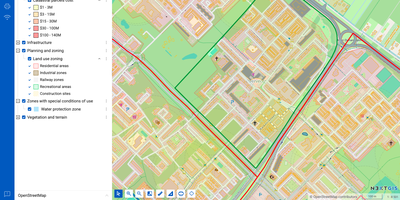
NextGIS Web turns shapefiles, GeoTIFFs, and QGIS projects into shareable web maps on your own server, with no per-seat GIS license to buy. Upload ESRI Shapefile, GeoJSON, GeoPackage, KML, CSV, or GeoTIFF files, or connect an external PostGIS database, then style layers with QGIS styles so web maps match the desktop project. Visitors can search, filter, measure, print, and embed maps on other sites, while editors draw or move points, lines, and polygons, type in coordinates, and snap to existing geometry without leaving the browser. Vector layers keep a history of who changed what and when, so a bad edit can be rolled back and a snapshot of the data at a chosen point in time can be recovered. Layers can be published as WMS, WMTS, WFS, OGC API Features, raster tiles, vector tiles, or Cloud Optimized GeoTIFF, and third-party TMS, WMS, and WFS services can be pulled into the same maps. With the NextGIS Connect plugin, QGIS users publish projects and edit server data directly, so a whole team works on one shared dataset. Permissions are granted to users and groups down to a single layer or map, and Galleries collect the key maps into one landing page. A REST API covers users, layers, services, maps, and permissions, and JavaScript libraries help developers build custom map applications. Running on a dedicated VPS on RepoCloud with guaranteed CPU, RAM, and SSD, full root SSH access, and a browser serial console. GPL-3.0 licensed.

Hammond
When Clarkson, the once-popular fuel logger, stopped receiving updates, Hammond stepped in as its logical successor - a self-hosted vehicle expense tracker. Written in Go with a Vue.js interface and SQLite storage - a single lightweight container, no external database - it tracks every cost your vehicles generate: fuel fill-ups with cost, volume, and odometer readings; maintenance and repairs; and arbitrary other expenses, each attachable with photos and documents stored against the vehicle. The multi-user, multi-vehicle design is what sets it apart from phone apps: a household or small business adds all its vehicles and all its drivers, shares vehicles across users, and every fill-up lands in one ledger no matter who was driving. The Quick Entries feature respects how expenses actually happen - snap a photo of the receipt or pump screen at the gas station, then complete the structured entry later when you have a minute. Reporting works at both the vehicle level (cost per distance, fuel economy trends) and across the whole fleet. Migration matters here: importers for Clarkson, Fuelly, and Drivvo bring years of fill-up history along, so switching does not mean starting your data over.
Kvitok
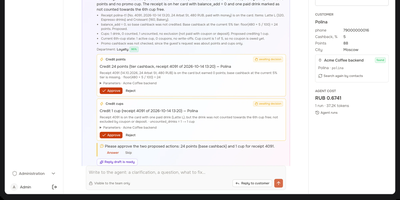
Kvitok is a helpdesk where an AI agent reads your backend, drafts the reply, and lines up the fix, so by the time an operator opens a ticket only the decision is left. Take a guest whose loyalty points never arrived: the agent finds her in your system, reads her receipts, and queues the missing credit for one click of approval. Requests arrive by mailbox or API channel, and your backend matches customers by phone, email, card number, or any identity it exposes. Rules you write run first and can set a department, priority, or tags, or skip the agent for senders such as partners. The agent calls tools your backend publishes, follows your playbooks, and picks a department with a confidence score, while your backend validates every action it proposes. Operators talk to the agent inside the ticket: say the receipt was really 540 and it revises only what that changes. Approved actions run exactly once, and the reply goes out by email or back through the channel the request came from. Each workspace picks its own model from any OpenAI-compatible endpoint, hosted or local, and every ticket shows what the agent spent. Test scenarios run against a real model, so policy or model changes get checked before reaching customers. Claude Code can tune rules and playbooks over MCP. Running on a dedicated VPS on RepoCloud with guaranteed CPU, RAM, and SSD, full root SSH access, and a browser serial console. AGPL-3.0 licensed.

Urocissa
Urocissa is a self-hosted photo and video gallery engineered to browse, search, and filter a million-image library in under a second on modest hardware. Its photo stream scrolls endlessly without pagination or lazy loading, flying past the browser DOM height limit that breaks other galleries long before a million items. Search understands boolean operators, so a query mixing and, or, and not narrows a lifetime of photos in milliseconds, and select-all is equally instant across the whole collection. Point it at folders and it watches them for new arrivals, importing photos and videos automatically while duplicate detection keeps redundant copies out. EXIF data is extracted for every image, and your own tags layer manual organization on top, with timeline navigation and rotation built in. Albums share collections with family or clients, a read-only mode publishes a public gallery safely, and videos play inline without leaving the page. The index that makes this fast lives in memory at roughly half a gigabyte per million photos, and the whole application ships as a binary of about 25 megabytes, optionally protected by a password. Running on a dedicated VPS on RepoCloud with guaranteed CPU, RAM, and SSD, full root SSH access, and a browser serial console. MIT licensed.
Pollen
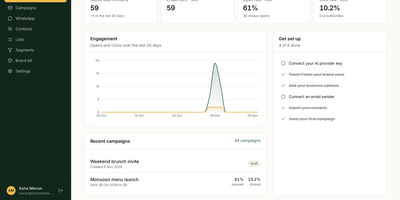
Sending regular email and WhatsApp campaigns without a copywriter starts with Pollen learning the business's voice from its website or writing samples, then drafting emails and replies in that tone. Compose takes a goal, a brief, a link, and a length, then returns three subject lines, preview text, and a body. A second model pass scores each draft, and a weak one is revised once. Rule checks catch spam phrases and a missing postal address. Contacts import from CSV. Segments come from rules over tags, source, email domain, and recent opens or clicks, or from a plain-English request the AI turns into rules. Emails carry signed tracking links and one-click unsubscribe. Campaign reports show delivered, opened, clicked, click-to-open, unsubscribed, and top links. A connected WhatsApp Business number adds a shared inbox that respects the 24-hour reply window, with AI-drafted replies, auto-replies, and template broadcasts to a list or segment. Many businesses can share one install, each in a workspace with its own team, keys, and data, plus a platform console for tenants and usage. Businesses bring their own OpenAI, Anthropic, or Gemini key and their own AWS SES or SMTP sender, and pay those providers directly. Seeding adds a demo café with 64 fictional contacts, a sent campaign, and three WhatsApp threads to browse before any key is added. Running on a dedicated VPS on RepoCloud with guaranteed CPU, RAM, and SSD, full root SSH access, and a browser serial console. MIT licensed.
CSV AI Analyzer
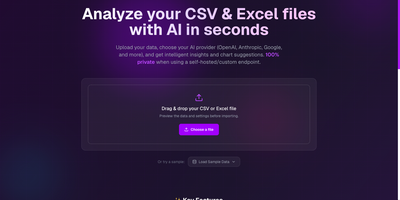
A spreadsheet goes in, a plain-English readout comes out, and with a local model the file never leaves your own network. CSV AI Analyzer reads CSV and Excel files, detects delimiters, headers, and column types, and opens with a data-quality report that counts missing values, repeated rows, and type mismatches per column. A searchable preview table sits next to column, sort, and filter controls. One click on Run Complete Analysis produces a summary with key insights, an anomalies view, and chart suggestions, and the Custom Query tab answers follow-up questions in a chat thread. Charts come as bar, line, pie, scatter, or area, can be built by hand from any two columns, and export as SVG, PNG, or CSV. Reports download as PDF or Markdown. Point it at OpenAI, Anthropic, Google, Mistral, or any OpenAI-compatible endpoint, including Ollama, LM Studio, and vLLM, to keep analysis fully local. API keys stay encrypted in the browser, and a language selector switches the interface. Monthly finance exports, operations reports, and founder dashboards turn into answers without a single formula. Running on a dedicated VPS on RepoCloud with guaranteed CPU, RAM, and SSD, full root SSH access, and a browser serial console. MIT licensed.
Euron Open SupportDesk
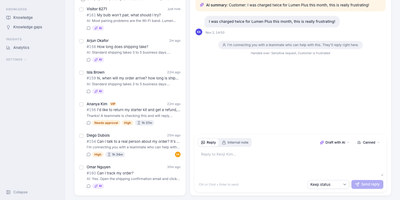
Behind one script tag on your website, Euron Open SupportDesk runs an AI help desk that answers customers from your documents, cites sources, and hands everything else to your team. Feed it PDFs, Word files, Markdown, HTML, or FAQ CSVs, or point it at a page or sitemap, and it indexes them in the background. No source, no answer. Your team gets the handoff with the transcript, a summary, and the reason. Refunds, cancellations, account changes, billing disputes, and data deletion are held for approval, and VIP or frustrated customers go straight to a person. Questions the documents miss become knowledge gaps. An agent's reply turns into the draft article, and publishing it lets the AI answer next time. Start with no API key at all, quoting your documents, or pick a local Ollama model, Anthropic, OpenAI, or vLLM. A ledger tracks tokens, cost, and delay for every model call, and daily or monthly budgets cap the spend. Around the AI sits a full helpdesk: shared inbox, views, round-robin routing by capacity, SLA timers, canned replies, and bulk actions. Customers reach you through the widget, threaded email, a magic-link portal, or a public help center. Analytics track first response, resolution time, deflection, and CSAT, and a REST API with signed webhooks feeds your other tools. Running on a dedicated VPS on RepoCloud with guaranteed CPU, RAM, and SSD, full root SSH access, and a browser serial console. MIT licensed.
Euron AgentStudio
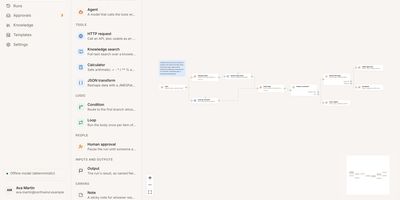
Euron AgentStudio lets you draw an AI agent workflow on a canvas, run it, and watch every step report its inputs, outputs, tokens, and cost live. Twelve node types cover prompts, tool-calling agents, HTTP requests, knowledge search, a calculator, JSON transforms, conditions, loops, human approvals, and sticky notes. Typed connections, inline validation, undo and redo, and autosave keep the editor honest. Branches run in parallel with timeouts, retries, and cancellation, and the run inspector shows the graph as it ran beside a timeline of loop iterations. A human approval step pauses a run for days without tying up a worker. Reviewers decide from an inbox, comment for the record, and let deadlines expire into the rejected branch. Start flows from the editor, a workspace API key that waits for the result, or a signed webhook. Every template runs on a built-in offline model with no API key, and any OpenAI-compatible endpoint or Ollama can take over step by step. Knowledge bases of Markdown and text feed the search steps. Any flow exports as JSON or as a standalone script you own, and published versions can be restored. Owners, editors, and viewers share a workspace with write-only secrets, expiring keys, an activity log, and a dashboard of runs, success rate, and spend. Running on a dedicated VPS on RepoCloud with guaranteed CPU, RAM, and SSD, full root SSH access, and a browser serial console. MIT licensed.
Euron Open ContextForge
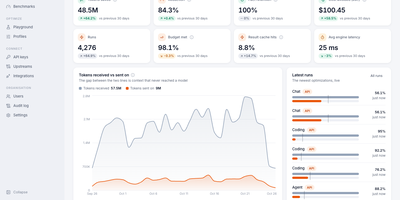
Euron Open ContextForge shrinks the history, retrieved passages, and tool output an LLM app is about to send, so each call costs fewer tokens and still carries every fact the task needs. Counts use the target model's own tokenizer, exact for OpenAI families. System instructions, recent turns, pinned messages, and tool call pairs are never rewritten, and any string you name stays intact. Duplicates go first (repeated turns, repeated test logs), then bulk tool output, with JSON kept valid and file reads kept whole. No GPU, no paid model, no network: the same input always gives the same output. What remains is ranked by relevance, recency, and importance, and older history folds into a verbatim summary of goals, constraints, decisions, facts, errors, and open questions. Six workload profiles (coding, agent, research, RAG, support, chat) split the budget differently, and a missed budget escalates balanced mode to aggressive. A citation map records whether each document id was kept, compressed, merged, or dropped, so references still resolve. Use it as a library, a REST API with optimize, count, summarize, rank, and job endpoints, or a streaming proxy that any OpenAI SDK can point at. A dashboard adds a playground with before and after panes, a per-stage trace, run history, and a benchmark against plain truncation. Budgets it cannot meet are reported, never silently cut. Running on a dedicated VPS on RepoCloud with guaranteed CPU, RAM, and SSD, full root SSH access, and a browser serial console. MIT licensed.
AgentTape
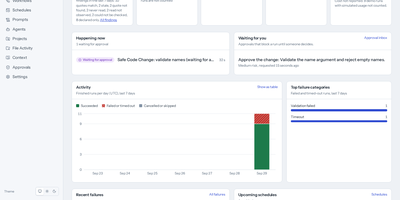
When a coding agent says the tests already cover a case, AgentTape checks the lines it cites against a recording of the run and shows a verdict beside them. The verdicts are Quote matches, Quote not found, Never read, Read not observed, and Stale, where the file changed after the read and both hashes are displayed. A finding with no citation reads Declared only. Matching is deterministic and no model judges anything: line endings, Unicode, and trailing spaces are normalized before each quote is compared. Confidence climbs a ladder from declared, to commands re-run, to a person's confirmation, and a second agent can challenge a finding, labeled as judgment. Today Claude Code findings are verified, while Codex CLI and any allowlisted command are recorded alongside them. Runs launched from the UI, CLI, API, a schedule, a webhook, or a workflow leave an ordered record of the prompt, commands, output, files read, and files changed. Any run can be replayed as recorded or forked with one variable changed, and the two are compared side by side. Workflows chain agent steps, commands, evaluation gates, and approval nodes that pause for a person, and evaluators check exit codes, diffs, regex, JSON schema, duration, and cost. Work happens in a separate Git worktree and commits locally only after approval. Running on a dedicated VPS on RepoCloud with guaranteed CPU, RAM, and SSD, full root SSH access, and a browser serial console. MIT licensed.
Plone
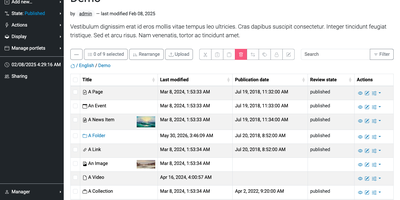
Editors who need to publish a page, route it through review, and roll back a mistake can do all of it in Plone, an open-source CMS, without writing any code. Pages are assembled in place from blocks such as grids, teasers, listings, maps, tables, and video, with a sidebar for page and block settings. A folder-style Contents view handles cut, copy, paste, rename, and workflow state changes in bulk. An editor can revert a page to an earlier revision from its version history. Administrators create new content types through the web in the Content Types control panel and attach behaviors such as versioning. Permissions are assigned per role, group, and workflow state. Content rules publish, move, or notify automatically when an item changes state. One installation can serve an intranet, a public website, and an extranet, with a form builder and a faceted search block built in. Sign-in integrates with LDAP, Active Directory, OpenID, Shibboleth, CAS, and Kerberos. The interface is translated into over 30 languages, and multilingual content is supported. The REST API makes Plone a headless CMS for custom frontends, and the server-rendered Classic UI stays available for sites that prefer it. Official Docker images are available, and clustering or PostgreSQL storage helps a busy site grow beyond one server. Running on a dedicated VPS on RepoCloud with guaranteed CPU, RAM, and SSD, full root SSH access, and a browser serial console. GPL-2.0 licensed.
LLemonStack
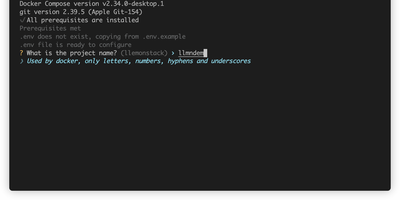
One CLI command deploys a complete AI development environment: n8n, Flowise, Supabase, Ollama, Qdrant, LiteLLM, Langfuse, Open WebUI, LightRAG, Browser-Use, Firecrawl, Crawl4AI, and more, all pre-wired with networking, credentials, and database connections. LLemonStack eliminates the hours of Docker Compose configuration that typically precede any local AI agent project. The llmn CLI initializes isolated project environments with auto-generated secure credentials, starts services in dependency order (databases first, then middleware, then apps), and displays a dashboard showing every service URL and access token. n8n brings 400+ workflow integrations, Flowise provides visual agent building, Ollama runs local LLMs like Llama and Mistral, Qdrant stores vectors at high performance, Open WebUI offers ChatGPT-style model interaction, and LiteLLM proxies requests to any provider with cost tracking. Langfuse automatically logs traces for every LiteLLM query, providing full observability. Each project maintains isolated Postgres schemas preventing data collision across parallel stacks. Firecrawl and Crawl4AI extract web content into LLM-ready formats for RAG pipelines feeding LightRAG or Qdrant. Dozzle streams live container logs for debugging. Import/export tooling migrates workflows between projects with automatic credential reconfiguration. Running on a dedicated VPS on RepoCloud with guaranteed CPU, RAM, and SSD, full root SSH access, and a browser serial console. AGPL-3.0 licensed.
Chiyogami
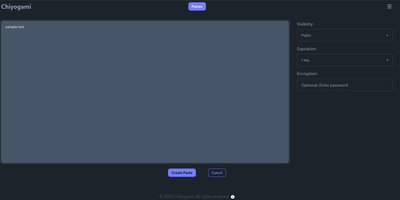
Chiyogami is a pastebin you host yourself for sharing code, logs, notes, and text snippets through short links that expire on your terms. Paste into the web editor and the content comes back formatted, with syntax highlighting for code and rendered Markdown for prose, so a stack trace or a runbook reads the way it was written. Anything sensitive can be encrypted in the browser before it leaves your machine, and the server never stores the password, which makes an encrypted paste safe to pass through chat or email. Every paste carries a configurable lifetime, from minutes to never, and visibility choices keep a snippet public, unlisted, or private behind an unguessable address. Registered users manage their own pastes from an account, and anonymous quick pastes stay available for one-off sharing. The public paste list supports search, so a team instance doubles as a small shared snippet library. Developers can skip the browser entirely: one curl command creates a paste from a file or a JSON body, and the API returns a short title that fetches the content later. Sharing extends to QR codes for moving text onto a phone, and built-in rate limiting throttles spam and abuse before it fills the database. Running on a dedicated VPS on RepoCloud with guaranteed CPU, RAM, and SSD, full root SSH access, and a browser serial console. BSD-3-Clause licensed.
Spameater
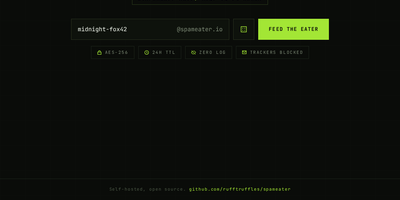
SpamEater gives you a disposable inbox on your own domain that burns itself down 24 hours after you create it. Type any name, or roll the dice for a random one, and mail sent to that address lands in a clean web inbox that refreshes itself every few seconds. Open a message and HTML mail renders faithfully, adapted to the dark interface, with inline images embedded and remote images blocked until you ask for them, so tracking pixels never fire behind your back. A live countdown in the corner tells you exactly how long the inbox has left, and a copy button grabs the address for the form you are about to fill. There are no accounts to create, no passwords to remember, and nothing to recover once the timer ends: the inbox, the messages, and the paper trail vanish together. Behind the scenes the service takes its own security seriously, with a web application firewall, intrusion prevention, rate limits, and mail bodies encrypted at rest. Dark and light themes switch with one toggle. Developers use it to test signup flows and password resets, and everyone else uses it to keep a real address out of reach of newsletters. Running on a dedicated VPS on RepoCloud with guaranteed CPU, RAM, and SSD, full root SSH access, and a browser serial console. MIT licensed.
Kumiho
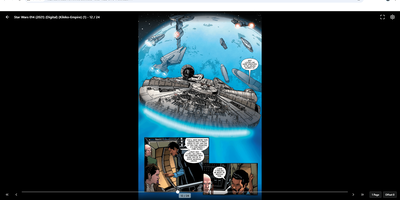
Drop a hard drive's worth of comics, e-books, and audiobooks into folders, point Kumiho at them, and the whole collection becomes a library you can browse and read from any browser. The scanner walks nested folders recursively and treats the folders that actually hold pages or files as series, so an existing collection works as it is, with no metadata matching ritual before the first read. Comics and manga open in a responsive viewer built for the format: page turning on a desktop, continuous webtoon scrolling on a phone or tablet. E-books in EPUB, PDF, and TXT open in the same library, while archives in ZIP and CBZ are read directly without unpacking. Audiobooks get a real player, with a chapter list, resume playback that remembers where you stopped, progress tracking, bookmarks, and a sleep timer for listening at night. A series folder can even carry its own soundtrack: an MP3 whose filename matches starts playing as background music while you read. Everything runs from one lightweight Go server in a single Docker container, storing its database and configuration in mounted volumes, so the library sits comfortably on a small VPS next to the files it serves. Running on a dedicated VPS on RepoCloud with guaranteed CPU, RAM, and SSD, full root SSH access, and a browser serial console. Apache 2.0 licensed.
ai-triage
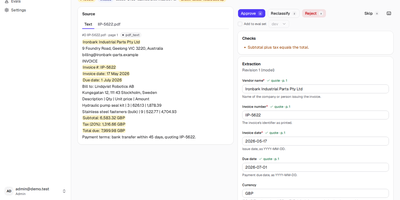
ai-triage reads every email and attachment in a shared inbox, pulls out the fields you care about with a quote behind each value, and sends anything uncertain to a person. Documents arrive through read-only Gmail sync, Postmark forwarding, an upload page, or a REST API that accepts PDFs, Word files, images, and .eml messages. A model classifies each document and extracts fields against a JSON Schema, then plain code checks the quotes exist, required fields are present, invoice totals add up, and the sender is authenticated. Auto-approval is earned per document type, switched on only after you measure accuracy on labeled data and freeze a threshold. Reviewers see the source with quotes highlighted beside an editable form with failed checks marked, and keyboard shortcuts approve, reclassify, or reject. Approved results reach your system as signed webhooks with an idempotency key, delivered at least once and retried with backoff. Evals run the production pipeline over labeled dev, calibration, and test splits, with threshold sweeps, reliability tables, and run-to-run diffs. Your own document types are defined in the UI, from starters like purchase order, receipt, credit note, and insurance claim. Any of Claude, OpenAI, DeepSeek, OpenRouter, or a local model can do the reading, and optional OCR covers scans and photos. Workspaces separate teams, with Google sign-in, invitations, and TOTP two-factor for admins. Running on a dedicated VPS on RepoCloud with guaranteed CPU, RAM, and SSD, full root SSH access, and a browser serial console. MIT licensed.