Zigbee2MQTT
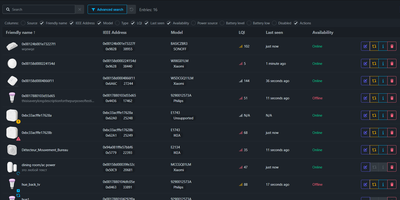
Zigbee2MQTT bridges a Zigbee smart home network to MQTT so bulbs, switches, sensors, and locks from hundreds of vendors work with your own automation server instead of each manufacturer's cloud bridge. It supports 5,798 devices from 608 vendors, so a Philips Hue bulb, an IKEA TRÅDFRI switch, an Aqara sensor, and a Tuya plug can all join one coordinator and speak one protocol. The built-in frontend on port 8080 shows every paired device with its link quality, battery level, and live state, and lets you rename, reconfigure, bind, or remove devices without editing YAML. A network map view charts which routers carry traffic for which end devices, making weak spots and dead zones visible before automations start failing. Groups collect devices that should act together, scenes capture lighting states for a room, and bindings let a switch talk directly to a bulb even when the server is briefly offline. Firmware stays current through over the air updates you can trigger or schedule per device from MQTT topics or the frontend, including downgrades when a new release misbehaves. Home Assistant picks everything up automatically through MQTT discovery, while openHAB, Domoticz, and Node-RED flows subscribe to the same plain JSON topics. The coordinator plugs into the host by USB or joins over the local network, while the bridge, frontend, and broker traffic run headlessly beside Mosquitto or EMQX. Running on a dedicated VPS on RepoCloud with guaranteed CPU, RAM, and SSD, full root SSH access, and a browser serial console. GPL-3.0 licensed.
Marble
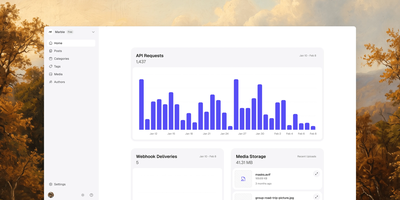
Marble gives your blog, changelog, or product updates a calm editorial home, then hands clean JSON to whatever website you already built. Writers work in a focused rich-text editor with headings, lists, code blocks, images, video, and embeds, while a readability score quietly grades each draft as it grows. Every post carries authors, one category, tags, a cover image, and typed custom fields, so a changelog entry and a long guide can share one predictable structure. Your frontend pulls sanitized HTML or Markdown through the REST API or typed SDK, filtering by category, tag, or search in a single request. Read-only public keys serve published posts safely, while scoped private keys unlock drafts and write access for the tools you trust. Uploads of images, video, audio, and documents land in a media library with alt text and dimensions, ready to embed anywhere. Signed webhooks announce every change to your site, Slack, or Discord with retries and a delivery log, and an MCP server lets AI agents search and draft content too. Running on a dedicated VPS on RepoCloud with guaranteed CPU, RAM, and SSD, full root SSH access, and a browser serial console. AGPL-3.0 licensed.

BookWyrm
Instead of handing your reading history to a retail platform and letting an algorithm decide what you read next, BookWyrm lets a self-hosted community of readers make the recommendations. Shelve every book as to-read, currently reading, stopped, or finished, record start and finish dates with progress updates along the way, and set an annual reading goal to keep the habit honest. Rate and review finished books, drop a comment while you are mid-chapter, or save a quotation worth keeping, and all of it can appear on the book page alongside reviews aggregated from other connected instances. Follow friends to see their shelves fill up, join a group to build a shared reading list, or create your own list and choose whether it stays closed, accepts suggestions for approval, opens to everyone, or belongs to the group. Posts, shelves, and lists each carry their own privacy level, public, unlisted, followers-only, or private, and you can approve followers by hand before they see anything. Because instances federate over ActivityPub, your readers can follow you from another BookWyrm community or straight from Mastodon, and book metadata is shared between servers so small instances do not catalog alone. Running on a dedicated VPS on RepoCloud with guaranteed CPU, RAM, and SSD, full root SSH access, and a browser serial console. Anti-Capitalist Software License licensed.
Obsei
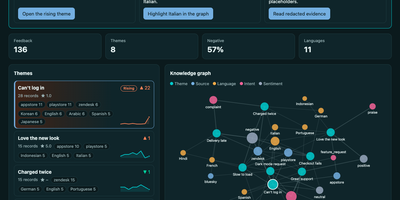
Before any AI model reads a single customer message, Obsei has already stripped out the names, email addresses, card numbers, and ID numbers hiding inside it. Obsei pulls in what customers are saying from App Store and Google Play reviews, Zendesk, Freshdesk, and Intercom tickets, GitHub issues, surveys, YouTube comments, Bluesky, RSS feeds, SQL databases, and even Gong call transcripts. Every record is pseudonymised on the way in and stored in an encrypted database that never phones home. Then the labelling starts: sentiment, intent, language, and your own custom questions, each answered with a confidence score by a zero-shot classifier running locally on your machine, or by an LLM you choose through your own keys. Answers the model is unsure about are escalated to a stronger model or queued for a human instead of being silently wrong. Related complaints roll up into stable themes with week-by-week trends, and anything mentioned by fewer than five people stays hidden, so individuals cannot be picked out of a chart. When a theme spikes, alerts and digests land in Slack, and individual findings can be routed straight into Jira, Linear, or GitHub issues. Your analysts browse it all in the built-in Studio, and your AI agents can ask questions over MCP and get cited, redacted evidence back, with any action they propose waiting for your approval. Running on a dedicated VPS on RepoCloud with guaranteed CPU, RAM, and SSD, full root SSH access, and a browser serial console. Apache-2.0 licensed.
Chat UI
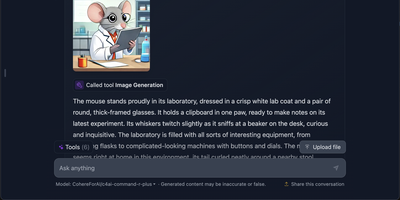
Self-hosting a language model is only half the job; people still need somewhere pleasant to talk to it, and Chat UI is that window, the same interface that powers HuggingChat. Point it at any OpenAI-compatible endpoint, your own Ollama or llama.cpp server, the Hugging Face router, or a hosted gateway like OpenRouter, and the models it serves appear in the picker automatically, with no per-model configuration. Conversations are saved to your database and stay browsable in the sidebar, so a thread from last week can be reopened, continued, and compared against a fresh answer from another model. Multimodal models accept image uploads right in the composer, and models that support it can call MCP tools mid-conversation to fetch data or run actions. For a shared team deployment, OpenID Connect sign-in keeps individual histories and settings separate, and per-user defaults travel with each account. Everything a consumer chatbot would keep on someone else's servers, prompts, uploaded files, and usage history, stays in the MongoDB you control on the same machine. Running on a dedicated VPS on RepoCloud with guaranteed CPU, RAM, and SSD, full root SSH access, and a browser serial console. Apache-2.0 licensed.
Dobase
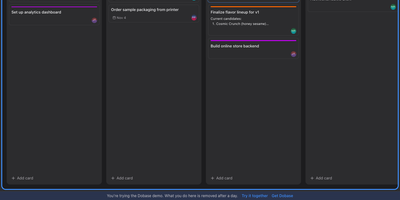
Dobase replaces the scattered pile of team subscriptions with one self-hosted workspace where mail, kanban boards, documents, chat, to-do lists, files, a calendar, and video rooms live side by side. Install only the tools your team needs, and share each one with exactly the collaborators you choose; a board for the whole company and a private todo list can sit in the same window. Several people can type in the same document at once, watching each other's colored cursors while the text merges cleanly, and presence faces in the sidebar show who is inside every tool right now. Open tools arrange themselves as tiles in a wide window, so chat can sit next to the board it discusses and the calendar under the mail you are answering. Pressing Cmd+K searches cards, todos, documents, files, chat, events, and mail in one motion, and nearly everything also works from the keyboard alone. Mail threads conversations and lets you accept calendar invites from the message, files get public links guarded by a password and an expiry, and the calendar syncs with CalDAV services or runs on its own. Video rooms with screen sharing join the same workspace, mentions and notifications follow you, and an email digest catches up anyone who was away. Running on a dedicated VPS on RepoCloud with guaranteed CPU, RAM, and SSD, full root SSH access, and a browser serial console. MIT licensed.
MicroBin
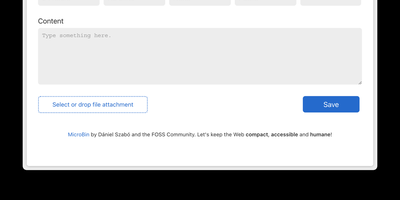
A video too large for Discord, a secret that should not live in a chat log, or a config file a headless server needs to fetch: MicroBin turns each into a short link with an animal name, served from your own machine. Paste text or code and it comes back with syntax highlighting, inline image and video embedding, and a QR code for moving it to a phone. Attach one file or several, then decide exactly who can see them: uploads can be public or private, editable or locked, set to expire on a schedule or to never expire. For sensitive material, server-side encryption and client-side end-to-end encryption keep contents unreadable without the password. Raw serving hands the plain bytes to curl, a browser, or another program, which makes the same box a tiny file endpoint for scripts and test rigs. A postbox mode lets people send you files and texts they cannot browse or delete afterwards, and a read-only mode with an uploader password turns the instance into a drop point with exactly one trusted sender. The admin console lists uploads and storage, and everything runs as one small binary backed by SQLite or a JSON file, comfortable in a few megabytes of memory. Running on a dedicated VPS on RepoCloud with guaranteed CPU, RAM, and SSD, full root SSH access, and a browser serial console. BSD-3-Clause licensed.
Eclipse Kura
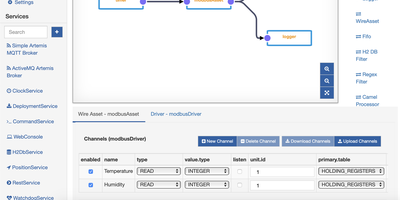
Between the factory floor and the cloud sits a gateway that has to speak Modbus to a PLC, OPC-UA to a machine, and MQTT to your platform, and Eclipse Kura is the framework that runs that gateway as a managed, programmable container. Drivers encapsulate each field protocol and its settings, while Assets model the data channels of attached devices, giving every sensor and controller a uniform mirror that applications can read, write, and publish. Kura Wires turns edge logic into a diagram: drag an asset onto the canvas, wire it through timers, filters, and SQL-based aggregation, and publish the result to the cloud, installing extra components from the Eclipse Kura Marketplace when the palette runs short. Telemetry survives bad networks because the data service stores messages locally and forwards them when the connection returns, with publishing policies abstracting the underlying MQTT transport. Administrators manage the whole gateway from the web console: network interfaces, firewall, installed bundles, snapshots of the full configuration that can be exported and restored, and remote deployment and upgrade of applications through the cloud connection. Hardware services expose serial ports, USB, Bluetooth, GPS position, GPIO, I2C, and a watchdog that resets the system when a critical component stops reporting. Running on a dedicated VPS on RepoCloud with guaranteed CPU, RAM, and SSD, full root SSH access, and a browser serial console. EPL-2.0 licensed.
walgit
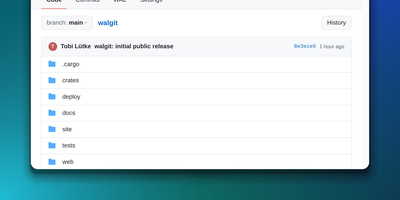
walgit is a self-hosted Git server that keeps every repository inside one S3 or GCS bucket, so the machine serving your code is disposable while your history stays durable. Point the binary at a bucket, start it, and pushing to a new repository name creates that repository on the spot, with no admin console or provisioning step in between. Developers clone, fetch, and push over smart HTTP with Git LFS support for large files, and big clones are delivered as static bundle files so multi-gigabyte repositories never bottleneck the server process. The built-in web interface lets you browse file trees, read files, review commit history, and inspect diffs directly in the browser. Per-repository policy files control protected branches, fast-forward-only references, and bypass lists, so release branches stay guarded without a separate compliance tool. A JSON API and the dependency-free repos.js SDK let scripts, internal dashboards, and automation agents read repository data programmatically, with long operations streaming progress as server-sent events. Webhooks deliver exactly-once reference events to CI systems, chat tools, and deployment pipelines whenever branches or tags move. Background checkpoints and compaction keep storage tidy on their own, while token or OpenID Connect sign-in decides who may read and who may push. Running on a dedicated VPS on RepoCloud with guaranteed CPU, RAM, and SSD, full root SSH access, and a browser serial console. MIT licensed.

Tryton
In Tryton, an invoice knows its shipment and a production order knows its stock, since accounting, inventory, purchasing, and sales are modules of one ERP rather than separate programs exchanging exports. Financial accounting posts customer and supplier invoices, reconciles bank statements imported from SEPA or configured CSV formats, manages dunning and direct debits, and produces Factur-X electronic invoices, while analytic accounting splits results across cost centers. Stock tracks goods through warehouses and locations with lots, shipments, inventories that warn when counts drift beyond tolerance, and automatic period closing, and production consumes bill-of-material inputs into finished goods with quantity checks. Sales quotations become orders, shipments, and invoices without retyping; purchases calculate real supplier lead times; point of sale records lot numbers at the till; subscriptions bill recurring services on schedule. Multi-company installations share the same database with per-company wizards, tax rules can be defined per organization for European trade, and parties, products, carriers, currencies, and customs duties are managed as shared reference data. Access happens through the browser web client, a desktop client, or scripting and REST libraries, so integrations read and write the same business objects your staff see. Running on a dedicated VPS on RepoCloud with guaranteed CPU, RAM, and SSD, full root SSH access, and a browser serial console. GPL-3.0-or-later licensed.
LightPost
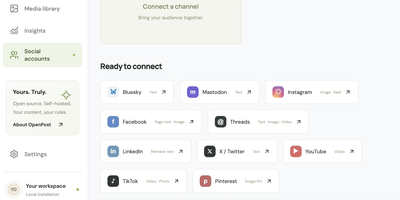
Write a post once in LightPost and it goes out to Bluesky, Mastodon, X, Instagram, Threads, Discord, LinkedIn, Telegram, and Facebook Pages on your schedule, with YouTube video uploads handled in the same workspace, from a dashboard running on your own server. The composer fans one message out to every connected account, including several accounts on the same platform, and each destination can receive text, images, or both within that network's limits. Drafts can be saved, edited, and duplicated, and scheduled times follow your browser's timezone so a week of announcements can be queued in one sitting. Images come in from public JPEG links or a saved library, with alt text and a preview before anything ships. Every delivery is tracked per account with links to the published posts, and when one network fails you retry just that destination instead of blasting the successful ones twice. The queue persists across restarts and overdue posts resume on their own, so an overnight reboot never eats a scheduled campaign. Built-in setup guides walk you through eligibility, credentials, and permissions for each platform, account connections can be verified or reconnected from the same panel, and your credentials stay encrypted on your disk with optional password protection and exportable post history. Running on a dedicated VPS on RepoCloud with guaranteed CPU, RAM, and SSD, full root SSH access, and a browser serial console. MIT licensed.
OpenList
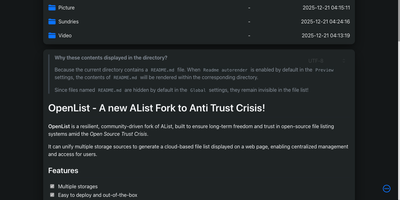
OpenList gathers every place your files live, local disks, S3 buckets, OneDrive, Google Drive, Dropbox, NAS shares, and forty-odd other services, into one browsable file list behind a single login. Mount each storage at its own path and the whole collection behaves like one tidy drive: documents open in the browser, whether PDF, Markdown, source code, or Office files, images get a gallery mode, and videos and audio play in place with subtitle and lyric support. Everyday file work happens in the same window: upload, delete, rename, move, and copy, including copying directly between two storages when you are migrating off a cloud plan. Offline download tasks let the server fetch links for you in the background, and multi-threaded acceleration squeezes speed out of sluggish single connections. Every folder can also be mounted as a real drive on your computer through the built-in WebDAV and FTP servers, with per-user permissions deciding who may read, upload, rename, or delete. Protected routes add passwords in front of sensitive shares, permalinks hand out direct download links, and granular user rules can hide files or open archive contents without extracting them. Running on a dedicated VPS on RepoCloud with guaranteed CPU, RAM, and SSD, full root SSH access, and a browser serial console. AGPL-3.0 licensed.
GlitchTip
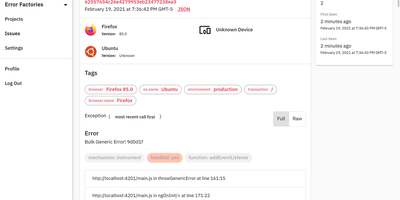
GlitchTip speaks Sentry's protocol without Sentry's operational weight - open-source error tracking that your existing SDKs already understand. The pitch is pragmatic: instrument your application with the official Sentry SDKs you already know - any language they cover - and point the DSN at your own GlitchTip instance instead. Errors, exceptions, log messages, and Content Security Policy violations flow into one place for triage, grouped into issues with stack traces, with alerts delivered by email or webhook the moment things break. Where self-hosted Sentry has ballooned into a docker-compose stack of twenty-plus containers, GlitchTip is a deliberately lean Django and PostgreSQL application a small team can actually run. Beyond errors, it bundles three more monitoring concerns: performance monitoring takes a works-out-of-the-box approach - no dashboard building, just your slowest web requests, database queries, and transactions surfaced automatically; uptime monitoring pings your sites and alerts on failures, or runs in reverse as a dead-man's-switch heartbeat for cron jobs that must check in on schedule; and log search puts application logs alongside errors for faster debugging. Unlimited projects and team members, MIT-licensed, built by Burke Software - your event volume is limited only by your own hardware.