
Claper
Passive slide decks put audiences to sleep, which is why Claper turns any presentation into a two-way live session where every attendee can vote in polls, submit questions, and react in real time from their phone. Speakers upload existing PDF or PowerPoint decks directly into the web studio and interleave interactive poll, quiz, form, and web embed slides between their static pages without rebuilding presentations from scratch. Conference organizers and educators share a short join code or QR link so hundreds of participants can enter the attendee room instantly from any mobile browser without installing an app or creating an account. During the talk, the presenter console displays incoming audience questions sorted by upvote popularity, alongside moderation controls to approve, pin, hide, or mark inquiries as answered on the main screen. Live polling supports multiple-choice, rating scale, and open-text prompts that animate into real-time bar charts and percentage breakdowns as votes arrive, while timed quizzes grade participant responses automatically. Integrated real-time speech transcription generates live captions and searchable session transcripts so international and hearing-impaired attendees can follow every spoken word. Universities and corporate training teams connect Claper directly to Moodle or OpenID Connect identity providers via LTI 1.3 to synchronize student rosters, push quiz scores to gradebooks, and export complete CSV engagement reports after every session. Running on a dedicated VPS on RepoCloud with guaranteed CPU, RAM, and SSD, full root SSH access, and a browser serial console. AGPL-3.0 licensed.
4ga Boards
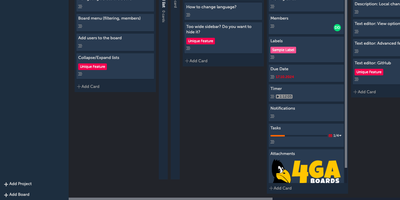
Instant board updates, side-by-side card multitasking, and a five-level task hierarchy make 4ga Boards a fast, clutter-free Kanban workspace for teams tired of sluggish project trackers. Work organizes cleanly from top-level projects down into boards, collapsible lists, cards, and granular subtask checklists. You can switch between classic drag-and-drop Kanban columns and compact to-do list views with a single click. While editing a card description in the rich Markdown editor with colored text, you can still scroll, filter, and rearrange other cards on the board without losing unsaved changes. Every move, label change, due date update, or comment syncs live across connected browsers without page reloads. Collapsible lists and a retractable sidebar free up wide-screen horizontal space during sprint reviews. Teams migrating existing workflows can import boards directly from Trello JSON exports or CSV files and export backups on demand. Cards support file attachments, custom cover images, multi-member assignments, and @mentions with instant activity notifications. Authentication integrates with Google, GitHub, Microsoft, and custom OIDC single sign-on providers alongside role-based board privacy. The interface includes dark mode, full keyboard shortcuts, and localization across 16 languages. Running on a dedicated VPS on RepoCloud with guaranteed CPU, RAM, and SSD, full root SSH access, and a browser serial console. MIT licensed.
Azimutt
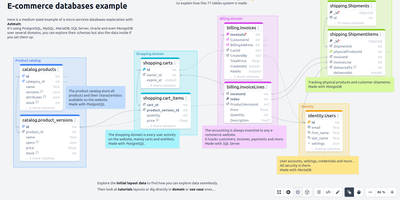
Inheriting a sprawling database with hundreds of undocumented tables usually means weeks of guesswork, unless you open it in Azimutt to visually map schemas, trace relationships, and inspect live rows in one workspace. Instead of dumping every table onto a cluttered canvas that crashes your browser, the visual explorer starts clean so you can search across entity names, column types, and SQL comments to reveal only the tables relevant to your investigation. Clicking foreign-key or primary-key indicators expands incoming and outgoing relations step by step, while the graph path-finder automatically calculates the shortest join route between any two distant entities. When debugging production issues or answering support tickets, you can query live records across PostgreSQL, MySQL, MariaDB, SQL Server, Oracle, SQLite, MongoDB, Couchbase, Snowflake, and BigQuery, then click directly through foreign keys in the result rows to follow data lineage visually. Architects and developers also design new schemas at typing speed using Azimutt Markup Language (AML), attach contextual markdown notes, tags, and memos to saved layouts for team onboarding, and run automated schema analysis that flags missing primary keys, implicit foreign keys, inconsistent column types, and oversized tables. Running on a dedicated VPS on RepoCloud with guaranteed CPU, RAM, and SSD, full root SSH access, and a browser serial console. MIT licensed.
Shaper
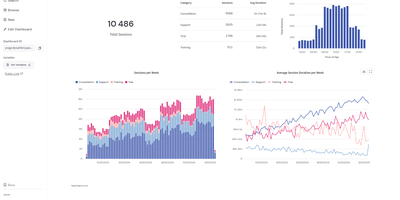
Write standard SQL queries and watch Shaper turn them into interactive dashboards, scheduled reports, and customer-facing analytics widgets without maintaining a heavy business intelligence stack. Every query maps directly to a visual component through simple type casts like BARCHART, LINECHART, GAUGE, BOXPLOT, or DROPDOWN. Analysts can attach external PostgreSQL and MySQL databases, read Parquet, CSV, JSON, and Excel files straight from S3 object storage, or stream live events into the HTTP ingest API. Interactive filter controls let viewers slice metrics by date ranges, multi-select dropdowns, and dynamic parameter variables that automatically re-evaluate downstream charts. Teams version-control their entire reporting layer as plain SQL files in Git, making dashboard updates auditable in pull requests and simple for AI coding assistants to generate. Product engineers embed white-labeled analytics directly into customer web apps without iframes, issuing per-tenant JWT tokens to enforce row-level data isolation. Need scheduled deliverables for stakeholders? Configure SQL-driven background tasks that transform datasets on a cron schedule, send threshold alerts to Slack or Microsoft Teams, and generate downloadable PDF, PNG, Excel, or CSV reports. External collaborators can also view live metrics through password-protected sharing links. Running on a dedicated VPS on RepoCloud with guaranteed CPU, RAM, and SSD, full root SSH access, and a browser serial console. MPL-2.0 licensed.
Sylius
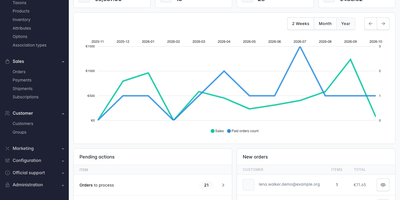
One install, many shops: Sylius runs separate storefronts with their own languages, currencies, and countries from a single admin panel. Products are simple or configurable. Define a size option, generate variants from S through XXL, and track stock per variant. Attributes, translations, and a nested taxon tree keep the catalog organized. Prices are set per channel. Catalog promotions add sale badges and struck-through prices. Cart promotions pair rules, like a minimum item total, with actions, like a fixed order discount, optionally behind coupon codes. Shipping methods carry delivery windows, zone eligibility, and shipping and tax categories. Order pages show items, shipping, taxes, promotions, payment state, and customer details. The dashboard charts sales and paid orders over time and lists pending work. A ready-made storefront covers product pages, a cart, checkout with address, shipping, payment, and review steps, customer accounts with order history, and product reviews. Custom frontends talk to separate shop and admin REST APIs, documented in OpenAPI. Every enabled locale adds a translation section to products, taxons, shipping methods, and promotions. Running on a dedicated VPS on RepoCloud with guaranteed CPU, RAM, and SSD, full root SSH access, and a browser serial console. MIT licensed.
Networking Toolbox
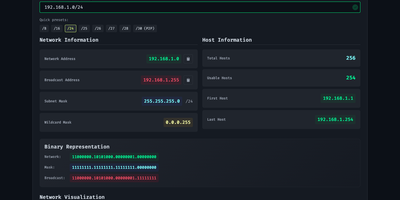
Subnet math, DNS lookups, DHCP options, and certificate checks share one browser tab in Networking Toolbox, a free toolkit for sysadmins and network engineers. Need to carve a /24 into departments? The VLSM planner fits named subnet requirements into a parent block, reports each subnet's efficiency and the leftover space, and exports the plan as CSV or JSON. Merging address lists? CIDR utilities summarize, split, compare, and deaggregate prefixes, with set operations for difference, overlap, and containment. Writing configs? Generators build DHCPv4 and DHCPv6 options, PXE profiles, Kea or ISC snippets, and SPF, DKIM, DMARC, CAA, TLSA, and SRV records, and DNSSEC helpers calculate key tags and DS records. Something broken? Diagnostics query DNS through Cloudflare, Google, Quad9, OpenDNS, or a resolver of your choice, read TLS certificate chains, grade HTTP security headers, trace redirects, check TCP ports, look up BGP routes and RDAP records, and test mail servers. Need a refresher? Reference guides explain private ranges, CGNAT, IPv6 address types, and common ports. A keyboard search palette puts any tool a few keystrokes away, and bookmarked tools stay available offline. Eighteen themes, four languages, custom branding, and accessibility switches make it feel like your own, and a keyless JSON API serves the subnet, CIDR, IP, and DNS utilities to scripts. Running on a dedicated VPS on RepoCloud with guaranteed CPU, RAM, and SSD, full root SSH access, and a browser serial console. MIT licensed.
Concourse
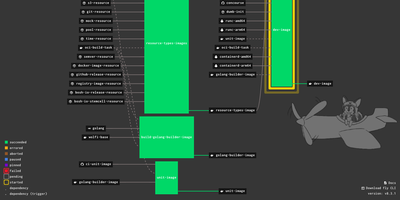
When a commit lands, a timer fires, or a pull request opens, Concourse runs the matching jobs in fresh containers and draws the entire CI/CD pipeline as a live graph you can read at a glance. Pipelines are plain YAML files that tie resources such as git repositories, registries, and buckets to jobs made of get, put, and task steps, so the same file behaves the same on every installation. Resources are checked continuously for new versions, webhooks can request an immediate check, and a version can be pinned when something needs to stay put. The dashboard lists every pipeline by team with status colors, a filter box, favorites, and a high-density view, while build pages stream colored logs and let you rerun a build with the exact same inputs. The fly command line sets pipelines, runs one-off tasks against local files from your laptop, and opens a shell inside the container of a failed step. A set_pipeline step lets pipelines configure other pipelines, and instance vars create a family of related pipelines, such as one per pull request. Teams keep projects separate and can be tied to a GitHub organization, credentials arrive at run time from Vault, CredHub, AWS, or Kubernetes, and policy rules can block disallowed images. Running on a dedicated VPS on RepoCloud with guaranteed CPU, RAM, and SSD, full root SSH access, and a browser serial console. Apache-2.0 licensed.
nopCommerce
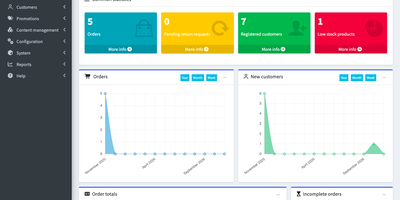
nopCommerce is a self-hosted shopping cart and merchant back office for selling physical goods, downloads, rentals, and gift cards from a storefront you fully control. The catalog covers simple, grouped, downloadable, rental, recurring, and gift card products, with categories, manufacturers, tier prices, product and specification attributes, stock tracking, and Excel import with Excel or XML export. Shoppers get a one-page checkout, wishlists, product comparison, reviews, reward points, gift card redemption, and return requests. Run several stores or outside vendors from a single back office; vendors can apply for accounts and manage their own products, orders, and shipments. Orders move through status changes, offline refunds, shipments, recurring payments, and PDF invoices, while built-in reports surface bestsellers, low stock, country sales, and top-spending customers. Multiple languages and currencies, tax and shipping providers, warehouses, pickup points, and EU Omnibus and GDPR settings support selling abroad. Discounts, affiliates, newsletters, campaigns, SEO-friendly page names, blog, news, forums, and polls cover promotion and content. Customer roles and an access control list set who can manage what, and multi-factor authentication protects sign-ins. Plugins and themes add payment gateways, social sign-in, search, and exchange rates, and the Web API plugin exposes store functions over REST for mobile apps, ERP, CRM, and accounting systems. Running on a dedicated VPS on RepoCloud with guaranteed CPU, RAM, and SSD, full root SSH access, and a browser serial console. nopCommerce Public License 4.0 licensed.
Nezha Monitoring
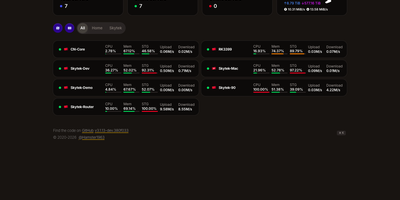
Keep every VPS, home-lab box, NAS, and router you run on one self-hosted dashboard, with a small agent on each machine reporting whether it is up and how hard it is working. Nezha tracks CPU, memory, swap, disk, load, traffic, process counts, and TCP and UDP connections on Linux, Windows, macOS, OpenWRT, and Synology machines, plus GPU and temperature where supported. Servers sort into groups and appear as cards, a list, or a world map, with live charts and, when the optional time-series database is on, 1, 7, and 30 days of history. HTTP GET, ICMP Ping, and TCPing monitors run from the servers you choose, chart latency and packet loss, and warn about HTTPS certificate changes and upcoming expiry. Alert rules watch offline servers, resource use, bandwidth, and cycle traffic limits, then message Telegram, Slack, Matrix, Feishu, DingTalk, or any webhook. A browser terminal and file manager handle quick fixes, while scheduled or alert-triggered tasks run backups, restarts, and scripts across many servers. DDNS updates Cloudflare, Tencent Cloud, or Hurricane Electric records when an agent's IP changes, and NAT traversal publishes a home router or NAS page on your own domain. Admin and user roles, scoped API tokens, and an optional MCP endpoint let people and AI tools list servers and run commands within their permissions. Running on a dedicated VPS on RepoCloud with guaranteed CPU, RAM, and SSD, full root SSH access, and a browser serial console. Apache-2.0 licensed.
EmDash
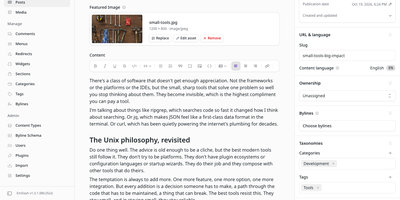
EmDash rebuilds the WordPress publishing experience as an open-source CMS, with drafts, revisions, scheduled posts, a media library, menus, widgets, and plugins that run in sandboxes and can only do what they declare. Writers get a rich-text editor with featured images, slugs, bylines, categories, and tags, plus signed preview links for unpublished work and a calendar of everything published or scheduled. Site builders define their own content types in a visual schema builder, choosing required and searchable fields, URL patterns, comments, SEO metadata, and edit locking so two people never overwrite each other. Uploads are drag and drop, with folders and filename search in the media library. Menus, sidebar widgets, reusable sections, and redirects with a 404 log shape the public site. Access is passkey-first, with OAuth and magic-link fallbacks, four roles from Contributor to Administrator, comment moderation, and personal API tokens. Coming from WordPress? Point the importer at a migration key, a site URL, or an exported XML file and it carries over posts, pages, media, and taxonomies. Plugins add hooks, settings, admin pages, dashboard widgets, custom blocks, and API routes after declaring capabilities such as content:read or email:send, while a built-in MCP server and CLI let AI assistants manage content directly. Blog, marketing, and portfolio templates give new sites a head start. Running on a dedicated VPS on RepoCloud with guaranteed CPU, RAM, and SSD, full root SSH access, and a browser serial console. MIT licensed.
AstrBot
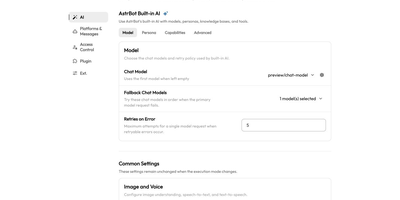
Getting a language model into the chat apps people already use takes a single self-hosted server running AstrBot, which answers in QQ, Telegram, Discord, Slack, Lark, DingTalk, LINE, and WeCom. The model itself is a setting. OpenAI-compatible endpoints, Anthropic, Google Gemini, DeepSeek, Ollama, and LM Studio all work, with fallback models and retry limits for failed requests, and Dify, Coze, or Alibaba Cloud Bailian can take over a conversation too. A bare model cannot act, so the built-in agent calls MCP servers and Skills, delegates to SubAgents, runs scheduled tasks, and executes code in an isolated sandbox. It cannot read your files either, so a knowledge base takes PDF, Word, Markdown, and EPUB uploads and searches them with hybrid dense and BM25 retrieval. Personas shape each bot's personality, and Whisper or Edge TTS adds speech. When an answer looks wrong, the ChatUI shows thinking, tool calls, token counts, and latency, and a per-message trace timeline shows how the bot got there. Because the panel steers the bot, administrator IDs, session whitelists, optional TOTP login, and HTTPS protect it. Backups live under System Settings, and the plugin market installs any of more than 1,000 extensions in one click. Running on a dedicated VPS on RepoCloud with guaranteed CPU, RAM, and SSD, full root SSH access, and a browser serial console. AGPL-3.0 licensed.

Knock-Knock
Bots that knock on your server's login ports are always turned away by Knock-Knock, a multi-protocol honeypot that shows every attempt on a live dashboard. Honeypots answer on the standard ports for SSH, Telnet, FTP, RDP, SMB, SIP, HTTP, and SMTP, with MQTT, Node-RED, Modbus, S7, and SNMP as optional extras. Authentication is always rejected, so no bot ever gets a shell. Who is knocking? The live feed shows each attempt's country, username, password, ISP, IP, and protocol. From where? A 3D globe marks the origin in one of six styles, including an extruded country heat map. Trying what? Leaderboards rank countries, usernames, passwords, ISPs, and IP addresses, and a trivia panel explains why bots favor certain credentials. A protocol filter re-slices the feed, globe, and leaderboards together; SIP shows dialed numbers and toll-call destinations, and RDP shows hostnames and accounts. Too fast? Press the space bar to pause, right-click any knock for details, or switch on a virtual Geiger counter that clicks as attacks arrive. Want to fight back? Download hourly 30-day and 365-day blocklists with recipes for CSF, CrowdSec, ipset, nftables, and pfSense, or query the optional API for any IP, CIDR range, or ASN. Several honeypot servers can stream into one aggregated dashboard. Running on a dedicated VPS on RepoCloud with guaranteed CPU, RAM, and SSD, full root SSH access, and a browser serial console. MIT licensed.
Rootprint
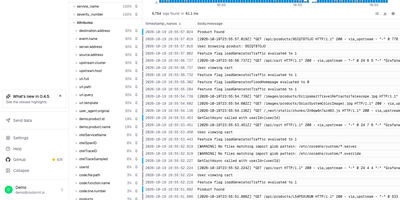
A year of searchable logs and traces no longer needs a metered logging service, because Rootprint keeps the whole index in a storage bucket you already own. A search matches any word on any line, since every log is indexed in full and no service name, stream, or label is needed first. A frequency histogram, one-click field filters, and saved views narrow the results, a fold mode collapses repeated lines, and exports arrive as NDJSON, CSV, or plain text, or as a share link. Open a trace from the log that emitted it, or paste a trace ID, and a waterfall shows per-span timing, attributes, events, and database calls grouped by query, with each span linking back to its logs. The trace explorer charts span volume, error rate, and p50, p95, and p99 latency, ranks the busiest operations, and filters spans by service, duration, and status. Every service gets its own page with request rate, error rate, operations, dependencies, and errors. Data arrives over OpenTelemetry from the Collector, Vector, or Fluent Bit, through a plain HTTP gateway, or by pulling from Kafka, Kinesis, or SQS, with guided setup for nine integrations. Indexes can live in S3, Google Cloud Storage, R2, MinIO, or Azure Blob. Teammates sign in with Google, GitHub, or any OpenID Connect provider, and scoped API keys serve scripts. Running on a dedicated VPS on RepoCloud with guaranteed CPU, RAM, and SSD, full root SSH access, and a browser serial console. Apache-2.0 licensed.
Dreeve
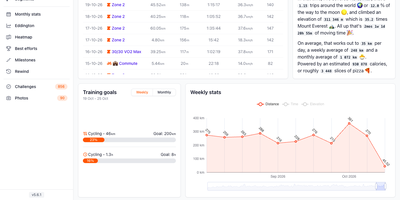
Every ride, run, hike, and swim you have ever recorded finds a home in Dreeve, a private fitness dashboard that lives on your own server rather than in a social feed. Import FIT, TCX, or GPX files from a watch folder, sync Strava, or add connectors for Garmin Connect, Wahoo, Polar Flow, Hammerhead, and Zepp/Amazfit. Weekly charts follow distance, time, and elevation beside training goals, heart rate zones, and training load analysis, and monthly stats pair per-sport totals with an interactive calendar. A heatmap paints every kilometer you have covered. Best efforts rank your fastest 5k, 10k, 50k, and 100k across every sport, while Eddington numbers, a milestones timeline, and a yearly Rewind mark the long game. Strava sync also brings segments, segment efforts, and challenges. Gear pages total the distance on each bike and shoe, and maintenance tasks send alerts through ntfy, Gotify, Discord, Telegram, Slack, or email when an interval comes due. Automation rules assign gear, flag commutes, and set sport types by device, distance, weekday, time of day, or location, so new imports arrive organized. Ask the AI workout assistant about your training, using cloud models, OpenRouter, or a local Ollama model. An installable mobile app and embeddable badges carry your stats to phones and blogs, and a password-protected admin panel keeps the settings. Running on a dedicated VPS on RepoCloud with guaranteed CPU, RAM, and SSD, full root SSH access, and a browser serial console. AGPL-3.0 licensed.
Nexterm
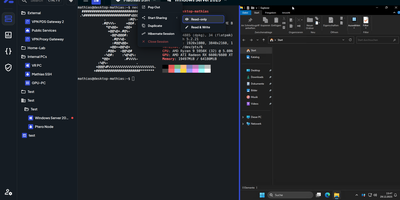
Terminals, remote desktops, and file browsers for every server you run: Nexterm opens them over SSH, VNC, RDP, Telnet, or SFTP from a self-hosted web page. Servers live in folders with tags and custom icons. Connections open as tabs or split views, keep running across browsers and devices, and can hibernate and resume later. The file manager handles SFTP and FTP: drag files in, upload whole folders, search, and edit in place with syntax highlighting. Live metrics track CPU, memory, disk, network, and processes for each host. Snippets store the commands you retype most. Scripts run whole maintenance jobs. Git repositories added as sources bring ready-made ones filtered by operating system. Organizations share servers through role-based permissions, and every action is logged. Record full terminal sessions for audits and training, or send a shared-session link so a colleague can join, read-only or writable. Authentication covers local accounts with TOTP and passkeys, OIDC providers such as Keycloak, Authentik, and Microsoft Entra ID, and LDAP or Active Directory. Saved passwords, SSH keys, and passphrases stay encrypted at rest. A Proxmox integration lists LXC containers and QEMU virtual machines and can start or stop them. An opt-in AI assistant drafts shell commands from plain-language requests. Running on a dedicated VPS on RepoCloud with guaranteed CPU, RAM, and SSD, full root SSH access, and a browser serial console. MIT licensed.
DbGate
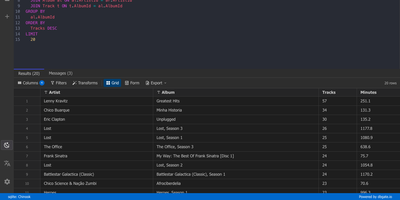
One browser tab can hold every database you manage, from MySQL and PostgreSQL to MongoDB and Redis, so there is no separate client to install for each engine. Connections are unlimited, and each can use its own SSH tunnel or SSL certificates. Tables open in an Excel-like grid where you edit cells inline, filter rows with expressions, and sort by any column. The SQL editor offers schema-aware code completion, a formatter, a join helper that builds clauses from foreign keys, query parameters, and a history of past runs, while result sets appear in separate tabs that you can filter, sort, and export. ER diagrams chart tables and their relations. The table editor creates columns, keys, and indexes and previews the SQL before anything is applied. Import and export move data between databases and files as SQL, CSV, JSON, XML, NDJSON, Excel, DBF, or YAML. Administrators can preconfigure connections through environment variables, mark them read-only, and protect the interface with logins that carry per-user permissions. Light and dark themes, customizable keyboard shortcuts, and translations into many languages keep daily work comfortable. Running on a dedicated VPS on RepoCloud with guaranteed CPU, RAM, and SSD, full root SSH access, and a browser serial console. GPL-3.0 licensed.
Instatic
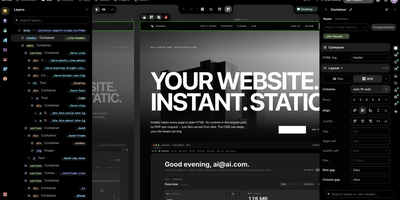
Design a website on a canvas, manage its content in spreadsheet-style tables, and publish plain HTML, all from one self-hosted Instatic server. Designers see several breakpoint frames side by side, or switch to live mode and edit one full-size page in place. A built-in design system expands one brand color into a full shade scale, generates fluid type and spacing scales, and writes the utility classes into a single small stylesheet. Reusable Visual Components take typed parameters and named slots, templates set site-wide or per-post-type layouts, and loops repeat a design over posts or media. Editors work in custom post types and data tables, and posts move through draft, scheduled, and published states. Forms on the site save their submissions to tables of your own. An AI agent can do the building, placing real, editable nodes on the canvas using Claude, OpenAI, OpenRouter, or Ollama with your own key, and an MCP connector lets Claude, ChatGPT, and other remote agents work on the site too. Super Import converts a whole static site into pages, styles, tokens, and media. Teams get roles built from 38 capabilities, TOTP two-factor sign-in, and an append-only audit log, plus site branches with private copies, shareable preview links, and merge review. Everything published is baked to plain HTML and CSS on disk. Running on a dedicated VPS on RepoCloud with guaranteed CPU, RAM, and SSD, full root SSH access, and a browser serial console. MIT licensed.
Oksskolten
Subscribe to a feed and Oksskolten fetches the complete text of every new article, cleans it, and files it as Markdown in a library you can read without leaving the app. About 500 cleanup patterns strip ads, navigation, and tracking, with no per-feed toggles or selectors to maintain. No feed on the site? Auto-discovery goes first, then RSS Bridge, then LLM-inferred CSS selectors, while FlareSolverr gets past bot protection. Every feed is checked on its own schedule, somewhere between every 15 minutes and every 4 hours. Inbox, Read Later, Liked, and Read views keep the queue tidy. Clip any URL as a standalone article. Likes and bookmarks feed an engagement score that shapes search ranking and recommendations. One click summarizes or translates an article through Anthropic, Gemini, OpenAI, Ollama, or vLLM, with Google Translate and DeepL as translation engines. Ask the chat questions about your archive, or point Claude Code or Codex at the built-in MCP server to use the same tools. Search forgives typos and covers every stored article. Login works with a password, a passkey, or GitHub. Pick from four layouts and fourteen color themes, import custom themes as JSON, rebind keyboard shortcuts, and keep reading offline as a progressive web app. Running on a dedicated VPS on RepoCloud with guaranteed CPU, RAM, and SSD, full root SSH access, and a browser serial console. AGPL-3.0 licensed.