DispatchSEO
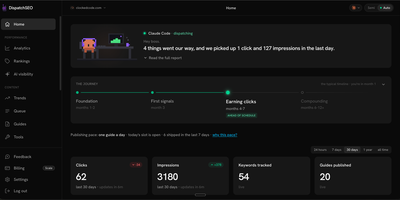
DispatchSEO runs an SEO program through your own AI agent: it researches keywords, queues ideas for your approval, and publishes a guide every morning. Connect Claude Code, Codex, Cursor, or the Claude app over MCP and the agent mines keywords from Search Console data and Google Autocomplete, then drops each idea into a queue showing volume, difficulty, and the reasoning behind it. Approve, reject, or drag to reorder, or switch on auto mode and skip the queue. Each morning the oldest approved idea becomes a real guide, delivered as a GitHub pull request or posted straight to a self-hosted WordPress site, checked against the live search results before it ships. Home greets you with a plain-language daily briefing, a journey tracker, publishing pace, and click and impression counters. Rankings charts daily positions with thirty-day sparklines, Search Traffic plots Search Console history, and an AI visibility page shows how often Claude cites your domain. A backlink playbook lists free and paid submissions with copy ready to paste. One deployment manages many sites, each with its own MCP token. Running on a dedicated VPS on RepoCloud with guaranteed CPU, RAM, and SSD, full root SSH access, and a browser serial console. AGPL-3.0 licensed.
Nzbget
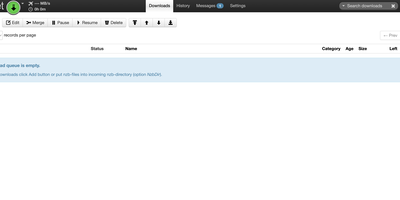
Written in optimized C++ where competitors use Python or Java, NZBGet saturates fast connections while idling on CPU and RAM - which is why the performance-obsessed Usenet downloader has long been the client of choice for NAS boxes, Raspberry Pis, and routers as much as full servers. The engineering shows in the recovery pipeline. Instead of shelling out to par2cmdline, NZBGet integrates the par2 source directly and exploits its knowledge of exactly which articles failed - quick par-verification checks only what needs checking, and its own multicore repair implementation runs 2-3x faster than the external tool on the same hardware. Fast par-rename deobfuscates scrambled filenames in seconds without a full verification pass, and rar-rename recovers names for multivolume archives even when no par2 files exist. DirectWrite assembles articles straight into sparse destination files, skipping temporary-file churn entirely, with an article cache and queue-pausing options to eliminate disk contention. Automation is complete: a remote web interface, full JSON-RPC API, RSS feeds with duplicate detection, scheduling and prioritization, and an extension manager for Python and Bash scripts triggered by download events. Sonarr, Radarr, and every major indexer integrate natively.
SubLane
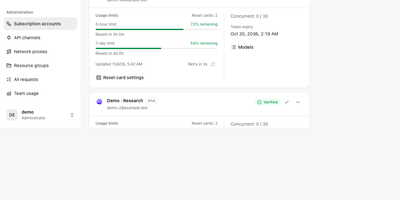
Five teammates sharing three AI subscriptions usually means a password in a group chat; SubLane replaces that with a gateway you host, where accounts are pooled and every person gets a managed key. Connect Codex, Claude, Antigravity, and Grok Build subscriptions once, by browser OAuth or credential import, and the gateway snapshots each account's quota windows and allowances so routing knows who still has room. Add API channels for OpenAI-compatible services alongside the subscriptions, then group everything into resource pools with model allowlists, conversation affinity, concurrency controls, and cooldown recovery for accounts that hit a limit. Each member receives a personal key scoped to one group, with its own expiry, rate and concurrency limits, and an allowance measured in tokens, internal dollars, or estimated quota share; keys can be paused or revoked without touching anyone else. Whatever the client speaks, the gateway answers: OpenAI Responses and Chat Completions, Claude Messages, and Gemini formats flow over HTTP, SSE, or WebSocket, independent of which subscription actually serves the request. Administrators watch per-member and per-model usage charts, activity heatmaps, and request diagnostics, bind a fixed outbound proxy to any account, and apply workspace content rules before dispatch. It all runs as one Go process with SQLite and an embedded dashboard, backed up and restored from the interface. Running on a dedicated VPS on RepoCloud with guaranteed CPU, RAM, and SSD, full root SSH access, and a browser serial console. AGPL-3.0 licensed.

Imagor Studio
Imagor Studio is a photo workspace where browsing a huge library and editing what you find happen in the same place, and the originals never get touched. The gallery scrolls virtually through thousands of images with no indexing wait, while drag-and-drop moves files between folders and multi-select handles bulk work. Open any image and the editor lets you stack layers: other images as overlays or watermarks, text layers you can style inline, and solid color layers with blend modes and opacity. Adjust color, apply effects, and crop with a live preview, then copy the generated transformation URL and use that rendition anywhere without exporting a file. A look you build once can be saved as a template in portable JSON and applied across the whole library, so a watermark, a resize, and a color grade become one reusable recipe. You can also start from a blank canvas at any dimensions and compose from scratch. Storage stays yours throughout: point it at a local folder, S3, MinIO, or Cloudflare R2 and manage the same library the same way. Running on a dedicated VPS on RepoCloud with guaranteed CPU, RAM, and SSD, full root SSH access, and a browser serial console. AGPL-3.0 licensed.
PandaDOS
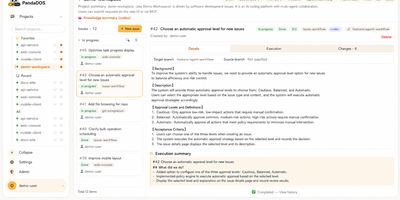
PandaDOS is a self-hosted control plane that turns Claude Code and Codex into long-running coding agents you direct through an issue queue from any browser, instead of babysitting a terminal. You file an issue with the outcome and acceptance criteria, and PandaDOS clarifies missing requirements, plans the work, picks the agent, and drives implementation, verification, and delivery in stages. Three approval levels, cautious, balanced, and automatic, decide which actions proceed alone; safe reversible steps continue automatically while destructive, irreversible, production, or secret-related decisions always come back to you. The browser workspace shows the real agent conversation, a native terminal, project files, Git history and diffs, and an execution summary, so you can inspect or intervene at any moment from a phone or laptop. Agents run on local or SSH-connected executor machines inside tmux sessions, and work sharing one repository is serialized while independent projects proceed in parallel without conflicting edits. Modules keep one assigned agent and durable project knowledge, so context from finished issues carries into the next task instead of evaporating when a chat ends. Teams can sign in through Feishu, ask the project manager questions in chat, and receive subscription notifications and approval cards on their phones. Running on a dedicated VPS on RepoCloud with guaranteed CPU, RAM, and SSD, full root SSH access, and a browser serial console. Apache-2.0 licensed.
Dawarich Atlas
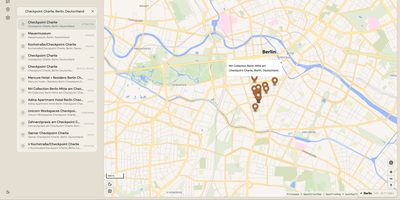
Atlas turns OpenStreetMap data for a city, a country, or the whole planet into a maps backend your applications can search, route with, and query for nearby places, all on hardware you control: pick a region and it downloads and indexes that territory's data locally. Search behaves the way users expect, with autocomplete matches grouped into clusters across the installed dataset, numbered so dense areas stay readable, and a show-all action that frames the full result set. Routing returns directions for driving, cycling, and walking, and a map-matching endpoint snaps noisy recorded GPS tracks onto the real road network. Ask what is here at any coordinate and category pickers surface restaurants, stations, parking, and hundreds of other place types around it, while transit planning threads timetables into door-to-door journeys. The settings panel is the control room: toggle search, routing, points of interest, and transit independently, switch the active region, and watch live progress as new territory is ingested and merged in the background. Developers plug in through one consistent JSON API covering geocoding, reverse geocoding in batches, coverage checks, and every map capability, documented as a public OpenAPI reference. Because every dataset lives on the box, the map keeps answering during outages and inside private networks. Running on a dedicated VPS on RepoCloud with guaranteed CPU, RAM, and SSD, full root SSH access, and a browser serial console. AGPL-3.0 licensed.
BackupX
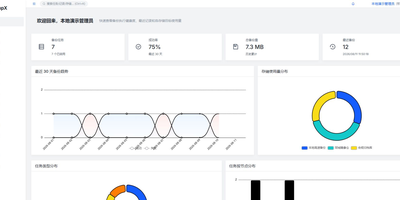
BackupX puts every server backup you are responsible for into one web console, so cron lines scattered across machines become scheduled, visible, and verifiable tasks. Files and directories from multiple sources, MySQL, PostgreSQL, SQLite, SQL Server, and SAP HANA databases all back up on cron schedules you can also build in a visual editor, with automatic retention by days or count cleaning up what expires. More than seventy destinations are reachable through rclone, from S3 and other object stores to Google Drive, WebDAV, FTP, SFTP, Azure Blob, Dropbox, and OneDrive, and storage targets show connection health and live capacity before a job ever fails against a full disk. A master and agent design lets remote servers poll outward only, even through proxies, private certificate authorities, or SSH bastions, so agents run tasks locally with no inbound connectivity to defend. Per-node bandwidth caps and concurrency limits keep a small node polite and a big node busy, each at its own pace. Success and failure notifications arrive by email, webhook, or Telegram, while Prometheus metrics, health probes, an SLA breach gauge, and a full audit log keep the platform observable, and signed audit webhooks forward events to SIEM or WORM storage for compliance records. Running on a dedicated VPS on RepoCloud with guaranteed CPU, RAM, and SSD, full root SSH access, and a browser serial console. Apache-2.0 licensed.
PlikShare
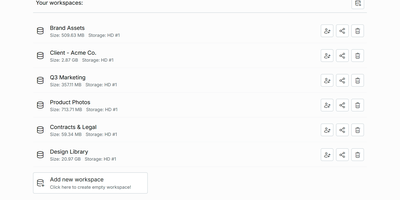
Sending a client a big file should not mean renting seats on someone else's cloud, and PlikShare turns your own server into a file sharing platform with unlimited users, unlimited workspaces, and no per-seat pricing. Its central idea is the box: a controlled gateway between your folders and the outside world, where you invite collaborators, mint anonymous links, and decide who may upload, download, preview, or drop files into an upload-only inbox. Quick share links carry custom slugs, expiry dates, passwords, and download caps, and every box can embed into another website as a live widget whose permissions update the moment you change them. Storage is your choice per workspace, from the server's own disk to S3, Cloudflare R2, Backblaze B2, Azure Blob, Google Cloud Storage, or any S3-compatible server, and each storage picks one of three encryption modes, including full encryption where names and contents are sealed with keys derived from each user's password. Bulk uploads arrive as a single zip that rebuilds its folder structure on landing, bulk downloads assemble from an explorer tree, and previews cover video, audio, PDFs, Markdown with diagrams, and even the inside of zip archives. Single sign-on through multiple OIDC providers, granular admin roles, an optional MCP server for scoped AI agents, and OCR or chat integrations round out a platform that stays lean on a small server. Running on a dedicated VPS on RepoCloud with guaranteed CPU, RAM, and SSD, full root SSH access, and a browser serial console. AGPL-3.0 licensed.
Homelab Atlas
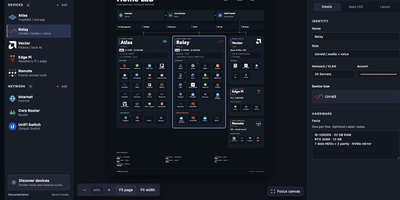
Every homelab eventually earns the question "so what is actually running on all those boxes," and Homelab Atlas turns the answer into a diagram worth posting. Add your servers, the services grouped on each one, and the network gear between them, and the canvas lays everything out automatically with real application logos instead of gray rectangles. Searchable logo pickers work offline, uploads accept your own PNG, JPG, WebP, or SVG marks, and Arrange mode lets you drag and resize cards when the automatic composition is not the story you want to tell. Discovery spares you the typing: point it at Docker or import a saved scan, then review every found device and app, all starting unchecked, before anything joins the diagram as one undoable change. Connections express logical relationships and VLANs, hardware details ride on each card, and your project autosaves in the browser with a downloadable JSON file as the durable copy. When it is time to share, export previews render PNG or SVG with addresses, URLs, and emails hidden by default, plus literal terms you name yourself. Running on a dedicated VPS on RepoCloud with guaranteed CPU, RAM, and SSD, full root SSH access, and a browser serial console. MIT licensed.
Senlo
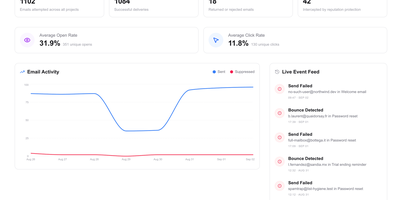
Product teams get a visual home for the transactional and lifecycle emails their application sends with Senlo, which sits on top of the delivery provider they already use instead of replacing it. A drag-and-drop editor builds responsive templates without hand-written HTML, exports to MJML or plain HTML when needed, and keeps templates versioned so edits can be reviewed and rolled back safely. Event-triggered automations turn product activity into onboarding sequences, trial reminders, and win-back flows: your app feeds contact events through the API, and Senlo decides which message goes out next. The transactional API sends a rendered template in one call, so receipts, password resets, and alerts stop living as scattered strings in your codebase. Delivery stops being a black box, with sends, deliveries, bounces, and engagement tracked per workspace, a live feed of failures, and suppressions that block bad addresses before they damage sender reputation. Because sending stays with Resend, Postmark, SES, Mailgun, or your own SMTP server, switching providers never means rebuilding a template. Running on a dedicated VPS on RepoCloud with guaranteed CPU, RAM, and SSD, full root SSH access, and a browser serial console. AGPL-3.0 licensed.
Meridian
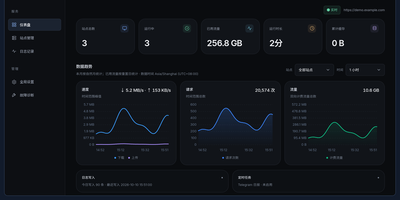
Meridian puts all of your Emby reverse proxy sites, playback routes, and day to day operations into one clean management panel instead of a pile of hand-written proxy configs. Each Emby site gets its own entry through a path, a dedicated port, or a subdomain, with primary and backup routes that switch automatically when one goes down. Three playback modes let video stream directly to clients while logins, posters, and API calls continue through the proxy, so bandwidth lands where it should. Accounts for each site are stored with passwords and expiry dates, renewal reminders arrive ahead of time, and account details can be imported or exported as JSON and CSV. Traffic trends, per-site quotas, rate limits, and static resource caching keep busy sites under control, while log filtering and connection diagnostics show exactly where a request went wrong. Certificates are handled through Cloudflare wildcard issuance and renewal, or by uploading your own, and encrypted backups protect the whole configuration. Routine administration can even happen from Telegram, checking daily reports, adding or pausing sites, and renewing accounts from chat. The whole panel runs as one small program with a built-in database and works comfortably from a phone. Running on a dedicated VPS on RepoCloud with guaranteed CPU, RAM, and SSD, full root SSH access, and a browser serial console. MIT licensed.
Docling Studio
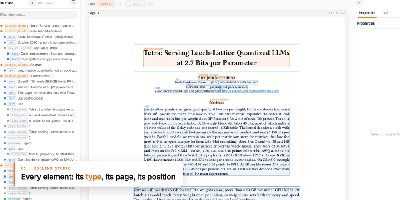
Docling Studio shows you exactly what a document parser sees, drawing a colored box around every title, paragraph, table, and picture it extracts from your PDFs. Import a PDF, run an analysis, and the result opens with three linked panels: the document tree on the left, the paged preview in the center, and the selected element on the right with its type, page, position, and text or table. Click any box on the page and the same element lights up in the tree and properties panel as other boxes fade away. The layers bar counts each element type and toggles boxes per type, or hides them all to reveal the bare page. You can analyze several documents at once from the list, watch progress percentages on long files, and queue work three analyses at a time. Ask a question and a local model answers from the document, with a reasoning timeline that links each step back to the passage it read. Finished results download as the original PDF, clean Markdown, or Docling JSON for downstream pipelines. AI agents connect over MCP to read and cite your documents, and an optional connection to your own Docling Serve server handles heavier parsing loads. Running on a dedicated VPS on RepoCloud with guaranteed CPU, RAM, and SSD, full root SSH access, and a browser serial console. MIT licensed.
MediaServer
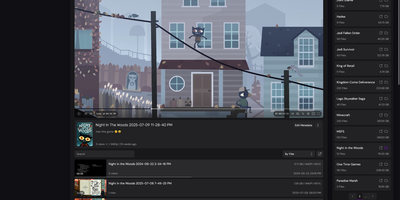
Your folders are the library with MediaServer, a self-hosted player that scans the directories you already keep and serves their video and audio through a tidy web interface. Browsing feels like a personal YouTube: folders open as shelves of content, and the custom player keeps the video going as you explore what to watch next. Keyboard shortcuts drive playback, speed controls and player statistics sit a click away, and an ambient background glows behind the video. Every view is remembered: full watch history with timestamps, re-watch counts, per-user totals, and playback heatmaps replace the single watched tick other servers stop at. Metadata belongs to you: edit titles, thumbnails, tags, seasons, and release dates for videos, folders, and albums, and the edits survive files being moved or renamed. Music gets its own treatment with embedded cover art, a lyrics viewer and editor fed by LrcLib, and auto-scrolling lines that follow the song. Subtitles extract themselves from embedded and external files, folders and single videos share as readable links, and each share renders a rich preview card for Discord or chat. Behind the scenes, a dashboard manages libraries, scanning jobs, users, and server performance. Running on a dedicated VPS on RepoCloud with guaranteed CPU, RAM, and SSD, full root SSH access, and a browser serial console. AGPL-3.0 licensed.
Chiban
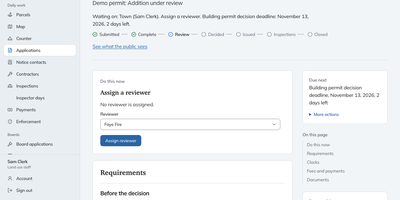
Chiban replaces a small town's paper files and permit spreadsheet with one system that files every application, hearing, inspection, and complaint under the parcel it concerns. Residents and contractors apply and pay online by card through Stripe or Clover, while staff enter paper applications at the counter, collect the fee, and issue the permit in the same visit. Inspectors book requests into open time slots, run checklists with photos from a phone, and track failed results through reinspection, with calendar invites landing in Microsoft 365. Planning Board and Zoning Board of Adjustment cases get abutter lists, notices carrying the required wording, hearings, agendas, member packets, votes, and written decisions. A state pack supplies the deadlines, holidays, and permit types for a state (New Hampshire ships today), and every deadline shows the statute it runs on, the day it started, and how it counts. Code enforcement follows a complaint, anonymous ones included, through violations, orders, court, and appeals. Records custodians log Right-to-Know requests, redact documents, and apply retention schedules and legal holds. Staff edit forms, fees, conditions, and notice wording in the app without code, and reports cover permit volume, processing time, revenue, and census figures in CSV or Excel. Imports bring in assessing exports, GIS parcel layers, old permit spreadsheets, and scanned files with OCR. Running on a dedicated VPS on RepoCloud with guaranteed CPU, RAM, and SSD, full root SSH access, and a browser serial console. AGPL-3.0 licensed.
octo-agent
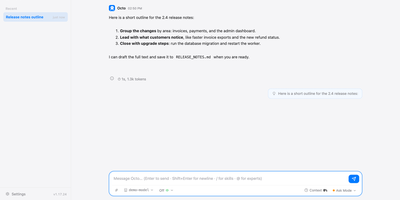
One download gives you a coding agent and personal assistant that is ready to work after a single message. The agent runs shell commands, reads and edits files, searches the web, calls MCP servers over stdio or HTTP with OAuth, and splits work across parallel sub-agents. Chat from the terminal, the web dashboard, a desktop app, VS Code, Obsidian, an Android app, or IM bridges for Telegram, Discord, Feishu, DingTalk, WeCom, and WeChat. Bring DeepSeek, Kimi, Qwen, Anthropic, OpenAI, or any compatible endpoint, with prompt caching tuned for each provider to keep token bills predictable. Skills use the Claude Code SKILL.md format, so an existing skills folder works unchanged. Cross-session memory, scheduled tasks, reusable multi-agent workflows, and Chrome automation that records, replays, and repairs browser steps cover the repetitive jobs. Light Apps are small agent-built tools that run in the browser with no further tokens. Safety is built in: catastrophic commands are hard-denied, deleted or overwritten files go to a recycle bin first, and an OS sandbox can confine the terminal. There is zero telemetry, and the web dashboard loads no outside fonts or scripts. Expose the server on a VPS behind its auto-generated access key and reach the same sessions from any device. Running on a dedicated VPS on RepoCloud with guaranteed CPU, RAM, and SSD, full root SSH access, and a browser serial console. MIT licensed.
Omnibus
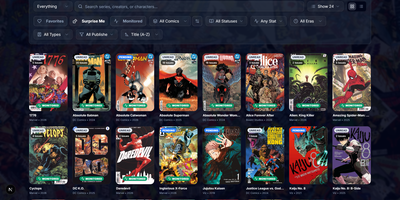
Omnibus runs your whole comic habit from one shelf: discover a series, request the missing issues, and read them in the browser when they land. Discovery starts with ComicVine or Metron metadata (high-resolution covers, synopses, and creator credits) and a release calendar that flags what you own and what is still missing across your monitored series. Requests are one click for a single issue or a whole run; Omnibus searches your indexers, hands the release to qBittorrent or SABnzbd, then imports, renames, and shelves the file with metadata embedded into the archive itself. Loose files that match nothing meet the Smart Matcher, which proposes the right series and applies every confident match in one pass. The built-in reader opens CBZ, natively read CBR and EPUB files in left-to-right, right-to-left manga, or continuous webtoon modes, with double-page spreads, brightness and contrast controls, page preloading, and preferences remembered per series; an offline button caches a full issue for the road. Reading lists assemble themselves from a pasted event ID or arrive by import from CBL files, League of Comic Geeks CSVs, AniList, or MyAnimeList, always showing how far through them you are. Everyone gets their own account, reading progress, follows, and an Updates feed, while OPDS, KOReader sync, and a Komga-compatible endpoint feed Panels, Mihon, and Paperback on the side. Running on a dedicated VPS on RepoCloud with guaranteed CPU, RAM, and SSD, full root SSH access, and a browser serial console. GPL-3.0 licensed.
FastLLM Proxy
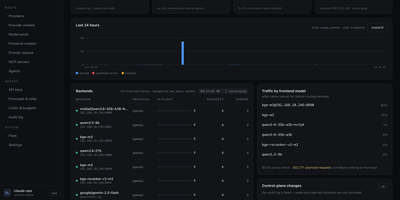
Local vLLM and llama.cpp boxes and hosted providers like OpenRouter, Anthropic, Bedrock, and Gemini all answer to one OpenAI-compatible address once FastLLM Proxy sits in front of them. Clients ask for a frontend model by name, and ordered rules pick the target by caller, prompt size, headers, budget spent, time of day, or how busy a backend is. Prompts that share a prefix return to the node holding their cache, and semantic routing sends coding questions one way and chat another using example prompts you write. API keys carry per-model grants, rate limits, and token or spend budgets, and the management console shows traffic, usage and spend, an append-only audit log, and a fleet topology. Failures fall through to the next target before a byte reaches the caller, and an admission gate turns a flooded engine into a bounded queue. An MCP gateway and an A2A agent endpoint put tool servers and agents behind the same address. Existing LiteLLM configs import unchanged. Running on a dedicated VPS on RepoCloud with guaranteed CPU, RAM, and SSD, full root SSH access, and a browser serial console. Apache-2.0 licensed.
GameAP
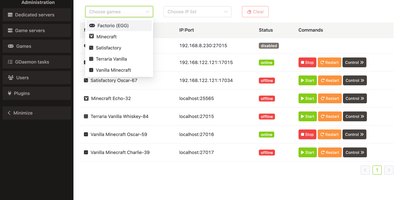
Start, stop, and restart Minecraft, Counter-Strike, Rust, FiveM, and other game servers from one browser panel instead of juggling SSH sessions. A live console streams server output and accepts RCON commands, so admins can kick players, change maps, and watch logs as they happen. The file manager edits configs, uploads and downloads files, searches inside a folder, shows checksums, and creates or extracts archives on the server itself. Scheduled tasks handle automatic restarts, updates, and backups at daily, hourly, or custom intervals. Roles and per-server permissions let a community hand out console, file, and player-management rights without sharing shell access, and single sign-on tickets let a billing system log customers straight in. Typed settings with validation and dropdown choices keep game parameters safe to edit, CPU and RAM limits cap each server, and Pterodactyl or Pelican eggs can be imported to reuse existing game definitions. One panel manages servers across many dedicated machines, plugins extend it, a documented REST API automates provisioning, and the interface speaks English, Russian, Spanish, and German. Running on a dedicated VPS on RepoCloud with guaranteed CPU, RAM, and SSD, full root SSH access, and a browser serial console. MIT licensed.