Berth
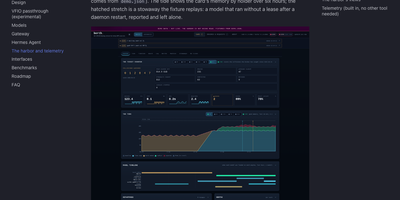
A single GPU can only hold so many models at once, and when a chat server, an image pipeline, and a voice engine all grab VRAM together, somebody runs out of memory and crashes. Berth fixes the scramble by making every engine lease the card: wrap a launch in berth run and the daemon grants memory in turn, queues the rest with an honest place in line and a start estimate, and drains a holder cleanly before the next load begins. The broker learns each engine's real footprint from its runs, so grants are sized by measured peaks instead of guesses, and processes that grab memory without a lease are reported as stowaways, never killed, with contested grants flagged in plain sight. A collisions board counts what the scheduling prevented: avoided collisions, VRAM handed off, drains, stuck releases, and refusals, and every count links back to a gap free event log you can follow live. The Harbor web UI turns that into a departures board of leases, a six hour tide of memory by holder, engine cards with decode throughput and a token ledger, plus a per model leaderboard and thirty days of stored history. Alerts reach your desktop or a webhook, Prometheus scrapes the metrics endpoint, and multi GPU machines can even pass one card through to a VM while the others keep serving. Running on a dedicated VPS on RepoCloud with guaranteed CPU, RAM, and SSD, full root SSH access, and a browser serial console. Apache-2.0 licensed.
GeoLens
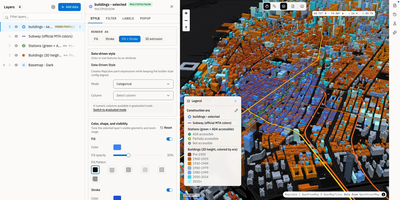
Transforming scattered spatial files into an interactive data catalog, GeoLens empowers engineering and GIS teams to organize geospatial assets, execute semantic searches, and build interactive 3D maps on self-hosted infrastructure. Users can ingest shapefiles, GeoJSON boundaries, database tables, and Cloud-Optimized GeoTIFF rasters into a centralized inventory with automatic source freshness auditing. Natural language queries evaluate dataset relevance across spatial boundaries and thematic tags, allowing analysts to uncover hydrology networks or zoning footprints without knowing exact layer names. The browser-based composition canvas lets cartographers extrude three-dimensional building footprints, overlay elevation terrain contours, color features by attribute values, and reorder layer hierarchies with drag-and-drop ease. Finished map projects publish immediately as secure shareable web links or responsive embeds for external dashboards. Desktop GIS operators can connect directly from QGIS or ArcGIS through native OGC API Features and STAC endpoints to query live vector tiles and run spatial filters. Teams can export filtered geometries into GeoPackage, FlatGeobuf, GeoParquet, or PMTiles archives to support downstream analysis workflows. Running on a dedicated VPS on RepoCloud with guaranteed CPU, RAM, and SSD, full root SSH access, and a browser serial console. Apache 2.0 licensed.
Sencho
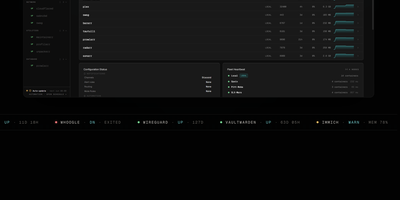
With over 430 GitHub stars and designed for DevOps engineers, platform teams, and homelab operators, Sencho is the self-hosted Docker Compose control plane that gives you a real operational cockpit without abandoning file-on-disk compose workflows. The web dashboard provides live CPU, memory, and disk sparklines per container, one-click start/stop/restart controls, and a Monaco-powered YAML editor with syntax highlighting, inline diff, and one-click rollback. Compose files remain the source of truth on the host filesystem. Multi-node management connects remote Sencho instances via authenticated HTTP and WebSocket proxy using long-lived API tokens, with no SSH access or exposed Docker sockets required. The Pilot Agent establishes an outbound-only WebSocket tunnel for nodes behind NAT, CGNAT, or strict firewalls. Blueprints define compose intent once and deploy it across label-targeted nodes, with drift detection keeping the fleet aligned. Fleet Federation provides cordon and pin controls for maintenance windows, while Fleet Actions execute bulk deploy, stop, and restart operations by stack label across the entire infrastructure. The security suite includes Trivy vulnerability scanning, deploy enforcement policies, SARIF and SBOM export, and Fleet Sync to replicate scan policies across replicas. Additional capabilities include 199+ one-click app templates, Git source integration, atomic deploys with auto-rollback, auto-heal, scheduled operations, webhooks, and custom S3 off-site backups to MinIO, R2, B2, or AWS. Running on a dedicated VPS on RepoCloud with guaranteed CPU, RAM, and SSD, full root SSH access, and a browser serial console. AGPL-3.0 licensed.
Kept
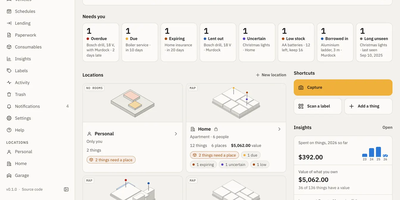
Kept is a self-hosted home inventory that answers where things are, what they are, and what is due. Locations, rooms, shelves, and boxes nest inside each other, so moving a box moves everything in it, and each location can be viewed as a list, a grid, or a 3D map with pins for low stock, loans, and due items. Every thing gets a short ID and a QR code for label sheets or roll printers, and scanning a label opens the box. Capture a thing, receipt, or whole room from the installable phone web app, offline too; an AI provider you choose, including Ollama, then suggests details for you to confirm. Receipts, manuals, and warranties attach to items, reminders arrive in the app, by email, by push, or in a calendar feed, and an insurance report exports photos, serials, and receipts. Lending tracking, vehicle readings and services, moving-house box lists, and stocktakes cover the rest of the household, with shared locations and roles for everyone you live with. An assistant answers questions like where the HDMI cable is, and an MCP endpoint lets Claude or other AI agents add and move things, with changes waiting for your approval. Nightly backups and imports from Homebox and CSV round it out. Running on a dedicated VPS on RepoCloud with guaranteed CPU, RAM, and SSD, full root SSH access, and a browser serial console. AGPL-3.0 licensed.

OpenTranscribe
OpenTranscribe is a self-hosted transcription platform that converts your audio and video library into searchable, speaker-labeled transcripts, then lets you summarize and chat with those recordings. Upload files up to 15 GB, record from the browser microphone, or paste a link from YouTube and a thousand other sites, and playlists queue up for batch processing automatically. WhisperX produces word-level timestamps in over 100 languages, while the diarization engine works out who spoke when, corrects turn boundaries, and recognizes the same voice again across different recordings. Speaker profiles accumulate a voice fingerprint, speaking-time analytics, and merged identities, so a regular guest is named correctly in every episode without relabeling. Point it at an LLM and recordings gain structured summaries with action items, suggested tags and collections, and a chat interface that answers questions about your transcripts with citations, grouped into projects that pin their source recordings and standing instructions. Leave the model unconfigured and transcription, diarization, full-text and semantic search, and redaction still run entirely on local models. Watch folders, S3 buckets, and network shares import new media on a schedule with three-layer deduplication and automatic stitching of split recordings, and everything exports as subtitles, Word or PDF documents with citeable numbered lines, or Markdown. Running on a dedicated VPS on RepoCloud with guaranteed CPU, RAM, and SSD, full root SSH access, and a browser serial console. AGPL-3.0 licensed.
AMUX
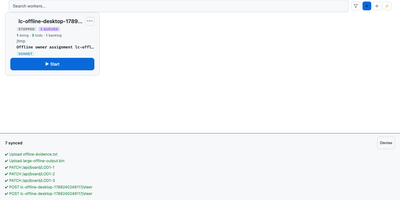
To coordinate swarms of autonomous coding agents across complex software projects, AMUX provides a concurrency-safe kanban workspace with real-time thought stream inspection and live steering controls. Engineers assign development tasks through an interactive board where autonomous worker processes claim cards using compare-and-swap mutexes to eliminate race conditions between parallel sessions. Operators monitor active reasoning streams, inspect streaming terminal outputs, and inject guidance commands mid-turn without interrupting background execution. A cryptographic origin router relays messages between agents, enabling workers to delegate sub-tasks, request automated peer code reviews, and share environment state safely. Built-in schedulers trigger recurring automated maintenance routines, dependency updates, and bug triage sweeps on cron-like timers or autonomous loop cadences. Teams can switch language models dynamically on active sessions to tackle complex architecture challenges with high-capability reasoning engines while conserving resources on routine tasks. An integrated self-healing supervisor watches over agent runtimes, automatically compacting context windows, restarting crashed terminal sessions, and resuming pending instructions seamlessly. Running on a dedicated VPS on RepoCloud with guaranteed CPU, RAM, and SSD, full root SSH access, and a browser serial console. MIT licensed.
pvecenter
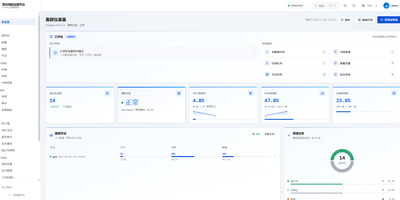
Handing a teammate the keys to a Proxmox cluster usually means handing over far too much, so pvecenter puts a narrower, self-service web panel in front of it. The dashboard shows node health, CPU, memory, storage, and recent tasks, and several Proxmox hosts can be managed from one place. Virtual machines are created through a guided wizard or in batches, then powered, cloned, migrated, resized, snapshotted, and reached through an in-browser console. LXC containers get their own pages, and a template pipeline builds cloud-init templates from cloud images. Bridges, VLANs, address pools, and the native Proxmox firewall are managed with rule templates pushed to many guests at once. Backups can run now or on a schedule, with restore, delete protection, and integrity checks. Administrators define reusable resource sizes, per-user quotas, roles, two-factor sign-in, and an audit log of every write. A security baseline scores hosts and offers guided hardening, SSH brute-force protection bans repeat offenders, and an AI inspection assistant explains findings and asks approval for every change. Alerts reach email, Feishu, and webhooks, and certificates renew automatically. The interface is Chinese-first, with a language switch and an English guide. Running on a dedicated VPS on RepoCloud with guaranteed CPU, RAM, and SSD, full root SSH access, and a browser serial console. Apache-2.0 licensed.
CPA Manager Plus
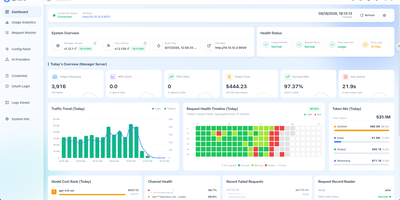
CPA Manager Plus is a self-hosted observability dashboard and management panel that tracks every AI request flowing through your CLI Proxy API gateway, breaking down failures, costs, and account health across providers like OpenAI, Anthropic, xAI, and Codex in one interface. When a request fails, drill into the persistent history to see status codes, affected models, latency, and redacted failure evidence without exposing raw response bodies. The cost analytics engine breaks down token consumption and estimated spend by model, provider, account, API key, project, channel, and time range while tracking input, output, reasoning, cache, and service-tier pricing semantics separately. Model prices sync automatically from models.dev with LiteLLM and OpenRouter fallbacks, and you can add local overrides for aliases or internal models. For teams running Codex or xAI accounts, the health inspector reads quota windows, reset evidence, credential state, and workspace status on a configurable schedule, routing credential failures into an action queue for review rather than letting them silently degrade throughput. Deploy the Lightweight Panel to replace your existing CPA management UI without adding another service, or run Full Mode as a single Docker container that adds the Manager Server with persistent SQLite storage for request history, historical analytics, and automated account inspections. Export or import request history as JSONL for external analysis, and back up the SQLite files alongside your encrypted management keys. Running on a dedicated VPS on RepoCloud with guaranteed CPU, RAM, and SSD, full root SSH access, and a browser serial console. MIT licensed.
LLMIO
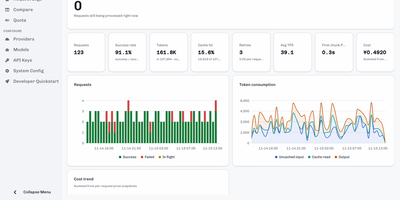
Every provider has its own API, quota, and price list, and LLMIO puts them all behind one door. Clients speak OpenAI Chat Completions, OpenAI Responses, Anthropic Messages, or Gemini, and a protocol bridge translates between OpenAI and Anthropic formats, including streaming events, when the upstream differs. Each model name maps to several providers with weights, a lottery or rotor load strategy, retry limits, and timeouts, and routing can follow tool calling, structured output, and image support. A per-model circuit breaker and rate-limit fallback keep one failing upstream from taking the rest down. The dashboard shows live requests, success rate, tokens, cache hits, retries, tokens per second, and cost, and analytics add trend, breakdown, latency, error, and model performance views with provider, key, and status filters. The request log records trace and session IDs with full request and response inspection, and a compare page lines up to six requests to show how a prompt cache builds. Access keys carry expiry dates, model allow-lists, and optional body logging. Quota sources, time-of-day pricing, and scheduled log cleanup round out the console. Running on a dedicated VPS on RepoCloud with guaranteed CPU, RAM, and SSD, full root SSH access, and a browser serial console. MIT licensed.
Levelrail
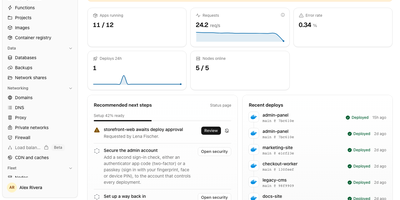
Push to git, watch the deploy go live over HTTPS, and roll back in one click, all on servers you own: Levelrail is a self-hosted platform for running apps and databases without Kubernetes. Deploys start from GitHub, GitLab, Bitbucket, or Gitea webhooks and build from a Dockerfile, Compose file, image, or framework preset such as Next.js, Go, React, or Spring Boot, with preview environments per pull request, canary and blue-green rollouts, approvals, and freezes. Embedded Caddy gives every app a domain with HTTPS: self-signed by default, Let's Encrypt with one toggle, a free sslip.io address when no domain exists, or your own uploaded certificate. Provision Postgres, MySQL, MariaDB, MongoDB, Redis, ClickHouse, and more with scheduled backups that are re-downloaded and verified, Postgres point-in-time recovery, and password rotation. Metrics with deploy markers, searchable live logs, alerts, and a public status page need no separate monitoring stack. Roughly 360 one-click templates and a Cmd+K search across apps, databases, and nodes speed up daily work. Extra servers enroll with a one-time token and a reverse-dialed agent that needs no inbound ports. Sign in with passkeys, TOTP, OAuth from 20 providers, or OIDC, then scope access with IAM policies, encrypted secrets, and a tamper-evident audit log. A CLI, HTTP API, and MCP server let scripts and coding agents deploy and roll back. Running on a dedicated VPS on RepoCloud with guaranteed CPU, RAM, and SSD, full root SSH access, and a browser serial console. Apache-2.0 licensed.
ghstats
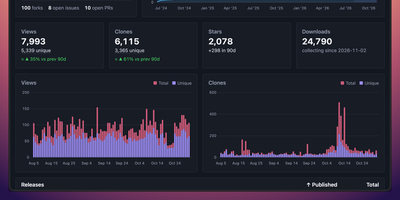
GitHub forgets your traffic after fourteen days; ghstats remembers it for years. This self-hosted dashboard polls the GitHub API every hour and keeps views, clones, stars, forks, issues, and pull requests for every repository in its own database, long after the built-in traffic tab has rolled over. Open a repository to see its charts for stars, clones, and views next to top referrers and popular paths, filter the list by owner, name, forks, or archived status, and include private repositories when your token allows it. Public stats pages and portfolios reuse the same numbers through a JSON API, embeddable SVG badges for views, clones, and star velocity, and cards ranking your top repositories or showing star history across projects. Release download counts accumulate as daily snapshots too, so a launch spike stays visible months later. The whole service is one small Docker image on port 8080 with a single file for storage, easy to back up and easy to move. Running on a dedicated VPS on RepoCloud with guaranteed CPU, RAM, and SSD, full root SSH access, and a browser serial console. MIT licensed.
Borg UI
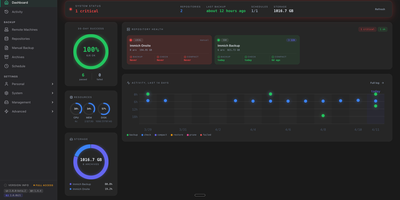
Borg UI is a self-hosted web management interface for BorgBackup that eliminates complex command-line syntax by organizing deduplicated backups, automated pruning schedules, and interactive file restorations into an intuitive graphical control center. System administrators connect local drives, remote SSH hosts, and SFTP endpoints to establish resilient storage repositories guarded by client-side encryption and cryptographic authentication. The centralized dashboard visualizes storage capacity, compression ratios, deduplication savings, and the health status of active backup jobs in real time. Configurable backup plans schedule automated cron jobs with granular retention rules, executing pre-backup database dumps and filesystem snapshots before running incremental syncs and background integrity checks. Users browse multi-version archive filesystems directly from the web browser, searching file trees and extracting individual files or entire folders without manual command line extraction. The platform orchestrates remote fleet backups by deploying SSH keys across client machines, tracking connection health, and executing non-disruptive background operations. Comprehensive alert routing dispatches real-time job status notifications, failure warnings, and storage alerts across Discord, Telegram, Slack, and email using integrated multi-channel messaging services. Running on a dedicated VPS on RepoCloud with guaranteed CPU, RAM, and SSD, full root SSH access, and a browser serial console. GNU AGPLv3 licensed.
Open Intelligent UI
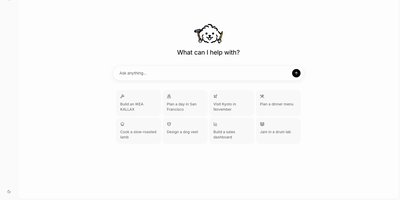
Ask for a day in San Francisco and get a routed map, photographs, and an editable itinerary instead of a wall of text. Open Intelligent UI recreates the interactive answers introduced in ChatGPT, with the model streaming a layout that the app renders live from a library of 55 components. A request for a phone comparison returns product cards and a side-by-side table, a money question returns sliders that recalculate loans and savings as they move, and a language question returns flip cards followed by a scored quiz. Dashboards offer date-range switches, KPI cards, area charts, ranked source bars, and sortable page tables, and maps add category filters, pins, expandable stops, and street routes. Fifty-nine built-in functions let each answer compute with its own state, so splits, schedules, and unit conversions update without another model call. Chat history keeps earlier answers, light and dark themes are one click away, and suggestion tiles start common requests. A development gallery shows worked examples, including a bike assembly guide, a retirement calculator, and a small arcade game, all without calling a model. Models connect through OpenUI Cloud, any OpenAI-compatible endpoint, or local Ollama, so keys and data stay in your control. Product teams, designers, and developers get a working reference for generative interfaces. Running on a dedicated VPS on RepoCloud with guaranteed CPU, RAM, and SSD, full root SSH access, and a browser serial console. MIT licensed.
xEdit
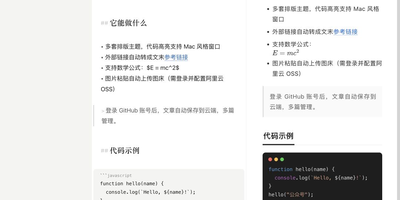
xEdit is a free, open-source Markdown editor that keeps your notes as plain text, on your device or on your own server, and hands AI clients a proper door instead of a scrape. Write in live preview, where headings, code and images render in place and only the line under your cursor shows its source, or flip to a split view when you want both sides visible. Slash commands insert headings, callouts, tables, to-dos, code blocks and media, and wiki links tie notes together by title, with renames updating every link that points at the note. Any checkbox in any note with a date rolls up into a Today view, and nested folders, global search and a recoverable trash keep a growing library tidy. Choose where notes live: browser storage, a local folder of Markdown files, or cloud sync with an offline mirror on every device. Cloud notes gain version history with line-by-line diffs and one-click rollback, share links that collect comments on selected passages, and exports to Markdown, HTML, PDF, PNG and Word. Pick one of thirteen layout themes and copy straight into WeChat or Zhihu with styles inlined and math intact, then connect Claude or Cursor through the built-in MCP server to search, organize and edit the whole library. Running on a dedicated VPS on RepoCloud with guaranteed CPU, RAM, and SSD, full root SSH access, and a browser serial console. MIT licensed.

Octo
Octo turns Navidrome into a streaming service with a memory: search finds songs you do not own yet, they play the moment you pick them, and the ones you heart come home as properly tagged files that stay in your library forever. Point the music apps you already use at Octo's endpoint and sign in with your Navidrome login, and your library behaves as before, except search now reaches past your shelves and any result streams instantly as a preview with zero disk impact. Press plus or heart a keeper and Octo downloads the best copy it can find, FLAC first, from Soulseek peers or your own Lidarr, catches lossless files that were faked from MP3s, then identifies, tags, covers, and files the song so it appears in your library like something you bought. Bring the music you already love by importing liked songs and playlists from Spotify or any other service; Octo shows what you already own and quietly fetches the rest a few songs an hour. Stations and discovery playlists learn from your listening through Last.fm and refresh themselves, the downloads drawer shows every fetch with its full decision log, and the browser admin dashboard runs settings, notifications, family accounts, and one-click updates. Running on a dedicated VPS on RepoCloud with guaranteed CPU, RAM, and SSD, full root SSH access, and a browser serial console. GPL-3.0 licensed.
Pug
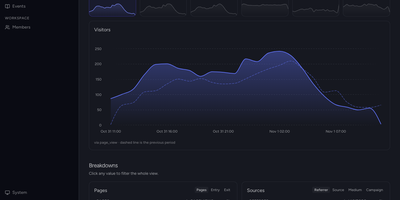
Pageviews tell you someone arrived; Pug is an open-source product analytics platform that shows what people actually did next, across events, funnels, retention, and user flows. Capture events from browser, Android, Flutter, Node, Go, or Ruby SDKs into an ingestion pipeline that enriches each hit with geography, user agent, bot detection, and web attribution automatically. Identify and alias the users behind events, then open a profile to see traits, sessions, and the full activity history of a person. Build insights as trends, funnels, retention cohorts, segmentation, Sankey user flows, and top-K breakdowns, with filters and period-over-period comparison on every chart. A web analytics overview is generated from your events with visitors, sessions, pageviews, bounce rate, and traffic sources, requiring no tile wiring. The live view plots every current visitor on a real-time world map, down to the person and the event they just fired. Compose dashboards from insight and markdown tiles on a time-windowed grid that analysts rearrange without touching ingestion. Erase a person's events and profile on request to satisfy GDPR and DPDP data-subject obligations. Running on a dedicated VPS on RepoCloud with guaranteed CPU, RAM, and SSD, full root SSH access, and a browser serial console. AGPL-3.0 licensed.
CaseCite
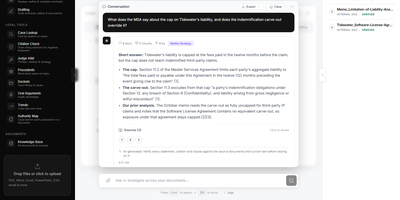
CaseCite puts a law firm's own files under questioning, returning cited answers, contract reviews, and drafted agreements without surrendering a single document to an outside legal platform. Ask a question across the indexed corpus and receive answers tied to the exact source passage, then narrow the search to selected files or a folder when only those should count. For bigger questions, deep research lays out a plan of sub-questions you can edit first, verifies every quote against its source, and keeps a step log of what was searched. Contracts can be analyzed, questioned one at a time, or compared clause by clause across two to four agreements against a baseline, with redlines exported as native Word tracked changes. Tabular review extracts the fields you define from hundreds of contracts at once, shows the supporting passage and estimated cost beside each value, and exports to Excel or CSV. Drafting starts from up to four precedent documents, and long agreements get a section plan for your approval before each section is written and reconciled. Each client engagement lives in its own matter workspace with controlled access and an activity feed, while case lookup, citation checking, judge analytics, dockets, oral arguments, and authority maps cover the caselaw side. Running on a dedicated VPS on RepoCloud with guaranteed CPU, RAM, and SSD, full root SSH access, and a browser serial console. Apache 2.0 licensed.
SourceWeft
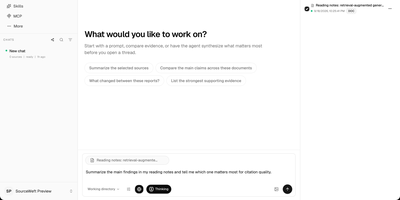
SourceWeft is an AI workstation you host yourself, where agents, your documents, and your model keys work in one place instead of scattering across chat tabs you do not control. Describe a job and a lead agent breaks it down, handing research, exploration, and execution to focused sub-agents that share the same working context and files. Agents draw on a skill library covering presentations, HTML pages, images, meeting summaries, and study guides, and you can add your own skills so good workflows become repeatable. MCP servers, web search, and web extraction connect agents to outside tools, while approved commands run inside a sandboxed environment that cannot touch the rest of your server. Feed it PDFs, web pages, notes, YouTube videos, Notion, Drive, Gmail, or Slack, then follow citations from any answer back to the source material it came from. Bring your own keys for the chat and indexing models you prefer, organize the team into workspaces with roles and access controls, and pick up any conversation from the web app or desktop clients. Running on a dedicated VPS on RepoCloud with guaranteed CPU, RAM, and SSD, full root SSH access, and a browser serial console. Apache-2.0 licensed.