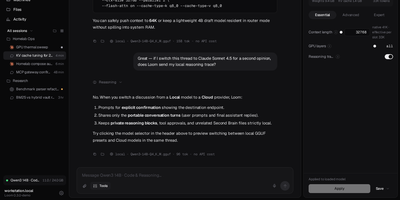
Loom Control Station
From one browser tab, Loom runs local and cloud models in a single conversation, steers coding agents such as Claude Code and Codex, and manages notes and machines. Local inference covers llama.cpp, or vLLM on Linux with CUDA or ROCm, with a Hugging Face GGUF library, saved presets and a VRAM estimate before loading. Cloud providers speaking the Chat Completions format join the same thread, and Loom asks for confirmation before any portable turn leaves the machine. Codeman integration lists live agent sessions, surfaces approvals with Allow once and Deny buttons, arranges terminals in a tmux-style grid and runs cron schedules. Second Brain is a confined Markdown workspace with a rich editor, slash commands and conflict detection, and its file browser reaches paired machines. Machines appear as capability bricks for local AI, voice, Codeman, files and terminals, pair with a single-use code or plain SSH, and report CPU, memory and GPU use. Quota pages track Claude, Codex, Antigravity and Copilot subscriptions with pace projection, alongside token usage, OpenRouter balance and a Model Watch feed. An OpenAI-compatible /v1 API swaps models safely and issues named keys with usage limits, and the /mcp/loom gateway lets external agents use machine and Codeman tools under revocable tokens. Local voice, an installable phone app for approvals and push notifications, and English or French interfaces are optional extras. Running on a dedicated VPS on RepoCloud with guaranteed CPU, RAM, and SSD, full root SSH access, and a browser serial console. MIT licensed.
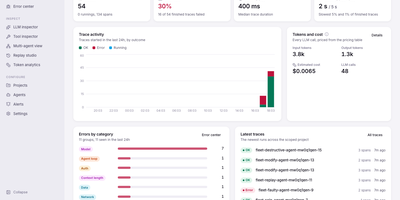
Euron Open AgentDebugger
When an AI agent gives the wrong answer on step three, Euron Open AgentDebugger shows which prompt went out, which tool the model chose and where the run broke. Decorated Python or Node functions become traces of agent, LLM and tool spans, and any OpenTelemetry exporter can post to the OTLP/JSON endpoint with no SDK. A zoomable timeline and an execution graph with highlighted delegation edges show every span, filterable by agent, kind, model, tool and status. A supervisor calling a child agent over HTTP still produces one correctly parented trace, and the multi-agent view lists each agent's share of time and tokens. The LLM inspector shows provider, model, tokens, latency, finish reason and cost, and the tool inspector shows arguments, results, errors and retries. The error center sorts failures into ten categories and groups repeats by fingerprint, while a loop detector flags a stuck agent without stopping it. Replay studio reconstructs a past run with zero new calls, re-runs it with recorded tool results, or changes one input and runs live side by side, and side-effect steps are refused unless allowed. Prompt and response text stays off unless a project turns on content capture. Alerts on error rate, latency or cost reach signed webhooks, and token analytics break spend down by model and agent. Running on a dedicated VPS on RepoCloud with guaranteed CPU, RAM, and SSD, full root SSH access, and a browser serial console. MIT licensed.
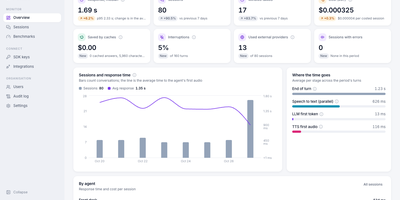
Euron Open VoiceOS
Every second of a voice conversation gets a timestamp and a price tag in Euron Open VoiceOS, a platform for building real-time voice agents that listen, think, and speak. Start from a template, such as receptionist, tutor, or meeting assistant, and talk to it in the browser. Each turn is split into end of turn, speech to text, the model's first token, and first audio, and each session adds usage and an estimated cost, so you see where time and money went. Local Whisper hears and local Kokoro speaks, so a new agent needs no cloud account, and any stage can switch to Deepgram, Sarvam, ElevenLabs, Cartesia, Anthropic, or any OpenAI-compatible endpoint. Callers can interrupt at any moment, and a failing provider earns a spoken apology instead of silence. No audio is ever stored, transcripts are redacted for emails, phone numbers, and cards, and callers are told up front when a provider runs outside your servers. A phrase cache, a response cache, and small-model routing for short turns trim the bill. Developers mint SDK keys scoped to agents and website origins, trade them for one-minute session tickets, and connect from any browser over WebRTC or WebSocket. Hindi templates come ready to use, and a bundled benchmark scores word error rate for English, Hindi, and Marathi. Running on a dedicated VPS on RepoCloud with guaranteed CPU, RAM, and SSD, full root SSH access, and a browser serial console. MIT licensed.
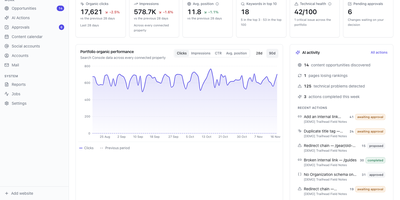
SEO OS
Instead of juggling a crawler, a rank tracker and a folder of spreadsheets, SEO OS audits your websites, proposes fixes, applies the ones you approve and measures whether they worked. Its crawler honors robots.txt, follows redirects and canonicals, avoids crawl traps and can render JavaScript. Sixty-one technical rules grade crawlability, indexability, metadata, content, links, structured data and security, each finding with evidence and a recommendation. Scores come with their factors, weights and a sentence explaining each one. Keyword reports flag striking-distance queries, CTR gaps, content decay and cannibalization, ranked by an explainable opportunity score. A content engine declines to create pages an existing one could cover, and a 14-stage pipeline takes approved ideas from research to publication. Internal-link suggestions come from PageRank over the site's link graph, with orphan detection and anchor-text auditing. GEO readiness scores pages across eleven machine-readability dimensions, while AI-visibility tracking checks whether assistants mention or cite the brand. Social listening watches Reddit, Hacker News and Bluesky for people describing the problem a site solves and drafts disclosed replies for approval. An approval queue groups changes by risk and shows each exact diff with the agent's reasoning, and adapters for WordPress, Git, Shopify, Webflow and webhooks apply only what you approve. Applied changes open experiments that report likely positive, inconclusive or likely negative, steering the next recommendations. Running on a dedicated VPS on RepoCloud with guaranteed CPU, RAM, and SSD, full root SSH access, and a browser serial console. MIT licensed.
Euron Open AI Chat
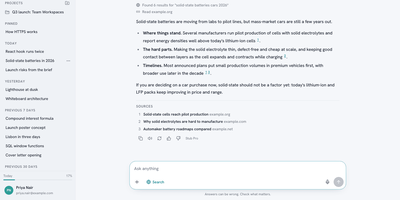
Your own ChatGPT-style assistant for a team or community runs on servers you control when Euron Open AI Chat answers from the models you enable. Admins add OpenAI, Anthropic, Gemini or any OpenAI-compatible endpoint, from OpenRouter and Groq to a local Ollama, and the picker lists only models whose provider has a key. Answers stream in and keep going when a tab closes or a phone drops its connection, and regenerated or edited messages stay as versions one click apart. Questions that need fresh facts trigger web search through SearXNG, Tavily, Exa or Brave, page reading, and answers with numbered citations. Attached images, PDFs, Word and Excel files, CSVs and code are read, and vision models describe photos. Image generation and editing work in the chat or in a studio with a gallery. Projects bundle shared instructions and knowledge files for a group of chats, and the assistant searches them and says where it looked. A memory page lists what the assistant remembers and who saved it, with a way to forget each fact. Voice means dictation and read-aloud. Shared conversations are frozen public links that an owner or admin can revoke. The /admin control plane manages users, roles, daily token and image allowances by tier, providers and models, sign-up rules, feature switches and an audit log, and never shows anyone's chats. Running on a dedicated VPS on RepoCloud with guaranteed CPU, RAM, and SSD, full root SSH access, and a browser serial console. MIT licensed.
NodePilot
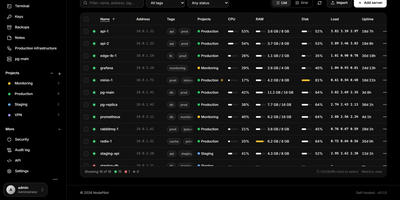
Admins who juggle dozens or hundreds of servers over SSH can run them all from one self-hosted browser panel, and let AI agents drive the same controls over MCP. Servers are grouped into projects, a server can belong to several, and a keychain holds the keys. The panel includes a web terminal, an SFTP file manager, process and systemd service controls, reboot and shutdown, and Markdown notes for runbooks. Agentless stats chart CPU, RAM, disks, network, and load history for every server, polled in parallel with backoff for unreachable hosts. One command can run on many servers at once, and infrastructure graphs map API, database, and VPN nodes with cascade links and notes on the canvas. Backups of files and PostgreSQL or MySQL databases run on schedules to the panel or to S3, encrypted to an age public key. AI agents reach 66 tools over MCP, through remote HTTP or a local stdio command, including persistent terminal sessions and graph editing, and an API token decides which tools each agent sees. Tokens can be full, read-only, or limited per area with an optional expiry, and every agent call is written to the audit log. Two-factor sign-in, a master key that can be sealed in a TPM, and pinned SSH host keys protect the credentials the panel stores. Running on a dedicated VPS on RepoCloud with guaranteed CPU, RAM, and SSD, full root SSH access, and a browser serial console. Apache-2.0 licensed.
Eidoloom Studio
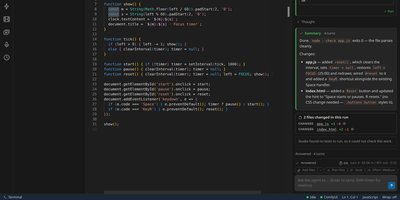
A model is only half an agent; Eidoloom Studio is the other half, with the planning loop, tools, approvals, undo, and checks, wrapped in a code editor that runs in your browser. The editor looks like VS Code, with a file tree, editor tabs, terminals, and the agent's chat beside it. Every edit arrives as a card with a diff to accept whole, in parts, or not at all. Commands wait behind Run and Skip. Trust it more and switch on auto-apply or auto-run; each edit stays an undo point. Plug in Ollama, llama.cpp, vLLM, LM Studio, or Strata, and nothing leaves your machine unless you add a cloud service. Switch on the sandbox and a folder's commands and terminals run in their own container, with the internet on, off, or only for installing packages. Admins invite people who each get a private sandboxed space, share folders with per-person rights, and wait their turn on one model. Plans become checklists, questions offer choices, goals keep it working, and a check after every edit confirms the file still parses. Optional tools add web search, a browser the agent drives, and Office documents, plus pictures, video, voices, and music on machines with a graphics card. The agent runs on the server, so closing the browser does not stop a run. Running on a dedicated VPS on RepoCloud with guaranteed CPU, RAM, and SSD, full root SSH access, and a browser serial console. AGPL-3.0 licensed.
Mabeyn
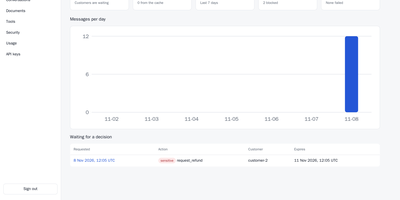
Customer-support bots tend to fail in two ways, inventing answers and taking actions nobody approved, and Mabeyn is a support agent built to stop both. Upload PDF, Markdown, or HTML files, or add a public web page, and policy answers come only from that material, citing the exact section and admitting when nothing fits. Register HTTP endpoints from your backend as tools, label each read, write, or sensitive, and attach policies that check the real order; the customer's identity comes from the verified session, never the model. Sensitive actions such as refunds wait in an approval queue that shows the exact arguments and the thread; once an admin approves, the answer reaches the shopper's chat without a reload. Returning shoppers are remembered: facts they state are kept for 180 days, instructions and personal data are never stored, and customers and admins can read or erase every note. A four-layer firewall screens messages, uploaded documents, tool calls, and replies, masks card numbers and e-mail addresses on the way out, and logs each block as a filterable security event. Businesses stay isolated in separate workspaces, each with secret and publishable API keys, per-customer rate limits, and daily token and cost reports. One script tag adds a streaming chat bubble to any page, and a shopper who asks for a person flags the conversation as escalated. Running on a dedicated VPS on RepoCloud with guaranteed CPU, RAM, and SSD, full root SSH access, and a browser serial console. MIT licensed.
ai-triage
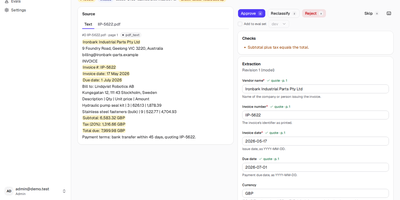
ai-triage reads every email and attachment in a shared inbox, pulls out the fields you care about with a quote behind each value, and sends anything uncertain to a person. Documents arrive through read-only Gmail sync, Postmark forwarding, an upload page, or a REST API that accepts PDFs, Word files, images, and .eml messages. A model classifies each document and extracts fields against a JSON Schema, then plain code checks the quotes exist, required fields are present, invoice totals add up, and the sender is authenticated. Auto-approval is earned per document type, switched on only after you measure accuracy on labeled data and freeze a threshold. Reviewers see the source with quotes highlighted beside an editable form with failed checks marked, and keyboard shortcuts approve, reclassify, or reject. Approved results reach your system as signed webhooks with an idempotency key, delivered at least once and retried with backoff. Evals run the production pipeline over labeled dev, calibration, and test splits, with threshold sweeps, reliability tables, and run-to-run diffs. Your own document types are defined in the UI, from starters like purchase order, receipt, credit note, and insurance claim. Any of Claude, OpenAI, DeepSeek, OpenRouter, or a local model can do the reading, and optional OCR covers scans and photos. Workspaces separate teams, with Google sign-in, invitations, and TOTP two-factor for admins. Running on a dedicated VPS on RepoCloud with guaranteed CPU, RAM, and SSD, full root SSH access, and a browser serial console. MIT licensed.
Euron Open ContextForge
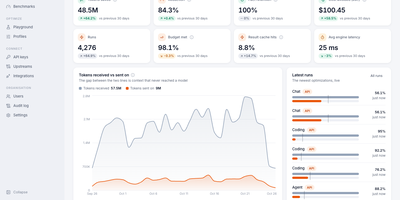
Euron Open ContextForge shrinks the history, retrieved passages, and tool output an LLM app is about to send, so each call costs fewer tokens and still carries every fact the task needs. Counts use the target model's own tokenizer, exact for OpenAI families. System instructions, recent turns, pinned messages, and tool call pairs are never rewritten, and any string you name stays intact. Duplicates go first (repeated turns, repeated test logs), then bulk tool output, with JSON kept valid and file reads kept whole. No GPU, no paid model, no network: the same input always gives the same output. What remains is ranked by relevance, recency, and importance, and older history folds into a verbatim summary of goals, constraints, decisions, facts, errors, and open questions. Six workload profiles (coding, agent, research, RAG, support, chat) split the budget differently, and a missed budget escalates balanced mode to aggressive. A citation map records whether each document id was kept, compressed, merged, or dropped, so references still resolve. Use it as a library, a REST API with optimize, count, summarize, rank, and job endpoints, or a streaming proxy that any OpenAI SDK can point at. A dashboard adds a playground with before and after panes, a per-stage trace, run history, and a benchmark against plain truncation. Budgets it cannot meet are reported, never silently cut. Running on a dedicated VPS on RepoCloud with guaranteed CPU, RAM, and SSD, full root SSH access, and a browser serial console. MIT licensed.
APEX Content Engine
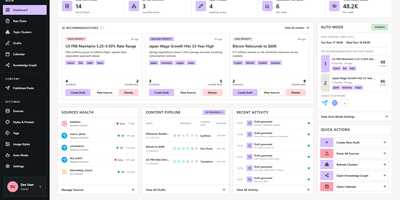
Telegram channels, RSS feeds, YouTube videos, and web articles go in, and researched, fact-checked posts for Telegram, LinkedIn, X, and email come out of APEX Content Engine. Collected posts are summarized, tagged, and embedded, then grouped by similarity into topic clusters that rank by priority, freshness, and source diversity. A cluster or a hand-chosen set of posts, a style preset, languages, and formats go into a pipeline that researches, writes, styles, translates, fact-checks, and optionally illustrates the draft, while a gate can block publishing as long as fact-check issues stay open. Drafts go out immediately or on a schedule, with X posts as a single tweet or a thread, and a month, week, or list calendar lays out everything planned. Auto Mode can run unattended inside chosen days, times, topics, and daily limits, either publishing once a fact-check comes back clean or stopping at a ready draft. A knowledge graph links raw and published posts by topic, continuation, contradiction, and supplement, and drafts export as PDF or PPTX. Provider keys for AI, Telegram, X, LinkedIn, and email can be pasted into the app and are encrypted at rest. Admin, editor, and viewer roles control access, Telegram alerts announce a ready draft, and a daily AI budget per organization stops spending once it is reached. Running on a dedicated VPS on RepoCloud with guaranteed CPU, RAM, and SSD, full root SSH access, and a browser serial console. MIT licensed.
SerOps
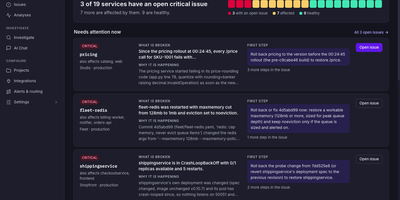
Root cause first, dashboards second: SerOps reads the logs, metrics, traces, deploys, and commits you already produce and explains why an incident happened, even when no alert fired. It plugs into Elasticsearch, Loki, Splunk, Datadog, and the big three clouds for logs, plus Prometheus, VictoriaMetrics, Jaeger, and Tempo. GitHub, GitLab, Bitbucket, Azure DevOps, Jenkins, Argo CD, and Flux supply the other half of the story: which change shipped, and when. Analyses come back as a plain-language root cause, the reasoning behind it, and numbered next steps, with the suspect commit linked beside it. Evidence, not guesses. The Overview page opens on what is broken, why, and the first thing to try, so whoever is on call starts at the fix. Issues are deduplicated and land in a table you can filter by severity, status, project, environment, or service, then resolve, mute, or acknowledge. Need an answer now? Run an investigation over a window you pick, then keep asking in AI Chat, which sees the same evidence. Choose Claude, Gemini, OpenAI, DeepSeek, or local Ollama, cap monthly spend, and re-run any analysis on a second model to compare answers. Regex masking strips secrets and personal data from what goes to the model, and quiet windows skip the AI call. Alerts reach Slack, Teams, PagerDuty, OpsGenie, or email, with routing rules, quiet hours, and digests. Running on a dedicated VPS on RepoCloud with guaranteed CPU, RAM, and SSD, full root SSH access, and a browser serial console. AGPL-3.0 licensed.
RAGOps Observatory
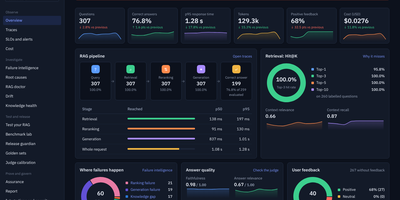
Between a RAG demo that looks fine and an assistant that fails quietly in production sits RAGOps Observatory, a platform that names the broken pipeline stage and blocks worse releases. Failed answers are assigned to one of seven stages, from knowledge gap and chunking to ranking and generation. An evidence graph links documents, retrieved passages, and answer claims, marking claims supported, contradicted, or sourceless. Failure intelligence groups recurring problems as new, growing, steady, or shrinking, so one fix can retire a whole pattern. The release guardian compares a candidate with the current version on the same questions and answers Pass, Review, or Block against your gates, logging every decision. A metric regression blocks only when statistically significant. The benchmark lab sets two to five runs side by side across models, retrievers, rerankers, or chunk sizes. The assurance report writes tests from your documents, including prompt-injection probes, then issues a sealed Ready or Not ready verdict with supporting evidence mapped to the EU AI Act. When answers go wrong, the RAG doctor re-runs your pipeline with candidate fixes and recommends only the one that verifiably helps. SLOs with error budgets, drift checks, cost tracking, and Slack, Teams, PagerDuty, or e-mail alerts cover monitoring. Use it to explain a quality drop, prove a new chunk size is safe, or give a reviewer evidence. Running on a dedicated VPS on RepoCloud with guaranteed CPU, RAM, and SSD, full root SSH access, and a browser serial console. MIT licensed.
Tiqora
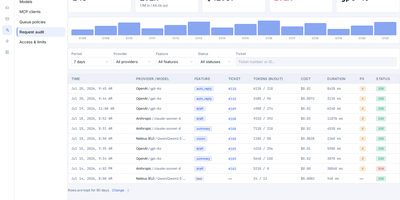
Swap the aging front end of an OTRS or Znuny helpdesk for a modern one that reads the same database and adds AI replies that show exactly which tools they called. Per-queue policies set how much freedom the assistant has, from drafts only to replying to customers without review, and a kill switch pauses all automatic replies at once. Draft replies, ticket summaries, queue triage, and a refine step with a word-level diff to review handle the daily agent workload. Personal data is masked before any model call, and an audit log records tokens, cost, and status per request against provider budgets. Any OpenAI-compatible endpoint works, and tasks like research, triage, summary, and vision route to their own model profiles with fallbacks. An MCP server and external MCP tool sources let agents search tickets, read the knowledge base, and look up customers under the same permissions as staff. A handoff to a human really stops the auto-reply. Mail, Telegram chat, phone calls with an incoming-call pop-up, and a web chat widget all become tickets. Incident, problem, change, and CMDB records, approvals by e-mail link, SLA escalation, and wallboards round out the service desk. PGP and S/MIME encryption, SAML and OIDC sign-in with SCIM provisioning, and GDPR anonymization jobs cover compliance. A customer portal with a knowledge base handles self-service. Running on a dedicated VPS on RepoCloud with guaranteed CPU, RAM, and SSD, full root SSH access, and a browser serial console. AGPL-3.0 licensed.
Euron Open SQLAgent
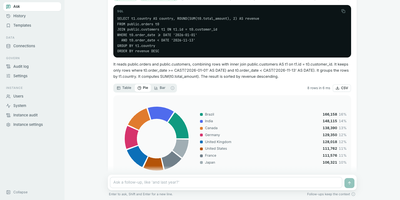
Every plain-English question put to Euron Open SQLAgent becomes one SELECT that is parsed, shown, and run on a read-only connection, answered with an explanation, a table, and a chart. Connect PostgreSQL or MySQL by host or upload a SQLite file, and tables, columns, keys, indexes, and row counts are discovered and refreshed daily. A parser for each database's dialect accepts only a single SELECT, the session itself is opened read-only, and per-connection scan, timeout, and row limits stop runaway queries. Follow-up questions keep the conversation's context, and results page in the browser, export as CSV, and show a bar, line, or pie chart when the shape fits. Paste any query into Explain SQL to read what it does without running it, and save good questions as templates that run again with one click. Each project picks its model provider (Anthropic, OpenAI, Gemini, Ollama, or any OpenAI-compatible endpoint) and a conversation can choose another. History lists every conversation and query, and an append-only audit trail records who asked what and which SQL ran or was refused. Admin, editor, and viewer roles per project and API keys with read, query, and manage scopes control who can ask, run SQL, or change connections. A Python SDK and CLI ask questions from scripts, and the CLI exits non-zero when a query fails. Running on a dedicated VPS on RepoCloud with guaranteed CPU, RAM, and SSD, full root SSH access, and a browser serial console. MIT licensed.
Duniya
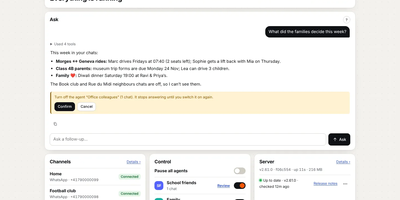
Duniya links to a spare WhatsApp number, plus a Telegram bot if you like, and runs AI helpers only in the family, school, and club chats you choose. Every other chat stays silent and is never stored. Start an agent from a template, such as car pooling, school friends, or neighbours, or describe it in a sentence and review every change as a visual diff. Corrections you make while reviewing answers become lessons the agent follows once you approve them. The owner gets an assistant too, with a morning brief, a catch-up on missed messages, and an Ask box that answers questions about people, events, and orders. A People page keeps families, kids, notes, and consent, Events track registrations, duties, and who has paid, and surveys follow up only with people who have not answered. Choose any model, from OpenRouter's free ones to a ChatGPT or Claude plan, OpenAI, Copilot, or Ollama, with a backup model and spending caps. It runs on a 1 GB server, installs with one command, and backs up encrypted to GitHub or S3. Updates arrive overnight by themselves, and a release that fails to start rolls itself back. The panel installs on a phone's home screen, in light or dark, with nothing from a store. Running on a dedicated VPS on RepoCloud with guaranteed CPU, RAM, and SSD, full root SSH access, and a browser serial console. MIT licensed.

AI Inbox Agent
You open the inbox and AI Inbox Agent has already done the first pass: the mail sorted and summarized, and a draft in your voice waiting wherever an answer is needed. Unread Gmail lands in one of six categories, urgent through spam, with a priority, a confidence score, and a one-line reason, and phishing is flagged instead of answered. Summaries come with key points, action items with deadlines, and the sender's sentiment. Drafts come from your own history: the agent finds the closest past replies, borrows their tone, and lists the ones it used. Nothing leaves without your yes. Approve it, edit it, skip it, or type a plain-words note like "shorter, and confirm we'll cover the cost" for a rewrite. Approved replies join the examples, so drafts drift closer to how you write. Action items go to Google Tasks, Notion, or Todoist through n8n or any webhook, high-priority ones automatically and the rest in one click. High-priority threads return the next day and medium ones after a few days, with Done and Snooze. A morning digest lists what to act on first, and a stats page estimates the minutes saved. Rules decide which categories earn drafts and whether approval stays required. Bring a key for Anthropic, OpenAI, Gemini, or DeepSeek, or try the recorded demo mailbox first. Running on a dedicated VPS on RepoCloud with guaranteed CPU, RAM, and SSD, full root SSH access, and a browser serial console. MIT licensed.
jobsearchPal
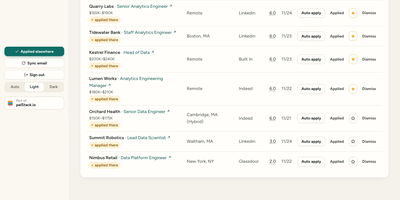
Anyone searching for work gets jobsearchPal, an AI assistant that finds new roles each weekday morning, tailors a resume and cover letter, and fills in the real application form, then stops so you press Submit. Roles come from Greenhouse, Lever, Ashby, Workable, and SmartRecruiters boards, RemoteOK, Remotive, The Muse, Adzuna, USAJOBS, any RSS feed, and job-alert emails from LinkedIn, Indeed, and Glassdoor. The agent uses your own Claude or ChatGPT subscription through Claude Code or the Codex CLI, or an OpenRouter key billed per token. Letters follow the tone you pick, then a browser fills the form at a person's pace, attaches both PDFs, takes a screenshot, and halts before Submit. The only Submit button sits on the dashboard behind a review tick box, consent and self-ID questions get only your saved answers, and captchas are left to you. Read-only email sync files each confirmation, interview invite, rejection, and recruiter note under the right application, then drafts follow-ups and interview prep packs. A morning coach says where to aim this week, a four-column board tracks the roles you shortlist, and Skills turns resume gaps into a four-week learning plan. People claiming unemployment can switch on a work-search log with rules for all 50 states, DC, Puerto Rico, and the US Virgin Islands, weekly proof downloads, and claim-day reminders. Running on a dedicated VPS on RepoCloud with guaranteed CPU, RAM, and SSD, full root SSH access, and a browser serial console. AGPL-3.0 licensed.