Agent Fleet
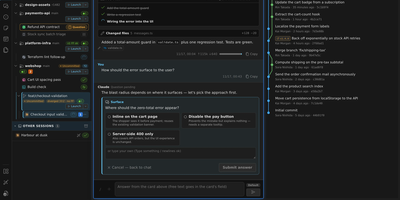
Closing the laptop no longer stops your coding agents: Agent Fleet runs Claude Code, Codex, GitHub Copilot, Cursor, and five more agent kinds on your own server, each member in a persistent, isolated workspace. One session list shows which agents are working and which are waiting on a question, a plan, or a permission prompt. Answer from a card in the browser, on a phone, or in the session's Slack or Discord thread. Each session can start in its own git worktree, and the console adds a commit graph, diffs, staging, split panes, and a live terminal. A session can hand a review to another agent kind, and a fleet graph draws who started whom. Scheduled runs wake a stopped workspace, and a turn cut short by a usage limit resumes when the limit lifts. Token use is broken down by feature, agent, and model, with calls that report no tokens counted as unmeasured. Sign-in works through Google, Microsoft Entra ID, GitHub, or any OIDC provider such as Okta or Keycloak, with tenants, roles, an audit log, and encrypted secrets. The interface switches between English and Japanese, and HTTPS certificates come from Let's Encrypt. Running on a dedicated VPS on RepoCloud with guaranteed CPU, RAM, and SSD, full root SSH access, and a browser serial console. Apache-2.0 licensed.
AI API Cost Tracker
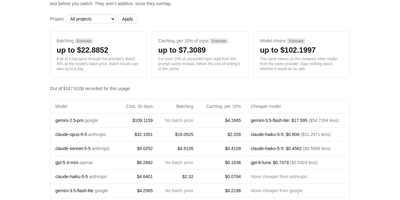
AI API Cost Tracker is an open-source ledger that prices every OpenAI, Anthropic and Gemini request and charges it to the customer, feature or agent run behind it. Apps report token counts through one HTTP endpoint, dependency-free client libraries or OpenTelemetry traces. Prompts and responses are never stored. Each request is costed at the price in force that day, so a rate change never rewrites history. Dashboards break spend down by project, provider, model, customer, feature and run, forecast month-end spend and flag spikes. Budgets, monthly or per run, alert at 80% and 100% by signed webhook, Slack or email. Agents can check a budget before they spend, or reserve it so concurrent steps cannot overspend. A "Why spend changed" page splits a rise into volume, model mix, tokens per request and price, and savings estimates size batching, caching and cheaper models. Outcomes turn spend into cost per resolved ticket. Reconciliation compares recorded costs with Anthropic's cost report, OpenAI's costs API and Google Cloud's billing export. An optional billing ledger sets each customer's revenue against their AI cost, drafts Stripe invoices and shares read-only portal links. Exports cover CSV, FinOps FOCUS and a reporting API. Roles, invitations and an audit log serve teams, with OpenID Connect sign-in for providers such as Okta or Keycloak. Running on a dedicated VPS on RepoCloud with guaranteed CPU, RAM, and SSD, full root SSH access, and a browser serial console. MIT licensed.
Memora
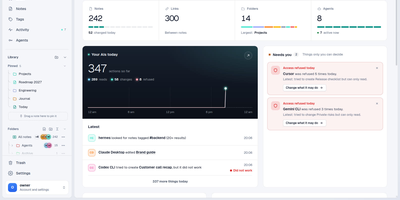
Memora is a self-hosted second brain where Claude Code, Cursor, ChatGPT, and your other AI agents share one memory made of plain Markdown notes that never leave your server. Agents read and write those notes through 77 tools on a Model Context Protocol endpoint, authenticating with a scoped API key per agent or with OAuth approved in the browser. Every change is committed to git, so any revision can be listed, diffed, and restored, and wikilinks and backlinks turn the vault into a navigable graph. The web UI shows a 3D brain with a region per folder, force, radial, and cluster graph layouts, and a canvas with a frame per folder, beside a reader and editor with reading settings. A live activity timeline records every read, write, search, and sign-in, with filters and JSON or CSV export. Mnemo, a built-in notes agent, finds, writes, tags, links, and tidies notes with your own OpenAI, Anthropic, or OpenAI-compatible key, shows every step, and hands tasks to sub-agents. Privacy rules hide folders from chosen agents, scopes and tool lists limit each key, and access rules allow or block by IP, CIDR, or domain. Images pasted into a note stay in its folder, and the interface installs as a PWA. Install with npm, Docker, or a systemd installer, then claim the instance with a one-time setup code. Running on a dedicated VPS on RepoCloud with guaranteed CPU, RAM, and SSD, full root SSH access, and a browser serial console. AGPL-3.0 licensed.
Agentic Customer Service Platform
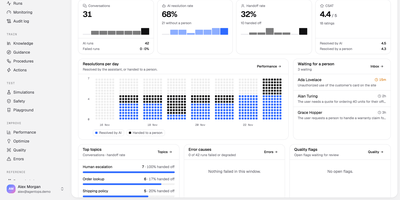
When a customer asks to cancel their latest order, this platform lets the AI propose the action while deterministic code checks the customer, applies policy, asks for confirmation and runs it exactly once. The assistant answers policy and FAQ questions from a knowledge base with hybrid dense and keyword retrieval, quotes its evidence and abstains when the evidence is thin. It looks up orders and tickets, handles refunds and cancellations, opens support tickets and escalates sensitive requests to a person with a priority, a reason and a first-reply deadline. Workflows pause at confirmation points and resume after a browser or backend restart, with duplicate effects prevented. AgentOps, the operator console, shows conversations, AI resolution rate, handoff rate and CSAT. A person can take over a live chat, reply, leave internal notes and hand back, and any run opens to show the model's proposal, the system's decision and what was allowed to execute. Teams edit knowledge articles, step-by-step procedures and plain-language guidance as versioned changes, and a knowledge-gaps list ranks the questions nobody could answer. Monitoring charts success rate, latency, token use and escalations per run, an audit log records every decision and takeover, and a safety page lists the release gates. Any OpenAI-compatible model works, including a local one. Running on a dedicated VPS on RepoCloud with guaranteed CPU, RAM, and SSD, full root SSH access, and a browser serial console. MIT licensed.
Junctio
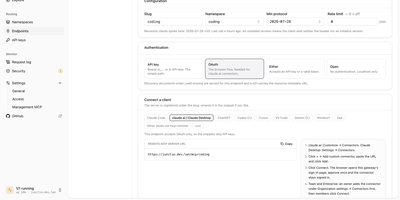
Every MCP client keeps its own list of servers and every server keeps its own login that expires at the worst moment, so Junctio puts them all behind one URL per client and refreshes the logins before they lapse. Add stdio servers by npm package, uv, container image or custom command, and remote servers over Streamable HTTP or legacy SSE, then group them into namespaces whose tools you can hide, rename or re-describe. Each endpoint accepts no auth, API keys bound to it, or OAuth, with a built-in authorization server for claude.ai and Claude Desktop connectors or token checks against Keycloak, Authentik or Auth0. Upstream tokens refresh on a schedule, parallel calls share one refresh, and a server that cannot refresh is flagged for re-login instead of failing silently. A dead upstream never blocks the rest, because tool lists load in parallel with a five second limit per server. The Explore page searches the official MCP registry and prefills the Add server form, and a pasted client config turns into rows you can add. A request log and per-endpoint rate limits watch the traffic, and an optional audit quarantines stdio servers with critical vulnerabilities. An optional management server with forty-six tools lets an agent configure the gateway, and there is no telemetry. Running on a dedicated VPS on RepoCloud with guaranteed CPU, RAM, and SSD, full root SSH access, and a browser serial console. MIT licensed.
Luna AI Engine
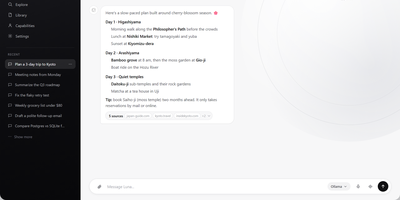
Chat, voice and files meet in Luna, an AI assistant that remembers your preferences, writes meeting minutes and answers through a local Ollama model or any cloud model you choose. Claude, Gemini, OpenAI, Groq, Mistral, Cohere, NVIDIA NIM and OpenRouter work through a setting, and several Ollama servers can be ranked ahead of a cloud fallback. Attached PDFs, Word files, spreadsheets, slides and code land in a searchable Library, and persistent memory carries facts and a learned style between chats. Wake-word and push-to-talk voice let Luna listen and answer back with local text-to-speech. Meeting mode records audio, transcribes it locally and writes minutes with decisions, action items and open questions. A skill is a JSON file plus a Markdown file, with built-ins for research, coding, documents, datasets, job search, news, papers and store-price comparison. Google Workspace, Microsoft 365, GitHub and Spotify connect as integrations, and six MCP servers hand memory, web research and workspace files to Claude Desktop and other clients. Fitbit, Oura, Garmin and Apple Health data sync into local metrics for questions such as how last week's sleep went. A business variant adds multi-user sign-in, rate limits and Telegram, Discord, Slack and webhook channels. The desktop, Android and home-screen iPhone apps reach the server privately over Tailscale. Running on a dedicated VPS on RepoCloud with guaranteed CPU, RAM, and SSD, full root SSH access, and a browser serial console. MIT licensed.
BlogFactory
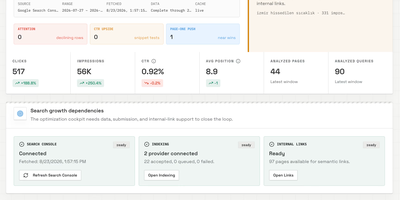
BlogFactory is the first open-source agent control plane purpose-built for multi-site content operations, shipping 16 distinct capabilities across four operational pillars — Operate, Grow, Control, and Deliver — in its v0.1.0 release. The platform keeps source evidence, AI-generated drafts, revisions, SEO metadata, human review, preflight checks, and CMS delivery destinations in one workspace while enforcing a server-side authority ceiling that prevents agents from ever publishing live content, accessing credentials, or performing administrative actions. AI agents connect through a Streamable HTTP MCP endpoint with OAuth authentication and site-scoped tool discovery, compatible with Codex, ChatGPT, and any MCP-capable client. Content creation supports single articles from keywords, titles, URLs, PDFs, text, or YouTube sources, batch campaigns, and programmatic content via reusable templates with structured data rows. The Search Growth module connects Google Search Console complete-day data to ranked optimization opportunities, 30-day growth plans, content classification by signal type (growing, low-CTR, almost-ranking, page-two, zero-click), indexing checks, and semantic internal-link suggestions. Brand Voice separates global voice rules, writer profiles, knowledge context, and brand guidelines from article mechanics. Approved drafts are delivered as CMS drafts to WordPress, Ghost, Wix, or Framer through idempotent, optimistic-locking-protected handoffs with explicit destination selection and preflight validation. The stack runs on React/Vite, a Hono/TypeScript API, PostgreSQL, and MinIO via Docker Compose, with providers including OpenRouter, OpenAI, and Google services under a bring-your-own-AI model. Running on a dedicated VPS on RepoCloud with guaranteed CPU, RAM, and SSD, full root SSH access, and a browser serial console. AGPL-3.0 licensed.
Sara
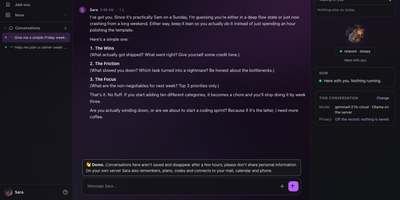
Meet Sara, an AI companion with a personality you design and a coding partner that writes, runs, and tests real software, using any model you choose. Pick a name and pronouns, start from a character or set dials for playfulness and bluntness, and keep memories you can inspect, correct, and forget. Chat from the web app, Windows and Mac apps, Android, iPhone, Telegram, Discord, Signal, or email, and talk through live voice calls you can interrupt or video calls with her moving portrait. A planner turns plain sentences into to-dos, reminders, and notes, with a board, a Today home screen, and routines such as a morning briefing. The library reads PDFs, scans, Word, Excel, PowerPoint, and e-books, then answers with the document and page it came from. For code, each project gets a sandboxed workspace with files, a shell, and git; Sara asks before risky commands, shows test results as cards, and lists every command and its output under each reply. Goals finish only when your own check passes. Use Ollama, vLLM, or llama.cpp locally, connect OpenAI, Anthropic, xAI, or OpenRouter, or reuse the ChatGPT and Claude plans you already pay for. Connect coding agents over MCP, call an OpenAI-compatible API, and add plugins from a signed store. Business workspaces add passkeys, roles, and shared workspaces. Running on a dedicated VPS on RepoCloud with guaranteed CPU, RAM, and SSD, full root SSH access, and a browser serial console. MIT licensed.
Outbound OS
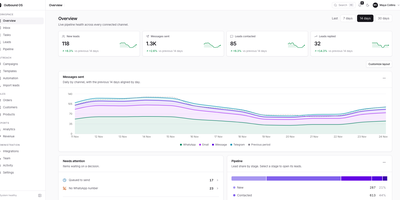
For sales desks that live in WhatsApp, Outbound OS is a CRM where the shared inbox, the follow-up sequences and the pipeline all hang off one lead record. Leads flow in from website forms (plain HTML, Webflow, WordPress, Framer), Facebook Lead Ads, Zapier, Make and n8n webhooks, and CSV or JSON imports, and a configured first contact goes out on an eligible channel. WhatsApp runs through Meta's official Cloud API: the composer checks the 24-hour reply window and offers an approved template once it has closed, while photos, PDFs and voice notes open in the inbox. Email works with any SMTP/IMAP mailbox or Brevo, and Telegram and iMessage (through a Mac running BlueBubbles) join the same thread list. Sequences follow each lead's working hours and stop on a reply, an opt-out or a closed deal, and campaigns target any slice by tag, status, country or score. A pipeline board, tasks, orders, invoices, shipments and revenue reports carry the sale past the first reply, with admin, manager, agent and viewer roles for the team. Dashboard widgets can be rearranged per account, and the phone workspace installs to the Home Screen from the browser. An MCP server lets ChatGPT, Codex, Claude and other remote clients search leads, read replies, preview audiences and prepare campaigns, with sends governed by the client's approval settings. Running on a dedicated VPS on RepoCloud with guaranteed CPU, RAM, and SSD, full root SSH access, and a browser serial console. AGPL-3.0 licensed.
Open Report
Open source reporting where an AI answers questions in plain words, builds whole dashboards page by page, and shows where a number comes from, while the data stays in your own databases. Ask what weighs the most and what has changed lately, in any language, and the answer arrives with its chart, a table view, and a button that adds it to a report. Describe the report you need and the assistant asks which pages you want, then builds the visuals, measures, data model, and look, ready to fine-tune on the canvas. Bring a local model through Ollama or LM Studio, any OpenAI-compatible API, Anthropic, or your Claude subscription, and decide how much of your data it may read: the schema only, cached aggregates, or query results. Connect Snowflake, BigQuery, Databricks, ClickHouse, Oracle, SQL Server, and MySQL, or load CSV, Excel, Parquet, and JSON files, then define joins with cardinality, dimensions, measures, and row-level security once for every report. The free canvas offers more than fifteen visual types, custom visuals, multi-page layouts, themes, cross-filtering, drill-down, and scheduled cache refreshes. Workspaces with viewer, editor, and admin roles, public links, PDF, PNG, and Excel export, and scoped API tokens cover sharing and automation, while OpenMetadata lineage maps a figure back through its bronze, silver, and gold tables. Running on a dedicated VPS on RepoCloud with guaranteed CPU, RAM, and SSD, full root SSH access, and a browser serial console. AGPL-3.0 licensed.
Agents Platform
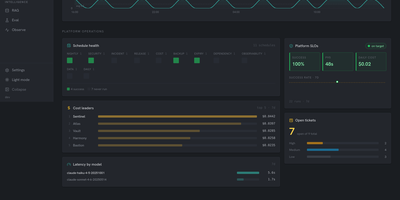
Twenty ready-made AI agent personas, a scheduler, a pipeline builder and a ticket board share one dashboard in Agents Platform, so recurring operations audits run, get summarized and turn into tracked work. Each agent carries a system prompt, skills in the SKILL.md format (adopted from the Anthropic skills catalog or imported by URL), MCP tool servers provisioned into SSH runs, and memories distilled from earlier results. Work runs in parallel, in sequence or as structured meetings, through conditional DAG pipelines or saved crews, on cron schedules or from inbound webhooks such as Prometheus alerts, git pushes and n8n flows. Execution happens over SSH on a host with Claude Code, through the Anthropic API, or against any OpenAI-compatible endpoint including local Ollama models. On SSH runs every tool call streams live into a step timeline, safety tiers stop read-only agents from writing files, supervised runs wait for approval, and scoped API keys guard the trigger endpoints. Recurring runs fuse into Combined Reports with a health score and metric trends, critical verdicts open tickets on a Kanban, Table or Gantt board, and Discord announces results. Cost, latency and SLO dashboards show per-agent spend, while eval suites with LLM-as-judge scoring and prompt A/B tests promote better prompts. A demo mode seeds weeks of sample history so everything can be explored without an API key. Running on a dedicated VPS on RepoCloud with guaranteed CPU, RAM, and SSD, full root SSH access, and a browser serial console. MIT licensed.
Inkling
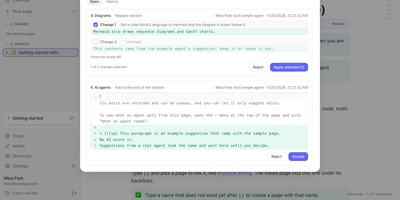
Built for small teams whose members each bring their own AI agent, Inkling keeps one shared set of notes that agents read by the section and change only through edits people can review. An agent asks a question and receives just the sections that answer it, packed into a token budget. It then edits one section against the version it read; if a teammate changed that section meanwhile, the agent gets the current text to merge instead of overwriting it. Edits can wait as suggestions that people accept in part or reject, and anything an agent changed can be reverted, one change or everything a connection touched on a page. A comment or database cell can hand a task to one member's agent, and a Team agents board shows what each connection is working on. The notes themselves cover Notion-style databases with table, board, calendar, gallery, timeline, chart, form and list views, plus wikilinks, backlinks, a graph, JSON Canvas whiteboards, Dataview-style query blocks and daily notes. Live co-editing shows cursors and presence, while roles, guests, edit locks and expiring password links control who sees what. Claude, Cursor and VS Code connect through OAuth to a built-in MCP server with 48 tools, and Slack or webhooks announce changes. Running on a dedicated VPS on RepoCloud with guaranteed CPU, RAM, and SSD, full root SSH access, and a browser serial console. MIT licensed.
Genkan
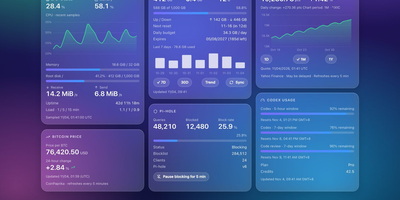
Your homelab home page can take orders from an AI assistant: ask Claude or Cursor to add Jellyfin, Sonarr and Radarr to Media with health checks, and Genkan updates the page on the spot. Other requests work the same way: group services by type, pin the five used most, or move dead links to an Archive category. The AI tab in Settings offers a one-click prompt for the Agent Skill, which calls the REST API, and a built-in MCP server with 29 tools. Links sit on a wallpaper as frosted-glass capsules, grouped into workspaces and categories, with a pinned row and sorting by use, recency or dragging. Slash or Ctrl+K searches every workspace and falls back to a web search. Seventeen bundled plugins add resizable widgets for weather, world clocks, countdowns, Pi-hole stats, RSS, Hacker News, a to-do list and Markdown notes, plus wallpaper feeds such as NASA APOD. Plugins from other authors show their permissions and source in a market before you enable one, and each runs in a sandbox with time and memory limits. A green or red dot beside each link reports its health, and favicons download on their own. Editing needs the admin login, a read-only guest mode shares the page, and JSON export and import carry everything to another instance. Running on a dedicated VPS on RepoCloud with guaranteed CPU, RAM, and SSD, full root SSH access, and a browser serial console. MIT licensed.
Githome
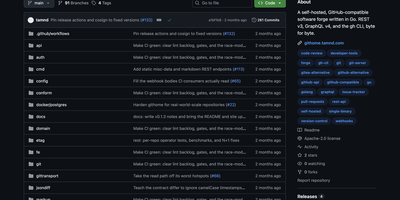
Point the gh CLI at your private Githome server and it works identically to github.com, because every REST v3 and GraphQL v4 endpoint returns byte-for-byte compatible JSON shapes, headers, Link pagination, and ETag caching. A single compiled Go binary serves the REST API under /api/v3, GraphQL under /api/graphql, git smart-HTTP transport, and a server-rendered web UI implementing the GitHub Primer design system with full functionality when JavaScript is disabled. The web interface provides repository browsing with Markdown rendering and syntax highlighting, issue tracking, pull requests with unified diffs and inline code review threads, full-text search, user profiles, and a notifications inbox. Authentication supports personal access tokens with prefix-based identification, OAuth device and web flows, and scoped permissions on every response header with only token hashes stored. The pull request system implements the complete lifecycle including async mergeable state computation, squash, merge, and rebase strategies, commit statuses, check runs, and statusCheckRollup fields. Webhooks deliver events with X-Hub-Signature-256 verification, SSRF protection, and at-least-once retry semantics. Storage supports SQLite for single-node deployments or PostgreSQL for production configurations. Performance optimizations include batch loaders replacing N+1 queries, keyset pagination, FTS-backed search, and GraphQL dataloaders. Docker deployment pulls the official multi-arch container image from GitHub Container Registry. Running on a dedicated VPS on RepoCloud with guaranteed CPU, RAM, and SSD, full root SSH access, and a browser serial console. Apache-2.0 licensed.
Olano
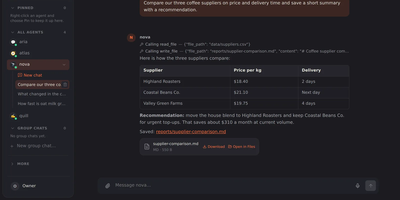
Olano turns one install into an office of AI agents, each with its own memory, workspace, tools and chat channels, all run from a web dashboard called Mission Control. Describe the agent you want to Agent Father in plain language, or edit a single config file, and it appears with its own schedule and permissions. Around 900 named tools across 88 toolkits cover Google Workspace, Microsoft 365, GitHub, Slack, Notion, Jira, Linear, HubSpot, Salesforce, Stripe and Shopify, alongside web search, a headless browser and SQL. People reach agents through 21 channels including Telegram, Discord, Slack, WhatsApp, Signal, Matrix, email and SMS, with approvals answered right in the chat. Each agent picks its own model from twenty providers, including Anthropic, OpenAI, Gemini, Bedrock and local Ollama. Memory persists in markdown files, a notes wiki with backlinks and searchable documents, while background workers write briefings and ideas into an approval queue. Cron schedules with time zones, a shared issue tracker, a calendar and an org chart keep work moving between humans and agents. Approval gates by tool category, PII and prompt-injection scanning, an encrypted vault and optional per-agent sandboxed shells behind an egress firewall keep each agent inside its lane. Agents speak MCP and A2A in both directions, and the dashboard installs as a phone app. Running on a dedicated VPS on RepoCloud with guaranteed CPU, RAM, and SSD, full root SSH access, and a browser serial console. MIT licensed.