Murmur
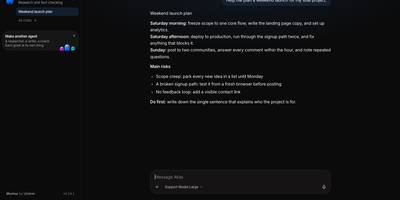
Every AI agent gets a face, a colour, and a job in Murmur, a chat app that makes running Hermes Agent as friendly as texting a colleague. Start from a template (Researcher, Writer, Planner, Coder, Coach, or Chef) or describe a new agent from scratch, then talk to one at a time or drop several into a group room and call on a single one with an at-mention. Replies stream in live, long jobs show a plan that ticks itself off, and every step appears in plain words. Connect a model with a ChatGPT plan, a local model server, or an API key from OpenRouter, OpenAI, Anthropic, and others, with the model and thinking effort chosen per agent or chat. Agents can reach Notion, Linear, Todoist, Figma, and dozens of other apps, and they ask for an Allow or Don't allow before changing anything important. Morning briefings run as routines, a memory view shows what each agent knows with controls to edit or forget it, and WhatsApp or Telegram can be linked by scanning a code. A voice call mode lets an agent answer out loud, and slash commands set long-running goals or ask quick side questions. Chats sync across browser, desktop, and phone. Solo builders, homelab fans, and small teams get a calm front door to their own agents. Running on a dedicated VPS on RepoCloud with guaranteed CPU, RAM, and SSD, full root SSH access, and a browser serial console. MIT licensed.
EinVault
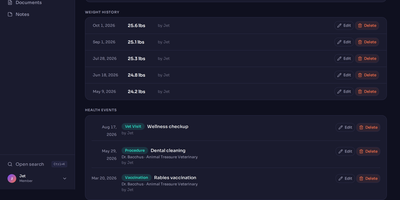
Every animal gets a proper health record with EinVault, a self-hosted tracker for companion care covering vet history, daily routines, and the helpers involved. Each profile holds species, breed, vet details, emergency contacts, and a photo, and the activity choices adapt to the animal, from dog walks to litter box visits. A daily journal records mood, photos, and videos, and tagged markdown notes keep feeding instructions and quirks pinned where caretakers find them. Health tracking covers vet visits, vaccinations, procedures, and weight history; medications carry doses and end dates linked to scheduling reminders. A one-tap Given log stamps each dose and shows the next due time, and incidents follow an injury or symptom to resolution with severity, updates, and owner alerts. For time away, a printable caretaker sheet puts schedules, contacts, and selected notes on one page for a sitter who needs no account. Recurring reminders, a calendar feed, full-text search with companion and type filters, and a token API for logging from smart buttons or scripts round out daily care. One Docker container runs it with admin, member, and caretaker roles, optional single sign-on and two-factor authentication, and six interface languages. Running on a dedicated VPS on RepoCloud with guaranteed CPU, RAM, and SSD, full root SSH access, and a browser serial console. MIT licensed.
Imp
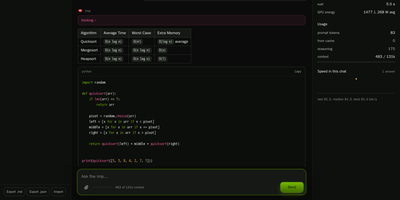
Imp runs large AI chat models privately on one NVIDIA RTX 50 or RTX PRO graphics card, exposing them through OpenAI and Anthropic compatible APIs plus a built-in browser chat. Start it with a single Docker command, point it at a model, and the chat opens in your browser with saved conversations and a live readout of generation speed. Coding agents such as Claude Code and Codex connect by changing one base URL, so your editor talks to the model on your own hardware instead of a rented cloud endpoint. Tool calls, structured JSON output, streaming responses, and reasoning models all work over the wire, and requests can be protected with an API key, per-IP rate limits, and concurrency caps. Load GGUF files you already have or NVFP4 and FP8 SafeTensors checkpoints straight from Hugging Face with no conversion step before the first answer. When a model is bigger than the card, mixture-of-experts weights stay in system RAM while the busiest experts are cached on the GPU, so a 123.6 GiB model still answers from a 32 GB card. Supported models can also read images alongside text, and tokenize, health, and model listing endpoints make the server easy to wire into scripts and monitors. Running on a dedicated VPS on RepoCloud with guaranteed CPU, RAM, and SSD, full root SSH access, and a browser serial console. MIT licensed.
Hivekeep
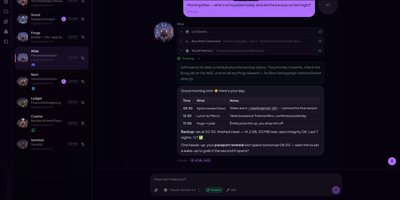
Most AI chats forget you by tomorrow; Hivekeep keeps a team of agents on your own server that remember everything, work together, and answer wherever you already talk. Each agent has a name, a role, and one continuous conversation that never resets, backed by long-term memory it can search. Agents hand tasks to one another, spawn helpers, and run scheduled jobs. Queenie, the built-in setup agent, connects providers and creates your first teammates through plain chat. They reach you on Telegram, Slack, Discord, WhatsApp, Signal, Matrix, or the installable web app, and a channel can move from one agent to another mid-conversation. Agents write custom tools, build mini-apps that open beside the chat, edit files in a workspace with a code editor, and add plugins from a marketplace. Credentials go straight into an AES-256-GCM vault that the model never reads. A context viewer and a token-usage dashboard show what each prompt contains and what each agent, model, and day costs. Running on a dedicated VPS on RepoCloud with guaranteed CPU, RAM, and SSD, full root SSH access, and a browser serial console. MIT licensed.
Headroom
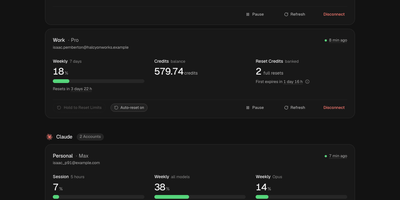
Headroom answers the question every multi-plan AI subscriber asks mid-task: which of my accounts still has room to work? It puts the live limits, reset times, credits, and spend of Claude, Codex, Cursor, Copilot, Grok, Antigravity, and Vercel AI Gateway accounts on one self-hosted dashboard instead of seven provider pages. Connect each account once, through its official CLI sign-in or a credential import, and a background scheduler refreshes every figure on schedule, renews tokens before they expire, and keeps 90 days of readings. Five-hour sessions, weekly pools, per-model limits, credit balances, banked resets, and on-demand spend sit side by side, and unreported figures show as unknown rather than a fake zero. Compare ranks same-provider accounts by the room they have left and names the one to use next, while Timeline lays every reset window on a two-week calendar. Analytics charts when you work, when you run dry, and whether each plan fits, and Wallet totals subscriptions, usage spend, and top-ups in one currency with renewals and budget alerts. In-app notices, Telegram messages, and signed webhooks warn about low limits, expiring resets, and broken sign-ins, and optional automations can spend a banked Codex reset or log a credit top-up the moment it lands. Personal, work, and side-project accounts stay separate under one owner login with passkeys and a Privacy Mode that blurs emails on screen. Running on a dedicated VPS on RepoCloud with guaranteed CPU, RAM, and SSD, full root SSH access, and a browser serial console. MIT licensed.
LocalCA
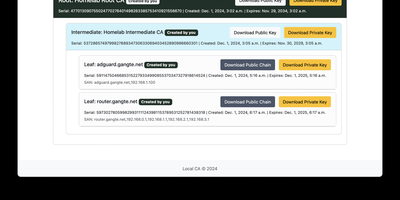
Your internal services deserve padlocks that browsers actually trust, and LocalCA is a small certificate authority you run yourself to issue them. From the web interface you create a self-signed root, install it once on your browsers and client devices, and then mint intermediate and leaf certificates underneath it for each service you host. Proxmox, Pi-hole, Jellyfin, Grafana, and the rest of a homelab stop showing insecure warnings and start presenting certificates your devices accept. The root can carry your own name, so the trust store shows your branding rather than a generic authority. Issued certificates also serve mutual TLS setups, where clients present certificates of their own before a service lets them in. Deployment stays deliberately small: a Docker Compose file brings the application up, ARM images cover Raspberry Pi class hardware, and a configurable time zone keeps expiry timestamps readable for your region. A reverse proxy path prefix is supported for placing the interface behind Traefik or Nginx at an address like /localca. Treat the instance as internal infrastructure, because issued private keys live in its database: keep it on a private network, change the default administrator password immediately, and restrict access to the host. Running on a dedicated VPS on RepoCloud with guaranteed CPU, RAM, and SSD, full root SSH access, and a browser serial console. AGPL-3.0 licensed.
OhMyBuddy
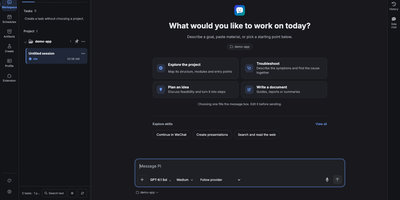
Give your AI assistant a name, a memory you can actually inspect, and a permanent seat on your own server. OhMyBuddy has two sides that share the same models and tools. The Buddy side keeps one ongoing conversation, learns your preferences, and shows a receipt under any reply that saved something, so every memory can be reviewed, edited, or undone. The Workspace side opens real project folders with threads, streaming tool calls, file diffs, side chats, and a branching history view. Add scheduled tasks, an artifacts library, and a media lab for image, video, and speech generation. Connect extensions, MCP tools, a browser, and subagents when a job needs more hands. Sessions live on the server, so a laptop, a tablet, and a phone home screen all continue the same chat, with notifications when a reply finishes. Bring Claude, GPT, Gemini, DeepSeek, or any OpenAI-compatible relay, and protect the instance with an access token. Keep a personal AI on hardware you control, reachable from every device you own. Running on a dedicated VPS on RepoCloud with guaranteed CPU, RAM, and SSD, full root SSH access, and a browser serial console. ISC licensed.
Chiyogami
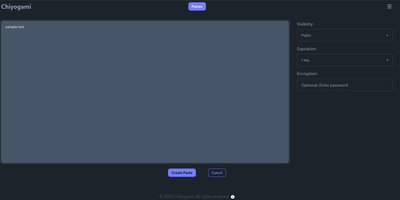
Chiyogami is a pastebin you host yourself for sharing code, logs, notes, and text snippets through short links that expire on your terms. Paste into the web editor and the content comes back formatted, with syntax highlighting for code and rendered Markdown for prose, so a stack trace or a runbook reads the way it was written. Anything sensitive can be encrypted in the browser before it leaves your machine, and the server never stores the password, which makes an encrypted paste safe to pass through chat or email. Every paste carries a configurable lifetime, from minutes to never, and visibility choices keep a snippet public, unlisted, or private behind an unguessable address. Registered users manage their own pastes from an account, and anonymous quick pastes stay available for one-off sharing. The public paste list supports search, so a team instance doubles as a small shared snippet library. Developers can skip the browser entirely: one curl command creates a paste from a file or a JSON body, and the API returns a short title that fetches the content later. Sharing extends to QR codes for moving text onto a phone, and built-in rate limiting throttles spam and abuse before it fills the database. Running on a dedicated VPS on RepoCloud with guaranteed CPU, RAM, and SSD, full root SSH access, and a browser serial console. BSD-3-Clause licensed.
Tessera
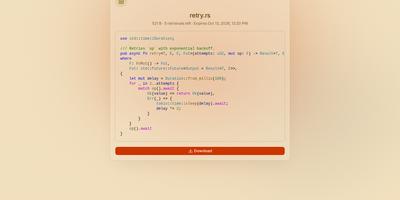
Most file sharing leaves copies lying around forever; Tessera shares things with a built-in goodbye. Drop in a file, a whole folder, a code snippet, or a link and you get back a short code and a URL that anyone can open until it expires or hits the download count you set, at which point it is deleted. Expiry is checked on every request and each retrieval is counted atomically, so a one-time share cannot be raced by two people at once. Passwords can be required before anything is shown, code arrives syntax-highlighted, and images, SVGs, and diagrams preview in the page, with link cards when you paste the URL into chat. Uploads resume after interruptions and stream through the server without ballooning memory at any size. Behind the scenes you choose where bytes live: local disk, S3-compatible storage, Azure Blob, Google Cloud Storage, or WebDAV, several at once, added or retired from the admin panel without a restart. Accounts are optional for a home server, sign-in through OpenID Connect suits a team, and roles with per-account quotas decide who may upload, view everyone's shares, or change settings. Optional malware scanning, anonymous-upload caps, and rate-limited code lookups keep a public instance honest. A CLI and API tokens drive the same endpoints as the web app, so scripts can share and clean up exactly like people. Running on a dedicated VPS on RepoCloud with guaranteed CPU, RAM, and SSD, full root SSH access, and a browser serial console. AGPL-3.0 licensed.
SpatiumDDI
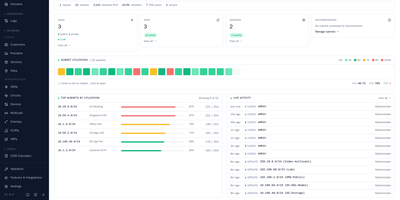
SpatiumDDI is the open alternative to commercial DDI platforms that charge by the IP, by the appliance, and by the feature, then lock every zone and subnet you own inside a renewal cycle. It does not just render configuration for servers somebody else runs, but deploys and operates BIND9, PowerDNS, Technitium, and Kea itself. Manage zones and records with per-server sync state, hand out DHCP scopes, pools, and static reservations per server group, and watch live leases reported back by the Kea agents. The IPAM side keeps spaces, blocks, and subnets in a tree with per-address DNS and DHCP sync, while the dashboard shows utilization, capacity, and platform health at a glance. Bring an existing estate with you through importers for BIND, Windows, PowerDNS, Technitium, Kea, ISC, and NetBox, and manage Windows DNS and DHCP agentlessly over WinRM when a full cutover is not on the table. Delegate safely with group-based roles over LDAP, OIDC, SAML, RADIUS, or TACACS+, search every object globally, and keep an append-only audit log of who changed what. Running on a dedicated VPS on RepoCloud with guaranteed CPU, RAM, and SSD, full root SSH access, and a browser serial console. Apache 2.0 licensed.
Fonrex
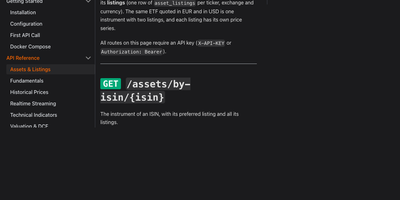
Good European market data is either expensive or wrong, so Fonrex runs it all on your server: a self-hosted API serving per-listing prices, cross-checked fundamentals, DCF valuations, and factor models for European and US shares, with no subscription or per-call meter. Every price is stored per listing in its own currency and dated by trading session, so AIR.PA resolves to Airbus rather than a same-ticker US namesake, and one ISIN can carry many listings cleanly. Fundamentals are cross-checked between sources first; figures that disagree with the consensus are rejected, and every answer names the sources it came from. Value any company three ways with FCF, EPS, and dividend DCF models, compare them side by side, and stress the result with a WACC by growth sensitivity matrix. Factor tools return Kenneth French returns for the US, Europe, and developed markets, compute listing factor exposure, and price equity with the risk-free rate of the right currency, alongside FRED and ECB rates, Treasury curves, and Eurostat indicators. Daily history spans ten years, split-adjusted with a dividend-adjusted close; live ticks stream over WebSocket, indicators and a screener run on your stored prices, and deduplicated news arrives per ticker or as a global feed. Results plug into OpenBB Workspace, Google Sheets, Python notebooks, and Zipline backtests, so spreadsheets, dashboards, and research pipelines all read the same numbers. Running on a dedicated VPS on RepoCloud with guaranteed CPU, RAM, and SSD, full root SSH access, and a browser serial console. AGPL-3.0 licensed.
Valet Homelab
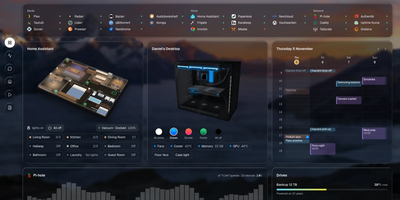
Open one page and see what is happening across every service in your homelab, then ask an AI assistant about downloads, lights, or what to watch tonight. Valet shows live status for 185 integrations, from Plex, Sonarr, and Immich to Home Assistant, Pi-hole, and Uptime Kuma, with progress bars and numbers that update without refreshing. Cards include a 3D floor plan with light controls, a PC with case and cooling controls, a calendar, backup health that flags overdue copies, and a year in review. The assistant works with a local or hosted model, switches models per chat, answers by voice, and supports slash commands, including your own. Anything it changes waits for your approval, and Valet works fine with the AI switched off. A wall mode at the /wall address turns a tablet or spare monitor into a read-from-across-the-room display with cards you pick, pages that take turns, and dimming at night. Add Valet to a phone Home Screen to install it as an app with its own notifications. API keys stay on the server, and there is no account and no telemetry. Running on a dedicated VPS on RepoCloud with guaranteed CPU, RAM, and SSD, full root SSH access, and a browser serial console. MIT licensed.
Issuerd
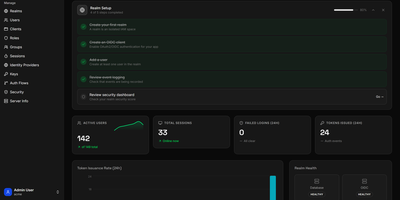
One login for every internal tool, without handing your users another password to forget: Issuerd is a Keycloak-compatible identity provider that runs single sign-on for your whole stack from a single binary. Administrators manage realms, users, groups, clients, roles, client scopes, and protocol mappers in an embedded admin console, while end users get their own account console for passwords, passkeys, and two-factor settings. Authentication flows cover MFA, social login, and themable, localized login pages with per-realm language and email templates, so each audience sees a sign-in that looks like your product. Federation connects Samba AD, OpenLDAP, and Active Directory with user and group sync, password validation and write-through, plus Kerberos and SPNEGO for desktop single sign-on. For modern clients it implements DPoP token binding so stolen access tokens are useless without the holder's key, CIBA for approvals that happen on a second device, and token exchange patterns aimed at AI agents calling downstream services. Declarative YAML provisioning, a full management API, OpenAPI export, Prometheus metrics, and health probes round out day-two operations, and nodes scale horizontally behind any load balancer with no sticky sessions. Running on a dedicated VPS on RepoCloud with guaranteed CPU, RAM, and SSD, full root SSH access, and a browser serial console. Apache-2.0 licensed.
DailyHub
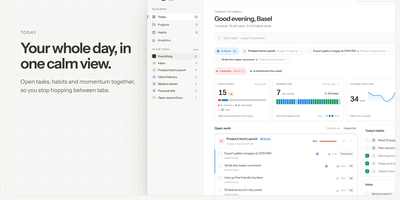
DailyHub is one calm page for a single person's whole day: today's open work grouped by project, the habits due this morning, and an inbox that catches everything that does not belong anywhere yet. The Today view greets you with a quick-add box, nudges about what is slipping, and a progress bar that fills as the day gets done. Focus mode pins the projects or tasks that matter and hides the rest until a date you pick or until you clear it, so the full list stops shouting. Projects carry status, due dates, and milestones, wear logos with accent colours derived from them automatically, and raise a banner when work stalls. Habits run on weekday schedules and report back with a 14-day consistency strip and a completion rate, so a streak is something you can see rather than guess. Analytics chart completions over time, break them down per project, and surface the weekday patterns that show when you actually get things done. A command palette jumps to any project, task, habit, or milestone from the keyboard, and light and dark themes keep long planning sessions easy on the eyes. An AI assistant can join through the built-in MCP endpoint: ask what is still open in the inbox, add a task to the website project for Friday, or mark today's workout done. Running on a dedicated VPS on RepoCloud with guaranteed CPU, RAM, and SSD, full root SSH access, and a browser serial console. MIT licensed.
LIA
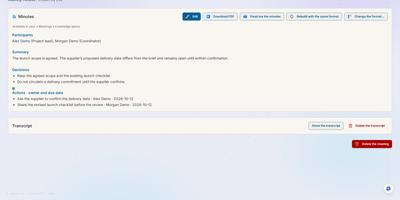
LIA is a self-hosted AI assistant that works out what you agreed with each person from your own mail, calendar, files, and meeting minutes, then drafts the follow-up for you to approve, edit, or refuse. Connect Google, Apple, or Microsoft accounts, and the Tools area opens mail, calendars, tasks, and contacts for hand browsing without a model call. Relations gathers each person's recent exchanges, debrief, and open commitments on one card. Record or import a meeting and LIA writes minutes from thirty built-in templates, with decisions and owners listed. Knowledge spaces index your documents in more than fifteen formats for hybrid search, memory keeps pinned rules and preferences you can edit or delete, and routines, reminders, and a daily briefing anticipate what is due. Administrators assign a provider and model to each pipeline stage, set per-user token and cost limits, and cap daily instance spend, with Grafana dashboards for monitoring. The interface covers six languages, with voice mode and a Telegram channel as options. Running on a dedicated VPS on RepoCloud with guaranteed CPU, RAM, and SSD, full root SSH access, and a browser serial console. AGPL-3.0 licensed.
AGenUI Studio
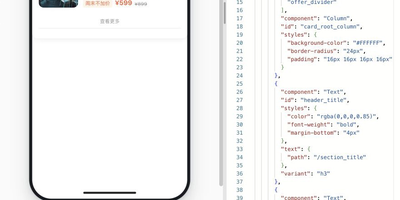
AGenUI Studio turns a written description into a working interface card: an AI agent generates the UI, binds it to your APIs and data, and packages it so it runs anywhere, no Studio required. Bring your own model by entering any OpenAI-compatible or Anthropic Messages endpoint and key in the console settings, and generation proceeds contract-first, steered by design rules you publish as versioned Markdown revisions. You preview each card live as it is generated, then refine it over multiple turns while every component, binding, and action you did not target stays protected from accidental edits. The console also manages the supporting cast: a local knowledge base, API definitions, and reusable operators, all starting from bundled demo data you can swap for real services whenever you are ready. When a card is finished, download it as a self-contained Runtime Package carrying its data sources, bindings, actions, and operators, and execute it with the bundled Card Runtime inside your own application, or register a delivery target and publish straight from the workbench over a callback or a message queue. Applications subscribe to native run events over HTTP and SSE, and production deployments can replace the local defaults piece by piece, MySQL for storage, Redis for hot state, MCP services for knowledge and data, while the packages keep the same contracts. Running on a dedicated VPS on RepoCloud with guaranteed CPU, RAM, and SSD, full root SSH access, and a browser serial console. Apache-2.0 licensed.
ClientSt0r
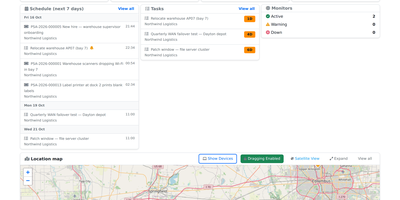
ClientSt0r is a self-hosted operations platform for managed service providers that keeps client documentation, IT assets, credentials, and the service desk in one multi-tenant system running on your own infrastructure. Open any ticket and the client's active contract, the asset it concerns, the runbook that covers it, and the vault entries you are allowed to use appear alongside the conversation, so nobody switches between four products during an outage. Readiness scoring grades every client against what should be documented, explains each gap, and queues the fixes, while versioned documents with owners and review dates keep runbooks from quietly going stale. The credential vault encrypts secrets with AES-256-GCM, isolates them per client, enforces IP, geography, and time-of-day access rules, logs every reveal, generates TOTP codes, checks passwords against known breaches, and imports existing Bitwarden or Vaultwarden libraries. Asset records cover hardware inventory, IP address management, rack layouts, and printable QR labels. The service desk adds queues, SLA timers, dispatch views, time entries, quotes with electronic signatures, invoices, contracts, approvals, a workflow rule builder, a threading email engine, and guided client portal forms, while procurement, profitability reporting, CVE scanning, SSL expiry tracking, and uptime monitoring round out daily operations. Running on a dedicated VPS on RepoCloud with guaranteed CPU, RAM, and SSD, full root SSH access, and a browser serial console. MIT licensed.
Depictio
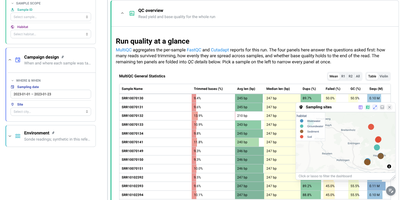
For teams drowning in pipeline output nobody reads, Depictio turns workflow results into dashboards you can hand to a collaborator. A MultiQC tab answers the first questions about a sequencing run: how many reads survived trimming, how evenly they spread across samples, and whether base quality holds to the end of the read, all in one glanceable table. Filter by sample, habitat, site, or sampling date on the left and every panel on the page follows, from community composition cards counting distinct taxa and phyla to differential abundance views that show what was tested, what survives correction, and how large the effects are. Alpha diversity tabs summarise richness and evenness per sample with rarefaction curves, and a sampling sites map lets you click or lasso points to filter the whole dashboard by geography. Forty two ready-made templates cover nf-core pipelines such as ampliseq, atacseq, and airrflow, while outputs from Nextflow, Snakemake, Galaxy, or plain shell scripts feed the same builder. Even a classic tabular dataset becomes an overview of distributions, box plots, and threshold counts, so the same tool serves a wet lab and a data science team. Running on a dedicated VPS on RepoCloud with guaranteed CPU, RAM, and SSD, full root SSH access, and a browser serial console. MIT licensed.