Wordpress
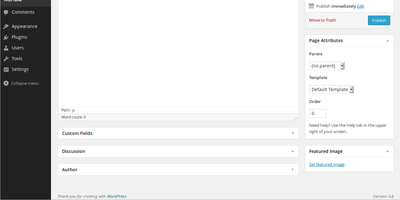
Roughly 43% of all websites and over 60% of the CMS market run on WordPress - the GPL-licensed platform that scales from a personal blog to publishing operations and WooCommerce stores. The Gutenberg block editor composes pages from reusable blocks, and full site editing extends block control to headers, footers, and templates; tens of thousands of plugins and themes cover essentially every capability a site might need, from SEO and caching to membership and e-commerce. WordPress 7.0 "Armstrong" marks the platform's biggest structural update since Gutenberg itself: a React-based DataViews admin replaces the legacy list tables with instant filtering, a provider-agnostic AI Client API ships with connectors for OpenAI, Anthropic, and Google, media processing moves into the browser via WebAssembly, and a universal Font Library manages typography across block, hybrid, and classic themes with local hosting for GDPR compliance. New Breadcrumbs, Icons, and lightbox Gallery blocks reduce plugin dependence, and server-side PHP block registration simplifies development. The REST API and WP-CLI make it automatable end to end. Self-hosting is what WordPress was designed for: your content, database, plugin choices, and upgrade schedule stay entirely under your control, free of wordpress.com plan limits.
Parse Server
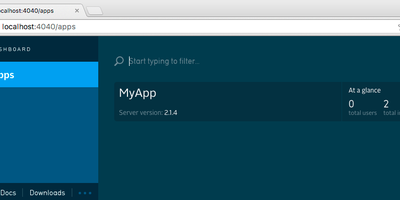
With 21,400 GitHub stars, 500+ contributors, and battle-tested since its 2016 open-source release after powering Facebook's mobile backend infrastructure, Parse Server delivers production-grade Backend-as-a-Service that eliminates months of custom API development. The platform generates REST and GraphQL endpoints automatically from your data schema with class-level permissions and object-level ACLs providing granular access control. Cloud Code enables server-side JavaScript execution for triggers (beforeSave, afterSave, beforeDelete, afterDelete), custom functions, and scheduled jobs — all deployable without restarting the server. Live Queries push realtime data changes to subscribed clients via WebSockets, powering chat applications, collaborative editors, and live dashboards. Push notification support spans APNs for iOS, FCM for Android, and web push for browsers with audience segmentation, scheduling, and delivery analytics. The Parse Dashboard provides a comprehensive admin interface with a data browser featuring configurable info panels, graph visualization, custom canvas builder with draggable elements, AI agent integration via OpenAI, data import/export, and multi-factor authentication. Database flexibility supports MongoDB 6-8 and PostgreSQL 13-18 with PostGIS for geospatial queries. Native SDKs cover JavaScript, iOS (Swift/Objective-C), Android, Flutter/Dart, .NET/Xamarin, Unity, PHP, and Arduino for IoT devices. Deploy via npm, Docker, or the official Express template with automatic schema migration. Running on a dedicated VPS on RepoCloud with guaranteed CPU, RAM, and SSD, full root SSH access, and a browser serial console. Apache 2.0 licensed.
Prime Agent
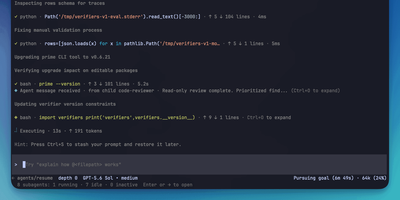
With over 14,000 GitHub stars and 41 releases since its May 2026 launch, Prime Agent delivers a fundamentally different approach to AI coding agents by treating the agent's own operating environment as programmable state that improves through use. The Recursive Language Model architecture provides the model exactly one tool — a persistent IPython kernel — where file operations, shell commands, subagent delegation via rlm() function calls, and context management all happen through code rather than rigid tool-calling schemas. Subagents launch as independent sessions with their own model, kernel, and history, communicating results through agent_message.send() without blocking the parent. The Continual Harness stores supplemental prompts, memories, skill descriptions, and reusable subagent specifications as durable state that the /refine command updates through small, evidence-backed edits with full rollback by ID. Daemon-backed sessions keep running when the terminal disconnects, with automatic context compaction summarizing older messages while preserving recent state. The TUI provides an Agent View for monitoring, switching between, and steering multiple live sessions simultaneously. Autonomous mode operates within configurable turn, token, and time budgets with user-defined quality gates. Persistent goals, heartbeats, and scheduled prompts maintain continuity across terminal sessions. Compatible with Anthropic Claude, OpenAI, Google Gemini, local models via Ollama or vLLM, and Prime Inference endpoints. Install via a single curl command on Linux or macOS. Running on a dedicated VPS on RepoCloud with guaranteed CPU, RAM, and SSD, full root SSH access, and a browser serial console. MIT licensed.
LiveKit
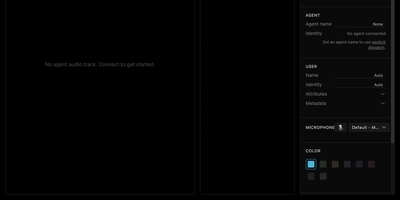
With over 20,000 GitHub stars and adoption by companies building everything from telehealth platforms to AI voice agents, LiveKit is the most widely deployed open-source real-time communication server available. The Go-based Selective Forwarding Unit handles hundreds of concurrent participants per node with adaptive bitrate streaming, simulcast layers, SVC codec support for VP9 and AV1, and end-to-end encryption. Client SDKs span JavaScript, Swift, Kotlin, Flutter, React Native, Rust, Python, Unity, and ESP32 embedded devices, while server-side APIs cover Node.js, Go, Ruby, Java, Python, Rust, PHP, and .NET. The Agents framework enables building AI-powered voice and video applications — real-time speech-to-text, LLM-driven conversations, and computer vision pipelines — running as server-side participants in any room. Egress records sessions to S3-compatible storage or streams to RTMP endpoints, while Ingress pulls external feeds from OBS via RTMP, WHIP, or SRT into LiveKit rooms. The SIP bridge connects traditional telephony to WebRTC rooms for hybrid conferencing. JWT-based authentication, webhook notifications, room-level moderation APIs, and selective subscription give operators granular control. Deploy as a single binary for development, Docker Compose for production single-node, or Kubernetes with the official Helm chart for distributed multi-region clusters using Redis for state coordination. Running on a dedicated VPS on RepoCloud with guaranteed CPU, RAM, and SSD, full root SSH access, and a browser serial console. Apache 2.0 licensed.
Open SEO
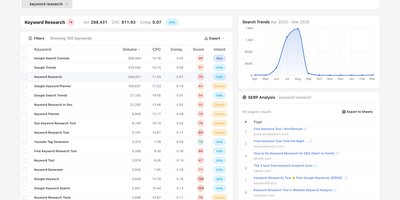
OpenSEO provides an alternative to the $100+/month SEO suite monopoly by connecting directly to DataForSEO APIs on a pay-as-you-go basis — you bring your own API key and pay only for the queries you actually make. The platform delivers focused workflows for keyword research with volume, difficulty, CPC, intent, and live SERP inspection; rank tracking with historical position monitoring; backlink analysis with referring domain quality scoring; technical site audits that crawl pages and surface issues; competitor insights comparing SERP positions across keyword sets; and AI visibility monitoring that tracks brand mentions, citations, and prompts across AI models. The integrated MCP server exposes all tools to AI coding agents including Claude Code, OpenClaw, Hermes, and Cursor, while Agent Skills provide reusable SKILL.md workflows that guide agents through complex SEO research tasks. Google Search Console integration reads first-party performance data including clicks, impressions, CTR, and position metrics with URL-level index status inspection. The Prompt Explorer compares how different AI models respond to SEO-relevant queries. Self-host via Docker for personal use or deploy to Cloudflare for team access with automatic database backups. The hosted version at openseo.so adds a 28% markup on DataForSEO requests. Running on a dedicated VPS on RepoCloud with guaranteed CPU, RAM, and SSD, full root SSH access, and a browser serial console. MIT licensed.
GoAccess
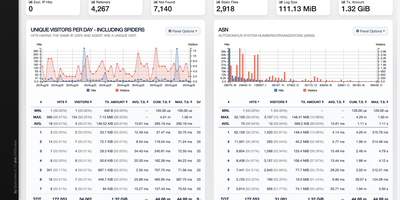
GoAccess processes millions of web log entries in seconds and renders the results as interactive dashboards that update every 200 milliseconds in the terminal or every second via WebSocket-connected HTML reports. Written entirely in C with only ncurses as a dependency, it achieves exceptional performance even on resource-constrained servers, reducing memory usage by approximately 20% and parsing time by 35% in recent releases through optimized in-memory hash tables with on-disk persistence support. The analyzer parses virtually every web log format out of the box (Apache Combined and Common, Nginx, Amazon CloudFront, Amazon S3, AWS Elastic Load Balancing, Google Cloud Storage, Squid, W3C IIS, Caddy JSON, and Traefik) while supporting fully custom log format strings for non-standard configurations. The self-contained HTML dashboard displays 15+ interactive panels covering unique visitors, requested files, static files, 404 errors, referring sites, search keyphrases, geographic location with city-level GeoIP resolution, operating systems, browsers, HTTP status codes, time distribution, and virtual host metrics. WebSocket authentication via JWT provides secure remote access, and incremental log processing ensures data continuity across daemon restarts. Docker deployment requires a single command with volume-mapped access logs. Over 20,800 stars with active development since 2010. Running on a dedicated VPS on RepoCloud with guaranteed CPU, RAM, and SSD, full root SSH access, and a browser serial console. MIT licensed.
CubeJS
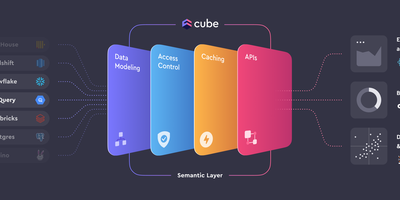
Between your databases and everything that consumes data - BI tools, embedded analytics, AI agents - sits Cube (formerly Cube.js), an open-source semantic layer. Metrics, dimensions, joins, and access rules are defined once as code in YAML, JavaScript, or Python, forming a governed data model that every downstream consumer shares, so "revenue" means the same thing in every dashboard. Caching is two-level: an in-memory cache absorbs bursts of identical queries, and declared pre-aggregations - rollup tables built in the warehouse or in Cube Store, Cube's distributed columnar engine, and refreshed in the background - deliver sub-second latency while cutting warehouse compute costs. The query planner routes each request to cache, rollup, or source automatically. Consumers connect through a Postgres-compatible SQL API (any tool that speaks Postgres works), plus REST, GraphQL, and a Meta API for model introspection. Row-level security and multi-tenancy are enforced in the layer itself, upstream of every client. Sources include Snowflake, BigQuery, Databricks, Postgres, MySQL, Presto, and Athena. Headless by design - bring your own UI.
dbx
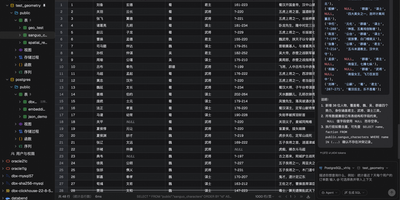
Universal database administration across modern enterprise infrastructure is simplified through dbx, a lightweight web client and SQL studio supporting over ninety database engines. Database administrators connect to MySQL, PostgreSQL, SQLite, Redis, MongoDB, ClickHouse, DuckDB, Oracle, and Microsoft SQL Server through authenticated network connections and encrypted SSH tunnels. The interactive query editor provides real-time multi-schema autocomplete, syntax linting, execution plan analysis, and natural language SQL query synthesis powered by configurable large language model backends. Teams visualize complex relational database architectures using interactive entity-relationship diagrams that map table foreign key constraints, primary indexes, and table partition layouts automatically. Operators inspect live Redis memory usage breakdowns, monitor real-time server command throughput, and manage key expirations without opening raw terminal sessions. The editable data grid supports multi-row modifications, foreign key reference lookups, CSV and JSON exports, and binary blob data inspection directly inside the browser viewport. Software developers expose connected databases directly to external AI coding assistants through native Model Context Protocol server endpoints. Running on a dedicated VPS on RepoCloud with guaranteed CPU, RAM, and SSD, full root SSH access, and a browser serial console. Apache-2.0 licensed.
Wagtail
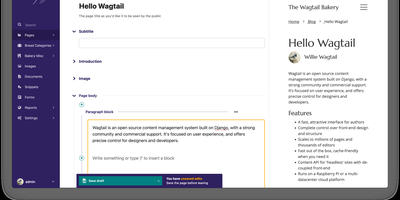
Backed by over 20,000 GitHub stars, 800 contributors, and organizations like Google, NASA, and the NHS, Wagtail is the Django-powered content management system that gives editors creative freedom through StreamField while keeping developers in full control of data structure and front-end rendering. StreamField lets editors compose pages from a custom library of content blocks — rich text, images, embedded videos, tables, code snippets, and developer-defined custom types — without compromising the underlying data model or breaking responsive layouts. The built-in JSON API supports headless deployments with versioned endpoints for pages, images, and documents, enabling decoupled front-ends in Next.js, Nuxt.js, or any framework that consumes REST. Editorial workflows provide configurable approval chains where content moves through draft, review, and publish states with commenting, task assignment, and email notifications built into the admin interface. Integrated search connects to Elasticsearch for full-text indexing with faceted filtering, or falls back to PostgreSQL and SQLite backends with fuzzy matching support added in v7.4. Multi-site management serves multiple domains from a single Wagtail installation with independent page trees, while the internationalization framework handles content translation with locale-aware URL routing. Image management includes focal point detection, responsive renditions, and automatic format conversion. The platform supports Django 5.2 and 6.0 with Python 3.10 through 3.14 and PostgreSQL, MySQL, MariaDB, or SQLite databases. Running on a dedicated VPS on RepoCloud with guaranteed CPU, RAM, and SSD, full root SSH access, and a browser serial console. BSD-3-Clause licensed.
Kortix
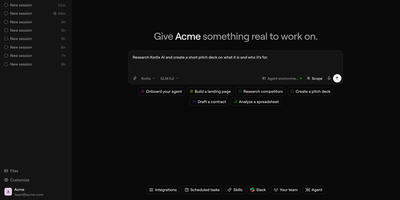
Kortix Suna is an AI management system where autonomous agents run on isolated Linux sandbox computers, producing finished deliverables that humans review through a change request workflow before anything merges. With 20,000+ stars, it positions itself against Claude Cowork and ChatGPT Work by storing every agent persona, skill, memory artifact, and connector in a git repository: versioned, diffable, and shared across an organization. Each session launches a dedicated sandbox with full terminal access, Playwright-controlled Chromium, writable filesystem, and internet connectivity. Over 3,000 app connectors are available through MCP, OpenAPI, GraphQL, and raw HTTP, with credentials brokered server-side so tokens never enter the sandbox. Skills (reusable markdown-plus-script packages encoding company workflows) load automatically into every session, compounding institutional knowledge over time. Bring-your-own-key model routing through LiteLLM connects to OpenAI, Anthropic, Google, Mistral, or local models without vendor lock-in. The deployment runs as a single Docker Compose stack bundling the Next.js frontend, FastAPI backend, Supabase, Redis, and Caddy with automatic TLS certificates. Enterprise features include SAML/OIDC SSO, SCIM provisioning, RBAC, and audit logging. Running on a dedicated VPS on RepoCloud with guaranteed CPU, RAM, and SSD, full root SSH access, and a browser serial console. Elastic License 2.0.
Bitwarden
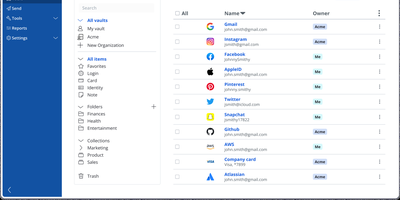
Backed by nearly 20,000 GitHub stars and ranked number one in G2's Enterprise User Satisfaction for eleven consecutive quarters, Bitwarden is the open-source password manager trusted by millions worldwide. The zero-knowledge encryption architecture ensures all vault data — passwords, passkeys, credit cards, identities, secure notes, and file attachments — is encrypted exclusively on client devices using AES-256 with PBKDF2-SHA256 or Argon2id key derivation and RSA-2048 for organization key exchange. Cross-platform clients span a web vault, browser extensions for Chrome, Firefox, Safari, Edge, Opera, Vivaldi, and Brave, native desktop apps for Windows, macOS, and Linux, mobile apps for iOS and Android, and a CLI for scripting. Bitwarden Send enables time-limited, password-protected sharing of text and files, while the built-in TOTP authenticator generates two-factor codes alongside stored credentials. Enterprise deployments integrate with identity providers through SAML 2.0 and OpenID Connect SSO, automate provisioning via SCIM or Directory Connector supporting LDAP, Active Directory, Azure AD, Okta, and OneLogin, and enforce security policies with custom roles and granular permissions. Emergency access allows designated contacts to request vault view or takeover through configurable waiting periods with cryptographic key exchange. The Secrets Manager stores API keys, tokens, and infrastructure credentials with native GitHub Actions, GitLab CI/CD, Ansible, and Terraform integrations. Running on a dedicated VPS on RepoCloud with guaranteed CPU, RAM, and SSD, full root SSH access, and a browser serial console. AGPL-3.0 licensed.
Bolt.diy
Prompt, run, edit, and deploy full-stack Node.js applications from a browser tab: Bolt.diy is the official open-source version of Bolt.new's AI coding agent. Its foundation is StackBlitz's WebContainer technology - a sandboxed in-browser Node.js environment where the AI controls the whole stack: filesystem, npm, dev servers, terminal, and browser console. That means the agent does not just generate code; it installs dependencies, runs Vite or Next.js, reads errors, and fixes them. The defining difference from Bolt.new is model choice per prompt: 19+ providers including OpenAI, Anthropic, Gemini, DeepSeek, Groq, Mistral, Amazon Bedrock, and local models via Ollama or LMStudio, extensible through the Vercel AI SDK. Development ergonomics include live preview, a diff view of AI changes, codebase search, file locking to prevent generation conflicts, 15+ starter templates (React, Vue, Next.js, Astro, Svelte, Expo), and MCP support for external tools. Projects integrate with Git and Supabase, and deploy in one click to Vercel, Netlify, or GitHub Pages.
LinkWarden
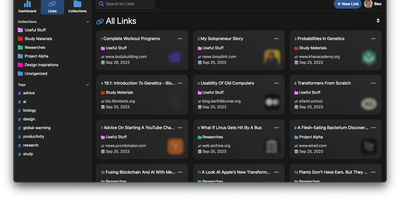
Links rot - the hard truth Linkwarden is built around, as a collaborative bookmark manager that preserves what it saves. Every page you save is fully preserved - a screenshot, a PDF, a self-contained single-file HTML archive (generated by the Monolith Rust binary), and a clean reader view - so the content survives even after the original site disappears. Think of it as a private Wayback Machine you own, with an optional one-click snapshot to archive.org on top. The reading experience matches the archival rigor: a distraction- free reader view supports text highlighting and annotation, and full-text search across everything you have saved is powered by Meilisearch. Optional AI tagging analyzes page content and auto-assigns tags - generate new ones, pick from your existing set, or constrain to predefined tags - with providers ranging from local Ollama models (fully private) to OpenAI, Anthropic, and OpenRouter. Organization is collections, sub-collections, and multiple tags per link; teams collaborate on shared collections with per-member permissions, and public collections share curated link sets (with preserved copies) to anyone. The stack is Next.js/React on TypeScript with PostgreSQL via Prisma, NextAuth supporting credentials, OAuth2, and SAML SSO, and a Playwright-driven headless Chromium worker doing the capture. Native iOS and Android apps and browser extensions feed it from anywhere.
Bookstack
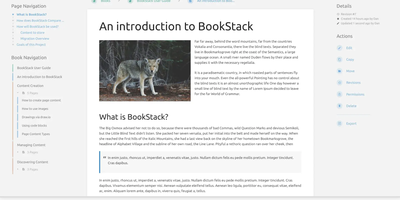
Most wikis die of flat page-and-tag sprawl; BookStack's defining decision is enforced structure - an MIT-licensed PHP/Laravel platform (over MySQL) where content lives in a hierarchy of shelves, books, chapters, and pages, the way a physical library works. A shelf maps to a department, a book to "Engineering Runbooks," a chapter to "Database Procedures," a page to the actual document. That opinionation removes the "where does this go?" friction and keeps knowledge bases tidy as they grow. Editing works both ways: a clean WYSIWYG editor for most users, a Markdown editor with live preview for those who prefer it - switchable per page. Full-text search spans all books or scopes to one, with direct links to individual paragraphs, and include tags let you embed one page's content inside another so shared blocks update everywhere at once. Every edit creates a diffable, revertible revision. Page templates standardize recurring formats, tags add cross-cutting categorization, and built-in diagrams.net integration draws architecture diagrams in place. Authentication covers email/password plus OIDC, SAML2, LDAP, and social login; a full role and permission system locks content down per shelf, book, or page. Pages and books export to PDF, HTML, plain text, and Markdown, a REST API automates content, and the whole thing runs happily on the cheapest VPS you can find.
DocuSeal
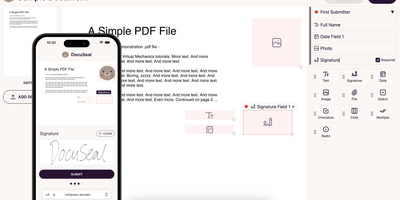
Contracts signed on your own server: DocuSeal is the most feature-complete open-source, self-hosted alternative to DocuSign. A WYSIWYG builder turns any PDF into a fillable form with 14 field types: signature, initials, date, file upload, checkbox, dropdown, radio, stamp, and more. Documents route to multiple submitters in sequence or parallel, with automated SMTP email notifications, reminders, and a mobile-optimized signing experience that works on any device without an account. Every completed document carries an automatic PDF eSignature with verification and an audit trail. Templates are reusable and can also be generated programmatically - from HTML via API or from PDFs and DOCX files with embedded field tags - and the REST API plus webhooks drive full workflow automation, with embedded signing forms and form builders for React, Vue, Angular, and plain JavaScript. Files store on disk or in S3, Google Cloud Storage, or Azure. The UI ships in 7 languages with signing in 14. Runs on SQLite, PostgreSQL, or MySQL; AGPL-3.0 licensed with unlimited documents and no per-signature fees.
Etherpad
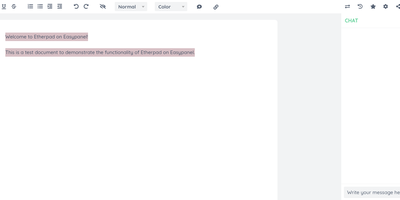
In continuous open-source development since 2009, Etherpad is the original really-real-time collaborative editor - used by Wikimedia, governments, EU public-sector institutions, and tens of thousands of self-hosters. Its core idea is visible authorship: every keystroke is attributed with author colors, every revision preserved, and the timeslider lets you scrub through a document's entire history character by character. Multiple people type into the same pad and see each other's changes instantly - it scales to thousands of simultaneous editors per pad. The base install is deliberately lightweight; capability comes from roughly 290 plugins installable from the admin web UI: comments, images, tables, drawing, video chat via WebRTC, math rendering, code highlighting, and authentication via OAuth, LDAP, or OpenID. AI is pointedly a plugin, not a default - you choose the model and infrastructure, or never turn it on. There is no telemetry. For integrators, an HTTP API (with OpenAPI definitions at /api/openapi.json) manages pads, users, and groups for embedding in your own applications, and the ueberDB abstraction layer supports PostgreSQL, MySQL, Redis, MongoDB, and SQLite backends. Full data export is built in, the format is open, it is translated into 105 languages, and it runs on anything from a Raspberry Pi to a server farm. Apache 2.0 licensed, Node.js based.

Calibre-Web
With over 17,700 GitHub stars and continuous development since 2015, Calibre-Web has become the definitive self-hosted digital library solution for book enthusiasts who want beautiful web access to their Calibre collections. The responsive Bootstrap 3 interface delivers instant browsing, searching, and filtering across titles, authors, tags, series, book formats, and languages, with custom shelves for organizing personal reading collections. In-browser reading supports EPUB, PDF, TXT, CBR, CBT, CBZ, and DJVU formats with a configurable EPUB reader featuring multiple themes and page location tracking, while one-click email delivery sends books directly to Kindle, Kobo, and other E-Readers without leaving the interface. Native Kobo sync lets Kobo device owners synchronize their entire Calibre library wirelessly, maintaining reading progress and bookmarks across devices. Metadata management includes editing capabilities with automatic metadata downloading from Google Books, Amazon, and other configurable sources, plus eBook format conversion through Calibre binaries for on-the-fly EPUB, MOBI, AZW3, and PDF conversion. User management provides fine-grained per-user permissions controlling download access, upload rights, editing capabilities, and content visibility based on categories or Custom Column values. Authentication supports local accounts, LDAP directory integration, Google and GitHub OAuth, proxy authentication, and Magic Link login for easy E-Reader access. The OPDS catalog feed enables any compliant E-Reader app to browse and download from the library. Running on a dedicated VPS on RepoCloud with guaranteed CPU, RAM, and SSD, full root SSH access, and a browser serial console. GPL-3.0 licensed.
Overleaf
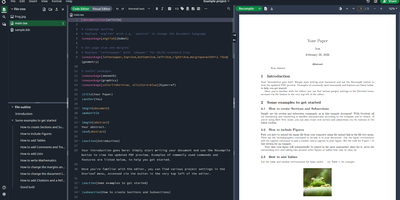
Multiple authors can edit the same LaTeX document simultaneously in the browser with live cursor tracking, conflict-free merging, and instant PDF compilation on every save. Overleaf Community Edition brings the collaborative editing experience that millions of researchers and academics rely on, with no compile time limits, storage quotas, or collaborator caps imposed by the hosted tiers. The web editor provides syntax highlighting, auto-completion, and bracket matching alongside an integrated PDF preview panel powered by a bundled TeX Live distribution supporting pdfLaTeX, XeLaTeX, and LuaLaTeX engines. The file tree panel organizes multi-file projects with separate files for chapters, figures, bibliography references, and style definitions. BibTeX and Biber handle bibliography management, and detailed compilation logs offer clickable error navigation to the exact source line causing each issue. Users upload images, PDFs, and data files directly through the browser, and a template gallery provides starting points for journal articles, conference papers, theses, presentations, and CVs. Over 17,800 GitHub stars and a decade of active development anchor the project. The application runs as containerized microservices including the Node.js web application, MongoDB for persistence, and Redis for session management. Running on a dedicated VPS on RepoCloud with guaranteed CPU, RAM, and SSD, full root SSH access, and a browser serial console. AGPL-3.0 licensed.