BitRouter
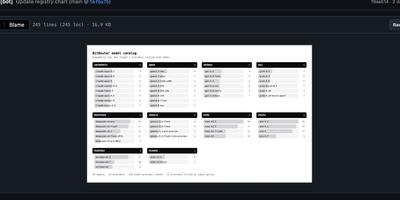
BitRouter is a context-aware LLM router that learns which model delivers the cheapest successful outcome per workflow step, cutting agent costs by up to 80% while maintaining 96% quality versus all-frontier baselines. Point any agent runtime at http://localhost:4356 with a one-line OPENAI_BASE_URL change and BitRouter routes to OpenAI, Anthropic, Google, Groq, DeepSeek, Mistral, Moonshot, MiniMax, Nvidia, and any OpenAI-compatible endpoint simultaneously, normalizing authentication, streaming, and cross-protocol translation between wire formats. The act-observe-evaluate-learn loop traces every hop with cost, tokens, and latency attribution, scores each decision against a versioned policy-lock.yaml, then tightens routes automatically with no LLM judge in the path. Native MCP gateway auto-discovers tools from connected servers and makes them routable and governed alongside model calls. Agent Client Protocol integration enables the TUI to manage Claude Code, Codex, OpenCode, OpenClaw, Gemini, and Copilot sessions in real time with inline tool-call approval and live streaming. Built-in guardrails inspect, redact, or block risky content before requests leave your network. Virtual keys scope API access per agent or user without exposing upstream credentials. Per-agent spend caps and loop guards contain runaway cost automatically. Multi-account failover reroutes mid-run so rate limits never re-pay completed work. Ships as a single Rust binary via npm or Cargo. Running on a dedicated VPS on RepoCloud with guaranteed CPU, RAM, and SSD, full root SSH access, and a browser serial console. Apache 2.0 licensed.

Nowen Video
Nowen Video turns the hard drive of films and series sitting on your NAS into a streaming service your family actually wants to open, posters, seasons, and all. Point it at your media folders and it scans the usual formats, reads streams with FFprobe, and scrapes rich metadata from TMDb, Douban, TheTVDB, Bangumi, and Fanart.tv, recognizing movie, season, and episode naming as it goes. NFO files and external subtitles are honored, filesystem watching keeps the library current, and collections plus episode navigation make a big archive feel curated rather than dumped. Pressing play is where the engineering shows: a server-side planner decides per client whether to direct play, remux, or transcode to HLS on demand, with automatic fallback when the first choice fails. Hardware acceleration through the GPU keeps transcoding cheap, subtitle and speed controls ride along in the player, and a local analysis pass can surface highlight clips from your own footage. Every family member gets favorites, watch history, and continue-watching progress under their own account, while library permissions decide who sees what. An Emby-compatible API even lets clients like Infuse connect as if it were an Emby server. Running on a dedicated VPS on RepoCloud with guaranteed CPU, RAM, and SSD, full root SSH access, and a browser serial console. GPL-3.0 licensed.
Mynah
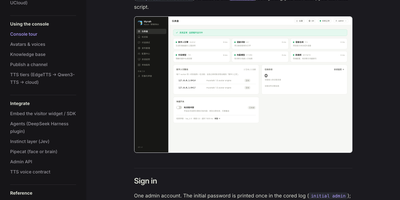
A visitor clicks your link and a face is already there, listening, answering within a fraction of a second, and stopping the moment they interrupt, because Mynah runs live digital humans in the browser instead of playing back rendered video. Underneath, cored takes WebRTC offers, runs the conversation through your chosen language model, speech recognition, and text to speech, and drives a lip synced avatar engine such as MuseTalk, FlashHead, or Wav2Lip, with a semantic end of turn model deciding when a person has finished speaking. The admin console is where you shape the experience: bake a new avatar from a talking video with explicit consent, clone or audition voices, swap avatars per channel without cold starts, and tune green screen keying and gestures live in the playground. Knowledge bases take your documents through ingestion and embedding so answers ground in your material, with retrieval tests before anything ships. Publishing freezes a model, voice, and knowledge snapshot into a channel: a shareable link with token, domain, or CIDR access control, its own branding, and a concurrency cap drawn from an engine pool that computes how many workers your VRAM can hold. Session monitoring shows who is connected and lets you kick a session, health checks watch every dependency, and light and dark themes with Chinese and English interfaces cover both console and visitor pages. Running on a dedicated VPS on RepoCloud with guaranteed CPU, RAM, and SSD, full root SSH access, and a browser serial console. Apache-2.0 licensed.
Overlook
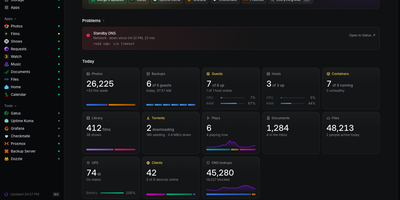
Overlook is a read-only status page that tells you at a glance whether your whole homelab is healthy, by pulling live answers from the monitoring, server, network, storage, and media tools you already run. The page leads with what is wrong, listing the checks your existing check engine is alerting on for as long as they fail, so the page and your alerts never disagree. Below that sit Servers, Network, Storage, and Apps, each marked up, degraded, or down with the last 30 results of its checks and its own detail page showing guests, DNS clients, or disk detail. A Today strip gives one figure from every source, such as guests running, DNS lookups, photos added, or the watts your UPS is drawing, while a weekly view lists each area's problems and events across the last seven days. Your apps appear as links with a dot that says whether each one answers, and chores due this week, waiting updates, batteries to change, and requests awaiting approval collect in one place you act on in the tool itself. A browser setup page appears before any config exists, tests each source you enter, and writes the config and secrets files for you. Running on a dedicated VPS on RepoCloud with guaranteed CPU, RAM, and SSD, full root SSH access, and a browser serial console. MIT licensed.
Tunnet
One encrypted network for every machine you run: Tunnet links laptops, home servers, cloud instances, and CI runners into a private mesh that behaves like a single LAN. Each enrolled machine gets an overlay IP and a hostname, so ordinary tools like ping, curl, SSH, and the browser just work across home servers, cloud instances, and laptops. Publish an internal app to your peers with Serve, or expose a local service to the public internet with an HTTPS tunnel when you need a shareable link. Send files directly between machines without detouring through cloud drives, email attachments, or fragile copy commands. SSH access follows identity instead of scattered key files, with session recording and no bastion host to maintain. Device posture checks gate which machines may join, and subnet routes, exit nodes, and high-availability gateways extend the fabric to whole networks. Write your ACLs, groups, tags, and SSH rules as Policy as Code in Git, simulate changes offline, review semantic diffs on pull requests, and roll back revisions when a change misbehaves. The Kubernetes operator advertises cluster networks, publishes services to peers, and exposes public HTTPS endpoints through custom resources. Run the full stack yourself, control plane, dashboard, management API, relays, and audit logs included, or skip the server entirely with Direct mode for a zero-server peer-to-peer mesh. Running on a dedicated VPS on RepoCloud with guaranteed CPU, RAM, and SSD, full root SSH access, and a browser serial console. AGPL-3.0 and MPL-2.0 licensed.

CC Our Story
CC Our Story gives a couple a private website of their own, a shared home for the timeline of small moments, anniversaries, wishes, and messages that no social platform gets to index, advertise against, or quietly delete. The home page shows the two of you, how long you have been together, and the memories you most recently added. Every photo and note lands on a moments timeline you scroll like a story, anniversaries count down so the next one never sneaks past, and a guestbook lets friends leave blessings without creating accounts, identified by a privacy-preserving fingerprint instead of a sign-up form. A wish shop turns promises into something playful: post the things you would do for each other as redeemable wishes, spend the heart points you earn, and have your partner confirm when the wish is fulfilled. Sensitive records can be locked, private extras include synchronized-answer compatibility tests and gentle cycle tracking with daily notes, and the database ever holds exactly two accounts, yours. Web Push and email notifications run as independent channels so a new post, comment, or heartbeat reaches the other phone even if one channel fails, while an optional AI companion group with named personas drops by occasionally to comment on new moments through any OpenAI-compatible endpoint, never seeing drafts or locked posts. Running on a dedicated VPS on RepoCloud with guaranteed CPU, RAM, and SSD, full root SSH access, and a browser serial console. MIT licensed.
Freshrss
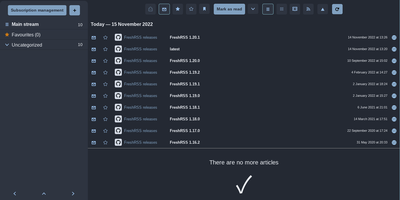
Where Miniflux strips reading down, FreshRSS gives you knobs - the feature-rich pole of self-hosted RSS, comfortable with thousands of feeds. It's a multi-user PHP aggregator (host family and friends on one instance, with an anonymous reading mode) with the reading workflow refined over a decade: favorites, custom tags, powerful filter and search queries, three reading views, and statistics that reveal each site's publishing frequency - useful for pruning subscriptions. Two properties make it the standard choice. First, the Google Reader-compatible API (plus a Fever API) syncs with virtually every serious RSS client - Reeder, NetNewsWire, ReadYou, FeedMe, Fluent Reader - so your phone reads from your server. Second, native WebSub support means compatible sources (WordPress, Blogger, Medium, Friendica) push new articles instantly instead of waiting for polling. A 50+ extension ecosystem adds what truncated feeds omit - full-text content fetching, reading-time estimates, trending views, auto-unsubscribe for dead feeds - alongside community themes and custom CSS. OPML import/export keeps subscriptions portable, a CLI handles administration, and article sharing posts to many services. AGPL-licensed, running on SQLite, MySQL, or PostgreSQL. Feedly Pro's feature set, minus Feedly's subscription and its algorithms.
FCaptcha
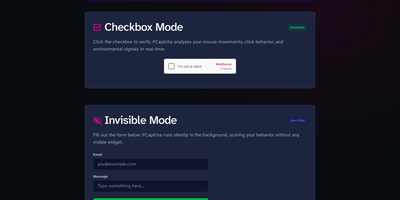
FCaptcha guards your forms with an invisible check that spots bots, headless browsers, and AI agents steering real browsers, all from a server you run yourself. Drop the widget into a signup or contact form and it quietly watches how the visitor actually behaves: pointer movement, typing cadence, scroll shape, and dozens of other signals that separate a person from a script. Vision agents that screenshot and click, and computer-use agents driving a browser through automation protocols, leave input traces the scoring engine catches. Self-declaring crawlers get flagged by name, and signed agent requests are verified cryptographically so polite, identified bots can be allowed while anonymous automation is blocked. A proof-of-work challenge adds a liveness gate behind the scenes. Humans see no puzzle at all, in any of 34 languages, and the widget meets accessibility standards for screen-reader and keyboard-only visitors. Your backend verifies each token through the same siteverify contract that Turnstile, reCAPTCHA, and hCaptcha use, so switching providers is a change of address rather than a rewrite. No cookies are set, no visitor data travels to a third party, and nothing phones home. Running on a dedicated VPS on RepoCloud with guaranteed CPU, RAM, and SSD, full root SSH access, and a browser serial console. MIT licensed.
Single Server
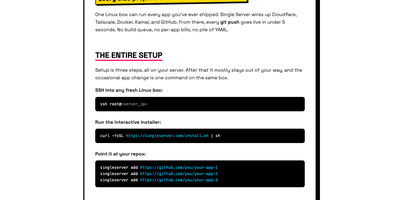
Point it at your GitHub repos and every push goes live in under five seconds: one Linux box becomes the deployment platform for every app you have ever shipped, with no build queue, no per-app bills, and no pile of YAML. An interactive installer wires the box up once, creating a GitHub App for limited, revocable repo access, Cloudflare DNS records and a tunnel so visitors get TLS and CDN at the edge while your server IP stays hidden, and Tailscale access so you SSH in without exposing SSH to the public internet. From then on you just push: the daemon receives the webhook through a Tailscale Funnel, verifies its signature, fetches the commit, builds the image on the server from your Dockerfile or a generated one, and swaps traffic only after the new container passes its health check, so a failed deploy leaves the previous version serving. Each app runs in its own container with its own environment variables and persistent storage, and one CLI on the box handles the rest: add or remove apps, attach a domain in one command, roll back to an earlier commit, stream logs, check status, take backups, or run doctor to diagnose every layer from daemon to DNS. Running on a dedicated VPS on RepoCloud with guaranteed CPU, RAM, and SSD, full root SSH access, and a browser serial console. MIT licensed.
Parse DMARC
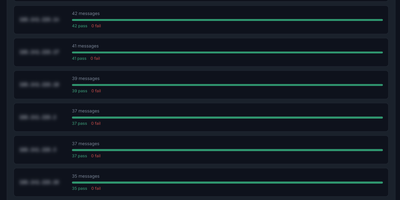
Parse DMARC reads the DMARC aggregate reports that Google, Microsoft, and Yahoo email about your domain every day and shows you, in one dashboard, who is sending mail as you and whether it passes authentication. It fetches the reports over IMAP, unpacks the gzip, zip, and XML attachments automatically, and charts your pass rate, message volume, and top sending sources at a glance. Any report opens down to its raw records, so when an unfamiliar IP starts sending as you, the evidence is one click away instead of buried in XML. Reports forwarded through Exchange or Outlook as message attachments are unwrapped too, and a local Maildir intake covers servers where the mailbox lives on the same host. A built-in generator writes your _dmarc TXT record from a form, so tightening your policy does not mean hand-writing DNS syntax from memory. Twenty-eight Prometheus metrics and a shipped Grafana dashboard move the same data into the monitoring stack you already run. An MCP server lets an AI assistant query your reports directly, asking which sources failed DKIM this week in plain language. Everything stores in a single SQLite file inside one static Go binary, with dark mode for late-night incident reviews. Running on a dedicated VPS on RepoCloud with guaranteed CPU, RAM, and SSD, full root SSH access, and a browser serial console. Apache-2.0 licensed.

Imagor Studio
Imagor Studio is a photo workspace where browsing a huge library and editing what you find happen in the same place, and the originals never get touched. The gallery scrolls virtually through thousands of images with no indexing wait, while drag-and-drop moves files between folders and multi-select handles bulk work. Open any image and the editor lets you stack layers: other images as overlays or watermarks, text layers you can style inline, and solid color layers with blend modes and opacity. Adjust color, apply effects, and crop with a live preview, then copy the generated transformation URL and use that rendition anywhere without exporting a file. A look you build once can be saved as a template in portable JSON and applied across the whole library, so a watermark, a resize, and a color grade become one reusable recipe. You can also start from a blank canvas at any dimensions and compose from scratch. Storage stays yours throughout: point it at a local folder, S3, MinIO, or Cloudflare R2 and manage the same library the same way. Running on a dedicated VPS on RepoCloud with guaranteed CPU, RAM, and SSD, full root SSH access, and a browser serial console. AGPL-3.0 licensed.
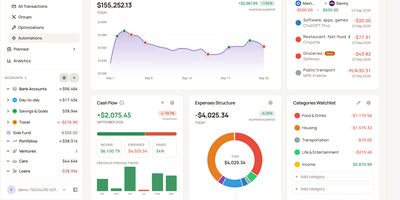
MoneyMatter
Your bank balance is only part of what you own, and MoneyMatter adds the rest: cash accounts, brokerage portfolios, cars, loans, and private deals roll into one net worth figure in your base currency. Add transactions by hand, import CSV, OFX, QFX, YNAB, Wallet, or Microsoft Money files, or let an AI model you provide parse a statement, while Monobank, SimpleFIN, Lunch Flow, and Walutomat connections sync accounts automatically. Each transaction can carry categories, tags, payees, notes, attachments, and splits, transfers and refunds link to their counterparts, and automation rules tidy new entries. Envelope-style budgets assign money to lines with Assigned, Activity, and Available columns and rollover rules, savings goals read progress from account balances, subscriptions and bills send reminders, and loans show payoff projections. Stocks, ETFs, and crypto are priced daily, vehicles depreciate along a curve, and a FIRE planner estimates years to Lean, Regular, Fat, Barista, and Coast FIRE. A customizable dashboard, cash flow, money flow, net worth history, trends comparison, and pivot table chart the results. Share accounts with a household member, export JSON, CSV, or XLSX, back up everything, or connect Claude, ChatGPT, or Claude Code through the built-in MCP server. Running on a dedicated VPS on RepoCloud with guaranteed CPU, RAM, and SSD, full root SSH access, and a browser serial console. AGPL-3.0 licensed.
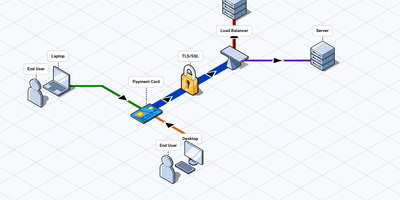
FossFLOW
Infrastructure diagrams do not have to look like a ransom note of boxes and arrows: FossFLOW draws your network as a clean isometric map in the browser. Drag servers, routers, databases, and cloud services from the component library onto the angled grid, then link them with connectors that snap between nodes in click or drag mode. Multiplexed connectors bundle parallel links into tidy runs, rectangles and freehand annotations mark zones and notes, and text labels explain the flow. A diagram of a messy production network becomes a picture a new hire can read in one sitting. Work saves automatically every few seconds, exports to a JSON file you can keep in version control, and imports back just as easily. Run it as a shared team instance and diagrams persist on the server, filed under the project name, protected by optional basic authentication. The editor also installs as an offline-capable progressive web app, so the canvas keeps working on a plane and syncs nothing anywhere you did not send it. Documentation authors use the exported views in architecture guides, and engineers sketch proposals before touching real hardware. Running on a dedicated VPS on RepoCloud with guaranteed CPU, RAM, and SSD, full root SSH access, and a browser serial console. MIT licensed.
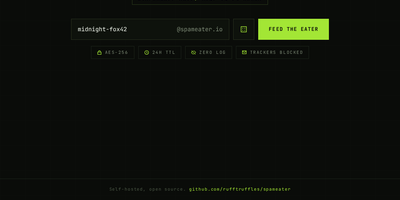
Spameater
SpamEater gives you a disposable inbox on your own domain that burns itself down 24 hours after you create it. Type any name, or roll the dice for a random one, and mail sent to that address lands in a clean web inbox that refreshes itself every few seconds. Open a message and HTML mail renders faithfully, adapted to the dark interface, with inline images embedded and remote images blocked until you ask for them, so tracking pixels never fire behind your back. A live countdown in the corner tells you exactly how long the inbox has left, and a copy button grabs the address for the form you are about to fill. There are no accounts to create, no passwords to remember, and nothing to recover once the timer ends: the inbox, the messages, and the paper trail vanish together. Behind the scenes the service takes its own security seriously, with a web application firewall, intrusion prevention, rate limits, and mail bodies encrypted at rest. Dark and light themes switch with one toggle. Developers use it to test signup flows and password resets, and everyone else uses it to keep a real address out of reach of newsletters. Running on a dedicated VPS on RepoCloud with guaranteed CPU, RAM, and SSD, full root SSH access, and a browser serial console. MIT licensed.
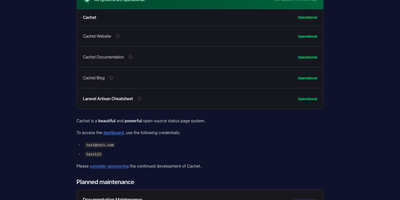
Cachet
Cachet Core is the open-source engine behind Cachet 3.x status pages, giving your team a self-hosted page where incidents, maintenance windows, component health, and live metrics keep customers informed during downtime. You publish an incident with a name, status, and visibility, then post updates on its timeline as work progresses, and the public page reflects every change immediately. Services become components you can group and mark operational, degraded, partially out, or fully down, so visitors see exactly which part of your platform is affected. Maintenance gets scheduled ahead with its own updates, and subscribers receive notifications when new incidents appear or change. Custom metrics accept data points through the API and render as charts on the page, turning response times or queue depths into public proof of recovery. A JSON API creates and updates incidents from your monitoring stack, and webhooks push incident events to the chat rooms and tools your team already watches. The dashboard handles components, incidents, metrics, subscribers, tags, and user accounts, with status page customization and localization in more than 10 languages. Running on a dedicated VPS on RepoCloud with guaranteed CPU, RAM, and SSD, full root SSH access, and a browser serial console. MIT licensed.
CELERITY Panel
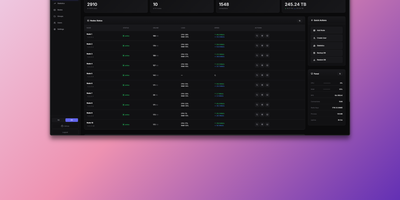
CELERITY Panel puts every Hysteria 2 and Xray VLESS node you run behind one clean web panel, so a fleet of proxy servers behaves like a single service. Add a node and the panel connects over SSH to install the software, certificates, and port hopping for you. Server groups map users to the nodes they may use, and load balancing spreads them by real server load. Cascade topology chains servers together, so clients connect to one node while traffic exits through another, drawn on a visual network map. Traffic rules block advertising domains and unwanted destinations or route selected traffic through custom proxies. Each user receives a subscription link that formats itself for Clash, Sing-box, Shadowrocket, and Hiddify. The dashboard watches online users, traffic volume, and node health in real time, and an in-browser SSH terminal reaches any node without leaving the panel. Programmatic control comes through scoped API keys with IP allowlists and rate limits, signed webhooks announce events as they happen, automatic backups land on S3-compatible storage, and AI assistants can operate the panel through its MCP interface. Two-factor authentication protects the admin login. Running on a dedicated VPS on RepoCloud with guaranteed CPU, RAM, and SSD, full root SSH access, and a browser serial console. MIT licensed.
Zusam
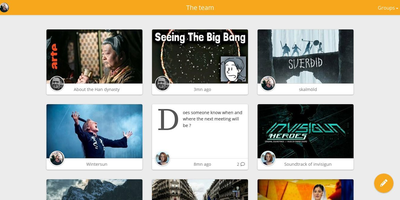
From the German "zusammen," together: Zusam is a private social space for a group of friends - a self-hosted alternative to the family WhatsApp group or the friends Facebook group, with no ads, algorithms, or data harvesting in between. The AGPLv3 project is deliberately modest in scope and stack: a Symfony PHP backend exposing a REST API over SQLite, with a lightweight Preact single-page frontend, designed for a low server footprint that runs comfortably on small hardware. Groups post messages into shared feeds that handle real life well: video and image uploads (with FFmpeg processing), photo albums for trips and events, and rich link previews with inline embeds for YouTube, Vimeo, Imgur, SoundCloud, Twitch, and Bandcamp - so sharing a song or a clip looks the way it should. When something needs to leave the circle, public link generation exposes a single message to non-members without opening the group. The interface is fully responsive and mobile-friendly, targeting Firefox ESR and recent Chrome. It is the small-web answer to a real question: where does a group chat's shared history live when you want it owned by the group instead of a platform?
OrcaQ
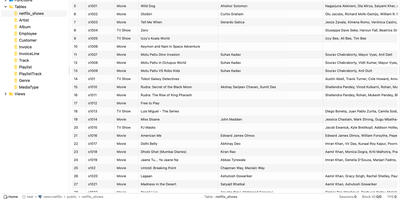
For developers and database administrators who want a full database IDE inside the browser without installing separate desktop clients on every machine, OrcaQ provides a unified workspace for PostgreSQL, MySQL, MariaDB, Oracle, SQLite, Cloudflare D1, Turso, and Redis. Engineers organize connections into named workspaces with SSH bastion tunneling, granular SSL configuration, and color-coded environment tags whose strict mode requires explicit confirmation before executing destructive mutations against production databases. The Quick Query data grid lets users filter, sort, paginate, and edit table rows inline while jumping across foreign-key relationships and inspecting table DDL metadata. When writing complex multi-statement SQL, the Raw SQL Editor provides context-aware autocomplete, query variables, nested script folders, and visual EXPLAIN execution plan analysis. Database architects can render interactive entity-relationship diagrams for single tables or entire schemas, compare two database schemas side by side to generate safe migration scripts, and manage Redis keys across string, hash, list, set, and sorted-set structures in a dedicated workbench. PostgreSQL administrators also gain a visual role-permission matrix, real-time instance health monitoring for active sessions, locks, and replication lag, native backup and restore job tracking, and an optional AI Orca Agent that drafts queries and detects anomalies while requiring human approval before any data modification runs. Running on a dedicated VPS on RepoCloud with guaranteed CPU, RAM, and SSD, full root SSH access, and a browser serial console. MIT licensed.